
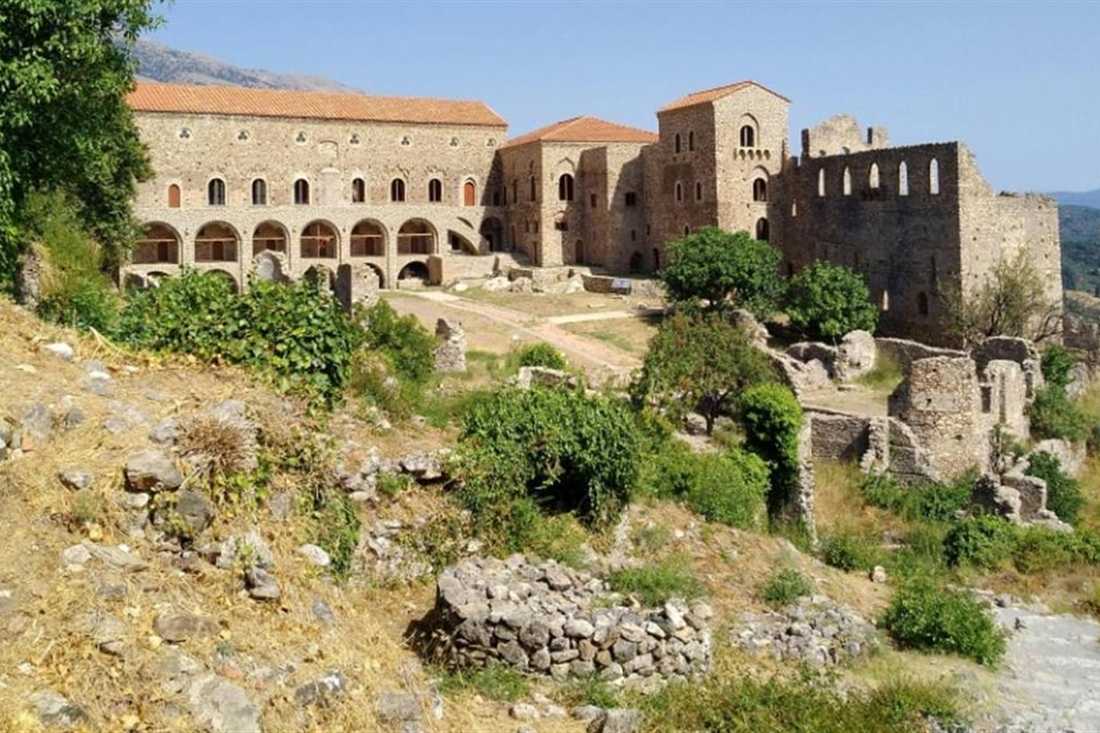
A Mystras day trip from Kalamata crosses Mount Taygetos by the Langada pass to the Byzantine ghost town of Mystras above Sparta, and returns to the Messenian coast the same day. Tours across the rest of the country are listed on Greece Tours.
The sections below cover the tours you can book, the mountain road, the castle, the palace, the churches, Sparta, Monemvasia, the seasons and booking for a Mystras day trip from Kalamata, with links into the Peloponnese tours pages. The tours shown are checked on GetYourGuide and Viator.
What is a Mystras day trip from Kalamata?
A Mystras day trip from Kalamata crosses Mount Taygetos and returns on the same day. It visits the ruined Byzantine town of Mystras, which sits on a spur of the mountain. The main tour on sale also includes a stop in Sparta.
Kalamata is the capital and chief port of Messenia. It ranks as the second-largest city of the Peloponnese, after Patras. Medieval Kalamata lay at the foot of the western outliers of Taygetos. Mystras stands in Laconia, the region on the far side of the mountain.
Taygetos is the mountain wall between Messenia and Laconia. The range runs for about 100 km, from the centre of the Peloponnese to Cape Matapan. It dominates the skylines of both Kalamata and Sparta. Its outline frames both ends of a Mystras day trip from Kalamata.
A Mystras day trip from Kalamata lets guests based in Messenia see Laconia without changing hotels. They keep the same Kalamata room before and after the tour. Laconia then becomes a single-day outing rather than a second base. The drive back reaches Kalamata in the evening.
Which Mystras day trips from Kalamata can you book?
GetYourGuide and Viator both list a Mystras day trip from Kalamata. GetYourGuide pairs Mystras with Sparta, and Viator sells two private tours, one with Sparta. A separate day-trip company links Mystras with Monemvasia in one day.
The GetYourGuide tour runs for 8 hours and also comes as a private version for one group. Both Viator listings are private from the start. The four listings below each sell a Mystras day trip from Kalamata:
- GetYourGuide: From Kalamata: Mystras & Sparta Day Trip
- Viator: Private Day Trip to Mystras from Kalamata
- Viator: Private Day Tour to Mystras and Sparta
- Day-trip company: Mystras and Monemvasia day from Kalamata
A 6-hour private Sparta day from Kalamata also runs, but it leaves Mystras out. That tour is shorter than the GetYourGuide day. Travellers who only want the ancient city can read about a Sparta day trip on its own page.
Guests who want more than one outing from Kalamata can browse the full list of Kalamata tours. A Mystras day trip from Kalamata takes up one full day of that stay.

How far is Mystras from Kalamata?
On a Mystras day trip from Kalamata, the road to Sparta runs about 60 km over Mount Taygetos. It follows National Road 82 and takes roughly 1.5 hours each way. Mystras lies 6 to 8 km west of modern Sparta, on the Kalamata side.
National Road 82 runs for about 107 km, from Sparta to Pylos by way of Kalamata. On a map, Kalamata and Sparta look close. The mountain, not the map, sets the pace of a Mystras day trip from Kalamata.
Kalamata sits at the head of the Messenian Gulf, so the drive begins close to sea level. The road then rises to a high pass and falls again toward the ruins. These heights mark the main points of the route:
- Artemisia: 860 m, on the Messenian side
- Langada pass: 1,316 m, the high point of the road
- Mystras: about 310 m, on the Laconian side
A Mystras day trip from Kalamata covers the mountain road twice, once out and once back. Driving fills a large share of the day, so the stops sit between two long crossings. Guests who feel unwell on winding roads can ask for a front seat.
Modern Sparta, the seat of Laconia, lies in the middle of the Evrotas valley. Classical Sparta stood on the west bank of the river, about halfway down the valley. The valley floor is fertile farmland worked from its villages. Mystras rises at the western edge of the same valley, where the mountain begins.
What does the road over the Langada pass show?
A Mystras day trip from Kalamata climbs past the village of Artemisia to the Langada pass. The road then drops through the Langada gorge to the Evrotas valley and Sparta. Taygetos itself is heavily forested, mainly with Greek fir and black pine.
Artemisia is a mountain village on the western side of Taygetos, 13 km northeast of Kalamata. It lies 1.5 km southwest of Alagonia. It belongs to the municipal unit of Kalamata, inside Messenia. Past the village, the road keeps climbing toward the pass.
The Langada pass cuts through the range far below its summit. A Mystras day trip from Kalamata crosses at the line between Northern Taygetos and the central range.
The Greek fir, Abies cephalonica, is native to the mountains of Greece. Black pine, or Pinus nigra, grows beside it on the same slopes. Fires have burned much of the central western forest of Taygetos, and about half of it remains.
Taygetos ranks among the oldest recorded place names in Europe. The name already appears in the Odyssey. From Byzantine times until the 19th century, the range was also called Pentadaktylos, or five-fingered. Its central part is nicknamed Skoteini Plevra, the dark side. The villages there get less sun in the early morning and late afternoon.
The descent on a Mystras day trip from Kalamata runs down the eastern face of Taygetos. The range is a limestone block bordering the Evrotas rift valley. The Sparta Fault follows this face. An earthquake on this fault levelled ancient Sparta in 464 BC. The Evrotas river flows 82 km north to south, between Taygetos and Parnon.
What is the Kaiadas chasm on Mount Taygetos?
The Kaiadas chasm is a pit near Trypi, on slopes that a Mystras day trip from Kalamata crosses. Ancient tradition says the Spartans threw prisoners and criminals into it. Tours from Athens and Kalamata stop at the site.
Trypi is one of the communities of the Mystras municipal unit. That unit now belongs to the municipality of Sparta. Trypi and the Byzantine ruins therefore sit in the same municipal unit. Guests on a Mystras day trip from Kalamata can ask ahead whether the chasm is on the route.
The pit also appears in sources as Keadas, Ceadas and Caeadas. Plutarch wrote that the Spartans left unfit newborn babies at the foot of Taygetos. A University of Athens study of the bones in the chasm found only adolescents and adults.
Theodoros Pitsios published the work as the Research Program of Keadas Cavern. These remains point to a place of punishment rather than a place for babies. The finds link the pit to three groups:
- Criminals
- Traitors
- Captives
Taygetos served as one of the natural defences of ancient Sparta. People have lived on its slopes since Mycenaean times. During the barbarian invasions, the mountain sheltered the local people.
What makes Mystras a UNESCO World Heritage Site?
UNESCO listed the Archaeological Site of Mystras in the late 20th century as an exceptionally well-preserved Byzantine city. A Mystras day trip from Kalamata reaches a whole medieval town on one slope. Its castle, palace, churches, monasteries and houses still stand.
UNESCO gave two reasons for the listing. The town keeps its Byzantine plan and buildings in a rare state of preservation. Its buildings also record how Late Byzantine and Post-Byzantine art developed. The builders followed the Helladic school of Byzantine architecture, with strong links to the style of Constantinople.
The town spreads down a steep spur of Taygetos in three levels. The Lower Town sits at the foot, and the Upper Town rises above it. The castle crowns the summit. On a Mystras day trip from Kalamata, stepped cobbled lanes join all three levels.
On a Mystras day trip from Kalamata, houses and mansions stand beside the churches. The Frangopoulos House and the Laskaris House both date from the early 15th century. The two homes share one plan:
- Vaulted ground floors that held cisterns and stables
- A raised platform built on top of those vaults
- One large main room on the upper level
- A balcony across the front of the main room
- A fireplace at the back of the main room
What does the castle at the top of Mystras show?
The castle shows how Mystras began as a Frankish fortress. Prince William of Villehardouin built it on the summit in the mid-13th century. On a Mystras day trip from Kalamata, its walls mark the highest point above the town.
William II of Villehardouin ruled the Frankish Principality of Achaea. He had just completed the Frankish conquest of the Peloponnese. He spent the next winter in Laconia, choosing sites for new forts. Grand Magne and Leuktron were two of his other picks. He directed the building work at Mystras himself, on a spur of Mount Taygetos.
The town grew below the castle walls. Raids and counter-raids made the old city on the open plain unsafe. Its people moved up the slope and built a new town in the shadow of the fortress. Visitors on a Mystras day trip from Kalamata see that order on the hillside: fortress above, houses beneath.
The castle proved hard to capture. Once it was in Byzantine hands, William himself laid siege to it and failed. In the 15th century, Sultan Murad II sent the commander Turahan south to take Mystras. Turahan failed as well. The fortress secured Byzantine rule over Laconia, while long years of war pushed the Franks back.
From the summit, the castle stands above the whole archaeological site and the modern village of Mystras. On a Mystras day trip from Kalamata, pines and cypresses frame the slopes below its walls.
Why did Mystras rule the Byzantine Morea?
Mystras ruled the Byzantine Morea because the Franks handed it to the Byzantines in the 13th century. It then became the capital of the Despotate of the Morea. A Mystras day trip from Kalamata visits the former seat of a Byzantine court.
The handover followed the Battle of Pelagonia, where the forces of Emperor Michael VIII Palaiologos captured William. He won his freedom by giving up Mystras and two other strongholds. From then on, Mystras was the seat of the Byzantine governor in the Morea. At first the governor changed every year. From the early 14th century, governors served longer terms.
In the mid-14th century, Emperor John VI Kantakouzenos turned the Morea into a despotate for his son Manuel. Manuel became the first despot to rule from Mystras. He kept peace with his Latin neighbours, and the region prospered. Despots of the Palaiologos dynasty followed him. Under them, the despotate grew to cover nearly the whole Peloponnese.
During the Palaeologan Renaissance, the despots drew artists, architects and scholars to their capital. Mystras became the last centre of Byzantine learning and culture. Within its walls, the capital gathered:
- A court around the ruling despot
- Workshops of fresco painters
- A school of philosophy
The last Byzantine emperor, Constantine XI Palaiologos, served as despot at Mystras. He was proclaimed emperor there in a small ceremony. The Ottomans took the city in the 15th century, when the last despot, Demetrios Palaiologos, surrendered it.
Mystras stayed inhabited under Ottoman rule. Venice held it for a spell in the late 17th and early 18th centuries. It emptied in the 19th century, when a new town was built on the plain below. A Mystras day trip from Kalamata therefore reaches a city its people left, not one later building covered.
What is left of the Palace of the Despots?
The Palace of the Despots stands restored in the Upper Town. The Byzantine rulers of the Morea lived and held court there. A Mystras day trip from Kalamata reaches a rare survivor of Byzantine palace building.
The palace grew in stages from the Frankish period to the 15th century. It fills the main terrace of the town, a level platform on the steep site. On a Mystras day trip from Kalamata, it reads as separate units built side by side.
The main block rises three storeys, and each level had its own role:
- Top floor: one large audience hall
- Lower floors: living apartments
- Lower floors: storerooms
Restorers worked on the palace for years. A Mystras day trip from Kalamata now finds its halls open again. The site plan marks the palace together with its own square.
How do the upper and lower gates of Mystras work for visitors?
Mystras has a lower gate by the Lower Town and a second gate higher up. A winding path links the two. On a Mystras day trip from Kalamata, the climb from the lower gate to the castle is steep.
The site plan names the lower gate as the main entrance. It opens onto the Lower Town at the foot of the slope. The higher gate is the upper entrance to the citadel, close to the castle. Visitors on a Mystras day trip from Kalamata can enter by either gate.
The steep ground kept wheeled carts out in Byzantine times, so the streets served as footpaths. The route between the two gates is still a footpath today. On a Mystras day trip from Kalamata, every level is reached on foot.
The site plan also marks gates of the medieval walled town. Among them are the Nauplia Gate and the Mavroporta. The Marmara entrance appears on the plan as well. Guided visits of the site appear on the Mystras tours page.
Which churches hold the Mystras frescoes?
Four church groups hold the Mystras frescoes: the Metropolis, the Brontochion and Perivleptos monasteries, and the Pantanassa convent. On a Mystras day trip from Kalamata, their paintings show the last phase of Byzantine art. Saints and Gospel scenes cover the inner walls and domes.
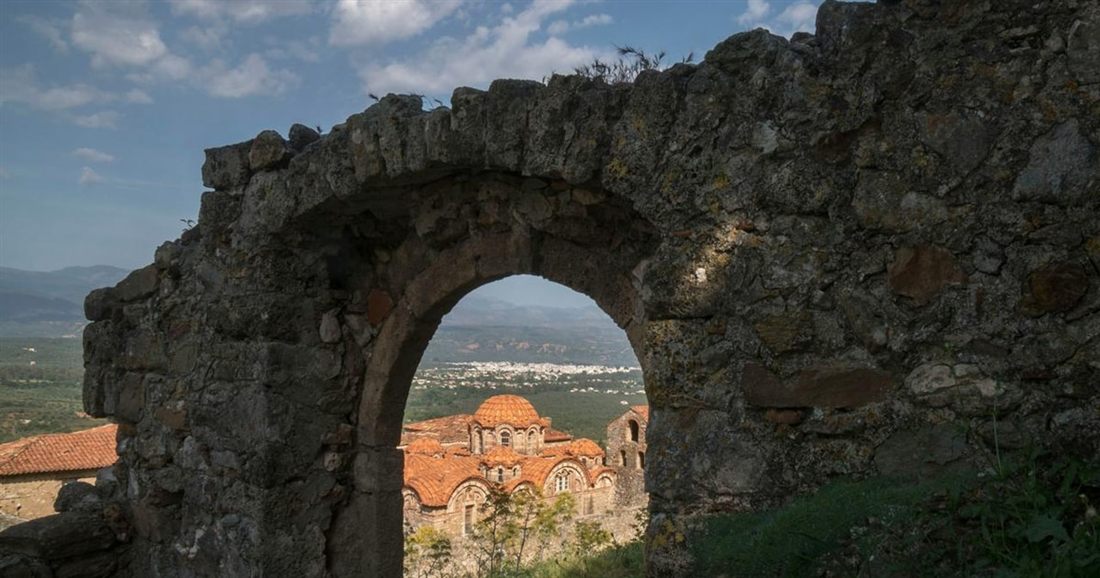
The Perivleptos monastery keeps the fullest fresco cycle at Mystras. Its 14th-century church is built into a cliff, and a cave helps support the structure. The outer walls combine squared stones with inlaid tiles. For one complete painted interior on a Mystras day trip from Kalamata, this is the church to see.
The cycle counts as a rare survival of late Byzantine painting. Scenes include the Nativity and the Baptism of Christ, with Saint John the Baptist. One art historian sees a Western feel in the way the painters handle space and movement.
The Brontochion monastery holds two painted churches, the Hodegetria and the Hagioi Theodoroi. The second name means Saints Theodore, after two warrior saints of the Orthodox Church. Three church names on the hill are titles of the Virgin Mary:
- Hodegetria: She Who Shows the Way
- Pantanassa: Queen of All
- Perivleptos: Seen from All Around
The Oxford Dictionary of Byzantium notes that Mystras drew artists and architects of the highest quality. Their work explains why a Mystras day trip from Kalamata centres on painted interiors as much as ruins. A separate page covers the trip to Mystras from Athens for travellers based in the capital.
What makes the Pantanassa convent different?
The Pantanassa is the only monastery at Mystras where people still live, a small community of nuns. On a Mystras day trip from Kalamata, modest dress applies before entering its church. Its facade mixes carved stonework with western Gothic details.
John Frangopoulos, a chief minister of the Despotate, paid for the convent. It was founded in the 15th century, which makes its frescoes later than the Perivleptos cycle. Visitors comparing the two churches see Mystras painting at two different stages.
The nuns are the only residents a visitor meets on a Mystras day trip from Kalamata. Every other house and church on the hill stands empty. Their presence makes the Pantanassa a home as well as a monument.
Anyone on a Mystras day trip from Kalamata keeps their voice low in the courtyard and church. The convent welcomes the public, but the rooms where the nuns live are private.
What is the Hodegetria church at the Brontochion monastery?
The Hodegetria, or Aphentiko, is the main church of the Brontochion monastery. It was the first church of the Mystras type, which joins two plans in one building. Visitors on a Mystras day trip from Kalamata see this design repeated in later churches.
The abbot Pachomios built up the Brontochion monastery around the turn of the 14th century. He added the small Hodegetria church to the monastery. Builders then rebuilt it early in that century. Scholars disagree on when the work ended, with estimates from the first decade to the third.
Blind arches on the outer walls show the influence of Constantinople, the imperial capital. Inside, the church rises over two storeys. On a Mystras day trip from Kalamata, the building reads clearly level by level:
- Ground floor: a basilica with three aisles
- Upper floor: a cross-in-square gallery
- Roof: five domes above the gallery
- Exterior: a portico with a belfry
Despot Theodore I Palaiologos is buried in the church. He died early in the 15th century, and his tomb ties the building to the ruling family. Above the royal door of the ground floor, a fresco shows Mary as the Life-Giving Spring.
What happened in the Metropolis of Mystras?
The Metropolis of Agios Dimitrios was the Lower Town cathedral, seat of the bishop of Lacedaemon. Tradition says the last Byzantine emperor, Constantine XI, was proclaimed here. Visitors on a Mystras day trip from Kalamata can stand where that story is set.
Historians treat this story with care. The sources describe a small civil ceremony at Mystras without naming the building. Constantine XI never received the usual crowning in Hagia Sophia in Constantinople. He held that the Mystras proclamation gave him full imperial rights.
A carved double-headed eagle in the floor is said to mark the spot of the proclamation. Byzantine rulers used the two-headed bird as an imperial emblem. On a Mystras day trip from Kalamata, it pays to look down, since the carving lies underfoot.
The word Metropolis marks the church of a metropolitan, a senior bishop of the Orthodox Church. Its dedication honours Saint Demetrios, an early Christian martyr. He is also the patron saint of Thessaloniki, in northern Greece.
A museum occupies the buildings beside the cathedral, so the church and its exhibits share one complex. A stop at the Metropolis on a Mystras day trip from Kalamata covers both in one visit.
Who taught philosophy at Mystras?
Georgios Gemistos Plethon, a Neoplatonist scholar, taught philosophy at Mystras and advised the despot Theodore II. He died there in the mid-15th century. A Mystras day trip from Kalamata reaches the hill where he lived and worked.
He also tutored Theodore II when the despot was young, and later served him as chief magistrate. Beyond his own writing, he compiled digests of classical authors. At Mystras he taught and wrote in four fields:
- Philosophy
- Astronomy
- History
- Geography
In the 15th century, Plethon joined the emperor John VIII Palaiologos at the Council of Florence. He was chosen for his reputation for wisdom, even though he was not a theologian. In Florence, he set out the ideas of Plato for Italian scholars. His lectures on how Plato differed from Aristotle fed the Greek revival in Italy.
Sources give two possible years for his death. One comes before the fall of Constantinople and one after it. It remains unclear whether he lived to see the city taken.
Visitors on a Mystras day trip from Kalamata will not find Plethon’s grave there today. Sigismondo Malatesta, lord of Rimini, and a group of Italian followers took his remains from Mystras. They placed them in the Tempio Malatestiano in Rimini, where they still lie.
Plethon did not work alone. Other scholars based at Mystras also influenced the Italian Renaissance, according to historians. On a Mystras day trip from Kalamata, the hill tells a story of learning as well as faith.
What does Sparta add to a Mystras day trip from Kalamata?
Sparta adds the ancient Greek story of Laconia to the Byzantine ruins of Mystras. A Mystras day trip from Kalamata can pair both in one outing. The modern town lies only 6 to 8 km east of Mystras, in the Evrotas valley.
The GetYourGuide tour “From Kalamata: Mystras & Sparta Day Trip” joins the two places in a single 8-hour day. Other ways to see the ancient town are listed on the Sparta tours page. The ruins of ancient Sparta lie north of the modern city. A Mystras day trip from Kalamata with a Sparta leg can cover four stops:
- The acropolis hill and its Roman theatre
- The sanctuary of Artemis Orthia
- The Menelaion ridge at Therapne
- The Leonidas statue in the modern town
The Menelaion is a hero-shrine on a ridge about 5 km from Sparta. The Spartans built it around the 8th century BC for Menelaus and Helen. They worshipped the pair as divine ancestors. Ruins from the 5th century BC still stand there. Digs also found a Late Mycenaean house of raw brick.
The sanctuary of Artemis Orthia sits on the south bank of the Evrotas. Spartan boys were whipped at its altar in a rite of passage. In another test, they tried to snatch cheeses from the altar past guards with whips. The Romans later built a theatre around the temple and altar.
What does the Archaeological Museum of Sparta show?
The Archaeological Museum of Sparta shows finds from Laconia, from the Neolithic to the late Roman era. A Mystras day trip from Kalamata can add it with a short stop. It was the first Greek museum in a provincial city.
On a Mystras day trip from Kalamata, the museum in the town centre explains Sparta’s open sites. Its seven rooms display only a small part of the collection. Each room follows one theme, from Roman stelae in Room I to Laconian sculpture in Room VII. Five rooms sit between them:
- Room II: finds from the sanctuary of Artemis Orthia
- Room III: Roman sculpture and portraits
- Room IV: prehistoric finds from across Laconia
- Room V: Roman floor mosaics
- Room VI: parts of the temple of Apollo at Amyclae
The marble figure known as Leonidas dates from the early 5th century BC. It shows a helmeted Spartan warrior. Tradition links it to the king who fell at Thermopylae. He led 300 Spartans there against the Persian army. The name is a nickname, not a proven identity.
Digs at Artemis Orthia turned up terracotta masks, carved ivories and lead figurines. The Amyclae pieces form a major section of the collection. The sanctuary there, south of Sparta, held a colossal statue of Apollo. The statue’s throne was the work of Bathycles of Magnesia. The Hyacinthia festival took place there each year.
Can a Mystras day trip from Kalamata add the olive oil museum?
Yes, a Mystras day trip from Kalamata can add this stop in Sparta. The Museum of the Olive and Greek Olive Oil stands in the modern town. Its rooms follow the olive through fossils, ancient written records and old presses.
The oldest exhibits are fossil olive leaves from Santorini, 50,000 to 60,000 years old. Copies of Linear B tablets come next. This Bronze Age script wrote Mycenaean Greek, the earliest known form of the language. The tablets record olive trees and oil, proof of the crop’s early value.
The museum covers both the culture of the olive and the technology of oil production. Its press collection shows how Greeks pressed oil by hand, by animal, by water and by engine. Two old presses, a set of models and a soap section tell this story:
- A wooden double press with a winch, from Xirokambi
- An animal-powered press from Lefkada
- Models of presses driven by water, steam and diesel
- A section on soap-making with olive oil
Messenia, the region of Kalamata, is olive country. The town gives its name to the Kalamata olive, a large, dark purple fruit. On a Mystras day trip from Kalamata, this museum tells the long story behind that harvest. It shares the town with the archaeological museum, so one stop covers the pair.
Can a Mystras day trip from Kalamata reach Monemvasia?
Yes, a Mystras day trip from Kalamata can reach Monemvasia, but the day grows very long. The walled town lies 95 km from Sparta, about an hour and a half by road. A day-trip company sells this pairing from Kalamata.
Monemvasia stands on a rock off the coast. A causeway about 400 m long joins it to the shore. Its name means “single entrance”, after that one way in. The flat top of the rock sits about 100 m above the sea. It stretches up to 300 m wide and 1 km long.
Monemvasia was founded in the 6th century by people from ancient Sparta who moved there. Its place on the sea routes made it a centre of trade and culture. The town’s Italian name, Malvasia, passed on to a wine. Today the upper town stands empty, with the Byzantine church of Hagia Sophia near the cliff edge.
A Mystras day trip from Kalamata that adds Monemvasia covers two Byzantine towns in one outing. The lower town sits under the southern wall of the upper town. For more time on both levels, the tours of Monemvasia make it a trip of its own.
Which months suit a Mystras day trip from Kalamata?
Spring and autumn suit a Mystras day trip from Kalamata, with mild air across an open, steep hillside. Summer brings strong heat to the Peloponnese. Winter brings cold weather to the range between the two towns.
Summer days climb above 30°C across the region. In Sparta, July and August highs pass 36°C. Shade is scarce on the upper levels of the site. A summer Mystras day trip from Kalamata runs cooler with an early start, before the midday sun.
In winter, snow settles on Taygetos. Its highest peak, Profitis Ilias, rises to 2,407 m. Snow or ice on the Langada pass road can slow the crossing or close it for a time. A look at road reports the day before keeps the plan safe.
Sparta has a sunny Mediterranean climate with a dry summer, and its rain peaks in January. Wet weather makes the stones slippery in any month. A dry spring or autumn day brings the safest conditions on the site.
How much walking does a Mystras day trip from Kalamata involve?
A Mystras day trip from Kalamata involves steady uphill walking on stepped cobbled lanes. The site spreads over three levels. The climb from the lower gate to the castle is the steepest part of the visit.
Mystras sits on a slope of the Taygetos mountains. The steep ground made wheeled vehicles impractical. For that reason, the old streets inside the walls are footpaths, not roads. Every move between levels happens on foot.
Worn stone turns slippery when wet, so each step on the way down needs care. Shade is scarce on the upper levels. A slow pace with water breaks makes the climb to the castle easier.
Travellers with knee or balance problems can stay on the lower level. The climb to the castle is optional on a self-paced visit. A walking pole helps on the steep steps going down.
What do you wear and bring on a Mystras day trip from Kalamata?
A Mystras day trip from Kalamata calls for firm walking shoes and sun protection. A light layer helps against the mountain air on the road over Taygetos. Modest clothing suits the convent inside the old walls of Mystras.
- Walking shoes with grip for worn stone steps
- Water for the climb between levels
- A hat and sun cream for the open slopes
- A light layer for the mountain air on the Langada pass
- A scarf or long sleeves for the Pantanassa convent
- Cash for the entry ticket and lunch
Smooth soles slide on polished steps. Shoes with a firm tread and closed toes hold better and guard against loose stones. Sandals and new boots that still pinch make a long day on foot harder.
On a Mystras day trip from Kalamata, a small backpack keeps both hands free on the stepped lanes. It also carries the light layer after the mountain stretch of the drive. A water bottle filled before entry saves a thirsty walk between levels.
Covered upper arms and knees suit the convent of the Pantanassa. A light scarf in the bag covers bare arms in seconds at the door. The same rule applies in Orthodox churches across Greece. The scarf therefore earns its place on every church visit of a Mystras day trip from Kalamata.
How does a Mystras day trip from Kalamata compare with a start in Athens?
A Mystras day trip from Kalamata spends far less time on the road than a start in Athens. Sparta lies about 60 km from Kalamata, roughly 1.5 hours each way. From Athens, the drive to Sparta covers about 235 km.
From Athens, the drive to Sparta takes just under three hours each way. That adds up to close to six hours on the road in one day. A Mystras day trip from Athens leaves a shorter window for the site and for lunch.
From Kalamata, the route crosses Taygetos on National Road 82. The shorter drive frees hours for the site itself. The walk between levels can then run at an easy pace, with time for photos and rests.
Kalamata works as a base for more than one outing. An Olympia day trip from Kalamata adds a second ancient site on a separate day. Pairing it with a Mystras day trip from Kalamata fills two days without changing hotels.
What can you see in Kalamata before or after the trip?
Kalamata is the capital of Messenia, on the Messenian Gulf. Its castle, old town, central market and seafront fill a free half-day in the city. They suit the hours before or after a Mystras day trip from Kalamata.
- The Frankish castle of Kalamata, above the cathedral of Ypapanti
- The Church of the Holy Apostles and the church of Agios Ioannis
- The Kalograion monastery, where silk Kalamata scarves are made
- The Benakeion Archaeological Museum, in the historical centre
- The Railway Park, with old steam engines on display
- The Polylimnio waterfalls, north-west of the city
Kalamata lends its name to black Kalamata olives and Kalamata olive oil. The central market is a good place to buy both. A sealed jar of olives travels well in checked luggage.
Travellers who want the old town explained on foot can book a walking tour of Kalamata. The seafront suits an evening stroll after the drive back over the mountain from Mystras.
Kalamata International Airport lies about 9 km west of the city, with mainly summer flights. Travellers who fly in can see the city sights on arrival day. The next morning then stays free for Mystras.
How do you book and cancel a Mystras day trip from Kalamata?
Book a Mystras day trip from Kalamata online through GetYourGuide or Viator. Each booking page asks for a date, the number of travellers and a pickup address. Free cancellation up to 24 hours before the start is standard on both.
- Open the listing and pick a date
- Enter the number of travellers
- Add the pickup address in Kalamata
- Read the cancellation terms
- Confirm and pay online
GetYourGuide sells “From Kalamata: Mystras & Sparta Day Trip,” an 8-hour tour with a private option. Viator sells a “Private Day Trip to Mystras from Kalamata (Price per Group).” One rate there covers the whole party.
Solo travellers and couples can take the standard GetYourGuide booking without the private upgrade. Families and friends who want the vehicle to themselves can pick the private option or the Viator trip.
A full pickup address, with the hotel name or street number, helps the driver arrive on time. The cancellation terms appear on each listing before payment. Reading them first avoids surprises if plans change.
Frequently Asked Questions
How long is the drive on a Mystras day trip from Kalamata?
Each leg takes roughly 1.5 hours, as the road climbs over the Taygetos range from Messenia into Laconia. The short drive leaves the larger share of the day for walking the site and for lunch.
Does a Mystras day trip from Kalamata also visit Sparta?
Yes, when the listing says so. The GetYourGuide trip “From Kalamata: Mystras & Sparta Day Trip” names both places in its title. The Viator private trip names only Mystras, so a quick question before booking settles it.
Is there a bus from Kalamata to Mystras?
KTEL runs buses from Kalamata to Tripoli, Corinth and Athens. Mystras itself is reached through the modern town of Sparti, about 8 km away. A Mystras day trip from Kalamata with pickup removes the need to plan a bus route.
Can a Mystras day trip from Kalamata be private?
Yes. Both the GetYourGuide trip and the Viator listing come in a private form. A private booking keeps the vehicle for one party. The walking pace on the site then follows that group alone.
Is Mystras a UNESCO World Heritage Site?
Yes. UNESCO lists Mystras as a World Heritage Site. It makes Mystras one of the World Heritage Sites of the Peloponnese within a day’s reach of Kalamata.
Can you cancel a Mystras day trip from Kalamata?
Yes. Free cancellation up to 24 hours before the start is standard on GetYourGuide and Viator. A later change of plan falls outside that free window, so pick the date with care.