
Prehistoric Thassos reaches back tens of thousands of years, long before the marble city of the classical age rose on the northern coast. Deep beneath the hills near Limenaria, miners of the Old Stone Age cut galleries into the rock to reach red ochre, leaving one of the oldest underground mines known in Europe. Farmers of the Neolithic later settled the fertile western shore, and Bronze Age communities raised fortified villages with carved stone stelae. The island you can explore today with our guides to Thassos holds this deep past in its caves, its old mine shafts and its museum cases. This guide traces that long story from the Palaeolithic to the dawn of metal.
Archaeologists have pieced this prehistory together from cave deposits, mine galleries and settlement mounds scattered across the island. The sections below explain what prehistoric Thassos means, describe the Palaeolithic ochre mine at Tzines near Limenaria, and set out how early people used red iron oxide. They cover the Neolithic and Bronze Age settlements, the fortified acropolis at Skala Sotiros, the first working of metals, and where to see the finds. Each answer opens with the essential fact, then adds the detail behind it. A visit to Thassos gains real depth once its Stone Age and Bronze Age roots come into focus.
What is prehistoric Thassos?
Prehistoric Thassos covers the island’s human story before written records, from Palaeolithic ochre miners through Neolithic farmers to Bronze Age villages. It spans roughly the last twenty thousand years, ending as the Iron Age and the first Greek colonists arrived.
Prehistoric Thassos names the long stretch of human activity that unfolded before the classical city was founded by settlers from Paros. People worked the island during the Old Stone Age, returned across the Neolithic, and built lasting villages in the Bronze Age. These eras leave no texts, so their record survives only in stone tools, pottery, bones and the scars of early mines. The story runs for something close to twenty thousand years, far longer than the famous marble city that followed. Understanding this deep background reframes the whole island, showing that its wealth in stone and metal was exploited by human hands ages before Greek writers ever named the place.
Ochre miners of the Palaeolithic mark the earliest chapter, tunnelling for red pigment near the modern town of Limenaria. Neolithic farmers followed thousands of years later, planting the western coastal plain and living in small clay-and-timber houses. Bronze Age communities then fortified their settlements, worked the first metals and carved human figures on standing stones. This sequence sits entirely before the events told in the history of Thassos, which begins with the Greek colony and its marble town. Prehistory and recorded history therefore form two halves of one island narrative, joined at the moment Parian settlers stepped ashore on the northern coast.
Geology explains why people came to Thassos so early. The island carries rich seams of iron oxide, marble, and metal ores including gold, silver and copper. Red and yellow ochre lay close enough to the surface to draw Stone Age miners underground in search of colour. Later communities prized the same hills for their gold and copper, laying the ground for early metalworking. This mineral wealth, celebrated across Thassos marble in the classical era, was already shaping human behaviour in the deep past. The prehistoric islanders were, in a sense, the first prospectors of a landscape that would make the later city rich.
Evidence for prehistoric Thassos comes from scattered but striking sites rather than one grand ruin. The ochre mine at Tzines, the Neolithic and Bronze Age layers at Limenaria, and the fortified acropolis at Skala Sotiros together sketch the arc. Excavations have recovered stone tools, painted pottery, grinding stones and human burials that flesh out daily life. The richest finds now rest in the island museum in Limenas, where prehistoric cases open the collection. Reading these sites in order lets a visitor follow the islanders from their first tunnels for pigment to their walled villages of the Bronze Age, thousands of years before the kouros was ever carved.
What is the Palaeolithic ochre mine at Tzines near Limenaria?
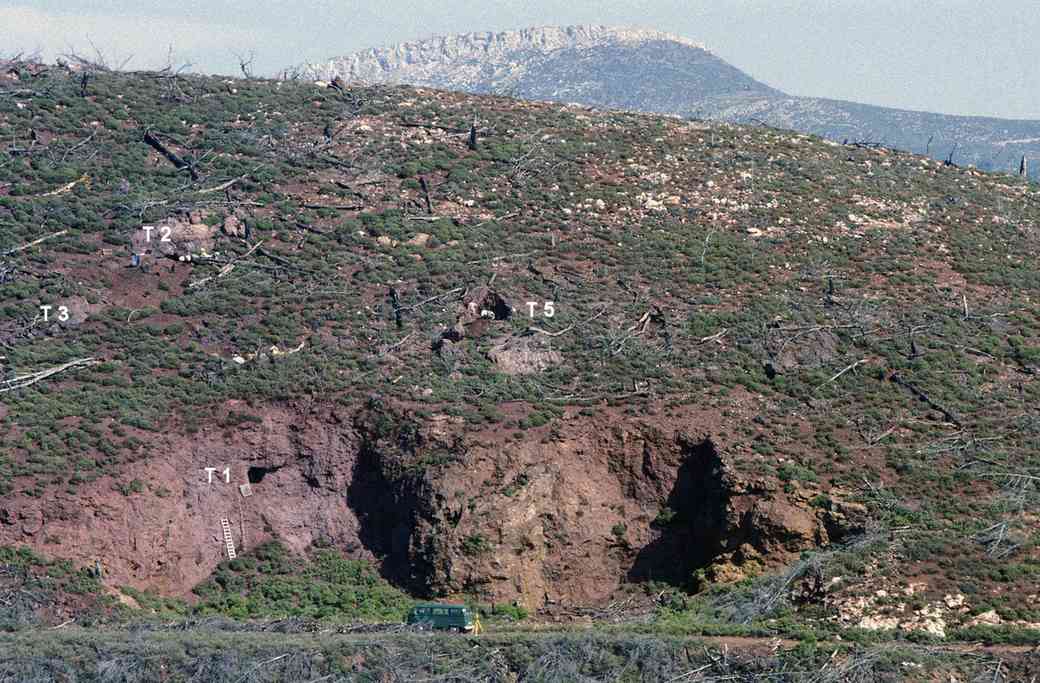
The Tzines mine, near Vrysoudia above Limenaria, is a Palaeolithic underground working where people dug red and yellow ochre from the rock. Dated to roughly twenty thousand years ago, it ranks among the oldest known underground mines in Europe.
The Tzines ochre mine lies in the hills above Limenaria, on the south-western side of the island near the locality of Vrysoudia. Prehistoric diggers followed veins of iron oxide into the hillside, cutting galleries and hollows to extract the coloured earth. Archaeologists working the site found stone hammers, digging tools and traces of the tunnels these early miners left behind. The scale of the effort surprised researchers, since reaching the pigment meant genuine underground quarrying rather than surface gathering. Discovery of the mine pushed the human story of Thassos back into the Old Stone Age, far earlier than anyone had once assumed for the island.
Dating placed the earliest work at the mine around twenty thousand years ago, in the later Palaeolithic. That antiquity is what earns Tzines its claim as one of the oldest underground mines in Europe, and among the oldest anywhere. Later prehistoric communities reopened and extended the workings, so the galleries record use across a very long span and outlived generations of islanders. Charcoal, tools and the worked rock faces gave excavators the evidence to fix these dates. The mine therefore documents not a single moment but a tradition of digging that endured for ages. Little in Greece preserves human labour of such age in so concrete a form as these pigment tunnels.
Ochre from Tzines is red and yellow iron oxide, a mineral pigment valued long before metals or farming. Stone Age people used such colour for painting bodies, hides and objects, and for ritual and burial across Ice Age Europe. Reaching a good source underground was worth the danger and effort of mining in the dark with stone tools. The Thassos deposit gave these communities a reliable supply of vivid pigment drawn straight from the earth. This early demand for colour, rather than for food or weapons, reveals a symbolic side to Palaeolithic life. The tunnels at Tzines stand as rare physical proof of that ancient hunger for pigment on the island.
The mine connects Thassos to a much wider prehistoric world of pigment extraction. Comparable ochre workings are known from a handful of Ice Age sites across Europe and beyond, and Tzines belongs among the earliest. Its position on an Aegean island shows that Palaeolithic people crossed water and read the landscape for useful minerals. The same instinct for the island’s geology would later drive the mining of gold, copper and marble. Travellers exploring the coast around Limenaria today pass hillsides that hide humanity’s oldest industrial effort on Thassos. The ochre mine turns an ordinary stretch of shore into a monument of the deep human past.
What did prehistoric people use ochre for?
Prehistoric people used ochre, a red and yellow iron-oxide pigment, for colouring bodies, hides and objects, for cave and rock art, for burial rites, and as a practical ingredient in tanning and adhesives. Colour carried both symbolic and everyday value.
Red ochre held deep symbolic meaning for Stone Age communities across the ancient world. Its blood-like colour tied it to life, death and ritual, and Palaeolithic people scattered it in graves and painted it on the dead. Body painting with the same pigment marked identity, status and belonging within the group. Cave and rock art from the era relies heavily on red and yellow iron oxide as its core colour. The miners of Tzines were therefore feeding a spiritual and artistic need, not merely a practical one. Their willingness to dig underground for pigment shows how central colour was to the prehistoric mind on Thassos.
Practical uses gave ochre value beyond ritual and art. Ground iron oxide served as an ingredient in preparing animal hides, helping to preserve and soften leather for clothing and shelter. Mixed with binders, the same powder strengthened the adhesives that fixed stone blades into wooden and bone handles. Ochre also worked as a mild antiseptic and insect repellent in early societies. These everyday applications meant a steady demand that a rich source like Thassos could supply. The pigment was, in effect, an all-purpose material of the Stone Age toolkit, prized for far more than its striking colour alone by the people who mined it.
Extraction of ochre at Tzines reveals how organised this demand had become. Cutting galleries into rock with stone hammers required planning, cooperation and knowledge passed between generations. Prehistoric miners had to locate the richest veins, prop their workings and carry the coloured earth back to daylight. This was industry in miniature, thousands of years before metals or wheels. The effort invested in the pigment underlines how much these communities valued it. Skills learned underground in the hunt for ochre helped prepare later islanders for the mining of metal ores, when Metalia and the ancient mines would extend the tradition into the age of gold.
Ochre-working links the earliest islanders directly to the story of Thassos as a mineral treasure-house. The same hills that gave up pigment in the Palaeolithic later yielded gold, silver, copper and the famous white marble. Prehistoric demand for iron oxide opened the island’s long relationship with its own underground wealth. Colour came first, then metal, then the marble that built the classical city. This unbroken thread of extraction runs through every age of Thasian history. Standing at an ancient ochre tunnel, a visitor sees the very beginning of an industry that would define the island for the next twenty thousand years.
What Neolithic and Bronze Age settlements existed on Thassos?
Neolithic farmers settled the western coast near Limenaria, and Bronze Age communities built fortified villages such as Skala Sotiros and Kastri. Excavations reveal houses, pottery, tools and burials spanning thousands of years, from the first farmers to the Bronze Age metal-workers.
Neolithic Thassos took shape when early farmers occupied the fertile western coastal plain. Excavations at Limenaria uncovered a settlement with clay-floored houses, hearths, storage pits and the polished stone tools of a farming people. Pottery, grinding stones and animal bones from the site show a community growing crops and keeping livestock. These villagers lived thousands of years after the ochre miners, in a fully agricultural world of fields and permanent homes. The Neolithic layers at Limenaria give the clearest picture of settled life on the island before metals. They mark the point when Thassos became a landscape of farms rather than only a source of pigment.
The Bronze Age brought fortified villages and a sharper sense of territory to Thassos. Communities on the coast raised stone walls around their settlements, defending homes and stores against rivals. Skala Sotiros on the west coast is the outstanding example, a walled acropolis of the Early Bronze Age. Kastri, in the island’s interior near Theologos, adds a further Bronze Age centre linked with early metalworking. These sites reveal denser, more organised communities than the scattered farms of the Neolithic. Pottery styles from the period tie Thassos into the wider Aegean and the northern mainland, showing an island firmly connected to its neighbours across the sea.
Houses and daily life at these settlements emerge clearly from the excavated remains. Rectangular buildings of stone footings and mudbrick walls stood along narrow lanes inside the defences. Inside them, archaeologists found ovens, storage jars, loom weights and the tools of farming, weaving and cooking. Burials near the settlements preserve the bones and grave goods of the islanders themselves. The pottery ranges from plain cooking pots to finer decorated wares traded across the region. This body of evidence lets researchers reconstruct entire communities, from their diet and crafts to their contacts abroad, in an age that left no written word on the island.
Continuity across these periods gives prehistoric Thassos its shape. The island moved from Palaeolithic pigment mines, through Neolithic farming villages, to the walled Bronze Age towns that mastered metal. Each phase built on the resources and knowledge of the one before. Settlements clustered on the same fertile western coast, near water, farmland and mineral wealth. Detailed study of these layers connects with Skala Sotiros, the best-preserved prehistoric acropolis on the island. Together the sites trace an unbroken human presence stretching from the Ice Age to the threshold of the Greek colony that would found the classical city.
What was the Skala Sotiros prehistoric acropolis?
Skala Sotiros is an Early Bronze Age fortified settlement on the western coast, ringed by a massive stone wall. Excavations there uncovered houses, metal finds and remarkable carved stone stelae bearing human figures, marking it as the island’s finest prehistoric acropolis.
Skala Sotiros stands on the west coast of Thassos, where an Early Bronze Age community fortified a low coastal hill. A massive defensive wall, built of large stone blocks, enclosed the settlement and still impresses excavators with its scale. Inside the circuit lay rectangular houses, streets and the ordinary equipment of Bronze Age life. The site belongs to the third millennium BC, making it around five thousand years old. Its size and strong defences suggest a wealthy, well-organised community that controlled part of the fertile western plain. Skala Sotiros ranks as the most important prehistoric acropolis so far excavated on the island of Thassos.
Carved stone stelae are the site’s most striking discovery. Tall slabs, reused within the great wall, bear simplified human figures pecked and carved into their surfaces. These anthropomorphic stones show heads, arms and features rendered in a bold, abstract style. Scholars read them as statue-menhirs, standing monuments to ancestors or protective figures set up by the community. Similar carved stones appear elsewhere in prehistoric Europe, tying Thassos to a wider tradition of monumental stone imagery. The Skala Sotiros stelae give the island a rare and haunting body of Bronze Age art, unmatched among the other prehistoric sites of the northern Aegean.
Metal finds at Skala Sotiros reveal a community already engaged with metallurgy. Excavators recovered evidence for the working of gold and copper, drawn from the island’s own ores. This early metalworking places the settlement at the leading edge of Bronze Age technology in the region. The wealth such metal represented helps explain the effort poured into the great defensive wall. Trade in finished goods and raw materials linked the site to communities across the northern Aegean. Skala Sotiros thus captures the moment when the island’s ancient mineral riches, first tapped for ochre, began to be exploited for the metals that defined a new age.
The ruins of Skala Sotiros lie beside the modern coastal village of the same name, open to visitors along the west coast. The fortification wall and building foundations remain visible, laid out where excavators exposed them. Information panels explain the plan, the stelae and the finds recovered from the site. The carved stones themselves, fragile and precious, are best appreciated through the museum in Limenas, which safeguards the originals. Standing within the ancient defences gives a vivid sense of a walled Bronze Age town facing the sea. Skala Sotiros turns abstract prehistory into a place you can walk, five thousand years after its builders raised the wall.
How did early mining and metallurgy develop on Thassos?
Early mining on Thassos began with Palaeolithic ochre and grew, by the Bronze Age, into the working of gold, silver and copper from the island’s rich ores. This metallurgy fed local wealth and trade long before the classical mines expanded the industry.
Mining on Thassos began underground in the Palaeolithic, when miners cut the Tzines galleries for ochre. That first taste of extraction taught prehistoric islanders to read the rock and follow useful veins into the hillside. Skills honed in the pigment tunnels carried forward as communities grew and their needs changed. The same instinct that sought colour later sought metal, when the island’s ores became valuable. This continuity makes Thassos a rare place to watch mining evolve across the ages from a single starting point. The ochre workings stand at the head of a tradition that would define the island’s economy for millennia.
Metallurgy arrived with the Bronze Age, when islanders learned to win gold, silver and copper from local ores. Thassos held genuine mineral wealth, and its ancient inhabitants exploited seams that later Greeks and Romans would mine on a grand scale. Sites such as Skala Sotiros show early metalworking already under way in the third millennium BC. Smelting and casting metal demanded fire, skill and control of scarce resources, marking a leap in technology. This metal wealth reshaped society, creating traders, craftsmen and defended settlements. The prehistoric metallurgy of Thassos laid the foundation for the island’s fame as a source of gold and marble in historical times.
Gold gave Thassos an outsized reputation that reached far beyond the island. Ancient writers later recalled early mining on and around Thassos, remembering workings said to be opened in the deep past. The metal drew outsiders and tied the island into wide networks of trade and ambition. Prehistoric gold-working began the process that classical mining would later carry to its height along the south-eastern coast. Copper and silver added further wealth to the island’s underground store. The metals of Thassos, first touched in prehistory, made it one of the mineral prizes of the northern Aegean for centuries to come.
Marble completes the island’s mineral story, though its great age came after prehistory. Bright white stone from the Thasian hills would build the temples and statues of the classical city, an industry celebrated in Thassos marble. The prehistoric islanders had already proved that the land was rich in ochre and metal before the marble trade began. Ochre, gold, copper and marble form one long sequence of extraction reaching back to the Old Stone Age. This is the deep meaning of prehistoric Thassos: a landscape mined by human hands for twenty thousand years. Each age drew a different treasure from the same generous ground.
Where can you see prehistoric Thassos today?
Prehistoric Thassos survives at the Skala Sotiros acropolis, the ochre-mining hills near Limenaria, and above all in the Archaeological Museum of Thassos in Limenas, whose opening galleries display the island’s Stone Age tools, Bronze Age pottery and carved stelae.
The Archaeological Museum of Thassos in Limenas is the best place to meet the island’s deep past. Its opening galleries gather prehistoric finds, from Stone Age tools to Bronze Age pottery and the carved stelae of Skala Sotiros. Cases of grinding stones, blades and painted vessels show how the earliest islanders lived and worked. Standing before these objects, a visitor grasps the long span the museum covers, from prehistory to Rome. A tour of the Archaeological Museum of Thassos gives essential context before visiting the sites themselves. The prehistoric rooms turn scattered excavations into a single, readable story of the island’s first people.
Skala Sotiros offers the clearest prehistoric site to walk in the open air. The fortification wall and house foundations remain on view near the west-coast village, a short drive from the main resorts. Panels at the site explain the acropolis, its stelae and its Bronze Age community. Pairing the ruins with the museum lets a traveller see both the place and its finest objects. The setting beside the sea makes the visit easy to combine with the beaches of the western shore. Families in particular enjoy exploring the ancient walls in the fresh air. Skala Sotiros gives prehistory a physical home, where the scale of a five-thousand-year-old wall speaks directly.
The hills above Limenaria hold the Palaeolithic ochre mine, the oldest chapter of all. The ancient galleries at Tzines are not a developed tourist attraction, yet the landscape around Vrysoudia carries real significance as the site of Europe’s early underground mining. Travellers exploring Limenaria and its surroundings pass close to this deep prehistoric ground. Knowing that people dug here twenty thousand years ago transforms an ordinary hillside into a monument. The mine reminds visitors that human industry on Thassos began in the Old Stone Age. Standing in the area, even without entering the tunnels, connects the modern coast to its astonishingly ancient roots.
Prehistoric Thassos rewards travellers who want more than beaches from a Greek island. The museum, the ochre hills and the Bronze Age acropolis together tell a story reaching back before writing, farming or metal. This deep past sits alongside the classical ruins, the marble quarries and the mountain villages of later ages. Weaving the prehistoric sites into a wider trip gives the whole island a richer meaning. A guided day can link the museum in Limenas with Skala Sotiros and the coast around Limenaria. Seeing where the island’s human story began makes every later chapter of Thassos easier to understand and far more vivid.
Frequently Asked Questions
How old is the ochre mine on Thassos?
The ochre mine at Tzines, above Limenaria, dates to roughly twenty thousand years ago, in the later Palaeolithic. That great age ranks it among the oldest underground mines known in Europe and indeed anywhere in the world. Prehistoric miners cut galleries into the hillside to reach red and yellow iron oxide, using only stone tools and firelight. Later prehistoric communities reopened and extended the workings, so the mine records use across thousands of years. Excavated tools, worked rock faces and datable material fixed this remarkable antiquity. The mine pushes the human story of Thassos deep into the Ice Age, long before farming, metal or the Greek city that later made the island famous.
What is ochre and why did prehistoric people want it?
Ochre is a natural pigment of iron oxide, ranging from deep red to warm yellow, found in mineral-rich ground. Prehistoric people valued it above all for colour, using it to paint bodies, hides, objects and the walls of caves. Red ochre carried strong symbolic meaning, tied to blood, life and death, and appears scattered in ancient graves. Practical uses added to its worth, from preparing leather to strengthening the glues that fixed stone blades to handles. This wide demand made a rich source like the Tzines mine well worth the danger of digging underground. Colour, ritual and craft together explain why Stone Age islanders tunnelled into the rock of Thassos for pigment.
What is Skala Sotiros on Thassos?
Skala Sotiros is an Early Bronze Age fortified settlement on the western coast of Thassos, roughly five thousand years old. A massive stone wall enclosed the acropolis, protecting houses, streets and stores of a well-organised community. Excavations there uncovered evidence of early metalworking in gold and copper, drawn from the island’s own ores. The site’s most famous finds are carved stone stelae bearing simplified human figures, reused within the great wall. These statue-menhirs give Thassos a rare body of Bronze Age monumental art. The originals are kept in the island museum, while the walls and foundations remain on view beside the modern village, making Skala Sotiros the finest prehistoric acropolis on the island.
Was there gold mining on Thassos in prehistory?
Gold drew miners to Thassos from deep in prehistory, and the island became known across the ancient world for its metal. Bronze Age communities such as Skala Sotiros already worked gold and copper from local ores in the third millennium BC. Ancient writers later recalled early mining on and around the island, remembering workings said to reach far back in time. This prehistoric metalworking began a tradition that classical and Roman mining would carry to a vast scale along the coasts. Silver and copper added to the wealth beneath the Thasian hills. The metals of Thassos, first touched by Bronze Age hands, made the island one of the great mineral prizes of the northern Aegean.
How is prehistoric Thassos different from the history of Thassos?
Prehistoric Thassos covers the ages before writing, from Palaeolithic ochre miners through Neolithic farmers to Bronze Age villages, all known only through archaeology. The recorded history of Thassos begins later, with the arrival of Greek colonists from Paros who founded the marble city on the north coast. Prehistory leaves no texts, so its story survives in tools, pottery, burials and the scars of early mines. Recorded history brings inscriptions, coins, named rulers and dated events. The two together span the full human occupation of the island across twenty thousand years. Reading the deep prehistory first gives essential background before turning to the classical city and everything the ancient writers recorded about it.
Can you visit prehistoric sites on Thassos?
Prehistoric sites on Thassos are open to travellers who want to explore the island’s deepest past. Skala Sotiros, on the west coast, preserves its Bronze Age fortification wall and house foundations in the open air, with panels explaining the acropolis. The Archaeological Museum of Thassos in Limenas displays the finest prehistoric finds, from Stone Age tools to the carved stelae and early metalwork. The ochre-mining hills above Limenaria mark Europe’s oldest underground mining, though the ancient galleries are not a developed attraction. Combining the museum with Skala Sotiros and the Limenaria coast makes a rich half-day of deep history. These sites reward visitors seeking more than beaches from a Greek island.