
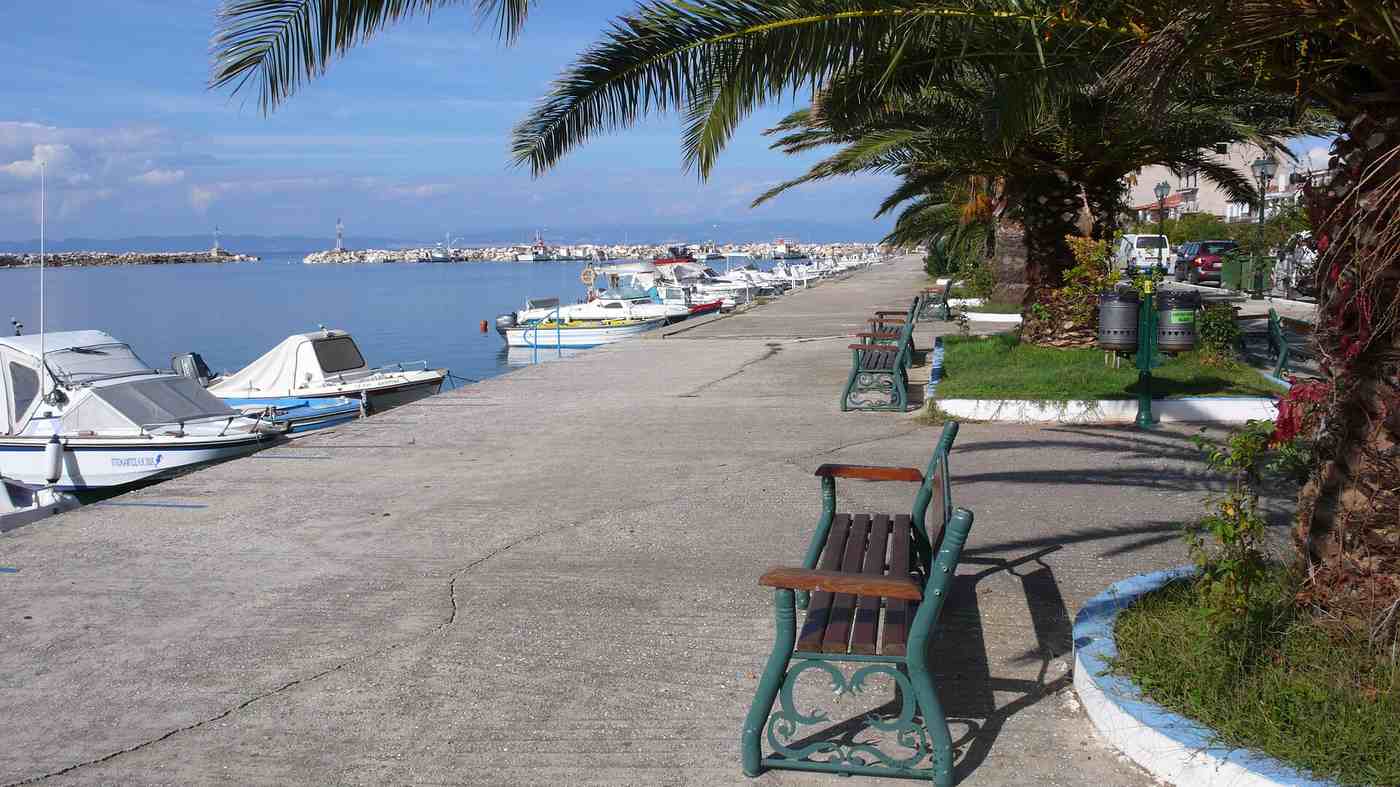
Skala Sotiros is a small, tranquil coastal village on the west coast of Thassos, built by the seaside in a green, sheltered area. The village lies 20 kilometres from Limenas, the island capital, and serves as the shore settlement of the inland village of Sotiros. It began as a modest fishing hamlet and grew slowly into a quiet holiday resort in the later twentieth century. Its real fame, though, is archaeological: a fortified Early Bronze Age settlement flourished here in the middle of the third millennium BC. Marble menhirs, a herringbone enclosure wall, and later Roman and Byzantine remains crowd a single hectare beside the sea. Plan a calm west-coast stay that pairs a peaceful beach with a genuine window on prehistory.
The sections that follow trace where Skala Sotiros lies and how to reach it, the prehistoric fortified settlement, the herringbone wall, the marble menhirs, the Roman and Byzantine remains, the modern village and beach, and how the site fits a Thassos history trip. Each section answers one clear question and points to what matters on the ground. Regular Thassos tours connect the village with Limenas, the beaches, and the wider island. Read on to plan a day, a swim, and a genuine journey through five thousand years of island history along this quiet western shore.
Where is Skala Sotiros and how do you reach it?
Skala Sotiros sits on the west coast of Thassos, 20 kilometres from the capital Limenas. Drivers follow the coastal ring road south from the port, reaching the seaside village in roughly half an hour.
Skala Sotiros occupies a green stretch of the western Thassian shore, built right beside the sea. The village lies 20 kilometres from Limenas, the island capital and main ferry port on the north coast. A drive down the coastal ring road links the two in about half an hour. The shore settlement belongs to the inland village of Sotiros, which sits back in the hills above the coast. Foliage and cultivated plots surround the houses, giving the place a leafy, sheltered feel rare on busier coasts. The plain behind the beach rolls gently toward the wooded slopes of the interior. This west-facing position catches soft afternoon light and calm swimming water through the summer season, and it keeps the village pleasantly quiet.
Neighbouring Skala Prinos lies a short drive north along the same coast, sharing the west shore’s quiet character. Travellers arriving on the Kavala ferry at Skala Prinos reach Skala Sotiros within fifteen minutes by car. The two villages sit on the flatter, gentler flank of the island, away from the northern crowds. Buses on the ring road stop near the village, linking it to Limenas and the southern resorts. Hire cars give the easiest access, since the coastal road threads directly through the settlement. Parking near the beach and the small harbour stays simple outside the peak weeks. The compact layout keeps the beach, the tavernas, and the archaeological site within a short, easy walk of each other.
Ferries from the mainland dock at Limenas and at Skala Prinos, the island’s two harbours. Passengers landing at either port drive south along the coast to reach Skala Sotiros. Kavala, the nearest mainland city, links to Skala Prinos by a crossing of about one and a quarter hours. Thessaloniki and its international airport lie a few hours’ drive from the Kavala and Keramoti ferry ramps. The Keramoti route runs the shorter hop into Limenas, the busier of the two harbours. Cars roll off the ramp and join the ring road within moments of arrival. The seaside village then sits a straightforward coastal drive away, clearly signposted along the western shore for arriving visitors.
The village centre gathers around a modest seafront rather than a built-up resort strip. Houses, rooms, and a handful of tavernas line the shore behind the beach. The archaeological site sits close to the water, within the modern settlement itself. Visitors reach the excavated enclosure on foot from the beach in a few minutes. Signposts along the coastal road mark the turning for the village and its ancient remains. The green setting, the quiet shore, and the ruins together define the arrival at Skala Sotiros. Travellers who value calm over nightlife find the pace here well judged. This easy access, paired with a genuine village feel, makes the settlement a rewarding stop on any western circuit of the island.
What is the prehistoric settlement at Skala Sotiros?
Skala Sotiros holds a fortified coastal settlement of the Early Bronze Age, one of several founded on Thassos in that era. The site flourished in the middle of the third millennium BC, packed onto roughly one hectare beside the sea.
Archaeologists uncovered the fortified settlement in the heart of the modern village, close to the shore. The site belongs to the Early Bronze Age, when small fortified coastal communities appeared around Thassos. Excavation revealed dense building over a compact area of only about one hectare. The settlement reached its peak in the middle of the third millennium BC, deep in prehistory. A study of the history of Thassos traces this early chapter long before the island’s famous ancient city. The coastal location gave the community access to the sea, to fishing, and to trade routes. Defensive concerns shaped the plan from the outset, since the whole settlement sat behind a strong perimeter wall. This early foothold marks one of the oldest organised communities on the island.
The one-hectare footprint packed houses, workshops, and storage tightly within the enclosure. Compact settlements of this kind rose across the northern Aegean during the same period. The builders chose a low coastal rise beside the sea for both access and defence. Stone foundations and floor levels survived to reveal the dense internal layout. Finds from the dig included pottery, tools, and traces of the community’s daily economy. The inhabitants farmed the plain, fished the western waters, and traded along the coast. The seaside setting placed the settlement on the maritime networks that crossed the Aegean. Small size did not mean isolation, since the material culture links the site to distant regions. This concentrated community reflects a wider Bronze Age pattern along these sheltered shores.
The excavation ranks among the most important prehistoric discoveries on Thassos. The site pushes the island’s settled history back into the Early Bronze Age, well before the Archaic city. Finds here connect Thassos to the broader early cultures of the Cyclades and Asia Minor. The fortified plan shows a community organised around defence and shared communal effort. Marble and gneiss sculptures from the site rank among its most remarkable yields. The prehistoric layers lie close to later Roman and Byzantine remains within the same village. Each phase adds a chapter to a settlement occupied across several thousand years. Researchers continue to study the material for what it reveals about early Aegean life. This depth of history sets the modest village apart from ordinary beach resorts.
The remains sit in the open within the modern settlement, close to the church and the shore. Visitors walk among the low walls and foundations that outline the ancient enclosure. Information around the site explains the Bronze Age phase and the later additions. The prehistoric core lies beneath and beside the buildings of the living village. A short walk connects the ruins with the beach and the tavernas along the front. The compact scale lets travellers grasp the whole settlement in a single relaxed visit. Marble menhirs, wall stretches, and later baths cluster within a small radius. The setting rewards anyone curious about the island’s earliest inhabitants. This accessible, open site turns a quiet village into a genuine window on prehistory.
What does the herringbone enclosure wall reveal?
A strong enclosure wall ringed the settlement, fitted with gates and projecting bastions. The masons laid the stones in a herringbone, or fishbone, pattern, a technique also seen in the fortified citadels of the Cyclades and Asia Minor.
The enclosure wall formed the settlement’s most striking piece of engineering. Builders ringed the one-hectare community with a solid stone barrier for defence. Gates pierced the wall at chosen points to control movement in and out. Bastions projected from the line to strengthen the defence and guard the approaches. The wall’s scale shows the effort a small community invested in its own security. Coastal settlements of the era faced raiders and rivals moving along the sea lanes. The fortification enclosed homes, workshops, and stores within a single protected perimeter. Its surviving stretches still trace the outline of the ancient settlement for visitors today. This defensive ring stands as the structural backbone of the whole prehistoric site.
The herringbone masonry gives the wall its particular archaeological interest. Masons set the stones at slanting angles to form a repeating fishbone pattern. The technique locks the courses together, adding strength to the structure without mortar. Builders across the Early Bronze Age Aegean used the same distinctive method. Citadels in the Cyclades and along the coast of Asia Minor show comparable walls. The shared technique ties Skala Sotiros into a wide network of early fortified centres. Craft knowledge clearly travelled the sea routes alongside goods and people. The pattern reflects both practical engineering and a common regional building tradition. This masonry links a small Thassian village to the broader currents of Aegean prehistory.
Gates and bastions structured the defence into a considered, deliberate system. Entrances channelled traffic through narrow, defensible points in the wall. Bastions gave defenders positions from which to cover the gates and the wall face. The arrangement mirrors the military thinking of contemporary fortified sites elsewhere. Planners laid out the perimeter with attack and defence clearly in mind. The projecting towers broke the straight line of the wall into stronger angles. Features of this kind rarely survive so clearly at settlements of such early date. The excavated remains let visitors read the logic of the defence on the ground. This careful design underlines how seriously the community took its own protection.
The fortifications place Skala Sotiros among the notable defended sites of its age. Comparable walls guarded early communities across the islands and the Anatolian coast. The parallels point to shared threats and shared solutions around the Bronze Age Aegean. The herringbone wall, the gates, and the bastions together form a coherent defensive scheme. Archaeologists prize the site for how much of this system survives intact. The stone lines give a rare, concrete picture of prehistoric military engineering. Visitors trace the perimeter and picture the enclosed settlement within its walls. The fortification anchors the site’s importance well beyond its small physical size. This defended circuit remains the clearest link between Thassos and its Aegean neighbours in prehistory.
Why are the menhir columns at Skala Sotiros important?
A remarkable group of megalithic anthropomorphic columns came to light in the settlement. These marble and gneiss menhirs depict warriors or hunters and belong to a pan-European current of early stone sculpture spanning the third millennium BC.
Excavators recovered a large number of megalithic columns from within the settlement. The stones take an anthropomorphic form, shaped to suggest the human figure. Carvers worked them from marble and from gneiss, both stones available on the island. The figures appear to represent warriors or hunters, marked with schematic features. Menhirs of this type stand among the earliest monumental sculpture in the whole region. The find gives Skala Sotiros a rare place in the study of prehistoric art. The columns once stood within or around the fortified settlement. Their discovery transformed understanding of the community’s beliefs and identity. This body of early sculpture ranks among the most important yields from the entire site.
The menhirs belong to a broad current of early anthropomorphic sculpture across Europe. Communities from the Atlantic coast to the Aegean raised standing stones carved as human figures. The Skala Sotiros columns tie Thassos into this wide prehistoric tradition. Scholars group them with menhir-statues found far beyond the Greek world. The shared form suggests connected ideas moving across great distances in the third millennium BC. Warriors and hunters clearly held a central place in the imagery of the age. The stones may have marked graves, honoured ancestors, or asserted status. The pan-European link raises the site’s importance well above its local scale. This connection places a small Thassian village firmly on a continental map of early art.
Marble and gneiss gave the carvers durable stone for their monumental figures. Thassian marble, later famous across the ancient world, appears here in its earliest sculptural use. The gneiss offered a harder, darker stone for other columns in the group. Craftsmen shaped the blocks with the simple tools of the Early Bronze Age. Schematic faces, arms, and weapons distinguish the warriors and hunters carved on the stones. The scale of the columns marks them as deliberate, significant monuments. Their survival lets researchers study prehistoric technique and belief together. Museums and the site itself preserve and interpret the finds for visitors. This early working of Thassian marble foreshadows the island’s later sculptural fame.
The menhirs draw archaeologists and curious travellers to the modest village alike. The figures rank among the most evocative prehistoric objects found on Thassos. Their warriors and hunters put a human face on a community five thousand years old. The columns bridge the gap between raw defence and expressive art at the site. Finds of this quality rarely emerge from settlements of such small physical size. The sculptures deepen the meaning of every wall and foundation around them. Visitors who grasp the menhirs read the whole site with fresh understanding. The stones connect the fortified village to the wider prehistoric world beyond the Aegean. This sculptural legacy stands as the crowning discovery of Skala Sotiros.
What Roman and Byzantine remains survive at Skala Sotiros?
Roman and Byzantine occupation left a bathhouse, later baths, and traces of an early Christian basilica at the site. Beneath the church courtyard lie ruins of an even older prehistoric settlement of the early copper age.
Roman builders added a bathhouse to the site long after the Bronze Age settlement faded. The baths reflect the comfortable public life of the Roman period across the Aegean. Their remains lie among the older prehistoric structures within the village. Finds from the various phases often travel to the Archaeological Museum of Thassos in Limenas for study and display. The museum sets the Skala Sotiros material alongside treasures gathered from across the island. The Roman layer shows the site’s long, layered occupation through many centuries. Bathhouses of this kind served as social hubs as much as places to wash. Their presence marks the village as a settled community well into Roman times. This later phase adds real depth to a site already rich in prehistory.
Byzantine baths and a Christian basilica followed in the centuries after Rome. The basilica points to an early Christian community established at the coastal site. Its traces survive among the tangle of earlier and later structures. Byzantine bathing facilities continued the long local tradition of public baths. The church that stands today rises close to these earlier religious remains. Worship on the spot appears to stretch across many centuries in a single place. The basilica links Skala Sotiros to the wider Christianisation of the Aegean. Its foundations add a clear medieval chapter to the settlement’s deep timeline. This religious continuity threads through the site from antiquity into the Byzantine era.
Ruins of an early copper age settlement lie beneath the church courtyard itself. The copper age phase predates even the fortified Bronze Age enclosure nearby. Excavation under and around the church exposed these deep prehistoric layers. The stacked periods show people returning to the same favourable coastal spot repeatedly. Each culture built over or beside the traces of those who came before. The copper age remains extend the site’s history yet further back in time. Digging here reveals a sequence running from prehistory to the Byzantine centuries. The layered ground turns a small courtyard into a cross-section of the island’s past. This depth of occupation makes the quiet village a genuine archaeological landmark.
The site preserves an unusually complete run of periods within a small area. Copper age, Bronze Age, Roman, and Byzantine remains crowd together beside the shore. Few places on Thassos compress so much history into one modest village. The overlapping layers challenge and reward the archaeologists who study them. Visitors move from prehistoric menhirs to Roman baths within a few short steps. The church, the courtyard, and the enclosure knit the phases into one visit. Each structure marks a different chapter of the same long coastal story. The combined remains explain why scholars value the site so highly. This continuous occupation is the true significance of Skala Sotiros.
What is the modern village of Skala Sotiros like?
Skala Sotiros today offers a quiet beach, family tavernas, and simple accommodation in a green seaside setting. The village keeps a genuine, non-touristy atmosphere, drawing travellers who prefer calm shores and local life to crowded resorts.
The modern village grew from a small fishing hamlet into a modest holiday resort. Fishermen once worked this shore before tourism arrived in the later twentieth century. Development stayed gentle, so the village kept its small scale and quiet mood. Houses, rooms, and tavernas cluster near the beach in a green, sheltered setting. The seafront serves the daily needs of residents and the trickle of summer visitors. Cultivated plots and greenery press close behind the narrow coastal strip. The pace stays slow, shaped by fishing, farming, and low-key tourism together. Travellers find a working Greek village here rather than a purpose-built strip. This unhurried character sits at the very heart of the village’s appeal.
The beach at Skala Sotiros offers calm, clear water on the sheltered west coast. Pebbles and sand line the shore directly in front of the village. West-facing water warms in the shallows and stays gentle through the afternoon. Swimmers and families settle on the quiet strand without the crush of larger resorts. Tavernas and rooms sit within a few steps of the sand behind the beach. Trees and greenery edge the shore, offering welcome patches of shade at midday. The gently shelving seabed suits young children and cautious swimmers alike. Sunset light on the western water draws strollers along the peaceful front. This calm beach forms the daytime centre of village life through the season.
Family-run tavernas serve fresh fish and local dishes along the seafront. Kitchens here cook with Thassian olive oil pressed on the island itself. Grilled catch, mezes, and simple Greek staples fill the menus each evening. Meal prices tend to undercut the busier resorts on the north and south coasts. Tables spill toward the shore, so diners eat almost on the beach. Local wine and homemade dishes anchor the relaxed evening meals. The tavernas double as social hubs for villagers and guests alike. Warm, unfussy hospitality marks the dining along this quiet front. This honest food culture rewards travellers who seek the real island table.
Accommodation in the village runs to rooms, studios, and small guesthouses. Family-owned lodgings keep prices modest and the welcome personal. Guests wake a few steps from the beach and the morning quiet of the shore. The genuine, non-touristy atmosphere sets the village apart from packaged resorts. Travellers seeking calm, local life, and easy access to ruins settle in happily. The green setting and the gentle sea frame restful days and quiet nights. Independent visitors use the village as a peaceful base for touring the coast. Families value the safe beach and the walkable, low-traffic centre. This authentic feel is exactly what draws people back to Skala Sotiros.
How does Skala Sotiros fit into a Thassos history trip?
Skala Sotiros anchors the prehistoric chapter of any Thassos archaeology tour, complementing the classical monuments of Limenas. Travellers pair its Bronze Age enclosure and menhirs with the ancient city’s agora, theatre, and museum for a complete historical picture.
The ancient city of Limenas holds the classical heart of the island’s archaeology. Travellers exploring the capital walk the Ancient Agora, the theatre, and the acropolis on the north coast. Skala Sotiros adds the missing prehistoric layer to this classical story. The Bronze Age settlement predates the famous city by more than two thousand years. A combined visit spans the island’s history from prehistory to the Roman era. The two sites sit 20 kilometres apart along the western and northern coasts. Drivers link them in a single day using the coastal ring road. This pairing turns a simple beach holiday into a genuine journey through time.
A history-focused day on Thassos naturally starts or ends at Skala Sotiros. Visitors walk the fortified enclosure, the menhirs, and the layered ruins first. A short drive north then reaches Limenas and its classical monuments. The agora, theatre, and city walls fill an afternoon in the ancient capital. The archaeological museum ties both sites together with finds under one roof. The route runs along scenic western and northern coasts between the stops. Beaches and tavernas break the driving for swimming and a long lunch. The compact island keeps every site within an easy day’s reach. This itinerary balances ruins, scenery, and rest within a single loop.
Thassos rewards travellers who read its landscape as a long human story. Skala Sotiros supplies the opening chapter, set in the Early Bronze Age. Limenas carries the tale forward into the Archaic, Classical, and Roman periods. Byzantine churches and towers add the medieval layer across the island. The marble quarries that made Thassos famous lie within reach of both coasts. Each site adds a piece to a history running back five thousand years. Guided tours and self-drive routes both stitch the sites together. Curious visitors gain far more than a simple beach break. This depth of heritage distinguishes Thassos among the northern Aegean islands.
A stop at Skala Sotiros costs little time yet adds real depth to a trip. The open site sits within the village, steps from the beach and the tavernas. Visitors combine ruins, a swim, and lunch in a single relaxed morning. The prehistoric enclosure and menhirs reward even a short, curious visit. Families mix the archaeology with beach time to suit every age. The quiet setting makes the history feel personal rather than crowded. Travellers touring the west coast fold the site easily into their route. The village links prehistory, the sea, and modern island life in one place. This blend makes Skala Sotiros a natural highlight of any Thassos archaeology tour.
Frequently Asked Questions
Where is Skala Sotiros on Thassos?
Skala Sotiros lies on the west coast of Thassos, 20 kilometres south of the capital Limenas. The seaside village serves as the shore settlement of the inland village of Sotiros. The coastal ring road links it easily to Limenas, Skala Prinos, and the southern resorts.
What is there to see at Skala Sotiros?
Skala Sotiros holds a fortified Early Bronze Age settlement, its most notable sight. Visitors see stretches of the herringbone enclosure wall, marble and gneiss menhirs, a Roman bathhouse, and traces of a Christian basilica. The quiet beach and seafront tavernas round out a visit to the village.
Can you walk around the archaeological site at Skala Sotiros?
The archaeological remains lie in the open within the modern village, close to the church and shore. Visitors walk freely among the low walls, foundations, and menhirs of the ancient enclosure. The compact site sits steps from the beach, making a short, self-guided visit simple.
How far is Skala Sotiros from Limenas?
Skala Sotiros sits 20 kilometres from Limenas, the island capital and main ferry port. Drivers cover the coastal distance in roughly half an hour along the ring road. Buses on the same route also connect the village with the capital through the season.
Is there a beach at Skala Sotiros?
The beach at Skala Sotiros offers calm, clear water on the sheltered west coast. Pebbles and sand line the gently shelving shore, which suits families and cautious swimmers. Tavernas and rooms sit within steps of the sand behind the beach.
What else is near Skala Sotiros?
Skala Prinos, the island’s second ferry harbour, lies a short drive north of Skala Sotiros. Limenas and its ancient monuments sit 20 kilometres away on the north coast. The southern resorts of Limenaria and Potos, plus quiet west-coast beaches, lie within easy reach by car.