
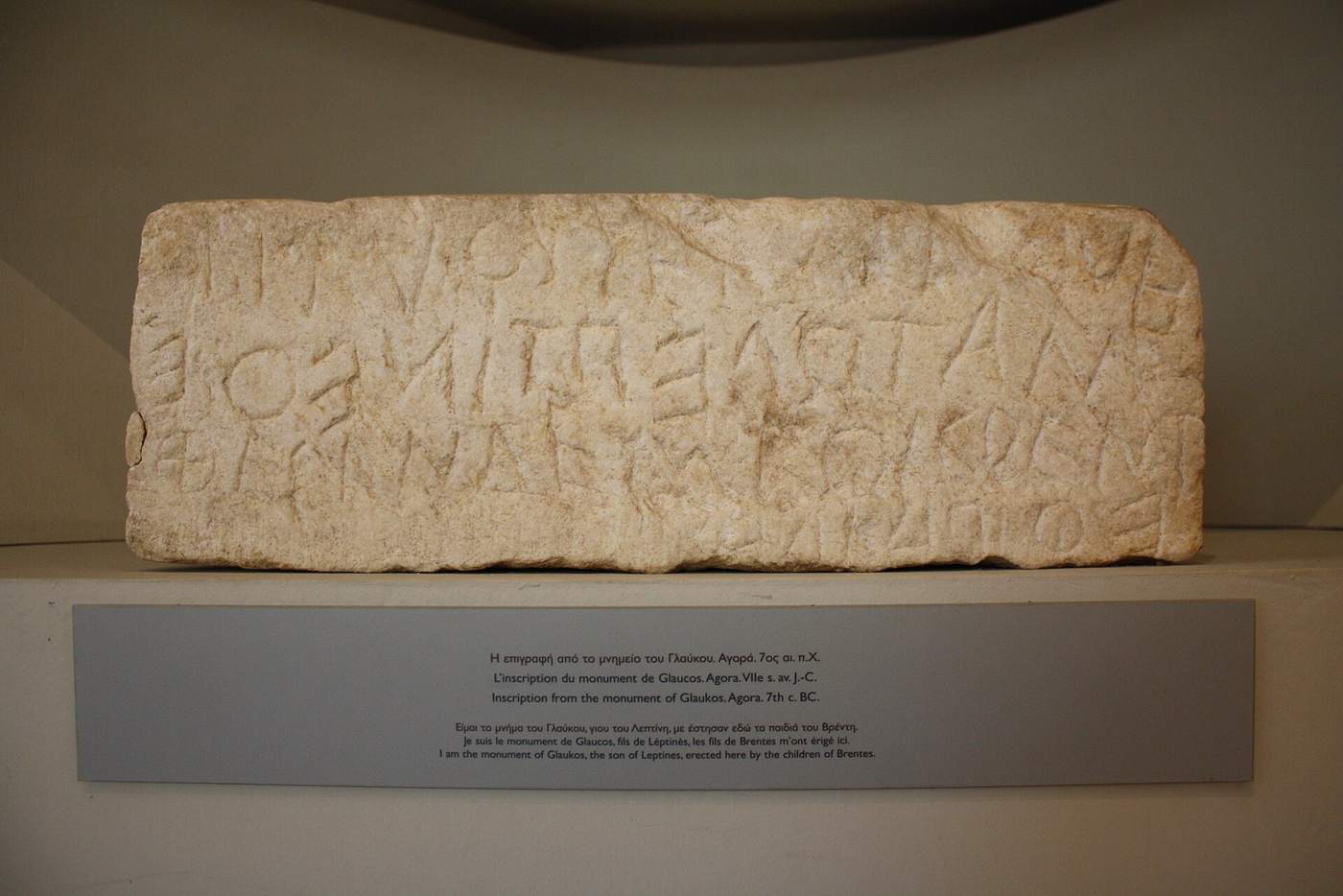
The Monument of Glaukos stands in the ancient agora of Thassos, a plain marble memorial that carries one of the oldest Greek inscriptions ever found. The block names Glaukos, son of Leptines, a warrior and companion of the poet Archilochos who helped the Parians settle the island in the early seventh century BC. Few objects tie archaic poetry to solid stone so directly. The inscription proves that a man praised in surviving verses truly lived, fought and won honour on Thassos. This guide sets out what the monument is, what its inscription records, and how the memorial links the island’s colonists, its poet and its early alphabet, prepared with My Greece Tours for a clear visit.
The memorial rewards attention beyond its modest size, because it opens a window onto the founding generation of Greek Thassos. The sections below explain the monument itself, the wording and script of its inscription, the identity of Glaukos, and the poet Archilochos who named him. Later answers place the memorial within the Parian colonisation, its exact spot in the agora, and the practical route for seeing it today. Each answer opens with the essential fact, then adds the detail behind it. Readers planning a trip to the ancient city will find the memorial an ideal first stop, small in scale yet unusually rich in early history.
What is the Monument of Glaukos in Thassos?
The Monument of Glaukos is an early Archaic memorial in the ancient agora of Thassos. Built of local marble in the early seventh century BC, it honours Glaukos, son of Leptines, and bears one of the oldest surviving Greek inscriptions.
The Monument of Glaukos ranks among the earliest dated structures in the city that grew into Limenas. Marble blocks from the island’s own quarries form its core, cut and set within the first civic square of the young colony. Archaeologists read the memorial as a funerary or heroic monument, raised to keep the memory of a named individual alive in public view. The plain form hides its importance, since the carved letters on the stone matter far more than the architecture. A visitor sees a low marble structure, yet stands before a document that fixes a real seventh-century life in the ground of the ancient agora.
French School excavations at the agora uncovered the memorial and pieced together its inscribed block over long field seasons. The letters belong to the archaic Greek alphabet in its Parian form, brought across the Aegean by the settlers from Paros. Scholars date the writing to the early seventh century BC on the shape of those letters, which places it near the very start of the colony. The memorial therefore joins a small group of the oldest Greek inscriptions known from anywhere. Its survival lets historians hear a name spoken at the founding moment of Greek settlement on the island, recorded not in later copies but in the original stone itself.
The monument sits inside the ancient agora, the open civic heart where the colonists conducted trade, worship and public affairs. Position mattered to the men who raised it, since a memorial in the agora kept Glaukos before the whole community rather than hidden in a private plot. Public honour of this kind usually marked a leader, a founder-figure or a fallen warrior held in high regard. The choice of the central square signals that Glaukos held real standing among the first generation of settlers. Excavated foundations still mark the spot, so the memorial can be located within the ruins that spread across the square today.
Value in the monument comes from the meeting of stone and verse. Glaukos appears by name in the poetry of Archilochos, the Parian poet tied to the colony, and the inscription confirms that this Glaukos was no invention. Confirmation of a poetic figure through an excavated inscription is genuinely rare in Greek archaeology. The memorial turns a literary companion into a documented citizen with a father, a family and a public grave. Study of the block has shaped how historians understand the founding of Thassos, the reach of early writing, and the world Archilochos described. One quiet marble structure carries the weight of poetry, history and the island’s first alphabet at once.
What does the inscription on the Monument of Glaukos say?
The inscription reads that the stone is the memorial of Glaukos, son of Leptines, set up by the sons of Brentes. Carved in the archaic Parian alphabet, it counts among the oldest Greek inscriptions found on Thassos.
Text on the block declares, in translation, that it is the memorial of Glaukos, son of Leptines, and that the sons of Brentes set it up. Wording of this direct kind is typical of the earliest Greek grave markers, which often speak in the first person as the stone itself. Naming both the dead man’s father and the men who raised the memorial fixes Glaukos within a family and a circle of comrades. The phrasing gives historians a patronymic, Leptines, that ties the warrior to a Thasian lineage. Every word on the block adds a hard fact to a period that otherwise survives mostly in fragments of poetry.
Letters cut into the marble follow the archaic Parian script, an early form of the Greek alphabet carried to the island by settlers from Paros. Stone from the island’s own beds, the same Thassos marble that made the city rich, carries the carved text. Early Greek writing of this date often runs boustrophedon, turning direction line by line like an ox ploughing a field. The shapes of the individual letters let epigraphers date the inscription to the early seventh century BC. Reading the script is a technical craft, yet the result is plain: the memorial preserves a rare and precise sample of the Greek alphabet at its dawn on Thassos.
Content of the inscription does more than name a dead man, because it records a social bond. Sons of Brentes, named as the men who set up the stone, appear as kin or close companions honouring Glaukos after his death. Public commemoration by comrades points to a warrior culture in which loyalty outlasted the battlefield. The wording matches the world of Archilochos, whose verses speak of fighting, comradeship and the hard life of the early colony. Historians treat the block as a primary source for social ties among the first settlers. Short as it stands, the text opens a direct line into how the founding generation remembered and honoured its own.
Preservation of the inscribed block lets modern visitors read a document from the birth of the colony. Conservators have studied the surface closely, recording each letter so the fragile text survives even as the stone weathers. The find ranks among the treasures explained in the Archaeological Museum of Thassos, which sets the inscription beside other early finds from the city. Seeing the letters, whether on the monument or through the museum’s records, makes the archaic alphabet real rather than abstract. The memorial and its text form one of the clearest early links between writing, memory and identity in the Greek world, all recovered from a single square in Limenas.
Who was Glaukos, son of Leptines?
Glaukos, son of Leptines, was a warrior and companion of the poet Archilochos among the Parian settlers of Thassos. Named in surviving verses and confirmed by his inscribed memorial, he stands as a documented figure from the seventh century BC.
Glaukos belonged to the generation of Parians who crossed the Aegean to seize and hold Thassos in the early seventh century BC. Poetry of Archilochos addresses him by name, treating him as a trusted friend and fellow fighter in the struggle for the island. The patronymic on the memorial, son of Leptines, marks him as a member of a settled Thasian family rather than a passing mercenary. Warrior life in the young colony meant constant conflict with the Thracian tribes of the mainland opposite. Glaukos lived that life, earned lasting honour among his comrades, and gained a public memorial that named him for the whole community to remember.
Character of Glaukos survives partly through the way Archilochos speaks to him. One famous fragment opens by calling on Glaukos to look at the storm gathering over the sea, using him as the steady friend a poet turns to. Another warns him about a soldier’s true worth, favouring a solid, planted fighter over a showy one. Verses like these treat Glaukos as a real companion, not a symbol, giving him a voice within the poet’s world. The memorial then confirms the friendship from the ground. A man addressed in living seventh-century poetry reappears, centuries later, as an excavated name carved by his own comrades on the island.
Standing of Glaukos within the colony shows in the honour his memorial received. Burial or commemoration in the public agora, rather than an ordinary cemetery, marked him as a figure of weight, likely a leader among the settlers. The same generation raised sanctuaries across the growing town, including the Sanctuary of Herakles, the island’s chief protective cult. Glaukos moved through that founding world of shrines, walls and hard fighting. His memorial fits the pattern of a society that honoured its warriors and founders in stone. The public setting of the monument argues that his contemporaries counted him among the men who had made the colony possible and secure.
Identity of Glaukos matters far beyond one grave, because he links poetry and archaeology in a single case. Historians rarely confirm a named individual from archaic verse through a contemporary inscription, yet Glaukos provides exactly that proof. His memorial anchors the poems of Archilochos to a real time, place and community on Thassos. Students of early Greece use the pairing to test how far poetry reflects genuine events and people. Glaukos, once a friend addressed in verse, now stands as evidence that the world Archilochos described truly existed. The son of Leptines has become one of the best-documented private citizens of the entire seventh century BC.
How is the monument connected to the poet Archilochos?
Archilochos, the seventh-century poet from Paros tied to the colonisation of Thassos, names Glaukos as a close companion in the surviving fragments of his verse. The inscribed memorial confirms that this Glaukos was a real man from the poet’s own circle.
Archilochos of Paros counts among the first great personal voices of Greek poetry, active in the early seventh century BC. Family ties bound him to Thassos, since tradition made his father Telesikles a leader of the Parian settlers who founded the colony. Verse by Archilochos describes soldiering, seafaring and the rough life of the island’s founding years. Glaukos appears inside that body of work as a named friend the poet trusts and advises. The connection between poet and memorial runs direct: the same Glaukos praised in the verses lies commemorated in the agora. One writer’s surviving lines and one carved stone illuminate the same small circle of early Thasian settlers.
Fragments addressed to Glaukos give the friendship a vivid, personal texture. One well-known piece calls on Glaukos to watch the deep sea rising into storm, a shared image between two men who knew the Aegean. Another advises him on the mark of a real commander, preferring a short, firm, sure-footed soldier to a tall and swaggering one. Lines like these read as advice between comrades rather than grand public verse. The intimacy tells historians that Glaukos stood close to the poet within the colony. Reading the poems beside the inscription lets a visitor hear the living voice that the silent memorial can only name in stone.
Colonisation of Thassos frames the whole relationship between Archilochos and Glaukos. Both men belonged to the wave of Parians who fought the Thracians to hold the island and its gold and marble, a story told within the history of Thassos. Warfare, hardship and hard-won settlement fill the poems, and Glaukos shared that experience at the poet’s side. The memorial then preserves a comrade from those founding battles in the civic square they helped to build. Poetry and inscription describe one campaign of settlement from two directions. The pairing gives the early history of the colony a human face rather than a bare list of dates and events.
Legacy of the link reaches well beyond Thassos itself. Archilochos became a model for later Greek and Roman poets, and any solid fact about his real world carries weight. Glaukos supplies exactly such a fact, grounding the poet’s circle in an excavated, datable monument. Scholars cite the pairing whenever they argue that archaic poetry reflects genuine people and events. The friendship of poet and warrior, recorded in verse and confirmed in stone, has become a textbook example of literature meeting archaeology. Visitors who know the poems find the plain memorial charged with meaning, since it holds the grave of a man whose name a famous poet spoke aloud.
What does the monument reveal about the Parian colonisation of Thassos?
The monument shows the Parian settlers organising a civic community with public honours and written records within the early seventh century BC. Its inscription proves that a literate, structured colony took root on Thassos almost from its founding.
Settlers from Paros crossed to Thassos in the early seventh century BC, drawn by the island’s gold, timber and marble. Conflict with the Thracian peoples of the mainland shaped their first decades, as the poems of Archilochos record in sharp detail. The Monument of Glaukos belongs to exactly this founding period, raised while the struggle for the island still ran hot. Public commemoration of a warrior shows a community already able to honour its own in an organised, formal way. The memorial thus dates the colony’s civic life to its earliest years. Parian Thassos emerges from the stone not as a rough camp but as a settled town with shared institutions.
Writing on the monument marks one of the colony’s most telling achievements. A community that could carve a formal inscription in the agora possessed literacy, a civic centre and an idea of public memory. The Greek alphabet itself had spread only two or three generations earlier, so this early text places Thassos near the front of Greek literacy. Colonists carried the Parian script across the sea and used it at once to record their dead. The memorial shows writing serving the community from the founding moment. Early literacy of this kind gave the young colony tools for law, trade and remembrance that shaped its later rise to wealth.
Location of the monument in the future heart of Limenas reveals how the settlers planned their town. The agora they laid out became the fixed centre of civic life, and placing a memorial there tied private memory to public space. Colonists did not scatter at random but built around a shared square from early on. The presence of Glaukos in that square shows the founders honouring leaders where the whole community would gather. Urban order of this kind speaks of intention and confidence among the settlers. The plan they set at the start guided the growth of the town for centuries, with the agora always at its living core.
Evidence from the monument corrects any image of colonisation as mere adventure. Parian settlement on Thassos appears, through this stone, as a deliberate project with warriors, families, cults and written commemoration in place from the beginning. The memorial ties named individuals to the founding effort, giving the colony faces as well as dates. Historians weigh the monument alongside the poems and the archaeology of the walls and sanctuaries to reconstruct those first decades. A single inscribed block thus carries broad meaning for how Greeks planted new cities overseas. Thassos, seen through the Monument of Glaukos, stands as a clear case of an ordered, literate colony from its earliest days.
Where does the Monument of Glaukos stand in the ancient agora?
The Monument of Glaukos stands in the ancient agora of Thassos in Limenas, the civic square at the centre of the ancient city. Excavated foundations mark its place among the ruins near the old harbour.
Ruins of the agora spread across a broad open area behind the modern waterfront of Limenas, the island capital. The Monument of Glaukos sits within this square, among the foundations of stoas, altars and public buildings that once framed civic life. Excavation has exposed the memorial’s base, so its spot can be traced on the ground rather than guessed. Standing in the agora, a visitor occupies the same civic space the founders used, with the sea close on one side and the acropolis hill rising behind. The setting explains the honour paid to Glaukos, since only a valued figure earned a lasting place at the very heart of the town.
Position within the square followed a clear logic for the men who raised the stone. Agoras served as the meeting point for trade, assembly, worship and public memory, so a memorial there reached the whole community daily. Placement of Glaukos among the civic buildings kept his name in constant view for generations of Thasians. Ordinary graves lay outside the walls, which makes his central commemoration a mark of unusual respect. The monument shared the square with the institutions that governed the colony. Its location alone tells a visitor that Glaukos ranked among the founders and leaders whom the early town chose to honour in its most public ground.
Excavations by the French School at Athens uncovered the agora over long campaigns, revealing the monument in its archaeological context. Layers around the memorial help date it and show how the square changed across the centuries. Later building sometimes reused or crowded early structures, yet the Monument of Glaukos kept its identity through the inscribed block. Careful digging recorded exactly where the stone stood in relation to the surrounding foundations. That context turns the memorial from an isolated curiosity into a fixed point in the plan of the ancient city. Visitors today walk paths laid out by the excavators, following the same ground that first revealed the founding-era monument.
Orientation helps a visitor find the memorial among the wider ruins. Paths cross the agora from the entrance near the waterfront, passing the bases of stoas toward the northern edge of the square. Signboards on site explain the main structures, and the excavated centre lies within easy walking distance of the harbour cafes. Reaching the monument takes only a short, level stroll through the open archaeological area. The compact scale of Limenas keeps the memorial, the square and the sea within minutes of each other. Finding Glaukos in the agora becomes part of a single walk through the founding heart of ancient Thassos.
How can visitors see the Monument of Glaukos today?
Visitors reach the Monument of Glaukos on foot within the archaeological area of the ancient agora in Limenas. Pairing the walk with the Archaeological Museum of Thassos explains the inscription and the wider founding story.
Access to the monument runs through the open archaeological area of the agora, at the centre of Limenas. Arrivals reach the island by ferry from the mainland near Kavala and dock close to the ancient city. Walking from the harbour to the agora takes only minutes across level ground. The memorial stands among the excavated foundations, reachable on foot once inside the site. No special arrangement is needed beyond comfortable shoes and a little time. The central position of the ruins means most visitors to Limenas pass close to the monument, making a short detour to see the founding-era stone an easy addition to any day in the town.
Pairing the site with the Archaeological Museum of Thassos gives the visit its full meaning. The museum sets the inscription and its era beside the other early finds from the city, from marble sculpture to painted pottery. Reading the museum first supplies the background of the colony, the poet and the alphabet before you reach the stone itself. Seeing the memorial afterwards then turns abstract history into a fixed object in the ground. The museum stands close to the agora, so the two form one easy circuit. Combining them lets a visitor grasp both the object and the world that produced it within a single morning.
Timing a visit rewards a little thought. Morning and late-afternoon light suit the open agora, when the sun sits lower and the ruins photograph well. Midday heat in summer makes the shaded museum the wiser choice for the hottest hours. A single ticket often covers the archaeological area, and the museum charges only a small state fee. Water and a hat make the outdoor half more comfortable, since the square offers little shade. Planning the walk around the cooler parts of the day keeps the visit relaxed. The compact layout of Limenas means the monument, the agora and the museum all fall within one unhurried outing.
Context deepens the reward of seeing the monument. Knowing that the inscription names a friend of Archilochos, carved at the founding of the colony, changes a plain stone into a moment of contact with the seventh century BC. Reading a fragment of the poet before the visit sharpens that link even further. Guides and site boards help place the memorial within the wider story of the agora and the town. A guided island tour can tie the monument to the museum, the harbour and the ancient walls in one planned day. Prepared this way, the Monument of Glaukos becomes a highlight rather than an overlooked block among the ruins.
Frequently Asked Questions
How old is the Monument of Glaukos?
The Monument of Glaukos dates to the early seventh century BC, placing it among the oldest structures in the ancient city of Thassos. Epigraphers fix the date from the shapes of the letters in its inscription, which belong to the archaic Parian alphabet in an early form. That timing sets the memorial close to the founding of the Parian colony, when settlers were still fighting to hold the island. Its inscription therefore counts among the earliest surviving Greek texts, carved when the alphabet itself was only two or three generations old. The monument stands, in effect, at the very start of written history on Thassos, a document from the colony’s first decades preserved in local marble.
Was Glaukos of Thassos a real historical person?
Glaukos, son of Leptines, was a genuine historical figure, confirmed by both poetry and archaeology. The poet Archilochos names him as a companion in the surviving fragments of his verse, and the inscribed memorial in the agora records his death and commemoration. Confirmation of a named individual from archaic verse through a contemporary inscription is rare, which makes Glaukos unusually well documented for the seventh century BC. The patronymic on the stone, son of Leptines, ties him to a Thasian family, and the men who raised the memorial appear as his comrades. Poetry gives Glaukos a character and a voice, while the inscription proves his existence in stone. Together they establish him as a real settler of early Thassos.
What language and script is the inscription written in?
The inscription is written in ancient Greek, using the archaic alphabet in the Parian form that the settlers brought from Paros. Early Greek writing of this period often runs boustrophedon, changing direction from line to line like a ploughing ox. The letter shapes are angular and early, which lets epigraphers date the text to the early seventh century BC. Carved into local marble, the inscription ranks among the oldest Greek texts found on the island. Reading it calls for specialist knowledge of archaic letter forms, since the script differs from later classical Greek. The memorial thus preserves not only a name but a precise sample of how Greeks first wrote on Thassos.
Why is the Monument of Glaukos important for Archilochos?
The monument matters for Archilochos because it confirms that a person named in his poetry truly lived. Archilochos addresses Glaukos as a friend and fellow soldier in the surviving fragments of his verse, advising and calling on him by name. The inscribed memorial then proves that this Glaukos was a real settler, buried and honoured in the agora of Thassos. A direct link between a poet’s verses and a datable inscription is rare in Greek studies. Scholars use the pairing to argue that Archilochos wrote about genuine people and events rather than pure invention. The monument therefore anchors the poet’s world in solid ground, giving his early Thasian circle a documented, excavated member.
Where is the inscription from the Monument of Glaukos kept?
The inscribed block from the monument has been studied and conserved as part of the excavated agora of Thassos, and the Archaeological Museum of Thassos in Limenas explains the early epigraphy of the ancient city. The museum sets the inscription within the wider story of the colony, alongside marble sculpture, coins and pottery from the same centuries. Visitors gain the fullest picture by seeing the agora, where the monument stood, together with the museum that interprets its writing. The stone belongs to the archaeological zone of Limenas, kept and protected within the ancient city it commemorates. Museum and site together preserve the memorial and make its rare early text understandable to a modern visitor.
Can you visit the Monument of Glaukos?
Visitors can see the Monument of Glaukos within the open archaeological area of the ancient agora in Limenas, the capital of Thassos. The memorial stands among the excavated foundations of the civic square, a short, level walk from the harbour. Reaching it needs only a ticket to the site and comfortable shoes, since the ruins sit at the centre of the town. Pairing the walk with the Archaeological Museum of Thassos explains the inscription and the founding era behind it. Morning or late afternoon suits the open square best, away from the midday summer heat. Combining the monument, the agora and the museum makes a rewarding half-day in the ancient heart of the island.