
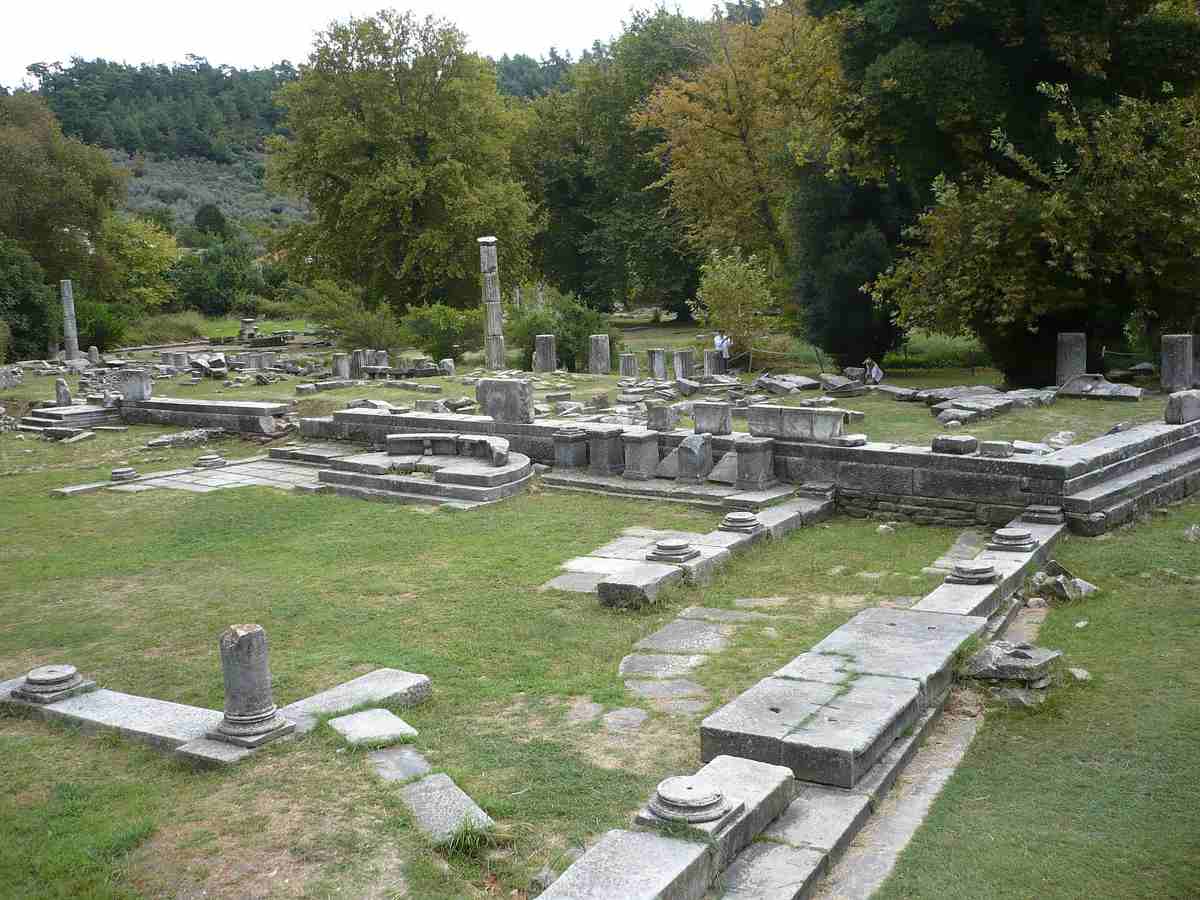
Evraiokastro in Thassos is a low rocky headland that juts into the sea beside the old harbour of Limenas, the main town of the island. Ruins of a large Early Christian basilica of the fifth and sixth centuries AD crown its summit, while the sacred deposits of an ancient sanctuary lie buried at its foot. The name means the Jews’ Castle in Greek, a folk title whose true origin scholars still debate. Pagan altar and Christian church share this one small promontory, layering roughly a thousand years of worship onto a single spur of stone above the water. Wind, salt and the open Aegean frame the site on three sides. Travellers reach the headland easily on a wider tour of the ancient town with My Greece Tours across Thassos.
Evraiokastro compresses the whole religious history of ancient Thassos into a single rocky point above the harbour. Pagan worshippers first honoured a deity here, filling the ground with offerings, before Christian builders raised a basilica on the summit above. The sections below explain what the headland is, where it stands within Limenas, what the Early Christian basilica looked like, how the site shifted from pagan sanctuary to Christian church, why it bears the curious name the Jews’ Castle, what a visitor sees on the ruins today, and how to reach it among the nearby monuments. Each part ties the headland to the wider ancient city and its long story of worship. Planning stays simple with the guided walks around Thassos that take in the old town and its ruins.
What is Evraiokastro in Thassos?
Evraiokastro is a small rocky headland beside the old harbour of Limenas in Thassos, crowned by the ruins of a large Early Christian basilica of the fifth and sixth centuries AD and holding the buried votive deposit of an earlier ancient sanctuary.
Evraiokastro rises as a modest spur of grey rock at the northern edge of the ancient harbour of Limenas. The headland stands barely ten metres above the waves, yet it commands the whole sweep of the old port and the open sea beyond. Foundations of an Early Christian basilica spread across its flat summit, low walls tracing the nave and apse against the sky. Sacred offerings of a far older cult lay buried in the rock and soil of the seaward slope below. The little promontory therefore stacks two religions on one stone, a pagan sanctuary underneath and a Christian church above. Fishing boats still shelter in the harbour it guards, just as ancient vessels once did.
Rock and sea define the character of Evraiokastro more than any single building. Waves break against the low cliffs on three sides, and salt spray reaches the ruins on a windy day. The summit lies flat and open, easy to walk yet fully exposed to the weather off the northern Aegean. Wild thyme and dry grass grow between the tumbled marble blocks in summer. The headland forms a natural bastion at the harbour mouth, a defensible point that drew builders across successive ages. Its shape, half island and half shore, gave the spot both a strategic value and a sacred one. No other spot on the island holds so long a history in so small a footprint of stone.
Two monuments define the site for the modern visitor, one buried and one exposed. The ruined basilica on the crest represents the Christian phase, its plan readable in foundations of local marble. The votive deposit of the older sanctuary represents the pagan phase, recovered by excavation from the ground below. The finds from that deposit belong with the great sanctuary of the goddess nearby, described at the Sanctuary of Artemis in the same town. Church and cult thus divide the headland between them across the centuries. Reading the two together turns a small rocky point into a lesson in how worship changed on the island. The layered story rewards a slow, attentive walk over the summit.
Evraiokastro belongs to the tight cluster of ancient sites packed into the northern shore of Limenas. The headland sits within the walled circuit of the classical city, close to the harbour quays and the civic quarters. Ancient Thasians raised sanctuaries, gates and public buildings across the same narrow strip of coast. The whole story of the island, told at the history of Thassos, runs through this crowded ground. The promontory adds a Christian chapter to a landscape already dense with pagan and civic ruins. Its position at the water’s edge kept it in use long after the classical city faded. This concentration of monuments makes the old town one of the richest archaeological zones in the northern Aegean.
Where does the Evraiokastro headland stand in Limenas?
Evraiokastro stands on the northern shore of Limenas, the main town of Thassos, forming a rocky headland at the edge of the old commercial harbour, close to the ancient agora, the acropolis hill and the modern seafront of the town.
Evraiokastro guards the northern side of the old harbour of Limenas, the port and capital of Thassos. The headland closes one arm of the ancient commercial anchorage, where trading ships once loaded marble, wine and gold. Modern Limenas, described at Limenas (Thassos Town), spreads its quays and tavernas along the same waterfront today. The promontory lies a short walk from the town centre, easy to reach on foot from the seafront. Its rocky mass marks the join between the working harbour and the open sea. Visitors passing along the coast road can hardly miss the low spur crowned with ruins. This central shore position kept the site busy through pagan, Christian and later ages alike.
The ancient agora spread inland from the harbour only a short distance from the headland. Public life gathered in the ancient agora, the great square ringed by porticoes, shrines and civic offices. Traders moving between the quays and the market passed close beneath Evraiokastro on their daily rounds. The route tied the promontory into the commercial heart of the classical city. Merchants, sailors and magistrates all knew the rocky point at the harbour mouth. Its nearness to the square set the sanctuary and later the church at the busy centre of town. This link between market and headland shows how firmly the site belonged to the everyday life of ancient Thassos.
The acropolis of Thassos rises on the hill behind the harbour, looking down on the headland from the south. The fortified summit of the Acropolis of Thassos carried temples and towers high above the town. Evraiokastro answered it at sea level, a low bastion where the walls met the water. The two heights framed the harbour between them, one on the hill and one on the shore. Defenders could watch the port from both points at once. The line of the ancient ramparts ran down from the acropolis toward the coast near the headland. This pairing of high citadel and low promontory shows how carefully the ancient city fortified its precious harbour.
Sea and town press close around the headland from every side. Water laps the rocks to the north and east, while the streets of modern Limenas run up to its landward foot. The old harbour lies immediately to the south, still busy with small boats. A short walk along the shore links the promontory to the museum, the agora and the ancient gates. Cafes and hotels stand within a short walk of the ruins. Morning walkers reach the summit easily before the day grows hot. This snug fit of ancient stone and living town lets a visitor step from a harbour table straight onto a headland layered with roughly a thousand years of worship.
What was the Early Christian basilica on Evraiokastro?
The Early Christian basilica on Evraiokastro was a large three-aisled church of the fifth and sixth centuries AD, raised on the summit of the headland with a nave, side aisles and an eastern apse, built partly from marble reused from the older ancient sanctuary.
Foundations on the summit outline a substantial Early Christian basilica of the fifth and sixth centuries AD. The plan followed the standard early church form, a long rectangular hall divided into a central nave and two flanking aisles. Rows of columns once separated the aisles from the nave down the length of the building. A semicircular apse closed the eastern end, where the altar and clergy stood during worship. Marble paving and low walls survive to trace the outline across the crest. The church rose in the confident years when Christianity spread across the Byzantine north Aegean. Its size shows that the small headland still mattered to the island community long after the pagan cult had faded.
Local marble supplied the fabric of the basilica, part quarried fresh and part reused. Builders drew on the famous white stone of Thassos that had raised the temples and monuments of the classical city. Columns, capitals and paving slabs from older structures were set into the new church, a common Early Christian practice. Spolia of this kind tied the Christian building physically to the pagan past beneath it. The reused marble carried the craft of ancient Thassos into the age of the basilica. Weathered blocks of it still lie scattered across the summit today. This blend of fresh and salvaged stone gave the church a fabric literally built from the ruins of the older sacred ground.
Three aisles and an apse gave the basilica the shape shared by early churches across the Mediterranean. The central nave rose higher than the side aisles, lit by windows in its upper walls. Worshippers gathered in the nave and aisles while the clergy served at the altar within the eastern apse. A narthex, or entrance porch, most likely fronted the western end in the usual manner. Mosaic or marble floors would have covered the interior, as at comparable churches of the period. The design turned the exposed headland into a proper place of Christian assembly. This familiar basilica plan places the Evraiokastro church firmly within the mainstream of Early Christian building in the eastern empire.
Size and setting made the basilica a landmark for sailors and townspeople alike. The church stood on the highest point of the headland, visible from the harbour and the approaching sea. Ships entering the old port would have seen its walls rising above the rocks. The building served the Christian community of the town through the early Byzantine centuries. Its prominent position claimed the ancient sacred spur for the new faith in the plainest way. Storm, earthquake and time eventually reduced the church to the low ruins seen today. This once-imposing basilica, now a scatter of foundations, still marks how thoroughly Christianity took over the old harbour headland of Thassos.
How did the headland shift from pagan sanctuary to Christian church?
The headland shifted from pagan sanctuary to Christian church as the old cult of the goddess faded and Christianity rose across the island, so a large basilica of the fifth and sixth centuries AD rose directly above the buried votive deposit of the ancient shrine.
Sanctity clung to the headland long before any church stood on it. Ancient Thasians honoured a deity at the rocky point, leaving offerings that two French excavators later found in the votive deposit. The spot held sacred meaning for the pagan city over successive generations. Christian builders did not choose the summit at random when the new faith prevailed. Holy ground of the old religion often drew the churches of the new one across the Greek world. The basilica therefore claimed a site already charged with centuries of worship. This reuse of sacred space shows how the two religions met on the very same stone, the church rising where the older altar had stood.
Decline of the pagan cult opened the way for the Christian church on the headland. Worship of the old gods weakened across the empire through the later Roman centuries as Christianity spread. Temples fell silent, and their marble lay ready for reuse in new building. Thasian Christians raised their basilica during the fifth and sixth centuries AD, when the faith was firmly established on the island. The votive deposit of the earlier sanctuary passed out of use and settled into the ground below the crest. Bishops and congregations replaced priests and worshippers at the sacred point. This religious turnover left its clearest island mark on the layered headland of Evraiokastro, where church and cult meet.
Excavation exposed the two phases of the headland stacked one above the other. Archaeologists found the Christian foundations on the summit and the pagan offerings in the deposit below. The stratigraphy read the story plainly, the older cult beneath and the later church on top. Finds from the deposit fixed the ancient phase, while the basilica plan dated the Christian one. The dig separated the layers that a casual eye would blur into a single ruin. Careful recording tied each object and wall to its proper age. This vertical sequence of pagan deposit and Christian church makes Evraiokastro a textbook case of one sacred site serving two faiths in turn across the long centuries.
Continuity of worship, not rupture, best describes the change on the headland. The same rocky point drew devotion under both the old gods and the new faith. Christian builders honoured, in their own way, a place their pagan forebears had already held sacred. The shift ran across centuries rather than a single dramatic moment. Marble from the ancient shrine passed into the walls of the church, binding the phases together. Sea and rock stayed constant while the names of the gods changed above them. This long thread of unbroken sanctity, from ancient altar to Christian basilica, gives Evraiokastro a depth of meaning far greater than its modest size would suggest.
Why is Evraiokastro named the Jews’ Castle?
Evraiokastro means the Jews’ Castle in Greek, a folk name of uncertain origin attached to the headland in later times, with no confirmed link to the ancient sanctuary or the Christian basilica, and scholars still debate how the spur earned it.
Evraiokastro translates from Greek as the Jews’ Castle, a striking name for an ancient sacred point. The word joins evraioi, meaning Jews, with kastro, meaning castle or fortress. The title attached to the headland in later centuries, long after the basilica had fallen. Local tradition rather than any inscription preserved the name into modern times. The fortified look of the rocky spur, ringed by low walls, likely suggested a castle to later islanders. How the Jewish element entered the name remains unclear from the record. This folk title, colourful yet unexplained, adds a further layer of mystery to a headland already rich in pagan and Christian history.
Folk etymology, not documented history, most likely shaped the curious name. Island communities often attached vivid stories to old ruins whose true purpose they had forgotten. A fallen church and scattered marble on a defensible rock could easily gather a legend over time. Names of this kind appear at other Greek sites, where later people explained ancient stones through tales of foreigners or lost peoples. The Jews’ Castle may reflect such a story rather than any real Jewish settlement. Scholars treat the name with caution, since no evidence ties a Jewish community to the spot. This gap between the vivid title and the silent record keeps the origin of Evraiokastro genuinely open.
The castle element in the name fits the strong, walled appearance of the headland. Low ruins of the basilica and older walls gave the spur the look of a small fortress from a distance. Later islanders, seeing masonry on a rocky point by the harbour, naturally read it as a castle. Defensive associations came easily to a site that guarded the entrance to the port. The classical city had indeed fortified this stretch of coast in antiquity. Memory of those walls may have fed the idea of a stronghold on the rock. This martial reading of the ruins shows how the meaning of a site can drift far from its original sacred purpose.
Names carry their own history alongside the stones they label. Evraiokastro records not the ancient cult or the Christian church but a much later way of seeing the ruins. The title belongs to the age of legend and local memory rather than of archaeology. Modern scholarship has restored the pagan and Christian phases that the folk name never mentioned. The old title survives on maps and signs even as the true story emerges from the ground. Visitors now learn both the legend and the excavated facts side by side. This double identity, part documented monument and part local myth, makes the headland as intriguing in name as it is in stone.
What can you see at Evraiokastro today?
Visitors to Evraiokastro today see the low foundations of the Early Christian basilica across the summit, the rocky headland and its walls, and wide views over the old harbour and the Aegean, while the finds from the ancient deposit fill the town museum.
Foundations of the basilica form the main upstanding remains on the summit today. Low walls of marble trace the nave, the aisles and the curve of the eastern apse across the flat crest. Scattered column drums and carved blocks lie among the dry grass and thyme. The plan reads clearly enough for a visitor to picture the vanished church whole. Weathering and time have reduced the walls to knee height in most places. The bare stone against the sky gives the ruin a stark, memorable beauty. These modest remains reward a slow walk, since the shape of a great Early Christian basilica emerges from the low outlines once the eye adjusts.
Sea views open on every side from the exposed summit of the headland. The old harbour lies below to the south, still crowded with fishing boats and small craft. Open water stretches north toward the mainland coast and the distant hills of Thrace. Sunset light floods the ruins and the sea in the evening, a favourite hour for photographs. Wind off the Aegean keeps the point cool even in high summer. The panorama takes in the town, the port and the mountains behind in a single sweep. This wide outlook, free and unbroken, ranks among the finest reasons to climb the small rocky spur of Evraiokastro.
Finds from the ancient deposit rest not on the headland but in the town collection. The votive offerings recovered from the sanctuary phase moved to the Archaeological Museum of Thassos for study and display. Seeing the objects there completes the story that the bare summit only half tells. The museum sets the small finds against the wider archaeology of the ancient city. Labels tie each piece to its find spot on or near the headland. A visit to the galleries pairs naturally with a walk over the ruins. This division between open site and indoor gallery lets a visitor rebuild both phases of Evraiokastro, pagan and Christian, in the mind.
Quiet and atmosphere set the headland apart from the busier ruins of the town. Most travellers head for the beaches or the agora, leaving the rocky point calm for much of the day. Morning and evening bring the best light and the coolest air for a visit. Waves against the low cliffs supply the only sound beyond the wind and the gulls. The exposed summit offers little shade, so a hat and water help in summer. Sturdy shoes suit the uneven marble and the rough path to the top. This peaceful, wind-swept setting gives Evraiokastro a mood quite unlike any other monument in ancient Limenas.
How do you visit Evraiokastro, and what lies nearby?
Visitors reach Evraiokastro on foot from the Limenas seafront in a few minutes, walking out to the headland by the old harbour, and combine it easily with the nearby agora, acropolis, sanctuaries and museum on one compact tour of the ancient town.
Access to Evraiokastro could hardly be simpler for a visitor staying in Limenas. The headland lies a short, level walk from the town seafront along the harbour front. A rough path climbs the low rock to the summit and the basilica ruins within minutes. No fence or ticket bars the way, since the point sits among the open archaeological zones of the town. Sturdy shoes help on the uneven marble and loose stone underfoot. Early morning or late afternoon suits the walk best in the summer heat. This easy reach from the harbour makes the headland one of the least demanding ancient sites to add to a day in Thassos Town.
The ancient agora waits only a short stroll inland from the headland at the civic heart of old Thassos. Porticoes, offices and monument bases spread across the great square a few minutes from the harbour. Walkers pass easily from the rocky point to the market ruins in one short circuit. The acropolis hill rises behind the town for those with more time and energy to climb. Ancient gates carved with reliefs of the gods stand along the old walls nearby. All these sites lie within a compact area of the northern shore. This dense grouping lets a visitor thread the headland into a rich half-day of ancient sightseeing on foot.
The town museum rounds out any visit to the headland and its buried offerings. Galleries near the harbour hold the finds from Evraiokastro and the other sanctuaries of the ancient city. A visitor moves naturally from the open ruins to the display cases in a single morning. Cool rooms offer a welcome break from the sun of the exposed summit. Labels and plans there explain what the bare foundations on the rock cannot. The collection sets the small headland within the whole story of ancient Thassos. This pairing of site and museum turns a brief walk to a rocky point into a fuller understanding of the island’s long religious past.
Guided tours draw the scattered monuments of Limenas into one connected story. A local guide links Evraiokastro to the agora, the sanctuaries, the theatre and the walls in a single walk. My Greece Tours arranges such visits across the ruins of the ancient town and the wider island. The headland gains meaning when set beside the other sites rather than seen alone. Half a day covers the northern shore at an unhurried pace. Comfortable shoes, water and a hat make the circuit easy in any season. This joined-up approach, moving from cult to church to civic square, shows why the small rocky spur of Evraiokastro repays a place on every serious tour of Thassos.
Frequently Asked Questions
What is Evraiokastro in Thassos?
Evraiokastro is a small rocky headland beside the old harbour of Limenas, the main town of Thassos, layered with two phases of worship. Ruins of a large Early Christian basilica of the fifth and sixth centuries AD crown its flat summit, their low marble walls tracing a nave, side aisles and an eastern apse. Beneath the crest lay the votive deposit of an older ancient sanctuary, recovered by excavation and now studied in the town museum. The Greek name means the Jews’ Castle, a folk title of uncertain origin from far later centuries. Pagan cult below and Christian church above share this one spur of stone above the water. Wide sea views over the harbour and the northern Aegean complete the appeal of the modest but memorable site.
What was found at Evraiokastro?
Excavation of Evraiokastro recovered the votive deposit of an ancient sanctuary buried in the ground beneath the Christian church. Offerings left by pagan worshippers over successive generations filled the sacred earth of the headland. The finds belong with the rich material from the great sanctuary of the goddess nearby, and archaeologists moved them to the town museum for study and display. Foundations of the Early Christian basilica came to light on the summit above the deposit, built partly from marble reused from the older shrine. The dig separated the two phases cleanly, the pagan offerings below and the Christian walls on top. Together the finds and foundations record a rocky point held sacred first by the old religion and then by the new faith across the long centuries.
How old is the basilica on Evraiokastro?
The basilica on Evraiokastro dates to the Early Christian period, the fifth and sixth centuries AD, when Christianity was firmly established across the Byzantine north Aegean. Builders raised the large three-aisled church on the summit of the headland, above the buried deposit of a far older pagan sanctuary. The plan followed the standard early church form, with a central nave, two side aisles and a semicircular apse at the eastern end. Local white marble supplied the fabric, part of it reused from the ancient shrine below in the common practice of the age. Storm, earthquake and time reduced the church to the low foundations seen today. The building belongs to the confident centuries when the new faith claimed the old sacred sites of the classical island for its own.
Why is it called Evraiokastro?
Evraiokastro means the Jews’ Castle in Greek, joining the word for Jews with the word for a castle or fortress. The name attached to the headland in later centuries, long after the basilica had fallen into ruin, and its true origin remains uncertain. Folk tradition rather than any inscription or record preserved the title into modern times. The fortified look of the rocky spur, ringed by low walls and scattered marble, likely suggested a castle to later islanders. How the Jewish element entered the name stays unclear, since no evidence ties a Jewish community to the spot. Scholars treat the title as folk etymology, a vivid story told about ruins whose real purpose had been forgotten. The colourful name adds further mystery to an already layered site.
Where is Evraiokastro located?
Evraiokastro sits on the northern shore of Limenas, the main town and port of Thassos, forming a rocky headland at the edge of the old commercial harbour. The promontory closes one arm of the ancient anchorage where trading ships once loaded marble, wine and gold. Modern Limenas spreads its quays, tavernas and hotels along the same waterfront a short walk away. The ancient agora lies inland only a short stroll off, while the acropolis hill rises behind the town to the south. Visitors reach the headland on foot from the seafront within minutes along the harbour front. Its central position among the ruins of the classical city keeps it close to every major monument, from the sanctuaries to the museum and the ancient gates.
Can you visit Evraiokastro on Thassos?
Visitors can walk out to Evraiokastro freely, since the headland lies among the open archaeological sites on the northern shore of Limenas. A short, level stroll from the town seafront leads to the foot of the rock, and a rough path climbs to the summit within minutes. Low foundations of the Early Christian basilica spread across the crest, offering wide views over the old harbour and the Aegean. Sturdy shoes suit the uneven marble, while a hat and water help on the exposed, shadeless point in summer. Morning and evening bring the best light and the coolest air for the climb. The ruins pair easily with the nearby agora, the acropolis, the sanctuaries and the town museum on one compact tour of the ancient city.