
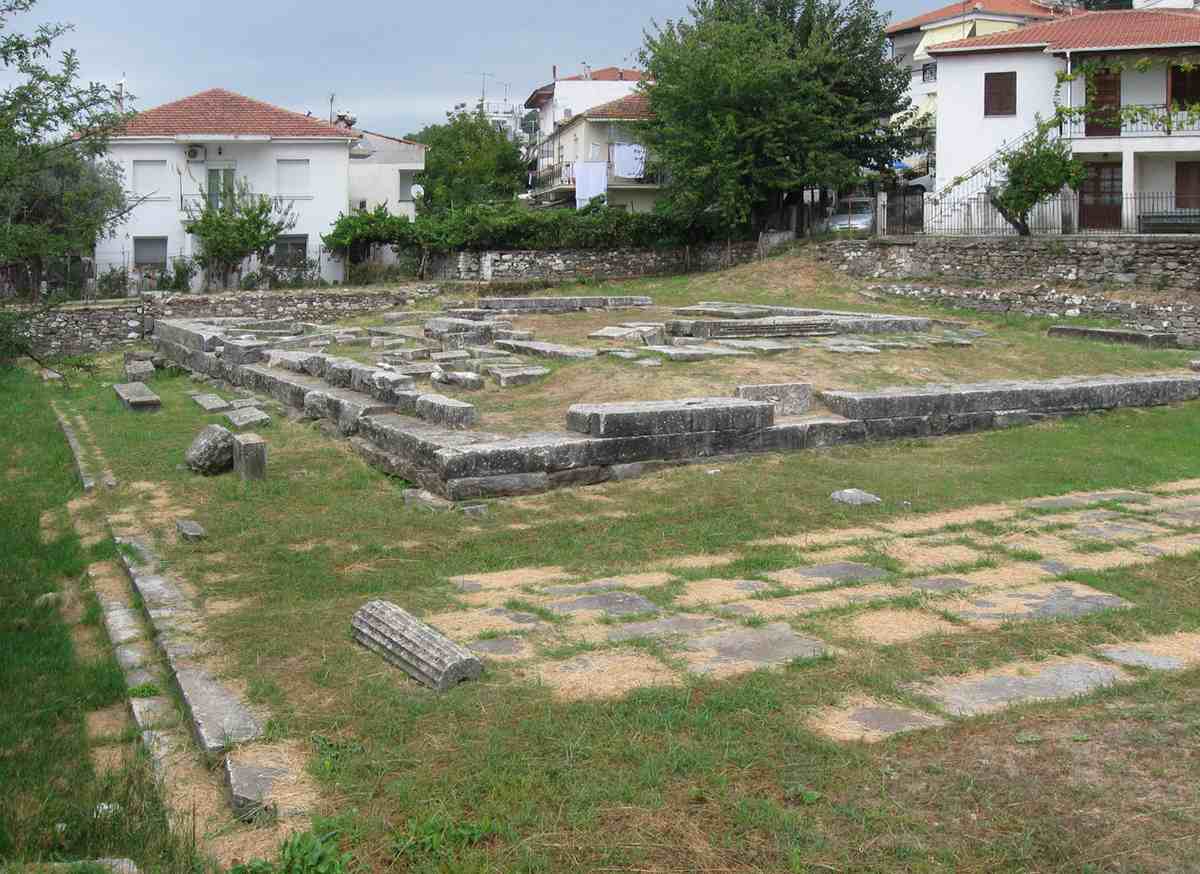
The Sanctuary of Herakles in Thassos, known in antiquity as the Herakleion, was the principal civic cult of the ancient island city and the home of its chief patron deity. Herakles guarded Thassos as protector, savior and founding hero, and his great precinct filled the south-western quarter of ancient Limenas. Priests, magistrates and athletes gathered on its sacred ground beside a monumental gateway, a broad altar court and a small temple. Marble walls, dining rooms and inscribed slabs framed the worship of the god across many centuries. The ruins now lie on open ground within the modern town, a short walk from the harbour. Visitors reach this ancient sanctuary easily on a wider island tour with My Greece Tours across Thassos.
The Herakleion grew in importance as Thassos rose to wealth on marble, gold and wine traded across the northern Aegean. Its cult tied the identity of the whole city to a single powerful god, whose image stamped the island’s silver coins and whose name filled its public decrees. The sections below cover what the sanctuary was, where it sat in Limenas, why the Thasians chose Herakles, how Phoenician settlers first brought the cult, what the gateway, altar court and polos temple looked like, what coins and inscriptions reveal, and how the French School uncovered it. Each part links the sanctuary to the wider ancient city and its ruins. Planning stays simple with the range of guided trips around Thassos that take in the town and its monuments.
What is the Sanctuary of Herakles in Thassos?
The Sanctuary of Herakles in Thassos, the ancient Herakleion, was the chief religious precinct of the island city, dedicated to Herakles as patron god, savior and founding hero, and the principal civic cult of ancient Thassos for centuries.
Herakles held the rank of chief patron deity across ancient Thassos, and the Herakleion served as the seat of his worship. The precinct occupied a walled enclosure in the south-western part of the ancient city. Priests led sacrifices, festivals honoured the god, and the community swore its public oaths in his name. The sanctuary bound religion, civic pride and communal identity into one sacred space. Its buildings rose in local marble, the same white stone that made the island rich. Foundations of the gateway, court and temple still mark the plan on the ground. This single precinct held the spiritual heart of ancient Thassos, and its low walls trace that role for visitors today.
Worship at the Herakleion ran from the archaic period deep into Roman times. Citizens gathered here for the Herakleia, the athletic and religious festival held in the god’s honour. Magistrates recorded decrees on marble and set them within the precinct for all to read. Statues of gods, victors and benefactors stood on inscribed bases across the court. The sanctuary carried the memory of the city in stone, since laws and dedications were cut into its slabs. Every base and block preserved a name, a gift or a rule. This long record of festival and decree makes the Herakleion a written archive of Thasian public life, read directly from its scattered marble.
Herakles guarded more than one part of Thasian life at once. Sailors prayed to him as Soter, the savior who brought ships safely home across the Aegean. Athletes sought his favour before the games, since the hero embodied strength and endurance. Soldiers honoured him as Kallinikos, the god of glorious victory in war. The single deity therefore protected trade, sport and defence together within one precinct. His many roles drew the whole community to the same sacred ground. This breadth of protection explains why the Herakleion outranked every other sanctuary on the island and stood at the centre of civic religion for so many generations.
Excavation has laid bare the footprint of the sanctuary rather than standing buildings. Foundations, column stumps, paved courts and inscribed bases spread across open ground near the ancient walls. The upstanding masonry is low, yet the plan of the gateway, altar and temple reads clearly from the paths. Wild herbs grow between the blocks in spring, and the sea lies a short walk beyond. The finest finds, from sculpture to inscriptions, now sit in the town museum. Reading the empty court beside the objects lifted from it joins stone and statue into one story. This pairing of open ruins and indoor gallery lets you rebuild the ancient Herakleion in the mind.
Where is the Herakleion located within ancient Limenas?
The Herakleion stands in the south-western quarter of ancient Limenas, close to the city walls and the Gate of Herakles and Dionysos, a short walk inland from the harbour and the excavated civic centre.
The sanctuary sits within Limenas (Thassos Town), the modern capital built directly over the ancient city. The precinct lies in the south-western district, back from the seafront among quiet streets and gardens. You reach it on foot in minutes from almost anywhere in town. The ancient walls run close behind the site, marking the old edge of the city. A monumental gate nearby carried carved reliefs of Herakles and Dionysos, the two great gods of Thassos. This tight link between ruins and living town means you walk from a taverna table straight onto sacred classical ground. Rarely does a Greek town keep its chief sanctuary so close to present-day life.
The city walls beside the Herakleion explain the setting of the precinct. Massive marble blocks form the circuit, fitted without mortar and pierced by gates carved with gods. The Gate of Herakles and Dionysos stood only steps from the sanctuary, honouring its patron at the very threshold of the city. Defenders manned the walls above while worshippers gathered at the altar below. This closeness of rampart and shrine placed the god at the guarded edge of Thassos. A walk along the walls links the sanctuary to the Acropolis of Thassos rising behind the town. The line of masonry ties the low precinct to the high citadel in one continuous defended circuit.
The harbour and civic centre lie a short walk north-east of the Herakleion. Ships once docked close by, and the paved streets of the ancient city linked the port to every sanctuary. Traders and pilgrims crossed the ancient agora on their way between the quay and the shrine of Herakles. The route tied the god’s precinct to the market and the sea in one connected plan. Worshippers arriving by ship reached the sanctuary within minutes of stepping ashore. This easy approach made the Herakleion a natural first stop for sailors giving thanks. The whole ancient city reads as one designed landscape, from harbour to holy ground, rather than scattered separate sites.
Open ground and low walls mark the sanctuary today, dotted with olive trees and blocks of grey marble. Simple paths guide you between the foundations of the gateway, court and temple. The site stays quiet even in high summer, since most visitors head for the beaches instead. Morning light rakes across the paving and picks out the carved bases. The sea breeze reaches the precinct through gaps in the old walls. A visit fits neatly into a walk around the ruins of the ancient city before a harbour lunch. This calm, central position makes the Herakleion an easy and rewarding stop for anyone exploring the rich archaeology of Limenas slowly on foot.
Why did the Thasians worship Herakles as their patron god?
The Thasians worshipped Herakles as their patron god because they saw him as savior, protector of the city, guardian of sailors and athletes, and the divine source of the strength that built their wealthy and well-defended island state.
Herakles embodied the qualities the Thasians most needed as a trading sea power. Strength, endurance and victory defined the hero, and the city claimed those virtues as its own. Merchants credited the god with the safe passage of marble, gold and wine across the Aegean. Citizens looked to him for protection against enemies who coveted the island’s riches. The choice of such a powerful patron matched the ambition of a city that grew wealthy fast. His deeds and labours offered a model of courage for every Thasian. This close fit between the hero’s character and the city’s needs explains why Herakles rose above all other gods on the island.
Herakles Soter, the savior, drew the prayers of sailors and traders above all. Ships left the harbour of Thassos laden with cargo for distant ports, and the sea held constant danger. Crews dedicated offerings at the sanctuary before a voyage and gave thanks on their safe return. The god’s promise of rescue tied the whole maritime economy of the island to his precinct. Wealth from the sea flowed back into the Herakleion as gifts and monuments. The link between trade and worship kept the sanctuary rich for centuries. This role as protector of ships made Herakles the natural guardian of a city that lived by the water and the routes across it.
Athletes and soldiers honoured Herakles for the strength he embodied. The Herakleia festival staged contests of running, wrestling and boxing in the god’s name, drawing competitors and crowds to Limenas. Victors dedicated statues and inscribed bases within the precinct to record their success. Warriors called on Herakles Kallinikos, the god of glorious victory, before battle. The hero linked physical excellence and martial courage under one cult. His festival tied civic pride to public spectacle year after year. This union of sport, war and worship gave the Thasians a patron who governed both the body and the defence of the state, reinforcing his place at the head of the island’s many gods and shrines.
The image of Herakles spread through every corner of Thasian public life. Silver coins carried the kneeling archer, drawing a bow, as an emblem of the city recognised across the Greek world. Public decrees invoked the god and dated events by the calendar of his festival. The long story of the island, told in the history of Thassos, runs through the rise and endurance of this single cult. The hero appeared on stone, metal and monument alike, binding coinage, law and religion together. His presence reached far beyond the walls of his precinct. This saturation of civic life with one deity marks Herakles as the true patron of ancient Thassos, not merely one god among many.
How did Phoenician settlers bring the cult of Herakles to Thassos?
Phoenician settlers reportedly brought the cult to Thassos long before Greek colonists arrived, worshipping their god Melqart, whom later Greeks identified with Herakles, as the historian Herodotus recorded after visiting the island’s ancient sanctuary himself.
Herodotus, the Greek historian, visited Thassos and described the origin of its Herakleion. He wrote that Phoenician colonists founded the sanctuary while searching the Aegean for the abducted princess Europa. These settlers arrived generations before Herakles the son of Amphitryon was ever born in Greece, in his account. The historian therefore split the Thasian cult into two layers, an older eastern god and a later Greek hero. His visit gave the sanctuary a written pedigree stretching deep into legendary time. The report placed Thassos at the meeting point of eastern and Greek religion. This ancient testimony makes the Herakleion one of the few Greek sanctuaries whose foreign roots a classical author recorded at first hand.
Melqart, the great god of the Phoenician city of Tyre, lay behind the eastern layer of the cult. Greeks who met Phoenician traders identified this powerful deity with their own Herakles, since both were mighty protectors and travellers. The equation let two religions share a single sanctuary under different names. Phoenician sailors ranged widely across the Mediterranean in search of metals and trade, and Thassos held rich gold and marble. Their presence on the island fits the pattern of early eastern voyaging into the northern Aegean. The blending of Melqart and Herakles at Thassos shows how gods crossed cultures with merchants. This fusion gave the Thasian Herakles a depth and antiquity that few other Greek cults could claim.
Parian colonists from the Cyclades settled Thassos in the archaic period and inherited the older cult. Greek newcomers took over the sanctuary and reshaped its worship around their own Herakles. The god kept his supreme rank while gaining Greek myths, festivals and iconography. Layers of building on the site reflect this long, continuous devotion under changing hands. The colonists drew on the island’s gold and marble to enrich the precinct further. Their arrival tied the eastern foundation legend to the historical Greek city that followed. This continuity from Phoenician root to Parian city gave the Herakleion an unbroken sacred history, one reason it held such authority over the religious life of Thassos.
Debate still surrounds how literally to read the Phoenician foundation story. Scholars weigh Herodotus against the archaeology, which shows clear Greek building from the archaic period onward. Some treat the eastern origin as genuine memory of early Phoenician contact, others as a Greek attempt to explain a very old cult. The gold mines that first drew outsiders to Thassos lend the tale some plausibility. Physical proof of a Phoenician shrine beneath the Greek sanctuary remains debated. The question keeps the Herakleion at the centre of study on early Aegean religion. This mixture of legend and evidence gives the sanctuary a fascination beyond its stones, tying Thassos to the wider story of gods moving between East and West.
What did the sanctuary look like, from its gateway to the polos temple?
The sanctuary opened through a monumental gateway into a walled court holding a great altar, ranges of dining rooms for sacred banquets, and a small distinctive shrine known as the polos temple, all built in local Thasian marble.
A monumental gateway, or propylon, formed the main entrance to the Herakleion. Worshippers passed between marble piers from the city street into the sacred enclosure. The gate set a solemn tone for anyone stepping toward the altar of the god. Its threshold separated ordinary ground from the holy precinct within. Column bases and door blocks of the propylon still mark the line of the entrance. The structure faced the heart of the ancient city, drawing processions in from the streets. This carved threshold turned the simple act of entering the sanctuary into a passage from the everyday town into the presence of the patron god of Thassos and his festival.
The altar court formed the ritual centre of the sanctuary beyond the gate. A large open-air altar stood in the court, where priests burned sacrifices to Herakles before the assembled crowd. Smoke and prayer rose here on festival days and at the great Herakleia. The court gave room for processions, offerings and the gathering of citizens. Its paved surface and surrounding walls framed the most sacred act of the cult. Foundations of the altar and the court still define this space on the ground. This open heart of the precinct, rather than any roofed temple, carried the main public worship of the god, in the usual manner of Greek open-air sacrifice at a central altar.
Ranges of dining rooms lined the courts of the Herakleion for sacred banquets. Several oikoi, roughly square chambers, held couches on which worshippers reclined to feast after sacrifice. Sharing the meat of the offering bound the community to the god and to one another. These banqueting halls made the sanctuary a place of gathering as well as prayer. Doorways set off-centre allowed couches to line the walls in the Greek fashion. Foundations of the rooms survive around the edges of the precinct. This provision for communal dining shows that worship at the Herakleion mixed feast with sacrifice, turning the festival of Herakles into a shared civic banquet for the people of Thassos.
The polos temple gave the sanctuary its most distinctive building. This small shrine took an unusual form and housed the cult of the god within the precinct. Its plan differed from the standard rectangular Greek temple, marking the special character of the Thasian cult. Marble walls and a modest interior sheltered the sacred image or symbol of Herakles. Foundations of the structure survive among the ruins for visitors to trace. The building stood apart from the open altar, offering a roofed focus for worship. This unusual temple, alongside the gateway, court and dining rooms, completed a sanctuary whose layout matched the unique standing of Herakles as the chief god and civic patron of ancient Thassos.
What do Thasian coins and inscriptions reveal about the cult?
Thasian coins and inscriptions reveal Herakles as the official emblem and chief god of the city, showing him as a kneeling archer on silver, naming him Soter and Kallinikos, and recording the festivals and rules of his sanctuary.
Silver coins of Thassos carried Herakles as the badge of the whole city. The classic type showed the god kneeling on one knee, drawing a bow, a striking image recognised in markets across the Greek world. Coinage spread the patron deity far beyond the island wherever Thasian silver traded. The choice of Herakles on state money declared the god the official symbol of the community. Mints struck the archer type over a long span, tying currency to cult. Collectors and museums still prize these coins today. This use of the god on the city’s own money shows how completely Herakles stood for Thassos itself in the eyes of the ancient world.
Inscriptions from the sanctuary record the titles and rules of the cult in detail. Carved slabs name Herakles as Soter, the savior, and as Kallinikos, the glorious victor. Sacred laws set out who might enter the precinct, what sacrifices were due and how festivals ran. Dedications honour the god from grateful sailors, athletes and magistrates. The stones fix the calendar of worship and the offices that served it. Many of these texts guided the French excavators in reading the site. This wealth of written record makes the Herakleion one of the best-documented sanctuaries of the northern Aegean, its ritual known from the god’s own precinct rather than later report alone.
The Herakleia festival stands out among the events recorded in the inscriptions. This great celebration honoured the god with athletic contests, sacrifice and public feasting at the sanctuary. Victors in the games won prizes and the right to set up statues within the precinct. The festival drew competitors and spectators to Limenas and reinforced civic pride. Its dates ordered the public calendar of the city year by year. Records of the games survive on marble among the ruins. This regular gathering turned the cult of Herakles into a shared spectacle, binding the whole population of Thassos to their patron god through sport, worship and the common table of the feast.
Sculpture and finds from the sanctuary now fill the galleries of the Archaeological Museum of Thassos nearby. Statues, reliefs, inscribed slabs and votive offerings lifted from the precinct sit under cover for safety. Seeing the objects and then the empty foundations joins the two halves of the site. Portraits, dedications and cult images give faces and names to the worship once staged outdoors. The museum stands a short walk from the ruins in the heart of Limenas. Its coins, in particular, let you hold the kneeling archer in view beside the god’s own precinct. This close pairing of gallery and ground brings the ancient cult of Herakles vividly back to life.
How did the French School excavate the Herakleion, and how do visitors see it today?
The French School at Athens excavated the Herakleion across the twentieth century, uncovering its gateway, court, dining rooms and temple, and visitors now walk the open ruins in the heart of Limenas within a short stroll of the wider ancient city.
The French School at Athens has led the archaeology of Thassos since the early twentieth century. Its teams uncovered the Herakleion along with the agora, the theatre and the city walls over many seasons of careful digging. Excavators cleared the gateway, altar court, dining rooms and temple from centuries of soil. They read the inscriptions on the spot to identify the buildings and the cult. Published reports spread knowledge of the sanctuary to scholars worldwide. The work continues to refine the plan and history of the precinct. This long French campaign turned a buried mound into one of the best-understood sanctuaries in the northern Aegean, open for visitors to walk today.
Careful method marked the excavation of the Herakleion from the start. Archaeologists recorded each layer, wall and find in relation to the others, building a full picture of the precinct over time. Inscriptions guided them in naming Herakles Soter and dating the phases of the cult. Conservation followed digging, so the exposed foundations survive for visitors to see. Finds moved to the town museum for study and display. The record they built underlies every modern account of Thasian religion. This disciplined approach makes the Herakleion a model of how patient excavation can recover an entire ancient cult from little more than foundations, scattered marble and the words cut into weathered stone.
Visitors reach the Herakleion on foot within the modern town of Limenas. Simple paths lead among the foundations of the gateway, court and temple, with the city walls close behind. Allow half an hour to walk the precinct at an easy pace and picture its buildings whole. Flat, sturdy shoes suit the grass and uneven marble. A hat and water help in summer, since shade is limited on the open site. The ruins sit within a short walk of the museum, the agora and the harbour. This central position lets you fold the sanctuary into a morning of ancient sightseeing before the beaches or a taverna lunch draw you back to the modern town.
A full visit joins the Herakleion to the other monuments of ancient Thassos in one easy loop. You walk from the sanctuary to the ancient theatre on the acropolis slope, then down to the agora and the museum. The four sites together tell the whole story of the city, from patron god to civic square. Each stop lies within a short walk of the last in compact Limenas. A guided tour adds the detail that unlabelled foundations hide. Half a day covers the loop at a relaxed pace. This tight grouping of sanctuary, theatre, market and gallery makes Thassos Town one of the easiest ancient cities in Greece to grasp on foot.
Frequently Asked Questions
What is the Herakleion of Thassos?
The Herakleion of Thassos was the sanctuary of Herakles, the chief patron deity and principal civic cult of the ancient island city. It filled a walled precinct in the south-western quarter of Limenas, close to the city walls and the Gate of Herakles and Dionysos. Worshippers passed through a monumental gateway into a court holding a great altar, ranges of dining rooms for sacred banquets and a small shrine known as the polos temple. Herakles guarded the city as savior and patron of sailors and athletes, and his image stamped the island’s silver coins. The historian Herodotus recorded that Phoenician settlers first founded the cult. The French School at Athens excavated the site, and the finds now fill the town museum near the harbour.
Where is the sanctuary of Herakles in Thassos?
The sanctuary of Herakles stands in the south-western quarter of ancient Limenas, the main town and port of Thassos, built directly over the classical city. The precinct lies back from the seafront among quiet streets, close to the massive marble city walls and the Gate of Herakles and Dionysos that honoured the patron god at the edge of the city. Worshippers arriving by ship reached the sanctuary within minutes of the harbour, crossing the ancient agora on the way. The acropolis hill rises behind the town, linked to the precinct by the line of the walls. Visitors today walk to the ruins on foot from almost anywhere in Limenas, since the site sits near the museum, the agora and the old fishing port.
Why was Herakles the patron god of Thassos?
Herakles became the patron god of Thassos because his strength, endurance and victory matched the needs of a wealthy trading sea power. Sailors prayed to him as Soter, the savior who brought their ships safely home across the Aegean with cargoes of marble, gold and wine. Athletes sought his favour at the Herakleia festival, whose contests of running, wrestling and boxing drew crowds to Limenas. Soldiers honoured him as Kallinikos before battle. The single hero therefore protected trade, sport and defence within one great precinct. His image spread through public life, from the kneeling archer on the city’s silver coins to the decrees cut in his name. The whole community dated its calendar by his festival, ranking him above every other god on the island.
Did Phoenicians found the cult of Herakles on Thassos?
Phoenician settlers reportedly founded the cult, according to the Greek historian Herodotus, who visited Thassos and described the Herakleion himself. He wrote that Phoenician colonists established the sanctuary while searching the Aegean for the abducted princess Europa, generations before Herakles the son of Amphitryon was born in Greece. These easterners worshipped their own great god Melqart of Tyre, whom Greeks later identified with Herakles, since both were mighty protectors and travellers. Parian colonists from the Cyclades settled the island in the archaic period and inherited the older cult, reshaping its worship around the Greek hero. Scholars still debate how literally to read the foundation story, weighing Herodotus against archaeology that shows clear Greek building. The gold mines that drew early outsiders to the island lend the tale some plausibility.
What can you see at the Herakleion today?
Visitors to the Herakleion today see the excavated foundations of the sanctuary spread across open ground in south-western Limenas. Low walls, column bases and paved courts mark the monumental gateway, the altar court, the ranges of dining rooms and the small polos temple. The massive marble city walls run close behind the site, pierced by the ancient gate that honoured Herakles and Dionysos. Wild herbs grow between the blocks in spring, and the sea lies a short walk beyond. The finest finds, from statues and reliefs to inscribed slabs and coins, now sit in the Archaeological Museum of Thassos a few minutes away. The ruins lie within an easy walk of the agora, the theatre and the harbour, so the sanctuary fits neatly into a morning of ancient sightseeing.
Who excavated the sanctuary of Herakles in Thassos?
The French School at Athens excavated the Herakleion, leading the archaeology of Thassos since the early twentieth century. Its teams uncovered the sanctuary along with the agora, the theatre and the city walls over many seasons of careful digging, clearing the gateway, altar court, dining rooms and temple from centuries of soil. Excavators read the inscriptions on the spot to name Herakles as Soter and Kallinikos, fixing the phases of the cult. Conservation followed the digging, so the exposed foundations survive for visitors to walk today, while the finds moved to the town museum. Published reports spread knowledge of the sanctuary to scholars worldwide. This long French campaign turned a buried mound into one of the best-understood sanctuaries in the northern Aegean.