
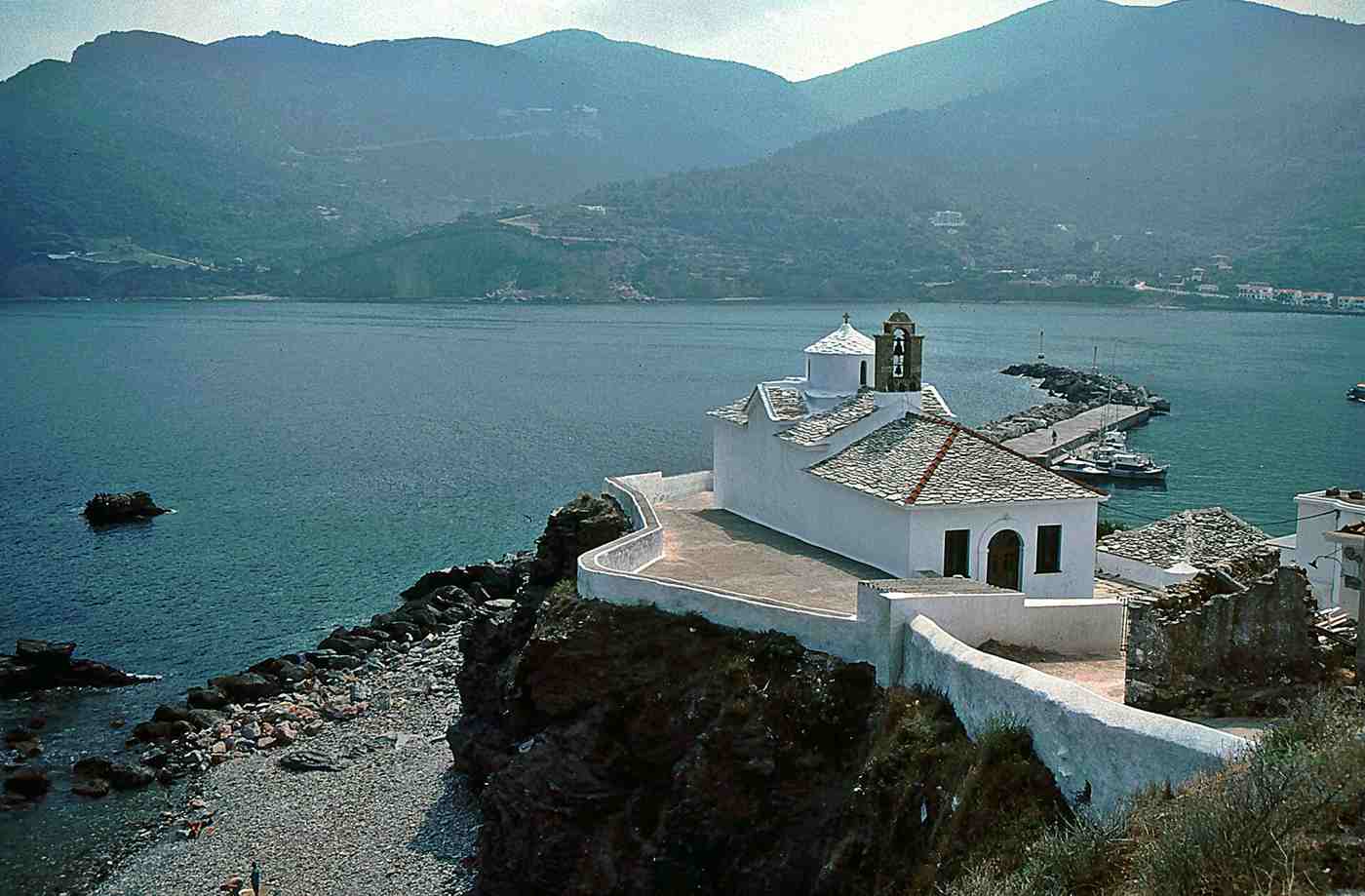
The monasteries of Palouki stand on a pine-clad hill east of Skopelos Town, across the bay from the harbour. The cluster includes the active convent of Evangelistria, the older Metamorphosis tou Sotiros, the convent of Prodromos, Agia Barbara and the Taxiarches. A winding road and older cobbled paths climb the slope, linking the buildings and opening wide views back over Skopelos Town and the sea. Plan the whole trip with Greece Tours.
Several of the Palouki monasteries remain active, so modest dress and quiet are expected inside their courtyards and churches. The buildings sit within a short drive or a longer walk of the town. The road climbs the hill in a series of bends before reaching Evangelistria near the top. The cluster reflects the island’s long reputation as a place of churches and small chapels.
What are the monasteries of Mount Palouki on Skopelos?
The monasteries of Palouki are a cluster of Orthodox monasteries and convents on Mount Palouki, the pine hill east of Skopelos Town. Evangelistria, Metamorphosis tou Sotiros, Prodromos, Agia Barbara and the Taxiarches form the main group.
The monasteries of Palouki are a group of Orthodox religious houses spread across the wooded slopes of Mount Palouki, the hill that rises directly across the bay from Skopelos Town. The best known is the convent of Evangelistria, dedicated to the Annunciation and set high on the hillside with a long view back over the harbour. Below and around it stand the monastery of Metamorphosis tou Sotiros, the Transfiguration. The convent of Prodromos honouring Saint John the Baptist, the church of Agia Barbara and the Taxiarches dedicated to the Archangels. Each occupies its own terrace or fold in the pine forest, so the walk or drive between them passes through shaded woodland.
Together they form one of the densest concentrations of monastic buildings anywhere in the Sporades.
The buildings share a common island style, with whitewashed or stone walls, red-tiled roofs and small fortified courtyards that once offered shelter from raiders. Their compact churches hold carved wooden screens, hand-painted icons and oil lamps, and the courtyards are planted with cypress trees, vines and flowers tended by the resident nuns or monks. Some of the houses are fully active, with a small religious community living on site year-round, while others open mainly for feast days or stand quietly under the care of the parish. The distances between them are short, measured in a few hundred metres of climbing road and path, which allows a visitor to see several in a single morning.
The setting among the pines keeps the cluster cool and green even at the height of summer.
Mount Palouki itself is a rounded pine-covered hill that reaches roughly 500 metres above the sea on the eastern side of the island. The monasteries occupy its western and southern flanks, facing the town and catching the afternoon light off the water. From these terraces the outlook takes in the harbour, the amphitheatre of white houses that forms Skopelos Town, and the open channel toward the neighbouring islands of the Sporades. The elevation gives each house a defensive position and a commanding view, which explains why so many were founded on this single hill rather than scattered across the island.
The forest that clothes the slope is dense and fragrant, and the road that climbs it winds through the trees, revealing the buildings one after another as it gains height.
The cluster reflects a long tradition of monasticism in the Sporades, and it forms one of the signature sights of the island. Visitors touring Skopelos often set aside a morning for Palouki, pairing the climb with the panorama over the town and a look inside the working convent of Evangelistria. Because the houses hold active religious communities, the atmosphere differs from that of a museum, and the same courtesies apply as at any place of worship. The combination of forest, monastery architecture and the wide sea view gives the hill a distinct character.
For travellers the monasteries of Palouki stand alongside the harbour and the beaches as one of the defining experiences of a stay on the island. The short walk between the houses lets visitors take in churches in one unhurried morning on the hill.
Where is Mount Palouki and how do you reach the monasteries from Skopelos Town?
Mount Palouki rises east of Skopelos Town, across the bay from the harbour. A paved road climbs the hill from the edge of town, reaching Evangelistria in about ten minutes by car or roughly forty minutes on foot uphill.
Mount Palouki sits immediately east of Skopelos Town, forming the green wall of hillside visible across the bay from the waterfront. The monasteries are reached by a paved road that leaves the eastern edge of town and climbs the slope in a series of bends through the pine forest. By car or scooter the drive up to Evangelistria takes only about ten minutes, covering roughly four kilometres of winding road. The route is signposted, and it gains height steadily, opening views back over the harbour at each turn. Small pull-offs and a modest parking area near the convent allow visitors to leave a vehicle before continuing on foot.
A slow and steady pace is sensible, particularly when meeting oncoming traffic on the steeper sections.
Walkers can reach the monasteries directly from Skopelos Town by following the road or the older cobbled paths that predate it. On foot the climb to Evangelistria takes around forty minutes at a steady pace, rising through shade for much of the way. The walk is popular with visitors who want to combine the monasteries with light exercise and the changing view over the town. Sturdy shoes and water are needed, since the ascent is continuous and the sun is strong on the exposed upper stretches. Those preferring not to walk both ways sometimes take a taxi up and stroll back down, which keeps the effort to a downhill return.
The old paths link several of the houses, allowing a walker to move between them without always returning to the road.
There is no dedicated bus service to the monasteries, so most visitors arrive by rental car, scooter or taxi, or on foot from the town. A taxi from the harbour to Evangelistria is a short ride, and drivers know the route well. Anyone weighing transport for the wider trip finds it useful to read a full guide on how to get to Skopelos, since the island has no airport and is reached by ferry through Skiathos. Once on the island, hiring a scooter or small car makes the hill and the rest of the coast easy to explore.
The compact size of Skopelos means the monasteries are never far from the main town, wherever a visitor is based. The hill road leaves the eastern edge of the harbour, so the climb begins within minutes of the waterfront.
The natural base for a visit is Skopelos Town, since the hill rises directly behind it and the road to the monasteries starts at its edge. From the harbour the whole excursion, including the drive up, time at two or three of the houses and the return, fits comfortably into a morning or a late afternoon. Visitors staying elsewhere on the island drive in to the town first and pick up the hill road from there. The short distances mean the monasteries pair easily with a walk through the town’s lanes or a coffee on the waterfront.
Planning the climb for the cooler hours avoids the midday heat on the exposed upper road and leaves the clearest light for the view over the bay. An early start also secures a space in the small parking area near the convent.
What is the convent of Evangelistria on Mount Palouki?
Evangelistria is an active convent near the top of Mount Palouki, dedicated to the Annunciation. It holds a carved wooden iconostasis and a revered icon, and its terrace gives a panoramic view over Skopelos Town and the bay.
Evangelistria, also called Evangelismos, is the best known and most visited of the Palouki monasteries, standing high on the hillside above Skopelos Town. The convent is dedicated to the Annunciation of the Virgin, and it functions as an active community of nuns who maintain the church, the courtyard and the gardens. The main church holds an elaborately carved and gilded wooden iconostasis, one of the finest pieces of church woodwork on the island, along with a revered icon of the Virgin. Whitewashed cells and workrooms surround a paved courtyard planted with flowers, cypress and vines, and the whole complex is enclosed by a low protective wall in the old fortified style.
From the terrace the ground falls away toward the town and the bay below.
The view from Evangelistria is one of the main reasons visitors climb the hill. From the courtyard and the terrace outside the walls, the outlook takes in the full amphitheatre of Skopelos Town. Its white houses rising in tiers from the harbour. The blue sweep of the bay beyond. The neighbouring hills and the open channel toward the other Sporades fill the distance on clear days. The elevation places the convent well above the town, so passing ferries and small boats in the harbour are easy to pick out. Morning light falls across the town from the east, while the late afternoon sun warms the white walls of the convent itself.
Many visitors linger on the terrace for the panorama as much as for the church.
The convent keeps a working religious rhythm, and it opens to visitors during set daylight hours, usually with a break in the middle of the day. Modest dress covering shoulders and knees is required to enter the church, and wraps are sometimes available at the gate for those who arrive unprepared. Inside, visitors move quietly, keep phones silent and avoid flash photography near the icons. The nuns produce handwoven textiles and embroidery in the traditional island manner, and these are sometimes offered for sale from a small room within the complex. Quiet and respectful behaviour are expected throughout, since the convent is a home and a place of prayer rather than a museum.
During services visitors wait or stand at the back until the liturgy has finished.
Evangelistria is generally the highlight of any tour of the Palouki monasteries and the one house that most visitors are sure to see. Its combination of fine church art, a living community and the wide view over the bay sets it apart from the quieter buildings lower on the hill. Because it lies near the top of the road, it also makes a natural turning point for a walk or drive up Palouki, with the other monasteries encountered on the way. The convent’s feast of the Annunciation draws worshippers from the town and beyond, when the church and courtyard fill for the liturgy.
On an ordinary day, though, the terrace is calm, and the panorama over Skopelos Town rewards the climb up the hill. From here visitors work down the slope to the other houses on a single descent.
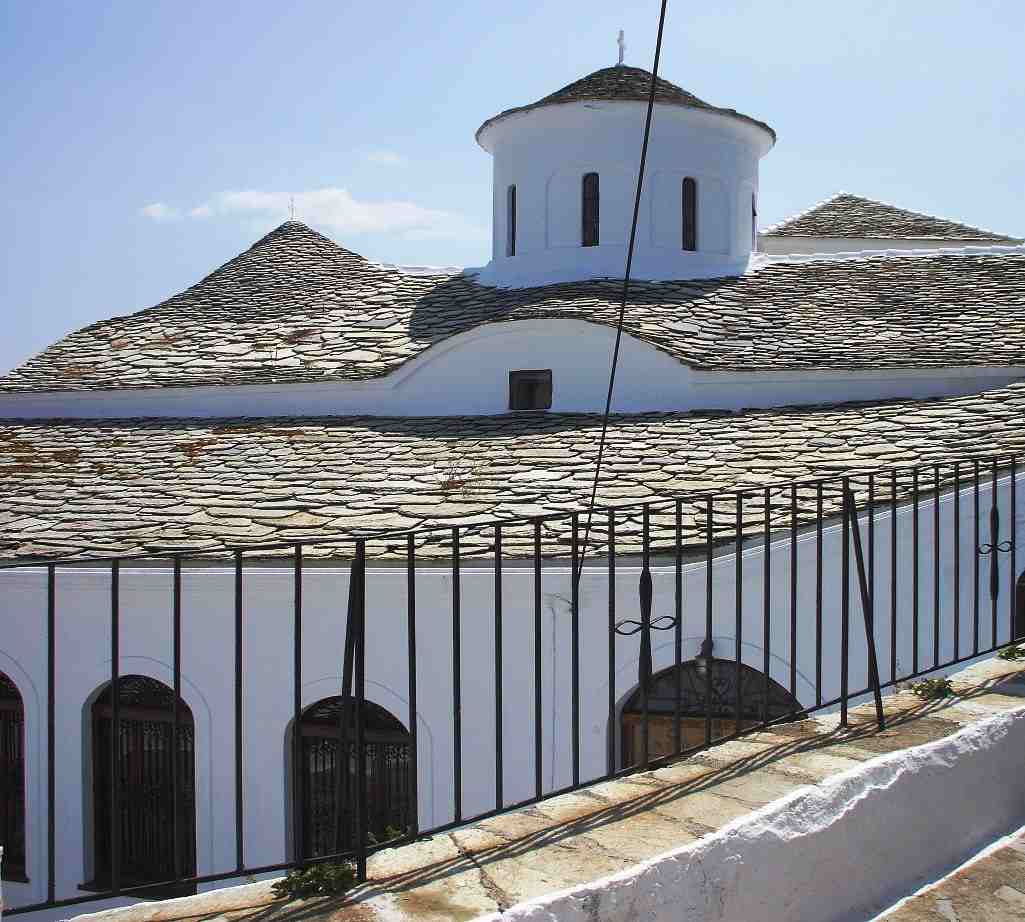
What other monasteries stand on Mount Palouki near Skopelos?
Beyond Evangelistria, Mount Palouki holds Metamorphosis tou Sotiros, the convent of Prodromos, the church of Agia Barbara and the Taxiarches. These older, quieter houses spread across the wooded slope below and around the main convent.
The monastery of Metamorphosis tou Sotiros, the Transfiguration of the Saviour, is among the oldest religious houses on Mount Palouki. It sits lower on the slope than Evangelistria, tucked among the pines, and its small church centres on the feast of the Transfiguration celebrated in high summer. The building keeps the plain island style, with whitewashed walls, a modest belfry and a quiet enclosed courtyard. For much of the year the monastery is calm and little visited, coming to life mainly on its feast day, when residents climb the hill for the service. Its age and simplicity give it a different character from the larger. Busier convent above.
Walkers on the old paths often pass it on their way up or down the hill between the other houses.
The convent of Prodromos, dedicated to Timios Prodromos, Saint John the Baptist, is a working house occupied by a small community. Set on its own terrace on the hillside, it holds a finely carved wooden iconostasis and hand-painted icons within a compact church, surrounded by cells and a walled courtyard. Like Evangelistria, it observes set opening hours and asks visitors for modest dress and quiet behaviour, since nuns live and pray there. The convent’s position among the trees gives it shade and seclusion, and its terrace shares the wide outlook over the town and sea common to the Palouki houses.
Prodromos is often visited on the same round as Evangelistria, a short distance further along the linking road and paths that thread the wooded slope.
Agia Barbara stands as one of the older and more fortified of the Palouki churches. Built in a defensive form with thick walls to withstand the raids that once troubled the Aegean islands. The small church preserves traces of old wall paintings, and its sturdy shape reflects the insecure centuries in which it was founded. Nearby, the Taxiarches, dedicated to the Archangels Michael and Gabriel, adds another link in the chain of religious buildings scattered across the hill. Both houses are quieter than the active convents, opening chiefly for their feast days or for visitors who seek them out along the paths.
Their presence, alongside Evangelistria, Metamorphosis and Prodromos, gives Mount Palouki its remarkable density of monastic architecture within a small compass of forested slope.
Taken together, the older houses on Palouki reward visitors who go beyond the main convent to explore the wider cluster. A walk or slow drive links Metamorphosis, Prodromos, Agia Barbara and the Taxiarches through the pine forest, each offering its own terrace, church and view. Because several are quiet or open only occasionally, part of their appeal lies in the calm and the sense of stepping back into an older, monastic Skopelos. Those planning a fuller day on the hill can weave the monasteries into a wider list of things to do in Skopelos, combining the religious sites with the forest, the town and the coast.
Seeing more than one house shows how the whole hill functioned as a monastic landscape rather than a single sight.
Why is Skopelos known as an island of churches, and how does Palouki reflect that?
Skopelos holds hundreds of churches and chapels across town and countryside, earning it a reputation as an island of churches. The monasteries of Palouki concentrate this tradition on one hill, forming its most visible expression.
Skopelos carries a long-held reputation as an island of churches, with a very large number of Orthodox churches, chapels and monasteries spread across the town and the countryside. Local tradition counts them in the hundreds. From the many small churches packed into the lanes of Skopelos Town to the field chapels and hilltop shrines scattered through the pine forest. This density reflects centuries of devotion, private endowments by island families, and the building of chapels in thanks or memory. The monasteries of Palouki gather this tradition into a single, concentrated group on one hill, making them the clearest and most accessible expression of the island’s religious heritage.
Their prominence on the slope above the town keeps them constantly in view from the harbour and the waterfront.
The monastic settlement of Palouki grew because the hill offered both seclusion and a defensive height above the main town. Monks and nuns founded houses here over successive centuries, and older foundations were joined by later ones until the slope held a whole community of religious buildings. The fortified walls of the earlier churches, such as Agia Barbara, recall the insecurity of the medieval and early modern Aegean, when piracy and raids made a defensible position essential. Later foundations, including the grander convent of Evangelistria, were built in calmer times and given finer church art.
The result is a layered landscape in which buildings of different ages sit close together, each adding to the religious character that gives the hill and the island their identity.
The churches of Skopelos are known for their carved and gilded wooden iconostases, their hand-painted icons and the distinctive slate and tile roofs of the town. The Palouki monasteries share in this craftsmanship, with Evangelistria and Prodromos in particular holding notable examples of church woodwork. The feast days of the houses punctuate the island’s calendar, drawing worshippers up the hill for the liturgy and, on the greatest occasions, a communal meal in the courtyard. These living traditions keep the monasteries as more than historic monuments, tying them to the yearly rhythm of the island community.
Visitors who arrive on a feast day see the buildings in their intended use, filled with candlelight, chanting and the people of the parish. On such days the courtyards, normally quiet, hold the community that has maintained these houses for generations.
For the traveller, Palouki offers a way to understand the island’s religious character in a single visit rather than by hunting out scattered chapels. The cluster brings together active convents, older monasteries and defensive churches within a short walk, set against the forest and the wide sea view. This concentration explains why the hill features so prominently in accounts of the island and why it is regularly recommended as a half-day excursion. Seeing the monasteries alongside the churches of the town below completes the picture of Skopelos as a place shaped by faith over the centuries.
The hill thus serves as both a scenic viewpoint and a compact introduction to the tradition that earned the island its lasting reputation for churches. It leaves visitors with a clear image of a religious landscape built over centuries.
What should you wear and know before visiting the monasteries of Palouki?
The active convents on Palouki require modest dress covering shoulders and knees to enter their churches. Visitors keep quiet, observe opening hours with a midday break, avoid flash photography, and carry water for the climb up the hill.
Modest dress is required to enter their churches and courtyards. Shoulders and knees should be covered, which means long trousers or a skirt below the knee and a top with sleeves rather than beachwear. Some convents keep wraps or skirts at the gate for visitors who arrive unprepared, but bringing suitable clothing avoids relying on this. Lightweight layers work well, allowing a visitor to cover up on arrival and remove a layer once back outside in the heat. The dress code applies out of respect for the nuns who live and pray in the buildings, and it is enforced at the entrance.
Quiet, unhurried behaviour throughout the courtyards and churches matches the expectations of any working religious house.
The monasteries observe set opening hours, typically through the morning and again in the later afternoon, with a break in the middle of the day when they close to visitors. Planning the visit around these windows avoids a wasted climb, and arriving in the morning generally finds the buildings open and the light good over the town. Photography is usually permitted in the courtyards, but inside the churches visitors avoid flash and keep phones silent, especially near the icons and during any service. Eating, drinking and loud conversation are out of place within the walls. When a liturgy is under way, visitors wait quietly at the back or outside until it ends.
These courtesies keep the houses welcoming and preserve the calm that draws people to the hill.
The climb to the monasteries, whether on foot or by the winding road, calls for a little preparation. Sturdy shoes suit both the walk up from the town and the uneven paths that link the houses, while sandals or grippy trainers cope with the paved road. Water is the single most useful item, particularly in summer, since the upper slopes are exposed and there are facilities on the hill. A hat, sunglasses and sunscreen guard against the strong light, and a small backpack keeps hands free on the steeper stretches. Anyone driving takes the tight bends slowly and parks clear of the road near the convent.
Facilities are limited, so most visitors treat the trip as a self-sufficient excursion, buying refreshments in the town before setting out.
Timing and behaviour together shape the quality of the visit. The middle of the day brings the strongest heat on the exposed road and coincides with the midday closure, so early morning or late afternoon suits the climb better. Feast days transform the quieter houses, filling them with worshippers and adding chanting and candlelight, though they also bring crowds. On ordinary days the monasteries are calm, and a respectful, unhurried visitor is welcome to look inside the open churches and enjoy the view. Choosing a base near the town, and reading about where to stay in Skopelos, makes it easy to reach the hill in the cooler hours.
A little planning around dress, timing and water covers almost everything a first visit requires. Arriving prepared lets a visitor concentrate on the churches and the view.
How do you hike the old paths between the Palouki monasteries?
Old cobbled paths climb Mount Palouki from Skopelos Town and link the monasteries through the pine forest. Walkers follow these routes on foot in about forty minutes to Evangelistria, moving between the houses without always returning to the road.
Mount Palouki is threaded by old cobbled paths, known locally as kalderimia, that predate the modern road and once carried monks, pilgrims and pack animals up the hill. These stone-laid routes climb from the eastern edge of Skopelos Town through the pine forest, connecting the monasteries in a network that walkers can still follow today. Reaching Evangelistria on foot takes around forty minutes of steady uphill walking, with shade for much of the way. The paths are steeper and rougher than the road but more direct and more atmospheric, passing through dense woodland scented with pine and herbs. In places the old cobbles are worn and uneven, so care is needed underfoot.
For walkers, the ascent is as much a part of the experience as the monasteries themselves.
Between the houses, the paths allow a walker to move from one monastery to the next without dropping back to the road each time. From Evangelistria near the top, a short walk leads on to Prodromos and down toward Metamorphosis, while further branches reach Agia Barbara and the Taxiarches lower on the slope. The linked route turns a visit to a single convent into a fuller circuit of the hill, taking in churches and a range of viewpoints. Because the network is not always signposted, a map or a downloaded track helps in following the correct branches through the forest.
Walkers set out with enough time to complete the loop before the midday closure of the active houses, planning the order to end near their return path.
The walk suits reasonably fit visitors prepared for a continuous climb and uneven ground. Sturdy shoes with grip are essential on the worn cobbles and forest paths, and water is carried for the whole circuit, since there are no reliable sources on the hill. Early morning is the best time to start, before the heat builds on the exposed upper stretches and while the light is clear over the town. The forest offers shade, but the open sections near the summit catch the full sun. Walkers keep to the marked paths to avoid disturbing the monastery gardens and the quiet of the houses.
A hat, sunscreen and a small pack complete the kit, and the descent is taken with the same care as the climb on the smoother worn stones.
The Palouki paths form part of a wider network of trails that crosses the green interior of the island. The monastery circuit can be extended into a longer forest walk. Those who enjoy the climb often go on to explore other routes described in a guide to hiking on Skopelos, which links the town, the monasteries and the wooded hills. The combination of a clear objective, the shade of the pines and the reward of the view makes Palouki a popular introduction to walking on the island. Because the hill sits so close to the town, the walk needs no transport and can be started straight from the harbour.
For active travellers, hiking the old paths is the most rewarding way to reach the monasteries.
When is the best time to visit the monasteries of Palouki?
Late spring and early autumn bring mild weather and thinner crowds to Mount Palouki, easing the climb. Within a day, the morning opening hours suit visits best, before the midday closure and the strongest heat on the exposed hill.
The monasteries can be visited across the long Greek travel season, but late spring and early autumn are the most comfortable times to climb Palouki. In these shoulder months the temperatures stay moderate, the pine forest is green and fragrant, and the road and paths are far quieter than in high summer. Spring follows the winter rains, when the hillside is at its greenest and wildflowers line the paths, while autumn brings clear light and a warm but fading heat. Peak summer sees the largest numbers of visitors and the strongest sun on the exposed upper slopes, so the climb feels harder in July and August.
Winter is very quiet, though ferry links to the island thin out and services close, which complicates access to Skopelos.
Within any given day, the morning is the best window for a visit, since the monasteries open then and the air is cooler for the climb. Arriving soon after opening finds the churches accessible, the light clear over the town and the courtyards calm before other visitors arrive. The active houses close for a break in the middle of the day, so a late-morning visit risks finding the gates shut. The later afternoon, once the houses reopen, offers a second quieter window with softer light on the white walls and the town below. Midday, by contrast, combines the strongest heat with the closure, making it the worst time to attempt the hill.
Planning around the opening hours is essential to avoid a wasted climb. Confirming the current times locally avoids arriving at a closed gate on the hill.
Weather shapes the visit as much as the season, since the upper slopes and terraces are exposed to sun and wind. On calm, clear days the view from Evangelistria reaches its full extent, taking in the town, the bay and the distant islands of the Sporades. Strong summer winds can make the terraces uncomfortable, while rain leaves the old cobbled paths slippery, so walkers take extra care or wait for them to dry. Checking the local forecast for wind and temperature helps in choosing the right day and hour for the climb. Because the monasteries sit high above the town, conditions on the hill can differ from those at sea level.
A light layer is useful against the breeze on the terraces even in warm weather.
Feast days form a special category of their own, when the quieter houses come alive with worshippers, chanting and candlelight for the liturgy of their patron saint. These occasions show the monasteries in their intended use but also bring crowds and limited access for casual visitors. Travellers who want the calm of an ordinary day avoid the major feasts, while those drawn to the living tradition plan around them. For guidance on the wider seasonal patterns of the island, a guide to the best time to visit Skopelos helps in choosing when to come. Whatever the season, an early start on a clear day gives the most comfortable climb and the clearest view over the town and bay.
Matching the visit to the opening hours and the weather turns the excursion into a straightforward and rewarding morning on the hill.
What can you combine with a visit to the monasteries of Palouki?
A visit to the Palouki monasteries pairs naturally with Skopelos Town below, a forest walk on the hill, and the beaches of the nearby coast. Together these stops fill a relaxed half-day or a full day on the island.
The natural companion to a visit to Palouki is Skopelos Town, which sits directly below the hill and supplies the road and paths to the monasteries. After descending, visitors wander the town’s stepped lanes, packed with small churches, whitewashed houses and tavernas, and take a coffee or a meal on the waterfront. The harbour front offers a relaxed contrast to the quiet of the monasteries, with fishing boats, cafes and the ferry quay along the water. From the town the hill and its convents remain in view, closing the loop of the excursion.
The monasteries and the town combine easily into a single half-day, with the climb in the cooler morning and the town for lunch and a slower afternoon by the sea.
The forested slopes of Palouki lend themselves to a walk beyond the monasteries themselves, extending the visit into the green interior of the island. The old paths that link the houses connect with wider trails through the pine woods, so an energetic visitor turns the monastery circuit into a longer forest hike. The shade of the pines keeps these walks cool even in summer, and the routes reveal viewpoints over the town, the bay and the neighbouring islands. Walkers pack water and sturdy shoes and set out in the cooler hours, since facilities on the hill are limited. Combining the monasteries with a stretch of the island’s footpaths shows a different side of Skopelos.
The green and wooded interior that gives the island its distinctive character among the Sporades.
The beaches of the coast near Skopelos Town round out a day that begins on the hill. After the climb and the town, visitors drive a short distance to the sheltered bays along the shore for a swim in clear water, cooling off after the walk. The pebble and sand coves within easy reach of the town suit a relaxed afternoon by the sea, with several offering tavernas and sunbeds. This pattern, monasteries in the morning, town at midday and a beach in the afternoon, uses the short distances of the island efficiently.
The transition from the wooded height of Palouki to the water below takes only minutes, giving the day a satisfying range from forest and monastery to harbour and beach.
Building the day around the monasteries, the town and a beach makes full use of the hill’s position above Skopelos Town. A common plan starts with the climb to Evangelistria and the other houses in the cool of the morning. Moves down to the town for lunch and a wander through its lanes. Ends with a swim on the nearby coast as the light softens. Travellers with less time trim the loop to the main convent and the town, while those with a full day add a forest walk or a second beach.
It is arranged, the cluster of sights around Palouki and the town gives the eastern side of the island a complete itinerary, with the monasteries as its high point and the panorama over the bay as its most memorable view.
Frequently Asked Questions
Where exactly are the monasteries of Palouki on Skopelos?
The monasteries of Palouki stand on Mount Palouki, the pine-clad hill that rises east of Skopelos Town, directly across the bay from the harbour. The hill reaches roughly 500 metres above the sea, and the religious houses occupy its western and southern slopes, facing the town and the water. The best known, the convent of Evangelistria. Sits near the top and is reached by a paved road that climbs about four kilometres from the eastern edge of town in a series of bends. Other houses, including Metamorphosis tou Sotiros, Prodromos, Agia Barbara and the Taxiarches, spread across the slope below and around it.
By car the climb to Evangelistria takes about ten minutes, while on foot along the road or the old cobbled paths it takes around forty minutes uphill. The hill is always in view from the waterfront, which makes it easy to locate and a natural half-day excursion from the town below. Its position directly opposite the harbour means the monasteries can be reached within minutes of leaving the quay by car.
Are the Palouki monasteries still active, and can visitors go inside?
Several of the Palouki monasteries remain active, with small communities of nuns living on site and maintaining the churches, courtyards and gardens. The convent of Evangelistria and the convent of Prodromos are the main working houses. Both open to visitors during set daylight hours. Usually through the morning and again in the later afternoon with a break in the middle of the day. Visitors can go inside the open churches to see the carved iconostases and the icons, provided they dress modestly with shoulders and knees covered and behave quietly.
Some of the older houses, such as Metamorphosis, Agia Barbara and the Taxiarches, are quieter and open mainly on their feast days or under the care of the parish. During any service, visitors wait at the back or outside until the liturgy has finished. Photography is generally allowed in the courtyards but should be discreet inside the churches, without flash and with phones silenced near the icons.
What is there to see at the convent of Evangelistria?
Evangelistria is the highlight of Mount Palouki, an active convent dedicated to the Annunciation and set high on the hillside above Skopelos Town. Its main church holds one of the finest carved and gilded wooden iconostases on the island, together with a revered icon of the Virgin and hand-painted icons on the walls. A paved courtyard planted with flowers, cypress and vines surrounds the church. Enclosed by a low protective wall in the old fortified style, with the nuns’ cells and workrooms around it. From the terrace the view sweeps across the full amphitheatre of Skopelos Town, its white houses rising from the harbour, and the blue bay beyond toward the neighbouring islands.
The nuns produce handwoven textiles and embroidery in the traditional island manner, sometimes offered for sale within the complex. Modest dress is required to enter, and quiet, respectful behaviour is expected throughout, since the convent is a home and a place of prayer.
How do you get to the Palouki monasteries without a car?
Visitors without a car reach the Palouki monasteries on foot from Skopelos Town or by taxi from the harbour. The walk to Evangelistria takes around forty minutes uphill. Following either the paved road or the older cobbled paths that climb through the pine forest from the eastern edge of town. Sturdy shoes and water are essential for the continuous ascent, which is shaded for much of the way but exposed near the top. A taxi from the harbour is a short ride and drivers know the route well. Some visitors take a taxi up and walk back down to keep the effort to a downhill return.
There is no dedicated bus service to the monasteries, so the choice is between walking, a taxi, or hiring a scooter or small car in the town. Because the hill rises directly behind Skopelos Town, the monasteries are never far, and the climb doubles as a scenic walk with a widening view over the harbour and bay.
What should I wear to visit the monasteries of Palouki?
Modest dress is required to enter the churches and courtyards of the active convents on Palouki, meaning shoulders and knees must be covered. Long trousers or a skirt below the knee, paired with a top that has sleeves, meet the code, and beachwear is not accepted at the gate. Some convents keep wraps or skirts available for visitors who arrive unprepared, but bringing suitable clothing avoids relying on this. Lightweight layers work well, letting a visitor cover up on arrival and remove a layer once back outside in the heat.
Beyond the dress code, sturdy shoes suit the climb up the hill and the uneven old paths that link the houses, while a hat, sunglasses and sunscreen guard against the strong light on the exposed slopes. Carrying water is important, since facilities on the hill are limited. The clothing requirements reflect respect for the nuns who live and pray in the buildings, and they are enforced at the entrance to the churches.
How long does a visit to the Palouki monasteries take?
A visit to the Palouki monasteries takes between about two hours and half a day, depending on how houses are seen and whether the climb is made on foot. Driving up to Evangelistria takes around ten minutes, and a focused visit to the main convent, including the church, the courtyard and the view, occupies roughly an hour. Adding the nearby houses of Prodromos, Metamorphosis and the older churches extends the trip, since the old paths link them across the wooded slope and invite a slower circuit. Walking up from Skopelos Town, rather than driving, adds around forty minutes each way and turns the excursion into a half-day.
Most visitors combine the monasteries with time in the town below, which lengthens the outing further. Planning around the midday closure of the active houses is important, as arriving in the late morning risks finding the gates shut until the afternoon reopening. An early start gives the coolest climb and the clearest light over the bay.
Can you take photographs at the monasteries of Palouki?
Photography is generally permitted in the courtyards and on the terraces of the Palouki monasteries, where the view over Skopelos Town and the bay is the main draw. From the terrace at Evangelistria in particular, the outlook across the white town. The harbour and the channel toward the neighbouring islands makes one of the finest photographs on the island. Inside the churches, however, visitors keep photography discreet, avoiding flash and lowering their voices. Especially near the icons and the carved iconostasis. Some houses ask visitors not to photograph the interiors at all. During any service, cameras and phones are put away out of respect for the worshippers.
Photographing the nuns without their permission is not appropriate, since the convents are homes as well as churches. The best light for exterior shots falls in the early morning, when the sun lights the town from the east. In the late afternoon, when it warms the white walls of the convent itself before the day fades.