
A Mycenae day trip from Corinth is a drive south from the isthmus past Nemea to the Bronze Age citadel of Agamemnon in the Argolid, with time for the Lion Gate, the royal tombs and the museum. Tours across the rest of the country are listed on Greece Tours.
The sections below cover the tours you can book, the road, public transport, timing, Nemea, the start points, the citadel and its monuments, Schliemann, Homer, the Corinthian sites, tickets, the season, packing and booking for a Mycenae day trip from Corinth, with links into the Mycenae pages. The tours shown are checked on GetYourGuide and Viator.
What is a Mycenae day trip from Corinth?
A Mycenae day trip from Corinth is a land journey from modern Corinth. The archaeological site lies near Mykines in Argolis. The route crosses the northeastern Peloponnese and reaches a Bronze Age citadel above the Argive plain. It suits a full cultural outing.
Modern Corinth is the capital of Corinthia and a major road hub in the Peloponnese. The city stands northeast of Ancient Corinth, near the Isthmus that joins mainland Greece with the peninsula. This position gives a Mycenae day trip from Corinth its natural northern departure point. The route heads south-west toward Mycenae.
Mycenae lies about 48 kilometres south of Corinth. It stands near Mykines, 11 kilometres north of Argos, and 19 kilometres inland from the Saronic Gulf. The archaeological site occupies a hill rising 274 metres above sea level.
Which Mycenae day trips from Corinth can you book?
Available Mycenae day trip from Corinth choices include private guided tours and audio-guided visits. Other itineraries combine Mycenae with Nemea, Ancient Corinth, the canal, or Nafplio. Each format changes the route, commentary, and time spent at the connected sites.
For a Mycenae day trip from Corinth, Viator lists “Mycenae and Ancient Nemea Private Tour from Corinth”. Its Corinth destination also includes Ancient Mycenae Private Tour with Licensed Expert Guide. Another listing combines the archaeological site with the Tomb of Agamemnon.
Viator also lists Mycenae Private Tour with Licensed Guide and Tickets. Its catalogue includes Mycenae E-ticket with Audio Tour on Your Phone. These options focus on the Mycenae visit rather than a broad Corinthia circuit.
GetYourGuide lists Mycenae Private Tour with Licensed Guide and Tickets. Its site visit lasts 1.5 hours. A separate virtual-reality audio tour lasts 3 hours and offers multilingual commentary through an app.
- Private guide format with a planned site visit.
- Phone-based audio format for independent movement.
- Mycenae and Nemea combination from Corinth.
- Eight-hour private route including Corinth, the canal, Mycenae, and Nafplio.
The GetYourGuide catalogue also lists an archaeological-site audio guide covering the site and museum. Another private itinerary covers the Corinth Canal, Ancient Corinth, Mycenae, and Nafplio in 8 hours. The route choice depends on whether travel time or site depth matters more.


Which road runs from Corinth to Mycenae?
The main road for a Mycenae day trip from Corinth is the A7, also called the Moreas Motorway. It begins west of the Isthmus and leaves the Corinth area southwards. The motorway then approaches the Nemea and Argolid region.
The A7 is a controlled-access motorway through the Peloponnese. A Mycenae day trip from Corinth uses its southbound direction before leaving for local roads. Its northern end is Corinth, and its southern route continues through Tripoli toward Kalamata. The motorway branches from the road network near the western side of the Isthmus.
From Corinth, the A7 replaces the older north-south route through Nemea, Dervenakia, Argos, and Achladokampos. This makes a Mycenae day trip from Corinth faster than the historic alignment. That earlier road remains open to local traffic. The motorway offers the modern through-route, while the older alignment explains the historic landscape.
Mycenae is not inside Corinth or Ancient Corinth. The final approach leaves the motorway network for local roads near Mykines. Drivers need a site destination rather than the modern city of Argos.
The road plan has two useful parts. First, follow the A7 south from Corinth. Then continue through the Mykines area toward the archaeological entrance. This sequence keeps the motorway leg separate from the final local approach.
Can you travel from Corinth to Mycenae by public transport?
A Mycenae day trip from Corinth by public transport requires a connection plan. The confirmed network serves Corinth and regional towns, not a direct archaeological-site shuttle. The practical pattern combines intercity travel with a final local road transfer near Mykines.
Corinth has intercity KTEL bus service through Corinthia. A Mycenae day trip from Corinth begins with this regional transport hub when no private vehicle is used. The network serves the Peloponnese and Athens through the Isthmos station southeast of the city centre. Local buses also operate within the modern Corinth area. KTEL Argolida buses between Athens and Nafplio stop at Fichti, on the main road below Mycenae. From Fichti, a Mycenae day trip from Corinth needs a short taxi ride uphill to the site.
Corinth also has an Athens Suburban Railway station. The station connects the city with Athens, and it sits about five minutes by car from the centre. This rail service helps reach Corinth from the capital, not the Mycenae site.
- Reach Corinth through the intercity bus or suburban rail network.
- Continue south through the Corinthia and Argolid route.
- Use a local connection for the Mykines approach.
- Allow time for the return connection before leaving the site.
A private vehicle removes the interchange problem and follows the A7 directly. A private tour also links the driver, route, and site timing in one plan. Public transport remains workable when the itinerary allows a longer travel day.
How long does a Mycenae day trip from Corinth take?
A Mycenae day trip from Corinth needs a full day with return travel and a focused archaeological visit. The site lies about 48 kilometres from Corinth. Combined routes add Nemea, Ancient Corinth, the canal, or Nafplio.
Mycenae sits south-west of Corinth, and the A7 provides the main motorway direction. Traffic, the final local road, and the length of the site visit shape the schedule.
A private Mycenae visit listed by GetYourGuide gives 1.5 hours at the site. Its virtual-reality audio format gives 3 hours. These durations show how the visit length changes the shape of the same route.
A direct visit allows time for the archaeological setting and the surrounding Argive landscape. A combined day needs separate time blocks for each stop. The eight-hour private route adds the Corinth Canal, Ancient Corinth, Mycenae, and Nafplio.
- Direct visit: motorway travel, local approach, site time, and return.
- Mycenae with Nemea: two archaeological landscapes on one southbound route.
- Corinthia circuit: canal, Ancient Corinth, Mycenae, and Nafplio.
Departure from central Corinth saves the transfer into the city. Departure from Ancient Corinth adds a short repositioning. The ruins lie south-west of modern Corinth. The start point affects the first road segment, not the destination.
What does the drive pass at Nemea and the Dervenakia pass?
On a Mycenae day trip from Corinth, Nemea marks the Corinthia section. Dervenakia identifies the narrow historic passage toward the Argolid. Together, they explain the landscape between Corinth and Mycenae. They connect modern road travel with ancient and nineteenth-century history.
Nemea was an ancient sanctuary in northeastern Peloponnese. A Mycenae day trip from Corinth can place this Corinthia site before the Argolid destination. It now lies in Corinthia, near the village of Archaia Nemea. The sanctuary stood on neutral ground near ancient Argolis, Arcadia, and Corinth.
Nemea hosted the Nemean Games, one of the four Panhellenic games. The sanctuary included a Temple of Zeus and a stadium. Nemea is also the largest red-wine appellation in Greece, planted with the Agiorgitiko grape. A Mycenae day trip from Corinth passes its vineyards on the way south. A tunnel connected the athletes’ changing building with the stadium.
The A7 passes south from Corinth through the Nemea area. This makes Nemea a logical addition before continuing toward Mycenae. The stop changes the trip from a single-site visit into a two-site archaeological route.
Dervenakia is a narrow defile in the route between Corinth and Argos. A Mycenae day trip from Corinth passes through the same regional corridor described by this historic route. The Battle of Dervenakia took place in the 19th century, during the Greek War of Independence. Greek forces under Theodoros Kolokotronis defeated an Ottoman expedition led by Mahmud Dramali Pasha.
Dramali’s army had retaken Corinth before moving toward Nafplion. His forces passed through the Dervenaki defile on the way to Argos. The return movement later met Greek ambushes in narrow ravines and passes.
The modern motorway reduces the importance of the old road’s dangerous curves. The earlier route ran through Nemea, Dervenakia, Argos, and Achladokampos. The landscape still helps explain why this corridor mattered for movement across the peninsula.
Where does a Mycenae day trip from Corinth start: the city, the canal or Ancient Corinth?
A Mycenae day trip from Corinth starts directly in modern Corinth, the capital of Corinthia. The city is the northern road hub. The Corinth Canal and Ancient Corinth are optional starting-area stops, not the same place. Each choice changes the opening route.
Modern Corinth lies beside the Gulf of Corinth and near the Isthmus. A Mycenae day trip from Corinth therefore begins beside a major land bridge. The Corinth Canal lies east of the city. It cuts through the Isthmus and separates the Peloponnese from mainland Greece.
The canal is 6.4 kilometres long and has no locks. A road and motorway cross above it. A canal viewpoint fits at the start of a Mycenae day trip from Corinth, before the A7 leg. This stop adds an Isthmus landmark before the motorway.
Ancient Corinth lies south-west of the modern city. The ancient city stood on the Isthmus. New Corinth developed northeast after an earthquake destroyed the older settlement in the nineteenth century.
Acrocorinth rises above Ancient Corinth as a monolithic rock. Its fortress commanded the Isthmus and served as a defensive position in southern Greece. It forms a distinct hilltop site beside the ancient city.
Starting in modern Corinth gives the clearest travel sequence. Drive south toward Nemea, continue toward Mykines, and finish at Mycenae. Starting at the canal adds an eastern detour before joining the same southbound route.
Starting at Ancient Corinth adds a historical stop near the city. The ancient ruins and Acrocorinth remain separate from Mycenae. Travellers combining both areas need a route that returns to the A7 corridor.
For background on the northern archaeological area, see this Ancient Corinth day trip guide. For a different Argolid base, compare the Mycenae day trip from Nafplio. Both links describe separate starting points and route logic.
Add the canal before the A7 when the itinerary begins with the Isthmus. Add Ancient Corinth when the plan starts with the older city and Acrocorinth. Both stops belong to Corinthia, but neither replaces the Mycenae visit.
Continue through the Nemea area for a paired archaeological day. Nemea adds a sanctuary, Temple of Zeus, museum, and stadium setting. The route then continues through the historic Dervenakia corridor toward the Argolid.
- Modern Corinth: direct departure and transport hub.
- Corinth Canal: Isthmus landscape and waterway crossing.
- Ancient Corinth: ancient city and Acrocorinth setting.
- Nemea: sanctuary and stadium stop in Corinthia.
- Mycenae: final archaeological destination near Mykines.
How did Mycenae rise to rule the Argolid?
A Mycenae day trip from Corinth reveals a hilltop centre that controlled routes across the Argive plain. Its rulers gained status through fortified power, organised burial, farming, and water. Long-distance exchange added further wealth during the Bronze Age.
Mycenae stands on a hill between two high conical hills in the north-eastern Peloponnese. The acropolis rises above the Argive plain. It overlooks routes toward the Gulf of Argolis and the Isthmus of Corinth. UNESCO lists Mycenae and Tiryns together as one World Heritage Site.
This position joined defence with access. The settlement had farmland and a reliable water supply. It also watched land and sea routes, helping local rulers direct movement through the wider region. From the citadel, a Mycenae day trip from Corinth looks over the plain those rulers controlled.
- Early occupation began in the Neolithic period, with traces dating from the seventh millennium before the common era.
- Grave Circle B marks an early ruling group. Rich burials appeared around the seventeenth century before the common era.
- Grave Circle A followed in the sixteenth century, with gold, weapons, jewellery, and ceremonial objects signalling elite authority.
- Palaces and fortifications expanded during the Late Bronze Age, when Mycenae became a major centre of Mycenaean civilisation.
- Commercial links reached other Mediterranean regions, reflected in imported materials and designs within the royal graves.
The rulers’ power grew beside the cemetery tradition. Monumental graves displayed wealth, while the hill’s rising walls protected the settlement and its central buildings. During the fifteenth century before the common era, Mycenae stood among the leading centres of the Aegean. Its influence reached Crete, western Peloponnese communities, Athens, and Thebes.
The visible palace and fortification system belongs to the later peak. Construction began during the fourteenth century and continued into the thirteenth century, creating the stronghold seen today.
What do visitors see first at the Lion Gate of Mycenae?
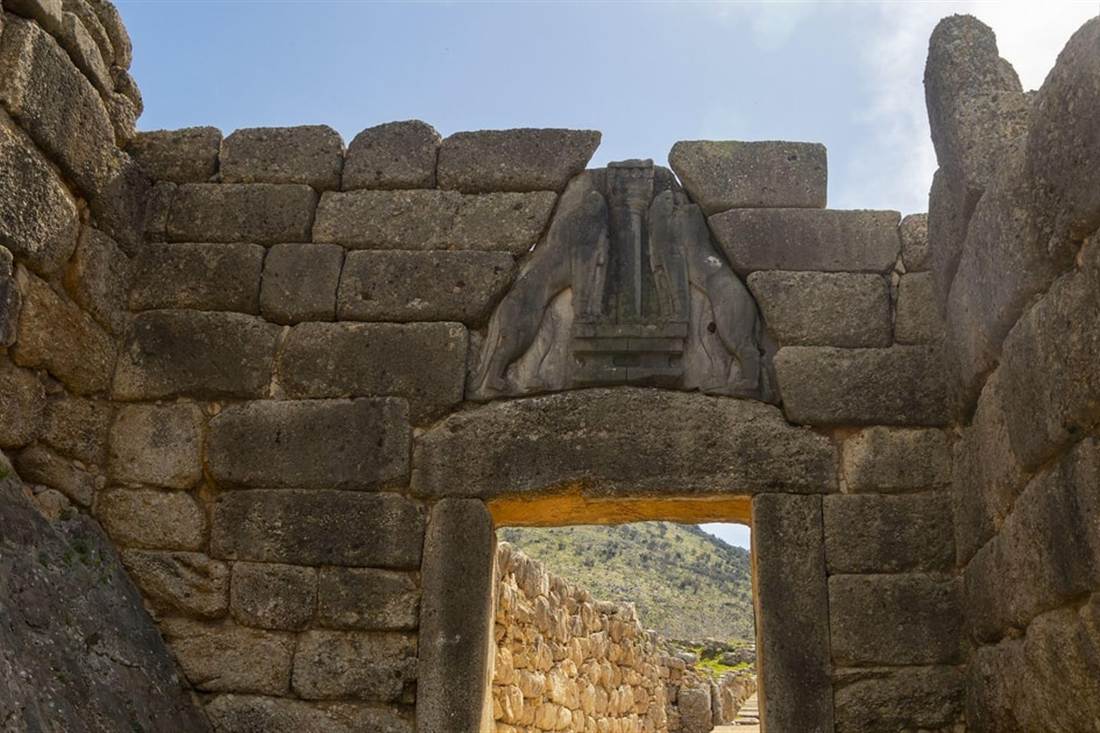
The Lion Gate gives a Mycenae day trip from Corinth its clearest first view of royal power. A broad approach leads between defensive masonry to a limestone relief. Two animals flank a central column above the entrance.
The gate stands on the north-western side of the acropolis and dates from the 13th century BC. A partly natural, partly engineered ramp narrows toward a small open court before reaching the doorway. On a Mycenae day trip from Corinth, this ramp is the first climb of the visit.
A bastion lines one side of the approach. Its position helped defenders act against attackers carrying shields on their left arms, leaving the right side exposed.
- The entrance measures about 3.10 metres wide and 2.95 metres high at the threshold.
- Two large upright stones support a lintel measuring about 4.5 by 2.0 by 0.8 metres.
- A corbelled relieving triangle reduces the weight pressing on the lintel.
- The limestone slab carries two confronted lionesses in a heraldic pose.
- The animals’ heads were made separately and no longer survive.
The central pillar rises above an altar-like platform. The lionesses place their front feet on the platform, creating a balanced image over the passage. The relief is the only surviving monumental Mycenaean sculpture above ground. It also forms the largest surviving sculpture from the Bronze Age Aegean.
The entrance connected the defensive circuit with the route toward the palace. A stepped ramp carried visitors through the gate and past the burial precinct inside the expanded walls. A closer look at the Lion Gate’s relief explains its architecture. It also shows how royal symbolism worked there.
Who built the Cyclopean walls, according to legend?
According to legend, Cyclopes built the walls because ordinary people lacked the strength to move their enormous stones. In a Mycenae day trip from Corinth, the masonry shows a real Bronze Age building method. That method stands behind the later explanation.
The term describes walls formed from huge limestone boulders fitted with narrow gaps. Smaller limestone pieces fill spaces between the larger blocks, while clay mortar appears in parts of the construction.
Builders founded the walls in shallow beds cut into bedrock. The outer faces received rough hammer dressing, but the stones did not become carefully cut rectangular blocks.
- The Cyclopean style is strongly associated with Mycenaean fortifications.
- Mycenae and Tiryns contain the clearest surviving examples of the technique.
- The largest stones at Mycenae include lintels and gate jambs exceeding twenty tonnes.
- The Lion Gate uses different ashlar construction around the gateway.
- Later Greek tradition connected the massive walls with the one-eyed Cyclopes.
The legend reflects the visual impact of the fortifications. Huge blocks rise in uneven courses, creating a surface that appears difficult to build without extraordinary strength. The wall system developed through phases. An early circuit came first. Later extensions enclosed Grave Circle A. A final northeast extension protected the underground water supply.
The surviving masonry therefore records engineering choices as well as defensive ambition. Its uneven stones belong to a planned fortification system, not a random pile of rocks. The walls line the path a Mycenae day trip from Corinth follows from the Lion Gate to the summit.
What treasures came from the shaft graves of Mycenae?
The shaft graves produced gold masks, weapons, jewellery, cups, staffs, and imported objects. These finds make a Mycenae day trip from Corinth a close look at early ruling families. Their wealth and rank appear through the objects.
Grave Circle B lies outside the later citadel and contains twenty-six graves. Fourteen of them are shaft graves. It predates the later expansion of the citadel walls.
The burials span the seventeenth and sixteenth centuries before the common era. Their goods became richer over time, with ornaments, weapons, drinking vessels, and objects from the Cyclades.
- Women were buried with earrings, necklaces, gold and silver bands, pins, and other ornaments.
- Men were buried with swords, daggers, arrowheads, and clothing trimmed with gold.
- One burial contained an electrum death mask placed in a wooden box.
- A boar’s tusk helmet supplied evidence for Mycenaean warrior equipment.
- Hunting scenes appeared on two grave stelae.
Grave Circle A stands just south of the Lion Gate inside the later fortifications, the first monument after the entrance on a Mycenae day trip from Corinth. Its six shaft graves held nineteen people, including men, women, and children. The later walls curve around it.
The circle measures about 27.5 metres across. Gold death masks, full weapon sets, ornate staffs, gold jewellery, and silver cups came from the graves. One gold mask received the name Mask of Agamemnon after Heinrich Schliemann’s excavation. The burials date to the sixteenth century, centuries earlier than the traditional period assigned to that figure.
The objects combine local Mycenaean scenes with Minoan designs. Their materials also reveal exchange across the Aegean and wider Mediterranean. The Grave Circle A burial complex shows a later change. Rulers turned an older cemetery into a protected ancestral precinct.
How did the palace on the acropolis of Mycenae work?
The palace organised rule around a megaron, a courtyard, storage, workshops, and a raised route across the acropolis. A Mycenae day trip from Corinth shows how architecture directed movement. The route led toward the ruler’s central room on the summit.
The visible palace belongs to the final sequence of palatial buildings on the summit. Earlier structures were cleared away or built over as the acropolis developed. The climb to the summit is the steepest stretch of a Mycenae day trip from Corinth.
A grand staircase rose from a lower terrace to a courtyard with a columned portico. This approach moved visitors from the fortified entrance toward the palace interior.
- The megaron contained a central hearth beneath an opening in the roof.
- Four columns stood around the hearth in a square arrangement.
- A throne stood against the wall beside the hearth.
- The entrance gave the ruler an unobstructed view of approaching visitors.
- Plaster walls and floors carried fresco decoration.
The room’s arrangement placed fire, columns, throne, and doorway within one controlled visual field. The design linked ceremony with the practical movement of people through the palace. Buildings beyond the walls included the House of Shields and the House of the Oil Merchant. The House of the Sphinxes and West House stood nearby.
These structures served as residences, workshops, or both. Their remains show that the citadel formed part of a larger settlement rather than standing alone. A temple inside the citadel contained a Room of the Idols. A scarab connected with the Egyptian queen Tiye was found there. It lay beside a statue from the Late Bronze Age.
The palace also depended on secure water access. A later passage descended about ninety-nine steps to a rock-cut cistern about fifteen metres below the surface.
Why is the Treasury of Atreus called a tholos tomb?
It is called a tholos tomb because its circular burial chamber has a corbelled beehive vault. The Treasury of Atreus adds a long dromos and deep doorway. A Mycenae day trip from Corinth therefore shows a complete tomb type.
The monument dates to the thirteenth century before the common era. It is the largest and richest known Mycenaean tholos tomb in the Aegean Bronze Age. It stands outside the citadel, so a Mycenae day trip from Corinth reaches it by a short walk or drive down the road.
Its plan has three parts. A narrow passage called the dromos leads to a doorway, then into the circular chamber called the thalamos.
- The dromos measures about 36 metres long and 6 metres wide.
- The burial chamber measures about 14.5 metres across.
- The chamber rises about 13.2 metres beneath the corbelled dome.
- The dome contains thirty-three courses of worked stone.
- A side chamber opens from the main room through a doorway on the north side.
Builders first excavated a cylindrical cavity into the hillside. They then raised the stone courses inward until the layers formed the beehive-shaped roof. The entrance façade once carried coloured marble columns and sculptural decoration. A relieving triangle above the doorway directed pressure away from the lintel.
The inner lintel measures about eight metres long, five metres wide, and 1.2 metres thick. Its weight reached about 120 tonnes. The name links the monument with Atreus and Agamemnon, but the burial identity remains unknown. The structure’s scale indicates a ruler or a person at the top of Mycenaean society.
Which finds fill the museum beside the site?
The museum presents pottery, sculpture, fresco fragments, weapons, jewellery, and burial objects from Mycenae. It gives a Mycenae day trip from Corinth material detail for the stones outside. The displays also explain their setting.
The galleries bring together objects from the acropolis, cemeteries, houses, and religious areas. Their arrangement connects daily activity with palace administration, burial customs, craft, and ceremony.
Pottery helps establish the sequence of occupation. Vessels also show how people stored goods, served food, drank, and participated in funerary rites.
- Replicas of the gold death masks, whose originals are in the National Archaeological Museum in Athens.
- Swords, daggers, spear points, and arrowheads show the equipment placed with warriors.
- Silver and gold cups reveal high-status drinking and presentation practices.
- Seals, figurines, and decorated objects connect administration with ritual activity.
- Fresco fragments preserve parts of the painted decoration used in palatial spaces.
The museum also helps separate objects from later names. The so-called Mask of Agamemnon belongs to an earlier burial period than the traditional date assigned to Agamemnon.
Objects from Grave Circle B add an earlier layer to the story. Their ornaments, imports, weapons, and electrum mask show how elite burial changed before Circle A.
Architectural pieces explain the site’s construction. Stone fragments, column elements, and decorative remains make the palace, gate, and tombs easier to understand.
The museum stands beside the archaeological site in Mykines and opened in the early 21st century. Its displays turn scattered finds into evidence for a settlement that grew, ruled, rebuilt, and finally declined. The Archaeological Museum of Mycenae collection shares one ticket with the site on a Mycenae day trip from Corinth.
How did Heinrich Schliemann dig at Mycenae?
Heinrich Schliemann began excavating Mycenae in the late nineteenth century after studying Homer and Pausanias. His team exposed Grave Circle A, six shaft graves, nineteen burials, and rich funerary objects. The Mycenae day trip from Corinth then became a visit shaped by archaeology.
Schliemann was a German businessman and amateur archaeologist who pursued places named in Homer. He had already excavated Hisarlik, identified with Troy, before turning to Mycenae. Greek archaeologist Panagiotis Stamatakis supervised the work as a condition of Schliemann’s excavation permit.
In the late nineteenth century, Schliemann read Mycenae as the city of Agamemnon. He searched for a royal cemetery linked with the king in the Iliad. Grave Circle A lies inside the later citadel enclosure, although its burials belong to the sixteenth century BC.
- Schliemann excavated Grave Circle A in the 19th century.
- Stamatakis later identified a sixth shaft grave.
- The burials predate the traditional Trojan War period.
- The named mask cannot identify Agamemnon.
The name “Mask of Agamemnon” reflects Schliemann’s interpretation, not a proven identity. The mask is not a confirmed portrait. The graves date roughly three centuries before the traditional date assigned to Agamemnon. That gap gives the visit a useful lesson about separating literary tradition from archaeological evidence.
A focused guide to Schliemann at Mycenae adds context before entering the site.
How does Homer link Agamemnon with Mycenae?
Homer presents Agamemnon as king of Mycenae and commander of the Achaeans at Troy. That literary link gives a Mycenae day trip from Corinth a clear theme. The surviving graves and buildings belong to earlier Bronze Age communities.
In the Iliad, Agamemnon leads the Greek forces during the Trojan War. He is the son of Atreus, brother of Menelaus, and husband of Clytemnestra. The Catalogue of Ships credits him with 100 ships, the largest contingent sent to Troy. His children include Orestes and three daughters. The poems place his royal power at Mycenae.
Homer also calls Mycenae rich in gold. Archaeology supplies a reason for that image through royal cemeteries and elaborate tombs. Grave Circle A held gold masks, weapons, vessels, and ornaments. Its burials do not belong to Agamemnon’s supposed lifetime.
The story of Agamemnon continues after Troy. Greek myth says Clytemnestra killed him after his return, while other versions name her lover Aegisthus. These accounts belong to epic and tragedy, rather than a confirmed biography of a Bronze Age ruler.
On a Mycenae day trip from Corinth, this distinction keeps the story precise. The citadel is not presented as a proven palace of the Iliad’s commander. It is a real Bronze Age centre that helped later generations imagine the House of Atreus.
Which Corinthian sites pair with a Mycenae day trip from Corinth?
Ancient Corinth, Acrocorinth, the Corinth Canal, and Nemea create four different historical settings near Corinth. Adding one carefully chosen stop gives the day contrast without turning every site into a rushed checklist. A Mycenae day trip from Corinth then keeps its central archaeological focus.
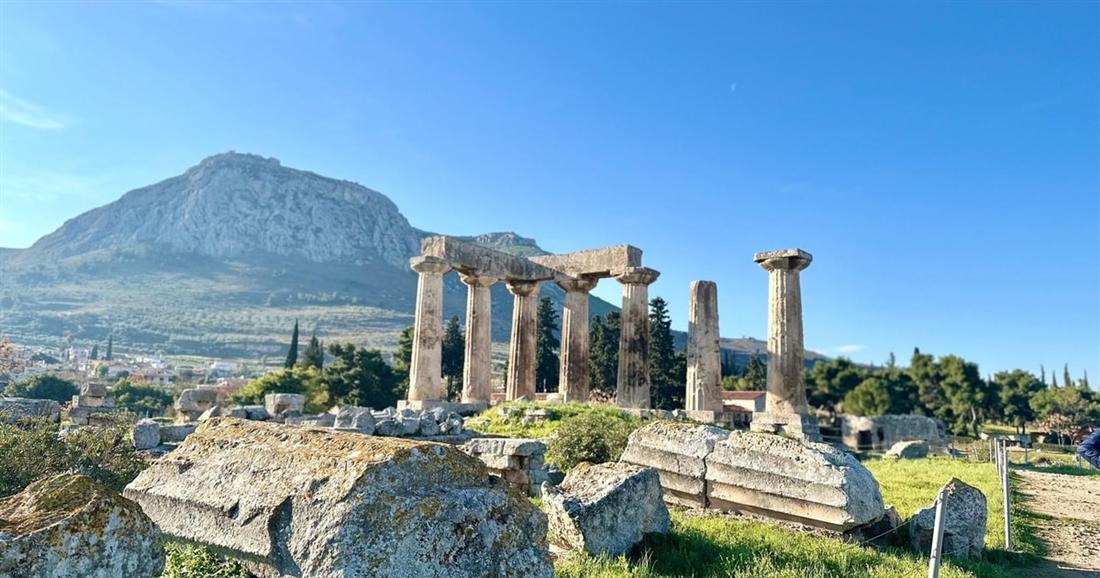
Modern Corinth is the capital of Corinthia, while Ancient Corinth preserves the earlier city-state on the Isthmus. Seven Doric columns of its Temple of Apollo, from the 6th century BC, still stand. The apostle Paul preached in the city, and the Bema where he spoke survives in the forum. The ancient ruins lie south-west of the modern city. Their position between mainland Greece and the Peloponnese shaped trade, travel, and military power.
Acrocorinth rises as a fortified rock above Ancient Corinth. Its walls and water supply supported defence from archaic times through the early nineteenth century. A visit adds a high defensive landscape to the low archaeological setting at Mycenae.
- Ancient Corinth adds a city, temple, and museum setting.
- Acrocorinth adds a fortified summit and wide views.
- The Corinth Canal adds a modern engineering landmark.
- Nemea adds a sanctuary, temple, museum, and stadium.
The Canal guide describes the waterway. It cuts through the Isthmus and links the Gulf of Corinth with the Saronic Gulf. It opened in the late nineteenth century. Its straight cut contrasts with the hilltop citadel of Mycenae.
Isthmia, east of the canal, held the sanctuary of Poseidon and the Isthmian Games. The diolkos, a paved track for dragging ships across the Isthmus, survives in short sections beside the canal.
Nemea lies in Corinthia and is linked with the Nemean Games. The sanctuary includes the Temple of Zeus, an on-site museum, and a stadium with a vaulted entrance tunnel. Those features give a combined day a religious and athletic focus.
A useful pairing depends on the main interest. Ancient Corinth suits visitors who want another major city. Nemea suits visitors who want a sanctuary and stadium. Acrocorinth suits visitors who want fortifications and elevation.
How do tickets and opening hours shape the day at Mycenae?
One Mycenae ticket covers the archaeological site, museum, and Treasury of Atreus. Opening hours change between summer and winter. A Mycenae day trip from Corinth needs a date-based plan, not one fixed timetable.
The Greek cultural administration lists a winter schedule and longer summer schedules. The date-specific opening period matters for planning. The published hours also include seasonal changes during autumn. Good Friday and Holy Saturday have separate hours, while different public holidays bring closure.
Free-entry dates include 6 March, 18 April, and the international museums day in late spring. The last weekend of September and 28 October also provide free entry. This rule can affect a Mycenae day trip from Corinth.
- Use one ticket for the site and museum.
- Include the Treasury of Atreus in the same visit.
- Allow time for the museum before closing.
- Recheck hours when a public holiday is involved.
Seasonal hours affect the order of the day. A late arrival can reduce museum time even when the citadel remains the main goal. An early start leaves space for a second Corinthian site without compressing the archaeological visit.
Visitors using a digital ticket or audio product need to distinguish admission from interpretation. A prebooked entry product can include a phone audio tour or virtual reality commentary. Those tools do not replace the site’s own opening schedule.
Read the practical details in this Mycenae ticket guide before choosing a start time.

Which months suit a Mycenae day trip from Corinth?
Late spring, early summer, and early autumn offer useful daylight. Winter brings shorter official hours and quieter paths. A Mycenae day trip from Corinth works in every season when clothing and site time match the calendar.
Late spring supports outdoor walking before the hottest part of the year. The hill, paths, and exposed stone surfaces require water and shade breaks. The season also fits a plan that includes Nemea or Ancient Corinth.
Early summer brings long daylight and extended opening hours. Heat builds on the open hillside. A morning arrival protects energy for the museum and a second stop. A hat and water bottle become practical equipment.
Early autumn combines warm days with a changing schedule. September hours differ from October hours, and October hours shorten during the month. The last weekend of September is also a free-entry period.
- Late spring suits outdoor walking and combined sites.
- Early summer suits long daylight and extended hours.
- Early autumn suits warm weather and free-entry dates.
- Winter suits shorter visits and quiet paths.
Winter has a shorter opening period and lower sun angles. A winter Mycenae day trip from Corinth meets fewer visitors on the paths. The stone surfaces can feel cold in wind, while rain changes the comfort of the paths.
Holiday closures also matter. The site closes on New Year’s Day, Labour Day, Easter Sunday, Christmas Day and the day after Christmas. A date near a holiday needs a direct opening-hours check before departure.
What do you wear and bring on a Mycenae day trip from Corinth?
Wear firm shoes, light layers, sun protection, and clothing that handles uneven ground. A Mycenae day trip from Corinth includes exposed paths, museum rooms, and outdoor stops. A compact day bag keeps practical items together.
Firm shoes give safer footing on stone and earth paths. They suit a Mycenae day trip from Corinth better than thin sandals. Thin sandals offer less support on slopes and uneven surfaces. Shoes with a closed toe also protect feet from loose gravel around the open-air remains.
Light layers handle the change between sun, shade, vehicle interiors, and museum rooms. A brimmed hat protects the face on exposed ground. Sunglasses reduce glare from pale stone and bright paths.
Carry water, sunscreen, tissues, personal medicine, and a phone charger. A small notebook helps record names such as Grave Circle A and Grave Circle B. The Treasury of Atreus also belongs in the notes.
- Choose shoes with a secure sole.
- Pack water for the open-air paths.
- Carry a hat and sun protection.
- Bring a charged phone for tickets or audio.
- Add a light layer for shade and indoor rooms.
Keep the bag small enough for easy movement. Large luggage complicates entrances, narrow paths, and museum circulation. A reusable bottle reduces the need to search for water during the visit. It suits a Mycenae day trip from Corinth because the open-air paths offer limited shade.
Food planning also affects comfort. A simple snack supports a long outdoor visit, while a sit-down meal works better after the archaeological site.
How do you book and cancel a Mycenae day trip from Corinth?
Book a Mycenae day trip from Corinth on Viator or GetYourGuide after comparing the guide, ticket, audio and private-tour options. Check the start time, the language and the cancellation rule before paying.
Viator lists private Mycenae experiences from Corinth, including a tour that adds Ancient Nemea. Its Corinth destination includes private options with expert guides and site and tomb focus. Other listings offer licensed guiding with tickets and phone audio.
GetYourGuide lists a licensed-guide visit lasting 1.5 hours at the site. Another product combines a prebooked ticket with a virtual reality audio tour lasting 3 hours. A separate e-ticket includes the site and museum with audio on the phone.
A private eight-hour itinerary combines the Corinth Canal, Ancient Corinth, Mycenae, and Nafplio. This format suits a full day with different stops. A shorter site product leaves room for a slower Corinth plan.
Read the cancellation line beside the date and start time. GetYourGuide listings that offer free cancellation permit cancellation up to 24 hours before the start. The rule belongs to the individual listing.
Save the confirmation, meeting details and ticket or audio access before a Mycenae day trip from Corinth. A screenshot helps where mobile coverage drops. The Mycenae private tour page compares the private formats.
Where do you eat on a Mycenae day trip from Corinth?
The village of Mykines, below the citadel, has tavernas along its main street. A Mycenae day trip from Corinth can also stop at a Nemea winery for a tasting on the drive back. Both fit a lunch break after the site.
Mykines sits on the road up to the citadel, so lunch there adds no detour. Heinrich Schliemann stayed at the La Belle Helene guesthouse in the village during his excavations. The building still stands on the main street.
Wineries around Nemea open their cellars for tastings of the local red wine. Book a tasting ahead, since a Mycenae day trip from Corinth passes the vineyards on a fixed schedule.
Corinth gave its name to the currant. Small dried grapes shipped from the city were sold as raisins of Corinth. A bag of currants makes a light snack for the road on a Mycenae day trip from Corinth.
- Tavernas on the main street of Mykines
- Red wine tastings in the Nemea vineyards
- Corinthian currants for the drive
- Oranges from the Argolid plain in winter
Frequently Asked Questions
Is a Mycenae day trip from Corinth possible by bus?
Yes, the journey is possible with regional public transport and local connections, but the route needs timetable planning. Bus travel gives less control over museum time and companion sites. A private tour removes transfers and keeps the itinerary together.
How much time does a Mycenae day trip from Corinth need at the site?
Allow at least 1.5 hours for a guided site visit. Then add time for the museum and Treasury of Atreus during a Mycenae day trip from Corinth. A three-hour audio experience gives a slower pace. Extra time helps visitors read displays and pause outdoors.
Can the Mycenae day trip from Corinth add Ancient Nemea?
Yes, a private itinerary can add Ancient Nemea beside Mycenae. Nemea brings the Temple of Zeus, museum, and stadium into the day. The extra stop needs a clear schedule because both archaeological sites require outdoor walking.
Is a Mycenae day trip from Corinth private?
Private options exist with licensed guides, tickets, audio products, or combined Corinthian stops. Shared public transport is a different arrangement. The booking title and inclusions identify whether guiding, entry, transfers, and a dedicated vehicle belong to the service.
How far ahead do you book a Mycenae day trip from Corinth?
Book after fixing the travel date, opening schedule, group size, and guide language. Earlier booking gives more choice for private guides and timed products. Flexible listings with cancellation up to 24 hours offer a later change window.