
A Pylos day trip from Kalamata is a drive west across Messenia to Navarino Bay, with the castles of Pylos, Voidokilia beach and the Palace of Nestor in one day. Tours across the rest of the country are listed on Greece Tours.
The sections below cover the tours you can book, the road, timing, the Battle of Navarino, Niokastro, Sphacteria, Old Navarino, Voidokilia, the Gialova lagoon, the Palace of Nestor, Methoni and Koroni, food, the season, packing and booking for a Pylos day trip from Kalamata, with links into the Pylos tours pages. The tours shown are checked on GetYourGuide and Viator.
What is a Pylos day trip from Kalamata?
A Pylos day trip from Kalamata connects two Messenian cities with harbour history, fortifications, and ancient sites. The route reaches Navarino Bay. Sphacteria protects its entrance, and Niokastro rises above Pylos and its harbour today.
Kalamata stands beside the Messenian Gulf. Pylos faces the Ionian Sea. Both towns belong to Messenia, yet their settings change during a Pylos day trip from Kalamata. Kalamata is an urban base beside the Nedon River. Pylos is a smaller harbour town beside a closed bay.
The town was historically known as Navarino. Its present name recalls the ancient Pylos linked with King Nestor in Homer. Pylos records Neolithic occupation, Mycenaean rule, Frankish fortification, Venetian control, and Ottoman naval use. The modern town followed Greek independence.
For visitors, a Pylos day trip from Kalamata treats Pylos as a historic landscape. The harbour explains the town’s strategic value. Niokastro explains Ottoman defence. Sphacteria explains the battles of the fifth century BC. Old Navarino castle and Nestor’s Cave add a separate route above the northern shore.
Which Pylos day trips from Kalamata can you book?
A Pylos day trip from Kalamata comes in private sightseeing, cruise-port, and active touring formats. The tours range from five to eight hours. They combine Pylos with castles, archaeology, walking, or kayaking in one region.
One six-hour private option for a Pylos day trip from Kalamata visits Nestor’s Palace, Pylos, and Niokastro. It suits travellers wanting one vehicle, a fixed theme, and fortress time. The route also places Mycenaean administration beside later military history.
A five-hour Pylos day trip from Kalamata begins at the cruise port. It includes Pylos, Methoni Castle, and Koroni Castle. A local driver-guide provides the transport, while the itinerary allows customisation. This format suits a short shore visit that needs a compact circuit through western Messenia.
- A private Pylos and Methoni journey from Kalamata focuses on two coastal strongholds.
- A Voidokilia, Pylos, and Methoni tour runs for eight hours and includes a seaside meal in a fishing village.
- Sea kayaking in Navarino Bay adds close water access to the bay and its shore.
- Hiking around Navarino Bay turns the visit into a walking-based landscape experience.
The right choice for a Pylos day trip from Kalamata depends on the main purpose of the day. Private routes keep the schedule together. A history-focused plan gives Niokastro and Pylos more attention. An active plan uses the bay as the centre of movement. A cruise-port plan starts and ends around the ship’s schedule instead of Kalamata.


Which road leads from Kalamata to Pylos?
A Pylos day trip from Kalamata follows Greek National Road 82 towards the western coast. The road crosses Messenia before reaching Pylos. It then continues through the town before returning to Kalamata after the visit.
Greek National Road 82 runs between Sparta and Pylos. It links the Messenian interior with the coast. Kalamata lies along its western section, with the road also passing through Messini. The road stays inland across the olive country of Messenia.
During a Pylos day trip from Kalamata, the road crosses Messenia towards the west. The final approach reaches Pylos beside Navarino Bay. Pylos harbour sits below the fortified promontory. The journey shifts from inland views to the sea.
A Pylos day trip from Kalamata covers about 53 kilometres each way. The drive takes about 70 minutes without a stop. Traffic, roadworks, and town streets alter the final time.
Drivers using Kalamata tours can compare this western route with other Messenian excursions before setting the day’s order. The road works well as an out-and-back connection, while a longer circuit adds coastal fortresses and archaeological stops.
How long does a Pylos day trip from Kalamata take?
A Pylos day trip from Kalamata needs about two hours of driving for the return route alone. A full-day plan allows six to eight hours. It gives time for Niokastro, the harbour, and nearby sites.
On a Pylos day trip from Kalamata, the return journey uses close to two hours before parking, walking, or visiting a monument. The road distance is short, but a full itinerary includes separate local movements.
A six-hour Pylos day trip from Kalamata matches a focused programme around Nestor’s Palace, Pylos, and Niokastro. The time includes the outward and return drives, so each stop needs a clear limit. The town and fortress can form one compact visit because Niokastro stands directly above the harbour.
An eight-hour Pylos day trip from Kalamata allows a northern stop or a longer activity. A five-hour cruise-port excursion works on a tighter clock because departure and return take place at Pylos. Each format serves a different starting point and does not represent the same amount of time ashore.
- Allow about 2 hours for the return road journey from Kalamata.
- Allow about 6 hours for a focused private history itinerary.
- Allow about 8 hours for a wider coastal and castle circuit.
- Allow about 5 hours for a compact cruise-port excursion.
Local touring also needs time for entry gates, uphill paths, photographs, and harbour traffic. Niokastro’s position above the town adds a short climb within the visit. Old Navarino castle requires a northern route. It takes more time than a harbour walk.
Why did three fleets fight in Navarino Bay?
A Pylos day trip from Kalamata reaches the bay where three allied fleets fought Ottoman-Egyptian forces. The allied intervention supported Greek autonomy. It destroyed the opposing fleet inside the sheltered bay in the nineteenth century.
The Greek revolt against Ottoman rule began in the early nineteenth century. Ottoman forces struggled to end it, so the sultan called on Muhammad Ali Pasha of Egypt. His son Ibrahim led Egyptian forces into the Peloponnese. This strengthened the Ottoman campaign.
Britain, France, and Russia signed the Treaty of London in the third decade of that century. Their policy sought an armistice and Greek autonomy while limiting a wider conflict between the European powers. Naval squadrons entered the eastern Mediterranean to enforce that policy.
The allied fleet entered Navarino Bay to pressure the Ottoman commander into accepting the allied instructions. Fighting began after manoeuvres inside the bay. The British, French, and Russian ships defeated the Ottoman, Egyptian, and Algerian forces. The battle became the last major naval battle fought entirely with sailing ships.
The result changed the political future of Greece. A French expedition and a later Russo-Turkish war followed the naval defeat. Ottoman and Egyptian forces withdrew from the Peloponnese, and Greek independence became far more certain. Pylos therefore connects a local harbour with a major European decision.
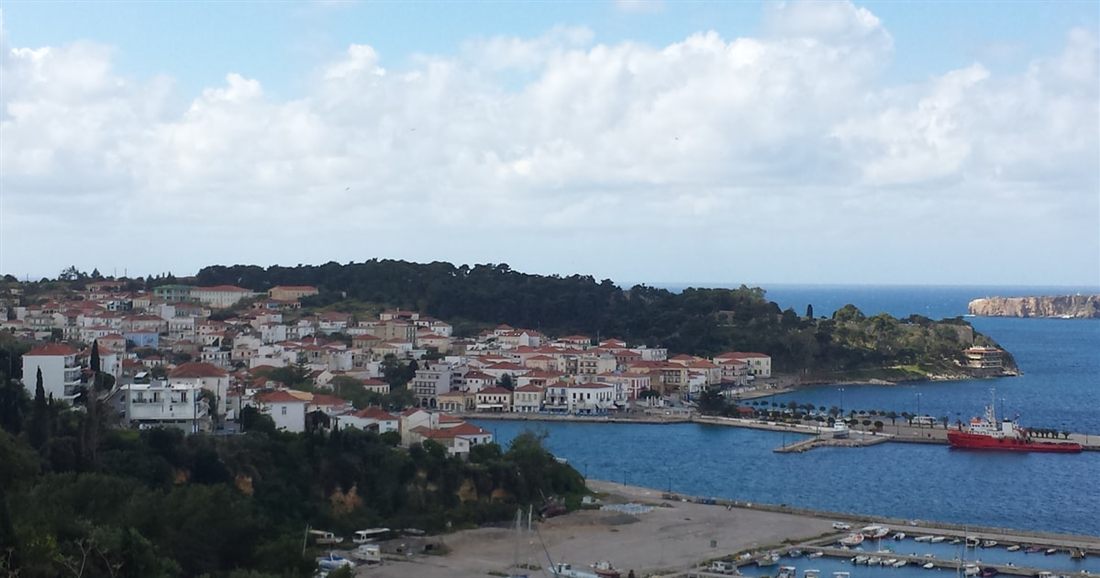
A visit to Pylos and Navarino Bay places the battle within the shape of the water. Sphacteria blocks part of the entrance. The shore and fortress explain the bay’s naval value.
What does Niokastro guard above the harbour of Pylos?
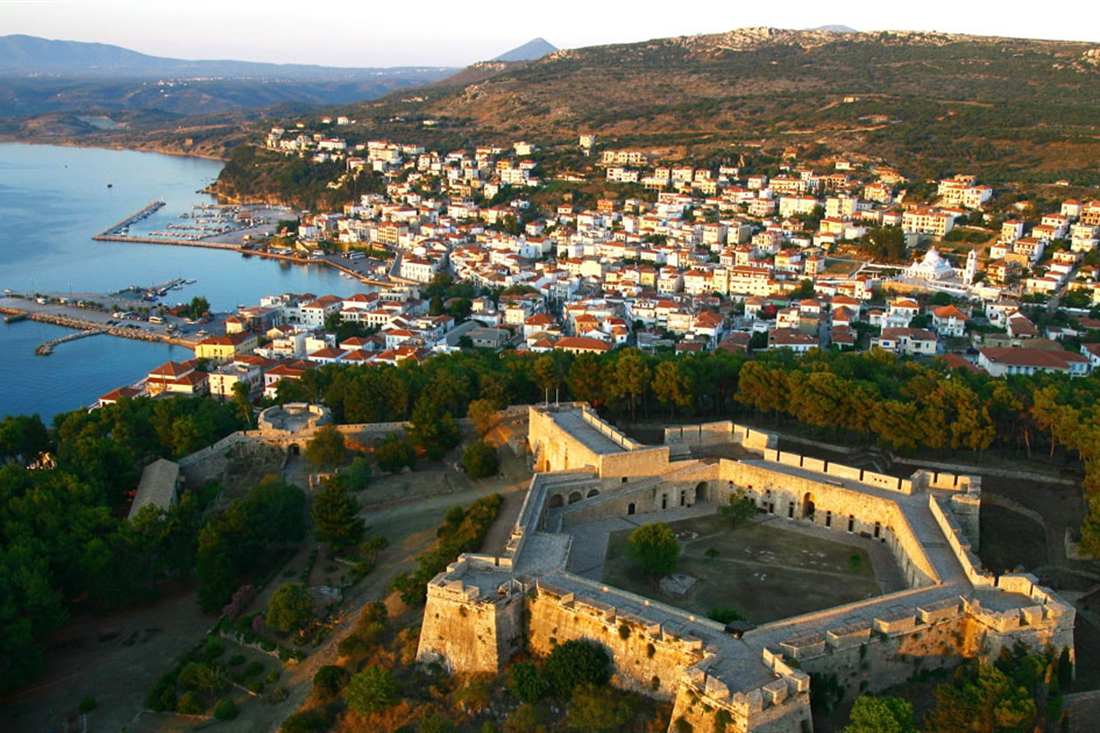
A Pylos day trip from Kalamata reaches Niokastro, the Ottoman New Navarino fortress above Pylos harbour. The stronghold guarded Navarino Bay’s southern entrance. The Pasha’s Building now presents underwater finds above the water and town.
The Ottoman authorities built New Navarino in the sixteenth century after the Battle of Lepanto. The Frankish castle stood north of the bay. The new fortress covered the practical southern entrance. Its position controlled movement between the open sea and the sheltered harbour.
Niokastro is more than a wall above the town. The fortress compound included buildings for administration, storage, worship, and military use. The Pasha’s Building is a rectangular, two-storey stone structure dated to the seventeenth and eighteenth centuries. Its name recalls Ibrahim Pasha of Egypt.
The building now hosts an exhibition of underwater archaeological finds. The exhibition presents material recovered from the seas around the Peloponnese. This gives the fortress a direct link with shipwrecks, maritime travel, and the waters that made Navarino valuable.
- Niokastro guards the southern entrance to Navarino Bay.
- The fortress is also called New Navarino.
- The Pasha’s Building dates from the seventeenth and eighteenth centuries.
- The building became Greece’s first museum for underwater archaeological finds.
- The fortress stands above the modern harbour of Pylos.
The official cultural site records that the Greek Archaeological Service received the fortress in the twentieth century. Restoration later prepared the Pasha’s Building for exhibition and education. The compound therefore joins Ottoman military history with modern archaeological work.
Why did Spartan soldiers surrender on Sphacteria?
A Pylos day trip from Kalamata reveals the island where Spartan soldiers surrendered. Athens used light troops and missile fire. A rear approach isolated the defenders after a failed siege and a difficult retreat across the island.
The crisis began after the Battle of Pylos in the fifth century BC. Athens fortified the Pylos peninsula after a storm drove its fleet ashore. Spartan forces attacked by land and sea. The Athenian fleet later defeated their ships.
About 420 Spartan hoplites became trapped on Sphacteria, an island at the harbour entrance. The Spartan government treated the danger as severe because 120 prisoners belonged to the elite Spartiate class. Sparta surrendered its fleet as security and asked Athens to negotiate peace.
The negotiations failed, so Athens continued the blockade. A long siege threatened to bring winter conditions and supply problems. An Athenian attack then landed on a weakly defended part of the island. Light troops harassed the Spartans with bows and spears instead of meeting their heavy armour directly.
The defenders withdrew behind northern fortifications. A Messenian commander led troops through rough ground that the Spartans had left unguarded. This move reached their rear and removed the last secure position. The Spartans had no route to victory or escape, so they threw down their shields and surrendered.
Sphacteria covers about 3.2 square kilometres and lies at the entrance to the bay. The island has no permanent population. The island later witnessed fighting in the Greek War of Independence. Its position explains why control of a small landform affected the harbour, the peninsula, and the wider war.
What waits at Old Navarino castle and the cave of Nestor?
A Pylos day trip from Kalamata can continue north to Old Navarino castle and Nestor’s Cave. The thirteenth-century fortress stands on a 200-metre rock. Nestor’s Cave lies beside Voidokilia above the northern shore of the bay.
Old Navarino castle occupies the northern edge of Navarino Bay. Frankish rulers built it in the thirteenth century. Steep cliffs flank the rock. The site also occupies the position of the Athenian fort from the Battle of Pylos.
The castle ruins are closed because the structure is considered dangerous. This matters when planning a visit. The site is a viewpoint and exterior landmark. It is not a normal museum route. The elevated rock still explains the defensive value of the headland.
Nestor’s Cave lies below the castle on the rock face above Voidokilia. The cave measures about 20 by 16 metres, with a height reaching about 30 metres. Archaeology found Final Neolithic and Late Helladic material. Later Classical and early Hellenistic traces also remain.
- The Old Navarino fortress dates from the thirteenth century.
- The rock rises about 200 metres above the northern bay area.
- The castle stands above Nestor’s Cave.
- The cave has evidence from Neolithic and Late Helladic periods.
- The official cultural record places the cave at Pylos, Voidokilia.
The cave also belongs to the mythic landscape of Nestor’s Pylos. Ancient stories connect the cavern with hidden cattle. Archaeology records hearths, tools, bones, and pottery. Myth and excavation therefore describe the same hollow from different angles.
A complete historic route places the harbour first. Then a Pylos day trip itinerary continues to the northern sites. Each stop adds a separate period to the landscape. This order moves from modern Pylos to the Frankish castle, cave, and ancient landscape.

Why is Voidokilia beach shaped like the letter omega?
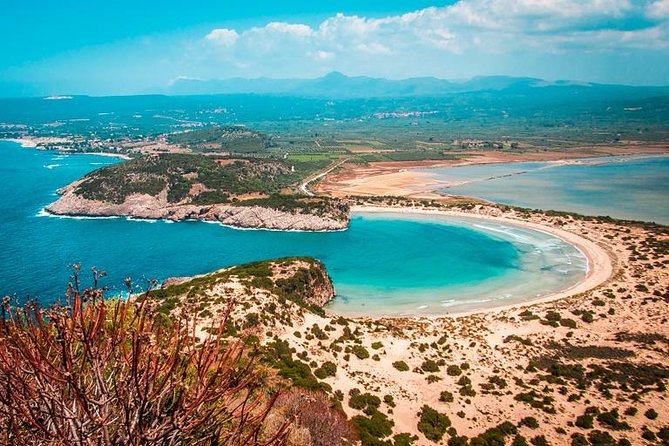
Voidokilia forms a curved sand barrier like the Greek letter omega. A Pylos day trip from Kalamata turns this shape into coastal geography. Dunes create the rounded shore, while Gialova Lagoon lies behind the sand. The beach belongs to a protected Natura 2000 area.
Voidokilia sits on the Ionian coast near Petrochori. Its sand curves into a near semicircle between low headlands. The Greek capital omega, Ω, gives the beach its visual description. Low dunes hold the curved sand in place.
The land-facing side opens toward the lagoon, not the open sea. This position creates two linked environments within a short walk. Saltwater reaches the beach, while brackish water supports wetland life. Voidokilia lies north of Pylos, beyond the Gialova lagoon, so a Pylos day trip from Kalamata reaches it after the town visit.
- Follow the sand curve from one end to the other.
- Keep clear of dune plants and nesting areas.
- Carry water because shade is limited along the shore.
- Use marked access routes near the protected habitat.
A Pylos day trip from Kalamata gains a strong outdoor stop here. Swimming, shoreline walking, and bird watching fit the same visit. The beach also begins a walking route toward the hill above the bay.
Which birds stop at the Gialova lagoon?
Gialova Lagoon receives migratory birds travelling between Africa and Northern Europe. A Pylos day trip from Kalamata includes this protected wetland encounter. The lagoon also shelters fish, reptiles, amphibians, mammals, and the threatened African chameleon.
Gialova Lagoon is a brackish body of water near the village of Gialova. It lies about eight kilometres north of Pylos. The wetland and Voidokilia Bay form one protected ecosystem.
Migratory birds use the lagoon as a stopping place during their northward and southward journeys. Birdwatchers visit the lagoon edge rather than crossing sensitive habitat. Quiet movement helps preserve clear views.
The wider area protects 258 bird species. Seventy-nine appear in the regional Red Book of threatened species. A visit has greater value when observation replaces loud activity near the water.
Bring binoculars for distant birds and a hat for exposed paths. Early visits give cooler conditions and softer light. A Pylos day trip from Kalamata can pair the lagoon with the nearby beach.
Why does the Palace of Nestor matter to Mycenaean history?
The Palace of Nestor preserves a major Mycenaean administrative centre. A Pylos day trip from Kalamata gains direct evidence of Bronze Age government there. Its rooms, archives, and Linear B tablets reveal organised political, financial, and religious activity.
The palace stands on Epano Englianos hill, about seventeen kilometres north of Pylos. It formed the centre of a larger Late Helladic settlement. The complex included two storeys, storerooms, workshops, baths, reception rooms, light wells, and drainage.
Fire destroyed the palace during the thirteenth century before the common era. Archaeologists found about 1,000 clay tablets written in Linear B. Michael Ventris helped show that Linear B records an early form of Greek.
The tablets belonged to a royal archive. Their records confirmed the palace as an administrative, political, and financial centre for Mycenaean Messenia. That written evidence connects buildings with the people who managed the kingdom. A modern roof now covers the excavated rooms, and raised walkways let visitors look down into them. Finds from the palace are shown in the Archaeological Museum of Chora, a short drive from the site.
- Walk along raised paths above the excavated rooms.
- Look for the arrangement of storage and reception spaces.
- Read the site displays before entering the palace area.
- Allow time for the hilltop setting and surrounding views.
A Pylos day trip from Kalamata gains historical depth when the palace follows a coastal stop. The site works for visitors who prefer architecture, writing, and political history. It also connects with the literary tradition of Nestor’s kingdom.
What do the castles of Methoni and Koroni add to the day?
Methoni and Koroni add Venetian and Ottoman layers beyond Pylos. A Pylos day trip from Kalamata becomes a wider Messenian history route through these stops. Their harbour fortifications show how coastal towns guarded trade, ships, and movement across the western Peloponnese.
Methoni lies about eleven kilometres south of Pylos. Its harbour had protection from the nearby Oinoussai islands. The settlement became an important Venetian base on routes toward the eastern Mediterranean. Methoni castle covers the whole headland, and a stone bridge crosses its moat at the land gate. The Bourtzi, an octagonal tower on an islet, guards the southern tip of the castle.
Venice captured Methoni and Koroni in the early thirteenth century. The two fortresses became mainland possessions that supported trade and pilgrim travel. Ottoman forces took both towns around the start of the sixteenth century.
Koroni now rises on a hill above the Gulf of Messinia. The town developed below its castle and reaches the water’s edge. Its earlier name, Corone, appears in Venetian and Ottoman history.
- Choose Methoni for harbour walls and a broad fortress site.
- Choose Koroni for a hill town beside the gulf.
- Wear firm shoes on uneven stone surfaces.
- Leave time for a short waterfront pause.
Visitors seeking both fortresses can use the dedicated Methoni and Koroni tour as a planning reference. A Pylos day trip from Kalamata then gains two distinct coastal viewpoints. The route also gives context for Messenia’s harbour history.
Which Messenian foods fit lunch in Pylos?
Lunch in Pylos suits a Pylos day trip from Kalamata. The meal stays simple and close to the harbour. Choose grilled fish, seasonal vegetables, olives, bread, and regional cheese for a practical pause between visits.
Pylos is a harbour town on Navarino Bay. Waterfront tavernas make lunch easy to place between archaeological and coastal stops. A table near the square keeps the town’s layout within walking distance.
Fresh fish fits the coastal setting, while vegetables and olives reflect Messenian farming. Bread, feta, and local oil create a filling meal without a long service period. Ask for dishes that are ready for the table.
Seasonal fruit gives a lighter finish after time outdoors. Water matters during warm months, especially after walking on open sand or stone. A shaded seat helps visitors recover before the next visit.
Lunch timing affects the whole route. An early meal leaves daylight for Methoni or the palace. A later meal works after Voidokilia, when beach time comes before the town. Harbour tables also shorten the walk between food and the next stop.
For another regional route, the Mani day trip from Kalamata offers a separate comparison. A Pylos day trip from Kalamata keeps food, harbour views, and short walks in one western Messenian circuit. The Sparta day trip from Kalamata provides a separate inland history comparison.
Which months suit a Pylos day trip from Kalamata?
Late spring and early autumn suit a Pylos day trip from Kalamata. These months bring moderate temperatures and manageable outdoor time. Summer brings longer daylight and hotter sand. Winter brings cooler conditions and shorter visiting hours.
Late spring supports walking at the palace, lagoon, and fortresses before peak heat. The countryside has green growth after winter rainfall. Beach visits remain comfortable when the route avoids the strongest midday sun.
Summer provides long daylight for a full coastal circuit. Voidokilia receives stronger sun, and exposed stone surfaces heat quickly. Start outdoor stops early, then place lunch in the middle of the day.
Early autumn keeps warm sea conditions and reduces the intensity of midday heat. The lagoon remains useful for bird observation. Shorter daylight later in the season requires a clear order of stops.
Winter gives the quietest atmosphere and cooler walking. Wind and rain can affect open beaches and hilltop ruins. Indoor meals and flexible timing help when outdoor access changes. Confirm opening hours before setting the route.
What do you wear and bring on a Pylos day trip from Kalamata?
Wear firm shoes, light layers, sun protection, and swimwear on a Pylos day trip from Kalamata. A small day bag also needs water, binoculars, personal medicine, and space for a towel after coastal stops. These items cover the main terrain.
Stone paths at archaeological sites need shoes with secure soles. Sandals with weak grip make uneven ground harder. Light trousers protect skin near dry plants and rough walls. Closed footwear also helps across gravel near the beach.
A hat, sunglasses, and sunscreen suit exposed beaches and fortresses. A thin layer helps during cooler morning travel. Carry a waterproof pouch for phones near the shore or lagoon. A spare layer fits changing coastal wind.
- Take refillable water for every outdoor section.
- Pack a towel and spare shirt for beach time.
- Carry binoculars for distant lagoon birds.
- Bring identification and required personal medicine.
- Keep a small snack for gaps between meals.
Visitors using public transport need a compact bag for easier movement. A Pylos day trip from Kalamata stays easier when every item serves walking, sun, or water.
How do you book and cancel a Pylos day trip from Kalamata?
Book a Pylos day trip from Kalamata after matching the route, duration, pickup point, and group size. The advertised options run privately, while cruise-port itineraries and custom routes serve different starting points. Each format suits a different schedule.
One private experience lasts six hours and combines the palace, Pylos town, monuments, and the town’s main castle. Another five-hour option starts at the Pylos cruise port and includes Methoni and Koroni.
An eight-hour private route combines Voidokilia, Pylos, Methoni, and a seaside meal in a fishing village. Separate activities cover sea kayaking and hiking around Navarino Bay. Route length therefore matters as much as the stop list.
Read the pickup wording before reserving. Kalamata accommodation, Pylos cruise arrivals, and independent meeting points create different logistics. State accessibility needs and meal timing during the booking process. This detail prevents delays at the start.
- Match the duration with the number of planned stops.
- Choose private travel for a tailored sequence.
- Choose cruise pickup for a port-based start.
- Reserve earlier for fixed travel dates and small groups.
GetYourGuide listings offering free cancellation allow cancellation up to 24 hours before the start. The rule applies only to listings carrying that offer. Read the cancellation terms attached to the selected booking.
Keep the selected route realistic for the available hours. A palace visit, lagoon walk, beach stop, and fortress tour each require separate outdoor time. Removing one stop creates a calmer schedule and leaves room for lunch in Pylos.
Frequently Asked Questions
Is a Pylos day trip from Kalamata possible by bus?
KTEL Messinias runs buses between Kalamata and Pylos. The bus reaches Pylos town only, so the palace, Voidokilia and the castles need a taxi or a tour. Check the current timetable before the day.
Does a Pylos day trip from Kalamata include Voidokilia?
Selected private itineraries include Voidokilia with Pylos and Methoni. Other routes focus on the palace and town, or on cruise-port pickup. The selected itinerary decides whether the beach, lagoon, and Pylos visits fit together.
Is a Pylos day trip from Kalamata private?
Private options include a six-hour palace and Pylos route, plus an eight-hour route with Voidokilia and Methoni. A five-hour cruise-port option uses a local driver guide. The booking description identifies the format and pickup arrangement.
Can cruise passengers join a Pylos day trip from Kalamata?
Yes, one five-hour itinerary offers pickup at the Pylos cruise port. Its route covers Pylos, Methoni Castle, and Koroni Castle, with a local driver guide. Cruise passengers need a schedule that returns them before ship departure.
How far ahead must a Pylos day trip from Kalamata be booked?
Reserve as soon as travel dates become fixed, especially for private vehicles, cruise arrivals, and small groups. Earlier booking leaves time to compare durations, pickup points, and cancellation terms. Late spring and summer dates need attention during busy travel periods.