
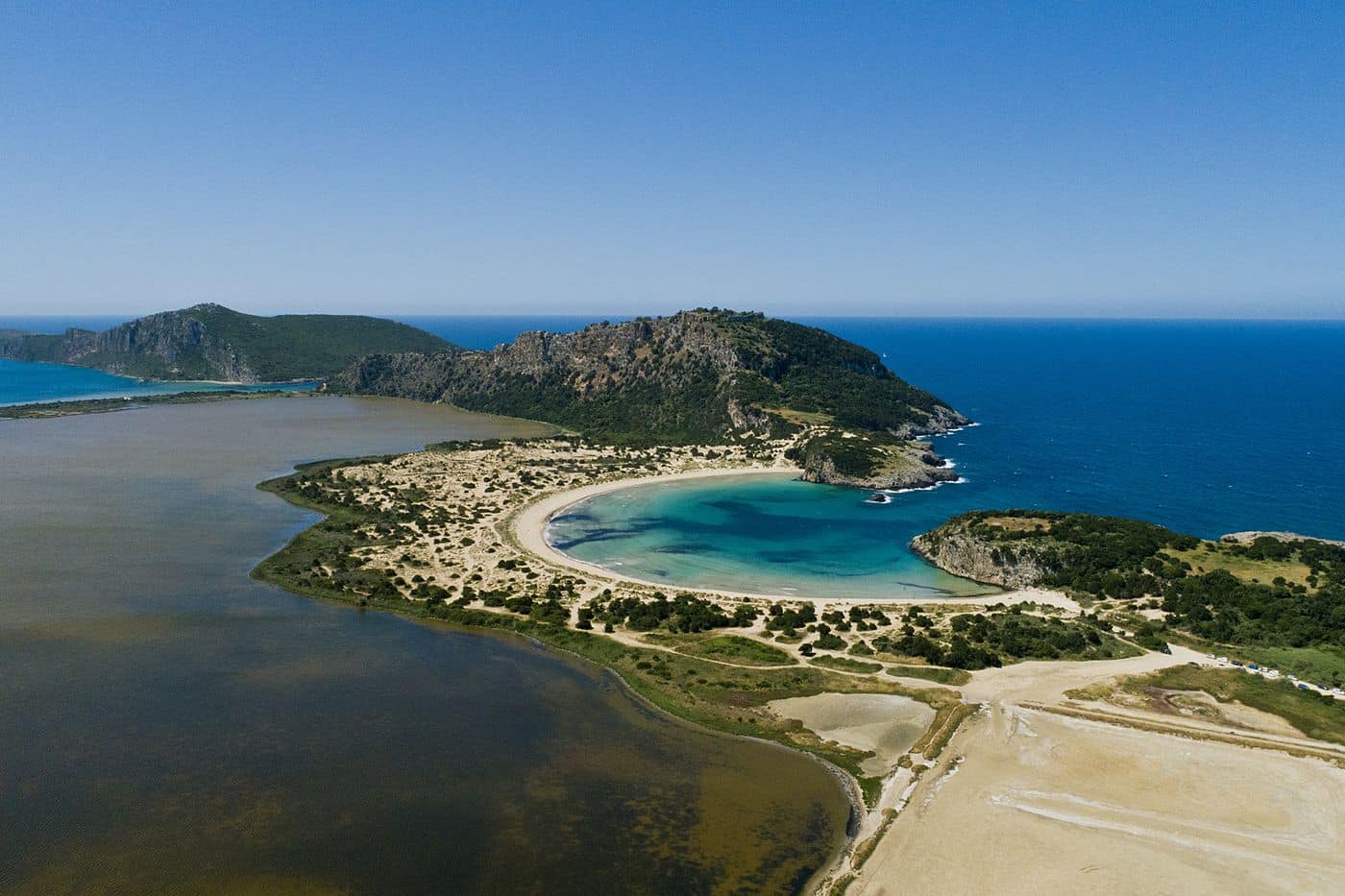
Pylos tours start in the harbour town on the Bay of Navarino, at the south-western end of the Peloponnese in Messenia, below the Niokastro fortress and opposite the island of Sphacteria. The routes cover the castle, the battle site in the bay, the Palace of Nestor, Voidokilia beach and the Gialova lagoon, and the castle towns of Methoni and Koroni. Greece Tours lists the day trips and boat trips that start in Pylos and Kalamata.
This page covers what Pylos tours see at the Niokastro castle, the history of Navarino Bay, the Palace of Nestor, the beaches and the lagoon, the routes to Methoni and Koroni, the boat trips, how visitors reach Pylos and which season suits each route. The tours below are checked on GetYourGuide and leave from Pylos, Kalamata and Athens.
What do Pylos tours cover?
Pylos tours cover the main harbour on the Bay of Navarino, at the south-western end of the Peloponnese in Messenia. The town is the seat of the municipality of Pylos-Nestor, and the community of Pylos had 2,568 residents at the 2021 census.
Pylos lies at the foot of a promontory that extends Mount Aghios Nikolaos, 482 metres high, and carries the Niokastro fortress. The narrow island of Sphacteria serves as a natural breakwater for the bay, so the port ranks among the safest anchorages on the Ionian coast. Pylos tours start in a town that leans against two hills and faces the bay.
The town was long known as Navarino. Military engineers of the French Morea expedition built the present town outside the fortress walls from 1829. Lieutenant-colonel Joseph-Victor Audoy drew its street plan, and the governor Ioannis Kapodistrias approved it on 15 January 1831. A royal decree revived the ancient name Pylos in 1833. Pylos tours on foot pass the house of the Olympic champion Kostis Tsiklitiras, now a museum with paintings, engravings and documents collected by the French philhellene René Puaux.
- Municipality: Pylos-Nestor covers 554.265 square kilometres and had 17,194 residents in 2021.
- Former municipalities: Chiliochoria, Koroni, Methoni, Nestoras, Papaflessas and Pylos merged into Pylos-Nestor in the 2011 reform.
- Municipal unit: the unit of Pylos covers 143.911 square kilometres and had 4,559 residents in 2021.
- Nearby villages: Gialova, Pyla, Elaiofyto, Schinolakka and Palaionero.
- Rank: Pylos is seventh by population in Messenia, after Kalamata, Messini, Kyparissia, Filiatra, Gargalianoi and Chora.
Pylos tours link the town with the castle above it, the battle sites of the bay, the Palace of Nestor 17 km north and the Gialova lagoon about 8 km north.
What do Pylos tours see at the Niokastro castle?
Pylos tours see Niokastro, the Ottoman fortress that the Kapudan Pasha Uluç Ali Reis built in 1573, soon after the Battle of Lepanto. It guards the southern entrance of the bay and holds the Archaeological Museum of Pylos and the Museum of Underwater Antiquities.
Niokastro means new castle. It replaced the outdated Frankish castle on the north side of the bay. Pylos tours enter a fortress built for gunpowder warfare, with thick, low and sloped walls. A hexagonal citadel holds the highest point, with a dry moat, six pentagonal bastions and almost 60 guns. The Seventh bastion covers the entrance of the bay, and the Santa Maria bastion covers the harbour.
Pylos tours inside the walls stop at the Maison building, a long two-storey stone barracks of the French Morea expedition, named after General Nicolas-Joseph Maison. Since August 2018 it has housed the Archaeological Museum of Pylos. Its exhibition, In the Footsteps of Pylos, traces western Pylia from Roman times back to the Palaeolithic.
- Museum collections: pottery, bronzes and finds from Pylian tholos tombs, such as the sealstone, gold bands and two necklaces from Koukounara.
- Pasha building: a stone hall of the 17th or 18th century, home since 2012 to the first Museum of Underwater Antiquities in Greece.
- Citadel vaults: amphorae from shipwrecks, and a digital re-creation of the Battle of Navarino in the large vault.
- Church of the Transfiguration: built as a mosque between 1573 and 1595 under Sultan Murad III, and an Orthodox church since the liberation.
The Venetians took the fortress in 1686, the Russians in 1770, Greek fighters in 1821 and Ibrahim Pasha in 1825, and French troops received it in 1828. Pylos tours today see a fortress that the Ephorate of Underwater Antiquities renovated from 1982 to 1987.
What history do Pylos tours tell at Navarino Bay?
Pylos tours tell of two battles in the bay. In 425 BC, Athens defeated Sparta at Pylos and trapped Spartan hoplites on Sphacteria. On 20 October 1827, the British, French and Russian fleets destroyed the Ottoman-Egyptian fleet in the Battle of Navarino.
In 425 BC, a storm drove an Athenian fleet ashore at Pylos. At the urging of Demosthenes, the soldiers fortified Koryphasion, the rocky promontory at the northern edge of the bay. The Spartans had 43 triremes, but the defenders held for a day and a half. Then 50 Athenian triremes sailed in from Zacynthus, beat the Spartan fleet and trapped 420 hoplites on Sphacteria.
Pylos tours then look across to Sphacteria, where an Athenian force under Cleon and Demosthenes landed 800 hoplites and the Messenian general Comon led his men behind the last Spartan position. Of the 440 men on the island, 292 surrendered and went to Athens as hostages.
Under the Treaty of London, Britain, France and Russia sent 27 warships, led by the admirals Edward Codrington, Henri de Rigny and Lodewijk van Heiden. The Ottoman-Egyptian fleet lay at anchor in a horseshoe of three lines, and eight of its 78 vessels stayed seaworthy. Pylos tours recall Navarino as the last major naval battle fought entirely with sailing ships.
- Three Admirals’ Square: a marble monument by Thomas Thomopoulos to the three admirals, unveiled in 1930.
- Sphacteria: a wooden chapel in the Russian Orthodox style for the Russian dead, and a memorial to the philhellene Santarosa, killed on the island in 1825.
- Helonaki and Pylos islets: the memorials to the British and the French dead.
- Koryphasion: Paliokastro now stands on the site of the Athenian fort of 425 BC.
Pylos tours around the harbour and the islets are set out on the Pylos and Navarino Bay page.
What do Pylos tours see at the Palace of Nestor?
Pylos tours see the best-preserved Mycenaean palace discovered, on the hill of Epano Englianos, 17 km north of Pylos. Fire destroyed the two-storey palace around 1200 BC, and the same fire baked the clay Linear B tablets of its archive.
The palace is traditionally identified with the home of Nestor, the Homeric king of sandy Pylos. Carl Blegen of the University of Cincinnati and Konstantinos Kourouniotis of the Greek Archaeological Service began trial digs on 4 April 1939, and the first day brought stone walls, fresco fragments and inscribed tablets. After the Second World War, Blegen uncovered the palace from 1952 to 1966.
Pylos is the largest source of Linear B tablets in Greece, with 1,087 fragments from the palace. In 1952 Michael Ventris and John Chadwick deciphered the script, and its language proved to be the earliest attested form of Greek. Pylos tours point out that the tablets already name the site pu-ro, Pylos.
- Throne room: 12.90 by 11.20 metres, with a round clay hearth, four wooden columns and frescoes of griffins and lions beside the throne.
- Bathroom: a painted clay bathtub, the only bathroom of its kind found well preserved in a Mycenaean palace on the Greek mainland.
- Oil stores: 17 storage jars in room 23 and 16 in room 24.
- Griffin Warrior: a shaft grave of around 1450 BC near the palace, found in 2015 by Sharon Stocker and Jack L. Davis, with the Pylos Combat Agate inside.
- Roof: since June 2016, Pylos tours walk raised walkways under a shelter that covers 3,185 square metres.
Pylos tours that add the Archaeological Museum of Chora, 4 km north of the palace, see finds from the site. In later centuries Sparta subjugated the region of Pylos, together with that of ancient Messene.
Which Pylos tours reach Voidokilia and the Gialova lagoon?
Pylos tours to the north of the bay reach Voidokilia, a beach in the shape of the Greek letter omega, and the Gialova lagoon behind its dunes. Paliokastro and Nestor’s Cave rise above the beach, and the whole area belongs to the Natura 2000 network.
The sand of Voidokilia forms a semicircular strip of dunes on the Ionian Sea, and the beach has been named a Place of Particular Natural Beauty. It is presumed to be Homer’s sandy Pylos, where King Nestor welcomed Telemachus. At its north-eastern end stands the tholos tomb of Thrasymedes, son of Nestor, 5 metres wide.
Pylos tours on foot climb from the south-west end of the beach to Nestor’s Cave, which reaches a height of 30 metres. In myth, Hermes hid the cattle stolen from Apollo there. The route continues to Paliokastro, the Frankish castle of the 1280s on a 200-metre rock.
The brackish Gialova lagoon, also called Divari from the Latin vivarium, lies about 8 km north of Pylos. Migratory birds make their first stop here on the way from Africa to northern Europe. Pylos tours stop at the observation post of the Greek Ornithological Society, and paths circle its ecosystems.
- Birds: no fewer than 270 species, among them greater flamingos, glossy ibises, great egrets, ospreys and imperial eagles.
- African chameleon: a species threatened with extinction, thought to have reached the area in Roman times.
- Divari beach: a 1.5-kilometre sandy bar between the bay and the lagoon, from Gialova west to Paliokastro.
- Protection: a Zone of Special Protection, code GR2550008, and an Area of EU Importance, code GR2550004.
Pylos tours on this shore pass through Gialova, a village about 6 km north of Pylos whose name means lowland shore.
Which Pylos tours continue to Methoni and Koroni?
Pylos tours continue 11 km south to Methoni, whose Venetian castle ends in the octagonal Bourtzi tower, and about 40 km to Koroni, where a second Venetian castle crowns the hill above the town. Finikounda, a fishing village between the two, adds long sandy beaches.
Pylos tours enter Methoni castle over a dry moat, on a stone bridge of 14 arches that the French force of General Maison built in 1828. Inside stand a granite column from 1493/4, the Byzantine church of Saint Sophia and the ruins of a Turkish bath. A paved path and a small bridge lead to the Bourtzi, a two-storey octagonal tower under a round dome that has served as a garrison post, lighthouse and prison.
Koroni sits on a small rocky cape on the Messinian Gulf, 56 km by road from Kalamata. Its castle stands on the site of ancient Asine. Within the walls are the ruins of a three-aisled basilica of Saint Sophia, the church of Agios Charalambos and the convent of John the Baptist. The church of Panagia Eleistria stands below the walls in a grove of palm trees.
Finikounda lies 9 km east of Methoni, on the provincial road to Koroni. Its beach has golden sand and warm, shallow water, and it holds a Blue Flag. Fishing boats and excursion boats tie up in the small harbour, and the village faces the islands of Schiza and Agia Mariani. Three more stops on Pylos tours to the south:
- Old road: French engineers built the road from Pylos to Methoni as the first road of independent Greece, and it is still in use.
- Zaga and Memi: more than 2 km of golden sand run from the foot of Koroni castle, with cafes and tavernas at both ends.
- Cape Akritas: one of the southernmost points of mainland Greece and of Europe, south-west of Koroni and south-east of Methoni.
The two castles also have a page of their own: the Methoni and Koroni tour.
Which Pylos tours go to sea?
Pylos tours go to sea on local boats from the Pylos harbour that cross Navarino Bay to the islets of Tsichli Baba and Chelonaki and to the island of Sphacteria. From Methoni and Finikounda, small boats run to Sapientza and its Ammos beach.
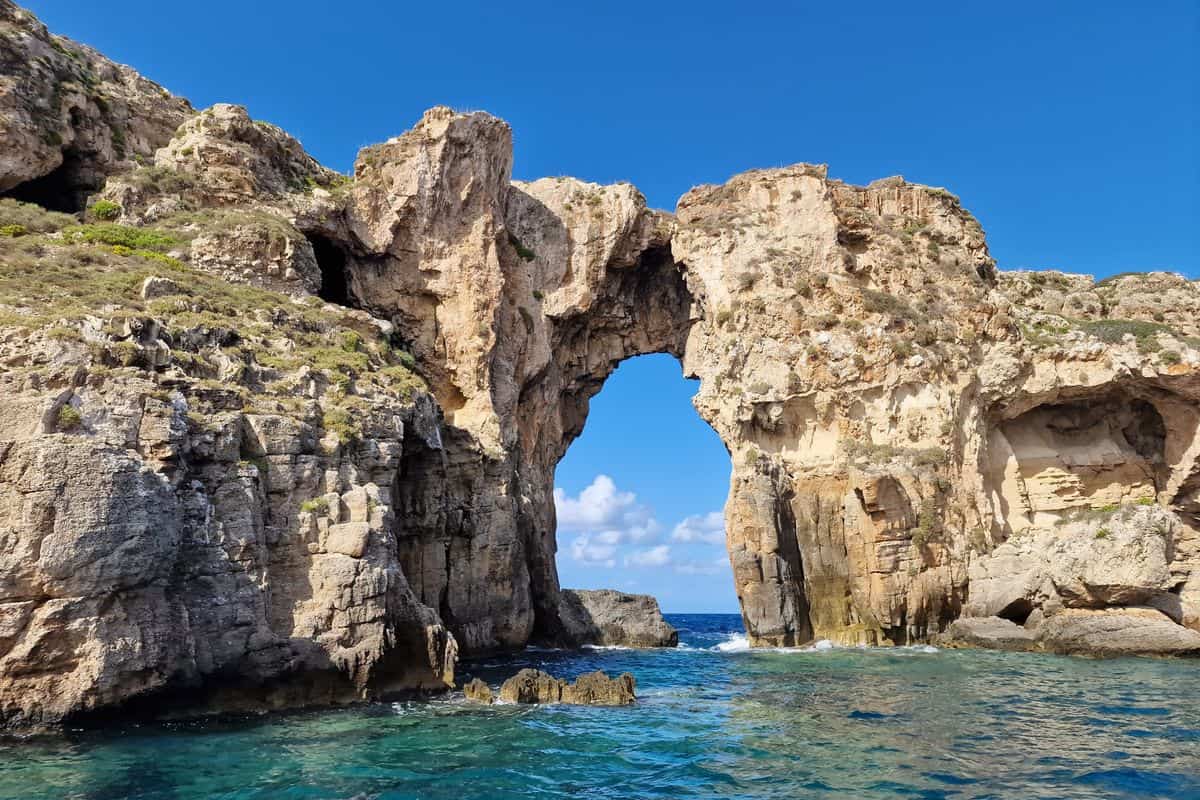
Pylos tours by boat stop at Tsichli Baba, called Fanari after its lighthouse, which first operated in 1873. The islet sits at the entrance to the bay off the southern tip of Sphacteria, and its landmark is a rock gateway called Trypito. From a small jetty, 140 stone steps climb to the French monument of 1890, with views east to Pylos and the Niokastro. Chelonaki, a flat islet in the middle of the bay, has its own jetty and the British monument.
Sphacteria is a narrow island of 3.2 square km that shields the bay as a natural breakwater. Since October 2010 it has been a Natura 2000 site for wintering and migrating birds such as little egrets, great egrets and glossy ibises. Ashore stand a monument to the Italian philhellene Santorre di Santarosa and a wooden church of Agios Nikolaos that Russians built in 1997. Further sea trips on Pylos tours:
- Diving: the sunken tanker Irenes Serenade forms an underwater park in Navarino Bay, the first of three in the municipality and ready for visits.
- Sapientza: the island opposite Methoni shelters kri-kri goats, mouflon and arbutus trees up to 12 m tall, and its lighthouse, built by the British in 1885, shines for 28 miles.
- Column wreck: reddish granite columns lie at a depth of about 10 m off Cape Karsi, the north cape of Sapientza, where the Ephorate of Underwater Antiquities has worked since 1962.
- Methoni beach: shallow sand and pebbles below the castle, safe for small children near the walls on windy days, while kite and wind surfers gather further round the bay.
Each 17 July, the faithful cross from the Messinian shore to the islet of Agia Mariani for the feast of its chapel of Agia Marina.
How do visitors reach Pylos for Pylos tours?
Pylos tours use Kalamata International Airport (KLX), 9 km west of Kalamata beside the EO82 road to Pylos. Pylos lies 55.5 km south-west of Kalamata and 274 km from Athens, less than an hour from Kalamata and two hours more to Athens.
The airport opened in 1959 and carries the name of Captain Vassilis Constantakopoulos. Aegean Airlines set up a base there in March 2013, and flights arrive mainly in summer. The Hellenic Air Force shares the runway with civil aircraft. Ground links are car, taxi or bus; the bus stop sits close to the terminal, and the ride to Kalamata takes 20 to 25 minutes.
The western end of the EO82 lies in the centre of Pylos, and the road runs east to Kalamata and Sparta. Kalamata meets the EO7 to the west, and the motorway from Tripoli to Kalamata is complete. Pylos tours by car from the north follow National Road 9, which runs from Patras through Kyparissia and ends at Methoni. Ways in for Pylos tours without a car:
- Coach: KTEL buses link Kalamata with Tripoli, Corinth and Athens on frequent services.
- Local bus: KTEL Messinias buses provide the main public transport links between the villages of Pylos-Nestor and the neighbouring municipalities.
- Cruise ship: cruise ships berth at the modern pier of Pylos in the summer season.
- Yacht: the marina of Pylos lies east of the port, and Navarino Bay serves as a shelter for ships during storms.
The drive west from Kalamata suits a Pylos day trip, and Kalamata airport transfers cover the road from the terminal to the start of Pylos tours.
When do Pylos tours run best?
Pylos tours run best from June to September, the dry season, when the Kalamata airport station records mean highs of 28.4 to 31.4 °C. Spring fills Methoni castle with wild flowers, and the Navarinia festival peaks in the Pylos harbour around 20 October.
The Hellenic National Meteorological Service station at Kalamata airport, the arrival point for Pylos tours, gives normals for 1971 to 2010. July averages a high of 31.3 °C and a low of 18.8 °C, with 6.0 mm of rain and 367.6 hours of sunshine. Methoni has hot, dry summers and mild winters, with a mean of 19.0 °C over the year. North winds blow from July to October.
Spring and autumn give Pylos tours cooler days: mean highs reach 19.9 °C in April and 24.3 °C in October. The municipal tourism guide points to autumn and winter for long walks and quiet visits to cultural sites. November and December are the wettest months, with over 141 mm of rain each. Dates on the calendar:
- Carnival: Koroni holds its large carnival parade on Tyrofagou Sunday, the second Sunday of the carnival season.
- 30 April: Methoni marks the naval battle of 1825 with a reenactment of the burning of the Egyptian fleet on the beach in front of the castle.
- June: the Koroni Arts Festival presents classical music, opera, dance evenings and visual arts.
- 7 July: Finikounda honours its patron, the Virgin Mary of Tricherousa, with a parade of the icon through the village.
- Around 20 October: the Navarinia bring Hellenic, British, French and Russian frigates and old sailing ships to the port of Pylos, with a sound and light show and fireworks.
Frequently Asked Questions
Which local food do Pylos tours taste in Koroni?
Pylos tours to Koroni reach one of seven emblematic communities for the Mediterranean Diet, which UNESCO lists as Intangible Cultural Heritage. Local shops sell Koroneiki olives and olive oil, local wines and raisins. Fish taverns, cafes, pastry shops and ouzeries line the waterfront and its pier, and the parallel street, Kato Dromos, is full of shops.
What wildlife do Pylos tours meet around Sapientza?
Sapientza, Schiza and Cape Akritas, all in the Natura 2000 site GR2550003, hold 29 important vertebrate species besides birds. The Mediterranean monk seal and the loggerhead turtle Caretta caretta rank as endangered in the Greek Red Data Book, and the greater horseshoe bat ranks as vulnerable. The protected fauna around Finikounda also includes the green turtle.
Do Pylos tours run in winter?
Pylos tours continue in winter, when January at Kalamata airport averages a high of 14.7 °C and a low of 5.4 °C. On Theophany, 6 January, residents of Pylos, Methoni, Koroni and Finikounda gather for the blessing of the waters. In Pylos, a procession heads to the sea near Nestor Square for the immersion of the Cross.
Which catacombs do Pylos tours pass near Methoni?
The Early Christian cemetery of Agios Onoufrios lies on the slope of Mount Agios Nikolaos, north of Methoni. Its six rock-cut chambers hold arched wall tombs and pit graves, used up to the 6th century. Pylos tours reach it by a turn at the second kilometre of the Methoni to Pylos road, then a walk.