
Delphi with Kids
Delphi is a rewarding place to visit with children: an open-air archaeological site that reads as an adventure, with a real ancient theatre to sit in, a stadium to run down, the bronze Charioteer and the winged Sphinx in the cool museum, and the dramatic myths of Apollo and the oracle to bring every stone alive. Plan the whole trip with Greece Tours.
This family guide covers Delphi with kids in full: what children enjoy most and how to prepare them, the archaeological site and the climb, safety and practical tips, the museum and the myths, family tours and activities, how long to spend, the day-trip-versus-overnight question, what to pack, where to eat and stay with children, and the kid-friendly places nearby.
Is Delphi good to visit with kids?
Delphi is an excellent visit with kids because it is an open-air archaeological site that reads as an adventure: a real ancient theatre and stadium to explore on foot, the bronze Charioteer and a winged Sphinx in the museum, and the dramatic myths of Apollo and the oracle that bring every stone alive.
The site climbs the slope of Mount Parnassus in a series of terraces, so children move from the Sacred Way past the Treasury of the Athenians up to the Temple of Apollo, then higher to the theatre, and highest of all to the stadium. Each level rewards the climb with a new structure to name and a new view down the ravine toward the sea of olive trees at Itea. The path is a sequence of discoveries rather than a single monument behind a rope, and that suits the way children explore.
The Delphi Archaeological Museum sits beside the entrance and holds the finds that make the myths concrete. The Charioteer of Delphi stands at eye level with his inlaid glass-and-stone eyes intact, the Naxian Sphinx perches on her tall column, and the twin statues of Kleobis and Biton face young visitors directly. The rooms are cool, the labels are short, and the walk through them takes a manageable stretch before the outdoor climb begins.
The story of the place carries a child through the ruins. Apollo killed the serpent Python here and claimed the sanctuary, the priestess called the Pythia gave riddling answers to kings, and two eagles released by Zeus met above this exact spot to mark the centre of the world. For a full picture of why the site earns its reputation, the guide to whether Delphi is worth visiting sets out the case, and the Delphi destination hub maps the wider region for a family day out.
What will children enjoy most at Delphi?
Children enjoy running the full length of the ancient stadium, sitting in the stone theatre and testing its acoustics, spotting the Charioteer’s preserved glass eyes and the winged Sphinx in the museum, and hearing the myths told on the exact spot where they happened.
The stadium sits at the top of the sanctuary, cut into the mountainside, with stone starting blocks still set in the track and tiers of seats along one side. It hosted the running races of the Pythian Games, and the flat track invites children to line up at the marks and run the distance the ancient athletes ran. The climb to reach it also delivers the widest panorama on the site, so the effort pays off twice.
The theatre stands just below the stadium, above the Temple of Apollo. Thirty-five rows of limestone seats curve around the stage, and a word spoken from the centre carries clearly to the back. Children sit where spectators watched dramas and choral songs during the games, look straight down over the temple columns, and hear how the shape of the bowl gathers sound. The moment of standing at the centre and being heard from the top row lands with every age.
The museum rewards close looking, and a short list keeps young eyes busy:
- The Charioteer of Delphi, whose eyes of white stone and dark glass survive in his bronze face.
- The Naxian Sphinx, a winged lion with a woman’s head, seated on a column taller than an adult.
- The silver bull and the two gold-and-ivory statues recovered from a pit beneath the Sacred Way.
- The omphalos stone, the carved marker that named Delphi the navel of the world.
Hearing each myth at the place it belongs to fixes it in memory. The tale of the oracle told in front of the Temple of Apollo, the eagles of Zeus explained beside the omphalos, and the games recounted from a seat in the stadium turn a walk through ruins into a story the children help tell.
How do you prepare children for a visit to Delphi?
You prepare children by telling the myths before you go: Apollo slaying the serpent Python, the priestess who spoke in riddles, and the two eagles that met at the centre of the world. Then you turn the site into a treasure hunt for the temple, the theatre and the stadium.
The three core stories do the groundwork. Apollo came to the slopes of Parnassus, killed the great serpent Python that guarded the spring, and founded his sanctuary on the spot. His priestess, the Pythia, sat over a cleft in the rock and answered questions from kings and cities in riddles that demanded careful reading. Zeus released two eagles from opposite ends of the earth, and they crossed above Delphi, which fixed the place as the omphalos, the navel of the world, marked by a carved stone kept in the museum.
A treasure hunt gives the visit a spine. Set three targets before the gate: find the Temple of Apollo where the oracle spoke, find the theatre where a whisper carries, and find the stadium at the very top where the races ran. Add the museum finds as bonus finds, the Charioteer and the Sphinx and the omphalos, and let each child mark them off as the family climbs. The structure turns a long uphill walk into a run of small wins.
Practical readiness keeps the day steady. The site is a continuous ascent on uneven stone, so children wear closed shoes with grip and carry water, since the terraces hold the sun. Start at the museum while legs are fresh, then walk the Sacred Way and climb to the stadium, and name the buildings aloud as you reach them so the myths and the map lock together. A child who arrives knowing Apollo, the Pythia and the eagles reads the ruins as a story already begun.
What is the archaeological site of Delphi like for children?
The site is a single rising path that reads to children as a mountain adventure: the Sacred Way climbs past the treasuries to the Temple of Apollo, then the theatre, then the stadium at the very top, so every monument is a new stage reached by gaining height.
Children enter at the bottom gate and follow the Sacred Way, a zig-zag paved lane that switchbacks up the slope of Mount Parnassus. The first stretch passes the bases of votive monuments and the reconstructed Treasury of the Athenians, a small marble building that looks like a doll-sized temple. Framing this first block as the start of a quest gives young walkers a target: reach the little marble house, then keep climbing.
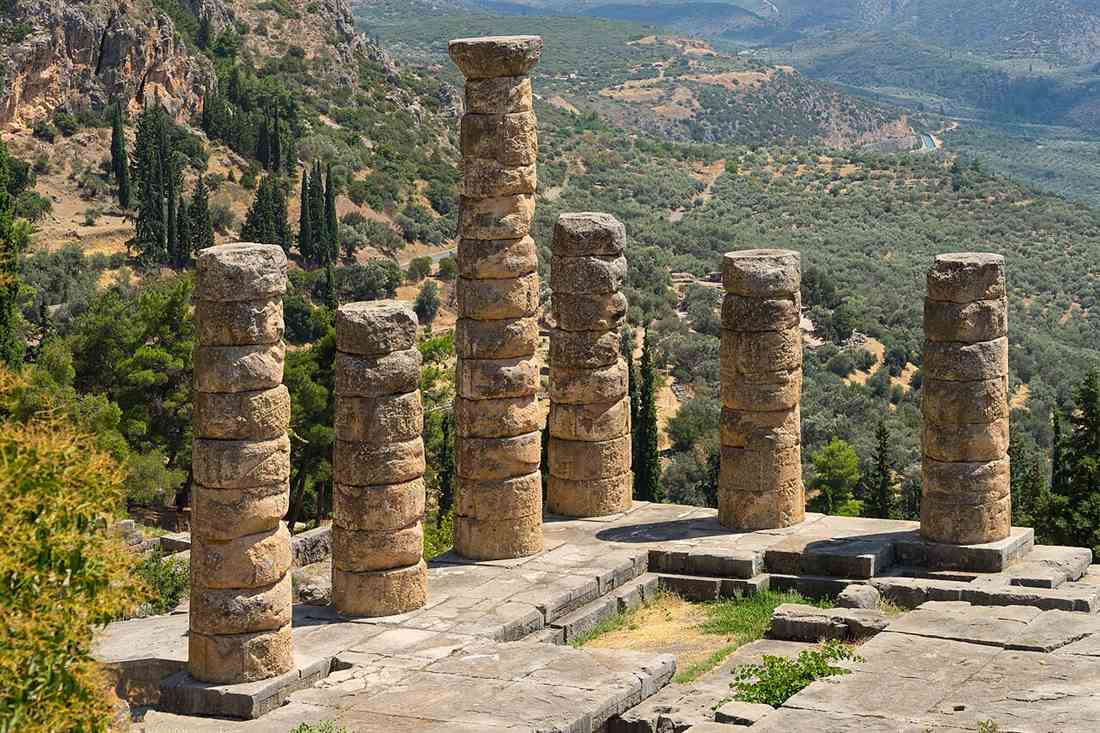
Above the treasuries the path opens onto the Temple of Apollo, the largest platform on the mountain and the home of the ancient oracle. The six standing columns give children a clear landmark and a natural halfway marker. From the temple terrace the whole valley of olive trees drops away toward the sea at Itea, and the view rewards the effort of the first climb.
Past the temple the ground keeps rising to the theatre, carved into the hillside with tiered stone seats that children climb like giant steps. The final push reaches the stadium at the top, a long flat running track ringed by seating where the ancient Pythian Games were held. Standing on the start line of a stadium older than most cities turns the whole visit into a story with a summit at the end. Reading the monuments in order on a guided Delphi tour gives children a running narrative that ties each stage to a myth.
Is the climb at Delphi manageable with young children?
The climb is manageable with pacing and a back carrier. The stepped path is steep and the marble is uneven, so families rest at the theatre, carry toddlers on their backs rather than push a stroller, and turn back early at the temple when small legs tire.
The route from the entrance to the stadium gains height across the full flank of the mountain, and the surface changes constantly between paved slabs, worn marble steps, and loose gravel. A stroller does not work on this ground: the steps and the gradient stop wheels within the first section. A back carrier keeps a toddler secure and leaves the adult’s hands free on the polished stone.
Older children walk the whole climb at their own speed. Breaking the ascent into segments keeps it comfortable: the treasuries, then the temple, then the theatre, then the stadium, with a proper rest at each. The theatre makes the best mid-climb stop, because the tiered seats give a place to sit, water, and look back down the valley before the last stretch to the top.
Families with the youngest walkers turn back at the Temple of Apollo and skip the theatre and stadium without losing the heart of the visit, since the temple holds the oracle and the finest views. The path is two-way, so the descent retraces the same route, and going down the marble steps needs the same slow footing as going up. Timing the walk for cooler morning hours makes the gradient far easier, and the guidance on the best time to visit Delphi sets out which slots keep the climb pleasant.
What safety and practical tips help at Delphi with kids?
The site sits on an open mountain slope with strong sun, little shade, unfenced drops at the edges of the terraces, and stone polished smooth by centuries of feet. Keeping children close, hydrated, and hatted covers the main risks across the visit.
The sun is the first concern, because the Sacred Way and the temple terrace carry almost no shade through the middle of the day. Hats, sunscreen, and full water bottles filled at the entrance keep children cool on the exposed climb. The taps and toilets sit at the gate near the museum, so families use them before starting up, as there are none higher on the mountain.
The terraces are the second concern. Many platforms end in open drops to the level below with no railing, and the retaining walls fall away sharply on the outer edge of the path. Children stay on the inner side of the Sacred Way and away from the edges of the temple platform and the theatre seating, where a slip runs downhill. The stone itself is the third concern: centuries of feet have polished the marble to a slick finish that turns dangerous in the rain or the early-morning damp, so grippy closed shoes replace sandals.
- Fill water bottles and use the toilets at the entrance, since neither exists higher up.
- Wear hats and sunscreen against the shadeless sun on the open terraces.
- Keep children on the inner side of the path, away from the unfenced drops.
- Put children in closed, grippy shoes for the polished, slippery marble.
- Hold hands on the steep steps and at the edges of the temple and theatre.
Planning the route in advance closes off the remaining risks. Families agree a meeting point at the temple in case a child runs ahead on the wide platform, carry a small snack for the climb, and set a turnaround time so tired children head down before the light drops. A slow, well-watered pace keeps the whole ascent safe from the gate to the stadium.
Is the Delphi Archaeological Museum good for children?
The Delphi Archaeological Museum suits children well: it is compact, cool, and air-conditioned, and its greatest treasures stand at or near child eye height. A focused visit of forty to sixty minutes covers the famous pieces without tiring young legs or short attention spans.
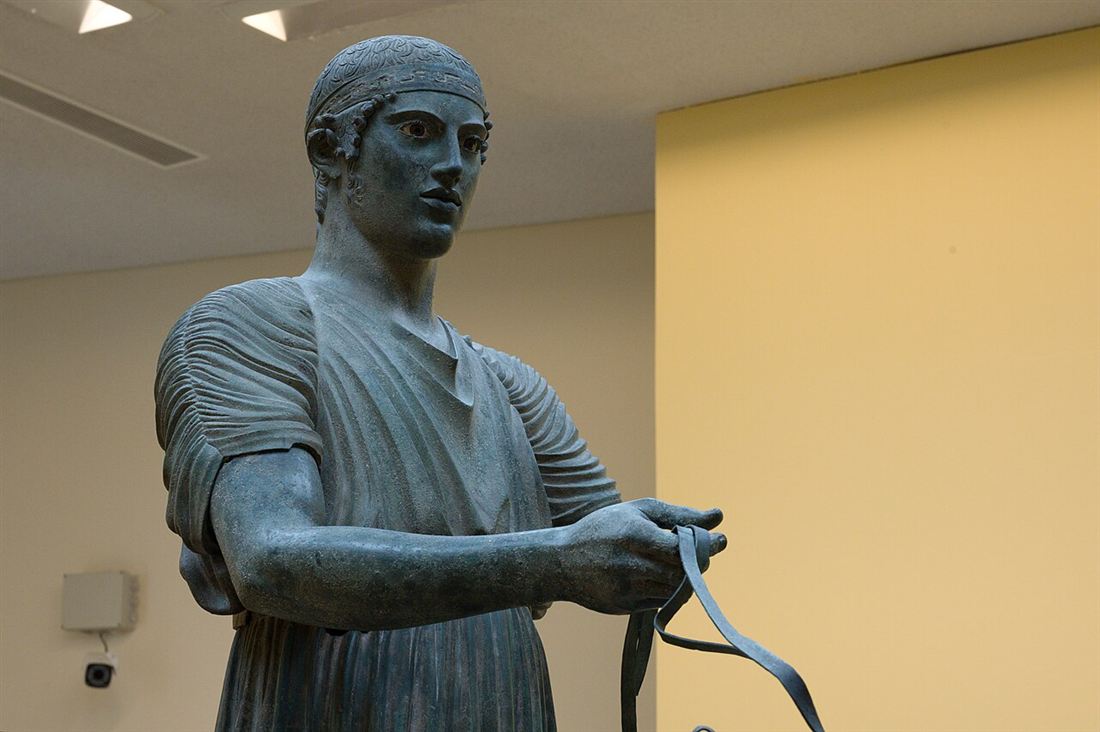
The star of the collection is the life-size bronze Charioteer of Delphi, who has kept his inlaid glass-and-stone eyes and his copper eyelashes for two and a half thousand years. Children lock onto that steady gaze at once, because the eyes look wet and alive. Point out his fingers curled around the missing reins, the delicate folds of his tunic, and the veins raised on the backs of his hands. Ask a child to find where the horses and chariot broke away, and the statue turns from an object into a puzzle.
Around the Charioteer sit four more pieces that hold a young visitor. The winged Sphinx of Naxos, a lion-bodied woman who once perched on a tall column, greets children with her ancient half-smile. The twin kouroi, two broad-shouldered brothers carved in stone, stand side by side like giant action figures. A small silver bull, hammered from sheet metal over a wooden core, gleams in its own case, and the carved omphalos stone, a beehive-shaped rock the Greeks called the navel of the world, gives a story a child grasps in one sentence.
Keep the visit to the highlights and skip the rooms of pottery fragments and inscriptions that dull young interest fast. Walk straight to the Charioteer, linger there, then loop back past the Sphinx, the kouroi, the silver bull, and the omphalos on the way out. The Delphi Archaeological Museum has clean toilets, benches, and a shaded café by the entrance, so a family rests before or after the exhibits rather than pushing through hot galleries with a fading child.
Which Delphi myths capture children’s imagination?
The Delphi myths grip children because they mix monsters, riddles, and clever tricks. The young god Apollo kills a giant serpent to seize the oracle, a priestess breathes strange vapours and speaks in riddles, two eagles mark the centre of the world, and the god’s answers fool proud kings.
Start with Apollo and the serpent Python. The great snake guarded the slopes of Delphi and terrorised the land, so the archer god Apollo shot it dead with his silver bow and took the sanctuary for himself. Children picture the arrows flying and the coils thrashing on the very ground beneath their feet, which turns the whole hillside into the scene of the battle. The name Pythia, the title of Delphi’s priestess, comes straight from the serpent Python, and pointing that out links the monster to the woman who prophesied.
Then tell the story of the Pythia herself. She sat over a crack in the rock, breathed the vapours that rose from below, fell into a trance, and answered questions from kings and farmers alike, always in riddles that a priest wrote down as verse. Add the two eagles: Zeus released one bird from the east and one from the west, and they flew toward each other and met exactly over Delphi, marking it as the navel of the whole earth. That is the moment the omphalos stone in the museum records.
The riddling answers make the best stories of all, because the oracle tricks the mighty and the greedy. Kings marched to war on prophecies that pointed both ways at once, and their pride filled in the wrong meaning:
- King Croesus asked whether to attack, heard that a great empire was fated to fall, and destroyed his own empire instead of his enemy’s.
- Athens learned that a wooden wall alone was its safety, and the citizens argued whether the wall meant a fence or the planks of their warships.
- Oedipus received a warning he ran from, and by running he walked straight into the fate the oracle named.
- Warriors asked which side wins, and the answer named a victor without saying which army it belonged to.
Are there tours, guides, or activities for kids at Delphi?
Delphi offers family-friendly guided tours pitched at children, an official site audio guide, and drawing and treasure-hunt sheets that turn the ruins into a game. A private guide who paces the visit to a child’s attention span delivers the best experience for a young family.
Several operators run guided tours built for families, where the guide swaps dates and architectural terms for the monsters, gods, and riddles that children remember. A good family guide sets small missions along the Sacred Way: spot the treasury shaped like a tiny temple, find the round stones of the tholos, count the steps of the theatre, and stand where the runners lined up in the stadium. These missions keep a child moving forward and give the adults the history at the same time.
For families exploring on their own, the site sells an audio guide, and many parents load a children’s audio story about Apollo and the Pythia onto a phone with headphones instead. A treasure-hunt sheet, either printed at home or supplied by a tour, sends children hunting for the omphalos, the Sphinx, the Charioteer, and the carved inscriptions, ticking each one off as they go. A small sketchbook and pencil work the same magic in the museum, where a child who draws the Charioteer’s eyes studies him far longer than a child who only looks.
Pace matters more than coverage with young children. A private guide adjusts the route on the spot, cuts the walk short when energy drops, adds a snack stop in the shade, and lingers only on the pieces that spark real questions. Book the tour for the first slot after opening, when the light is soft and the stones stay cool, keep the whole visit to about two hours across the site and the museum, and end at the café rather than dragging a tired child back up the hill for one more ruin.
How long do you need at Delphi with kids?
Families need about two to three hours at Delphi to cover both the archaeological site and the museum at a child’s pace. A half day is the comfortable maximum before attention fades, and splitting the site and the museum with a break in between keeps young visitors engaged throughout.
The walk up the Sacred Way to the Temple of Apollo, the theatre, and the stadium takes an hour to ninety minutes with children, because their legs are shorter and they stop often to look at lizards, loose stones, and the mountain drop below. The path climbs steadily on uneven marble and packed earth, so a toddler covers the distance far slower than an adult. Building in time to pause, drink water, and point out the ruins turns the climb into part of the fun rather than a march to the top.
The Delphi Archaeological Museum holds attention for forty-five minutes to an hour with kids. The bronze Charioteer, the twin statues of Kleobis and Biton, and the silver bull draw children in, and the air-conditioned halls give everyone a rest from the sun. Set a small goal for each room, such as counting animals carved into the marble, and the visit holds together.
Splitting the day works well for families with younger children. Tour the open-air site first, before the midday heat peaks, then break for a snack and a cold drink in the village, and finish in the cool museum afterward. This order matches a child’s energy, front-loading the harder climbing while legs are fresh and saving the calmer indoor visit for the tired afternoon stretch.
Is a Delphi day trip from Athens good for families, or is an overnight better?
A Delphi day trip from Athens works for families with older children, but the drive runs roughly three hours each way through the mountains, adding up to six hours in the car in one day. An overnight in Delphi village or Arachova breaks that drive, gets you on site early, and gives children a slower pace.
The road from Athens climbs from the plain up the flanks of Mount Parnassus, and the switchbacks tire drivers and unsettle children prone to motion sickness. A guided Delphi day trip from Athens handles the driving and the timing, which lifts a heavy load off parents, though the total distance keeps the day long and the return leg arrives back in the city after dark. Older kids who nap in the car or watch the scenery cope with the round trip; toddlers and preschoolers strain against six hours of seat time.
An overnight solves the timing problem. Staying in Delphi village or nearby Arachova puts families minutes from the entrance, so you reach the site at opening, before the tour buses and before the heat. Children explore the ruins in the cool early light, and there is no clock ticking toward a long drive home. The village itself, perched on the slope with views over the olive valley to the Gulf of Corinth, gives kids somewhere to run in the evening.
Arachova, fifteen minutes uphill, adds a mountain-town base with tavernas, cobbled lanes, and a relaxed pace that suits a family evening. Splitting the trip across two days turns a rushed dash into a proper break: the site one morning, the museum and the village the next, and time to build a full one day in Delphi without the fatigue of bookending it with mountain driving. For families with small children, the overnight is the calmer choice.
What do families pack for a day at Delphi?
Families pack water bottles, sun hats, and high-factor sun protection for the exposed slope, plus snacks, closed grippy shoes for the marble, a back carrier for toddlers, and a small notebook to run a treasure hunt. The site offers little shade, so sun and water lead the list.
Delphi sits on an open mountainside with almost no cover along the Sacred Way, and the marble and stone reflect the heat. Refillable water bottles matter because the climb is thirsty work and the on-site kiosk stocks are limited; parents top up before entering. Wide-brimmed hats and high-factor sunscreen protect small faces through the middle of the day, when the sun hits the terraces hardest.
- Water bottles, one per person, filled before you start the climb
- Sun hats and high-factor sun protection for the shadeless slope
- Snacks such as fruit, crackers, and nuts to refuel between terraces
- Closed, grippy shoes for the worn, slippery marble underfoot
- A back carrier for toddlers who tire on the uphill path
- A small notebook and pencil for a ruin-spotting treasure hunt
Closed shoes with grip protect small feet on the ancient paving, which is polished smooth in places and treacherous in sandals. A soft-structured back carrier saves the day with a toddler, since strollers do not roll up the steps and rubble of the Sacred Way. Snacks keep energy steady across the terraces, and eating them at a viewpoint turns a rest stop into a highlight.
The notebook powers a treasure hunt that carries children up the whole site. Write a short list before you go: find a column, a lion, an inscription, the round tholos, the theatre seats, the starting line of the stadium. Children tick each one off as they climb, and the game pulls them past the point where a plain walk loses them. This one item turns the ruins from a lecture into a quest.
Where do families eat near Delphi with children?
Families eat in the tavernas that line Delphi’s main street, Vasileon Pavlou kai Friderikis, where kitchens plate grilled chicken, pork souvlaki, chips, fried cheese pies and tomato pasta beside the mountain dishes, so children order the familiar plates while parents work through the local menu.
The village runs on two parallel streets stacked into the hillside, and the tavernas sit on the lower one with their dining rooms and balconies hanging over the Pleistos ravine toward Itea and the sea. A child eats a plain grilled chicken fillet with lemon potatoes; the next chair gets lamb kleftiko baked in paper, wild greens gathered on Parnassus, and formaela cheese from nearby Arachova seared until it crusts. Bread, tzatziki, and a bowl of chips reach the table within minutes of sitting down, which settles restless kids before the mains arrive.
Portions land big and prices stay village-level rather than tourist-strip level, and most kitchens split a single adult plate across two small children without a fuss. The staple orders that keep children fed cover:
- Chicken or pork souvlaki on the skewer, pulled off for younger eaters
- Pasta with tomato sauce or plain butter and grated cheese
- Tyropita and spanakopita, the cheese and spinach pies baked in filo
- Meatballs (keftedes) with a side of hand-cut fried potatoes
- Greek yogurt with Parnassus honey and walnuts for dessert
Book an early table, from six in the evening, and the room stays quiet enough for a stroller and calm enough for a tired child. Grab a balcony seat and the valley falls away below the railing while the olive groves of Amfissa turn silver at dusk, which holds a child’s attention through a long Greek dinner. Tap water arrives free in a jug, high chairs sit ready at the family-run rooms, and the walk back uphill to a guesthouse runs a few flat minutes along the same street.
Where do families stay in Delphi with kids?
Families stay in the small family-run guesthouses inside Delphi village, where balcony rooms face the gulf, breakfast comes included, and the archaeological site sits a flat ten-minute walk east; larger hotels and the stone town of Arachova add pools, suites, and space for a longer base.
Delphi village packs its lodging into the two terraced streets, so a guesthouse room opens onto the same valley view the ancient pilgrims climbed toward. The family-run places give parents interconnecting or triple rooms, cots on request, and a breakfast spread of local yogurt, honey, eggs, cheese pies, and fresh bread that fuels a morning at the ruins. Staying in the village itself means the site, the museum, the tavernas, and the bus stop all sit within a stroll, so a family drops the car and covers everything on foot. Our guide to where to stay in Delphi maps the village guesthouses against the larger hotels and the Arachova options.
Arachova, the stone mountain town, sits fifteen minutes east and runs bigger. Its hotels bring indoor pools, spa rooms, fireplaces, and family suites built for the ski crowd that fills Parnassus in winter, so the town works as a warmer, roomier base than the village for a two-night or three-night stay. Down on the coast, Galaxidi and Itea add seaside hotels with gardens and easy parking, trading the mountain view for a harbor walk and a swim.
Basing overnight, rather than running Delphi as a day trip from Athens, slows the whole pace. A family reaches the site gates at opening, before the tour coaches climb the mountain road and before the summer heat builds on the exposed terraces. The afternoon then empties into a taverna lunch, a nap, and a cool evening at the museum, and the children walk the Sacred Way rested instead of hauled through it against a three-hour drive home.
What kid-friendly places are near Delphi?
Kid-friendly stops near Delphi cluster within a short drive: the stone town of Arachova and the Parnassus snow in winter, the Corycian Cave hike above the plateau, the Corinthian Gulf beaches at Galaxidi and Itea, and the gold mosaics of Hosios Loukas monastery on the road back.
Arachova, fifteen minutes east, stacks stone houses up a slope with a clock tower, weaving shops selling wool blankets, and a bakery turning out the town’s formaela cheese and honey. In winter the Parnassus ski center opens above it, and families ride the lifts, rent sledges, and turn a Delphi trip into a snow day. The Corycian Cave (Korykion Antron) sits higher on the same mountain, a walk from the Parnassus plateau into a huge stalactite chamber that the ancient Greeks gave to the god Pan and the nymphs, and older children handle the marked trail with a torch and sturdy shoes.
Down at sea level, the Corinthian Gulf gives Delphi its beaches. Galaxidi, a captains’ town of neoclassical mansions around a double harbor, lets kids swim off pebble coves and eat fish by the water; Itea spreads a longer town beach a fifteen-minute drive straight down from Delphi through the largest olive grove in Greece. A morning at the ruins pairs cleanly with an afternoon swim, which resets young legs after the climb through the site.
On the drive between Delphi and Athens, the monastery of Hosios Loukas rewards a half-hour stop. Its two linked churches, set among the almond trees below Mount Helicon, hold Byzantine mosaics laid in gold glass and a crypt painted with saints, and children clock the shine of the domes and the resident cats in the courtyard even before the art registers. Our page on Hosios Loukas monastery covers the visit, the modest dress rule, and the timing that folds it into a Delphi day.
What ages of children is Delphi suitable for?
Delphi rewards every age from toddlers to teenagers. Toddlers ride in a back carrier and delight in the open mountain space and the shining bronzes, primary-school children chase myths and race the stadium, and teenagers grasp the real power of the oracle.
Toddlers travel best in a sturdy back carrier, since the stone paths defeat strollers. From that high seat a small child watches the valley of olive trees drop away toward the sea and points at the museum’s gleaming statues. The cool marble halls, the echo of footsteps and the giant bronze Charioteer hold a toddler’s attention while parents read the labels. Short visits suit this age, so families walk the lower terraces, rest at the museum benches, and leave before tiredness arrives.
Primary-school children reach Delphi at the perfect age. They already know dragons and monsters, and here Apollo kills the serpent Python and founds his sanctuary on the spot. These children run the ancient stadium track where real athletes once sprinted, hunt for carved lions and columns like treasure, and ask the priestess questions in their heads. The oracle of Delphi becomes a living game rather than a dusty ruin, and the climb turns into an adventure up the mountain of the gods.
Teenagers connect to the history itself. They stand where kings and generals sent messengers for advice that decided wars, colonies and constitutions across the ancient Mediterranean. The idea that one mountain shrine steered the choices of an entire civilization lands with force at this age. Teenagers read the inscriptions, photograph the Tholos, and debate whether the priestess spoke truth or theatre.
- Toddlers: the back-carrier view, open space, and the museum bronzes.
- Primary-school children: the monster-and-oracle myths, the stadium sprint, and treasure-hunting for carvings.
- Teenagers: the real history of an oracle that steered the ancient world.
How do you combine Delphi with kids into a wider family trip in Greece?
Delphi anchors a central-Greece family loop that balances ruins, myths, mountains and sea. Families pair it with the Acropolis and museums of Athens, the rock monasteries of Meteora to the north, and the calm beaches of the Corinthian Gulf across several unhurried days.
Athens starts the route. The Acropolis gives children the temple on the hill they recognize from books, and the Acropolis Museum lays out the same gods and heroes they meet at Delphi. Two days in the capital fix the mythology in their minds, so the drive west to Delphi builds on names and stories they own. The mountain road climbs through olive groves and delivers the sanctuary as the reward at the top.
North of Delphi the landscape changes to towering pillars of rock. The monasteries of Meteora perch on stone towers that astonish children, and the cliffs, caves and switchback roads turn the transfer into part of the adventure. Families spend a night near Kalambaka, watch the sunset paint the rocks gold, and let children scramble the viewpoints under supervision.
The Corinthian Gulf closes the loop with water and rest. The seaside town of Galaxidi below Delphi and the beaches along the coast road give children the swim they earn after the ruins. A family route through central Greece runs Athens, Delphi, Meteora and the gulf in five to seven days, alternating a morning of history with an afternoon of play, so ruins, myths, mountains and sea each get their turn.
Do children need a ticket for Delphi, and what does a family visit cost?
Children under 18 enter the Delphi archaeological site and museum free on proof of age, so a family pays only for the adults. A single combined ticket covers both the site and the museum, and entry is free for everyone on the first Sunday of each winter month.
The Greek state sets one admission policy across its archaeological sites, and Delphi follows it. Visitors under 18 enter free, and they carry a passport or identity card to prove their age at the gate. Young adults from European Union countries aged 18 to 25 enter at a reduced rate on proof of citizenship and age. A family with two adults and three children therefore pays two adult tickets and nothing for the children.
One ticket covers the whole visit. The combined ticket admits the holder to the archaeological site and to the Delphi Archaeological Museum together, so a family buys a single pass rather than paying twice. The combined ticket costs less than two separate entries and keeps the purchase to one step at the gate or online. Buying ahead of a busy summer morning skips the queue at the booth with restless children in tow.
Free days lower the cost further. Entry to the site and museum is free for every visitor on the first Sunday of November, December, February and March, and on several national holidays across the year. Families travelling in the quiet cold months pair the free Sunday with the emptiest terraces of the calendar. Current entry fees, the combined-ticket price and the free-admission dates sit on the Delphi tickets guide, so a family checks the figures before setting the budget for the day.
Beyond the ticket, a family day at Delphi carries small extra costs to plan for: parking at the site gate, water and snacks, lunch in the village, and an optional guide or audio guide. None of these apply to the children’s entry, which stays free, so the admission line of a family budget covers the adults alone. The saving on children’s tickets offsets the fuel or the tour seat that carries the family up the mountain from Athens.
Frequently Asked Questions
Is Delphi worth visiting with kids?
Yes. Delphi is an open-air site children explore as an adventure, with a theatre to sit in, a stadium to run, the bronze Charioteer and winged Sphinx in the museum, and monster-and-riddle myths that hold young attention. An early start and a two-hour pace suit families best.
How long do you need at Delphi with children?
About two to three hours covers the archaeological site and the museum at a child’s pace, a comfortable half day before attention fades. Splitting the site and the museum with a shaded break between keeps young visitors fresh.
Is Delphi suitable for toddlers and strollers?
A stroller does not work on Delphi’s stepped, uneven marble paths, so a back carrier suits toddlers far better. The lower terraces and the museum stay reachable, and families pace the climb with rests at the theatre rather than pushing to the stadium.