
Hosios Loukas Monastery
Hosios Loukas, also spelled Osios Loukas, is a walled Byzantine monastery near Distomo in central Greece, a UNESCO World Heritage site that holds the finest surviving middle-Byzantine mosaics in the country. Its two linked churches stand on a slope of Mount Helicon, about thirty-five kilometres east of Delphi, a natural stop on a Delphi day trip. Plan the whole trip with Greece Tours.
This guide covers Hosios Loukas monastery in full: what it is and where it stands, how to get there from Delphi, its history around the hermit Saint Luke, what you see inside the Katholikon, the crypt and the Church of the Theotokos, why its gold-ground mosaics matter, and how to visit today and pair the monastery with the sanctuary of Delphi.
What is Hosios Loukas monastery?
Hosios Loukas is a walled Byzantine monastery near Distomo in Boeotia, central Greece, and a UNESCO World Heritage Site. It holds the finest surviving middle-Byzantine mosaics in Greece, set across two linked churches on a green slope of Mount Helicon.
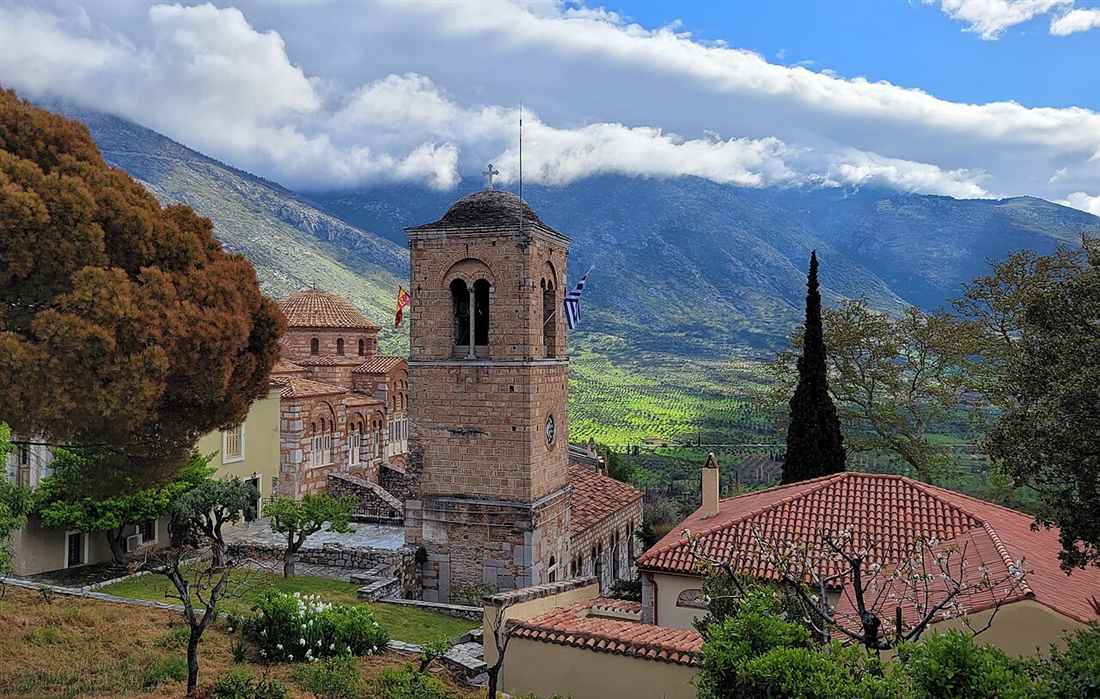
The complex pairs two churches under one roof. The larger Katholikon, dedicated to Saint Luke of Steiris, rises as a domed cross-in-square crowned by a broad octagonal drum, its interior sheathed in gold-ground mosaics, coloured marble revetment, and carved screens. Beside it stands the smaller Church of the Theotokos, an earlier cross-in-square church whose brick-and-stone cloisonné walls carry Kufic-style ornamental bands along the exterior.
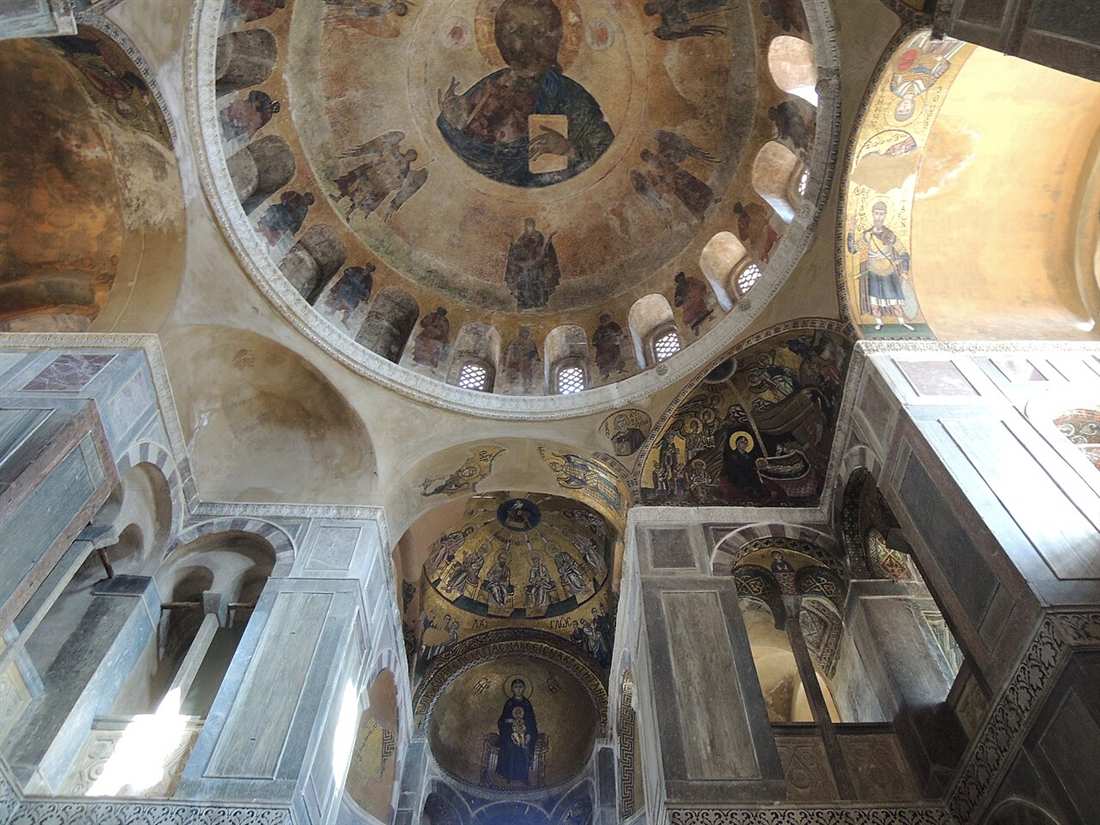
Inside the Katholikon the mosaics cover the narthex, the squinches, and the sanctuary. The Washing of the Feet, the Doubting of Thomas, the Anastasis, and ranks of standing saints look down from gold fields that catch the light through the drum windows. Where mosaic ends, fresco continues the programme into the crypt below, which shelters the founder’s tomb and further painted scenes.
The monastery keeps its monastic shape: a fortified enclosure, cells and refectory ranges, a bell tower, and terraces planted with cypress and almond. A working community still occupies part of the site, so the churches function as places of worship alongside their role as a museum-grade monument of Byzantine art.
Where is Hosios Loukas, and how do you get there?
Hosios Loukas sits above the village of Distomo in Boeotia, central Greece, about thirty-five kilometres east of Delphi. A signposted detour leaves the Delphi-Athens road and climbs to the gate. Arriving by car is the direct route, and the monastery is a frequent stop on a Delphi day trip.
From Delphi the drive runs east and south through Arachova and toward Distomo, where brown heritage signs mark the final ascent to the monastery terrace. From Athens the approach follows the national road toward Livadeia, then branches west to Distomo. Either way the last stretch is a quiet rural road across olive slopes, ending at a car park beside the enclosure wall.
Public buses reach Distomo village from Athens and Livadeia, but no scheduled service runs the final climb to the gate, so most visitors reach the monastery under their own transport. Drivers pairing the site with the oracle can plan the wider route through the Delphi sanctuary and its museum, then drop to Distomo on the way back.
The monastery works cleanly into a single itinerary out of the capital. A guided or self-drive Delphi day trip from Athens often threads Hosios Loukas into the loop, since the detour adds a short leg rather than a separate journey. Practical points for planning the visit:
- Nearest village: Distomo, with tavernas, fuel, and parking below the terrace.
- Distance from Delphi: about thirty-five kilometres by road, roughly a forty-minute drive.
- Access: private car or organised tour; no bus climbs to the gate.
- Dress: covered shoulders and knees for entry to the working churches.
What is the history of Hosios Loukas?
Hosios Loukas grew around Saint Luke of Steiris, a tenth-century hermit whose relics the monastery still holds. The Church of the Theotokos rose first, then the larger Katholikon was raised over his tomb, and the site now shares its UNESCO listing with Daphni and Nea Moni as the three great middle-Byzantine monasteries.
Luke of Steiris settled on this slope of Helicon as an ascetic and healer, and his reputation drew followers who formed a community around his cell. After his death the monks kept his tomb as the focus of the site, and pilgrims came for the cures reported at his relics. That cult supplied both the reason to build and the funds to build grandly.
The Church of the Theotokos went up in the tenth century as the first monumental church, a cross-in-square design whose patterned brickwork and marble screens set the tone of the enclosure. In the following century the community raised the far larger Katholikon directly over the founder’s grave, giving it the octagonal-domed plan and the mosaic and marble decoration that carry the saint’s shrine in the crypt beneath the main floor.
Across the centuries the monastery held its place as a pilgrimage centre and an artistic landmark, surviving earthquakes, repairs, and periods of decline while keeping its two churches and its relic intact. UNESCO inscribed it together with Daphni Monastery near Athens and Nea Moni on Chios, three sites whose shared architecture and mosaic programmes define the classic middle-Byzantine church and mark Hosios Loukas as a monument of the first rank.
What can you see at Hosios Loukas?
Hosios Loukas holds two churches joined side by side: the grand Katholikon crowned by a high dome of golden-ground mosaics over marble revetment and carved capitals, a painted crypt sheltering the tomb of Saint Luke, and the older Church of the Theotokos with its patterned brickwork.
The Katholikon rises as the centrepiece. Its broad dome sits on squinches above an octagonal nave, and gold mosaics of Christ, the Virgin and ranks of saints line the vaults and arches. Below the gleaming upper zones, the walls wear sheets of coloured marble revetment cut to mirror one another, framed by capitals carved with foliage and interlace. Light enters through the drum windows and moves across the gold as the day turns.
Beneath the main church lies the crypt, reached by a stair from the south side. This low, vaulted chamber guards the tomb of Saint Luke of Steiris, the hermit whose relics drew pilgrims to this slope of Mount Helicon. Wall paintings cover the crypt ceiling and lunettes with scenes of the Passion and portraits of monastic saints, a darker and more intimate counterpart to the radiant nave above.
Next to the Katholikon stands the Church of the Theotokos, the elder of the two. Its exterior shows cloisonne masonry, where each dressed stone is outlined by thin bricks, and bands of decorative brickwork and pseudo-Kufic ornament run along the walls. Together the buildings, the vaulted refectory, the bell tower and the terraced courtyard form a complete monastic ensemble set against the valley.
Why are the mosaics of Hosios Loukas important?
The gold-ground mosaics of Hosios Loukas rank among the finest middle-Byzantine art surviving in Greece, a complete decorative programme of Christ, the Virgin, saints and feast scenes that, alongside Daphni and Nea Moni, defines the art of its age and earns the monastery its UNESCO World Heritage listing.
The mosaics form a planned hierarchy across the interior. Christ Pantocrator once filled the central dome, the Virgin and Child sit enthroned in the sanctuary apse, and the feast scenes of the Christian year — the Nativity, the Baptism, the Anastasis — spread across the vaults and squinches. Full-length saints, monks and martyrs stand in the lower registers, each named in Greek script, so the whole nave reads as an ordered image of heaven and earth.
Set against continuous gold backgrounds, the figures gain weight and gravity. The tesserae are angled to catch and scatter light, so candle flames and daylight make the gold shift and glow as visitors move through the church. This interplay of gold and flame turns a static wall into a living surface, and it is the effect that later Byzantine churches across the empire sought to repeat.
Because the programme survives largely intact, Hosios Loukas serves as a benchmark for the eleventh-century style. Art historians read it beside the mosaics of Daphni near Athens and Nea Moni on Chios to trace how Byzantine masters composed sacred space. The three monasteries share the same UNESCO inscription, and Hosios Loukas preserves the most extensive mosaic and painting cycle of the group.
How do you visit Hosios Loukas today, and pair it with Delphi?
Hosios Loukas is a working monastery open to visitors for a small entrance donation, with covered shoulders and knees required inside the churches. It sits a short drive from Distomo, which makes it a natural stop on a Delphi day trip or on the road between Delphi and Athens.
Plan the practical side before you arrive:
- Opening hours run daily, with a longer afternoon closure in the hotter months and shorter hours in winter.
- Entrance is by a modest donation that supports the monastery and its upkeep.
- Dress modestly: shoulders and knees stay covered, and wraps are lent at the gate for those who need them.
- Photography without flash is permitted in most areas; the crypt asks for quiet and care.
- A shaded courtyard, a shop selling monastic products, and a small cafe sit beside the churches.
Reaching the monastery is simplest by car. From Delphi the drive runs east through the mountains past Arachova and Distomo, and the final approach climbs a quiet lane to the terraced complex. The calm of the site rewards an early or late visit, when tour coaches thin out and the interior falls silent enough to hear footsteps on the marble floor.
Slotting Hosios Loukas into a Delphi itinerary works in either direction. Travellers weighing whether Delphi is worth visiting gain a second world-class monument for the same trip, pairing the oracle sanctuary with the golden monastery. On the return leg to Athens, the monastery breaks the drive with an hour among mosaics that few day-trippers reach, and it closes the loop through Boeotia’s mountain country.
Who was Saint Luke of Steiris, and why is the monastery named for him?
Saint Luke of Steiris was a tenth-century Greek hermit, not the evangelist Luke of the Gospels. He settled on this slope of Mount Helicon, gained fame for prophecy and healing, and drew the followers whose settlement grew into the monastery that carries his name.
Luke was born to a farming family in Phokis and turned to the ascetic life as a young man. He moved between hermitages across central Greece before he fixed on the quiet hillside above the Boeotian plain, in the district of Steiris, where he passed his final decades. Contemporaries knew him for his fasting and prayer, and the name Hosios, meaning “holy” or “blessed,” marks him as a venerated monk rather than a martyr or apostle. That title separates him at once from Luke the Evangelist, with whom travellers often confuse him.
His reputation rested on two gifts. He foretold events that later came to pass, including the reconquest of Crete by the Byzantine army, a prophecy that spread his name far beyond the hill. He also healed the sick who climbed to his cell, and word of the cures brought a steady stream of pilgrims and disciples. A community of monks formed around him during his lifetime, and he directed them in building the first small church on the site, dedicated to Saint Barbara, the modest core from which the later complex expanded.
After his death the monks laid his body in the crypt beneath the main churches. The tomb and the relics preserved there turned the settlement into a pilgrimage destination, drawing worshippers who sought the same healing the living hermit had offered. Imperial patronage followed the crowds, funding the grand katholikon and the gold-ground mosaics that visitors admire now. The monastery took its founder’s name, Hosios Loukas, and has kept it through every century since, so that the buildings, the mosaics and the pilgrim tradition all point back to one man on Mount Helicon. Many travellers reach it as an extension of a Delphi trip, so plan the route with our guide on how to get to Delphi and fold the monastery into one day in Delphi.
Frequently Asked Questions
What is Hosios Loukas monastery known for?
Hosios Loukas is known for the finest surviving middle-Byzantine mosaics in Greece, gold-ground images of Christ, the Virgin, saints and feast scenes filling its domed Katholikon. It shares its UNESCO listing with the monasteries of Daphni and Nea Moni.
How far is Hosios Loukas from Delphi?
Hosios Loukas lies about thirty-five kilometres east of Delphi, near the village of Distomo, reached on a signposted detour from the Delphi-Athens road. By car it is a short drive, which makes it a common stop on a Delphi day trip.
Is there a dress code at Hosios Loukas?
Yes. Hosios Loukas is a working monastery, so shoulders and knees stay covered inside the churches. Wraps are lent at the gate for visitors who need them, and entrance is by a small donation that supports the monastery.