
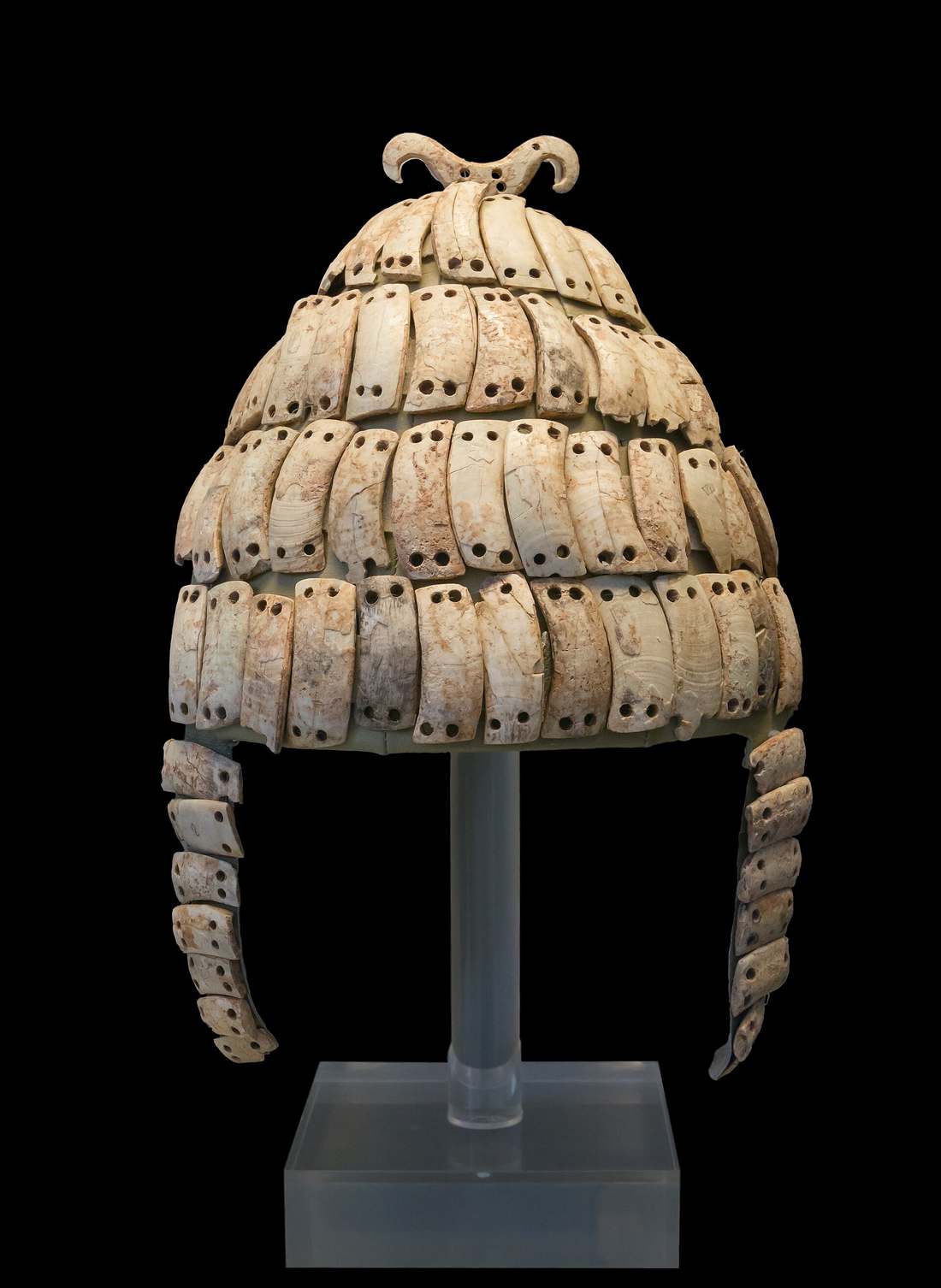
The boar’s tusk helmet stands among the clearest emblems of the Mycenaean warrior, a headpiece unlike any other in the ancient world. Craftsmen built it by splitting the tusks of wild boars into curved plates and sewing them in overlapping rows onto a padded leather cap, often finished with cheek-pieces and a tall plume. The result was light, tough and unmistakable, a mark of rank as much as a guard against the sword. The fighting elite of Mycenae wore it, and its curved rows survive in graves, frescoes and carved ivories across the Bronze Age. Step into the warrior world of the heroes with My Greece Tours.
The boar’s tusk helmet binds the warriors of Mycenae to the epic tradition that later Greeks inherited. Homer described such a helmet in careful detail in the Iliad. The tusk plates dug from Mycenaean graves prove that his account preserved a real memory of Bronze Age gear rather than a poet’s invention. The sections below cover how the helmet was made, what it cost in boars, how Homer recorded it, where its plates and images survive, and what it tells us about rank. Set the whole story against the citadel itself with our Mycenae travel guide.
What was the boar’s tusk helmet worn at Mycenae?
The boar’s tusk helmet was a distinctive piece of Mycenaean armour, a padded leather cap covered in curved plates cut from wild boar tusks. It ranks among the most recognisable items of Bronze Age Greek warfare and warrior dress.
The boar’s tusk helmet was the signature head protection of the Bronze Age fighting man in the Greek world, and no other helmet of the age looks quite like it. At its core sat a cap of padded leather, shaped to the head and strong enough to take a blow. Over this base ran rows of small curved plates, each one cut and ground from the tusk of a wild boar, giving the whole piece its pale, banded, scale-like surface. The design paired lightness with real strength, a rare balance in an age before iron armour. Rows of cheek-pieces often hung at the sides, and a plume or crest crowned the top.
This construction places the helmet at the heart of the Mycenaean civilization and its warrior class.
The look of the helmet set it apart from anything worn in the later ages of Greece. Where the classical hoplite would wear cast bronze, the Bronze Age warrior of Mycenae wore bone and leather, an older and more painstaking craft. The pale tusk plates, banded in neat overlapping rows around the skull, made the wearer stand out on the field and in the hall alike. This was headgear built for the front rank, for the chariot-borne noble and the champion rather than the common levy. Its very fabric, drawn from the hunt, tied the warrior to strength and daring.
The helmet belongs to the same martial world as the great chariots, long spears and figure-of-eight shields carried by the fighting elite. It was a world of heroes remembered long after the citadels of Mycenae had fallen into ruin.
How was the boar’s tusk helmet made and what did it cost in boars?
Craftsmen split boar tusks into curved plates and sewed them in overlapping rows onto a padded leather cap, adding cheek-pieces and a plume. One helmet drew tusks from dozens of hunted boars, making it costly to build.
The making of a boar’s tusk helmet was slow, skilled work that turned a hunter’s trophy into armour. The smith or craftsman began with the curved tusks of wild boars, splitting each one lengthwise into thin, gently bowed plates. He then pierced the plates and sewed them, row upon overlapping row, onto a stout cap of padded leather that carried the weight and softened the blow. The rows ran in alternating directions around the skull, so that the pale bands curved one way and then the other, giving the finished helmet its distinctive striped and scaled appearance. Cheek-pieces guarded the sides of the face, and a socket at the crown held a plume of horsehair or feathers.
The care lavished on such a piece marks it out among the treasures of Mycenaean art and craft.
The true cost of the helmet lay in the hunt behind it. Each wild boar yielded only two tusks, and each tusk split into three or four usable plates, so a single helmet swallowed the tusks of dozens of animals. Hunting that quantity of boars, dangerous beasts at the best of times, took time, men and no small courage. Only a wealthy warrior or his lord could command such a piece. The helmet thus carried its price on its surface, every plate a mark of the effort spent to win it. This lavish use of hard-won material set the boar’s tusk helmet apart from the plainer gear of the common soldier.
It marked its wearer as a man of standing, a champion of Mycenae fit to stand in the front line of battle.
How did Homer describe the boar’s tusk helmet in the Iliad?
Homer describes a boar’s tusk helmet in the Iliad, worn by the hero Odysseus, detailing rows of white tusks sewn onto a felt-lined leather cap. His account matches the real plates found in Mycenaean graves.
The poet Homer preserved the boar’s tusk helmet in verse long after the last one was worn. In the Iliad he pauses to describe such a helmet in careful detail, an object handed among heroes and set on the head of the cunning Odysseus for a night raid. The poet tells of a cap of leather, lined and stiffened with felt, and covered on the outside with the white tusks of a shining-toothed boar, set close and running this way and that in neat rows. The description is precise enough that it can only rest on real knowledge of the object, whether from surviving heirlooms or from a memory carried down in song.
This passage links the material record of Mycenae straight to the epic tradition, the same tradition that sang of the Trojan War and its heroes.
The value of Homer’s account lies in how exactly it matches the ground. The helmet the poet described in verse belongs to the Bronze Age, centuries before his own time, an age of chariots and tusk-plated caps that had long passed when the epics took their final shape. Yet the tusk plates dug from the graves of Mycenae confirm his words in every important respect, the split tusks, the rows, the leather base. This agreement tells us that the poet, or the singers before him, kept a true memory of Bronze Age gear alive across the dark centuries that lay between.
The boar’s tusk helmet became a sure proof that the world of the epics rested on a real past. It forms a bridge of bone and leather, joining Homer to the buried arms of the citadels.
Where do the tusk plates and images of the helmet survive at Mycenae?
Tusk plates from real helmets survive in Mycenaean graves, while painted and carved images of the helmet appear in frescoes, ivories and seal-stones. Finds from the citadel of Mycenae are displayed in the site museum built below the ancient walls.
The boar’s tusk helmet survives in two forms, the plates themselves and the images that record them. The plates turn up in the graves of the Mycenaean elite, scattered where the leather and stitching that once held them have long since rotted away. The pale curved bone stands as the sole witness to a helmet that once crowned a warrior. Careful excavation can sometimes recover the pattern of the rows from the fallen plates, letting scholars reconstruct the shape of the whole helmet from its scattered bone. The plates alone remain to tell the tale.
Finds from the citadel and its tombs are gathered and displayed in the Mycenae archaeological museum, which sits below the walls and lets the visitor stand face to face with the real gear of the Bronze Age fighting man.
The painted and carved images fill out what the bare plates cannot. Mycenaean frescoes show warriors wearing the banded helmet in procession and in battle, its rows picked out in careful colour on palace walls. Carvers cut the same shape into ivory plaques and tiny seal-stones, fixing the helmet in miniature for the ages. These pictures let us see the helmet as a living thing, worn on the head and set above the shoulders of the fighting elite, rather than as a heap of scattered bone. Together the plates and the images root the boar’s tusk helmet firmly in the warrior culture of Mycenae.
The same artistic tradition that painted these helmets also produced the famous Warrior Vase, a later record of armed men marching from the citadel to war.
What does the boar’s tusk helmet reveal about rank and warfare at Mycenae?
The boar’s tusk helmet marked the fighting elite, its high cost signalling wealth and status alongside protection. It reveals a warrior society at Mycenae where fine armour set the noble champion clearly apart from the common foot soldier.
The boar’s tusk helmet was as much a badge of rank as a guard for the head. The sheer labour behind it, the hunts, the splitting of tusks and the patient stitching of rows, meant that only a man of wealth and standing could own one. To wear it was to announce a place near the top of the warrior order, among the chariot-borne nobles and champions who led the fighting rather than filled the ranks behind them. The helmet thus reveals a society at Mycenae in which arms and armour carried social meaning, where the gear a man bore into battle spoke plainly of his position.
Fine armour of this kind belongs to the same elite world as the heavy bronze plating of the Dendra panoply, worn by the champions of the age.
The helmet also opens a window onto how the Mycenaeans made war. Its design suits a fighter who closed with the enemy, a champion protected enough to stand in the thick of the fray yet light enough on his feet to strike and move. This fits the picture drawn by the frescoes and the epics alike, of a warfare led by armoured nobles who sought out one another in single combat, their fine gear marking them as targets and prizes. The boar’s tusk helmet, costly and conspicuous, was made for exactly this kind of fighting man.
It stands, in the end, as one of the clearest emblems of the warrior culture of Mycenae, a piece that ties the buried arms of the citadel straight to the champions and heroes remembered in the songs of a later age.
Frequently Asked Questions
Why did the Mycenaeans use boar tusks instead of bronze for helmets?
The boar’s tusk helmet belongs to an early stage of Bronze Age armour, when working large sheets of bronze into a fitted helmet was still a difficult and costly craft. Split boar tusks offered a hard, naturally curved material that a skilled worker could shape and sew onto a leather cap without a foundry. The result was strong yet light, well suited to a warrior who fought on foot or from a chariot and needed to move quickly. The tusk plates also carried real prestige, since the hunt behind them demanded courage and resources that few could command.
The Mycenaeans did in fact use bronze for other armour, as the Dendra panoply shows, so the tusk helmet was a choice as much as a necessity. It gave the wearer a guard for the head that was tough, distinctive and richly symbolic of the effort spent to win it, a badge of the fighting elite of Mycenae worn with clear pride.
How do we know Homer’s helmet is the same as the Mycenaean one?
The match between the helmet Homer describes in the Iliad and the finds from the ground is close enough to leave little doubt. The poet writes of a leather cap lined with felt and covered on the outside with the white tusks of a boar, set in tight rows running in alternating directions. Every one of these details answers to the tusk plates recovered from the graves of Mycenae and other Bronze Age sites, the split tusks, the rows, the curved plates once sewn to a base that has since rotted.
The Bronze Age origin of the helmet is important here, since the object had passed out of use centuries before Homer sang, which means he could not have simply described gear from his own day. Instead the poet, or the singers before him, kept a true memory of the older armour alive in verse. The agreement of song and spade makes the boar’s tusk helmet a sure bridge between the epics and the Bronze Age past.
Can visitors see a boar’s tusk helmet at Mycenae today?
Visitors to the citadel can come close to this famous piece of armour, though the fragile stitched helmets themselves rarely survive whole. What endures is the pale curved tusk plates. The Mycenae archaeological museum below the walls gathers finds from the site and its tombs, so the traveller can study the real gear of the Bronze Age warrior at close range. Reconstructions and drawings often accompany the plates, showing how the rows once wrapped a leather cap into the striped helmet the frescoes depict. The grandest single helmet of this type came from a site to the north, so the very best example is displayed elsewhere in the country.
A visit to Mycenae still lets you stand where the warriors who wore such helmets once lived and fought, beneath the Cyclopean walls and the Lion Gate. The material record of their armour lies close at hand in the museum built to hold the treasures of the citadel.