
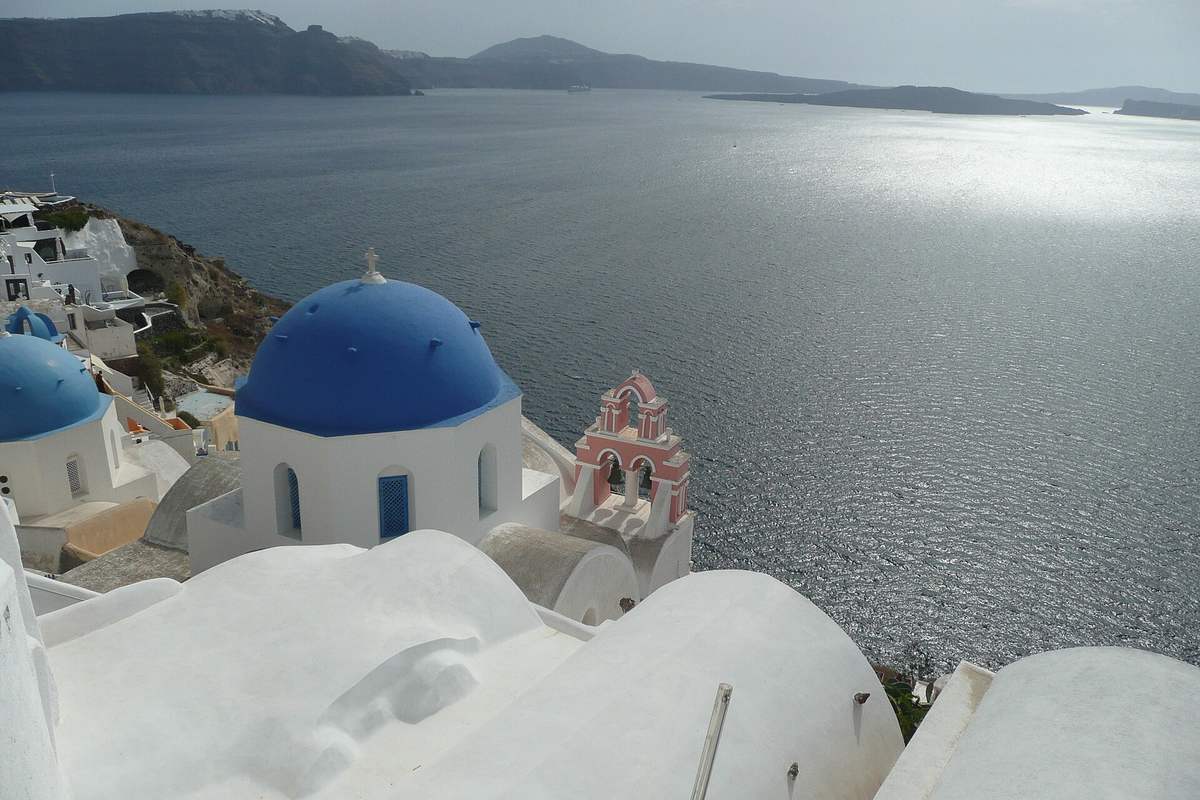
Santorini hiking is led by the spectacular Fira-to-Oia caldera trail, with shorter walks to Skaros Rock, the Profitis Ilias monastery and the craters of the Nea Kameni volcano. The clifftop paths offer some of the finest views in Greece. This guide covers the best trails, the difficulty, the timing and tips for hiking. Plan the whole trip with Greece Tours.
Walking is one of the best ways to see the wider Santorini travel guide. The caldera rim is made for it. The sections below cover hiking.
What is the best hike in Santorini?
The best hike in Santorini is the Fira-to-Oia caldera trail, a clifftop walk through Firostefani and Imerovigli to Oia. Rated the top thing to do on the island, it delivers continuous views over the caldera and volcano.
One walk stands above all others. The Fira-to-Oia hike follows the caldera rim from the capital, passing through Firostefani and Imerovigli. The path then turns wild and remote on the stretch to Oia. The bay, the volcano and the sea stay in view the whole way.
The route runs a couple of hours to half a day, depending on pace and photo stops. Its surface changes from paved promenade to cobbled lane to rough natural trail. Walkers rate it the single best thing to do on Santorini. It threads the four caldera-edge villages into one continuous line.
Most start in Fira in the cooler morning or the late afternoon and finish in Oia for the sunset, set within the wider Fira to Oia hike. The walk links Fira at the start with Oia at the finish. Other trails reward too.
What is the route from Fira to Oia?
The route leaves Fira north along the caldera edge, passes through Firostefani and Imerovigli, skirts the base of Skaros Rock, then crosses open volcanic hillside to reach Oia. The direction is always north, with the caldera on your left.
The line is easy to follow. From the caldera square in Fira the path heads north along the rim, keeping the drop and the sea on your left the whole way. It rises gently into Firostefani, the first village and a natural spot for a coffee before the trail proper.
Beyond Firostefani the promenade continues to Imerovigli, the highest of the caldera villages. Here the paving ends and the wild half begins. The path drops past the turnoff for Skaros Rock, then climbs onto open hillside dotted with two blue-domed chapels that mark the halfway point.
The final stretch crosses bare volcanic ground with no shade and no shops, so carry water for it. The trail rejoins a road on the edge of Oia and drops into the village lanes near the windmills. Ancient paths also climb the island.
What other trails are there?
Other trails include the short walk out to Skaros Rock below Imerovigli, the climb to the Profitis Ilias monastery on the island’s highest peak from Pyrgos, and the volcanic hike to the craters of Nea Kameni.
Beyond the famous rim walk, more trails fan out across the island. The exposed path from Imerovigli leads out to Skaros Rock, the crag that once held Santorini’s medieval capital, and down to the hidden Theoskepasti chapel beneath it. The round trip takes under an hour.
From the hilltop village of Pyrgos, a marked trail climbs to the fortress-like Profitis Ilias monastery on Santorini’s highest peak at 565 metres. The panorama takes in the whole island and, on a clear day, neighbouring Cyclades. On the volcanic islet of Nea Kameni, reached by boat, a gravel path winds up among steaming sulphur vents to the craters.
Each of these is a half-day at most, yet full of drama and history, set out alongside the guides to Skaros Rock and the Profitis Ilias monastery. A quieter coastal option runs the south too. The walking is moderate.
Can you hike to Ancient Thera?
Yes. You can hike to Ancient Thera up the Mesa Vouno ridge from Kamari or Perissa. Two footpaths climb the headland between the beaches to the ruined city, giving sea views on both sides and a demanding but rewarding walk.
The ancient city sits high on the saddle of Mesa Vouno, the rock that divides Kamari from Perissa. A steep zigzag path climbs from the Kamari side, and a second, longer path rises from Perissa in the south. Both reach the archaeological gate near the top.
The climb is a proper leg-burner on switchbacks with almost no shade, so treat it like the caldera walk for water and timing. The reward is the ruined streets of Ancient Thera spread along the ridge, with the coast falling away on both sides. The volcano itself invites walkers too.
Can you hike the Nea Kameni volcano?
Yes. You reach Nea Kameni by boat from the old port of Fira or from Ammoudi, then follow a marked gravel path up to the craters. The walk is short, steep in places and passes steaming vents on bare lava.
The volcano is a walk in its own right. Boats land at the islet’s small jetty, and a broad gravel path zigzags up the black lava slope. Guides on the boat trips point out the fumaroles, where warm sulphur-scented steam still rises from the ground.
The loop to the summit craters and back runs under an hour on foot, though the surface is loose and the sun brutal. Sturdy shoes matter here more than anywhere. The islet ties into the wider Santorini volcano trips and the Santorini boat cruises and tours. The lighthouse offers a gentler goal.
Is there a walk to the Akrotiri lighthouse?
Yes. A quiet trail runs to the Akrotiri lighthouse on the island’s south-western tip, past the Akrotiri excavation and along low coastal cliffs. It is one of the calmest walks on Santorini, well away from the caldera crowds.
The far south end of the island rewards walkers who want space. From the village of Akrotiri a road and footpath lead out to the whitewashed lighthouse on the cape, with the open Aegean on one side and the caldera mouth on the other. The ground is gentle by island standards.
Along the way the path passes the entrance to the Bronze Age town at Akrotiri, the buried settlement often called the Greek Pompeii. The lighthouse cape catches its own quieter sunset, a fine alternative to the Oia crush. Fitness and heat decide how hard any of these feel.
How difficult is hiking in Santorini?
Hiking in Santorini is moderate, needing reasonable fitness rather than experience. The Fira-to-Oia trail is not technical but has steep climbs, uneven ground and little shade. Walks like Skaros Rock and Mesa Vouno add steep steps.
The trails are achievable for most, yet not effortless. The Fira-to-Oia path carries no climbing or rope work on the main route. It does throw up steep ascents and descents, above all the sharp climb from Fira up to Imerovigli, on ground that ranges from smooth paving to rough, stony dirt.
The shorter trails to Skaros Rock, Ancient Thera and the monastery add steep steps and loose gravel with exposed drops. None demands special skill. What each rewards is a steady head for a bit of height and grippy footwear on the crumbly volcanic surface.
Reasonable fitness, sturdy shoes with grip and enough water are the real requirements, as much of the route is hot and shadeless under the summer sun, set out alongside the guide to the Santorini caldera. Timing makes a big difference.
How long does the Fira to Oia hike take?
The Fira to Oia hike takes a couple of hours at a steady pace, or up to half a day with photo stops, coffee breaks and village detours. Fit walkers finish faster; sightseers linger along the rim.
Time on this trail is elastic. A walker in good shape who keeps moving covers the caldera rim in a shade over two hours. Add the constant photo stops, a coffee in Firostefani and lunch in Imerovigli, and the same route stretches across a whole relaxed morning or afternoon.
The pace-setters are the climb out of Fira, the rough final stretch to Oia and the sheer pull of the view, which makes most people stop again and again. Plan generously rather than rush. Build in enough margin to reach Oia before the sunset crowds fill every wall and step.
When is the best time to hike Santorini?
The best time to hike Santorini is early morning or late afternoon in spring or autumn, when the air is mild and the trails are quiet. Peak summer brings fierce midday heat and shadeless paths that make walking hard.
Season and hour both shape the walk. Spring, from April into June, and autumn, through September and October, give warm, steady weather and thinner crowds. The wildflowers of spring and the softer autumn light both flatter the caldera. Winter walking is possible but wetter and windier on the exposed rim.
Within the day, the window before mid-morning and the hours from late afternoon are kindest. The midday sun bakes the treeless clifftop, and the light flattens the view. Starting a caldera walk at first light, or timing it to end at the Santorini sunset, avoids the worst heat, guided by the best time to visit Santorini. Kit matters as much as timing.
What should you bring and wear for hiking?
Bring sturdy shoes, more water than you expect to drink, sun cream, a hat, sunglasses and a charged phone with an offline map. Wear light, breathable clothing and grippy trainers or walking shoes for the uneven, dusty ground.
The kit list is short but non-negotiable on these exposed trails. Proper walking shoes or trainers with grip handle the loose gravel and cobbles far better than sandals or smooth soles. Light, breathable clothing suits the heat, and a hat and sunglasses take the edge off the glare.
Water is the item people underpack. Carry more than you think you need, because shade is scarce and shops thin out past Imerovigli. Pack a snack, a small first-aid item for blisters and sun cream you reapply. A charged phone with an offline map covers the wilder stretches to Oia.
Do you need a guide to hike Santorini?
No, you do not need a guide for the main caldera trail, which is well trodden and easy to follow north to Oia. A guide adds history and local detail on the volcano, Ancient Thera and Skaros Rock.
The Fira-to-Oia route is self-guided by design. The path hugs the rim, the villages are signed, and the direction never changes, so an offline map and common sense are enough for most walkers. The volcano islet, reached by boat, comes with a guide as part of the trip anyway.
A guide earns its keep where the story matters. On Nea Kameni, at Ancient Thera and around Skaros Rock, a knowledgeable local turns bare rock and ruins into living history. Guided walking tours also fold in transfers and timing, which suits travellers on a tight schedule.
Can you hike Santorini for the sunset?
Yes. Timing the Fira-to-Oia walk to finish in Oia for the sunset is the classic Santorini hike. Set out in the late afternoon, keep a steady pace, and arrive with a margin before the crowds.
The sunset walk is a rite of passage on the island. Leaving Fira in the cool of the late afternoon, walkers follow the rim as the light turns gold on the caldera. The whole path faces west, so the show builds the entire way rather than only at the finish.
Reaching Oia ahead of the crowds is the trick, because the famous viewpoints fill early. Allow a comfortable margin over the walking time, and settle in before the light drops. The Santorini sunset caps the walk, one of the finest things to do in Santorini. Safety keeps the day enjoyable.
Is hiking in Santorini safe?
Hiking in Santorini is safe with basic care. The main hazards are sun exposure, dehydration and steep, unfenced clifftop drops, not crime or difficult terrain. Stay hydrated, watch your footing near edges and avoid the midday heat.
The dangers here are natural rather than criminal. The exposed rim carries steep, unprotected drops, so keep back from the edge, mind children and take care on the loose gravel where a slip could send you sliding. Heat and sun cause more trouble than falls, through dehydration and burn.
Sun exposure is the real risk on the treeless clifftop. Reapply sun cream, drink often, and turn back rather than push on if the heat gets too much. A charged phone, an offline map and a walking partner add a safety margin on the wilder stretches toward Oia. Fitness rounds out the picture.
How fit do you need to be to hike Santorini?
You need moderate everyday fitness to enjoy Santorini hiking, not athletic training. Anyone comfortable walking uphill on uneven ground for a couple of hours can manage the caldera trail, and shorter walks suit gentler paces.
The bar is reasonable rather than high. Regular walkers who can handle stairs and slopes cope well with the Fira-to-Oia rim, taking the steep pull out of Fira at their own pace. Trekking poles help on the loose descents for anyone unsure on their knees.
Those who prefer an easier day can pick shorter targets. The stroll through the caldera villages, the flat cape walk to the Akrotiri lighthouse, or the brief loop on Nea Kameni all deliver the scenery without the full rim slog. Quieter coastal paths round out the choice for gentler days.
Are there quieter coastal walks on Santorini?
Yes. Beyond the busy caldera rim, quieter coastal walks run along the black-sand shore between Kamari and Perissa, out to the Akrotiri lighthouse, and around the beaches of the south-east, where the crowds thin and the pace slows.
The eastern and southern coasts trade cliff drama for calm. A flat promenade runs the length of the black volcanic sand at Kamari, and the neighbouring resort of Perissa offers the same on the far side of Mesa Vouno. These level walks suit an easy evening stroll rather than a hard climb.
The south-western cape holds the gentlest scenery of all, on the low coastal path to the Akrotiri lighthouse. Away from the caldera villages the ground rolls rather than climbs, and the sea fills the view on three sides. These flat routes pair well with a swim in the warm shallows, rounding out the wider Santorini villages and beaches for an unhurried day. The questions below cover the points travellers ask most.
Frequently Asked Questions
What is the best hike in Santorini?
The best hike in Santorini is the Fira-to-Oia caldera trail, a clifftop walk through Firostefani and Imerovigli to Oia. It is rated the top thing to do on the island for its continuous views over the caldera and volcano, and most walkers time it to finish in Oia for the sunset.
How hard is the Fira to Oia hike?
This caldera-rim walk is moderate, not technically difficult but with steep climbs and descents, uneven terrain and little shade. Reasonable fitness, sturdy shoes and enough water are the real requirements, and it is best walked early or late in the day to avoid the fierce midday heat.
What other walks are there in Santorini?
Other walks include the short trail to Skaros Rock below Imerovigli, the climb to the Profitis Ilias monastery on the island’s highest peak from Pyrgos, the ascent to Ancient Thera on Mesa Vouno, and the volcanic hike to the craters of Nea Kameni, reached by boat. Each is very scenic.
When is the best time of year to hike Santorini?
The best time of year to hike Santorini is spring, from April to June, or autumn, in September and October, when the weather is mild and the trails are quiet. Peak summer brings fierce heat on shadeless paths, so walk early or late, guided by the local weather.