
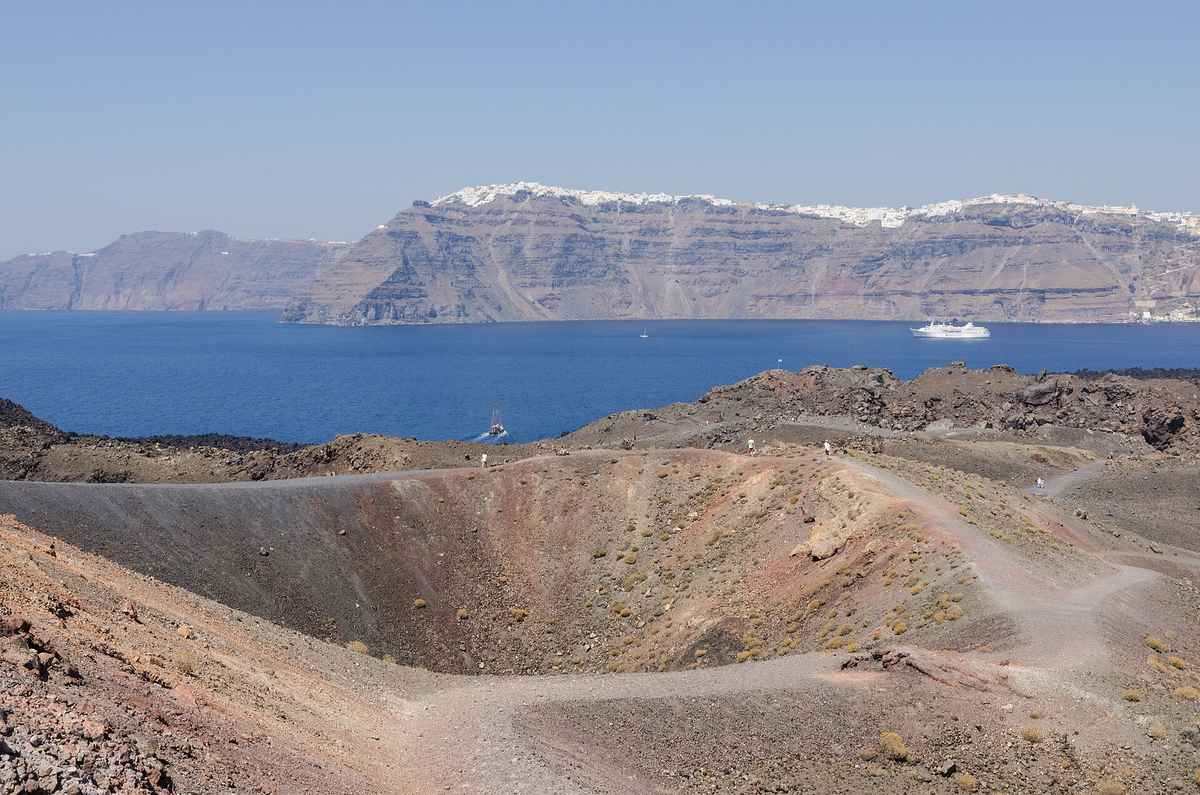
Santorini’s finest walk, the Fira to Oia trail, is a roughly 10.5-kilometre caldera-edge trail from the capital to Oia, taking two and a half to five hours past Firostefani, Imerovigli and Skaros Rock with non-stop views. This guide covers the route, the distance, the difficulty and the tips you need to walk it.
The cliff-top trail is the top free experience in the wider Santorini travel guide. It follows the rim of the flooded volcano. The sections below cover the hike.
What is the Fira to Oia hike?
The Fira to Oia hike is a caldera-edge trail of about 10.5 kilometres linking Fira with Oia, passing Firostefani and Imerovigli and open hillside, with caldera and sea views almost the whole way. It ranks among the island’s best walks.
This scenic walk is the island’s signature experience on foot. Following the lip of the caldera from Fira northward, the trail strings together the cliff-edge villages of Firostefani and Imerovigli before crossing open, rugged country to Oia at the northern tip. The reward is constant: the blue flooded crater, the volcanic islets and the white villages spilling down the cliffs stay in view for most of the route.
Free and unforgettable, the walk consistently tops travellers’ lists of things to do, and most walkers time it to finish with the famous sunset in Oia, set within the wider things to do in Santorini. The path needs no guide and no permit, which is part of its appeal. It doubles as a way to see the four caldera villages in one continuous line, so a single walk covers Fira, Firostefani, Imerovigli and Oia without a bus or a rental car.
The caldera itself frames the whole experience. The cliff drops several hundred metres to the water on the western side, and the flooded crater below is the remnant of a huge volcanic eruption that shaped the island’s crescent form. Walking the rim gives a clearer sense of that geology than any single viewpoint, tying the trail to the Santorini caldera guide. The route is easy to follow.
What is the route and distance?
The route runs about 10.5 kilometres from Fira through Firostefani and Imerovigli, then across hillside to Oia, taking two and a half to five hours. Surfaces mix pavement, cobblestone and dirt paths, with the high point at Imerovigli around 350 metres.
The trail divides naturally into two halves. The first stretch from Fira through Firostefani to Imerovigli is paved and easy, lined with cafés, hotels and viewpoints, ideal for a gentler taste of the walk. Beyond Imerovigli, the island’s highest caldera village at around 350 metres, the path becomes a rougher dirt and stone trail across open hills.
A pair of climbs and descents follow before the trail drops into Oia at about 130 metres. The full distance is just over 10.5 kilometres and takes most walkers between two and a half and five hours, depending on fitness, photo stops and the heat, set out alongside the guides to Fira and Oia.
The elevation profile explains the two-part feel. The trail starts in Fira at around 260 metres, climbs gently to Imerovigli’s high point near 350 metres, then rolls across the hillside with a total ascent that stays modest for the distance. The descent into Oia is gradual rather than steep, so the walk favours endurance over technical skill. Wearing a step tracker, most walkers log the equivalent of a long half-day hike, which is why an early start leaves time for a rest and a meal in Oia. Skaros Rock is a worthwhile detour.
How hard is the hike?
The hike is moderately difficult rather than technical, with steep sections and uneven terrain on the second half that call for reasonable fitness. The main challenge is the heat, punishing from late morning in summer, so an early or late start works best.
The walk sits within reach of most reasonably fit people, though it rewards respect. The villages section is easy, but beyond Imerovigli the path climbs and drops over loose, uneven ground that demands sturdy shoes and stamina, with almost no shade. The biggest factor by far is the sun: Santorini bakes from late morning in summer, and walking the exposed second half in the midday heat is exhausting.
Timing solves the problem. Starting early in the morning, or setting out in the late afternoon to finish at sunset, makes the hike far more comfortable, set out alongside the guide to the best time to visit Santorini. Spring and autumn add cooler air and thinner crowds, which suit the exposed trail. A slow, steady pace with regular water breaks handles the climbs better than rushing the second half. A side trip adds to the day.
Should you detour to Skaros Rock?
The short detour to Skaros Rock at Imerovigli is well worth it, a volcanic headland that once held a Venetian fortress. The there-and-back walk adds about an hour and rewards with the finest 360-degree caldera views on Santorini.
Skaros Rock is the standout detour on the route. Jutting into the caldera just below Imerovigli, this towering volcanic crag held a medieval Venetian fortress that once served as Santorini’s capital and its main defence against pirates, of which atmospheric ruins remain. A clear path from Imerovigli’s square descends along the cliff and stone steps toward the rock.
The there-and-back detour runs around twenty to thirty minutes each way and adds roughly an hour to the hike. The panoramas from and around Skaros, with the caldera curving away on both sides, rank among the best on the island, set out alongside the guide to Imerovigli. A short set of tips makes the day smooth.
What are the best tips for the hike?
The best tips are to start early or hike late for the heat, wear proper shoes for the rough second half, carry water bought in advance, use sun protection, and take the bus back from Oia. Walking Fira to Oia finishes at the sunset.
A little preparation turns the hike into a highlight. Set out early in the morning or in the late afternoon to dodge the fierce midday sun, and wear proper trainers or hiking shoes, as the dirt and stone path beyond Imerovigli is uneven. Buy water and snacks the day before, since shops open late and the trail has no kiosks, and bring sunscreen, sunglasses and a hat for the exposed route.
Most walkers take the Fira-to-Oia direction so the trail ends at Oia in time for the sunset, then catch the cheap KTEL bus or a taxi back to their base afterwards, set out alongside the guides to the Santorini sunset and getting around Santorini. Two litres of water per person covers a summer walk, and a light daypack keeps hands free. The questions below cover the points travellers ask most.
What should you bring on the Fira to Oia hike?
Bring at least two litres of water per person, proper trainers or hiking shoes, a hat, sunglasses and high-factor sun cream. Add snacks, a light daypack, a charged phone for photos and navigation, and cash for the bus back from Oia to your base.
Water tops the list on this exposed trail. The second half has no kiosks or fountains, so carry enough for the whole route, and add electrolyte sachets for a hot summer walk. Sturdy footwear matters just as much, since the dirt and stone path beyond Imerovigli turns ankles on loose ground where sandals fail.
Sun protection completes the core kit. A wide-brimmed hat, sunglasses and high-factor cream guard against the strong, reflective light, and a light long-sleeve layer shields the arms without adding heat. A charged phone handles photos and the offline map, and a small amount of cash covers the KTEL bus fare and a cold drink in Oia at the finish.
A few extras raise comfort on a long walk. A compact daypack keeps the load balanced and the hands free for the cobbled steps, and trekking poles help walkers who want extra stability on the loose downhill sections. Blister plasters, a small microfibre towel and a refillable bottle earn their place, and a light windproof layer takes the edge off the meltemi breeze that funnels along the exposed rim in the shoulder seasons.
Which landmarks do you pass on the trail?
The trail passes Firostefani and its chapels, Imerovigli with the Skaros Rock headland, the blue-domed churches of the cliff villages, open volcanic hillside, and the windmills and Byzantine castle ruins of Oia at the finish. Caldera views run the whole way.
The first landmarks come quickly. Firostefani sits minutes from Fira, with quiet squares and the small church of Agios Gerasimos framing the caldera. Imerovigli follows as the highest village on the rim, home to the Anastasi church and the path down to Skaros Rock, the medieval headland that once guarded the island. Both villages make natural rest stops, with cafés and shaded terraces before the open stretch begins.
The open middle section trades villages for raw landscape. The trail crosses volcanic hillside dotted with wild thyme, chapels and grazing land, with the caldera on the left the whole way. The ground here is red and grey volcanic rock, and the quiet contrasts sharply with the busy village stretch, giving the walk its sense of escape.
Oia arrives at the northern tip with its ruined Byzantine castle at Goulas, the row of windmills and the blue-domed churches that draw the sunset crowds, tying the walk to the guide to the Santorini blue domes. The final approach threads between whitewashed cave houses and narrow lanes before opening onto the castle viewpoint, the classic spot to watch the sun drop into the Aegean at the end of the walk.
How do you get back to Fira from Oia?
Take the KTEL public bus from Oia’s main square to Fira, a ride of about twenty-five minutes for a low flat fare. Taxis and pre-booked transfers also link Oia with Fira, so there is no need to walk the trail twice.
The KTEL bus is the simplest return. Buses run between Oia and Fira through the day and into the evening, cost a few euros and take around twenty-five minutes, though the sunset departures fill fast and standing room is common. Buying no ticket in advance is fine, since the conductor collects the fare on board.
Taxis offer a faster, pricier option and are worth pre-booking around sunset, when demand peaks and the rank empties quickly. Hotels often arrange a transfer for guests, and travellers based in Kamari, Perissa or the port connect through Fira’s central bus station, laid out alongside the Santorini bus guide.
Timing the return around the sunset takes a little planning. The buses after golden hour fill quickly as the crowds leave Oia together, so waiting twenty minutes for a less crowded departure, or lingering for a drink until the rush clears, makes the ride back smoother. Walkers who prefer certainty pre-book a taxi or a private transfer for a set pickup time, which removes the queue at the busiest moment of the day. Ending the day with the ride back leaves energy for the sunset itself.
Is the Fira to Oia hike worth it?
The Fira to Oia hike is worth it for the non-stop caldera views, the cliff-edge villages and the free, self-guided route that ends at the Oia sunset. It suits reasonably fit walkers who start early or late.
Few walks pack this much scenery into a half-day. The caldera, the volcanic islets and the whitewashed villages stay in frame for most of the route, and the trail costs nothing beyond water and the bus back. The mix of easy paved village paths and rugged open hillside gives a real sense of the island away from the crowds.
The payoff peaks at the finish. Timing the walk to reach Oia for golden hour turns the last stretch into the classic Santorini experience, with the sunset over the caldera as the reward. Walkers short on time or energy still gain from the easy Fira-to-Imerovigli half, which delivers the best views for the least effort.
The hike also frames the island as a whole. Covering the caldera rim on foot links the capital, the quiet cliff villages and the postcard sunset in one route, and it costs only water and a bus fare. For a first visit, the walk pairs naturally with a boat trip to the volcano and a wine tasting inland, spreading the highlights across a few days rather than one crowded viewpoint. That balance of scenery, exercise and value is why the trail keeps its place at the top of the island’s to-do lists, and why so many returning visitors set out to walk it again on a second or third return trip back to the island of Santorini itself.
Frequently Asked Questions
How long is the Fira to Oia hike?
The trail is about 10.5 kilometres and takes most walkers between two and a half and five hours, depending on pace, photo stops and the heat. It runs along the caldera edge through Firostefani and Imerovigli before crossing open hillside down to Oia.
Is the Fira to Oia hike difficult?
The hike is moderately difficult, with several steep sections and uneven terrain on the second half beyond Imerovigli, needing a reasonable level of fitness. The main challenge is the heat, so start early or hike in the late afternoon and carry plenty of water.
Which way should you walk, Fira to Oia or Oia to Fira?
Most people walk from Fira to Oia so the trail finishes in Oia in time for the famous sunset, then take the bus or a taxi back. Either direction offers the same caldera views, but ending in Oia at sunset is the classic, most rewarding way to do it.
What is the best time of day to hike Fira to Oia?
Early morning and late afternoon are the best times to hike Fira to Oia. A dawn start beats the heat and the crowds on the paved village stretch, while a mid-afternoon start lands the finish at the Oia sunset. Midday walks in summer face full sun with almost no shade on the second half.
Can beginners do the Fira to Oia hike?
Beginners with reasonable fitness can do the Fira to Oia hike, especially the easy paved section from Fira to Imerovigli. The rougher stretch beyond Imerovigli needs sturdy shoes and a steady pace over uneven ground. Splitting the walk, resting in the villages and carrying enough water keeps it manageable for first-time hikers.
Is there shade or water along the trail?
There is little shade and no reliable water on the second half of the trail. The Fira-to-Imerovigli stretch has cafés and shops for drinks and rest, but the open hillside toward Oia has no kiosks or fountains. Carry at least two litres of water per person and start before the midday sun for the exposed section.
Do you need a guide for the Fira to Oia hike?
No guide is needed for the Fira to Oia hike, as the caldera-edge route is clear and well trodden with the sea on one side the whole way. An offline map helps on the open middle section where the path forks. Guided walks add history and pace for travellers who prefer company on the trail.
How many kilometres and steps is the Fira to Oia walk?
The Fira to Oia walk covers about 10.5 kilometres along the caldera rim, which logs roughly fifteen thousand steps for an average stride. The paved Fira-to-Imerovigli half is gentle, and the open second half adds the climbs and loose ground, so the step total feels longer than a flat walk of the same distance.