
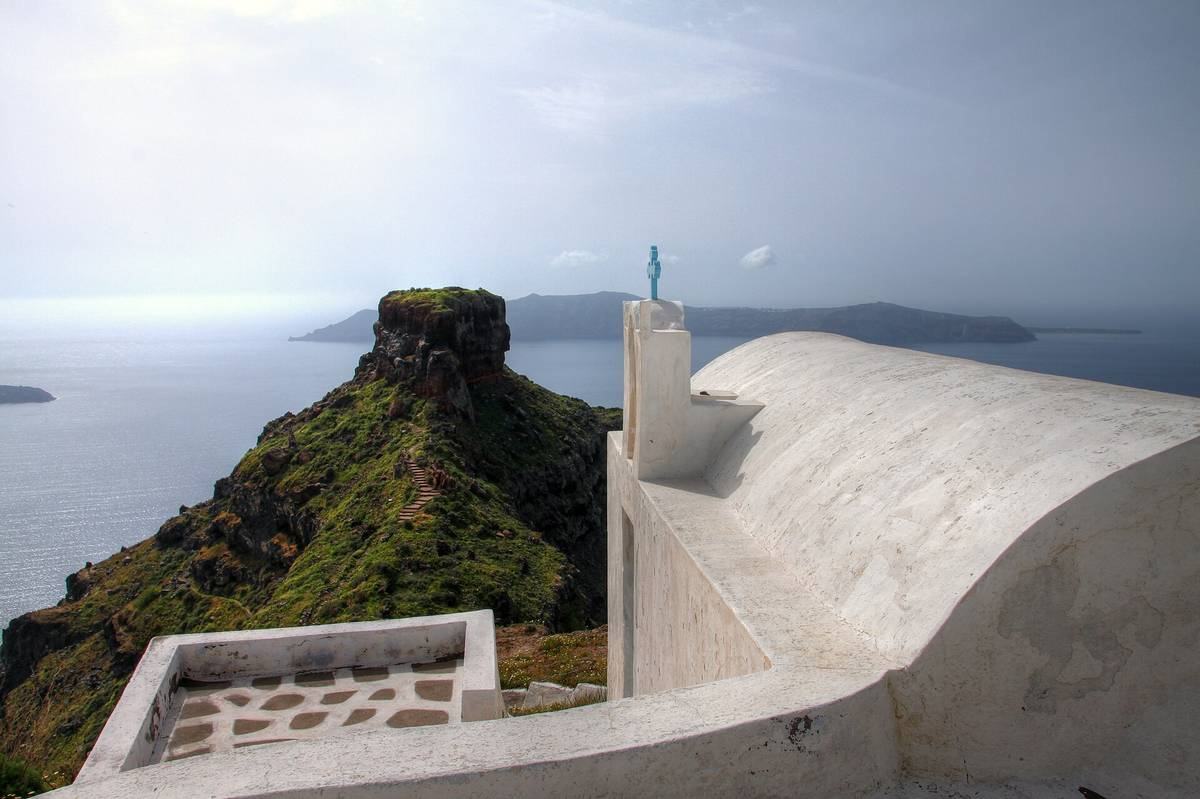
Skaros Rock is a dramatic volcanic headland jutting into the caldera below Imerovigli, once the site of Santorini’s medieval capital and great fortress. A short, scenic hike reaches it for some of the island’s finest 360-degree views. This guide covers the history, the hike, the chapel below and how to visit.
Skaros is one of the island’s most striking landmarks in the wider Santorini travel guide. It sits on the caldera between Fira and Oia. The sections below cover the rock.
What is Skaros Rock?
Skaros Rock is a volcanic crag protruding into the caldera from Imerovigli, between Fira and Oia, once crowned by a Venetian fortress that was Santorini’s medieval capital. It now bears ruins and draws hikers for caldera views.
Skaros Rock is one of the most arresting natural features on Santorini’s western, caldera-facing side. A flat-topped crag of volcanic rock thrusts out from the cliffs below Imerovigli, the highest village on the rim, into the flooded crater. For centuries it carried a fortress and a whole settlement. Little but ruins remains today, yet the rock itself, with the caldera curving away on either side and the sea far below, is an unforgettable sight and a rewarding short hiking destination. It sits within the wider Imerovigli area, and its history is remarkable.
Where is Skaros Rock located?
Skaros Rock sits directly below Imerovigli, on the caldera-facing western edge of Santorini between Fira and Oia. It projects from the base of the cliffs into the flooded crater, roughly 300 metres below the village rim.
Imerovigli is the highest of the caldera-rim villages, perched at around 300 metres above the sea, and Skaros lies just beneath it where the cliff drops toward the water. The rock is unmistakable from the village pathway: a broad, dark headland pushing out into the crater, cut off from the settled clifftop by a saddle of steep ground. From the promenade above you look straight down onto its flat crown and the chapel at its foot. To the north the caldera curves toward Oia, and to the south it runs back toward Fira, so Skaros stands at the visual centre of the whole western arc. Its position at the heart of the rim is exactly why the Venetians chose it for their stronghold.
What is the history of Skaros?
Skaros was founded in the early 13th century by Venetian rulers and grew into Santorini’s capital and main fortress, with an upper castle raised later above the original. Its sheer cliffs kept it unconquered for 600 years.
Skaros has a long and dramatic past. The Venetians fortified the rock in the early 13th century, recognising its natural strength, and it became the capital of Santorini and its first line of defence against the pirates who roamed the Aegean. Over time it bore an upper castle, the Epano Kastro, raised in the 15th century atop an earlier structure known as La Roka. At its height a dense settlement of around 200 houses, businesses and churches clung to the crag. Thanks to its sheer cliffs and elevation it was never conquered by force across its 600-year history, declining only after repeated earthquakes shook the crag. The ruins are atmospheric today, set out alongside the guide to the Fira to Oia hike. A short trail now reaches it.
How do you get to Skaros Rock?
You reach Skaros Rock on foot from Imerovigli. A signposted path drops from beside the Grace Hotel, running concrete steps then gravel toward the crag. The trail is free and open, with no ticket or gate.
Getting to the trailhead is straightforward. Imerovigli sits on the main caldera bus route from Fira, and the walk between Fira and Imerovigli along the clifftop path takes around 30 minutes on foot. Cars and the local bus reach the village edge, though the narrow lanes leave little parking, so most walkers start from the central church square and follow the promenade north.
The Skaros path itself begins at the steps that descend from beside the Grace Hotel, marked and easy to spot once you reach that stretch of the rim. From there the route drops toward the saddle and the rock. No entrance fee applies and the trail stays open through the day and into the evening, which lets you time the walk for the softer light near sunset.
What is the Skaros Rock hike like?
The Skaros Rock hike starts in Imerovigli by the steps near the Grace Hotel and runs roughly 45 minutes each way over concrete steps then rugged gravel. It is moderately demanding, rewarding you with 360-degree caldera views.
The walk out to Skaros is short but memorable. The clearly marked path begins at the edge of Imerovigli, on the steps that lead down from beside the Grace Hotel. It starts with concrete steps and a wire guardrail before turning into a more rugged gravel trail with no barriers as it descends toward the rock. The route runs around 45 minutes each way, mostly up and down, and is moderately demanding, with steep steps and loose gravel that call for sturdy shoes and a head for the exposed drops. It is best avoided in the searing midday heat. The reward is a spectacular, near 360-degree panorama of the caldera, the volcano and the sea, set out alongside the guide to the Santorini sunset. A hidden chapel lies below.
How tall is Skaros Rock?
Skaros Rock is a substantial headland whose flat top stands well below the Imerovigli rim, which sits around 300 metres above the sea. The crag rises steeply from the water yet falls short of the village clifftop above it.
The rock reads as a mid-height crag rather than a towering peak. It grows out of the base of the caldera cliff, so its crown sits lower than the promenade you walk from, and the descent from Imerovigli to the saddle underlines the drop. From the water the crag rises in near-vertical dark walls, which is what made it defensible, while from above it looks like a broad platform tilted toward the sea. Rather than fixate on an exact figure, picture a compact fortress hill wrapped on three sides by sheer cliff, joined to the rim only by the narrow neck the trail crosses. That form gave the medieval castle its natural walls and gives today’s walker the sense of standing on an island within the island.
What is the Theoskepasti chapel?
The Theoskepasti is a small white chapel built into the base of Skaros Rock by Venetian sailors, reached by one of the two paths from Imerovigli. A steep descent leads to a peaceful spot beneath the crag.
Beyond the rock itself, a lovely reward awaits the walker. One of the two routes from Imerovigli leads down a steep path to the Theoskepasti, a tiny whitewashed chapel tucked against the base of the Skaros promontory, built long ago by Venetian sailors and still a place of quiet devotion. Set right beneath the towering crag with the caldera opening out beyond, it is one of the most peaceful and photogenic corners of this part of the island. The other path attempts the scramble up onto the flat top of the rock, but this is an unmarked, sketchy rock climb rather than a real trail and is best left to the sure-footed, set out alongside the guide to the caldera villages. A short checklist helps.
What are the tips for visiting Skaros?
Wear sturdy shoes for the steep steps and loose gravel, carry water and sun protection, and avoid the midday heat by going early or late. Take the path to the Theoskepasti rather than scrambling to the summit.
A little preparation makes the Skaros walk a joy. Comfortable, grippy footwear is essential for the concrete steps and the loose gravel beyond, and there is no shade on the exposed trail, so carry water and wear sun protection and a hat, going early in the morning or in the late afternoon to avoid the punishing midday sun. The descent to the Theoskepasti chapel is the rewarding, achievable route for most walkers, while the unmarked scramble to the rock’s flat top is best avoided unless you are confident on exposed terrain. Timing the walk for the golden light before sunset gives the caldera views at their richest, set out alongside the guide to Fira and Imerovigli. A quick look at who the hike suits helps you plan.
Who does the Skaros Rock hike suit?
The Skaros Rock hike suits reasonably fit walkers in proper shoes who are comfortable on steep, unbarriered ground. Families with older children manage the descent to the chapel, while the summit scramble suits only confident, sure-footed hikers.
Matching the walk to your group avoids surprises on the trail. The descent from Imerovigli to the rock and down to the Theoskepasti chapel works for most active visitors, including teenagers and older children who are steady on their feet. The exposed drops and the absence of railings on the lower gravel make it a poor choice for very young children in arms, for anyone uneasy with heights, or for walkers with limited mobility. The clifftop promenade above Imerovigli still delivers the view of Skaros for those who prefer to admire it from the rim. The table below sets out how the main options compare so you can pick the version that fits your day.
| Option | Effort | Best for |
|---|---|---|
| Clifftop view from Imerovigli | Easy, flat promenade | All visitors, limited mobility |
| Descent to Theoskepasti chapel | Moderate, steep steps and gravel | Active walkers, families with older children |
| Scramble to the flat summit | Hard, unmarked rock climb | Confident, sure-footed hikers only |
Where is the best place to stay near Skaros Rock?
Stay in Imerovigli to be closest to Skaros Rock, since the trailhead sits at the village edge. Fira and Firostefani, a short walk or bus ride south along the caldera, also put the hike within easy reach.
Imerovigli is the natural base for the hike. Its clifftop hotels look straight onto Skaros, and the trailhead by the Grace Hotel is a stroll from the village square, so an early start or a sunset descent needs no transport. The village trades on quiet luxury and caldera views, which suits couples and honeymooners.
For a wider range of prices and a livelier evening, Firostefani and Fira sit just south, linked to Imerovigli by the caldera path and the local bus, and both keep the Skaros trailhead within a 30-minute walk. Oia lies farther north with its own famous sunset, so a stay there pairs a separate half-day trip along the rim with the Skaros walk. Wherever you base yourself, the caldera path threads the villages together and makes the rock an easy addition to a day exploring the western cliffs.
Frequently Asked Questions
What is Skaros Rock in Santorini?
Skaros Rock is a dramatic volcanic headland jutting into the caldera below Imerovigli, once the site of a Venetian fortress that was Santorini’s medieval capital. It now bears ruins and is reached by a short hike with the island’s finest 360-degree caldera views.
How long is the Skaros Rock hike?
The Skaros Rock hike runs roughly 45 minutes each way, starting at the edge of Imerovigli near the Grace Hotel, over concrete steps then a rugged gravel path. It is moderately demanding with steep, loose sections, so wear sturdy shoes and avoid the midday heat.
Is the Skaros Rock hike difficult?
The Skaros Rock hike is moderately difficult, with steep steps and loose gravel and exposed drops with no barriers on parts of the trail. The descent to the Theoskepasti chapel suits most walkers in good shoes, but the scramble to the summit is an unmarked rock climb best avoided.
Is there an entrance fee for Skaros Rock?
There is no entrance fee for Skaros Rock. The trail from Imerovigli is free and open, with no ticket office or gate. You can walk it at any time of day, which makes it easy to time your visit for the softer light near sunset when the caldera views are at their richest.
How tall is Skaros Rock?
Skaros Rock is a mid-height crag rising from the base of the caldera cliff. Its flat top stands well below the Imerovigli rim, which sits around 300 metres above the sea. The near-vertical walls that made it defensible give the rock its imposing profile from the water below.
Is Skaros Rock worth visiting?
Skaros Rock is worth visiting for the combination of medieval history and 360-degree caldera panorama that little else on Santorini matches. The short hike, the atmospheric fortress ruins and the hidden Theoskepasti chapel reward the effort, especially in the golden light before sunset when the crowds along the rim thin out.