
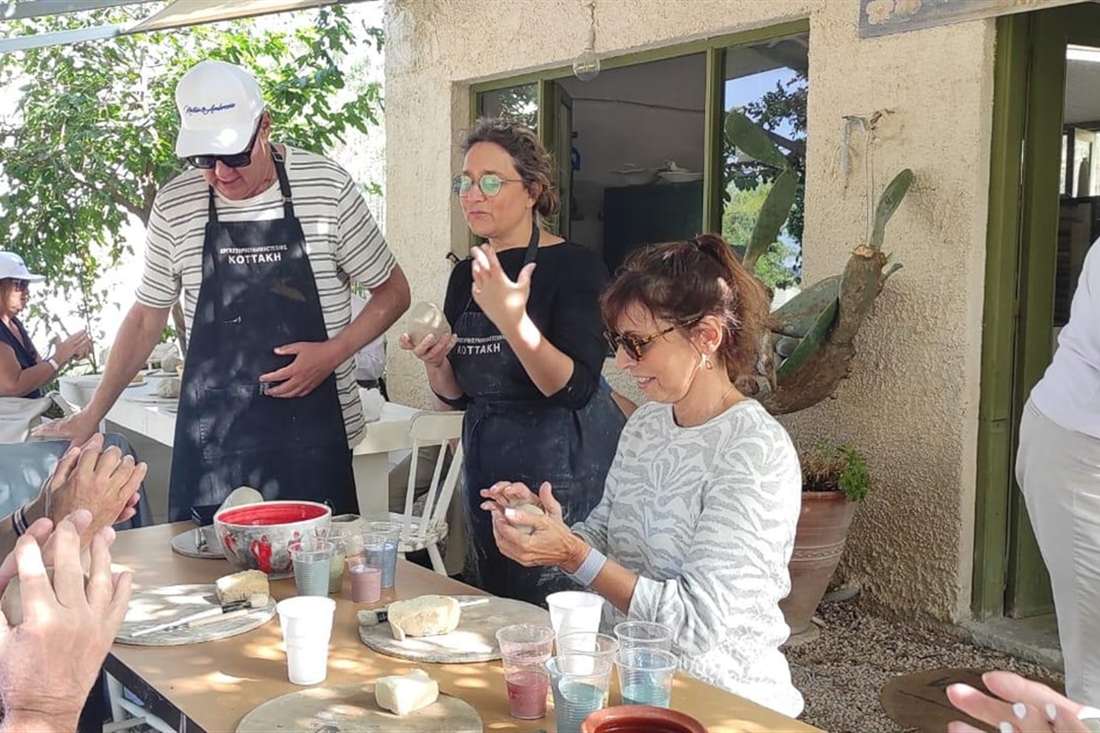
An Aegina pottery class is a hands-on ceramics lesson with a local potter on Aegina, the island near Athens known for its pottery since ancient times. Guests shape clay by hand, try the wheel and colour their own piece. Tours across the rest of the country are listed on Greece Tours.
The sections below cover the classes, the studios, the island’s pottery past, the steps, pinching, the wheel, what you make, colouring and firing, multi-day workshops, who it suits, inclusions, getting there and booking, with links into the Aegina pages. The class shown is checked on GetYourGuide.
What is an Aegina pottery class?
An Aegina pottery class is a short, hands-on lesson in shaping clay on the Greek island of Aegina. A local potter shows you simple methods. You make your own piece, colour it and take home an everyday object.
The Aegina pottery class on GetYourGuide is called Ceramics Class with a Local Potter. Kiki Rebel Tours runs it. Your teacher is Maria, a potter with over 30 years of experience.
Each lesson mixes history and craft. First, you hear how pottery grew from ancient times to today. Then you work the clay with your own hands. No earlier skill is needed.
Longer ceramics courses also run on the island. They last from three days to a full week. A short Aegina pottery class takes just two hours.
Which Aegina pottery classes can you book?
You can book four kinds of Aegina pottery class on the island. Each has its own teacher, place and length. Options range from a two-hour lesson with Maria to a six-day course at The Cool Projects.
- Ceramics Class with a Local Potter: a two-hour Aegina pottery class with Maria in Aegina Town.
- Kottaki Ceramics: an adult class on Saturdays from 6pm to 8pm in July and August.
- Katerina Giannaka: a multi-day workshop that mixes clay and painting.
- The Cool Projects: six-day workshops with Marina Coriolano-Lykourezos, also sold as week-long retreats.
At Kottaki Ceramics, the potters Maria and Martha Kottaki design and make every piece. Their shop sells kitchen items, candle holders and decorative objects. A second store on the waterfront hosts ceramic workshops and exhibitions.
Katerina Giannaka is a painter and ceramicist. Her Aegina pottery class runs over three days and joins clay work with paint and colour. She teaches in Greek, English, French and Italian.
The Cool Projects courses are run by Marina Coriolano-Lykourezos. Classes there take small groups of up to four people. Guests can book a course alone or as a retreat with lodging.
Where does an Aegina pottery class take place?
Every Aegina pottery class listed here runs on the island of Aegina itself. Kottaki Ceramics and Maria’s class are based in Aegina Town. Katerina Giannaka works on Kipselis Avenue. The Cool Projects studio sits on Agion Anargyron Street.
- Aegina Town: Kottaki Ceramics, at 22 P. Irioti Street.
- Kipselis Avenue 58: the studio of Katerina Giannaka, open by appointment only.
- Agion Anargyron Street: The Cool Projects, a fully equipped ceramics and painting studio.
- Chloi: a ceramics workshop listed under Maria Kottaki, at Agiou Dionysiou 39.
Ferries from Piraeus dock at the harbour of Aegina Town. That makes an Aegina pottery class in town easy to reach on a day trip. Retreat guests at The Cool Projects get transport from and to the port.
The Cool Projects course also leaves the studio. Students visit two places where old potters once dug their clay. They pick natural objects there to inspire their work.
Katerina Giannaka’s studio also offers a separate two-hour visit. It is called Discover an island and an artist. Like her workshop, it runs by appointment only.
Why is Aegina known for pottery?
An Aegina pottery class builds on a very old craft. Archaeologists found Neolithic pottery at the ancient site of Kolona. In the Bronze Age, Aegina was a busy pottery hub. Its pots travelled across the Saronic and Argolic Gulfs.
The ruins of Kolona lie just north of Aegina Town. Researchers have recorded 2,120 Aeginetan pots from 130 sites. Trade carried them up to 200 kilometres from the island. Digs also show family workshops that shared the same clay sources.
Aeginetan cooking pots were red-brown and strong. Potters mixed volcanic rock into the clay, which helped the pots stand up to heat. From the Late Archaic period, they shaped them on the wheel.
Centuries later, the village of Mesagros made kanatia, clay water jugs that kept water cool. Local clay runs through Aegina’s history, from the Stone Age to recent times. An Aegina pottery class pairs well with a visit to the Temple of Aphaia.
What happens step by step in an Aegina pottery class?
An Aegina pottery class with Maria follows five clear steps. It starts with a short history talk. Then you shape the clay by pinching and decorate it with ceramic colours. You can also try the potter’s wheel.
- History talk: Maria explains how pottery grew from a Mycenaean tradition.
- Ancient context: you learn why Greek pottery mattered and how it changed daily life.
- Shaping: you pinch a ball of clay into a mug or a bowl.
- Colouring: decoration with ceramic colours.
- Wheel: you try throwing a pot on the spinning potter’s wheel.
Each Aegina pottery class takes up to 10 people. That small size gives everyone time with the teacher. The session ends back at its starting point.
A multi-day course starts in a different way. At The Cool Projects, students first prepare wild island clay by hand. Next, they practise with studio clays through short exercises. They work six hours a day, in morning and afternoon blocks.
What is the pinching technique taught in an Aegina pottery class?
Pinching is the hand method at the heart of the Aegina pottery class with Maria. You press your thumb into a ball of clay. Then you squeeze the walls between thumb and fingers until a small cup or bowl takes shape.
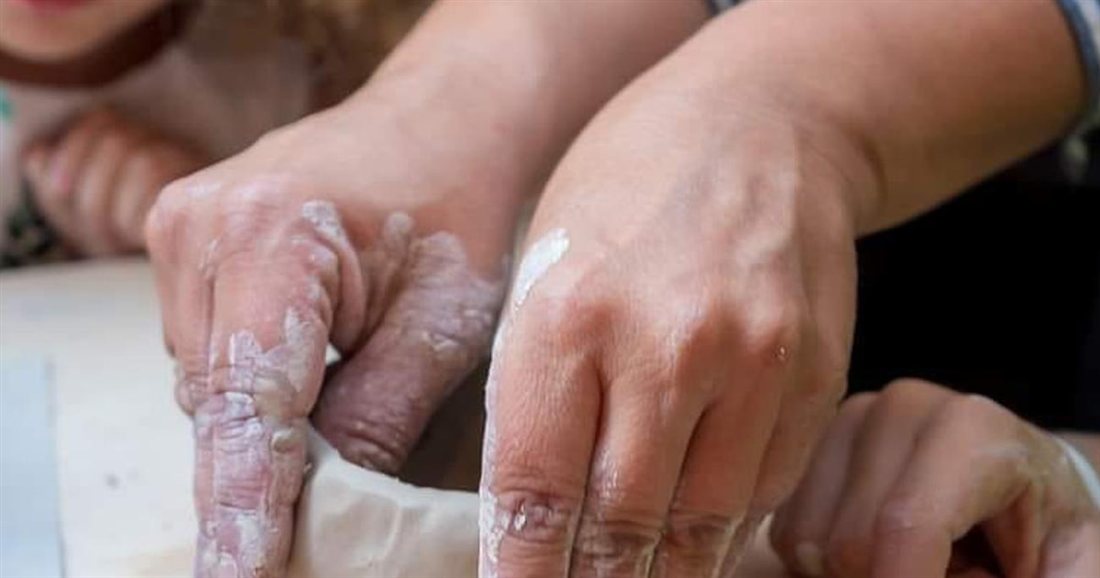
Pinching needs no machine and hardly any tools. Your hands do the work. It is the simplest and fastest way to make a pot. Teachers give it to beginners and children first.
In the Aegina pottery class, Maria starts everyone with pinching. You turn the ball in one hand and pinch with the other. Each turn thins the wall a little, so the pot grows evenly.
- Roll the clay into a smooth ball.
- Push your thumb into the centre.
- Pinch the wall between thumb and forefinger.
- Turn the ball after each pinch.
- Shape the rim and flatten the base.
Pinch pots have been made from ancient times to the present. After class, the museums of Aegina show clay vessels from the island’s past. Look at how the walls curve and thin.
Can you use the potter’s wheel in an Aegina pottery class?
Yes. The two-hour Aegina pottery class with Maria includes a chance to try throwing on the potter’s wheel. Throwing means shaping spinning clay with wet hands. It comes as an extra once your pinched piece is done.
A potter’s wheel is a flat round plate that spins fast. The clay sits in its centre. Your hands press and lift it into a tall tube. That tube becomes a cup or a vase.
In Aegina Town, the Kottaki workshop works mainly on the wheel for the pieces it makes for sale. Sisters Maria and Martha Kottakis teach in the basement of their shop. Their lessons welcome all ages, alone or in groups.
Wheel work takes long practice, so an Aegina pottery class keeps it brief. Full wheel lessons run at the pottery classes in Athens. There, the whole session is spent at the spinning plate.
What can you make in an Aegina pottery class?
In the two-hour Aegina pottery class you make one everyday object, such as a mug or a bowl. You take it home and use it. Longer workshops add cups, bowls, plates, small sculptures and pieces of your own design.
Maria shares stories of the island’s pottery past to spark ideas. The aim is a useful item for your home. Pinching suits round, open shapes, so mugs and bowls work well.
- Black pinch pot cups and bowls in the Shape & Decorate week
- Everyday cups, bowls and plates in the writing and ceramics week
- Small sculptures or objects in the Creative Flow week
- Painted ceramic pieces in the 3-day workshop with Katerina Giannaka
Kottaki Ceramics shows what local hands make. Its shop sells jugs, mugs and bowls painted with fish, roses and pomegranates. Browse it for ideas before your Aegina pottery class. Then plan other things to do in Aegina around your session.
How are pieces coloured, fired and taken home after an Aegina pottery class?
After shaping, the Aegina pottery class moves to colour. You paint your piece with special ceramic colours of your choice. The piece then dries and goes into a kiln, a very hot oven for clay, before it reaches you by post.
Ceramic colours differ from normal paint. They are made to survive the heat of the kiln. The first firing drives out water and hardens the clay for good.
- Shape the piece by hand.
- Paint it with ceramic colours.
- Leave it to dry in the studio.
- Fire it in the kiln.
- Receive it by post at home.
Wet clay cannot travel safely. That is why your piece stays behind after the Aegina pottery class. You leave the island free of fragile luggage, and the parcel follows you home.
Multi-day workshops fire pieces in the studio during your stay. At The Cool Projects, materials and firing are part of the deal. Students also learn basic slips and glazes. A slip is liquid clay. A glaze is a glassy coat that seals the surface.
How does an Aegina pottery class compare with a multi-day ceramics workshop?
A single Aegina pottery class lasts two hours and gives you one finished piece. Multi-day workshops run for three or seven days. They add local clay, more techniques and a small set of finished objects you take home.
Katerina Giannaka, a painter and ceramicist, runs a 3-day creative ceramics workshop at Kipselis Avenue 58. Groups hold one to five people. She blends pottery techniques with painting and colour, in Greek, English, French or Italian.
The Cool Projects studio runs 7-day weeks from Saturday to Saturday with the ceramicist Marina Coriolano-Lykourezos. Each day brings six hours of work, split between morning and afternoon. The Creative Flow week takes up to 10 people.
- Clay foraging, a trip to a local pit to dig wild clay
- Coil building, which stacks rolled ropes of clay into walls
- Slab building, which joins flat sheets of clay
- Sgraffito, which scratches lines through a coloured top layer
- Retreat stays, which add a house with breakfast and lunch
Aegina Retreats also runs a condensed 3-day weekend retreat from time to time. Free hours leave room to swim or taste Aegina pistachios. A single Aegina pottery class fits into a day trip from Athens. For another island option, see the pottery classes on Rhodes.
Who suits an Aegina pottery class?
An Aegina pottery class suits complete beginners, families and children. The GetYourGuide class welcomes all skill levels and runs in English and Greek. Kottaki Ceramics teaches individuals and groups of all ages, from young children to adults.
No past clay experience is needed for the Aegina pottery class on GetYourGuide. Maria, the local potter who leads it, has over 30 years of experience. Guests who have tried pottery before still get space to experiment.
Families have extra options at Kottaki Ceramics, which runs lessons only for children. The studio also arranges private workshops for groups and families on request. More family plans are on the Aegina with kids page.
- Aegina Retreats: beginner to advanced levels, taught in English
- Creative Flow ceramics week: groups of up to 10 participants
- Shape and Decorate retreat: solo travellers, couples or groups of 2 to 4 friends
How long does an Aegina pottery class last, and what is included?
A standard Aegina pottery class lasts 2 hours. The GetYourGuide class supplies every tool needed to make your piece. Groups stay small, with a limit of 10 guests. Multi-day courses add more studio time, meals and stays.
The GetYourGuide Aegina pottery class meets at Aegina Cruises on the main port of Aegina Town. The session ends back at the same spot. Each Kottaki adult class also runs for 2 hours.
Longer courses give you far more time with the clay. The Creative Flow ceramics week has a daily 6-hour workshop, split into 3 hours each morning and afternoon. Its sister retreat, Shape and Decorate, includes 30 hours of teaching.
- Accommodation with breakfast and lunch every day
- Transport to and from Aegina port on arrival and departure
- A day road trip around the island
- All materials, kiln firing and use of the studio
How do you get to an Aegina pottery class from Athens?
To reach an Aegina pottery class from Athens, take a ferry from Piraeus port. The crossing covers about 28 kilometres. High-speed boats reach Aegina Town in 40 minutes. Conventional car ferries take 1 hour 10 minutes to 1 hour 25 minutes.
Ferries sail every day, all year round. The first boat leaves Piraeus between 6 am and 6:30 am, and the last leaves in the evening. Timetables and operators are on the Athens to Aegina ferry page.
One fast route lands at Agia Marina in 30 minutes. Agia Marina lies on the east coast, far from the studios in Aegina Town. A 2-hour Aegina pottery class fits easily into an Aegina day trip from Athens.
Kottaki Ceramics is on pedestrian P. Irioti Street, one road back from the seafront. The Cool Projects studio lies on the outskirts of Aegina Town, about a 10-minute walk away. For other transport on the island, see getting around Aegina.
When does an Aegina pottery class run, and how do you book and cancel it?
The GetYourGuide Aegina pottery class runs on dates listed online, with start times shown when you check availability. Kottaki Ceramics holds adult classes every Saturday from 6 to 8 pm in July and August. Multi-day workshops run from Saturday to Saturday.
You book the GetYourGuide Aegina pottery class online. Free cancellation applies up to 24 hours before the start, with a full refund. A reserve-now, pay-later option lets you hold a place without paying upfront.
Kottaki takes bookings by phone. Katerina Giannaka works by appointment only, and booking at least one week ahead is advised. The ceramics week at The Cool Projects runs once a month, and other dates can be requested.
Current retreat listings show autumn dates from September to December. Longer courses need a room, so see where to stay in Aegina and the right time to visit Aegina.
Frequently Asked Questions
Can you buy finished ceramics after an Aegina pottery class?
Yes. Kottaki Ceramics runs a shop above its basement studio, in a restored mansion. It sells handmade household objects, decorative pieces, kitchen accessories and candle holders. The family opened a second store on the Aegina seafront. That store also hosts ceramic workshops and exhibitions.
Is an Aegina pottery class wheelchair accessible?
The GetYourGuide Aegina pottery class is listed as not suitable for wheelchair users. Service animals are allowed. Another listing for Maria’s hand-building class rates the activity level as light. Kottaki’s lessons take place in the basement of its shop, below street level.
Do the multi-day courses include time away from the studio?
Yes. The Creative Flow week includes a day trip to the Temple of Aphaia and Palaiochora. Guests also meet locals, taste traditional food and relax at The Grapevine House or The Lemon House. Katerina Giannaka’s 3-day workshop adds a tour of quiet island spots and a swim.
Can you combine creative writing with ceramics on Aegina?
Yes. Aegina Retreats runs a Creative Writing and Ceramics Workshop over 5 full days. Each day has a morning and an afternoon session of about 3 hours. All materials, firing of your pieces and six meals are included. The boat to Aegina and accommodation are not.
Can you visit a potter’s studio without joining an Aegina pottery class?
Yes. Katerina Giannaka, a painter turned ceramicist, offers a 2-hour visit to her ceramics workshop on Aegina. Her studio is at Kipselis Avenue 58. The Benaki Museum recommends her work, which blends painting and clay. One hand-shaped bowl carries a leaf pattern outside and a plant-green inside.