
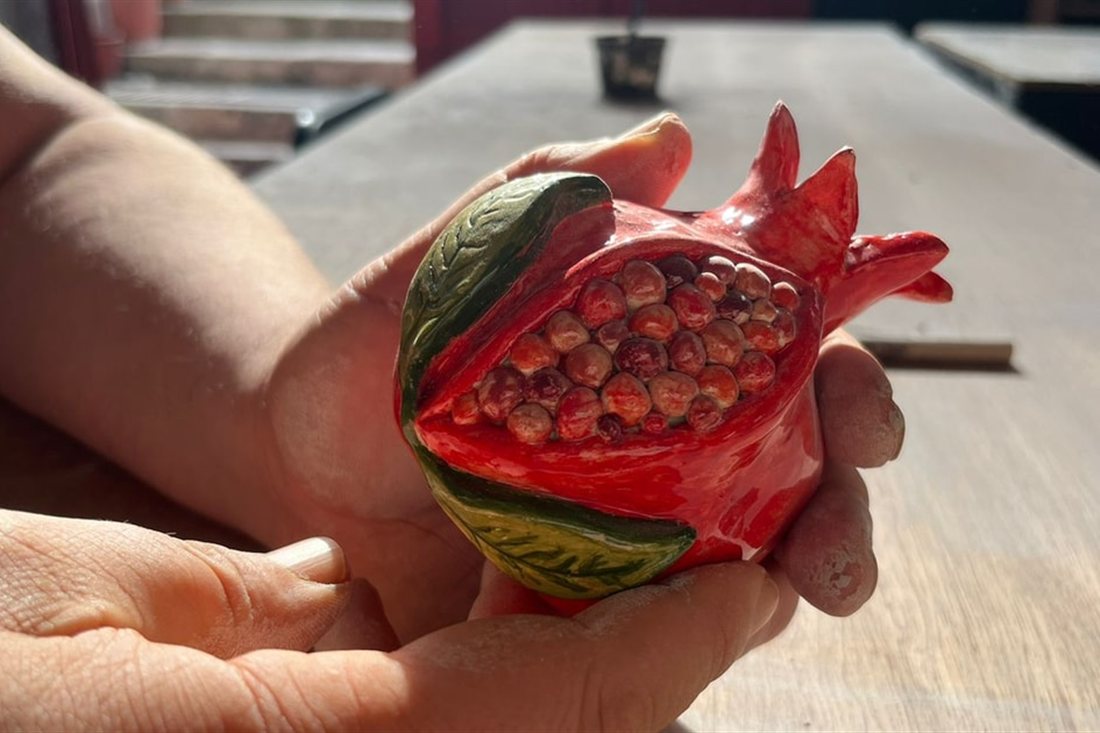
A Rhodes pottery class is a hands-on clay workshop on the Dodecanese island of Rhodes. Guests shape and paint ceramic pieces, such as the pomegranate, a Greek symbol of luck, with a local potter. Tours across the rest of the country are listed on Greece Tours.
The sections below cover the studios, the pomegranate theme, the steps, Lindos ware and the Archangelos potters. They also cover glazing and firing, who it suits, inclusions, getting there, the season and booking, with links into the Rhodes pages. The class shown is checked on GetYourGuide.
What is a Rhodes pottery class?
A Rhodes pottery class is a short, hands-on clay lesson on the Greek island of Rhodes. A local ceramic artist guides a small group. Each guest shapes a piece by hand and paints it, with no earlier skill needed.
Clay is soft, wet earth that turns hard once it dries and is baked. Ceramics is the craft of making objects from clay and hardening them with heat. In a Rhodes pottery class, you work clay with your fingers and simple tools.
The Pomegranate Pottery Masterclass in Rhodes Town centres on one object. Each guest makes a clay pomegranate, the Greek fruit of luck and plenty. The lesson runs in English and Greek.
Longer courses exist too. A week-long Rhodes pottery class retreat adds the potter’s wheel. A potter’s wheel is a spinning disc that turns clay into round pots and bowls.
Which Rhodes pottery class can you book?
You can book the two-hour Pomegranate Pottery Masterclass in Rhodes Town through GetYourGuide. The same studio, Oktana Pottery, also runs a mug-painting session. For a full week of clay, a Rhodes pottery class retreat runs at Ceramicaza near Koskinou.
The GetYourGuide listing is called Rhodes Town: Pomegranate Pottery Masterclass. Its provider is Creative Cube – Oktana Pottery. Guests craft ceramic pomegranates, a symbol of abundance and fertility.
- Pomegranate Pottery Masterclass, Rhodes Town: two hours of hand-building for up to 10 guests
- Pottery Masterclass – Make a Pomegranate, Rhodes Town: the same lesson under a second title
- Paint Your Ceramic Mug, Rhodes Town: one and a half hours of painting a ready-made mug
- Ceramicaza pottery retreat, Koskinou: a week on the potter’s wheel and hand-building in a garden studio
Theo, the Oktana teacher, is a contemporary ceramics artist living on Rhodes. Gudrun Wilsterman founded Ceramicaza and teaches pottery in the Netherlands and Greece.
Karpathos lies in the same Dodecanese island group as Rhodes. Travellers heading there can follow a Rhodes pottery class with a pottery class on Karpathos.
Where does a Rhodes pottery class take place?
The main Rhodes pottery class takes place in a basement studio on Agathonisiou Street in Rhodes Town. The Ceramicaza retreat runs at a family property in Rhodes. Village workshops also work clay in Archangelos, Lindos, Afantou, Salakos and Embonas.
The Oktana studio is a 120-square-metre workshop below street level. Look for its red windows and the sign outside on Agathonisiou Street. Guests arrive 10 minutes before the start.
- Rhodes Town: Oktana Pottery, home of the pomegranate and mug sessions
- Rhodes: Ceramicaza in the Dream House, a 150-year-old family property with a pool
- Archangelos: the main pottery centre of Rhodes in the last century, about 30 km south of town
- Lindos: the village whose old houses gave Rhodian plates their name
- Afantou, Salakos and Embonas: further village areas with pottery workshops
The town studio for each Rhodes pottery class lies near public transport. It is not wheelchair accessible. Service animals are allowed inside.
Ceramicaza’s garden studio has new pottery wheels and kilns. Guests on its retreats stay in rooms at the Dream House, with the sea nearby. A studio or an old house close by is also on offer.
Why does a Rhodes pottery class make pomegranates?
A Rhodes pottery class makes pomegranates because the fruit stands for luck, wealth and new life in Greece. Its packed seeds stand for abundance and fertility. Greeks hang one over the door and smash it at New Year for good fortune.
The custom peaks on New Year’s Eve. Families hang a pomegranate above the front door over the holidays. Just after midnight, a child or lucky guest steps in first, right foot forward. The head of the house then smashes the fruit against the doorframe.
The more seeds scatter, the more luck the family expects. Greeks also give pomegranate charms of glass, metal or ceramic as New Year gifts. These lucky charms are called gouria. Such charms mark the opening of a new shop or a move to a new home.
Your clay fruit in a Rhodes pottery class carries the same wish.
What happens step by step in a Rhodes pottery class?
A Rhodes pottery class follows a clear order. Theo first tells the story of the pomegranate over fresh coffee. Then you mould clay by hand, shape it into a fruit and paint it. The whole lesson fits into two hours.
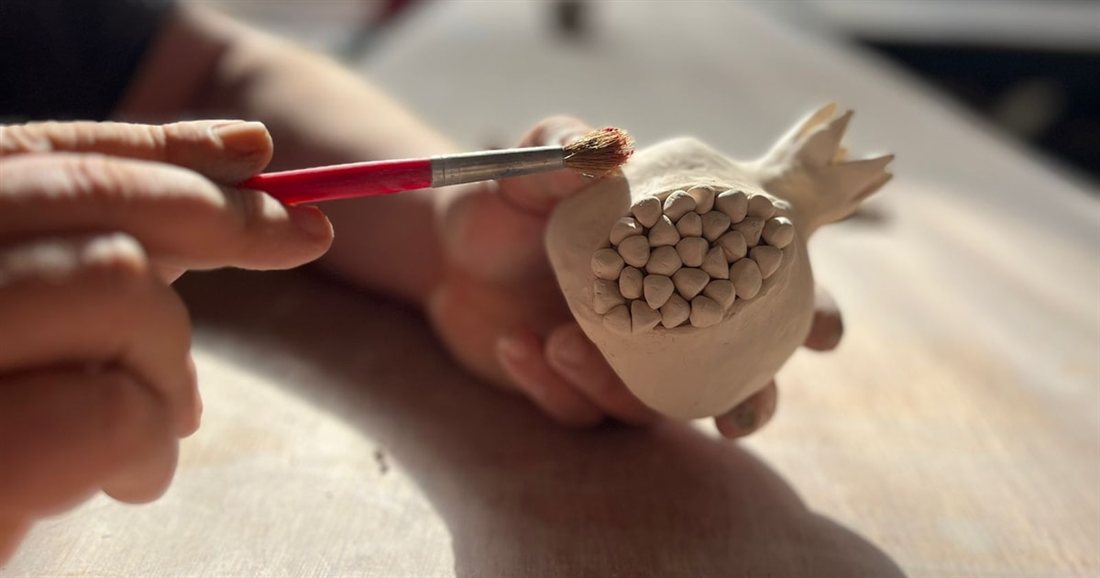
The method is hand-building. Hand-building means forming clay with your hands and simple tools, without a spinning wheel. Each Rhodes pottery class at Oktana teaches the basic hand-building techniques.
- Hear what the pomegranate means in Greek tradition
- Mould a lump of clay into the round body of the fruit
- Shape and decorate the surface with simple tools
- Paint the fruit with the colours supplied
- Leave the piece at the studio for firing and glazing
The mug session skips the clay work. Guests decorate a ready-made ceramic mug with glazes, brushes and stencils from the studio. No artistic skill is needed.
What is Lindos ware, and how does it shape a Rhodes pottery class?
Lindos ware is the old name for glazed plates found in the houses of Lindos. The plates were in fact made in Iznik, in Turkey. They form the long background of painted pottery behind any Rhodes pottery class.
Visitors in the 19th century called these plates Lindos or Rhodian ware. They are glazed earthenware, a common baked clay, with flower patterns on a white ground. Tulips and carnations are favourite motifs. Houses in Lindos were decorated with such plates.
In the last century, Italian rulers set up a factory called ICARO to copy the Lindian style. Its plates showed peacocks, costumed figures and boats painted Greek blue. Family workshops and shops in Rhodes Town still sell hand-painted Rhodian plates.
To see the real thing before a Rhodes pottery class, visit the Decorative Arts Collection. It shows Lindos plates in an old Knights’ armoury on Argyrokastrou Square, inside the Old Town. Its pieces span four centuries, from the 16th to the early 20th.
What is the Archangelos pottery tradition near a Rhodes pottery class?
Archangelos is a large village on the east coast, about 33 km from the Old Town. Its potters keep an old craft alive. A Rhodes pottery class in town gives you a taste of the skills these village workshops still use.
The village of Archangelos has around 6,000 people. It sits on the east coast, about midway between Faliraki and Lindos. Traditional pottery and carpet-making are still practised there.
Its workshops draw on Rhodian and Byzantine patterns. Byzantine art comes from the Christian empire that ruled Rhodes before the Knights. Near the village church, house walls carry ceramic plates from Lindos.
Bonis Ceramics, at the 28th kilometre of the Rhodes–Lindos road, sells wheel-thrown, hand-glazed pottery. Wheel-thrown means shaped on a spinning wheel. A traditional Rhodes workshop is a long, narrow room laid out simply:
- The potter’s wheel sits in a corner of the room.
- A bench beside the wheel is where the potter sits.
- A wooden plank holds fresh pots while they dry a little.
- The clay blends three soils from three parts of Rhodes.
- The potter’s skilled hands do almost all the work.
How are pieces glazed, fired and taken home after a Rhodes pottery class?
After a Rhodes pottery class, your clay piece dries slowly. It is then fired in a kiln, an oven that hardens clay. A glaze, a glassy coating, goes on before a second firing. The finished piece takes about two weeks.
The first firing is the bisque firing. It heats the clay to around 950 to 1,000 °C. After that, the clay can never turn soft again.
The glaze firing melts the coating into glass. Earthenware, a soft and porous clay, is glaze-fired at 1,020 to 1,180 °C. Oktana’s own stoneware, a dense clay for daily use, is fired at 1,240 °C.
- Drying: the shaped clay slowly loses its water in the air.
- Bisque firing: the first bake leaves the clay hard but full of tiny holes.
- Glazing: the glassy coating is brushed or dipped onto the piece.
- Glaze firing: the second bake turns that coating into glass.
- Cooling: the kiln stays shut until it drops below 200 °C.
At Oktana, you leave with a finished, painted pomegranate made by an earlier guest. Your own piece from the Rhodes pottery class goes into the kiln for future guests. This swap is the class’s global exchange of artistry.
Who suits a Rhodes pottery class?
A Rhodes pottery class suits beginners, couples and families. The Pomegranate Pottery Masterclass is open to ages 7 and up. Children under 7 cannot join. Classes are taught in English and Greek, in groups of up to 10.
No clay skills are needed for a Rhodes pottery class. The instructor, Theodoros Karayiannis, known as Theo, explains each step. He makes contemporary ceramics on Rhodes and teaches in his own studio.
Parents and older children make their pomegranates side by side. The Rhodes with kids page has more family ideas. Food lovers can add a Rhodes cooking class on another day.
Cruise passengers can fit a two-hour Rhodes pottery class into a single port day. The Rhodes shore excursion page covers other plans for a day in port.
How long does a Rhodes pottery class last, and what is included?
The Pomegranate Pottery Masterclass is a two-hour Rhodes pottery class. Clay, tools, paints and an instructor are included. Filtered coffee, cold bottled water and light refreshments come with it. The session also covers the meaning of the pomegranate in Greek culture.
Rhodes studios run short sessions and full residential weeks. A short session fits into half a day. Each Rhodes pottery class format has its own length and focus:
- Pomegranate Pottery Masterclass: 2 hours of hand-building and painting.
- Paint Your Ceramic Mug at Oktana: 1.5 hours of painting a mug.
- Ceramicaza beginners’ retreat: a week of daily lessons.
- Ceramicaza wheel retreat: a week of throwing, crystal glazes and raku, a fast, fiery firing.
The mug class uses a bisque mug, which has already been fired once. Guests decorate it with ceramic stains, glazes, brushes and stencils. The studio supplies every material.
Ceramicaza retreats take place at The Dream House on Vasileos Pavlou in Rhodes. Lessons run in gardens with covered areas and a pool. Three meals a day, an excursion and all facilities are included.
How do you get to a Rhodes pottery class?
The Pomegranate Rhodes pottery class meets at Agathonisiou 4 in Rhodes Town, behind the Creative Cube sign. Guests walk there from the cruise port and the Old Town, or take a bus or taxi from the resorts.
Cruise ships dock beside the Gate of Panagia, one of the Old Town gates. From the ship, the Old Town entrance is about 400 metres on foot. The Old Town itself is closed to cars.
The main bus station stands by the New Market on Averof Street, 350 metres from Liberty Gate. RODA buses serve the west coast. KTEL buses serve the east coast.
Taxis queue outside the cruise port gate. The getting around Rhodes guide explains bus routes and taxis. From each resort, the road distance to the Old Town is:
- Ixia: 4 to 6 km
- Kallithea: 9 km
- Faliraki: 14 km
- Kolymbia: 25 km
- Pefkos: 53 km
When does a Rhodes pottery class run, and how do you book and cancel it?
You can book the Pomegranate Rhodes pottery class online, with a mobile voucher and instant confirmation. Cancel up to 24 hours ahead for a full refund. Oktana also runs its own booking portal and mobile app.
Peak season on Rhodes runs from June to September. Bus timetables change between the peak months and the quieter months. A Rhodes pottery class takes place indoors, so hot or wet days do not stop it.
Ceramicaza holds a beginners’ retreat week in late spring. A week for beginners and intermediates runs from late September into early October. The wheel-throwing week follows straight after.
Pick a date for your Rhodes pottery class with the guide on when to visit Rhodes. It sets out the weather and crowds month by month.
Frequently Asked Questions
What do you wear to a Rhodes pottery class?
Wear comfortable clothes that you do not mind marking, as wet clay and glaze can stain fabric. Short sleeves keep your cuffs clear of the clay. Tie back long hair and slip rings into a pocket before you start shaping.
Can you learn the potter’s wheel on Rhodes?
Yes, a Rhodes pottery class at Ceramicaza’s studio can use eleven wheels and two kilns. Its founder, ceramic artist Gudrun Wilsterman, splits her time between Rhodes and Andijk in the Netherlands. Guest teacher José Mariscal is a master thrower. He specialises in crystalline glazes, which grow crystals as they cool.
Where else on Rhodes do potters work?
Pottery workshops cluster in Lindos, Salakos, Afantou, Archangelos and Embonas. The island has good clay that is easy to find, so potters have worked here since ancient times. Old Rhodian pots have turned up all around the Mediterranean, because top pieces were made for export.
How do you reach a Rhodes pottery class from the airport?
RODA buses link the airport with the New Market bus station in Rhodes Town. They run about twice an hour from 05:45 to 23:45. The ride takes up to 45 minutes, since the bus stops along the way. The airport stop sits between the two terminals.