
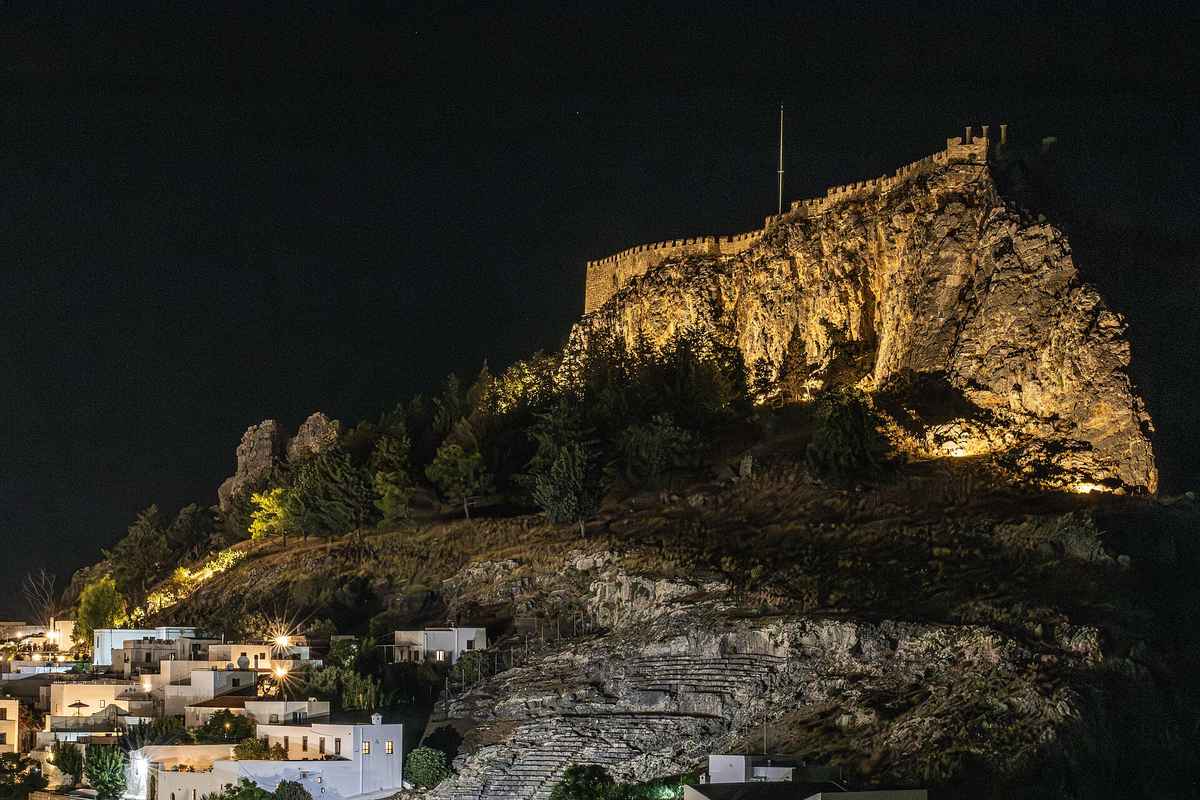
Lindos is a clifftop village on the east coast of Rhodes, roughly fifty kilometres south of Rhodes town, crowned by an ancient acropolis and ringed by whitewashed houses and a sheltered bay. Plan tickets and tours through My Greece Tours.
For the wider island context, see our Rhodes travel guide. The sections below cover what Lindos is, the Acropolis of Lindos, what to do in the village, the beaches around the bay, and how to get there and visit.
What is Lindos?
Lindos is a historic clifftop village on the east coast of Rhodes, about fifty kilometres south of Rhodes town, known for its dazzling whitewashed houses, car-free cobbled lanes and the ancient Acropolis of Lindos rising on the rock directly above the settlement and its protected bay.
Lindos grew up beneath one of the most important sanctuaries of the ancient Dodecanese, and the village still wraps tightly around the base of the acropolis rock. Its lanes are narrow, paved with stone and closed to ordinary traffic, so the place is explored entirely on foot. Sugar-cube houses press together in a dense maze, their walls washed brilliant white against the blue of the Aegean. Many of these are former captain’s houses, grand sea-merchant homes with carved doorways and courtyards floored in black-and-white pebble mosaic, a craft known locally as choklakia that gives Lindos much of its distinctive character. The whole village is protected as a listed settlement, so the white houses, the carved doorways and the patterned courtyards have been preserved largely as they were in the heyday of the Lindian sea captains, and new building is tightly controlled to keep that historic character intact.
Above the rooftops, the fortified acropolis dominates every view, while below the village the land drops to a curved, sheltered bay. The combination of antiquity, traditional architecture and clear coastal water has made Lindos one of the best-known destinations on Rhodes, busy in the warm months yet still recognisably a living Greek village. Our guide to things to do in Rhodes covers excursions across the whole island, and the next section covers the Acropolis of Lindos.
What is the Acropolis of Lindos?
The Acropolis of Lindos is the fortified ancient citadel crowning the rock above the village, holding the Hellenistic Temple of Athena Lindia, a grand colonnaded stoa, a medieval fortress built by the Knights of Saint John and remains of a Byzantine church, with sweeping views over the sea and St Paul’s Bay below.
At the heart of the acropolis stands the Temple of Athena Lindia, a sanctuary that drew pilgrims long before the classical age and gave Lindos its religious importance. Climbing up, visitors pass the monumental stairway and the long Hellenistic stoa, a colonnaded hall whose surviving columns frame the approach to the temple terrace. Later centuries left their own marks: the Knights of Saint John fortified the summit during the medieval period, wrapping the ancient ruins in defensive walls and gateways, and a Byzantine church survives among the older stones, layering Christian worship over the earlier pagan sanctuary.
The reward at the top is the panorama. From the temple terrace the ground falls away on every side, opening over the open Aegean to the east and down onto the almost enclosed circle of St Paul’s Bay to the south. Reaching the gate means climbing a series of steep stone steps from the village; donkey rides up the hill have traditionally been offered for those who prefer not to walk. Our guide to Rhodes Old Town covers the Knights’ medieval heritage in the capital, and the next section covers what to do in Lindos village.
What can you do in Lindos village?
In Lindos village you can wander the car-free cobbled lanes, step inside captain’s houses with their choklakia pebble-mosaic courtyards, visit churches such as the Church of the Panagia, browse boutiques and craft shops, and pause at tavernas and rooftop terraces with views up to the acropolis and out over the bay.
The village itself is the attraction. Walking its tangle of whitewashed alleys leads past the great captain’s houses, whose sea-captain owners built courtyards paved in black-and-white pebble mosaic and framed doorways with carved stone. Several of these historic homes can be visited, offering a glimpse of the wealth Lindos drew from seafaring and trade. The Church of the Panagia, the village’s main Byzantine-era church, sits among the lanes with frescoed interiors and a choklakia floor, a quiet counterpoint to the busy shopping streets nearby. The village also has a working square with cafes where locals gather, small museums and galleries in restored houses, and viewpoints where you can look up at the floodlit acropolis after dark, so there is plenty to fill the hours between the climb to the temple and a swim in the bay below.
Beyond the monuments, Lindos rewards slow exploration. Small boutiques, jewellers and craft shops fill the ground floors along the main routes, and tavernas spill onto terraces where you can eat with the acropolis lit above you. Rooftop bars take advantage of the height and the views, and the short walk down to the waterfront opens up the beaches and boat moorings. Our guide to where to stay in Rhodes covers accommodation across the island, and the next section covers the beaches at Lindos.
What are the beaches at Lindos?
Lindos has two main beaches set in sheltered coves below the acropolis: the principal Lindos Beach, a broad sandy stretch curving around the main bay with calm shallow water, and the small, almost enclosed St Paul’s Bay to the south, a tiny scenic cove framed by rocks beneath the temple rock.
The main Lindos Beach sits directly below the village, filling the curve of the bay with soft sand and gently shelving, sheltered water. Because the bay is well protected, the sea here is usually calm and shallow close to shore, which makes it an easy, family-friendly place to swim. Sun loungers and small boats share the waterfront, and the village rises behind, so it is only a short walk back up to the lanes and tavernas when you have had enough of the sand.
To the south, tucked beneath the acropolis rock, lies St Paul’s Bay, one of the most photographed coves on Rhodes. Almost ringed by land, it forms a near-circular natural pool with a narrow opening to the open sea, giving exceptionally sheltered, clear water. Its small chapel and dramatic setting under the temple make it a favourite spot for swimmers and couples. Our guide to Rhodes beaches covers the best coast across the island, and the next section covers how to get to Lindos and visit.
How do you get to Lindos and visit?
Lindos lies about fifty kilometres south of Rhodes town and is reached by car, by public bus along the east-coast road, or by boat excursion from Rhodes town harbour. From the village edge the acropolis is climbed on foot up steep stone steps, with donkey rides traditionally offered up the hill.
Most visitors arrive from Rhodes town, the island’s capital and main port, which sits at the northern tip of Rhodes. The drive south follows the east coast for roughly fifty kilometres and brings you to a car park area outside the village, since vehicles cannot enter the narrow lanes. Regular public buses also run down the coast to Lindos, making it reachable without a car, and in the warm season boat excursions sail along the shore from the harbour, approaching the village from the sea with the acropolis towering above the bay.
Once at Lindos, getting around is on foot. From the village you walk up through the lanes and then climb the steep stone steps to the acropolis gate; donkey rides up the hill have long been offered for those who would rather not tackle the ascent. Comfortable shoes, sun protection and water are sensible, as the climb is exposed and the stones can be slippery. Plan your visit and tours through our Rhodes travel guide.
Frequently Asked Questions
How far is Lindos from Rhodes town?
Lindos sits on the east coast of Rhodes, roughly fifty kilometres south of Rhodes town, the island’s capital and main port at its northern tip. The journey follows the east-coast road and is comfortably done as a day trip. You can drive yourself, in which case you park outside the village because the cobbled lanes are closed to cars, or take one of the regular public buses that run down the coast from Rhodes town. In the warmer months, boat excursions also sail along the shoreline from Rhodes town harbour, arriving at Lindos from the sea with the acropolis and the white village rising dramatically above the bay. Each option suits a different kind of visit, from independent exploring by car to a relaxed cruise that combines the journey with swimming stops along the coast before reaching the village.
Is the Acropolis of Lindos hard to climb?
Reaching the Acropolis of Lindos involves walking up from the village through the lanes and then climbing a series of steep stone steps to the citadel gate. The route is not long, but it is uphill and exposed, and the worn stones can be slippery underfoot, so comfortable, grippy shoes are strongly advised. The climb passes the monumental stairway and the Hellenistic stoa before opening onto the temple terrace, where the views over the sea and St Paul’s Bay are the reward. Donkey rides up the hill have traditionally been offered for those who prefer not to walk, though many visitors choose to make the ascent on foot at their own pace. Sun protection, a hat and water make the climb easier, particularly in summer, when the rock and the steps grow hot and there is little shade along the way up to the top.
What is St Paul’s Bay at Lindos?
St Paul’s Bay is a small, almost completely enclosed cove on the southern side of Lindos, tucked beneath the rock that carries the acropolis. Land wraps around it on nearly every side, leaving only a narrow opening to the open sea, so the bay behaves like a sheltered natural pool with calm, exceptionally clear water. This makes it a popular and very scenic place to swim, and it is one of the most photographed spots on the whole of Rhodes. A small chapel beside the cove adds to its appeal, and the towering temple rock above gives it a dramatic backdrop. It takes its name from the tradition that the Apostle Paul sheltered here. Compared with the broad main Lindos Beach on the village bay, St Paul’s Bay is smaller and more intimate, prized for its setting as much as for its swimming.