

Tsougria is a green, uninhabited islet facing Skiathos Town across the harbour channel, and it delivers the simplest island-off-an-island day trip in the Northern Sporades. Taxi boats cross from the old port in about 15-25 minutes, landing day-trippers on a sandy northwest beach with clear, shallow water, a seasonal taverna and pine-backed shade. Plan the whole trip with Greece Tours.
This guide covers the crossing from the old port, the main beach and the quieter second cove, the facilities you find and the ones you leave behind. Swimming and snorkelling conditions, packing essentials, family suitability, the islet’s protected setting. The smartest way to slot Tsougria into a wider island itinerary.
What is Tsougria and where does it sit opposite Skiathos Town?
Tsougria is a small, green, uninhabited islet directly opposite Skiathos Town, across the harbour channel on the island’s southeast side. Pines and scrub cover its low hills, no roads or cars exist, and summer taxi boats connect it daily.
Tsougria belongs to a cluster of islets that shelters the harbour of Skiathos from open water, sitting roughly 2 km off the town waterfront. The islet measures under 2 square kilometres, rises in low pine-covered hills, and carries no permanent population, no roads and no vehicles. Boats approach its northwest side, where a sandy beach and a seasonal taverna handle the day-trip traffic. The green profile stands out against the blue channel, and ferries entering the port pass close to its shores. Fishermen worked these waters for generations, and a small chapel marks the human trace on the interior. Day-trippers see the islet as the closest escape from the town quays, reachable faster than most south-coast beaches.
Its name appears on every excursion board along the old port.
Skiathos Town faces the islet directly, so the crossing doubles as a harbour tour: boats pass the Bourtzi peninsula, the ferry quay and the fishing caiques before entering open water. Views from Tsougria run straight back to the amphitheatre of whitewashed houses on the two town hills, with the Agios Nikolaos clock tower visible on the ridge. Aircraft on final approach to the runway cross low over the channel, and the beach gives one of the best free plane-spotting seats on the island. The islet’s position also explains its calm water, because the channel blocks the worst of the north swell. Photographers time the late-afternoon light, which falls on the town facades and turns the harbour front gold.
Evening boats return before the waterfront dinner hour begins.
The islet forms part of a protected natural cluster together with its smaller neighbour Tsougriaki, and building activity stays banned across both. Pine, olive, lentisk and wild scrub cover the slopes, and the vegetation reaches close to the waterline on the sheltered sides. Bird species rest here on migration routes through the Sporades, and the surrounding seabed holds seagrass meadows that keep the water clear. Visitors stay on the beaches and the single footpath, since the interior has no marked trail network. The absence of cars, engines and construction keeps the noise level to waves, cicadas and arriving boats.
This protected status shapes every practical detail of a visit, from the limited facilities to the leave-no-trace expectations placed on day-trippers. The rule set is simple: carry out everything you carry in.
History left a light footprint on Tsougria. Monks from the Evangelistria monastery once farmed plots on the islet, and olive terraces from that period still line parts of the interior. A small chapel stands above the main beach, whitewashed and maintained, visible to boats arriving from the channel. No hotel, house or harbour was ever built, which separates Tsougria from developed islets elsewhere in the Aegean. The islet’s role today is purely recreational: a swimming and picnic ground for the town opposite. That continuity matters, since the view from the beach. Pines, water, town. Has barely changed across living memory, and the crossing itself follows the same line the farm boats used.
Older islanders still call the islet the town’s garden. The only structures are the taverna, the chapel and old terrace walls.
How do you get to Tsougria from Skiathos?
Taxi boats and small excursion boats leave the old port of Skiathos Town on summer mornings and reach Tsougria in about 15-25 minutes. Boats run multiple daily crossings in high season and collect passengers again in the afternoon.
The old port, the western half of the town waterfront beside the Bourtzi, serves as the departure point for all Tsougria crossings. Signboards along the quay list morning departure times, and skippers sell tickets beside the gangway rather than through offices. First boats leave mid-morning in July and August, with extra crossings added on calm, hot days when demand rises. The ride crosses about 2-3 km of sheltered channel, so seasickness is rarely an issue on the short hop. Passengers land directly on the main beach or at a small jetty, depending on the boat and the swell. Return times are announced on board before landing, and the last boats leave the islet in the late afternoon.
Arrive 15 minutes early on peak days to secure deck seats.
Longer Skiathos boat tours also call at Tsougria as part of wider itineraries, pairing the islet with swimming stops along the south coast or with the sea caves of the north. These combination trips give around 1-2 hours on the islet rather than a full day, which suits travellers who want variety over a single base. Dedicated taxi boats work the opposite pattern: they drop passengers in the morning and return on a fixed afternoon schedule, leaving 4-6 hours of beach time. Choose the taxi-boat option for a full swimming day and the tour option for a sampler. Both leave from the same old-port quay, and both cancel when the channel turns rough.
Tickets for combination trips sell out earlier, so book them a day ahead at the quay.
Private options widen the choice. Small motorboats rent by the day at the harbour, and lower-horsepower categories require no licence, which puts Tsougria within reach of confident beginners on calm days. The crossing takes about 20-30 minutes at modest speed, and anchoring off the second cove opens a corner the scheduled boats skip. Sea kayaks and stand-up paddleboards make the trip only in flat conditions with experienced paddlers, since ferries and hydrofoils use the same channel and the wind builds fast after midday. Skippers advise checking the forecast before any self-drive attempt, because the meltemi funnels between the islands in July and August.
The scheduled taxi boat stays the simplest and cheapest route for the large majority of visitors. Fuel, deposit and return-time terms are agreed at the rental kiosk before departure.
Timing shapes the experience. Morning crossings carry the day’s main wave of visitors, so the first boat wins an hour of near-empty sand before the beach fills. Midday arrivals meet the fullest sunbed rows and the busiest taverna tables. The channel usually stays calm through the morning and picks up chop in the afternoon, which makes the return ride livelier than the ride out. Trips cancel entirely on strong-wind days, and operators refund or rebook without drama. June and September crossings run on reduced schedules with lighter loads, and the water still holds summer warmth in early autumn. Outside the season the boats stop, and Tsougria returns to fishermen, gulls and the odd private hull swinging at anchor.
Plan the crossing for the earliest departure you can manage.
What is the main beach on Tsougria like?
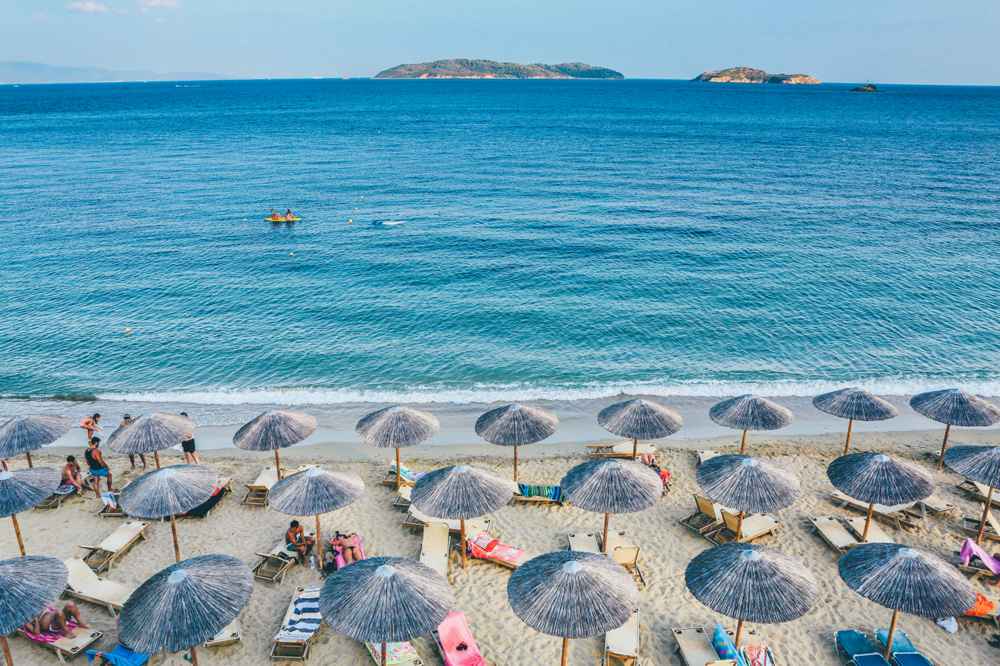
The main beach spreads along the islet’s northwest side: pale sand mixed with fine pebbles, water that stays shallow for around 20-30 metres, pine shade at the back, one seasonal taverna and a short row of sunbeds.
The main strand faces Skiathos Town across the channel, running roughly 200-300 metres between low rocky points. Sand dominates the centre, small smooth pebbles gather at the waterline, and the seabed continues sandy well past standing depth. The gradient is gentle: adults wade around 25 metres before losing footing, which explains the beach’s reputation among families. Pines lean over the back third of the sand and drop real shade from late morning, a rarity on commercial beaches. The water clarity beats most town-side alternatives because no road, river or building drains into the bay. Boats moor at the northern end, keeping the swimming zone clear, and a roped line separates bathers from the approach lane in high summer.
The view holds the whole town skyline from sand level.
Comparison with the famous Skiathos beaches across the water clarifies what Tsougria offers. Koukounaries and Vromolimnos deliver water sports, beach bars and bus access; Tsougria delivers space, silence and a boat ride. Sunbed numbers stay low — a short double row near the taverna — so most visitors spread towels on open sand or under the pines at no cost. Music does not play, jet skis do not operate, and the loudest interruption is an aircraft descending toward the runway across the channel. The trade-off is real: no showers, no changing cabins, no shop beyond the taverna. Visitors who rank calm above convenience rate the islet’s main beach ahead of every organised strip on the south coast.
Arrivals on the first morning boat often have 200 metres of sand to themselves.
Practical rhythm on the main beach follows the boats. The sand fills between late morning and early afternoon, peaks around lunchtime when taverna tables turn over fastest, and empties again as the return crossings begin. Shade migrates through the day: the pine line covers the back of the beach until midday, then the western rocks throw afternoon shadow at the far end. Sunbed pairs with umbrellas sit closest to the jetty and go first, so towel space under the trees becomes the default for later arrivals. The northern point shelters the bay from channel chop, and the water surface usually stays flat enough for comfortable swimming all day.
Rubbish bins stand behind the taverna, and everything else leaves on the afternoon boats. Peak-season Saturdays run busiest; midweek visits feel half as full.
Families dominate the demographic mix, joined by couples, snorkellers and a steady stream of private boats anchoring off the sand. The shallow entry suits toddlers, the clear water suits mask-and-fin explorers working the rocky points, and the taverna anchors the long lunch crowd. Older visitors appreciate the flat sand and the short walk from the jetty, which involves no steps or steep paths. Dogs travel on the taxi boats at the skipper’s discretion, and shade under the pines keeps them comfortable. The beach never reaches the towel-to-towel density of Koukounaries in August because boat capacity caps the daily headcount.
That built-in limit is the main beach’s quiet advantage: the crowd size stays fixed no matter how full the town gets. Space opens further at both rocky ends for anyone walking two minutes.
Which quieter coves does Tsougria offer beyond the main beach?
A second, smaller cove sits south of the main beach, reached on foot over a low headland path in about 10-15 minutes. It has no facilities, fewer visitors, mixed sand and pebbles, and equally clear water.
The second cove rewards the short walk. A dirt path leaves the southern end of the main beach, climbs gently through pine and lentisk. Crosses the low headland and drops to a strip of sand and pebble about 80-120 metres long. Visitor numbers here run at a fraction of the main beach, and weekday mornings often deliver the cove to a single group. The water deepens slightly faster than at the main strand but stays calm under the same shelter. No taverna, sunbeds or bins exist, so everything needed walks in and everything used walks out. Swimmers who value privacy over amenities head straight here off the first boat and return to the taverna side only for lunch.
Sturdy sandals beat flip-flops on the stony sections of the path.
Rocky corners multiply the swimming spots beyond the two named beaches. Flat slabs at both ends of the main bay serve sunbathers who prefer stone to sand, with ladder-free entries into deeper water for confident swimmers. The southern shoreline toward the second cove hides pocket inlets a couple of metres wide. Reachable by swimming or careful scrambling, each holding its own patch of turquoise over pale sand. Private boats anchor off these corners at midday, and their swimmers share the inlets with snorkellers circling from the beaches. The eastern and northern shores face open water, take the swell, and stay unvisited except in flat calms. Sticking to the western, town-facing side keeps conditions gentle for everyone on foot.
Water shoes help on the slabs, where sea urchins colonise the shaded ledges.
Walking on Tsougria stays informal. The headland path between the two beaches is the only established route, and the interior beyond it belongs to pine, olive terraces and scrub without waymarks. Explorers who push uphill find the small chapel and long views over the channel to the town. The Bourtzi and the flight path, with Skopelos rising to the east on clear days. Long trousers help against the scrub, and the round trip to the high point takes about 30-45 minutes at an easy pace. Summer heat builds fast on the open slopes, so walkers move early and swim after.
The islet is small enough that no one gets meaningfully lost: downhill in any western direction returns to visible water. Carry water on every inland detour; no source exists beyond the taverna.
Choosing between the coves comes down to group needs. Parents with young children stay at the main beach for the shallows, the sunbeds and the lunch option 50 metres from the towel. Couples and readers cross to the second cove for quiet and return refreshed. Snorkellers split the day: morning at the southern rocks before boat traffic, afternoon at the northern point once the light angles in. Groups mixing all three profiles use the main beach as base camp, since the path makes the quiet cove a 15-minute round trip rather than a commitment. The final boat time rules every schedule regardless of the split, and skippers count heads before leaving.
Missing the last crossing means negotiating a private pickup across the channel. Set a phone alarm 30 minutes before the departure time.
What facilities exist on Tsougria islet?
Tsougria has one seasonal taverna behind the main beach, a short row of sunbeds with umbrellas, and basic toilets at the taverna. No shops, showers, roads, accommodation or fresh-water sources exist anywhere on the islet.
The taverna operates through the summer season, opening with the first regular boats and closing when the crossings stop in autumn. Tables spread under trees and shade sails a step from the sand, and the kitchen works a short menu built on grilled fish, salads, simple oven dishes and cold drinks. Supplies arrive by boat from the town, which keeps the offer honest rather than extensive. Lunch service peaks between the late-morning arrivals and the first afternoon departures, and the terrace fills fastest on weekends. Card payment depends on the signal across the channel, so cash remains the reliable option.
The toilets behind the kitchen serve customers, and a courteous order of drinks earns access for everyone else in practice. Reserve a table on arrival during August; walk-ups wait at peak lunch.
Sunbed provision stays deliberately small. A short double row with umbrellas lines the sand nearest the taverna and jetty, rented per set for the day, and the stock runs out by late morning in August. The rest of the beach remains free ground for towels and beach tents, with the pine line providing natural shade that outperforms canvas at midday. No shop sells sunscreen, water, snacks or forgotten hats, so the town supermarket run happens before boarding, not after. Mobile coverage reaches the west-facing beaches from the antennas across the channel, and phones hold a usable signal for calls and maps.
Power sockets do not exist for public use, which turns the islet into an accidental digital detox for battery-dependent visitors. Pack a power bank for cameras on long beach days.
Safety infrastructure is minimal by design. No lifeguard tower stands on either beach, so swimmers watch their own depth and children stay inside the shallow shelf. The taverna crew handles first-aid basics and radios the port for anything serious. Taxi boats double as evacuation transport in an emergency, with the crossing back taking about 15-25 minutes. The gentle west-side conditions keep incidents rare: no rips, no shore break, no boat lanes through the swimming zone. Hazards reduce to sunburn, urchins on the rocky edges and dehydration on inland walks. A basic kit — plasters, antiseptic, painkillers — covers the realistic scenarios.
Parents rate the risk profile easier to manage than at surf-exposed beaches, provided the sun gets the respect it demands. Water shoes solve the urchin question for rock explorers outright.
The facilities gap defines the islet’s character rather than diminishing it. Tsougria works as a bring-your-own destination: water bottles, snacks, shade, entertainment and patience all travel in the beach bag. The single taverna removes the need for a packed lunch without turning the beach commercial. The absence of music, rental kiosks and vendors preserves the quiet that justifies the crossing. Visitors who need showers, cabins and cafe rotation pick the organised south-coast strips instead and lose nothing. The islet’s economics reinforce the balance: one operator, one season, supplies by boat, no expansion pressure under the protection rules.
The result is a beach day closer to the Aegean of decades past than anything reachable by bus on the main island. Pack accordingly and the missing infrastructure never registers as a problem.
How good are swimming and snorkelling around Tsougria?
Swimming conditions rank among the best in the Skiathos area: sheltered, clear, shallow-shelving water on the west side. Snorkelling shines around the rocky points, where seagrass, fish shoals and octopus territory start within 50 metres of the sand.
Water clarity is the islet’s headline asset. The seabed off the main beach reads sharp at 5-8 metres of depth, helped by the seagrass meadows that stabilise the sand and filter the water column. The bay’s westerly aspect shelters it from the meltemi, so the surface stays swimmable on days when north-coast beaches close their flags. Sea temperature follows the regional curve: cool in early June, warmest in August, and pleasant well into September, when the crowds thin and the clarity peaks. Morning water is glassiest, before boat wakes and afternoon breeze texture the surface.
Distance swimmers trace the shoreline between the two beaches, a route of around 600-800 metres each way with continuous visual contact with the bottom. A bright swim buoy keeps boat skippers aware of open-water swimmers.
Snorkelling routes organise themselves around the rocky points. The northern point holds the densest fish life: shoals of saddled seabream, damselfish over the boulders, wrasse patrolling the crevices and the occasional octopus tucked under ledges. The southern rocks toward the second cove offer longer, shallower reef lines that suit children and beginners, with sandy patches for easy standing rests. Seagrass beds between the points shelter juvenile fish and pen shells, and patient floaters spot them without diving. Visibility routinely reaches 10-15 metres on calm mornings. Masks, snorkels and fins come from town shops, since nothing rents on the islet. The golden rule stays constant: look, photograph, touch nothing, and give octopus dens the space they need.
Late morning brings the best light angles for underwater photography.
Conditions vary by wind direction, and reading them saves a wasted crossing. South and west winds push mild chop into the main bay while leaving the second cove workable. The meltemi from the north flattens the west side completely and makes Tsougria the calm choice on blustery days. Operators judge the channel each morning and simply cancel when the ride turns unsafe, so a running boat signals swimmable water on arrival. Currents inside the bays stay negligible, though the points feel a light pull on windy afternoons. Jellyfish appear in occasional pulses, as everywhere in the Aegean, and the taverna crew knows the day’s status.
Deep water starts only beyond the points, keeping the core swimming zone honest for mixed-ability groups. Check the forecast the evening before and book the boat accordingly.
Swimmers structure a Tsougria day around the water rather than squeezing swims between other activities, which is the islet’s real advantage over multi-stop cruises. A typical rhythm: long morning swim off the main beach, snorkel circuit of the southern rocks before lunch. Taverna break through the hottest hour, second cove for the afternoon session, final cool-down before the return boat. Children log more water hours here than anywhere on the main island because nothing competes for their attention. Adults training for open-water events use the shoreline route for measured laps.
The combination of shelter, clarity and low boat traffic inside the swim zones produces conditions that organised beaches with jet-ski lanes cannot match at any point of the season. Rash vests spare shoulders during multi-hour sessions under the July sun.
What do you pack for a Tsougria day trip from Skiathos?
A Tsougria day bag holds water, sunscreen, hats, snorkel gear, water shoes, cash for the taverna and boat, and a power bank. Shops do not exist on the islet, so town purchases happen before boarding.
Hydration tops the list. Each person needs about 1.5-2 litres of water for a full summer day, more for walkers heading inland, and the taverna supplements rather than replaces the supply. Frozen bottles packed the night before double as cool packs for fruit and sandwiches, then thaw into cold drinking water by afternoon. Sun protection follows: high-factor cream applied before boarding and repeated after each long swim, hats with brims, and sunglasses rated for glare off water. The pine line shades the back of the main beach, but towel spots on open sand bake from late morning. A lightweight beach umbrella earns its carry weight for families staking a full-day position away from the trees.
Reef-safe formulas protect the seagrass meadows that keep the water clear.
Footwear and swim kit decide how much of the islet opens up. Water shoes handle the pebble waterline, the rocky points and the urchin ledges; sturdy sandals manage the headland path to the second cove. Snorkel sets travel from town because no rental exists on the sand, and children’s masks in correct sizes come from the same shops. Inflatables for small children pack flat and pump up on the beach. Dry bags protect phones, cameras and boat tickets from spray on the crossing and from sand on shore. Towels double as pine-shade picnic ground sheets.
Everything fits one backpack per adult when packed with intent, which matters on a boarding gangway with 40 other passengers doing the same thing. Label the bags; identical beach gear swaps owners easily on crowded decks.
Cash covers the day’s three costs: the boat fare, the taverna bill and the sunbed set, since card terminals depend on a signal that comes and goes across the channel. ATMs cluster around the old port in town, a two-minute detour before boarding. Food packing depends on strategy. Taverna diners carry only fruit and snacks. Picnic groups carry the full spread plus a bag for every scrap of rubbish, because bins exist only behind the taverna. Entertainment weighs nothing: a deck of cards, a paperback, a snorkel and the beach itself fill 6 hours without effort.
Phone batteries drain fast on camera duty and hotspot searching, so the power bank moves from luxury to essential on a full-day visit. Small notes speed up boat-ticket payments at the gangway.
The leave-behind list matters as much as the packing list. Speakers stay in the hotel room, since sound carries across the whole bay and silence is the product everyone paid the fare for. Glass bottles risk breakage on rocks and stay home in favour of cans and refillables. Drones face restrictions near the flight path into the airport directly across the channel, so pilots check the rules before packing one. Valuables beyond the day’s cash serve no purpose on an islet with no locks. The final check before the return boat is the sand sweep: pebbles stay on the beach. Rubbish leaves in the bag. The pitch under the pines looks exactly as it did at arrival.
Ten seconds of tidying keeps the protected islet worth revisiting.
Is Tsougria a good day trip for families visiting Skiathos?
Tsougria ranks among the top family outings on the island: a short 15-25 minute boat ride, shallow sheltered water, pine shade, a taverna for lunch, and zero traffic. Children treat the crossing itself as the highlight.
Guides to Skiathos with kids consistently place the Tsougria crossing near the top of the activity list, and the logic holds on the ground. The boat ride is short enough for toddlers’ patience and exciting enough for older children. With fish visible in the clear channel water and aircraft roaring low overhead on the approach. The landing beach removes the usual family friction points: no road to cross, no long walk with bags, no hunt for space. Parents set a base under the pines within sight of the shallows and the day runs itself. The fixed return time even helps, giving the day a clean structure that children accept without negotiation.
The whole outing costs a family less than one organised excursion and delivers more actual swimming time.
Age suitability spans wider than most boat-based outings. Babies travel fine on the calm morning crossings with shade waiting on arrival. Toddlers get a natural paddling pool: the sandy shelf holds knee depth for 20-plus metres, and the water warms fastest in the shallows. Primary-age children graduate to first snorkelling on the southern rocks, where fish appear within seconds of putting a mask in the water. Teenagers claim the second cove or the rock-slab jumping spots, close enough for independence and visible enough for parental radar. Grandparents manage the flat sand and the jetty landing without difficulty. The one gap is the buggy: wheels struggle beyond the taverna, so baby carriers work better for the headland path.
Three generations share one beach here without anyone compromising their day.
Timing a family visit takes three decisions. Boat choice first: the earliest crossing wins empty sand, cooler air and the calmest water, and it returns before late-afternoon meltdowns. Duration second: a half-day suits under-fives, while school-age children fill the full 4-6 hours without a single screen. Season third: late June and early September deliver warm sea, running boats and thinner crowds, the ideal family window; August works with an early start and a secured shade position. Lunch at the taverna breaks the day cleanly, and children’s staples — grilled fish, chips, salad, bread — anchor the short menu. The return boat lands at the old port steps from ice-cream counters, closing the day on a reliable high note.
Book the crossing the evening before during the August peak weeks.
Safety math favours the islet over busier alternatives. No cars exist, so the single biggest holiday hazard disappears at the jetty. The swimming zone stays roped off from boat approaches. The shallows extend far enough that children stay in their depth for genuine play. The enclosed bay means a wandering child hits pine forest or visible shoreline, never a road or a crowd. Parents still run the standard protocols: rash vests and repeated sunscreen, a meeting point at the taverna, water confidence checks before rock exploring. The compact geography does the rest, since the whole usable area fits in a 15-minute walk.
Families who test Tsougria once tend to repeat it, often booking the same boat for later in the week. Repeat visits cost nothing extra in planning; the formula simply works.
What makes Tsougria’s landscape and protected setting distinctive?
Tsougria carries full pine-and-olive cover on a low-hilled islet under 2 square kilometres, protected from construction as part of the harbour-mouth cluster with Tsougriaki. Seagrass meadows, migratory birdlife and an intact shoreline define its ecology.
The vegetation tells the islet’s story at a glance. Aleppo pines crown the ridges and lean over the beaches, the same species that forested Koukounaries and most of the mother island. Olive terraces from the monastic farming era step down the western slopes, their dry-stone walls still holding line after generations without maintenance. Lentisk, kermes oak and thyme fill the gaps, releasing resin scent in the midday heat. Green cover survives here at a density the developed coasts lost decades ago, which is why the islet reads so dark and full against the water from the town waterfront. Spring paints the open patches with wildflowers, and autumn rains bring the ground layer back to life within weeks.
Cicadas run the summer soundtrack from the first hot week.
Wildlife concentrates where land meets water. Gulls and shags work the rocky points. Herons stalk the shallows in the quiet months. Migration seasons bring passerines through the pine canopy on the flyway between Africa and the Balkans. Underwater, the seagrass meadows function as nurseries: juvenile bream, wrasse and cuttlefish shelter in the blades, and the meadows’ health explains the bay’s exceptional clarity. Octopus hold territories along both rocky shores, and moray eels keep to the deeper crevices off the points. Lizards and geckos populate the interior, thriving without traffic or crowds. None of this is exotic by Aegean standards; the distinction is density and proximity, with the full cast visible within 100 metres of a beach towel.
Quiet observers see more here in an hour than on the busy coasts.
Protection shapes the rules of engagement. The islet cluster at the harbour mouth carries natural-protection status, which bans construction, keeps the shoreline free of concrete and limits commercial activity to the single seasonal taverna. Anchoring practice matters here: responsible skippers drop anchor on sand patches rather than seagrass, since the meadows regrow slowly and hold the whole clarity system together. Fires stay strictly forbidden — the pine cover that makes the islet green also makes it burnable, and no fire service stands closer than the town. Camping falls under the same restrictions as elsewhere in Greece. The rules run light for day visitors: land, swim, eat, walk, leave nothing.
That framework has kept Tsougria unchanged while the coast opposite filled with hotels. Visitors inherit the result: an intact islet 20 minutes from an international airport.
The setting rewards more than swimmers. Photographers work the contrast between green canopy, white sand and the town panorama across the channel, with aircraft on approach adding a kinetic element no other Greek beach view offers. Sketchers and painters set up under the pines for the same composition. Birdwatchers time visits for the migration windows of spring and autumn, when the boats still run and the canopy fills with movement. Sea-kayak groups circle the islet on calm days, reading the geology of the exposed eastern cliffs. Slow visitors. The ones who walk the terraces. Sit at the chapel and watch the ferries thread the channel.
Take home the strongest sense of what the Sporades coastline looked like before tourism reorganised it. One short crossing delivers that perspective without a single road involved.
How does Tsougria fit into a Skiathos itinerary?
Tsougria works best as the recovery day in a Skiathos week: slot it after the round-the-island cruise or a Skopelos excursion. Half-day visits suit tight schedules, and the crossing pairs naturally with an old-port morning.
A standard week on the island sorts itself into three trip tiers. Tier one covers the committed excursions: the round-the-island boat to Lalaria and Kastro, and the full-day crossing to Skopelos. Tier two holds the bus-line beach days at Koukounaries, Banana and Vromolimnos. Tsougria anchors tier three — the low-effort day that still feels like an event. The islet needs no early alarm beyond the morning boat, no bus timetable, no walking in heat, and it returns visitors to town with the evening intact. Travellers on a 4-5 day stay fold it into a half-day; week-long visitors give it a full day and often a second visit.
The short crossing makes it the easiest plan to change when weather shifts. No other outing on the island offers that scheduling flexibility.
Pairings sharpen the day. The morning before the boat suits the Papadiamantis House museum or the climb to the Agios Nikolaos clock tower, both minutes from the old port. The evening after fits the waterfront taverna circuit, since the return boat lands in the middle of it. Meltemi days rewrite the plan in Tsougria’s favour: the north wind that cancels Lalaria trips leaves the sheltered channel crossing running. The islet becomes the reliable substitute when the marquee excursion falls through. The reverse pairing works too — travellers who find the organised beach strips too dense trade one bus day for the islet and recalibrate.
Repeat Skiathos visitors report the same pattern: Tsougria moves up the list with each stay. Flexibility is the whole point of basing a holiday beside a harbour.
Budget logic supports the islet’s place in the plan. The taxi-boat fare undercuts every organised cruise on the excursion boards, lunch costs match any town taverna, and the beach itself charges nothing for towel space under real shade. A family of four spends less on a full Tsougria day than on two seats of most full-day cruises. The swim-hours-per-euro ratio tops everything else bookable at the old port. Couples watching a shoulder-season budget stretch it further, since June and September boats run with space to spare. The value calculation excludes nothing important: the islet delivers its full offer — clear water, quiet sand, pine shade, taverna lunch — at every price level of visit.
Sunbeds and snorkel gear stay the only optional extras, and both are skippable without loss.
The islet also earns a role beyond the beach day. Photographers cross in the late afternoon on the last outbound boat for golden-hour shots of the town and return on the final crossing. Runners and walkers use the cooler shoulder-season months for a circuit of the paths and terraces. Sailors on flotilla routes through the Sporades anchor off the second cove for a lunch stop between Skiathos and Skopelos harbours. Even a non-landing encounter counts: the ferry and hydrofoil routes pass close enough that arriving travellers get their first green preview of the trip across the rail.
Tsougria functions as the town’s offshore extension, and treating it that way — casually, repeatedly, without ceremony — is exactly how the locals use it. Build it into the week early and adjust the rest around it.
Frequently Asked Questions
How long is the boat ride from Skiathos Town to Tsougria?
The crossing takes about 15-25 minutes depending on the boat type and the day’s conditions. Taxi boats and small excursion boats leave the old port of Skiathos Town on summer mornings. Cross roughly 2-3 km of sheltered channel and land passengers on the main beach or at the small jetty on the islet’s northwest side. Slower wooden boats sit at the top of that range, faster rigid-hulled craft at the bottom. The channel stays calm through most mornings because the islet cluster itself blocks open-sea swell, so the ride suits passengers of every age, including babies and travellers prone to seasickness.
Return crossings run on a fixed afternoon schedule announced on board before landing, and the last boats leave the islet in the late afternoon. Crossings cancel outright on strong-wind days, with operators refunding or rebooking. The short duration makes Tsougria the quickest boat destination available from the harbour, closer in time than most south-coast beaches by bus.
Is there a taverna on Tsougria island?
One seasonal taverna operates behind the main beach on Tsougria’s northwest side, and it is the islet’s only commercial facility. Tables sit under trees and shade sails a step from the sand. The kitchen serves a short menu of grilled fish. Salads, simple oven dishes and cold drinks, with supplies arriving by boat from Skiathos Town. Service runs through the summer season only, opening with the regular crossings and closing when the boats stop in autumn. Lunch peaks between the late-morning arrivals and the first afternoon departures, and weekend terraces fill fastest, so August visitors reserve a table on arrival.
Cash remains the reliable payment method because the card terminal depends on a signal that comes and goes across the channel. Basic toilets stand behind the kitchen. Beyond the taverna the islet offers no shop, kiosk or vending of any kind, so water, snacks, sunscreen and beach gear travel across with the visitor on the morning boat.
Can you stay overnight on Tsougria?
No accommodation exists on Tsougria, and overnight stays are not part of how the islet works. The protected status of the harbour-mouth cluster bans construction. No hotel, room or campsite was ever built. And wild camping falls under the general Greek restrictions that apply across the islands. Day visits define the entire rhythm: boats deliver passengers in the morning. Collect them in the late afternoon. The islet empties completely outside those hours except for the taverna crew during the season. Visitors wanting quiet nights near the islet base themselves in Skiathos Town, where rooms. Studios and boutique hotels sit minutes from the old-port departure quay. Repeat the crossing as often as they like.
Sailors provide the single exception in spirit: private yachts and flotilla boats anchor off the coves overnight in settled weather, sleeping aboard rather than ashore. Everyone else treats Tsougria as a day destination, which is precisely what keeps its beaches and interior intact.
Is Tsougria good for young children?
Tsougria suits young children better than almost any beach outing on Skiathos. The main beach shelves so gently that knee-deep water extends around 20-30 metres from the sand. The bay sits sheltered from the meltemi. The roped swimming zone keeps boats away from bathers. Pine trees drop real shade over the back of the beach for naps and picnics, and the seasonal taverna solves lunch 50 metres from the towel. The crossing itself entertains: fish show in the clear channel water and aircraft pass low overhead on the airport approach. Hazards stay manageable. No cars exist, no rips form inside the bay. The main cautions are sun exposure and urchins on the rocky edges.
Both handled with rash vests, repeated sunscreen and water shoes. Buggies struggle beyond the taverna, so carriers work better for babies. Families choose the earliest boat for empty sand and calm water, and a half-day covers toddlers’ stamina comfortably. No lifeguard operates, so adult supervision stays constant at the waterline.
What wind conditions affect a Tsougria trip?
The meltemi, the dry north wind of the Aegean summer, sets the rules for boat days around Skiathos, and Tsougria handles it better than most destinations. The islet’s main beach and second cove face west toward the town. Sheltered by the landmass and the harbour channel. They stay swimmable on days when north-coast beaches like Lalaria close to boats entirely. South and west winds reverse the picture, pushing mild chop into the main bay while leaving the crossing itself manageable. Operators judge the channel each morning and cancel outright when conditions turn unsafe, refunding or rebooking passengers without fuss; a running boat therefore signals swimmable water on arrival.
Mornings run calmer than afternoons through the whole season, which makes the early crossing both the quietest and the smoothest. Travellers check the forecast the evening before, book accordingly, and keep Tsougria in reserve as the sheltered fallback whenever the marquee north-coast excursions blow out. That fallback role saves more holiday days than any other planning trick.
How does Tsougria compare with the round-the-island boat trip?
Tsougria and the round-the-island trip serve different purposes, and the smart itinerary includes both. The round-the-island route delivers sightseeing: Lalaria’s white pebbles and rock arch, the sea caves of Skotini. Galazia and Halkini. The Kastro peninsula, with around 1-2 hours of swimming spread across brief stops. Tsougria delivers the opposite ratio — a 15-25 minute crossing followed by 4-6 uninterrupted beach hours with a taverna, shade and two coves to alternate between. The cruise depends heavily on calm northern water and cancels in the meltemi; the islet crossing survives most wind days because the channel stays sheltered. Costs differ too, with the taxi-boat fare sitting well below full-cruise tickets.
Families with young children usually rank Tsougria first for the swimming time, while first-time visitors rank the cruise first for Lalaria. Travellers with 4 or more days on Skiathos schedule the cruise early in the week and keep Tsougria as the flexible follow-up. Combining both in one stay covers the island’s full sea-day spectrum.
When is the best time of year to visit Tsougria?
Late June through mid-September gives the full Tsougria experience: daily boats, the taverna open, warm sea and dependable sunshine. Inside that window, late June and early September stand out as the sweet spot, pairing summer water temperatures with lighter passenger loads and free choice of shade under the pines. July and August deliver the busiest beaches and the most crossings per day, balanced by the need for an early boat to secure sunbeds and taverna tables. Late spring works for walkers and swimmers who accept cooler water, though crossings run on thinner schedules that depend on demand and weather.
October tapers fast: the taverna winds down, boats drop to occasional runs and the islet returns to fishermen and private hulls. Winter closes the service entirely, leaving Tsougria visible but unreachable from the town waterfront without a private arrangement. Calm mornings after a settled forecast produce the clearest water and the smoothest ride in any month. Book morning boats in every season for the calmest channel.