
The Papadiamantis House on Skiathos preserves the two-storey home where Alexandros Papadiamantis, the writer often called the saint of Greek letters, grew up and later died. The house stands in a small square just off the pedestrian street of Skiathos Town that now carries his name, about a two-minute walk from the old port. Its plain rooms keep original furnishings, manuscripts, icons and personal effects, and they show how an island family lived in the nineteenth century. Visitors step directly from a shopping street into the quietest interior on the island, a museum that explains why this small Sporades island holds a permanent place in Greek literature. Plan the whole trip with Greece Tours.
This guide covers the writer’s life, the rooms of the house, the objects on display, the fiction that maps the island, and the practical details of a visit. It also connects the museum to the harbour bust, the airport that bears the Papadiamantis name, and the streets that appear in his stories. The house asks for about half an hour, yet it anchors an entire cultural walk through Skiathos Town, from the Bourtzi peninsula to the clock-tower hill. Readers of Greek prose find the source of a major body of work; travellers without the language find a preserved island home with a clear, human story.
Who was Alexandros Papadiamantis and why does Skiathos honour him?
Alexandros Papadiamantis was a Greek prose writer born on Skiathos in the nineteenth century, author of around 170 short stories and the novella The Murderess, and the island honours him with a museum, a street, a bust and its airport.
Alexandros Papadiamantis was born in the port town of Skiathos, the son of an Orthodox priest, and the island shaped nearly every page he wrote. He studied at schools on the island and on neighbouring Skopelos before moving to Athens, where he earned a living translating foreign novels and writing for newspapers. His fiction returned constantly to the harbours, chapels, olive groves and poor households of his birthplace. Critics rank him among the most important prose writers of modern Greece, and the epithet saint of Greek letters follows his name in textbooks and anthologies. Musicians and film-makers keep adapting his stories for stage and screen.
He never married, lived on minimal income, and spent his final years back on the island, in the family house that is now the museum.
The writer produced around 170 short stories, three long novels and the novella The Murderess, regarded as a peak of Greek prose. His novels The Gypsy Girl, The Emigrant and Merchants of Nations appeared first as newspaper serials in Athens. The short stories, written in a personal mix of formal katharevousa narration and island dialect in the dialogue, describe fishermen, widows, priests, shepherds and children on Skiathos. Christmas and Easter provide the frame for dozens of them, which is why Greek readers link his name to the holidays. He also worked as one of the era’s busiest translators, turning English and French fiction, including work by Dostoevsky from French versions, into Greek for the Athens press.
Payment stayed low, and he lived in rented rooms for decades.
Greeks call him kosmokalogeros, the monk in the world, because he combined deep Orthodox faith with a secular writing life. He chanted at church services, kept the fasts, and wrote through the night in Athens rooms lit by oil lamps. Illness and poverty pushed him back to Skiathos in his final years, and he returned to the family house beside his unmarried sisters. He died there in the upstairs room in the early twentieth century, and the island buried him in the small town cemetery. The funeral drew the whole town, and memorials followed in Athens newspapers.
The house passed through the family and the municipality before opening as the museum that visitors walk through today, with the deathbed room kept close to its original state.
Skiathos honours the writer at four separate visible points. The pedestrian spine of the town carries the name Papadiamantis Street and leads from the harbour toward the square with the house. A bust of the writer stands on the waterfront, facing the boats that fill his stories. The island airport carries the official name Alexandros Papadiamantis, so arriving passengers meet the writer’s name before they meet the town itself. The museum completes the set and gives the name a physical interior. Cultural events on the island return to his work each summer, with readings and church memorials.
No other Greek island ties its identity this tightly to one prose writer, and that connection gives the small museum a cultural weight far beyond its modest floor area.
Where does the Papadiamantis House stand in Skiathos Town?
The Papadiamantis House stands in a small paved square about 50 metres off Papadiamantis Street, the main pedestrian lane of Skiathos Town, roughly a two-minute walk uphill from the old port and its excursion boats.
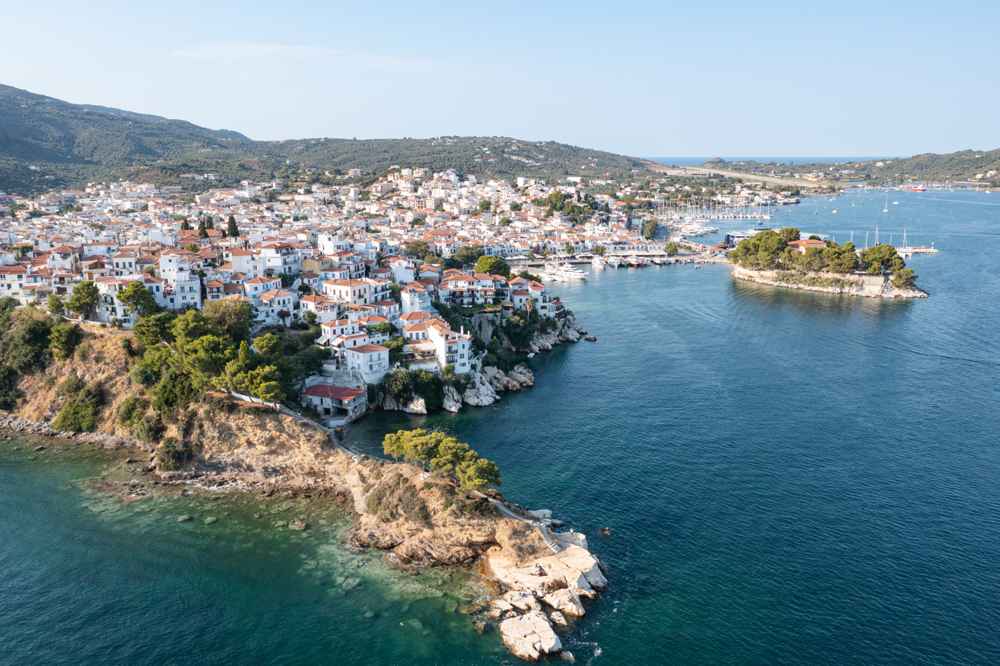
Skiathos Town is the island’s only town, and the museum sits at its exact social centre. The waterfront splits at the pine-covered Bourtzi peninsula into the new port, where ferries dock, and the old port, where wooden excursion boats load for Lalaria each morning. Papadiamantis Street runs inland from the harbour for about 300 metres, lined with bakeries, jewellers and travel agencies. A signed lane branches off the street into a small square shaded by trees, and the two-storey house stands on its edge. The location means the museum needs no planning at all; the walk from any harbour cafe takes under five minutes, and the square offers a bench for the wait.
Shops surround the museum on three sides, yet the square stays noticeably quieter than the street it touches.
The building itself is a plain two-storey island house with whitewashed walls, a low doorway and a tiled roof, built in the traditional style of the Sporades. Its footprint covers less ground than the shops beside it, and the modest scale is the point: the family lived on a priest’s small income, and the house shows it. Wooden shutters frame the windows, and a short flight of steps leads to the entrance. Nothing about the facade announces a museum apart from a small sign and a marble plaque. Visitors regularly walk past it on the first attempt, then double back from the shopping street.
The contrast between the plain house and the boutiques around it captures the distance between the writer’s era and the resort island of today.
Directions stay simple from every arrival point. Passengers landing at the new port walk along the waterfront past the Bourtzi, turn inland at the start of Papadiamantis Street, and reach the square in about five minutes. The old port sits even closer, roughly 200 metres away. Drivers park on the ring road above the town, because the centre is pedestrian, and drop downhill through the lanes toward the harbour. The Agios Nikolaos clock tower stands on the hill east of the square, about a five-minute climb, and pairs naturally with the museum for a one-hour circuit.
Street signs across the town centre point to the house in Greek and English, and local maps mark the square clearly, so nobody needs navigation apps inside the old lanes.
The square gives the museum its atmosphere before the door opens. Traffic never enters the town centre, so footsteps replace engine noise ten steps off the main lane. Whitewashed houses with bougainvillea climb the slope behind the museum, and cats claim the doorsteps in the afternoon heat. Evening changes the scene: shop lights from Papadiamantis Street reach the corner, taverna noise drifts up from the old port, and the closed house photographs well against the lit lane. Morning offers the quietest visit, before the excursion boats return in the late afternoon and refill the town with day-trippers.
The square also hosts island cultural gatherings tied to the writer’s memory, with public readings held in front of the house on anniversary evenings through the summer season.
What does the ground floor of the Papadiamantis House on Skiathos show?
The ground floor of the Papadiamantis House shows the working spaces of a nineteenth-century Skiathos household, with a stone hearth, clay storage jars, oil lamps and plain wooden furnishings arranged as the family used them.
The entrance leads straight into the ground floor, where thick stone walls keep the air cool even in August. Light falls from two small windows, and the room presents the working life of the household rather than the writer’s desk. Clay jars for oil and olives stand along the wall, a stone hearth marks the cooking corner, and simple wooden shelves carry pots, plates and lamps of the period. The floor and beams remain close to their original state, so the room smells of old wood and lime wash. Displays stay uncluttered, because the museum shows the house as a home rather than a case-filled gallery.
A caretaker greets visitors at the door, points out the route through the rooms, and answers questions about the family history.
Island households in the writer’s era produced most of what they consumed, and the ground floor documents that economy piece by piece. Storage dominated the space, since grain, oil, wine and salted fish carried a family through the winter months when boats stayed tied in the harbour. The Papadiamantis family lived on a priest’s income, so the objects here are plain, repaired and functional rather than decorative. Visitors who know the fiction recognise the setting immediately, because the same jars, lamps and cooking vessels furnish the poor households of his stories. The room turns abstract literary history into objects with worn handles and smoke-darkened surfaces.
Standing beside the hearth, readers grasp the material world behind the prose faster than whole chapters of written biography ever explain it to them.
Individual objects reward slow attention on the ground floor. The oil lamps on the shelves are the kind the writer read by as a boy. The wooden chest by the wall held household linen of the type counted in the dowry lists that drive the plot of The Murderess. Water jugs, copper pans and hand tools mark the cooking corner, and woven textiles soften the stone walls. Labels identify the objects briefly, and the caretaker fills the gaps with family detail. Nothing sits roped off at a distance, because the rooms stay small enough that visitors stand within arm’s reach of every display. The museum asks only that nothing be touched.
That closeness separates the house from larger Greek museums, where glass divides visitor from object.
Preservation follows a restraint that suits the writer. The house is kept structurally sound, whitewashed and dry, while the interior resists conversion into a bright modern exhibition space. The rooms hold their original proportions, the staircase keeps its narrow tread, and the furniture stands where household use placed it. Restoration work over the decades repaired the roof and walls without enlarging a single opening. The result reads as a preserved home rather than a curated display, which mirrors the effect the writer’s plain prose creates on the page. Visitors leave with a sense of scale above all, because Greek literature’s most revered prose writer grew up, worked and died inside rooms smaller than a modern hotel suite.
That single fact reframes every story he wrote.

What survives upstairs in the Papadiamantis House on Skiathos?
The upper floor of the Papadiamantis House keeps the family’s living quarters, including the writer’s bed, his worktable, manuscripts, photographs, family icons and personal effects, together with the small room where he died.
A narrow wooden staircase climbs from the ground floor to the living quarters, where the family slept, prayed and received guests. The main room follows the island pattern of one space serving every purpose, furnished with low wooden seating, woven covers and a shuttered window that looks over the square. Family icons hang in the eastern corner with an oil lamp beneath them, marking the household shrine that anchored daily life in a priest’s home. The ceiling sits low, the boards creak, and the proportions explain the compact interior scenes that recur across the writer’s fiction.
Visitors move through the floor in a slow loop of a room or two at a time, since the space holds only a handful of people comfortably at once.
Manuscripts and papers form the intellectual core of the upper floor. Framed pages show the writer’s dense, sloping hand, with corrections crowding the margins of drafts written for Athens newspapers. Photographs present the bearded writer in his later years, together with portraits of his father the priest and members of the family. Printed editions of the novels and story collections trace his passage from serialised newspaper fiction to bound national literature. Each framed sheet pairs the pay-per-line journalist with the national classic he became. The display explains his double life clearly, because the manuscripts were written for pay in Athens while their subject matter stayed rooted in this house and this island.
Readers linger longest here, matching the handwriting to stories they know, while the caretaker identifies faces in the photographs on request.
Faith fills the upper floor as visibly as literature does. The icons belonged to a family that produced a priest father and a writer son who chanted in church all his life. The two vocations meet in the objects displayed. A censer, candlesticks and devotional books sit near the household shrine. The writer’s own religious practice is documented through his work as a chanter in Athens and on the island. His fiction treats chapels, festivals, fasts and litanies as the calendar of island life, and the room shows the source of that calendar.
The combination gives the museum its particular tone, quieter and more devotional than a standard literary house, closer to a chapel than to an archive in its atmosphere. The town churches keep that chant tradition alive each Sunday.
The small room where the writer died carries the greatest weight in the house. He returned from Athens in poor health, lived his last months here beside his sisters, and died in the early hours after asking them to sing a hymn. The bed, the plain furnishings and the window remain in place, and the museum keeps the room spare rather than dressing it with drama. Visitors stand at the doorway of a space that measures only a stride or two across, holding the ending of a national literary life. Summer crowds thin to single visitors at this doorway.
The restraint of the display matches the restraint of the prose, and most people fall silent here without being asked. The room closes the visit and sends people back down the narrow stairs changed.
How did Papadiamantis write about Skiathos in his fiction?
Papadiamantis mapped Skiathos into his fiction street by street, naming the harbour, the Kastro cliffs, country chapels, springs and shepherd paths, so the island now reads as an open-air companion volume to his collected stories.
Skiathos appears in his fiction under its real name, with real topography and real distances. The harbour town, rebuilt on the ancient site after the War of Independence, frames the social stories of gossip, poverty and festivals. The abandoned medieval settlement of Kastro on the northern cliffs, where the islanders lived through the pirate centuries, supplies the fiction with ruins, memory and older ways of speech. Country chapels, threshing floors, sheepfolds and springs mark the interior stories, and the sea defines the edges of every plot. Readers with a map of the island can trace routes that characters walk, because the writer measured his fiction against ground he had crossed on foot since childhood.
That documentary precision keeps the stories alive for local readers today.
His recurring subjects grow directly from the island economy of his era. Fishermen wait out storms, widows count dowry linen, emigrants leave for America and return changed or not at all, and shepherd families measure the year in feast days. Poverty presses on nearly every household in the stories, as it pressed on his own family in this house. Women carry the heaviest loads in his fiction, decades before Greek literature made that a common subject, and The Murderess turns that observation into tragedy. Children drown, olive harvests fail, and small kindnesses carry enormous weight.
The stories refuse both nostalgia and cruelty, recording island life with the accuracy of a man who never stopped belonging to it, even while writing in Athens. Fishing boats still work the same harbour his characters watched.
The island functions as a complete world in his work, not as a backdrop. Its calendar runs on Orthodox feasts, its geography supplies the plots, and its dialect colours the dialogue inside the formal narration. He set a body of Athens sketches among the poor districts of the capital. Drawing on his decades of rented rooms there. The Skiathos stories outnumber and outrank them in the national memory. Critics compare his island method to that of regional masters in other literatures who built universal fiction from one small place.
The comparison explains why a house museum on an island of about 48 square kilometres matters to Greek letters as a whole, and why translations keep appearing in other languages. That focus kept his reputation growing long after regional fiction faded elsewhere in Europe.
Walking the town with the stories in mind turns literature into route-finding. The lanes above the old port keep the scale and turns of his interior scenes. The waterfront still fills for the summer feasts he described. The springs and chapels of the countryside survive along the marked walking trails of the island. Visitors who read one story before arriving, even in translation, see the town differently from those who arrive cold. The museum supports that reading with its manuscripts and editions, and the square outside serves as a starting line for literary walks. The clock-tower viewpoint frames the whole stage of his stories.
The distance from the page to the pavement stays unusually short on Skiathos, which is the island’s quietest attraction and the strongest reason the house draws readers from abroad.
What is The Murderess and how does it portray Skiathos?
The Murderess is Papadiamantis’s novella about Hadoula Frangogiannou, an ageing Skiathos widow who begins killing infant girls in the belief that death spares them a life of hardship, and it ranks among the peaks of Greek fiction.
The novella opens at night beside a cradle, where the old widow Hadoula, called Frangogiannou, watches over her sick newborn granddaughter. Her whole life passes through her mind as she sits: a hard childhood, a poor dowry, a harder marriage, daughters who each demanded a dowry in turn. The reflection hardens into a terrible logic, that a girl born poor is born to suffer, and she strangles the infant in its cradle. Further deaths of young girls follow, each framed by the same reasoning, until suspicion closes around her and she flees her village. The plot compresses the economics of island poverty into a single criminal mind, which is why the book still unsettles readers far beyond Greece.
The night vigil beside the cradle remains the most quoted scene in his work.
Skiathos itself carries half the novella. Frangogiannou’s flight crosses the real island, moving from the town through olive groves, ravines, sheepfolds and hillside chapels that stand on the actual map. She hides near springs where she once gathered herbs, sleeps in country huts, and reads the landscape with the knowledge of a healer who has walked it for decades. The geography tightens the net around her, because an island of about 48 square kilometres offers nowhere final to run. Her end comes in the sea, on a tidal reef between the shore and a hermitage. Where she drowns halfway between divine and human justice, in the novella’s famous closing line.
The setting is not decoration; it is the mechanism of the tragedy. Boat trips along the north coast pass below the same cliffs today.
The novella distils the dowry system that shaped Greek island life in the writer’s era. A family with daughters owed each of them a house, land or cash before marriage, and the obligation crushed poor households across generations. Frangogiannou’s crimes grow from arithmetic that every reader of the time recognised, which makes the book social criticism as much as psychological portrait. Frangogiannou herself worked as a midwife and healer, roles the narration documents in detail. The narration never excuses her and never caricatures her, holding a balance that critics still study. Her interior monologue, thick with island idiom, ranks among the most closely analysed passages in modern Greek prose.
Students across Greece read the novella in school, and the museum in the writer’s house supplies the material context for the poverty the book describes.
Translations carry The Murderess into English, French, German, Italian, Spanish and other languages, and the novella leads every list of the writer’s work abroad. The novella stays in print in Greek continuously. Stage and film adaptations return to it regularly in Greece, and its scenes are the ones readers most often carry to the island. Visitors to the museum meet the book everywhere in the displays, from the dowry chest downstairs to the manuscripts upstairs. Reading the novella before a visit multiplies the effect of both, because the house explains the poverty and the island explains the geography. The walk from the museum square to the countryside trailheads follows ground the fictional Frangogiannou crossed.
The distance between the crime story and the holiday island gives the book its lasting shock.
How long does a visit to the Papadiamantis House on Skiathos take?
A visit to the Papadiamantis House on Skiathos takes about 20 to 30 minutes across both floors, and the square, Papadiamantis Street and the waterfront bust extend the literary circuit to roughly one hour.
The visit follows a compact loop with no dead time. The ground floor holds the household displays and asks for about ten minutes of slow looking. The staircase takes seconds. The upper floor with the manuscripts, icons and the deathbed room absorbs another ten to fifteen minutes. Readers of the fiction stretch the upper floor to half an hour by studying the handwriting and photographs, while casual visitors complete the whole house in a quarter of an hour without feeling rushed. The rooms hold only small groups at once, so a short wait forms at the door in the peak weeks of July and August.
The bench in the square outside covers that wait, with the shopping street a step away for anyone impatient.
Timing shapes the quality of the visit. Morning hours give the emptiest rooms, because day visitors head for the excursion boats at the old port and leave the town quiet until midday. Late afternoon brings the returning boat crowds up Papadiamantis Street, and the museum square fills with foot traffic through the evening shopping hours. The house closes in the middle of the day in the island pattern, so visitors plan around the break rather than assume continuous opening. Heat argues for the same schedule, since the stone ground floor stays cool while the upper floor warms under the tiles by afternoon.
A morning slot followed by a harbour coffee produces the most comfortable version of the visit in high summer. Shoulder-season visitors in spring and autumn meet no queue at all.
Different visitors take different value from the same rooms. Readers of Greek literature treat the house as a primary source and plan a full hour with the manuscripts. Families use it as a short cultural stop between the beach bus and lunch. Children respond to the household objects. The steep stairs and the caretaker’s stories more than to the framed pages. Couples fold it into an evening walk when the lit square photographs at its best from the outside. Rain, rare in high summer but regular in spring and autumn, turns the museum into the town’s main indoor refuge alongside the churches.
Every version works, because the house demands no queue, no transport and no planning beyond a five-minute walk. Guides across the island recommend it as the town’s first cultural stop.
The museum also anchors wider itineraries across the island. A literary morning combines the house with the waterfront bust and the clock-tower viewpoint in about 90 minutes on foot. Walkers extend the theme inland to the Evangelistria monastery, about 4 km north of town, where the island’s monastic tradition that shaped the writer’s faith continues. Boat passengers see Kastro, the medieval setting of his childhood memory and his fiction, from the round-the-island routes. The house earns its place on every list of things to do in Skiathos as the island’s main cultural interior, the single stop that explains the names on the street signs, the airport and the harbour statue in one visit.
The literary circuit runs entirely on foot inside the pedestrian centre and slots between beach hours and boat departures without transport.
How do visitors reach the Papadiamantis House in Skiathos Town?
Visitors reach the Papadiamantis House on foot in about five minutes from either port of Skiathos Town, following Papadiamantis Street inland from the waterfront to the signed square where the two-storey museum stands.
Arrival on foot stays the default for nearly everyone. Ferry passengers step off at the new port, follow the waterfront promenade past the Bourtzi peninsula, and turn inland where Papadiamantis Street opens between the harbourfront cafes. The walk covers about 400 metres in total. Wheeled luggage manages the level waterfront route easily. Excursion-boat passengers at the old port stand even closer, with roughly 200 metres and one turn between the gangway and the museum square. Signs in Greek and English mark the lane, and the crowd flow up the shopping street leads toward the square in any case.
Nobody needs a taxi within the town, because the centre is pedestrian and the distances run shorter than a single city block in most capitals. Which keeps the museum effortless to include.
The island bus supports visitors staying along the south coast. The single line runs the 12 km coastal road between Koukounaries and the town. With stops numbered roughly 1 to 26. It terminates beside the new port within sight of the waterfront. Passengers from Troulos, Kanapitsa, Achladies or Megali Ammos ride to the terminus and walk the last five minutes. Drivers leave cars on the ring road above the town, since the lanes admit no traffic, and descend through the whitewashed alleys toward the harbour. Scooter riders park in the same zone.
The bus runs frequently through the summer season and thins outside it, so off-season visitors staying beyond walking distance time the return trip before setting out for the museum. Taxis also wait at both ports throughout the season.
The airport sits about 2 km northeast of the town. Closer to the centre than almost any other Greek island airport. Taxis cover the transfer in around five to ten minutes. Arriving passengers see the writer’s name before the baggage hall, because the airport carries the official title Alexandros Papadiamantis. Travellers with an evening departure use that proximity in reverse, fitting a final museum visit and a harbour walk into the last hours before check-in. Plane-spotters who come for the famous low landings over the coastal road stand about a 25-minute walk from the museum square. The island’s loudest attraction and its quietest one sit within one afternoon of each other. An unusual pairing for one small town.
The short transfer keeps arrival-day visits realistic even before hotel check-in.
Reaching the island itself comes first, and the options are the widest in the Sporades. Seasonal flights connect European cities and Athens to the Alexandros Papadiamantis runway, while ferries and fast boats cross from Volos in about 1.5 to 2.5 hours and from Agios Konstantinos on comparable schedules, continuing onward to Skopelos and Alonnisos. The full picture of routes, seasons and mainland ports sits in the guide to how to get to Skiathos. Both ferry piers land passengers within a ten-minute walk of the museum. The airport transfer adds minutes rather than hours, so the house ranks among the most accessible literary landmarks in Greece from the moment of arrival.
Winter thins the schedule to the year-round ferries, yet the museum stays reachable in every month of the year.
Which Skiathos landmarks connect to Papadiamantis beyond the house?
Skiathos connects to Papadiamantis at the waterfront bust, along Papadiamantis Street, at the Alexandros Papadiamantis airport, at his grave in the town cemetery and at the Bourtzi peninsula, which hosts summer cultural events.
The bust on the waterfront gives the writer his public face. It stands near the harbour he described all his life, bearded and severe, facing the water where excursion boats, fishing caiques and ferries cross the same channel his characters watched. Photographers frame it against the Bourtzi pines, and locals treat it as a meeting point. The position matters more than the sculpture, because the harbour was the writer’s constant subject: departures for Athens and America. Returns for the feasts, storms that kept the boats in. Drownings that shaped his darkest stories.
Visitors who pass it on the way from the ferry to the museum walk a straight line from the monument to the rooms where the commemorated life actually happened. Evening light turns the spot into the town’s busiest photo stop.
Papadiamantis Street turns the writer’s name into the town’s daily habit. The pedestrian spine runs about 300 metres from the waterfront into the heart of the town, and every shopping trip, evening stroll and school run crosses it. The name appears on shop receipts, delivery addresses and bus conversations, keeping the writer in circulation among people who never open his books. The airport repeats the gesture at national scale, printing Alexandros Papadiamantis on boarding passes across Europe through the summer season. The double naming, street and airport, brackets the island experience from arrival to evening walk.
Between the two stands the museum square, where the name finally attaches to a door, a staircase and a bed rather than to signage. Children learn the name from the street long before school assigns the stories.
The grave in the town cemetery closes the biographical circuit for readers who want it. The writer lies on the island he rarely left in spirit, and the stone carries his name without literary decoration. His cousin Alexandros Moraitidis, the island’s second writer of the same generation, shares the town’s memory. The two men grew up in the same lanes. Worked in the same Athens press. Returned to the same island, and Moraitidis took monastic vows late in life. Churches across the town preserve the liturgical world both men served, and the psalmody the writer performed as a chanter continues in the same buildings each Sunday.
The cemetery visit stays optional, but it completes the town’s map of one life. The walk there from the museum crosses the town in about ten minutes.
The Bourtzi peninsula extends the commemoration into performance. The pine-covered islet between the two ports, once a fortress of the Venetian era. Hosts open-air cultural events through the summer. The island’s literary anniversaries return to the writer’s work with readings and music. School programmes across Greece mark his memory each year, and island institutions carry his name in their titles. The scale of remembrance stays island-sized, which suits a writer who refused honours in his lifetime and left Athens ceremonies unattended. Visitors who connect the points, bust, street, museum, cemetery and Bourtzi.
Complete a commemorative walk of under two hours that no other Greek island can duplicate around a single prose writer, all of it inside one small harbour town. The full walk fits comfortably between breakfast and the midday boats.
How does the Papadiamantis House fit a full day in Skiathos Town?
The Papadiamantis House anchors a natural full-day route through Skiathos Town: museum and shopping street in the morning, harbour lunch, the Bourtzi and clock tower in the afternoon, and the old port toward sunset.
Morning belongs to the museum and the lanes around it. The route starts at the waterfront bust, climbs Papadiamantis Street while the shops open, and reaches the museum square before the mid-morning crowd. The house visit takes about half an hour, and the lanes behind it reward another 30 minutes of unplanned climbing among whitewashed houses and bougainvillea. The Agios Nikolaos clock tower on the eastern hill delivers the harbour panorama, with the Bourtzi below and Tsougria islet across the channel. The descent lands back at the old port as the excursion boats finish loading for Lalaria.
Which fixes the day’s rhythm: culture while the town is quiet, water while the sun is high, harbour when the boats return. The whole morning covers under two kilometres of walking in total.
Lunch follows the route downhill without a detour. Fish tavernas line the old port a two-minute walk from the museum square, and the lanes off Papadiamantis Street hold traditional and modern kitchens described in the guide to Skiathos restaurants. Waterfront tables face the harbour the writer described, and inland courtyards trade the view for quiet. The dishes match the museum’s subject matter directly, because the fresh fish. Cheese pies and slow-baked lamb on the menus are the same foods that mark feasts and funerals across the fiction. A long Greek lunch after the museum turns the morning’s literary material into the island’s living present, which is the pattern the whole town repeats daily.
Menus lean on the morning catch landed at the same quay, and tables fill through the long island afternoon.
Afternoon options fan out from the harbour in every direction. The Bourtzi peninsula offers pines, fortress remains and sea views five minutes from the lunch table. Megali Ammos beach starts about a ten-minute walk southwest of the centre for a swim without transport. Water taxis leave the old port for south-coast beaches, and the bus at the new port reaches Koukounaries at the end of the line, about 12 km away. Visitors with a car climb to the Evangelistria monastery, about 4 km north, where the flag of the independence era was woven and raised.
Each option returns easily to the town by early evening, because nothing on the island sits more than about half an hour from the harbour. Swimmers and monastery visitors alike regain the harbour before the evening promenade begins.
Evening completes the circle at the old port. The excursion boats tie up, the waterfront cafes fill, and Papadiamantis Street runs its nightly promenade past the lane to the darkened museum. Dinner in the lanes, a slow walk to the bust under the harbour lights. The day ends where the writer’s fiction spent most of its hours. At the meeting line of town and water. Travellers weighing this island against its greener neighbour Skopelos compare town evenings above all, and the contrast starts here on the lit waterfront. Night buses and taxis return south-coast guests from the same waterfront stops.
The house museum gives that evening its meaning, because the town on display is the one the writer preserved, page by page, from this square.
Frequently Asked Questions
Why is Alexandros Papadiamantis called the saint of Greek letters?
The epithet joins his subject matter, his style and his life into one description. His fiction treats Orthodox faith as the structure of island existence, with feasts, fasts. Chapels and litanies setting the calendar of nearly every story. His narration carries the cadence of liturgical Greek inside its formal language. His life matched the material: he chanted in churches in Athens and on Skiathos, kept the fasts strictly. Refused honours and public ceremonies, never married. Lived in poverty despite decades of published work. Greeks also call him kosmokalogeros, the monk in the world, for the same combination of devotion and secular labour.
The epithet is critical shorthand rather than church recognition, and it marks his standing at the top of Greek prose alongside the sanctity of his themes. The museum makes the phrase concrete, because the household icons, the censer and the devotional books upstairs sit beside the manuscripts that earned the literary half of the title.
What objects are displayed inside the Papadiamantis House on Skiathos?
The displays divide by floor. The ground floor keeps the working household: a stone hearth, clay storage jars for oil and olives, water jugs, copper pans. Oil lamps, hand tools, woven textiles and a wooden linen chest of the dowry type that drives the plot of The Murderess. The upper floor holds the personal and literary material: the writer’s bed and worktable, framed manuscript pages in his dense sloping hand, photographs of the writer and his family. Printed editions of the novels and story collections, family icons with their oil lamp, a censer and devotional books. The plain furnishings of the small room where he died. Labels stay brief, and the caretaker adds family history on request.
Everything sits within arm’s reach in rooms preserved at their original scale, with nothing behind glass walls in the manner of larger museums. The house itself, its staircase, beams, shutters and proportions, counts as the largest exhibit of all.
Is the Papadiamantis House worth visiting for readers who do not know Greek?
The house works fully without the language, because the building itself carries the story. Visitors read the rooms directly: the poverty of a priest’s household, the compact scale of island life in the nineteenth century. The icons beside the manuscripts. The small deathbed room that closes the visit. Signage covers the essentials, the caretaker communicates the family history to foreign visitors daily, and the objects need no translation. Readers who want the literature itself find The Murderess in English, French, German. Italian and Spanish translations. Reading it before or after the visit binds the rooms to the fiction permanently.
Travellers who skip the reading still gain the island’s best half hour of cultural context, since the museum explains the name printed on the street signs, the airport and the harbour bust. The visit costs five minutes of walking from either port, which sets the effort-to-understanding ratio among the best of any Greek island attraction.
Which real Skiathos places appear in the stories of Papadiamantis?
The harbour town appears constantly under its own name, with its waterfront, lanes, churches and festivals framing the social stories. Kastro, the abandoned medieval capital on the northern cliffs, supplies ruins, pirate-era memory and older speech, and boat trips pass it today on the round-the-island route. The countryside carries the rest: hillside chapels, springs, olive groves. Threshing floors and sheepfolds mark the rural stories. The Murderess sends its central figure across that terrain in her flight, from the town through the ravines to the sea. The island’s walking trails cross the same ground, so readers trace the settings on foot in a day.
Even the channel toward Tsougria islet and the sea approaches that today’s ferries use appear as the stage for departures, returns and storms. The fiction names real ground with documentary precision, which turns a beach island of about 48 square kilometres into one of the most completely mapped landscapes in Greek literature.
Who was Alexandros Moraitidis, the other writer from Skiathos?
Alexandros Moraitidis was the writer’s cousin and close contemporary, born on the same island in the same era, and the second name in the town’s literary memory. He followed a parallel road: schooling on the island, decades of work in the Athens press as a journalist and writer. Short stories rooted in Skiathos life, travel writing that found a wide readership. A deep Orthodox faith that shaped both his subjects and his style. He returned to the island at the end of his life and took monastic vows late, completing in fact the monastic direction his cousin carried only as an epithet.
The two men are read together in Greek criticism as the Skiathos pair, and the island commemorates both. Visitors meet Moraitidis in the museum’s family photographs and in the town’s street names. His presence explains that the island produced a literary circle. Not a single isolated talent, from one small harbour population.
How much time does the Papadiamantis House add to a Skiathos Town walk?
The museum adds about half an hour to any walk through the town centre, and the full literary circuit adds about 90 minutes. The house sits roughly 200 metres from the old port and about 400 metres from the ferry pier, so the detour from any waterfront route costs five minutes each way. The rooms themselves take 20 to 30 minutes at an unhurried pace, with readers of the fiction stretching toward an hour among the manuscripts. Adding the waterfront bust, the length of Papadiamantis Street and the Agios Nikolaos clock-tower viewpoint builds the 90-minute version, all on foot and all inside the pedestrian centre.
Cruise and day-trip visitors fit the short version between boat arrivals comfortably, and overnight guests fold the long version into a morning before the beach bus. No other cultural stop on the island offers a comparable return on so short a detour, which keeps the house on every walking route through the town.
Why does the Skiathos airport carry the name Alexandros Papadiamantis?
The airport carries the writer’s name as the island’s highest civic honour, matching the national practice of naming airports for the most celebrated local figure. Papadiamantis is the most famous person Skiathos has produced. His standing in Greek letters places the small island permanently inside the national curriculum, so the name on the runway states the island’s identity to every arriving passenger. The choice creates one of the sharper contrasts in Greek travel: the airport is famous worldwide for low-approach landings over the coastal road. Filmed by crowds at the fence, while its namesake was a poor, publicity-refusing writer of quiet island fiction.
The two reputations sit about 2 km apart, runway to museum square, and a taxi covers the distance in around five to ten minutes. Visitors who follow the name from the boarding pass to the two-storey house complete the island’s full circle of commemoration, from its loudest modern spectacle to its quietest preserved room.