
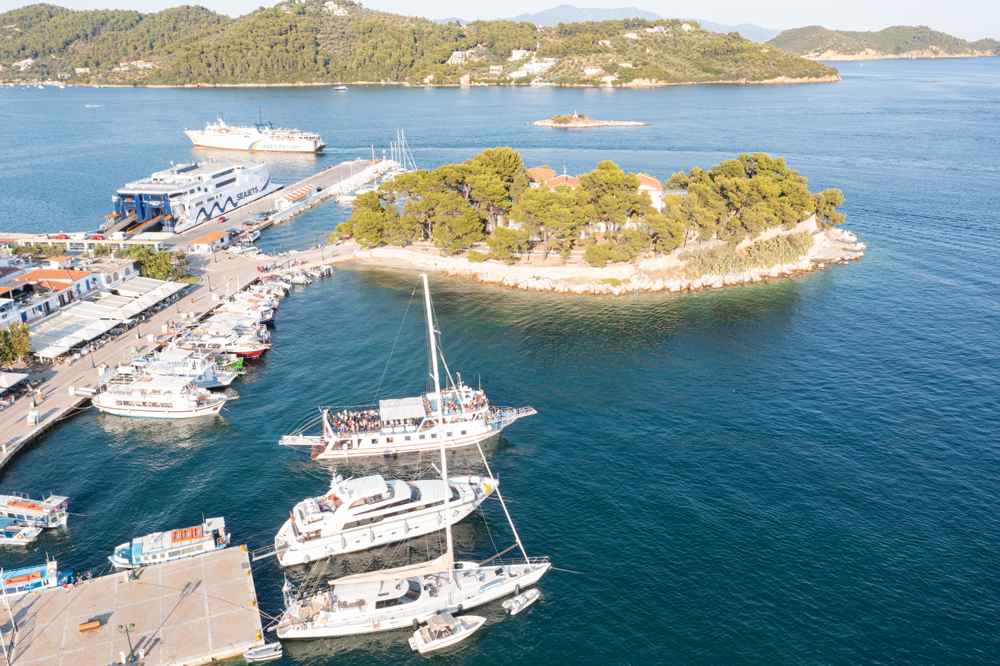
Skiathos ranks among the easiest Greek islands for a family holiday. The island measures about 48 square kilometres, airport transfers to most hotels take under 30 minutes. The sheltered south coast lines up shallow, sandy beaches with sunbeds, tavernas and toilets. One bus line with numbered stops connects everything, so parents manage the whole trip without a rental car. Plan the whole trip with Greece Tours.
This guide covers the best family beaches, car-free transport, boat trips children enjoy, plane-spotting at the runway fence. Eating out with kids, the right accommodation areas and the months that balance warm sea with thin crowds. Every recommendation stays within a 12 km stretch of coast, which keeps daily logistics short and predictable.
Which Skiathos beaches suit young children best?
Koukounaries, Troulos, Agia Eleni, Achladies and Vassilias suit young children best on Skiathos. All five south-coast beaches combine shallow sandy seabeds, sunbeds, tavernas and toilets, sit on the island bus route and stay sheltered from the meltemi north wind.
Troulos sits mid-coast, roughly 9 km from Skiathos Town, with a wide arc of pale sand and water that stays waist-deep for about 30 metres offshore. Tamarisk trees shade the back of the beach, two tavernas serve lunch steps from the sand, and the bus stops directly on the main road above. Toddlers dig safely near the shoreline because the seabed carries no rocks or sudden drops. Parents park pushchairs beside the sunbed rows without negotiating steps or dunes. The beach faces south, so the meltemi passes overhead and leaves the bay flat on windy afternoons. Late June brings the warmest combination of calm sea and free space.
The gentle gradient suits children still learning to swim, and the fine sand runs unbroken from the road to the waterline.
Agia Eleni occupies a west-facing bay one headland beyond Koukounaries, about 13 km from Skiathos Town, and closes the paved road at its own parking area. The sand shelves gently, the bay opens toward the Pelion peninsula on the mainland, and late-afternoon light lasts longer here than on the island’s east-facing coves. Families with babies value the short, flat walk from parking to sunbeds and the canteen that covers snacks and cold drinks. This cove records the calmest afternoon water of the more than 60 Skiathos beaches mapped around the 44 km coastline. Older children snorkel along the rocky northern edge, where the seabed drops slowly and small fish gather in the shallows.
The bus reaches the Koukounaries terminus, and the signed walk over takes about 15 minutes.
Achladies and Vassilias sit closest to Skiathos Town, at about 4 km and 3 km respectively, which shortens every journey for parents managing nap schedules. Both beaches spread fine sand under tamarisk trees, keep the water knee-deep for roughly the first 20 metres and back onto family accommodation with direct sand access. Vassilias descends from the coast road in about two minutes on foot, while Achladies adds a small jetty where water taxis call through the summer. Bus stops between numbers 5 and 8 serve the two bays, so a morning swim, a taverna lunch and an early-afternoon return fit inside four relaxed hours.
The gentle gradient and the absence of surf make both bays reliable settings for a child’s first proper sea swim. Tamarisk shade at the back removes the umbrella decision entirely.
Every beach on this shortlist rents sunbeds with umbrellas, keeps toilets behind the sand and serves food within 50 metres of the water. Shade matters most between noon and mid-afternoon, so families claim front-row umbrellas before mid-morning in July and August. The south coast faces away from the meltemi, which keeps flags green on the family beaches even when the north shore churns. Lifeguard posts operate on the busiest stretches in peak season. Sand quality stays consistent along the strip: fine, pale grains that rinse off easily and hide no sharp shells. Parents with children of different ages pick Koukounaries first, because its 1,200-metre length separates the water-sports zone from the calm family end by a comfortable walk.
Water stays calm enough for inflatables on a standard July afternoon.
How do families get around Skiathos without a car?
One public bus line carries families along the entire south coast of Skiathos, from the town harbour to Koukounaries, with stops numbered roughly 1 to 26. Water taxis, regular taxis and short flat walks cover everything else.
The bus route on Skiathos follows the single south-coast road for about 12 km between the town harbour and the Koukounaries terminus, taking around 30 minutes end to end. Departures run at short intervals through the day in high season, and the final evening services carry beach crowds back to town for dinner. Children track progress easily because every stop carries a number, from stop 1 near the port to stop 26 at Koukounaries. Fares stay low and are paid on board. The road passes Megali Ammos, Achladies, Kanapitsa, Troulos and the mid-coast bays, so one line covers the entire family-beach shortlist. Drivers announce the busiest stops, and the numbered signs remove the guesswork for tired parents.
The full timetable posts at the harbour terminus and at every stop.
Numbered stops turn the bus into a simple game for children: count down from 26, watch for the sign, press the bell in time. Strollers fold at the door and travel in the luggage bay or beside the driver on quieter services. Midday buses fill fastest in July and August, so families with buggies board at the terminus stops where seats remain open. The stop numbers map directly onto beaches — Vromolimnos sits near the Kolios stops, Troulos at its own marked stop and Agia Paraskevi mid-route. Parents plan whole days around three or four numbers instead of road names.
A phone photo of the stop sign outside the accommodation saves confusion on the return leg, when identical pine bends blur together. The countdown habit keeps young passengers busy for the whole ride.
Water taxis leave the old port for the south-coast beaches through the morning and return in the late afternoon, turning transport into part of the day out. The boats run at a gentle pace, and children sit close to the waterline with views of the Bourtzi, the harbour fishing fleet and the parasailers off Kanapitsa. Crossings to the nearer beaches take about 15 to 25 minutes depending on the stop. Skippers help lift buggies and cool bags aboard at the quay steps. The service operates in settled weather only, so a calm-morning forecast doubles as a green light.
Combining an outbound water taxi with a return bus gives families two experiences for one beach day and removes the parking search entirely. Return boats keep the same quay positions through the afternoon.
Taxis wait at the harbour rank beside the new port and cover the full length of the island in under 25 minutes, which rescues late evenings and early ferry mornings. Skiathos Town itself walks flat along the waterfront from the new port to the old port, with step-free surfaces past the Bourtzi causeway. The airport sits about 2 km from town, so arrival transfers rank among the shortest in the Greek islands: most hotels lie under 30 minutes from the runway. Families who skip the rental car save on parking stress at the popular beaches, where spaces vanish by mid-morning in peak weeks.
The bus, the water taxi and the harbour rank together cover every itinerary in this guide without a driving licence. Evening taxis stay available near the waterfront through the season.
What boat trips from Skiathos Town entertain children?
Taxi boats to Tsougria, round-the-island cruises past Lalaria and the sea caves, and short water-taxi hops to the south-coast beaches entertain children of every age. All departures leave the old port of Skiathos Town beside the Bourtzi.
Taxi boats cross from the old port to Tsougria islet in about 15 to 25 minutes, the single most child-friendly boat trip on the island. The main beach on the islet’s northwest side spreads sand into clear, shallow water, a seasonal taverna covers lunch, and pines shade the back of the beach. Children treat the crossing as the event itself: the boat passes the Bourtzi, the harbour mouth and the flight path, with aircraft descending ahead of the bow. The islet has no roads and no cars, so parents relax the usual traffic rules for a day. Boats return through the afternoon, and the whole outing fits comfortably between breakfast and an early dinner.
Snorkelling gear earns its space in the bag on this crossing, because the shallows stay clear.
Round-the-island cruises suit children of about six and older who manage a full day afloat. Wooden caiques and larger excursion boats leave the old port in the morning, pass the Kastro peninsula on the north coast. Stop below the medieval walls and anchor off Lalaria for a swim beneath the white limestone arch. The sea caves of Skotini, Galazia and Halkini punctuate the route, and skippers steer close enough for torchlit looks inside the largest. Lalaria itself carries smooth white pebbles instead of sand and offers no shade, so hats and water bottles matter on this stop. The full circuit runs around four to six hours.
Older children remember the arch and the caves longer than any beach afternoon. Deck rails carry shade canopies on the larger boats for the midday stretch.
Water-taxi hops to Kanapitsa, Vromolimnos or Achladies give younger children a short first ride without committing to a full cruise. The boats hug the coast, the swell stays low on the sheltered south side, and each hop lasts under half an hour. Harbour time before departure entertains as much as the ride: fishing boats unload at the old port. Ferries swing at the new port. The Bourtzi peninsula between them gives children a traffic-free headland to explore. Ice-cream counters line the waterfront steps for the wait. A first short hop in calm water tells parents quickly whether a longer cruise will work later in the week. At the cost of exactly one relaxed morning on the quay.
The quay itself stays flat and safe for buggies during boarding.
Morning departures beat afternoon ones for families: the sea sits calmer, the light stays cooler and children arrive fresh. The meltemi wind cancels north-coast routes on the roughest days, while Tsougria and the south-coast hops keep running in most conditions. Essential kit stays short — hats, water, snacks, swimwear worn on board and a light layer for the ride home. Children prone to motion sickness sit best at the stern with eyes on the horizon, where the movement reads smallest. Excursion boats carry life jackets and shaded seating areas as standard. Booking a day ahead in July and August secures space on the smaller caiques, and the harbour kiosks display every route clearly along the old-port quay.
Light seas in the morning keep the youngest passengers comfortable and dry.

Is Koukounaries a good family beach day on Skiathos?
Koukounaries delivers the most complete family beach day on Skiathos. The 1,200-metre crescent of fine golden sand sits at bus stop 26, about 12 km from town, backed by a protected pine forest and the Strofilia lagoon.
The layout at Koukounaries beach splits naturally into zones, which is the feature parents value most. Water sports concentrate at one end, sunbed rows fill the centre, and the far end stays quieter with space for sandcastle engineering. The crescent measures about 1,200 metres, long enough that even peak-season crowds spread thin toward the edges. The seabed slopes gently for the first 20 to 30 metres, keeping the swimming zone shallow and warm. Fine golden sand packs firm near the waterline, ideal for toddlers who are still steadying their walk. Buses terminate at stop 26 directly behind the beach, and the walk from the stop to the sand takes under five minutes through the trees.
The pine line behind the sand throws natural shade from late afternoon.
The protected pine forest behind the sand turns Koukounaries into a double destination. A flat, shaded path loops between the beach and the Strofilia lagoon, a wetland biotope connected to the sea by a channel and home to herons and other waterbirds. The loop suits strollers and short legs, runs mostly under stone-pine canopy and delivers children back to the sand within an hour. Bird-watching from the lagoon edge works best in the early morning, before beach noise rises. The forest floor stays cool even in August, which gives families a midday escape from the sun without leaving the area.
The area holds protected-reserve status, so paths stay marked and litter-free, and the pine scent carries all the way to the water. Benches along the loop give carriers a rest point halfway round.
Facilities behind Koukounaries cover a full family day without a car. Tavernas and snack bars sit at the back of the sand, toilets and showers operate near the main entrances, and sunbed rows come with umbrellas spaced for buggy access. Water-sports stations at the eastern end run pedal boats, canoes and towed rides for teenagers, while the swimming zone stays marked off from motor traffic by buoy lines. Cold-water showers rinse sand off before the bus ride home. The beach carries lifeguard cover on the main stretch through peak season.
Parents with mixed-age children station themselves mid-beach: the water-sports end sits within sight for teens, and the quiet western end stays within a short walk for toddlers needing calm water. Umbrella rows leave wide corridors, so buggies roll to the front line.
Timing shapes the Koukounaries experience more than anything else. Arrival before mid-morning secures front-row sunbeds and easy parking, while arrival after mid-afternoon catches softer light and thinner crowds. The bus from town takes about 30 minutes, so families staying near the harbour still manage a full beach day. Banana beach lies over the western headland, reached by a signed walk of about 10 to 15 minutes, and suits families with teenagers who want a livelier scene. Agia Eleni sits one headland further with calmer water. The three beaches share one bus terminus, which lets a family sample all of them across a week from a single stop.
September repeats the August warmth with half the towels on the sand. Weekday mornings run noticeably quieter than weekends across the summer.
Where do children watch planes land on Skiathos?
Children watch aircraft land from the road at the northern end of the Skiathos runway, beside the old port, where arriving planes pass roughly 15 to 20 metres overhead on final approach to Alexandros Papadiamantis airport.
Aircraft descend over the coastal road at the northern end of the runway. About a 15 minute walk from the old port. Pass roughly 15 to 20 metres above watching heads. The approach ranks among the lowest public viewing points at any airport in Europe, and the arrival of a mid-size jet over the fence stops traffic on the spot. Children hear the engines before the aircraft clears the headland, then track it across the bay and over the road in about ten seconds. Spotters gather along the fence and the low wall on the harbour side of the road.
The spectacle costs nothing, repeats through the day in summer and works for every age from toddler to teenager. The spot sits level with the tarmac, so pushchairs park beside the wall.
Safety rules at the fence stay simple and strict. Families stand to the sides of the runway centreline, keep behind the marked road edge and hold hats. Phones and small children firmly during departures, when jet blast pushes loose objects toward the sea. Warning signs along the fence spell out the blast risk in words and pictures. Arrivals overhead carry no blast and give the calmer show, so parents with younger children time visits around landings rather than take-offs. Ear protection helps sensitive toddlers, since a departing jet at close range reaches painful volume. The road stays open to traffic, so children hold hands on the verge and watch from the wall rather than from the tarmac side.
Clear sightlines from the wall keep small children away from the road edge.
Summer schedules multiply the show: domestic flights from Athens land alongside seasonal arrivals from across Europe, and the busiest weeks bring a steady stream through the middle of the day. Watching works from more spots than the fence itself. The Bourtzi headland frames aircraft against the town. The old-port quay catches them low over the water. Tsougria-bound boats pass directly beneath the flight path. Photographers favour the fence line in late afternoon, when the light angles across the bay. Children keep score of airlines and liveries the way earlier generations counted train numbers. Quiet spells between arrivals fill with harbour watching, which keeps the outing moving for the shortest attention spans in the family.
Arrivals cluster around midday in peak weeks, which suits a morning walk.
Plane-spotting slots neatly into a town morning or evening. The walk from the old port passes the fishing quay and reaches the fence in about 15 minutes on flat ground, manageable with a stroller. Ice cream on the waterfront bookends the outing on the return leg. Older children pair the fence with the Bourtzi and the clock-tower viewpoint for a full free afternoon. Younger ones manage one landing and a swim at Megali Ammos. The town beach a short walk in the other direction. Rainy-day options on the island run short, and the runway fence fills the gap whenever clouds keep families off the sand. One landing witnessed from 20 metres becomes the story children retell at school.
The fence sits close enough to town that no bus ride is needed.
What nature walks on Skiathos work with children?
The Strofilia lagoon loop at Koukounaries, the signed track to Evangelistria monastery about 4 km from Skiathos Town, and the shaded pine paths behind the south-coast beaches work with children. Gradients stay gentle and distances stay short.
The Strofilia lagoon loop behind Koukounaries gives families the island’s flattest nature walk. The path circles a coastal wetland linked to the sea by a channel, passes under mature stone pines and returns to the beach in about an hour at child pace. Herons and other waterbirds feed along the reed edges, and dragonflies patrol the channel in high summer. Educational value comes free: children see how a lagoon, a dune line and a pine forest stack into one protected system within 200 metres of the sunbeds. Early morning delivers the best bird activity and the coolest air of the day.
Buggies roll the full loop without lifting, which makes this the default first walk for families with mixed ages. Binoculars turn the reed beds into a full hour of quiet observation.
The signed track to Evangelistria monastery climbs gently through pines for about 4 km from the edge of Skiathos Town, a round trip that fills a morning with older children. The monastery at the top holds a small museum of ecclesiastical and folk items. A shop selling its own products and the story of the early Greek flag woven and raised on this hill. Modest dress applies inside, with shoulders and knees covered, and the courtyard offers shade and water. Children respond to the flag story more than to the architecture, so parents lead with it at the gate. Walking down takes noticeably less time than walking up.
Drivers reach the same gate by car or taxi in about ten minutes from town. Benches under the pines break the climb into easy stages.
Marked trails cross the interior between olive terraces, pine ridges and the quieter north coast, and short sections match distance to age. Paths near town pass whitewashed chapels, dry-stone walls and shaded groves, with gradients that primary-age children walk without complaint. Morning starts beat the heat from June to September, and closed shoes beat sandals on the loose stones. Water fountains stay scarce beyond the monastery route, so each walker carries a bottle. Trail maps sell in town bookshops, and signposts mark the main junctions with painted symbols. A one-hour out-and-back beats an ambitious loop with children under ten: the turnaround point becomes the summit, complete with a snack ceremony. The return leg runs downhill toward a swim.
Spring wildflowers line the lower tracks and slow every walk pleasantly.
Nature on Skiathos engages children at ground level. Stone pines drop the large cones that name the island’s most famous beach — koukounaria means stone pine in Greek — and cone collecting occupies an entire forest walk. Rock pools along the edges of Agia Eleni and Kanapitsa hold crabs and darting fish for patient observers. Cicadas hit full volume in July, loud enough to count as a phenomenon rather than background noise. Goats appear on the inland tracks, and the lagoon’s herons lift off at close range when walkers round the reed beds quietly. Snorkelling over the sandy shallows introduces masks and fins in water where standing up remains an option.
Pebbles stay on the beaches, and that habit starts young. The island packs all of this inside about 48 square kilometres.
How family-friendly is Skiathos Town in the evening?
Skiathos Town welcomes families in the evening. The flat harbour waterfront suits strollers end to end, the traffic-free Bourtzi peninsula gives children space to run, and Papadiamantis Street keeps gelato counters and shops open until late.
Evenings in Skiathos Town start on the waterfront, where the walk from the new port past the Bourtzi to the old port runs flat and step-free for about a kilometre. Fishing boats land the next day’s catch, excursion caiques wash down after the day’s cruises, and late aircraft descend across the harbour lights. Strollers roll the full length without a single kerb problem, and benches punctuate the route for feeding stops. Families fill the waterfront from early evening, well before the adult crowd arrives, so children set the tone until well after sunset. The harbour smells of grilled fish and salt, and the evening promenade costs nothing beyond the ice cream that traditionally ends it.
The whole loop from port to port and back takes under an hour with children.
The Bourtzi peninsula divides the two ports and works as the town’s traffic-free playground. Pines shade the low headland, the remains of a Venetian-era fortress edge the paths. No vehicles ever cross the short causeway, so children run ahead while parents follow at strolling pace. Views from the tip take in the harbour on one side and the open channel toward Tsougria on the other, with the airport approach crossing overhead. Evening light on the water holds toddlers’ attention almost as long as the boats do. The circuit of the headland takes about 15 minutes at child speed. Steps exist on the outer paths, so buggy users keep to the flat central walkway and the causeway itself.
Railings edge the higher viewpoints, and the paths stay wide enough for two abreast.
Papadiamantis Street climbs gently from the harbour as the town’s pedestrian spine, lined with shops that stay open late through the season. Gelato counters, crepe stands, bookshops and toy displays give children a target every 50 metres, and the flat lower stretch handles strollers easily. The Papadiamantis House museum sits in a small square just off the street. A compact visit of about 20 to 30 minutes that shows island domestic life in the writer’s era. The lanes above the street climb in steps toward the Agios Nikolaos clock tower, worth the carry for the harbour view at the top.
Window shopping here replaces the car-park circuit of larger resorts, and the whole spine walks end to end in ten minutes. Forgotten beach kit resolves itself here on the evening walk.
Dinner with children works on Greek time or against it, and Skiathos Town accommodates both. Tavernas seat early diners from late afternoon, when kitchens stand ready and terraces sit half empty, which suits families with strict bedtimes. Greek families themselves eat late, so the second seating fills after dark with a livelier, noisier, equally child-tolerant crowd. Tables along the old port watch the excursion boats settle for the night; courtyard tavernas in the lanes trade the view for quiet. Waiters across the town treat children as customers rather than complications, bringing half portions and extra plates unprompted.
The after-dinner volta — the slow family walk along the waterfront — closes the evening the way it has for generations here. Reservations matter only at the waterfront tables in the peak fortnight.
What do children eat at Skiathos tavernas?
Children eat simply and well at Skiathos tavernas. Grilled chicken souvlaki, fresh fish, fried kalamari, pasta, hand-cut chips, tzatziki, cheese pies and horiatiki tomatoes appear on almost every menu, and kitchens split portions for younger diners.
Taverna culture on Skiathos treats children as regulars rather than exceptions. High chairs appear at family-oriented tavernas along the south coast and around the old port. Waiters bring extra plates without being asked. Kitchens split a portion of souvlaki across two young diners on request. Menus post outside, so parents screen options before sitting down. Service runs unhurried, which reads as slow to visitors from fast-food cultures and as breathing space to parents of toddlers, who gain time between courses. Tables sit outdoors from late spring to mid-autumn, meaning spills land on stone rather than carpet and nobody flinches. A basket of bread arrives first at almost every table, which solves the hungriest minutes before the food lands.
Extra napkins arrive with the bread, unasked, at family tables.
Reliable child favourites repeat across the island’s menus. Grilled chicken souvlaki, fresh fish, fried kalamari rings, pasta with tomato sauce and hand-cut chips anchor the savoury side, while tzatziki works as a dip for everything within reach. The Sporades bake honey-drizzled cheese pies, and bakeries in town sell tyropita by the slice for beach bags. Horiatiki arrives as building blocks — tomato, cucumber, cheese — that children disassemble to taste. Gigantes beans and briam cover vegetarian needs from the standard menu without special requests. Yoghurt with honey closes a meal as dessert and doubles as breakfast the next day.
Watermelon arrives unbidden at the end of dinner in high summer, a custom children learn to anticipate by the second night. Fruit stalls in town add peaches and grapes for beach snacks.
Beach tavernas turn lunch into the easiest meal of the day. Tables stand steps from the sand at Troulos, Achladies, Vassilias and behind Koukounaries, so families eat in swimwear with towels still spread by the water. The rhythm writes itself: swim through the morning, lunch in the shade at the taverna, rest through the hottest hour at the table, then return to the sand. Grilled fish, salads and chips dominate the beach menus, familiar enough that fussier eaters find a safe option everywhere. Shade at the table doubles as the day’s sun break, which spares parents the umbrella negotiation. Sand on the floor counts as decor rather than mess, and no dress code exists anywhere on this coast.
Kitchens keep serving through the afternoon, so late lunches work.
Practical food logistics stay simple across the island. Bakeries open early in Skiathos Town and along the ring road, covering breakfast with pies, bread rings and pastries before the first bus departs. Supermarkets and mini-markets dot the south-coast road at the resort clusters, stocking snacks, fruit, baby food and bottled water for beach bags. Bottled water sells everywhere in every size. Tavernas handle allergy questions in English across the tourist coast, and kitchens grill plain meat or fish off-menu for restrictive eaters. Feeding a family here takes planning rather than struggle: one bakery stop at breakfast. One taverna lunch near the sand and one early dinner in town covers the day with no cooking and no complaints.
Fruit, yoghurt and rusks cover toddler snacks from any mini-market shelf.
Which Skiathos areas suit families for accommodation?
Troulos, Achladies, Kanapitsa and the Koukounaries end suit families best for accommodation on Skiathos, with sandy beaches and bus stops at the door. Skiathos Town works for stays built around the harbour, museums and transport links.
Troulos, Achladies and Kanapitsa hold the strongest cards for family stays. The three mid-coast areas put sandy, shallow beaches within a five-minute walk of family-run hotels and studios, keep bus stops on the doorstep and stay quiet after dark. Tavernas and mini-markets cluster at each junction, so evenings run without transport. Troulos sits mid-route with the widest choice of nearby beaches. Achladies lies closest to town at about 4 km. Kanapitsa occupies the headland between them with Vromolimnos and Agia Paraskevi in walking range. Mid-coast bases cut both daily journeys — beach in one direction, town in the other — to under 20 minutes by bus.
Families with children under eight settle here more than anywhere else on the island. Streetlights and pavements line the main road at each cluster.
The Koukounaries end of the road suits beach-first families who measure a holiday in hours on the sand. Resort hotels stand beside the pine forest at the island’s southwest tip, about 12 km from town. With the famous crescent, Banana over the headland and Agia Eleni beyond it all within walking distance. Evenings stay quiet here, with dinner at the local tavernas rather than in town. The bus terminus at stop 26 links the area to the harbour in about 30 minutes for museum mornings or waterfront evenings. The forest keeps the area cooler than the open coast. Choosing this end trades spontaneity in town for the best beach access on Skiathos, a trade beach-focused families make gladly.
Quiet arrives early here, which suits households with strict bedtimes.
Skiathos Town anchors the other strategy: stay central, walk everything, bus to a different beach each morning. Rooms, studios and small hotels fill the lanes above the old port and the ring road. With Megali Ammos beach a ten-minute walk from the harbour and Vassilias a short bus hop beyond it. The port, the airport, the museums and the evening waterfront all sit within a stroller radius. Any comparison of where to stay in Skiathos places the town first for one-week first visits with school-age children. Light sleepers avoid the blocks nearest the club strip on the airport road; the lanes above the old port stay markedly quieter. Ferry-day logistics shrink to a five-minute walk.
Bakeries, pharmacies and supermarkets all sit within the same small walking radius.
Booking patterns on the island reward early planning for the peak weeks. Family-sized rooms and connecting studios sell out first at the mid-coast beaches, months ahead for the school-holiday window, while June and September keep later options open. Studios with kitchenettes suit families with babies, covering bottle-washing and early breakfasts without depending on hotel schedules. Ground-floor rooms shorten the buggy run to the pool or the sand. Distances forgive mistakes here: the whole accommodation strip spans about 12 km, so a base that disappoints still sits within a short bus ride of every beach in this guide. No family ends up more than half an hour from the airport, the port or the harbour waterfront in the evening.
Repeat visitors book the same rooms for the following summer before leaving.
Which months suit a Skiathos family holiday?
June and September suit a Skiathos family holiday best, pairing warm sea with open facilities and thinner crowds. July and August deliver peak heat, full flights and the busiest beaches; late spring and October trade warmth for space.
June and September deliver the strongest family weeks on Skiathos. Sea temperature holds warm enough for long swims, tavernas, buses. Boat trips and water-taxi routes all operate at full breadth. The sand carries visibly fewer towels than in the peak weeks. Sunbeds sit available at mid-morning rather than claimed at dawn, and dinner tables need no queueing on the waterfront. September edges June for water warmth after a summer of heating; June edges September for longer daylight in the evenings. School calendars decide the choice for most households: families with preschool children book these shoulder peaks and collect the same island at half the intensity, while school-bound families anchor to the summer holiday window instead.
Boat trips run their full route lists in both of these months.
July and August run the island at maximum: the hottest afternoons, the fullest beaches, the complete flight schedule and every boat, bar and beach service open long hours. The meltemi wind blows strongest in these weeks, sheltering the family beaches on the south coast while roughening the north and cancelling Lalaria trips on the windiest days. Peak season demands earlier planning, because accommodation, hire cars and popular boat trips book out well ahead. It rewards earlier daily starts. With beach arrivals before mid-morning and long shaded lunches through the heat. Evenings compensate in full: the harbour stays lively past midnight and children join the waterfront promenade far later than home routines allow.
Heat planning becomes the parenting skill of the fortnight. Shade becomes the family currency of August afternoons on the sand.
Late spring and October bracket the season with clear trade-offs. The sea runs cooler. Swimmable for hardy children, brief for the rest. While walking weather peaks and the pine forest and Strofilia wetland show their greenest weeks in spring. Seasonal businesses taper at both ends: the outermost beach tavernas and the smaller boat routes open late and close early in the season, so choice narrows outside the core months. Flights thin toward the edges of the charter window, and ferries via Volos and Agios Konstantinos carry more of the traffic. Prices ease across accommodation in general terms. Families bound to school calendars rarely see these weeks, which leaves the island to those with babies and full calendar freedom.
Empty beaches photograph at their best in these bracket weeks.
Matching the month to the child settles the decision. Babies and toddlers thrive in June and September, when heat stays manageable, crowds stay thin and midday naps cost nothing in missed sunshine. Primary-age children handle July once beach time shifts to mornings and late afternoons. Teenagers vote for August, when the water-sports stations, beach bars and evening scene run at full volume. Charter flights operate roughly from late spring to mid-autumn, and ferry links from the mainland run year-round with reduced winter frequency, which fixes the practical window for most itineraries. The island’s scale holds in every month: short transfers, one bus line and 60-plus beaches within 12 km keep a family holiday logistically small and experientially large.
One question settles it: how much heat does the youngest traveller handle happily.
Frequently Asked Questions
Are Skiathos beaches safe for children who cannot swim yet?
The south-coast beaches of Skiathos rank among the safest in the Aegean for non-swimmers. Koukounaries, Troulos, Agia Eleni, Achladies and Vassilias all shelve gently. With water that stays shallow for the first 20 to 30 metres and sandy seabeds free of rocks and sudden drops. The coast faces away from the meltemi, so the family beaches stay calm on days when the north shore turns rough. Lifeguard posts cover the busiest stretches at Koukounaries in peak season, and buoy lines separate swimming zones from boats and water sports. Surf stays minimal in settled weather, which describes most summer days on this coast.
Standard supervision rules still apply — the gentle gradient encourages children to drift outward as confidence grows, and depth arrives eventually on every beach. Armbands and floats sell at the mini-markets along the coast road. Parents of non-swimmers pick the western end of Koukounaries or the centre of Troulos, where the shallow shelf runs widest. Shade tents pitch freely at the quiet ends outside the sunbed rows.
Do Skiathos buses take strollers and pushchairs?
Strollers travel on the Skiathos bus folded at the door and stowed in the luggage bay or beside the driver, standard practice along the whole south-coast route. The single line runs about 12 km between Skiathos Town and Koukounaries with stops numbered roughly 1 to 26, and fares stay low and are paid on board. Midday services fill fastest in July and August. Families boarding mid-route with a buggy target the quieter early-morning and late-afternoon departures. Or board at the terminus stops where seats stand open. Drivers wait for the fold at the door, and locals pass folded buggies down the aisle without ceremony.
Stop signs carry numbers large enough for children to read from the road, which turns the journey into a countdown game. The bus, a folded stroller and a beach bag cover a full day out. Families who prefer zero folding switch to the harbour taxi rank. Where estate cars swallow buggies whole. Night services thin out, so evening returns lean on taxis instead.
Can families take babies on Skiathos boat trips?
Babies travel comfortably on the short, sheltered crossings from the old port of Skiathos Town. The taxi boat to Tsougria takes about 15 to 25 minutes over water protected by the harbour islets. Larger excursion boats carry shaded seating where a carrier or a lap works for the ride. Morning departures cross the calmest sea, and skippers help lift buggies and bags aboard at the quay steps. Water-taxi hops to Kanapitsa or Achladies run even shorter and hug the sheltered coast. Full round-the-island cruises suit babies less: the circuit lasts around four to six hours, passes the exposed north coast and stops at Lalaria, which offers no shade at all. Families with infants book the short south-side trips.
Pack sun protection and a light layer for the ride home. Keep the long cruise for a later visit. Or for the parent who stays out while the other naps ashore with the baby. Harbour cafes cover feeds and changes right beside the departure quay.
Is Lalaria beach suitable for young children?
Lalaria suits older, confident children better than young ones. The famous cove on the northeast tip of Skiathos carries smooth white pebbles rather than sand. Offers no shade, no sunbeds and no facilities of any kind. Is reachable only by boat from the old port. The seabed drops quickly compared with the south-coast family beaches, and pebbles underfoot challenge toddlers who are steady only on sand. Removing pebbles is prohibited and fined, a rule children hear before landing rather than after collecting. Swell from the north cancels trips in rough weather, and the stop itself often lasts under two hours within a longer cruise.
Children of about eight and older handle the visit well and remember the white limestone arch, Tripia Petra, longer than any sandy afternoon. Families with younger children see Lalaria from the deck on a round-the-island trip and save the swim stop for Tsougria or the sheltered south coast instead. Water shoes solve the pebble problem for children who insist on landing.
How long is the transfer from Skiathos airport with children?
Airport transfers on Skiathos rank among the shortest in Greece. Alexandros Papadiamantis airport sits about 2 km from Skiathos Town, and taxis at the arrivals rank reach harbour-area accommodation in around five minutes. The mid-coast family areas. Achladies, Kanapitsa and Troulos. Lie roughly 10 to 20 minutes from the runway along the single south-coast road. Even Koukounaries at the far southwestern tip arrives in under 30 minutes. Short transfers change the first and last days of a trip with children: no motorway hauls, no long coach circuits past other hotels and no carsick arrivals. Hotel-arranged pickups and the public bus supplement the taxi rank in high season.
Departure days run equally short, which lets families keep a final beach morning and still make an afternoon flight. The airport’s single terminal walks end to end in minutes, so the journey from sunbed to gate fits inside two unhurried hours. Car seats for taxi transfers need arranging in advance through the accommodation.
What do families pack for Skiathos beach days?
Beach days on Skiathos need less kit than most destinations because the facilities carry the load. Sunbeds with umbrellas rent on every family beach, tavernas and snack bars stand behind the sand. Toilets and showers operate at the main entrances, so the daily bag shrinks to hats, high-factor sunscreen, water bottles, swimwear and a light layer for boat rides or evening buses. Armbands, floats, masks, buckets and spades sell at mini-markets along the coast road, cheaper to buy on arrival than to fly with. Water shoes stay optional on the sandy south coast and become useful only on pebble stops such as Lalaria. Cash covers sunbeds and small kiosk purchases smoothly.
A folded stroller doubles as beach transport for the walk from bus stop to sand, under five minutes on every beach in this guide. The one genuinely scarce commodity is natural shade at midday, which the rented umbrella or the pine line at Koukounaries solves. A small torch earns its place for the walk home after dinner.
How does Skiathos compare with Skopelos for a family holiday?
Skiathos beats Skopelos on family logistics at almost every step. Skiathos has the airport with its short transfers, the sandy shallow south coast, the single numbered bus line and the widest choice of boat trips. Skopelos. One ferry hop east, has no airport, mostly pebble beaches and quieter evenings. Families with babies and primary-age children lean toward Skiathos for the sand alone — buckets and spades work here and struggle on Skopelos pebbles. The crossing between the islands takes about an hour, which turns Skopelos into a strong day trip from a Skiathos base: Mamma Mia! filming locations. A slower harbour town and a different island stamped into the holiday without repacking.
Teenagers rate Skiathos higher for water sports and evening energy. Households seeking silence and reading time rate Skopelos higher and accept the ferry. The combination — a Skiathos week with one Skopelos day trip — captures both islands with the logistics of one. Ferry tickets for the day trip sell at the harbour agencies on the morning itself.