
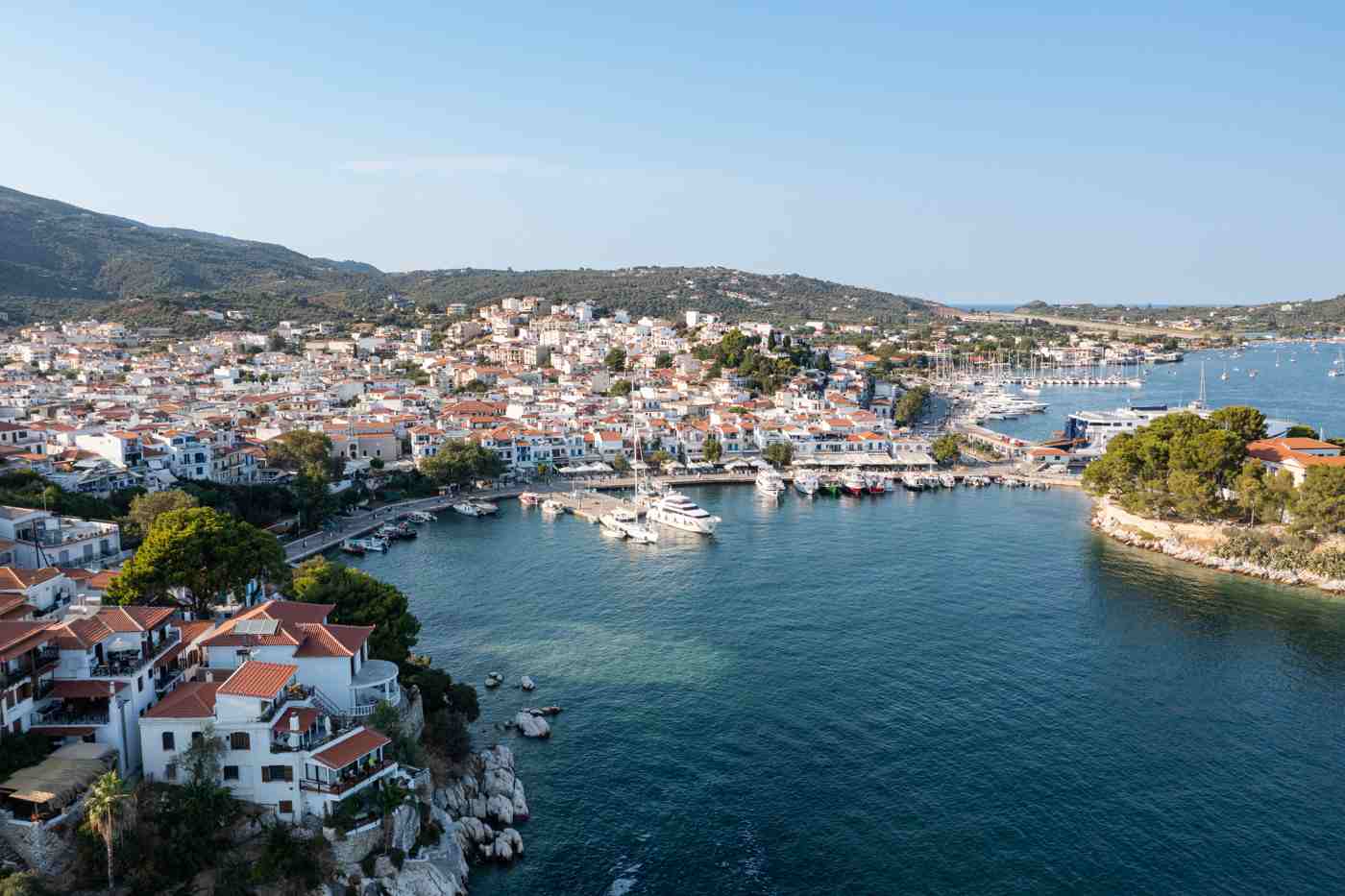
Vromolimnos beach spreads fine pale sand along the Kolios headland on the south coast of Skiathos, about 8 km from Skiathos Town. Water-ski and wakeboard stations, beach bars and gently shelving water make it the island’s liveliest sand outside the far southwest. The headland blocks the meltemi wind, so the sea stays calm on most summer days. Plan the whole trip with Greece Tours.
This guide covers the beach layout, the marsh behind the name, water sports, the bar scene, access by bus, car and water taxi. Family timing, the neighbouring coves of Kolios, Agia Paraskevi and Kanapitsa. Direct comparisons with Koukounaries and Banana.
Where does Vromolimnos beach sit on Skiathos?
Vromolimnos beach occupies a sandy bay on the Kolios headland, midway along the south coast of Skiathos, about 8 km west of Skiathos Town and roughly 15 minutes away by car.
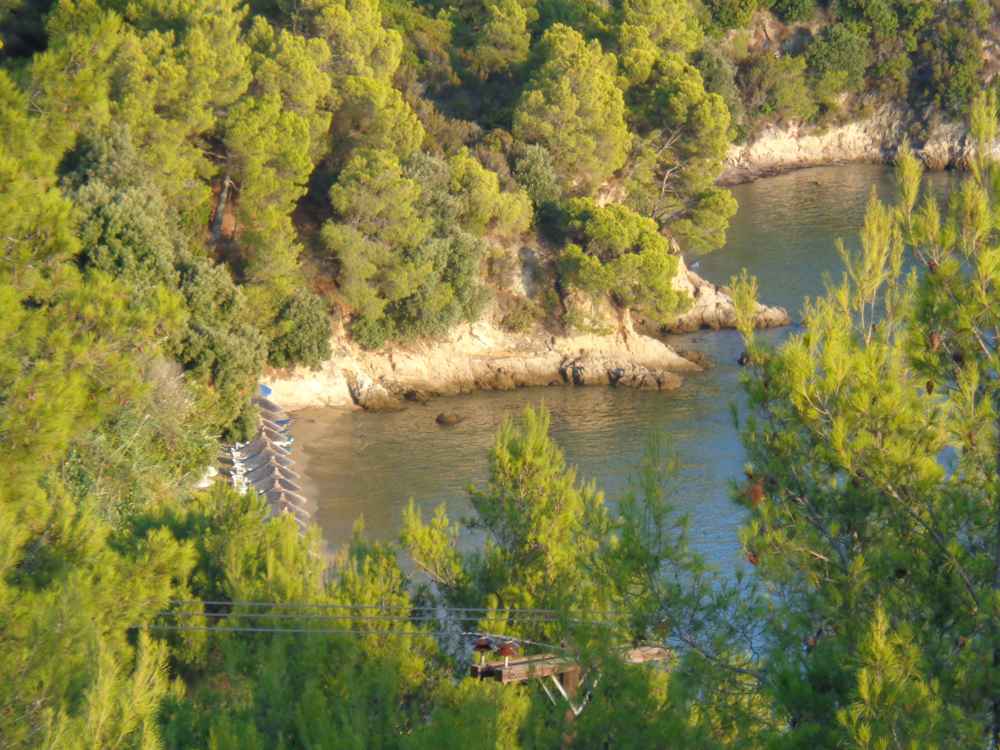
The bay opens due south on the western flank of the Kolios headland, between Kolios beach and Agia Paraskevi. About 200 metres of pale sand run between the two rocky points that close the bay. Skiathos covers about 48 square kilometres, and its single coastal road runs roughly 12 km from Skiathos Town to Koukounaries. Vromolimnos lies near the midpoint of that run. A surfaced lane leaves the main road at Kolios and drops through olive terraces to the parking area behind the sand. Pines and low scrub frame both ends of the bay, and the headland hides the shoreline from the road, so drivers watch for the signed turn.
The harbour, the airport runway and the Bourtzi peninsula all sit within a 15-minute drive east.
Skiathos Town lies about 8 km east along the coastal road, a drive of around 15 minutes past Achladies and Kanapitsa. Troulos beach continues about 3 km west of the Kolios junction, and Koukounaries marks the end of the road roughly 4 km beyond that. The island bus covers the whole stretch on its numbered town-to-Koukounaries route, stopping at Kolios on the main road above the bay. Taxis wait at the harbour rank in town and reach the Vromolimnos lane in about a quarter of an hour. Cyclists treat the coastal road with care in July and August, because rental cars, quad bikes and scooters fill both lanes through the middle of the day.
The final descent to the sand takes about ten minutes on foot.
The bay faces south toward the open Aegean, and the long ridge of Evia rises across the water on clear days. Morning sun reaches the sand early, and the western rocks keep light on the beach until late afternoon. The Kolios headland shoulders the meltemi. The dry north wind of high summer. The water inside the bay stays flat while north-coast beaches such as Lalaria and Aselinos take the swell. Boats at anchor gather off the beach on calm days, from small rental motorboats to sailing yachts on the flotilla routes. Swimmers look back at a green amphitheatre of pine and olive, with white studio buildings scattered along the slope.
The scene stays open and bright from mid-morning until the sun drops behind the headland.
The Kolios headland itself carries a scatter of villas, studios and a church above three separate coves. Kolios beach, the headland’s eastern bay, holds a jetty used by water taxis shuttling between the old port and the south-coast beaches. Agia Paraskevi, named for the chapel behind it, spreads a longer strip of sand immediately west of the Vromolimnos turn. Footpaths connect the coves across the low ridge, and walkers cross from Vromolimnos to Kolios in about 15 minutes. The headland’s position, midway along the developed coast, puts a supermarket, bakeries and car-rental desks within a short drive of the sand.
That mix of easy services and a protected bay explains why the beach fills fastest of the three each afternoon. Each cove keeps its own character, yet the headland works as one resort area.
What does the name Vromolimnos mean?
Vromolimnos translates as ‘dirty lake’, a name taken from the brackish marsh that once spread behind the sand. The marsh has largely dried, and the modern beach shows no trace of it on the shoreline.
The Greek name joins ‘vromiko’, meaning dirty, with ‘limni’, meaning lake, and describes the stagnant pool that stood behind the beach for generations. Winter rain collected in the hollow behind the sand, the outlet to the sea silted shut, and the trapped water turned brackish through the hot months. The pool bred mosquitoes and a marsh smell in late summer, and that smell gave the place its blunt label. Islanders across Greece named coastal features this way, putting plain observation ahead of flattery, and Skiathos follows the pattern. The label stuck on maps and bus signs long after drainage and building on the flat ground removed the pool itself.
Visitors now meet the name before they meet any lake, and the contrast amuses first-time swimmers every season.
Wetlands once dotted the low ground behind the south-coast beaches of Skiathos, fed by winter streams off the pine hills. The Strofilia lagoon behind Koukounaries survives as the clearest example, a protected biotope still linked to the sea by a channel and busy with birdlife. The Vromolimnos hollow followed the same logic on a smaller scale, trapping fresh and salt water behind a sand bar. Development on the flat ground and drainage works shrank the pool across the modern era, and the beach now backs onto bars, parking and greenery instead of reeds. Damp patches return to the lowest ground in wet winters, a faint echo of the old lake.
The geography still reads clearly to anyone who stands on the ridge and looks down at the bowl behind the bay.
The sea off Vromolimnos today contradicts the name completely. Clean sand covers the seabed far past the swimming line. No stream discharges into the bay in summer. The sheltered water stays unstirred by the meltemi, so clarity holds from June to October. Swimmers watch their own shadows on the bottom at chest depth, and snorkellers follow fish along the rocks at both points. Water quality across the organised south coast is monitored through the bathing season, and Vromolimnos performs at the standard that keeps the sunbed crowds returning. Sunlight through the shallow water gives the bay its bands of colour, pale over the sand and darker past the drop toward deeper ground.
The ‘dirty lake’ survives only on the map; the swimming here is as clean as the island offers.
Skiathos place names read like a field guide once translated. Koukounaries takes its name from the stone pines behind the sand, Megali Ammos means big sand. Agia Paraskevi and Agia Eleni carry the names of their chapels. Lalaria refers to the smooth pale pebbles of the boat-only beach on the north coast. Vromolimnos fits the same honest pattern, recording a feature instead of selling one. The habit helps navigation, because a name states what a visitor finds: pines, sand, pebbles, a chapel or, in this case, a vanished marsh. Bus drivers, taxi drivers and boat captains use these names unchanged, so learning the map teaches a little Greek along the way.
The blunt label deters nobody, and the bay counts among the busiest on the island.
What are the sand and sea like at Vromolimnos beach?
Fine pale sand lines the whole bay and continues underwater, shelving gently before the seabed deepens past the swimming line. The Kolios headland blocks the meltemi, so the surface stays calm on most July and August days.
Fine pale sand runs the full length of the bay, about 200 metres between the two rocky points that close it. The grain sits small and soft underfoot, closer in texture to Koukounaries than to the pebble coves of the north coast. The dry strip measures roughly 15-20 metres from the treeline to the waterline at midsummer, narrower than the great southern sweeps but deep enough for rows of sunbeds. Open sand survives at both ends for visitors with towels. Pine, olive and the terraces of the beach bars back the beach, so shade begins within steps of the last sunbed.
Late-afternoon light warms the whole strip until the sun clears the headland, and the sand holds heat into the evening parties. Sunbed rows fill the middle of the strip in high season.
The seabed continues in the same clean sand well past the swimming line, without rock shelves or sudden drops near the shore. Water reaches an adult’s waist about 20-30 metres out, so children splash inside a wide, visible margin. The gradient then steepens gently toward the anchorage where day boats swing in the deeper blue. Bathers walk in barefoot; nothing underfoot demands swim shoes on the main strip. Temperature peaks in August after a season of sun on shallow water, and the bay stays swimmable from about late spring to mid-autumn.
Clarity is the bay’s calling card: at chest depth a swimmer counts the ripples in the sand below, and masks reveal shoals working the edges of the rocks. The clean bottom also keeps the water bright on overcast days.
Snorkellers work the rocks at both points, where the sand gives way to boulders, weed and the small fish that shelter there. Morning delivers the best visibility, before boat traffic and swimmers stir the shallows. The western point stays quieter because the water-sports lanes run off the eastern half of the beach. Octopus, wrasse and bream appear along the boulder line on still days, and sea urchins dot the deeper rocks, so snorkellers keep their feet off the stone. A mask and snorkel from a town shop covers the whole game here; nobody needs a boat or a guide.
Swimmers who round the western rocks meet the next cove within about ten minutes, a short adventure with the beach still in sight. Fish gather thickest around the eastern boulders at first light.
The meltemi defines Aegean summer, a dry north wind that builds through July and August afternoons. Vromolimnos faces south with the Kolios ridge at its back, so the wind passes overhead and the sea surface keeps only a light texture. North-coast beaches such as Lalaria and Megas Aselinos take the swell head-on the same afternoon, and the round-the-island boats skip their northern stops. The shelter makes the bay dependable: a family plans a Vromolimnos day without checking the forecast twice. Winds out of the south reverse the arrangement on a minority of summer days, pushing chop onto the sand while the north coast falls calm.
Locals read the flags and the moored boats at a glance, and visitors learn the same trick within a day or two.
Which water sports run at Vromolimnos beach on Skiathos?
Water-ski and wakeboard stations tow across the flat water of Vromolimnos through the summer season, alongside inflatable rides, paddleboards and kayaks. The bay ranks with Kanapitsa among the main water-sports centres on the south coast of Skiathos.
A water-ski and wakeboard station operates from the eastern half of the beach through the summer season, towing riders across the flat water inside the bay. Morning sessions get the smoothest surface, before the day breeze textures the sea, and instructors start beginners on wide skis and short lines close to shore. Advanced riders carve the wake further out along the corridor that runs parallel to the swimming zone. The engine noise sets the beach’s daytime rhythm as much as the bar speakers do. Spectators follow every run from the sunbeds, which turns each wipeout into shared entertainment.
Skiathos concentrates its towed water sports on this stretch of the south coast, and Vromolimnos sits at the centre of the action. The station flag flies from June to late September in a normal year.
Inflatable rides fill the family end of the sports menu: ringos, banana boats and towable sofas that hold three or four riders behind a speedboat. Stand-up paddleboards and kayaks rent by the hour for slower exploration along the rocks toward Kolios or Agia Paraskevi. Paddle craft suit calm-water mornings, when the bay lies flat as a pool and the tow boats sit idle. The mix lets one group split cleanly: teenagers queue for the tubes, adults paddle the shoreline, and the youngest dig by the water. Equipment stands open from mid-morning to early evening in July and August, with shorter hours at the season’s edges.
Life jackets come with every tow and every rental as standard practice on the island. Calm shoulder-month mornings suit first-time paddlers best of all.
Shelter explains why the sports work here better than almost anywhere on the island. The meltemi that whips the north coast leaves this bay flat, so tows run on schedule through the windiest weeks of high summer. The buoyed swimming zone keeps bathers and boats apart, with the tow corridor angled out toward open water. Drivers loop wide turns beyond the anchorage and bring riders back along the same line, keeping the show in front of the sunbeds. Waiting lists build between about two and five on peak afternoons, so riders sign up early and swim until their turn.
September offers the sweetest combination on the water: warm sea, thin crowds and the same flat surface under the boats. Late afternoon adds a light breeze texture without stopping the tows.
Kanapitsa, the next peninsula east, runs its own water-sports centres and doubles the options within a short drive. Koukounaries adds stations at the island’s far southwest, so the whole south coast reads as one linked playground with the bus route along the road behind it. Vromolimnos holds its place in that line-up through atmosphere: the compact bay puts riders, music and audience within one glance. Rates across the island’s stations move with engine time and group size, so groups compare boards at two or three beaches before committing. Wetsuits matter only at the season’s edges, because the sheltered shallows warm early and hold their heat.
Photographers stand on the rocks at the eastern point for the cleanest shots of riders against the headland. One beach rarely exhausts a sports-minded week here.
What is the beach bar scene like at Vromolimnos?
Beach bars anchor Vromolimnos and run music from midday until after sunset through July and August. The bay draws the youngest crowd on the south coast, and parties carry on into the evening on peak weekends.
Beach bars run the daytime economy of Vromolimnos, pairing the sunbed rows with cocktails, coffee, cold beer and snack menus served on the sand. Music starts at a background level around midday and climbs with the afternoon, until the bay sounds more like a club terrace than a cove. Staff shuttle trays between the decks and the front-row loungers through the peak hours. The crowd skews young and international in July and August, with groups claiming blocks of sunbeds for the whole day. Nobody dresses up; swimwear and salt count as the dress code until sunset.
The bars also anchor the practical side of the beach, providing the toilets, shade and card payments that keep an all-day stay simple. Shade under the bar canopies fills as fast as the front-row loungers.
Sunset shifts the gear rather than ending the day. DJ sets carry the peak weeks, the loungers turn toward the light over the headland, and the swimming crowd thins while the drinking crowd holds its ground. Parties run into the evening on peak weekends, with the bay lit from the bar decks and the last swimmers moving through dark water. The scene stays concentrated: about 200 metres of sand keeps every group within sight of the music. June and September soften the volume to background level, and the same terraces serve quiet drinks to couples watching the anchor lights.
The seasonal contrast runs wider here than at any other beach on the island, from near-silence in October to full amplification in August. Weekday sessions run softer than the weekend peaks.
The bay works as the daytime opening act of Skiathos nightlife, which moves after dark to the cafe-bars of the old port, the cocktail lanes around Papadiamantis Street and the club strip on the airport ring road. Taxis and rental cars cover the 8 km back to town in about 15 minutes, so the beach-to-bar pipeline flows nightly through high summer. Skiathos runs the liveliest evening scene in the Sporades, and Vromolimnos feeds it from the sand. Visitors chasing the full circuit sleep late, reach the beach after noon, and treat the bay’s sunset session as the bridge into the night. The rhythm repeats daily from about late June to early September without a pause.
The bay therefore appears on every itinerary that ranks the island’s party beaches first.
Mornings tell the opposite story. Staff rake the sand and stack glasses before ten while early swimmers cross the empty bay, and the loudest sound is the first tow boat warming up. Visitors who want Vromolimnos without the party simply come early or come in the shoulder months, when the bars open late and close early. The sand stays public through every party, so swimmers share the bay with the music rather than paying into it. Families, walkers and older couples use the early window daily, then hand the beach over as the speakers wake. Two beaches exist here in one day, separated by the clock rather than by geography, and regulars pick their hour with confidence.
The empty-morning window lasts until about eleven in August.
How do you reach Vromolimnos beach from Skiathos Town?
Drivers leave the coastal road at the signed Kolios junction and follow a lane down to the parking behind the sand. Bus riders use the Kolios stop and walk about 10-15 minutes downhill; water taxis arrive from the old port.
The signed Kolios junction on the south-coast road marks the turn for the beach, about 8 km from Skiathos Town and about 4 km before Troulos. A surfaced lane drops from the junction to a parking area on the flat ground behind the sand, and the last steps to the beach take under a minute. Parking fills by late morning through the peak weeks, so drivers either arrive before eleven or accept a wait for a leaving car. Scooters and quad bikes squeeze in longer, which makes two wheels the flexible choice in August. Rental desks in town and along the coast road put a vehicle within reach of any visitor.
The drive from town takes about 15 minutes outside the morning rush. Signage makes the junction easy to find on a first drive.
The island bus runs the single south-coast road between Skiathos Town and Koukounaries. With stops numbered in sequence from the harbour to the final stop at the great beach, roughly 1 to 26. Riders bound for Vromolimnos leave the bus at the Kolios stop on the main road above the headland. Services run at high frequency through the summer day and into the night in peak season, so nobody plans around a timetable. The walk down to the sand takes about 10-15 minutes on the lane. The bus dodges the parking problem entirely and connects the beach to every other numbered stop on the coast.
Standing room is the norm on mid-afternoon runs in August, so riders travel light. Conductors call the stops aloud, which helps first-time riders.
Water taxis add the third route, linking the old port of Skiathos Town with the beaches of the Kolios headland through the summer season. The ride down the coast passes Megali Ammos, Achladies and Kanapitsa and takes about 20-30 minutes with stops. The crossing turns a beach transfer into a short cruise, with the town, the Bourtzi and the airport flight path falling away behind the stern. Families rate the boat as the most entertaining option, and drivers rate it as the one that skips every parking space on the island. Return boats collect swimmers through the afternoon, and passengers confirm the last departure when they board. Rough southern weather pauses the service on rare days each summer.
Boats fill fastest on the late-morning departures in August.
The return climb from the sand to the Kolios stop takes closer to 20 minutes uphill. August afternoons make it a hot one, so walkers carry water and favour the cooler hours. Taxis reach the parking area down the lane when called by phone from the beach. Combining routes works well: bus out in the morning, water taxi back at the end of the day, with the walk saved for the downhill direction. Travellers with pushchairs or heavy cool bags default to car or taxi. The bay’s access asks one small effort from bus riders, and that effort filters the crowd more than any gate ever would. Early boats and early buses land on the emptiest sand.
Sunset walkers get the lane’s best light on the climb.
Is Vromolimnos beach on Skiathos good for families?
Families get the best of Vromolimnos before noon and after five, when the music drops and the shallow sandy entry suits young children. Peak afternoons belong to the tow boats, the bar terraces and a younger crowd.
Morning belongs to families at Vromolimnos. The water lies flat, the sunbeds sit empty, the music stays off, and the shallow sand shelf gives children a wide margin where an adult stands chest-deep 25 metres out. Parents claim the sunbeds nearest the western rocks, the calmest corner of the bay, and let the morning run on digging, paddling and the first swim lessons of the holiday. Bar kitchens open for coffee and toasted sandwiches before the party crowd wakes. The tow boats start slowly, one run at a time, and double as free entertainment from the shoreline.
Families who leave by one o’clock read the beach as calm, organised and easy, a different beach from the one the afternoon crowd describes. The western corner also holds the longest morning shade.
Afternoon changes the contract. Music climbs, the sunbed rows fill with groups in their twenties, tow boats run continuously off the eastern half, and the shoreline traffic doubles. Toddlers nap badly next to a speaker stack, so families with the youngest children either leave after lunch or shift along the coast to a quieter cove. Older children read the same hours differently: tubes. Bananas and wakeboard lessons turn the bay into an activity park. Teenagers rank Vromolimnos first on the island for exactly the reasons toddlers rank it last. Parents split the difference by matching the visit to the child.
The bay never turns families away; it simply runs a schedule, and the schedule favours the young twice a day in different ways. Visiting twice settles the question fastest.
Practicalities line up well for a family day. Toilets sit in the beach bars, food and cold drinks arrive at the sunbed. Shade rents by the day. The sand stays soft the whole way to the water, so bare feet survive everywhere except the midday hour. The parking area sits close behind the beach, keeping the kit-carry short. Water shoes matter only for children who explore the rocks at the points. The gentle gradient means a fallen toddler sits in centimetres of water rather than a wave, and the buoyed swimming zone marks the safe box clearly.
Mini-markets on the coast road cover forgotten sunscreen within a short drive, and the bus stop above the bay handles car-free days. Strollers roll to the sand edge on the flat ground behind the bay.
Alternatives within 15 minutes cover every family mood. Troulos spreads calmer sand with tavernas about 3 km west, Agia Paraskevi next door runs at half the volume, and Agia Eleni faces the sunset near the road’s far end. Koukounaries adds the pine forest, the Strofilia lagoon walk and the longest sand on the island for a full family day out. Vassilias and Achladies sit back toward town for shorter transfers with the smallest children. The single bus line stitches all of it together, so a family based anywhere on the south coast samples a different beach every day without a car. Vromolimnos then re-enters the rotation on the mornings when the children want boats and bustle.
Each alternative sits on the same road and the same ticket.
Which beaches lie near Vromolimnos on the Kolios headland?
Kolios beach, Agia Paraskevi and Kanapitsa all sit within about 3 km of Vromolimnos on the same stretch of the south coast. Each cove pairs sand and calm water with tavernas and a different pace.
Kolios beach fills the headland’s eastern bay, a curve of sand beneath tavernas with terrace views over the moorings. The water-taxi jetty gives Kolios its role as the headland’s small transport hub, and yachts anchor in the lee through the summer. The pace runs slower than Vromolimnos: long lunches outrank long drinks, and the average visitor age climbs a decade. Walkers cross between the two beaches over the low ridge in about 15 minutes. Sunbeds line the front in high season without ever reaching the density of the party bay next door. Kolios suits the second half of a two-beach day, when a taverna table and a quiet swim complete what the wakeboard morning started.
Boats to and from town make Kolios the easiest cove to reach by sea.
Agia Paraskevi spreads the longest sand on this stretch immediately west of the Vromolimnos turn, backed by hotel gardens and the chapel that gives the beach its name. Families dominate the sunbeds, water sports run at a gentler tempo, and the shallow entry mirrors its neighbour without the speaker stacks. The bus stops on the road directly above, which makes it the easiest of the three coves for car-free visitors. Tavernas and hotel bars cover lunch on the spot. The beach absorbs crowds better than Vromolimnos because the sand runs longer, so late arrivals in August still find front-row space here after the party bay sells out.
The two beaches share weather, water and access, and differ almost entirely in soundtrack. Children manage the ridge path between the two with ease.
Kanapitsa occupies the next peninsula toward town, a knuckle of pine and villas with coves on both sides. Its water-sports centres rival the Vromolimnos station, and its sheltered western cove keeps the same flat, meltemi-proof water. Villas and small hotels on the slopes give the area a residential feel, quieter at night than the bar beaches. Small motorboats rent from the shore for self-guided runs along the coast, licence-free at the lower engine sizes. The Kanapitsa headland also marks the halfway line of the coastal road, so buses and taxis reach town in under 15 minutes.
Day visitors circle through Kanapitsa, Vromolimnos and Kolios in a single day on foot and by bus, three different beaches inside 3 km. The peninsula’s east side takes more breeze than its west.
The full roll of Skiathos beaches passes 60 around roughly 44 km of coastline, from the organised southern sand to the boat-only pebbles of Lalaria on the north coast. The Kolios headland cluster sits in the middle of the southern chain, balancing access, shelter and services better than any other stretch. West lie Troulos, Koukounaries, Banana and Agia Eleni; east sit Achladies, Vassilias and Megali Ammos on the way to town. North-coast wilderness at Aselinos, Mandraki and Elia waits for drivers and hikers. A week on the island covers one area a day without repeating a swim. Vromolimnos earns its place in that catalogue as the sheltered, loud, athletic one.
Bus stops, boat stops and parking cover the whole southern chain. The wild north asks more effort and returns emptier sand.
How does Vromolimnos compare with Koukounaries and Banana beach?
Vromolimnos trades size for shelter and energy: about 200 metres of sand packed with sports and bars. Koukounaries stretches about 1,200 metres in front of a pine forest, and Banana faces west for late-afternoon sun.
Koukounaries beach anchors the comparison as the island’s headline sweep: about 1,200 metres of fine golden sand at the end of the coastal road, roughly 12 km from town at the final numbered bus stop. A protected stone-pine forest and the Strofilia lagoon stand behind the sand, adding shade and a nature walk that no other beach on the island matches. Facilities stretch the full length, with sunbeds, tavernas and water-sports stations spaced out rather than stacked. The scale absorbs thousands without the crush that 200-metre Vromolimnos reaches by mid-afternoon. Koukounaries reads as the all-day, all-ages flagship. Vromolimnos answers with concentration: shorter sand, louder music, faster water sports and a crowd that came for exactly that.
Bus riders reach it on the same numbered line that serves Kolios.
Banana beach, officially Krassa, sits over the headland beyond Koukounaries at the island’s southwest tip, about 12 km from town. Golden sand faces west toward the late sun, sunbeds and bars fill the main cove, and a rock path leads to Little Banana, the smaller cove long known as naturist-friendly. The final approach involves a signed walk of about 10-15 minutes from the last bus stop or a drive to parking above the beach. Banana shares the young crowd and bar energy of Vromolimnos, with sunset as its trump card. Vromolimnos counters with easier access from mid-island bases and flatter water for skiing. The two beaches split the island’s party audience by geography as much as by style.
Sunset photographs from the main cove justify the walk alone.
Atmosphere separates the three more than sand quality does. Vromolimnos concentrates its energy: every sunbed sits within earshot of the music, and the tow boats perform in front of a single audience. Koukounaries spreads the same elements across six times the length, so the mood dilutes to family-day-out with lively pockets. Banana leans on its west-facing light and its bar terraces, peaking in the golden hour when the other two beaches empty. Wind rarely decides the choice, because all three face away from the meltemi. Access decides more often: Koukounaries and Banana share the long drive to the island’s tip, while Vromolimnos sits 15 minutes from town.
Crowds sort themselves accordingly, and each beach keeps its regulars all season. Each mood survives the whole season without drifting.
Choosing between them comes down to the shape of the day. A family with mixed ages books the morning at Vromolimnos, lunch at Kolios and keeps Koukounaries for a full-day outing with the forest walk attached. A group in its twenties runs the opposite line: late start, Vromolimnos afternoon, Banana sunset, then the town’s bars by midnight. Water-sports enthusiasts stay loyal to the flat water inside the Kolios lee. The single coastal road and its numbered stops make every combination workable without a car, and rental scooters shrink the distances further.
Nobody on Skiathos commits to one beach for a whole holiday; the island is built for rotation, and Vromolimnos claims the high-energy slot in every version of it. Ten days on the island fit all three beaches twice over.
Where do you stay near Vromolimnos beach on Skiathos?
Kolios, Kanapitsa and Achladies hold the closest beds to Vromolimnos, with studios, villas and mid-size hotels on the slopes above the coast road. Skiathos Town, about 8 km east, adds nightlife, shops and ferry access.
Studios, villas and mid-size hotels climb the slopes above the Kolios headland, most within a 10-20 minute walk of Vromolimnos, Kolios or Agia Paraskevi. The area suits visitors who want the beach first and the town as an occasional evening, with the bus stop above the bay covering the commute. Balconies here face the strait toward Evia, and the pine slope keeps the buildings low and scattered rather than blocky. Couples and groups of friends dominate the bookings closest to the party bay, while families cluster toward Agia Paraskevi. Evening options within walking distance run to tavernas and hotel bars rather than clubs. Cars stay optional, because two beaches and dinner sit within a walk of most doors.
Breakfast terraces along the slope look straight down the strait.
Achladies and Troulos widen the family choice on either side of the headland. Achladies, back toward town, lines up hotels above a long sandy beach with its own bus stops and water-taxi calls. Troulos, about 3 km west, pairs a calm family beach with a small cluster of tavernas, mini-markets and rental desks at the road junction. Kanapitsa fills the gap between Achladies and Kolios with villas and small hotels on its pine peninsula. Every one of these bases reaches Vromolimnos within about 10 minutes by car or bus plus a short walk. Rates generally step down with distance from Skiathos Town’s nightlife, and the mid-coast delivers the strongest balance of sand, quiet and connection on the island.
Buses stop at every one of these bases on the numbered line.
Skiathos Town works as the opposite strategy: sleep at the hub, commute to the sand. The town base adds the ferry quay, the airport, the old-port restaurants and the full evening circuit outside the door. With the bus or a 15-minute drive covering the beach run to Kolios. Rooms, studios and boutique hotels fill the lanes and the ring road, and early booking wins the quieter corners in high summer. Megali Ammos and Vassilias, the first beaches out of town, serve the quick daily swim while Vromolimnos becomes the planned outing. Night owls who intend to close the clubs pick the town and skip the late taxi run.
Light sleepers pick the coast and visit the noise on their own terms. The town also wins on rainy-day options and shopping.
The area-by-area guide to where to stay in Skiathos weighs every base from the town lanes to the Koukounaries resorts in detail. The short version for Vromolimnos regulars: sleep on the Kolios headland for the shortest walk. In Achladies or Troulos for family space, or in town for the nightlife pipeline that the beach feeds each evening. The island measures about 48 square kilometres, so no bed sits more than about half an hour from the bay. High-summer weeks sell out earliest at the mid-coast family hotels, and shoulder-season visitors choose freely at short notice. Matching the bed to the daily rhythm, beach-first, family-first or night-first, settles the decision faster than any star rating.
Repeat visitors often split the stay, town nights first and coast nights second.
Frequently Asked Questions
Does Vromolimnos beach have sunbeds and umbrellas?
Sunbeds and umbrellas fill the central strip of Vromolimnos from about June to late September, set out in rows by the beach bars that run the concessions. Renting works on a first-come basis, and the front rows near the waterline go first on peak mornings. Open sand remains at both rocky ends of the bay for visitors who bring towels and their own shade. Bar staff serve drinks and snacks directly to the loungers through the day, which keeps turnover low once the beach fills. Arriving before eleven in July and August secures a choice of position; after midday the pick shrinks to the back rows.
Off-season visits in spring and autumn find the furniture stacked away and the bay close to empty. The sand itself stays public, so nobody needs a rental to swim, and the ends of the beach keep the most towel-friendly space through the busiest weeks of the season. Umbrella shade matters most in the windless midday heat.
When does Vromolimnos beach get crowded in summer?
Peak crowding at Vromolimnos runs from about noon to six in July and August, when the sunbeds sell out, the tow boats run continuously and the bar music reaches full volume. Mornings before ten stay quiet even in the first week of August, with flat water, empty loungers and space at the shoreline for children. The crowd builds with the bus arrivals and the rental cars through late morning, peaks in mid-afternoon, and thins as the sun drops toward the headland. Evening brings a second, smaller wave for sunset drinks and the parties that carry into the night on peak weekends. June and September halve the density: the bars open, the stations tow, and the sand still breathes.
The beach’s compact size, about 200 metres, concentrates everything, so it feels fuller than larger beaches like Koukounaries at the same visitor count. Timing a visit around the noon-to-six block changes the whole experience. Cloudy days thin the sand but never empty the bars.
Is Vromolimnos beach sheltered from the meltemi wind?
The Kolios headland shields Vromolimnos from the meltemi, the dry north wind that blows across the Aegean in July and August. North-coast beaches such as Lalaria and Megas Aselinos take the full swell on meltemi days. Boat trips cancel their northern stops, while the water inside this south-facing bay stays flat enough for water-skiing. The shelter is the main reason the ski and wakeboard stations chose the bay, and the reason families trust the swimming here through peak season. A strong meltemi still sends gusts over the ridge in the afternoon, enough to flap umbrellas without raising waves.
Winds from the south, which arrive on a handful of days each summer, reverse the picture and push chop straight onto the sand; the north coast then turns calm. Checking the wind direction each morning tells a visitor which half of Skiathos swims best that day, and a north wind always favours Vromolimnos. The bay counts among the calmest anchorages on the island.
Can you take a water taxi to Vromolimnos beach?
Water taxis link the old port of Skiathos Town with the Kolios headland through the summer season. The crossing takes about 20-30 minutes depending on beach stops along the way. Boats leave from the quay near the Bourtzi and call at south-coast beaches including Achladies and Kanapitsa before reaching the headland. Travelling by sea removes the parking question entirely and turns a beach transfer into a short cruise beneath the island’s famous flight path. Departures concentrate between mid-morning and early evening, with return boats collecting swimmers through the afternoon; exact times shift with the season, so passengers confirm the last boat as they board.
Rough southern weather pauses the service on rare days, and the bus covers the same journey as a backup. Children rate the ride as an event in itself, which makes the water taxi the most entertaining of the three routes to Vromolimnos. Fares stay modest for the distance covered.
Where do you eat at Vromolimnos beach?
The beach bars at Vromolimnos cover drinks, coffee, snacks and light plates through the day, served at the deck tables or straight to the sunbeds. Fuller taverna meals wait within a short walk or drive: Kolios and Agia Paraskevi both keep tavernas above their sand. Grilling fish and turning out horiatiki, cheese pies and the slow-baked dishes typical of the Sporades. Mini-markets along the coast road sell picnic supplies, fruit and cold water for self-caterers. Skiathos Town, about 8 km east, expands the choice to the fish tavernas of the old port and the restaurants in the lanes off Papadiamantis Street. An easy evening move by bus or taxi.
Peak-season lunches at the busiest beach tavernas involve a wait around two o’clock, and eating before one or after three skips the queue. Nobody plans hard here; food sits within ten minutes of the towel in every direction on this coast. Beach-bar kitchens run longest at the height of the season.
Is swimming at Vromolimnos safe for weak swimmers?
Weak swimmers handle Vromolimnos better than almost any beach on Skiathos. The sandy bottom shelves gently, depth builds gradually rather than dropping. The Kolios headland keeps the surface calm through the meltemi weeks, so waves and undertow stay absent on a normal summer day. The buoyed swimming zone marks the safe box, and staying inside it keeps bathers clear of the water-ski corridor that runs off the eastern half of the beach. Tow boats launch and land all day in high season, which makes the marked boundary worth respecting rather than a formality. Children stand chest-deep a long way out, and a supervising adult keeps contact without treading water.
Water shoes stay optional because sand covers the entry from the first step. The rocks at both points hold sea urchins, so exploring feet need care there. Early mornings and the shoulder months offer the stillest water of all, close to pool conditions. Calm water still deserves respect, and adults watch children throughout.
How long is the walk from the Kolios bus stop to Vromolimnos?
The walk from the Kolios bus stop down to Vromolimnos takes about 10-15 minutes on the surfaced lane that leaves the coastal road at the signed junction. The route runs downhill the whole way, past villas and olive terraces, and ends at the parking area directly behind the sand. The return climb stretches closer to 20 minutes in afternoon heat, so walkers carry water and favour the cooler ends of the day. Flip-flops manage the surface without trouble; the lane is tarmac rather than track. The bus itself runs the single south-coast road between Skiathos Town and Koukounaries with stops numbered in sequence, roughly 1 to 26, at high frequency through the summer.
Riders tell the driver their beach, and the stop follows shortly after Kanapitsa. Visitors with pushchairs, cool boxes or heavy kit switch to a taxi or the water taxi and save the lane for the light-luggage days. The lane carries light car traffic, so walkers keep to the edge.