

Spetses and Hydra sit in the Argo-Saronic Gulf within easy reach of Athens, and both curb wheeled traffic, yet they feel distinct the moment you step off the boat. This My Greece Tours comparison weighs getting there, atmosphere, beaches, dining, nightlife and cost, so you can match either island to your trip. Start with the Spetses hub for the full picture.
Both islands earned fame in the 1821 Greek War of Independence and both keep their harbours largely free of cars, but the resemblance ends there. Hydra bans every wheeled vehicle and stacks grey-stone mansions above one deep port, while pine-covered Spetses allows bicycles, scooters and horse carriages and rings itself with swimmable beaches. Deciding between them comes down to scenery, beaches and pace rather than distance from the capital.
How do you choose between Spetses and Hydra?
Spetses suits travellers who want beaches, greenery and cycling, while Hydra rewards those drawn to dramatic stone architecture, art galleries and a strictly car-free port. Your beach priorities and preferred pace decide it.
The choice hinges on what you want from a car-free island. Spetses spreads across pine-covered hills, circled by a coastal road that cyclists, scooters and horse carriages share, and it hides a string of swimmable coves. Hydra rises in a tight amphitheatre of grey-stone mansions above one deep harbour, with almost no flat land and only pocket beaches. Travellers who prioritise sun, swimming and gentle movement lean towards Spetses, while those chasing architecture, galleries and a theatrical port choose Hydra. Both islands restrict private cars, so neither feels like the mainland; the difference lies in scenery, beach access and how you fill your days rather than in traffic.
A short visit can favour either, but a longer, beach-focused stay tilts firmly towards the greener island.
Landscape marks the clearest divide between the two. Spetses is genuinely green, cloaked in Aleppo pines that run down to the shore and shade many of its beaches, giving it a softer, more wooded character. Hydra, by contrast, is largely bare and rocky, its drama coming from architecture rather than forest: tiers of stone captains’ houses climb the slopes above the harbour in a natural amphitheatre. This single contrast shapes almost everything else. The pines of Spetses make cycling pleasant and beaches inviting, while the rugged, treeless slopes of Hydra concentrate life around its port and stone lanes.
Spetses fits; if it is coffee beneath grand facades, Hydra answers.
Size and shape also steer the decision in subtle ways. Spetses is compact and roughly rounded, ringed by a coastal road of about twenty-six kilometres that makes a full circuit feasible by bicycle in a couple of unhurried hours. Its beaches spread evenly around this loop, so no bay sits far from the town. Hydra is longer and more mountainous, with its population and visitors concentrated in the one main port town and a scattering of small settlements reached mostly on foot or by boat. This means Spetses invites active exploration of its whole coast, whereas Hydra encourages you to linger in and around a single, spectacular harbour and to reach outlying spots by water taxi.
History gives both islands weight, though each wears it differently. Spetses celebrates the naval heroine Laskarina Bouboulina and marks its role in the 1822 defence with the vivid Armata re-enactment each September. Its story is told through the Bouboulina and Spetses museums and grand shipowners’ mansions. Hydra grew rich from its merchant and naval fleet, and that wealth built the stone archontika mansions that still define its harbour, several now serving as museums and cultural venues. Both islands supplied ships and fighters to the revolution, so a sense of maritime pride runs through each. If heritage matters to your trip, you will find deep, well-preserved history on either island, expressed through very different architecture and celebration.
How do you get to Spetses and Hydra from Athens?
Both islands are reached by high-speed catamaran or hydrofoil from the port of Piraeus. Hydra lies closer, at roughly ninety minutes to two hours, while Spetses, the furthest Saronic island, takes about two hours to two hours thirty.
Getting to either island starts at Piraeus, the main port of Athens, where fast ferries operated by companies such as Hellenic Seaways depart through the day. Hydra sits closer to the capital and is usually reached in around an hour and a half to two hours by high-speed vessel. Spetses lies further south-west, the most distant of the Saronic islands. The journey runs to roughly two hours ten to two hours thirty depending on the boat and its stops. Many services call at islands in turn, often linking Poros, Hydra and Spetses on one route, which is why timings vary.
Booking ahead in high summer is wise, and consulting how to get to Spetses helps you plan the connection.
Spetses has a second, distinctive advantage: its closeness to the Peloponnese mainland. The small ports of Kosta and Porto Heli face the island across a narrow channel. From Kosta a short sea crossing by small ferry or water taxi reaches Spetses Town in only about ten to fifteen minutes. This makes the island easy to combine with a road trip through the Argolid. Travellers driving from Athens sometimes park at Kosta and cross by boat rather than sailing the whole way from Piraeus. Hydra has no such short mainland hop of comparable convenience for most visitors, though small boats do run from the tiny mainland port of Metochi.
For a self-drive Peloponnese itinerary, the Kosta crossing gives Spetses a clear edge.
Neither island has an airport, so the sea is the only way in, and that shapes how you arrive and what you bring. Because both are car-free or car-restricted, there is little point bringing a hire car onto them; most visitors leave vehicles on the mainland or travel from Athens without one. Pack light where you can, as you will move your own luggage from the quay to your accommodation, on foot or by water taxi on Hydra and by carriage, taxi-boat or a short walk on Spetses. The fast ferries carry foot passengers rather than cars for these routes, so plan your onward transfer for the moment you land rather than assuming you can simply drive off.
Day trips are feasible to both islands, but each rewards an overnight stay. From Athens you can reach either by morning ferry, spend the day. Return in the evening, and organised cruises often combine Hydra with Poros and Aegina in a single outing. Because Spetses is further, a day trip there leaves less time ashore, so it particularly repays staying at least one night. Checking the best time to visit Spetses helps you avoid the most crowded and expensive weeks and pick calmer sailing weather. Whichever island you choose, aligning your ferry times with your plans, and allowing a buffer for connections in high season, keeps the journey smooth from the capital.
How does the atmosphere of Spetses differ from Hydra?
Hydra feels more cosmopolitan and artistic, its stone harbour lined with galleries and drawing artists and celebrities, while Spetses is greener, more relaxed and family-friendly, with an elegant but easygoing seaside character.
Hydra carries a famously artistic, cosmopolitan air that has drawn painters, writers and film-makers for decades. Its perfectly preserved harbour, ringed by stone mansions and free of cars, has served as a backdrop for films and inspired a long line of creative residents, giving the port a gallery-and-cafe culture that feels worldly for so small an island. The singer Leonard Cohen famously kept a house here, and the island still hosts exhibitions and cultural events through the season. This concentrated, chic scene means Hydra can feel glamorous and busy around its waterfront, especially at weekends when Athenians and yachts arrive.
Contemporary art and a sophisticated harbour buzz, Hydra delivers it in a compact, walkable setting that rewards slow days spent close to the water.
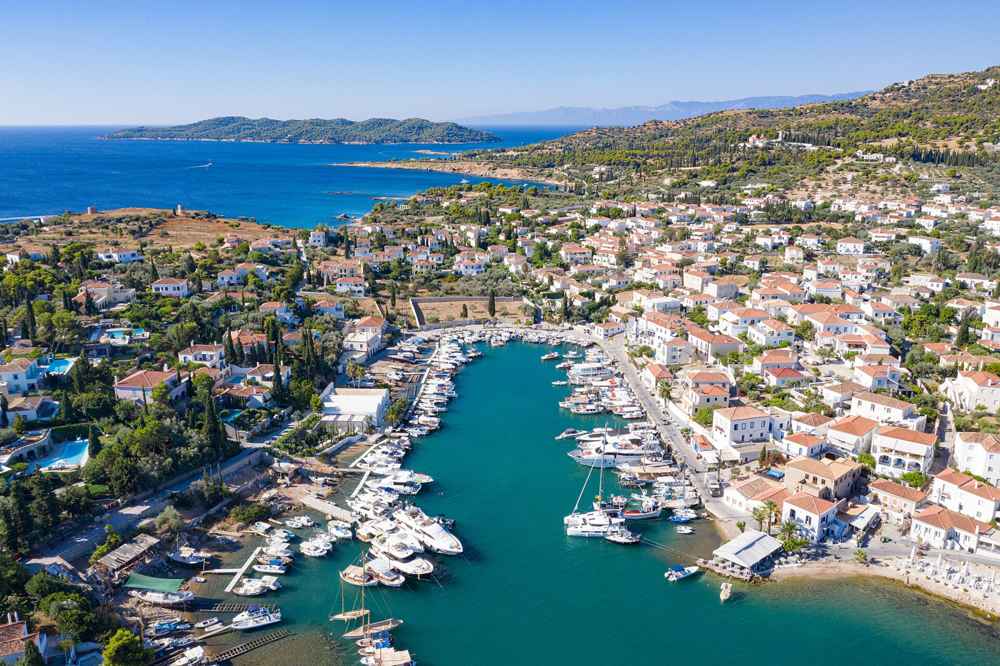
Spetses offers elegance of a gentler, greener kind. It has long been a fashionable retreat for well-to-do Athenians, and that shows in its handsome mansions, the grand Poseidonion Grand Hotel and a polished but unshowy seaside atmosphere. Yet the pine forests, wider spaces and abundance of beaches give the island a more relaxed, outdoors-focused mood than Hydra’s concentrated port. Families cycle the coast road, swimmers drift between coves, and evenings unfold along the waterfront and around the picturesque Old Harbour without the tightly packed intensity of Hydra’s single quay.
Reading up on things to do in Spetses reveals a broader spread of activity across the island, from beaches and cycling to museums, which suits travellers who like room to roam.
The physical layout reinforces these different moods. On Hydra, life presses in around the horseshoe harbour, where cafes, shops and galleries climb the slopes and almost everything happens within sight of the boats. The effect is intimate, theatrical and, in peak season, crowded. On Spetses, activity spreads between the main quay at the Dapia, the charming Old Harbour of Baltiza a walk away. Beaches strung around the whole coast, so the island rarely feels as concentrated. This gives Spetses a more dispersed, breathe-out rhythm, while Hydra concentrates its energy into one unforgettable stage set.
Neither is busier overall by nature, but Hydra’s compactness makes its crowds feel denser, whereas Spetses lets you find quiet simply by moving a little further round the shore.
Both islands attract a stylish, moneyed crowd, but they express it differently. Hydra leans towards the arty and international, with a reputation for glamour, celebrity sightings and a certain bohemian polish sharpened by its galleries and yacht traffic. Spetses feels more family-oriented and sporty, associated with sailing, cycling, tennis and long beach days. Its social life centres as much on the water and the pine-shaded coast as on the cafe terraces. Weekends on either island bring a lively influx from Athens, but Spetses generally offers more space to absorb it.
Choosing between the two atmospheres is really a choice between a concentrated, art-tinged harbour scene and a greener, more active island where elegance comes wrapped in pine woods and open sea.
How do you get around Spetses and Hydra?
Hydra bans all wheeled vehicles, so you travel on foot, by donkey or mule, and by water taxi. Spetses restricts cars but allows bicycles, scooters, ATV quads, horse carriages and water taxis, giving it more ways to move.
Hydra enforces the strictest transport rules in Greece: no cars, no motorbikes and no bicycles are permitted, and the ban is genuinely absolute. Instead, goods and luggage move by donkey and mule, sure-footed pack animals that climb the stepped stone lanes. People get around on foot or by water taxi between the port and outlying coves. This car-free, engine-free quiet is central to Hydra’s charm and its preservation, but it also means every journey up from the harbour involves steps and slopes on foot. For anyone with heavy bags or limited mobility, this is worth weighing carefully.
The trade-off is a hushed, timeless port where the loudest sounds are hooves, church bells and the sea rather than any engine.
Spetses takes a middle path that travellers find more practical. Private cars are heavily restricted, especially in the town and in high season, so the island keeps much of the peace of a car-free place. But it permits bicycles, small motorbikes and ATV quads, along with traditional horse-drawn carriages that clip-clop through the lanes and water taxis around the coast. This gives you real freedom to explore under your own power, and getting around Spetses becomes half the pleasure of a stay. Bicycles are the classic way to ride the flat coastal loop between beaches, while a scooter or quad covers the hillier stretches with ease.
The result is an island that stays calm and walkable yet lets you range widely.
Cycling is where Spetses pulls decisively ahead. The roughly twenty-six-kilometre ring road hugs the shore, stays fairly flat for long stretches and carries little traffic thanks to the car restriction, making it one of the finest cycling islands in Greece. Bikes rented near the Dapia let you chain beaches into a single outing, pausing wherever the water looks inviting. The pine-scented air makes the ride a joy in the cooler hours. A guide to cycling Spetses maps the loop and its best stops. On Hydra, cycling is simply impossible, so active travellers who love two wheels will find Spetses far better suited to their kind of exploring across a whole island.
Water taxis are the shared thread that ties both islands together. On each, small motorboats wait at the harbour and set off on demand once a destination and fare are agreed, turning the sea into a quick, scenic highway. On Hydra they are often the only sensible way to reach beaches and coves beyond walking range of the port. They play a central role in any beach day there. On Spetses they complement bicycles and scooters, whisking you out to distant coves such as Zogeria or sparing you a hot ride home in the afternoon.
For groups splitting the fare they can be good value on either island, and the approach along the shore is a pleasure in its own right.
Do Spetses or Hydra have the better beaches?
Spetses has clearly better beaches, with more numerous, larger and sandier bays such as Agioi Anargyroi, Agia Paraskevi and Zogeria. Hydra has only a few small, mostly rocky swimming spots reached on foot or by water taxi.
For beaches, Spetses is the stronger island by a wide margin, and this is often the deciding factor. Its pine-fringed coast holds a ring of proper beaches, from the broad organised sands of Agioi Anargyroi beach to sheltered coves like Zogeria and Vrellos, with pebbled inlets and town beaches filling the gaps. Many mix sand with fine shingle, slope gently into clear, calm water, and offer sunbeds, tavernas and shade from the pines. Because the beaches spread evenly around the coastal loop, you can sample three or four in a day by bicycle or water taxi. A guide to Spetses beaches shows just how much choice the island packs into its compact shore.
Hydra, by contrast, is not a beach island in the conventional sense, and it is important to arrive knowing this. Its rugged, largely treeless coast offers only a handful of small swimming spots, most of them rocky rather than sandy. Several reached only on foot or by water taxi from the port. Places such as Vlychos, Kamini, Bisti and Agios Nikolaos give lovely, clear-water swims off rocks, concrete platforms or small pebble strands, but nothing resembling the broad sandy sweeps of Spetses. For visitors this is fine, since Hydra’s appeal lies in its architecture and atmosphere rather than sunbathing. But travellers whose holiday revolves around long days on sand will feel the limitation keenly on Hydra.
The water itself is beautifully clear around both islands, so the difference is one of quantity, size and access rather than cleanliness. On Spetses the sheltered Argo-Saronic setting keeps many west-facing coves calm even when a breeze ruffles the open sea, and the pines provide natural shade close to the sand at beaches like Agia Paraskevi beach. On Hydra the swims are equally clear but smaller and more exposed, prized more for their dramatic rocky settings than for lounging space. If your ideal is a shaded, sandy bay with a taverna behind it, Spetses answers repeatedly. If you are content with a clear-water dip off the rocks between sightseeing, Hydra suffices.
Access to the beaches follows each island’s transport character. On Spetses you can cycle the coastal ring road to one beach after another, hop between coves by water taxi, or take the seasonal minibus to the popular western bays. Beach-hopping is easy and varied. On Hydra, with no bicycles or vehicles, you reach the better swimming spots either by walking the coastal paths from the port or, more often, by taking a water taxi to coves like Bisti or Agios Nikolaos and arranging a pick-up. This makes a Hydra beach day more of a planned boat excursion than the casual, roam-as-you-please affair it can be on Spetses. For sheer beach variety and ease, Spetses wins comfortably.
How does dining compare on Spetses and Hydra?
Both islands dine well on fresh seafood and Greek cooking, often waterside. Hydra concentrates smart, cosmopolitan tavernas and cafes around its harbour, while Spetses spreads its tavernas between the Dapia, the Old Harbour and the beaches.
Eating well is easy on either island, and both build their tables around fresh fish, seafood and classic Greek cooking served beside the water. Hydra concentrates its dining around the harbour and the lanes just behind it, where waterside tavernas, ouzeris and more polished, cosmopolitan restaurants sit close together, matching the island’s chic reputation. Because everything clusters near the port, choosing where to eat is a matter of strolling the quay and picking a terrace with a view of the boats. Prices at the smartest harbour spots can run high, in keeping with Hydra’s fashionable crowd, but simpler tavernas and cafes in the back lanes offer more everyday Greek meals.
The setting, framed by stone mansions and moored yachts, is a large part of the pleasure.
Spetses spreads its dining more widely, which suits its dispersed layout. Around the main quay at the Dapia you will find cafes and restaurants, while the picturesque Old Harbour of Baltiza is lined with some of the island’s most atmospheric tavernas and cocktail bars, set against a backdrop of traditional boatyards and moored yachts. Out on the coast, beach tavernas at bays such as Agioi Anargyroi and Zogeria serve fish and mezedes with your feet almost in the sand. A guide to Spetses restaurants maps this spread from town to shore. This variety means you can pair each meal with a different setting, from a buzzing quay to a quiet beach or the romantic Old Harbour after dark.
Local specialities give both islands a distinct flavour, though Spetses claims the most famous dish. Fish a la Spetsiota, fish baked in a rich sauce of tomato, garlic, parsley and wine, originated on the island and appears on menus across it, a genuine culinary landmark worth seeking out. Amanti and almond sweets also feature in the local repertoire. Hydra’s kitchens lean on the same Aegean bounty of fresh fish and seafood, with its own traditional sweets such as amygdalota almond treats. Its dining identity rests more on setting and sophistication than on a single signature plate.
Either way, you eat the sea’s freshest catch on both islands, prepared with the simple, ingredient-led confidence that defines good Greek island cooking.
The dining atmosphere mirrors each island’s wider character. On Hydra, meals feel part of a cosmopolitan, see-and-be-seen harbour scene, where a long lunch or dinner by the water is as much about the setting and the passing parade as the plate. On Spetses, dining is a touch more relaxed and varied, whether that is a family fish lunch at a beach taverna, a coffee on the Dapia, or a candlelit dinner beside the boats at the Old Harbour of Baltiza. Neither island disappoints the food-minded traveller, and both reward a willingness to step back from the busiest terraces to find honest, well-priced Greek cooking.
The real difference is whether you prefer your meals concentrated around one glamorous port or spread across a greener island.
What is nightlife like on Spetses versus Hydra?
Both islands keep nightlife stylish rather than clubby, centred on bars and late tavernas by the water. Hydra’s scene hugs its harbour, while Spetses adds livelier bars and clubs, especially around the Old Harbour of Baltiza.
Neither island is a party destination in the mould of Mykonos or Ios, and that restraint is part of their appeal. Both favour a refined, low-key evening built around long dinners, cocktail bars and waterfront cafes rather than large nightclubs. On Hydra the night unfolds around the harbour, where bars and lounges spill onto the quay and the crowd, often arty and international, lingers late over drinks with the moored yachts as a backdrop. There are a few livelier late spots, but the prevailing mood is stylish and conversational rather than raucous.
This makes Hydra ideal for travellers who want atmosphere, a good cocktail and a beautiful setting rather than dancing until dawn, and it fits the island’s cultured, cosmopolitan character neatly.
Spetses offers a slightly livelier night, particularly in high season, while keeping its elegant edge. The Old Harbour of Baltiza is the heart of the after-dark scene, where atmospheric bars and a handful of clubs sit among the boatyards and moored yachts, drawing a smart, youngish crowd that keeps going into the small hours. A guide to Spetses nightlife maps the bars from the Dapia to Baltiza. Closer to the main quay you will find more relaxed cafe-bars for an early-evening drink.
This spread lets you tune the night to your mood, from a quiet cocktail on the waterfront to a later, busier scene at the Old Harbour, without ever tipping into the frenzy of the big party islands.
The seasonal rhythm shapes nightlife on both islands. In July and August, weekends in particular bring an influx of Athenians and yacht crowds that fills the bars and lifts the energy. This is when both islands feel most lively after dark. Outside the peak, in spring and autumn, evenings grow quieter and more intimate, centred on dinner and a relaxed drink rather than a late scene. Spetses tends to sustain a slightly more active late-night offering than Hydra thanks to its clutch of Baltiza clubs. Neither island stays loud until sunrise as a matter of course.
Travellers seeking guaranteed nightclubs every night will find both islands modest; those wanting stylish bars in gorgeous settings will be well served on either.
Ultimately both islands treat the evening as an extension of their elegant, waterside days rather than a separate scene. On Hydra you drift from a harbour dinner to a cocktail on the quay, wrapped in the glow of the stone port. On Spetses you might dine at a beach or the Dapia before moving to the Old Harbour for a livelier drink among the yachts. This shared preference for quality over volume means neither island suits committed clubbers. Both reward anyone who enjoys a beautiful bar, a good drink and the company of a stylish crowd. If a marginally busier late scene matters, Spetses edges ahead; for pure atmosphere over a nightcap, Hydra is hard to beat.
How do costs compare between Spetses and Hydra?
Both islands sit at the pricier end of the Saronic, drawing well-to-do Athenians and yacht crowds. Hydra can feel dearer around its fashionable harbour, while Spetses offers slightly more range thanks to its larger spread of options.
Neither island is a budget destination, and it helps to arrive expecting Saronic prices rather than backpacker bargains. Both have long attracted affluent Athenians, weekenders and yacht owners, and that demand keeps accommodation, harbour dining and drinks above the Greek average, especially in July and August. Hydra, with its concentrated, fashionable harbour and international art crowd, can feel the pricier of the two at its smartest cafes, restaurants and boutique hotels, where the setting commands a premium. Weekends and the peak weeks push rates higher on both islands. Booking early and, where you can, travelling in the shoulder seasons of late spring or early autumn brings noticeably better value.
Planning ahead is the surest way to keep either island affordable without sacrificing the experience.
Spetses tends to offer a little more range, largely because it is bigger and its options are more spread out. Alongside the elegant Poseidonion Grand Hotel and smart waterfront restaurants, the island has a wider spread of mid-range studios, family tavernas and beach canteens. It is easier to find everyday prices away from the most fashionable spots. Thinking about where to stay in Spetses in relation to your budget pays off, since lodgings a short walk or ride from the Dapia often cost less than a room right on the quay. On Hydra, where everything clusters around one harbour, the price gap between the smartest and the simplest spots can feel narrower, with fewer obvious budget alternatives.
Getting there and around adds modestly to the cost on both islands, and the details differ slightly. The fast ferry from Piraeus costs a little more to Spetses than to Hydra because it sails further, though the difference is not large. On Spetses you may spend on bicycle, scooter or quad hire and the occasional water taxi, while on Hydra you rely on your own feet, donkeys for luggage and water taxis for beaches, which for a family reaching coves can add up. Neither island requires a hire car, which saves money against many Greek destinations.
The Kosta crossing gives Spetses a cheaper mainland approach for self-drivers, letting you park on the Peloponnese and cross by a short, inexpensive boat ride.
For value overall, much depends on how you travel and when. A couple happy with harbour dinners and boutique rooms will find both islands comparable and neither cheap, with Hydra perhaps a touch dearer at the top end. A family or a group willing to mix beach tavernas, self-catering studios and bicycles will generally stretch a budget further on Spetses, thanks to its greater choice and its beaches, which cost nothing to enjoy. Shoulder-season travel, early booking and staying a short walk back from the waterfront cut costs on either island.
In short, both sit at the smarter end of the Saronic, but Spetses gives you more levers to control spending, while Hydra concentrates its premium around one glamorous port.
Who should choose Spetses and who should choose Hydra?
Choose Spetses for beaches, cycling, families and active, spread-out days, and choose Hydra for architecture, art, romance and a strictly car-free stone harbour. Beach-focused travellers pick Spetses; culture-and-atmosphere seekers pick Hydra.
Spetses is the better fit for beach lovers, families and active travellers. Its ring of pine-backed beaches, from organised Agioi Anargyroi to sheltered Zogeria, gives children safe, shallow swimming and adults plenty of variety, while the flat coastal loop makes it one of Greece’s finest cycling islands. The greener landscape, wider spaces and mix of transport, from bicycles to horse carriages and water taxis, suit those who like to roam and to fill their days with swimming, riding and outdoor time. Add the elegant but relaxed atmosphere, the grand Poseidonion Grand Hotel and the lively Old Harbour. Spetses answers travellers who want an active, seaside holiday with elegance rather than a purely cultural one.
For a first family island in the Saronic, it is hard to better.
Hydra is the stronger choice for lovers of architecture, art and atmosphere. Its car-free, engine-free harbour, ringed by grey-stone mansions and free of any wheeled traffic, is one of the most beautiful and distinctive ports in Greece. Its galleries, cultural events and cosmopolitan crowd give it a worldly, creative edge. Couples seeking romance, photographers, art enthusiasts and anyone content to swim off the rocks between long cafe hours will find Hydra enchanting. The absence of beaches matters little to travellers who come for the setting rather than the sand, and the total ban on vehicles delivers a rare, timeless calm. If your ideal holiday is soaking up a spectacular stone port and its art scene, Hydra is unmatched.
Some travellers are better served by one island’s practicalities than the other’s. Families with young children, anyone with heavy luggage. Visitors who value easy movement often prefer Spetses, where bicycles, carriages and gentler gradients make daily life simpler than Hydra’s stepped, foot-only lanes. Those combining the island with a Peloponnese road trip also lean to Spetses for the quick Kosta crossing. Conversely, travellers who prize absolute quiet, who love architecture and who do not need beaches will find Hydra’s stricter car-free rule a feature rather than a drawback. Honest self-assessment about mobility, luggage and what you most want from your days points clearly towards one island or the other.
Neither choice is a compromise once made for the right reasons.
The happiest answer, for those with time, is to visit both. Because fast ferries link Poros, Hydra and Spetses on the same Saronic route, it is straightforward to pair the two islands in one trip, spending nights on each and comparing them first-hand. A common plan is to base first on Hydra for its harbour, art and romance, then move on to Spetses for beaches, cycling and a more relaxed finish, or the reverse. Even a single night on each reveals how different two neighbouring car-restricted islands can be.
Let your priorities decide: beaches and activity point to Spetses, architecture and atmosphere to Hydra, and either way the Argo-Saronic rewards the journey.
Frequently Asked Questions
Is Spetses or Hydra closer to Athens?
Hydra is closer to Athens than Spetses. Both islands are reached by high-speed catamaran or hydrofoil from the port of Piraeus. Hydra sits nearer the capital and is usually reached in around an hour and a half to two hours by fast ferry. Spetses is the most distant of the Saronic islands. The sea journey from Piraeus runs to roughly two hours ten to two hours thirty, depending on the vessel and how stops it makes along the way. Many services call at islands in sequence, often linking Poros, Hydra and Spetses on one route, which explains the range of timings.
Spetses does, however, have one advantage of its own: it lies close to the Peloponnese mainland at Kosta and Porto Heli. From Kosta a short boat crossing of only about ten to fifteen minutes reaches the island, which suits travellers already driving through the Argolid.
Can you visit both Spetses and Hydra in one trip?
Yes, visiting both Spetses and Hydra in one trip is straightforward and popular. Fast ferries from Piraeus run along the Saronic route that links Poros, Hydra and Spetses, so you can sail between the two islands directly without returning to Athens in between. A common plan is to spend nights on Hydra for its stone harbour, galleries and romantic atmosphere, then continue to Spetses for its beaches, cycling and greener, more relaxed pace, or to do the journey in reverse. Even a single night on each reveals how different two neighbouring car-restricted islands can be, since Hydra bans all wheeled vehicles while Spetses allows bicycles, scooters and carriages.
Combining them also lets you compare their dining, nightlife and character first-hand. Because both islands are compact and close together, pairing them makes an excellent short Saronic itinerary. It saves you having to choose between two islands that suit quite different moods.
Are there cars on Spetses and Hydra?
Both islands restrict vehicles, but to different degrees. Hydra enforces the strictest rule in Greece, banning all wheeled vehicles entirely: no cars, no motorbikes and no bicycles are allowed anywhere on the island. Instead, goods and luggage are carried by donkeys and mules up the stepped stone lanes. People move around on foot or by water taxi between the port and outlying coves. Spetses is car-restricted rather than fully car-free; private cars are heavily limited, especially in the town and in high season, so the island stays calm and largely traffic-free. However, Spetses does permit bicycles, small motorbikes, ATV quads, traditional horse-drawn carriages and water taxis, giving visitors ways to explore.
This makes Spetses the more practical island for those who want to cover ground under their own power or who have heavy luggage, while Hydra offers a purer, engine-free quiet for travellers happy to walk everywhere and rely on boats for the beaches.
Which island is better for families, Spetses or Hydra?
Spetses is generally the better island for families with children. Its greatest advantage is beaches: the pine-backed coast holds numerous organised, sandy bays such as Agioi Anargyroi, Agia Paraskevi and Agia Marina, with shallow, calm water, sunbeds, tavernas and natural shade that make long days by the sea easy with young children. The flat coastal ring road is also excellent for cycling as a family, and gentler options like horse-drawn carriages and water taxis turn getting around into part of the fun. Hydra, by contrast, has very few and mostly rocky swimming spots.
Its car-free town is built on steep, stepped lanes that can be tiring with small children, prams or heavy bags, since everything is reached on foot or by boat. While families certainly enjoy Hydra’s unique atmosphere and safe, traffic-free streets, Spetses offers the sandy beaches, easy cycling and greater practicality that most families with children ultimately prefer for a relaxed island holiday.
Which island has better beaches, Spetses or Hydra?
Spetses has clearly better beaches than Hydra. Its pine-fringed coast is ringed with proper beaches, from the broad organised sands of Agioi Anargyroi and Agia Paraskevi to sheltered, scenic coves such as Zogeria and Vrellos, many mixing sand with fine shingle, sloping gently into clear, calm water. Offering sunbeds, tavernas and shade from the pines. Because they spread evenly around the coastal loop, you can sample three or four beaches in a day by bicycle or water taxi. Hydra is not a beach island in the usual sense. Its rugged, largely treeless coast offers only a handful of small, mostly rocky swimming spots such as Vlychos, Kamini and Bisti, several reached only on foot or by water taxi.
The water is beautifully clear at both islands, so the difference is one of quantity, size and access rather than cleanliness. For sandy bays and easy beach-hopping, Spetses wins comfortably, while Hydra suits those content with clear-water dips off the rocks.
Which is more expensive, Spetses or Hydra?
Both islands sit at the pricier end of the Saronic, since each has long attracted affluent Athenians, weekenders and yacht crowds, so neither is a budget destination. Hydra can feel the more expensive of the two, particularly around its fashionable harbour, where the concentrated setting of stone mansions, galleries and moored yachts commands a premium at the smartest cafes, restaurants and boutique hotels. Spetses tends to offer a little more range: being larger and more spread out, it has a wider choice of mid-range studios, family tavernas and beach canteens alongside its elegant Poseidonion Grand Hotel and smart waterfront dining. It is easier to find everyday prices away from the most fashionable spots.
Travelling in the shoulder seasons of late spring or early autumn, booking early and staying a short walk back from the waterfront cut costs on either island. Overall, a family mixing beaches and self-catering usually stretches a budget further on Spetses, while Hydra concentrates its premium around one glamorous port.
Is Spetses or Hydra better as a day trip from Athens?
For a day trip from Athens, Hydra is the easier of the two, largely because it is closer. Its journey from Piraeus takes around an hour and a half to two hours by fast ferry, leaving more of the day to enjoy ashore. Organised cruises frequently combine Hydra with Poros and Aegina in a single outing, which makes it a classic one-day Saronic escape. Spetses is the most distant Saronic island, so the two-hour-plus sailing each way eats further into a day trip, leaving less time on the island. For that reason Spetses particularly rewards staying at least one night rather than rushing it in a day.
Hydra delivers a fuller experience of its harbour, lanes and atmosphere, whereas Spetses, with its spread-out beaches and cycling, comes into its own over a longer stay. Ideally, give each island an overnight if you can, since both offer far more than a few hurried hours allow.