
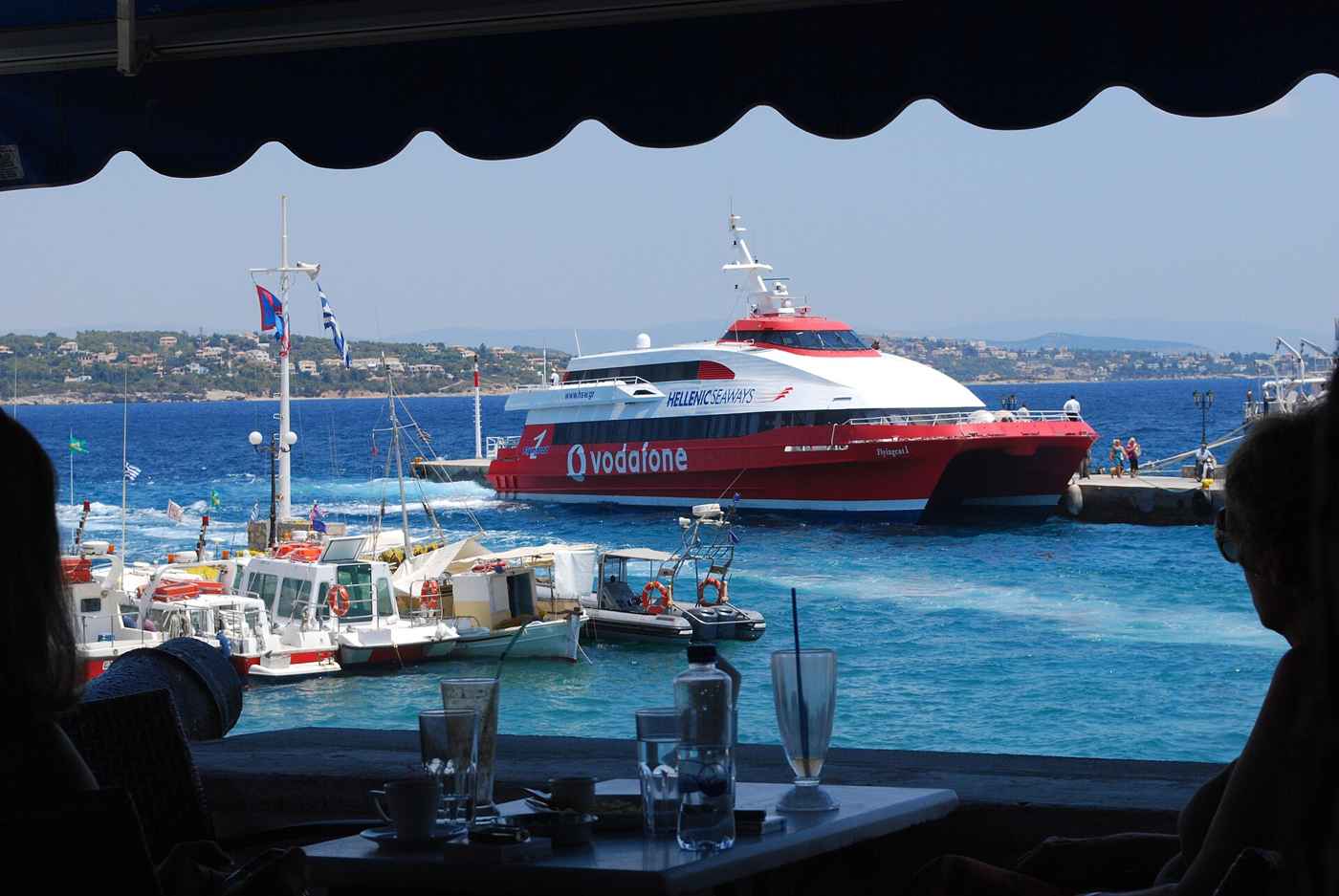
Spetses has no airport, so every visitor arrives by sea. The most direct route is a high-speed Flying Dolphin from Piraeus, though travellers drive to the mainland and cross from Kosta or Porto Heli. Planning your arrival with My Greece Tours means matching the right gateway to your schedule, because Spetses rewards a smooth, well-timed approach across the calm Argo-Saronic water.
This guide explains each realistic route to the island: the hydrofoils and catamarans from Piraeus, the short water-taxi hop from the facing mainland harbours, the drive down from Athens. The connections that link Spetses to Hydra and Poros. It also covers reaching Piraeus from Athens airport and handling luggage, so your first hours on this car-free island stay relaxed rather than rushed.
How do you get to Spetses when the island has no airport?
Spetses is reached only by sea, because the island has no airport and no bridge. You travel by high-speed ferry from Piraeus or by a short crossing from the facing mainland harbours of Kosta and Porto Heli.
Spetses sits at the southern edge of the Argo-Saronic gulf, close to the Peloponnese coast rather than out in the open Aegean. That position shapes every arrival: there is no runway on the island, so flying directly is impossible, and the sea crossing is always the final leg. Most independent travellers reach the island in one of two ways. They either board a high-speed vessel at Piraeus, the large port beside Athens, or they drive to the mainland and cross the narrow channel from Kosta. Both routes are well established and run year-round, though frequency thins in winter.
Understanding the map first makes the choice obvious, because Spetses is genuinely near the mainland even though it feels like a self-contained world once you step ashore at the Dapia.
The high-speed option suits anyone flying into Athens without a car. From Piraeus, Flying Dolphin hydrofoils and Flying Cat catamarans glide down the coast and reach Spetses in roughly two hours ten to two hours thirty, depending on the schedule and how many Saronic stops the vessel makes. It is comfortable, requires no driving, and drops you directly at the main quay in Spetses Town, known as the Dapia. This is the classic approach and the one most first-time visitors take. Because seats sell out in high summer and around Greek holidays, booking a specific departure ahead is sensible.
The vessel hugs the coastline, so the ride stays smooth and scenic rather than choppy, even for travellers who are wary of open-water sailing.
The mainland-crossing option suits drivers and anyone touring the Peloponnese. You drive from Athens to the small harbour of Kosta, directly opposite Spetses, then leave the car and hop across the channel by water taxi or small ferry in about ten to fifteen minutes. Nearby Porto Heli offers the same short crossing and a wider choice of connections.
This route is popular with families carrying gear and with visitors combining Spetses with Nafplio, Epidaurus or the Argolida. Because Spetses is car-free for visitors, the car simply waits on the mainland until you return. The crossing itself is quick and frequent in summer, turning what looks like a remote island into an easy day’s reach from Athens. That closeness is one reason Athenians treat Spetses as a favourite weekend escape.
Choosing between the two comes down to whether you want a car and how you plan to spend your days. Travellers staying put on the island, walking the waterfront and taking local boats to the beaches, rarely need a vehicle, so the direct Piraeus ferry is the cleaner choice. Travellers planning a wider Peloponnese loop keep the car and use Kosta as the launch point. Either way, arrival is straightforward and the sea leg is short by Greek-island standards. Once you know your route, the next questions are practical: which vessels run, how long each takes, and how to handle luggage and connections.
The sections below work through each option in the order most visitors actually consider them when planning a trip.
Which high-speed ferries run from Piraeus to Spetses?
Hellenic Seaways operates the high-speed vessels between Piraeus and Spetses, marketed for years as Flying Dolphin hydrofoils and Flying Cat catamarans. The journey takes about two hours ten to two hours thirty depending on the number of Saronic stops.
The Piraeus-to-Spetses corridor is served mainly by Hellenic Seaways, the operator most travellers associate with the Saronic gulf. Its fast fleet includes the low-slung hydrofoils long branded as Flying Dolphins and the larger Flying Cat catamarans, both purpose-built for quick island hops rather than car transport. These are passenger vessels, so you travel on foot with your luggage and no vehicle.
Departures leave from the fast-ferry section of Piraeus, and several run each day in summer, tapering to a reduced winter timetable. Because exact times shift by season and are adjusted year to year, always confirm the current schedule when you book rather than relying on an old printout. The reliability of this route is one reason Spetses stays easy to reach even without your own transport from Athens.
Journey time from Piraeus is typically about two hours ten to two hours thirty. The spread depends on how many intermediate Saronic ports the vessel calls at on the way south. A sailing that stops at Poros and Hydra takes longer than a more direct run, so if speed matters, check the routing before you choose a departure.
The vessels are enclosed and air-conditioned, with airline-style seating, a small bar, and luggage racks near the doors. Seas in this sheltered gulf are usually calm, which keeps the ride steady even on windier days. For travellers prone to motion sickness, a seat toward the middle of the vessel and away from the stern tends to feel most stable. Overall the crossing is comfortable and quick by the standards of Greek-island travel.
Booking ahead is strongly advised in the peak months of July and August and around Greek public holidays, when popular departures fill early. Tickets are sold online, through travel agents, and at the Piraeus port ticket booths, though buying on the day risks a sold-out sailing in high season. Fares vary by vessel and season, so treat any figure you see as indicative rather than fixed, and confirm the current price at the time of booking. Arriving at the fast-ferry gate around thirty minutes before departure gives you time to find the right berth, which can be a short walk from the metro exit.
Keep your ticket handy for boarding, and note that these high-speed craft depart promptly, so late arrivals genuinely risk missing the sailing.
Once aboard, the run south is scenic. The vessel threads past the Saronic islands, and on the longer routings you glimpse Poros and Hydra before the final approach to Spetses. Arrival is at the Dapia, the island’s main quay and social heart, where you step off into a lively harbour rather than an out-of-town terminal. From there, most accommodation is a short walk, a horse-drawn carriage ride, or a quick water taxi away, because Spetses restricts private cars. If you are still deciding when to travel, our guide to the best time to visit Spetses pairs naturally with ferry planning, since sailing frequency and sea conditions both track the season.
The direct Piraeus ferry remains the simplest single-leg way onto the island.

How do you reach Spetses by crossing from Kosta?
Kosta is a small mainland harbour directly opposite Spetses, and the crossing takes only about ten to fifteen minutes by water taxi or small local ferry. Drivers leave their car at Kosta because the island is car-free.
Kosta is the closest mainland point to Spetses, a modest harbour on the Argolida coast of the Peloponnese that faces the island across a narrow channel. The two are so close that the crossing feels less like a ferry trip and more like a short hop.
Small local ferries and, more flexibly, water taxis shuttle back and forth throughout the day, covering the distance in about ten to fifteen minutes. This is the route of choice for anyone arriving by car, because you drive to Kosta, park, and cross on foot. In summer the crossings are frequent, and water taxis run on demand even outside the ferry schedule, so you rarely wait long. The short duration makes Kosta feel like a gateway rather than an obstacle between the mainland and the island.
Parking at Kosta is the practical detail to plan for, since Spetses is effectively closed to visitors’ cars. There is parking near the harbour, both informal roadside spaces and paid options, and visitors simply leave the vehicle for the duration of their stay. Because demand peaks in high summer, arriving earlier in the day improves your chances of a convenient spot.
Once parked, you walk down to the quay and either wait for the next scheduled small ferry or flag a water taxi. Water taxis cost more than the ferry but leave when you are ready and can carry luggage easily, which suits families. The whole transition from car seat to island quay can take just minutes, making Kosta the fastest way onto Spetses if you are already driving in the region.
The Kosta crossing lands you close to Spetses Town, so onward movement on the island is immediate. Because private cars stay on the mainland, your first task ashore is usually a short walk, a scooter, a bicycle, or a horse-drawn carriage to your lodging, all of which fit the island’s relaxed, low-traffic character. If you want to understand how people actually move around once they arrive, our guide to getting around Spetses explains the taxis-by-boat, carriages and bikes that replace the car. The Kosta route therefore pairs a quick mainland drive with an equally quick water crossing, giving drivers a genuinely low-stress way to reach an island that otherwise forbids their vehicle.
The handover from car to water taxi takes only minutes, so the mood stays relaxed throughout.
Kosta suits a particular kind of trip. It is ideal if you are exploring the Peloponnese by car, visiting Nafplio, Epidaurus or the Argolida vineyards, and want to add Spetses without backtracking to Athens and Piraeus. It also helps travellers who prefer a shorter open-water leg, since the channel crossing is far briefer than the run down from Piraeus. The trade-off is the drive itself, which takes time and requires a hire car or your own vehicle. For visitors flying into Athens with no plans to drive, the direct Piraeus ferry is usually simpler.
But for road-trippers, Kosta turns Spetses into an easy, natural stop, and the ten-to-fifteen-minute hop across the channel is one of the shortest island crossings in Greece.
What role does Porto Heli play in getting to Spetses?
Porto Heli is a mainland resort town near Kosta that offers water-taxi and small-boat crossings to Spetses across a short stretch of sheltered water. It gives travellers a second, well-serviced gateway with more amenities than Kosta.
Porto Heli is a well-known resort settlement on the Argolida coast, a little further along the shore from Kosta and facing the same protected waters that separate the mainland from Spetses. Where Kosta is a functional harbour, Porto Heli is a fuller destination in its own right, with hotels, restaurants and a marina. That makes it a convenient gateway for travellers who want mainland comforts on either side of their island stay.
Water taxis and small boats connect Porto Heli with Spetses across a short crossing, and the sheltered bay keeps the water calm. For visitors combining a luxury-leaning Peloponnese base with island days, Porto Heli is a natural launch point, offering an alternative to Kosta that trades a slightly longer crossing for more services on the mainland side.
The crossing from Porto Heli is typically made by water taxi, which runs flexibly rather than on a rigid timetable. Because the distance is a touch greater than from Kosta, the hop takes a little longer, but it remains a short, sheltered ride rather than an open-sea passage. Water taxis carry luggage without fuss and depart when you are ready, which suits travellers arriving at odd hours or with heavy bags.
Costs are higher than a scheduled ferry, so factor that into your planning if you are watching the budget. For many visitors, though, the convenience and the resort setting justify the premium. Porto Heli therefore works best as a comfortable, flexible gateway rather than the cheapest option. It pairs well with a mainland hotel stay bookending the island portion of a trip.
Choosing between Kosta and Porto Heli comes down to what surrounds each harbour. Kosta is closer to Spetses and cheaper to cross from, but it is a small place with limited facilities. Porto Heli offers restaurants, shops and a genuine resort atmosphere, which appeals if you want to eat, sleep or refuel on the mainland before or after the island. Both leave you facing the same short channel, and both keep your car on the mainland, respecting the island’s car-free rule. Road-trippers use Kosta for the quickest possible crossing and reserve Porto Heli for a longer mainland pause.
Either way, the pair of harbours gives the western approach to Spetses real flexibility, letting you tailor the mainland side of the journey to your pace.
Porto Heli also broadens your options for combining Spetses with nearby experiences. Its marina and boat services connect it to the wider Argo-Saronic scene, and its hotels make it a comfortable place to stay if island accommodation is full in peak season. Travellers who intend to split their nights between the mainland and the island often base part of their trip here. If you are still weighing where to sleep, our overview of where to stay in Spetses helps you decide how many nights belong on the island itself versus a mainland base like Porto Heli.
Used thoughtfully, Porto Heli is less a mere ferry point and more a flexible hinge between the Peloponnese and Spetses, giving your itinerary room to breathe.
How do you drive from Athens to Kosta for Spetses?
Driving from Athens to Kosta takes about two and a half to three hours across the Corinth Canal and down into the Argolida. You park at Kosta and cross to Spetses on foot, because cars stay on the mainland.
The drive from Athens to Kosta is a straightforward Peloponnese run of roughly two and a half to three hours, depending on traffic and where in Athens you start. The route leaves the capital on the national road toward Corinth, crosses the Corinth Canal, and then heads south through the Argolida toward the coast facing Spetses.
Most of the journey is on good highway before the final stretch narrows into scenic secondary roads near the sea. Because timings vary with summer weekend traffic and the odd toll queue, treat two and a half to three hours as a realistic planning window rather than a guarantee. The drive is pleasant and passes close to famous sites, so it doubles as an opportunity rather than a chore for travellers who enjoy the road.
The drive’s appeal is that it opens up the Argolida on the way. Nafplio, one of Greece’s most elegant towns, lies close to the route, as do the ancient theatre of Epidaurus and the citadel of Mycenae. Visitors build a night or two into these places before continuing to Kosta, turning the transfer into a genuine mini-tour. That flexibility is the main reason to drive rather than take the direct ferry from Piraeus. If your holiday is centred only on Spetses itself, the driving time and the need to park may not be worth it. But if you want the Peloponnese and the island together, the car earns its keep.
Kosta sits naturally at the end of that loop as the crossing point onto Spetses.
At Kosta you leave the car and cross on foot, because Spetses restricts visitors’ vehicles entirely. Park near the harbour, gather your luggage, and take the short water taxi or small ferry across the channel, a hop of about ten to fifteen minutes. Plan for the car to stay put for your whole island stay, since bringing it across is not an option for tourists. This is the moment the trip changes character: you swap the freedom of the road for the calm of a car-free island, where getting around means walking, cycling, scooters, water taxis and horse-drawn carriages.
Leaving the car behind is not a limitation so much as part of the island’s charm, and Kosta makes that handover quick and painless.
Practical points smooth the drive. Fill the tank before the quieter stretches near the coast, carry some cash for tolls and parking. Set out early on summer weekends to dodge the worst traffic leaving Athens. A hire car collected at Athens airport can be driven straight down without returning to the city centre, which saves time for arriving visitors. Satellite navigation handles the route well, though the final coastal roads reward unhurried driving. Once parked at Kosta, the transition to the island is fast. For road-trippers, the Athens-to-Kosta drive is the backbone of a flexible itinerary, letting you weave Spetses into a broader Peloponnese journey while still enjoying the island exactly as car-free visitors are meant to.
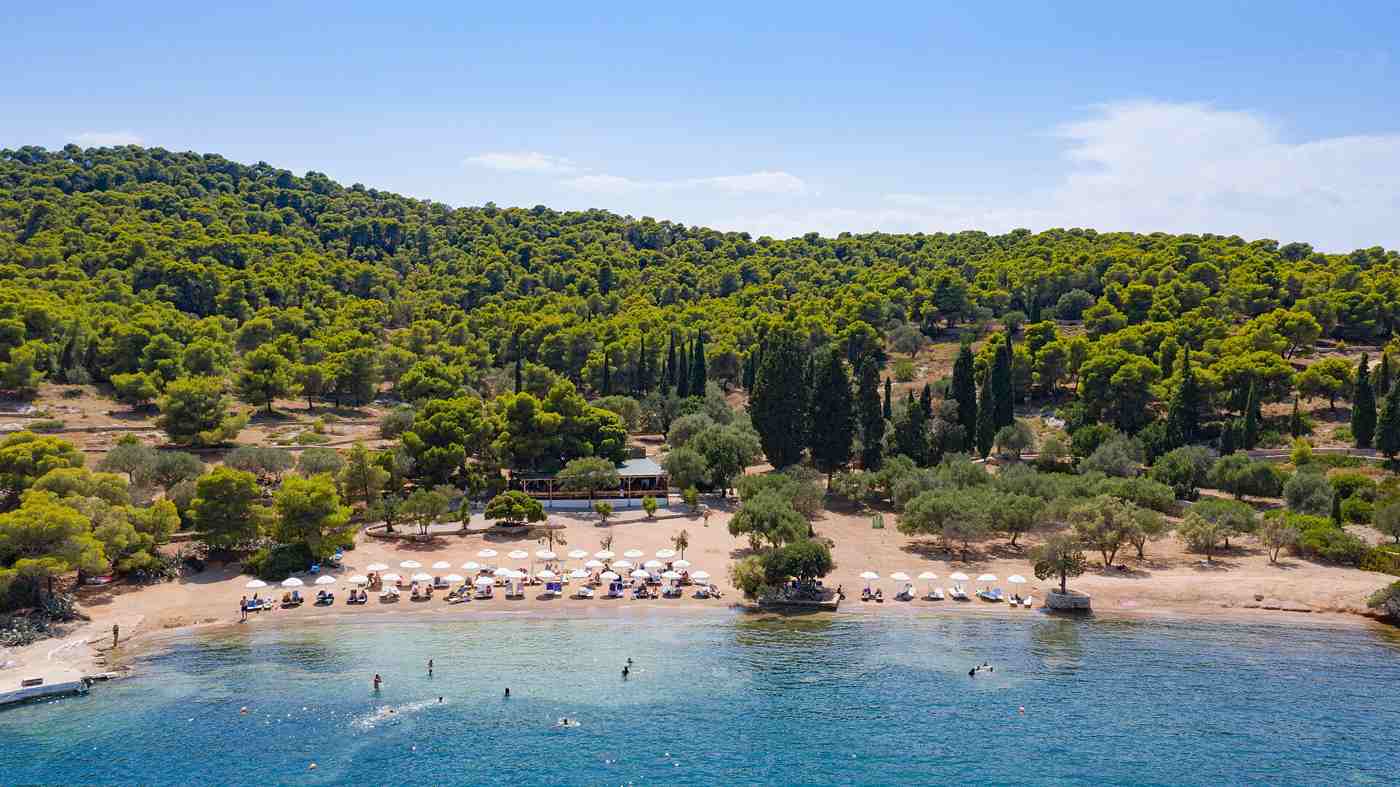
Can you reach Spetses via Hydra and Poros in the Saronic gulf?
Spetses connects to Hydra and Poros because the high-speed Saronic ferries call at these islands on the run between Piraeus and Spetses. That lets you island-hop or break the journey rather than travel non-stop.
Spetses shares its ferry corridor with the other Saronic islands, so Hydra and Poros are natural stepping stones on the way. The high-speed vessels running from Piraeus often call at Poros first, then Hydra, before reaching Spetses at the southern end of the route. That shared line is why journey times vary: a sailing that stops at both neighbours takes longer than a more direct run. For travellers, the upside is easy island-hopping. You can string Poros, Hydra and Spetses into a single trip, moving between them on the same fleet without returning to Piraeus each time.
This makes the western Saronic one of the most convenient island clusters in Greece for a multi-island holiday, with Spetses as the quieter, more residential anchor at the far end.
Hydra sits just north of Spetses and is the most common hop. The two islands share a similar car-free character, so a combined visit feels coherent rather than jarring. High-speed services link them in well under an hour on the direct legs, though exact times depend on the day’s schedule. Visitors spend a couple of nights on each, comparing Hydra’s steep stone amphitheatre of a town with Spetses’ greener, more spread-out layout. Because both islands ban private cars, you arrive and explore on foot or by local boat in each, keeping the whole trip relaxed.
Checking the current timetable is essential, since inter-island departures are fewer than the Piraeus sailings, and a missed connection can mean a long wait for the next suitable vessel.
Poros lies further north and closer to the mainland, making it the first major Saronic call on the southbound run. It is a greener, family-friendly island separated from the Peloponnese by only a narrow channel. Combining Poros with Spetses works well for travellers who want variety, since Poros has a different, pine-clad character.
The same high-speed fleet links them, so you can travel south from Poros to Spetses in one leg. As with Hydra, frequencies are lower than the full Piraeus service, so plan connections carefully. Building a little slack into your schedule avoids stress if a sailing is delayed by weather, which occasionally happens when strong summer winds pick up. Treated as a flexible chain, the Saronic islands reward a slower, hop-by-hop approach rather than a rushed single crossing.
For anyone planning a multi-island route, the practical advice is to book each leg with the current schedule in hand and to keep buffer time between connections. The Saronic gulf’s sheltered waters keep crossings comfortable, and the shared fleet means you rarely need to backtrack. A common pattern is Piraeus to Poros, on to Hydra, and finally down to Spetses, unwinding as you go, before returning directly to Piraeus from Spetses at the end. Because Spetses sits at the southern tip of this line, it makes a fitting final stop, the quietest and most residential of the group.
Island-hopping here turns the question of how to reach Spetses into a richer itinerary rather than a single point-to-point journey. Because each leg is short, the hopping feels like a gentle unwinding rather than a slog.
How do you get from Athens airport to Piraeus for the Spetses ferry?
You reach Piraeus from Athens airport by metro, express bus or taxi. The metro and the airport bus both run directly to the port area, taking roughly an hour, while a taxi is faster but costs more.
Most travellers heading to Spetses land at Athens International Airport and need to reach Piraeus, where the high-speed ferries depart. Three main options connect the airport to the port. The metro offers a direct rail link, the dedicated airport express bus runs to the port day and night, and taxis provide the quickest door-to-door service. Which you choose depends on your budget, your luggage, and how long you have before your sailing. Because the ferry and the transfer are two separate bookings, give yourself a comfortable margin so a slow transfer never causes a missed departure. Planning this leg carefully matters, since the crossing to Spetses only leaves from Piraeus.
The port is a genuine journey from the airport rather than a short hop next door.
The metro is the most reliable budget option. A single line runs from the airport into central Athens and continues to Piraeus, ending near the port. The ride takes roughly an hour to the port area, sometimes a little more, and trains run at regular intervals through the day. It avoids road traffic entirely, which makes timing predictable, an advantage when you have a ferry to catch. The trade-off is that you handle your own luggage on and off the train and through the station. Piraeus station sits a short walk or shuttle from the fast-ferry berths.
For independent travellers comfortable with public transport, the metro is dependable and inexpensive, and it removes the risk of sitting in road traffic on a busy summer morning.
The airport express bus is the round-the-clock alternative. It runs directly between the airport and Piraeus port, including through the night when the metro does not operate, which is invaluable for early sailings or late arrivals. Journey time is broadly similar to the metro but varies with traffic, so allow extra margin during rush hours. The bus is inexpensive and stops close to the ferry area, making it a practical choice for travellers arriving outside metro hours or preferring not to change trains. Luggage goes in the hold, easing the load on board.
Build in a buffer if your ferry leaves soon after you land, particularly on busy summer weekends when Athens traffic can slow the final approach to the port.
A taxi is the fastest and most comfortable option, taking you door to door in around forty-five minutes to an hour depending on traffic, though at a higher cost than public transport. It suits travellers with heavy luggage, families, or anyone on a tight connection who values certainty. Airport taxis are metered or offer fixed fares to central zones, so confirm the arrangement before setting off.
For a group splitting the fare, a taxi can be surprisingly reasonable and far less stressful than juggling bags on the metro. Whichever mode you pick, aim to reach the fast-ferry gate at Piraeus about half an hour before departure. Getting this airport-to-port leg right is the key to a smooth start, because everything after it flows easily once you are aboard the vessel to Spetses.
What should you know about luggage and planning your Spetses arrival?
Pack light because Spetses is car-free, so you move luggage on foot, by water taxi, scooter or horse-drawn carriage. Plan your transfer margins, book peak-season ferries early, and confirm current schedules before you travel.
Luggage strategy matters more on Spetses than elsewhere, precisely because private cars are banned for visitors. When you step off the ferry at the Dapia, you cannot simply load bags into a hire car. Instead you walk, take a water taxi around the coast to your lodging, hire a scooter, or ride a horse-drawn carriage.
Each of these handles bags well enough, but wheeled suitcases fare best on the flatter waterfront, while cobbled lanes reward a soft bag you can carry. Packing light therefore pays off, letting you move easily from quay to accommodation. If you are arriving via Kosta or Porto Heli, the same principle applies once you cross, since the island end of every route is car-free and moves at a gentler, more human pace.
Timing your transfers is the other half of smooth planning. Because reaching the island involves at least two legs, an airport-to-Piraeus transfer plus the ferry, or a drive plus a channel crossing, you should build in buffers so a delay on one leg does not cascade. Give yourself margin at Piraeus, arriving at the fast-ferry gate around thirty minutes ahead, and allow extra time in summer traffic if you are driving to Kosta. High-speed vessels depart promptly, so a late arrival genuinely risks losing the sailing. Confirming the current timetable close to your travel date is essential, since schedules change seasonally and are adjusted year to year.
A little planning here converts a potentially fiddly multi-leg journey into a relaxed, predictable one that leaves you fresh on arrival.
Booking ahead protects your plans in the busy months. Popular Piraeus departures fill during July and August and around Greek holidays, so reserving a specific sailing avoids a sold-out disappointment. The same applies to accommodation, which is why coordinating your ferry with your lodging saves stress. If you have not settled where to sleep, choosing a base near the Dapia shortens the walk from the ferry and simplifies the water-taxi drop-off. For water-taxi transfers on the island, it is worth having the name and rough location of your lodging ready, so drivers can drop you as close as possible. A quick message to your hosts before boarding can arrange the water-taxi meeting point.
These small preparations smooth the crucial first hour after you land.
An at-a-glance plan keeps the whole trip coherent. Decide first whether you want a car, which fixes your gateway: no car points to the direct Piraeus ferry, while a Peloponnese loop points to Kosta or Porto Heli. Then slot in the connecting legs, the airport-to-Piraeus transfer or the Athens-to-Kosta drive, and confirm each with the current schedule. Finally, plan the island end, from quay to bed, around the car-free reality. Pairing this with the right season ensures the ferries run often and the sea stays calm. Approached this way, a journey that looks like several separate steps becomes one clear, well-sequenced plan that delivers you to the island relaxed and ready.
Written down as three simple stages, it is easy to follow on the day itself.
Which arrival option to Spetses is best for your trip?
The best route depends on whether you want a car. Carless visitors should take the direct Flying Dolphin from Piraeus, while Peloponnese road-trippers should drive to Kosta or Porto Heli and cross the short channel.
The right way to reach Spetses is the one that matches how you intend to travel, not a single universal answer. Travellers flying into Athens with no plans to drive are best served by the direct high-speed ferry from Piraeus. It is a single, comfortable leg of about two hours ten to two hours thirty that drops you straight at the Dapia, with no parking to arrange and no car to worry about on a car-free island. This is the default choice for most first-time visitors and for anyone whose holiday centres on the island itself.
Its simplicity is its strength, turning the whole arrival into little more than boarding a fast, air-conditioned vessel and stepping ashore into the heart of Spetses Town a couple of hours later.
Road-trippers exploring the Peloponnese should instead drive to Kosta or Porto Heli and cross the short channel. This route rewards anyone combining Spetses with Nafplio, Epidaurus, Mycenae or the Argolida coast, because the island becomes a natural stop rather than a detour back to Athens. You leave the car on the mainland, cross in about ten to fifteen minutes, and enjoy the island exactly as car-free visitors do. Kosta suits those wanting the quickest, cheapest crossing, while Porto Heli adds mainland comforts and flexible water taxis. The trade-off is the driving time and the need to park, but for a wider Greek road trip that is a small price.
For these travellers, the western gateways are clearly the smarter, more flexible choice.
Island-hoppers form a third group with their own best route. If you want to see more of the Saronic gulf, chain Poros, Hydra and Spetses on the shared high-speed fleet, arriving at Spetses last as the quiet, residential finale. This approach uses the same Piraeus corridor but breaks the journey into rewarding stops, letting you compare the character of each island. It demands more schedule attention, since inter-island frequencies are lower, but it delivers a richer holiday than a single point-to-point crossing. For travellers with time and curiosity, hopping down the gulf is the most satisfying way to arrive.
It also makes the eventual step ashore at Spetses Town and the Dapia feel like the calm conclusion of a longer sea journey.
Whichever route you choose, the island itself is the reward, and every path ends the same way: by sea, at a car-free harbour, in an unhurried town. Match the gateway to your style, confirm the current schedules, and build in sensible margins, and the logistics fall into place. Carless visitors take the Piraeus ferry, road-trippers cross from Kosta or Porto Heli, and island-hoppers thread down through Poros and Hydra. All three arrive relaxed, ready to slow down to the island’s gentle rhythm.
With your arrival settled, the natural next step is understanding how you move about once ashore, since the same car-free character that shapes your journey in also defines how you explore once you have stepped ashore. That seamless shift from journey to island is exactly what makes arriving on Spetses feel so effortless.
Frequently Asked Questions
Does Spetses have an airport?
Spetses has no airport, so you cannot fly directly to the island. Every visitor arrives by sea, either on a high-speed ferry from Piraeus near Athens or by crossing the short channel from the facing mainland harbours of Kosta and Porto Heli. Because there is no runway and no bridge, the sea crossing is always the final leg of the journey. Travellers flying into Greece land at Athens International Airport, then transfer to Piraeus for the direct ferry, or hire a car and drive down to the Peloponnese coast opposite the island. The nearest sizeable mainland town with full facilities is Porto Heli, while Kosta is the closest crossing point.
This lack of an airport is part of what keeps Spetses feeling calm and self-contained, since arrivals are naturally paced by ferry schedules rather than constant flights. The island remains car-free for visitors throughout. In practice, most people fly into Athens, reach Piraeus, and simply board the high-speed ferry south.
How long does the ferry from Piraeus to Spetses take?
The high-speed ferry from Piraeus to Spetses takes about two hours ten to two hours thirty. The exact time depends on how many Saronic islands the vessel calls at on the way south, since a sailing that stops at Poros and Hydra runs longer than a more direct route. These are fast passenger vessels, long marketed as Flying Dolphin hydrofoils and Flying Cat catamarans and operated mainly by Hellenic Seaways. They are enclosed, air-conditioned and comfortable, with the sheltered Saronic gulf keeping the crossing smooth even on breezier days. Because timetables shift by season and are adjusted year to year, always confirm the current schedule when booking rather than relying on old information.
Departures are more frequent in summer and reduced in winter. Arriving at the fast-ferry gate around thirty minutes before departure is wise, as these vessels leave promptly and latecomers genuinely risk missing the sailing to the island.
Can you take a car to Spetses?
You cannot take a car to Spetses, because the island is car-free for visitors. Private tourist vehicles are not allowed. Drivers leave their car on the mainland, most often at Kosta or Porto Heli, and cross the short channel on foot by water taxi or small ferry. On the island itself, transport is limited to taxis-by-boat, scooters, bicycles, horse-drawn carriages and a small number of service vehicles. This restriction is a defining feature of Spetses and a large part of its relaxed appeal, keeping the waterfront quiet and walkable.
Plan to park at Kosta, where harbour-side parking is available though it fills in high summer, so arriving earlier in the day helps. Once you cross, you move around the island on foot or by local boat. Packing light makes this car-free reality much easier to manage from the moment you step ashore.
How do you get to Spetses from Athens airport?
From Athens airport you first travel to Piraeus, then take the high-speed ferry to Spetses. Three options link the airport with the port: the metro runs directly on a single line in roughly an hour, the airport express bus runs around the clock to the port area. A taxi covers the trip door to door in about forty-five minutes to an hour depending on traffic. The metro and bus are inexpensive and reliable, while the taxi is faster and more comfortable but costs considerably more. Alternatively, if you are hiring a car, you can drive straight from the airport down to Kosta, about two and a half to three hours away. Cross to the island from there.
For the ferry route, allow a comfortable margin between transfer and sailing, arriving at the fast-ferry gate around thirty minutes early, since the airport-to-port leg is a genuine journey rather than a short hop and the vessels depart promptly.
Where do you park to visit Spetses by car?
You park at Kosta, the small mainland harbour directly opposite Spetses, or nearby at Porto Heli, and cross the channel on foot. Because the island is car-free for visitors, your vehicle stays on the mainland for the whole of your stay. Kosta has parking near the harbour, including informal roadside spaces and paid options, though demand peaks in high summer. Arriving earlier in the day improves your chances of a convenient spot. From the quay you take a water taxi or small ferry across in about ten to fifteen minutes. Porto Heli offers an alternative with more facilities and hotels on the mainland side, at the cost of a slightly longer crossing.
Either harbour keeps your car safely on the mainland while you enjoy the island as intended. Bringing luggage you can carry easily helps, since the island end of the journey is walked, cycled or taken by boat rather than driven.
Can you island-hop from Spetses to Hydra and Poros?
You can island-hop between Spetses, Hydra and Poros because the same high-speed ferries link them along the Saronic corridor from Piraeus. Vessels typically call at Poros and then Hydra on the run south to Spetses. You can chain the three islands into a single trip without returning to Piraeus each time. Hydra lies just north of Spetses and shares its car-free character, making a combined visit feel natural, with direct legs taking well under an hour. Poros sits further north, greener and closer to the mainland, offering a different, pine-clad atmosphere. Inter-island frequencies are lower than the full Piraeus service, so check the current timetable and build in buffer time between connections to avoid long waits.
A common route runs Piraeus to Poros, on to Hydra, then down to Spetses as the quiet final stop. The sheltered gulf keeps these crossings comfortable, making the western Saronic ideal for a relaxed multi-island holiday.
What is the best way to reach Spetses?
The best way to reach Spetses depends on whether you want a car. If you are flying into Athens without a vehicle, the direct high-speed ferry from Piraeus is simplest, a single comfortable leg of about two hours ten to two hours thirty that drops you at the Dapia, the island’s main quay. If you are exploring the Peloponnese by car, drive to Kosta or Porto Heli and cross the short channel in about ten to fifteen minutes, leaving the vehicle on the mainland since the island is car-free. Island-hoppers can instead thread down through Poros and Hydra on the shared Saronic fleet, arriving at Spetses last.
Each route ends the same way, by sea at a calm, car-free harbour. Match the gateway to your travel style, confirm the current schedules close to your date. Build in sensible transfer margins, and your arrival on Spetses will be smooth whichever option you choose.