
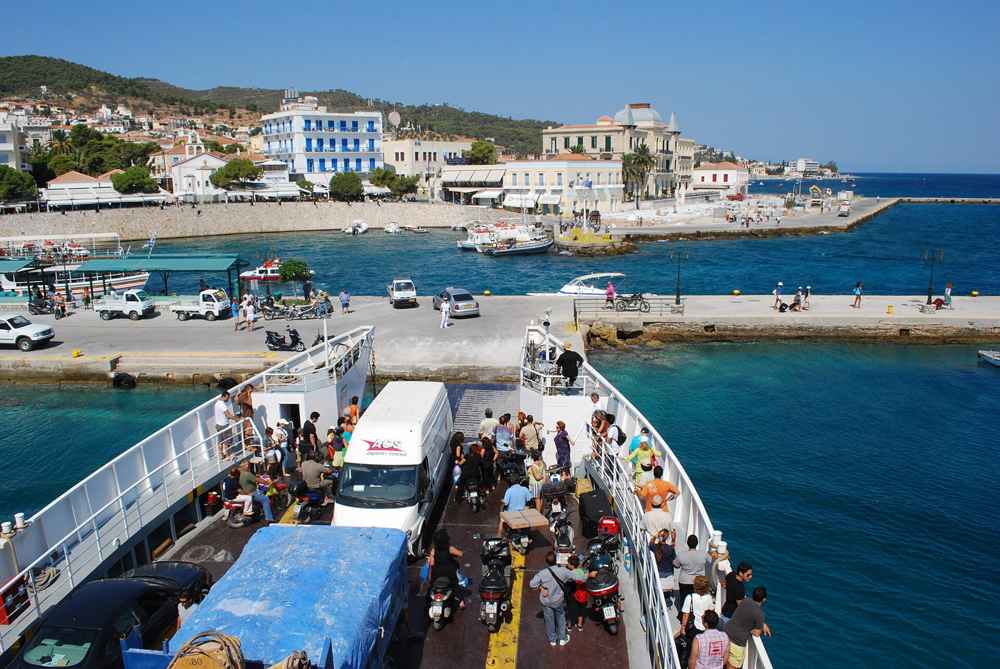
Spetses Town is the island’s capital and the point where nearly every journey begins, its waterfront arranged around the historic quay known as the Dapia. Step ashore and you meet the neoclassical Spetses that made its shipping captains wealthy and its heroine famous across Greece. This My Greece Tours guide walks you through the town’s landmarks, from the cannon-lined main quay to the boatyards and evening tavernas of the Old Harbour.
Everything in the old town radiates outward from the Dapia: the Poseidonion Grand Hotel stands to one side, the mansions of shipping families climb the lanes behind. The coast road curves toward the Old Harbour. Because private cars are banned in the centre, you explore Spetses on foot, by bicycle, or in a horse-drawn carriage, which keeps the waterfront calm and the neoclassical streetscape unusually intact.
What is the Dapia in Spetses Town?
The Dapia is the fortified main quay of Spetses Town, a stone waterfront terrace ringed with old bronze cannons where hydrofoils and ferries dock and cafés spread their tables toward the sea.
The Dapia takes its name from the Greek word for a fortified gun battery, and that military past is still visible in the cannons set around the paved terrace. During the 1821 War of Independence, Spetses armed this quay to defend its harbour, and the guns now point harmlessly over the water toward anchored yachts. The mosaic-patterned pebble paving underfoot, a traditional Spetses craft, adds to the sense of a stage set for the town’s history. Standing here, you look straight across the narrow channel to the wooded islet of Spetsopoula and the mainland beyond.
The Dapia is compact, so a slow circuit takes only a few minutes, yet it rewards a longer pause with coffee and a view of arriving boats.
The Dapia is the island’s front door, the place where almost every visitor first sets foot ashore. Passenger boats and fast hydrofoils from Piraeus tie up here. Small water taxis fan out from the same quay to beaches and to the mainland ports of Kosta and Porto Heli, which sit just across the water. If you are planning the crossing, our guide on how to get to Spetses explains the ferry and hydrofoil options in detail.
Ticket agencies, kiosks, and travel offices cluster along the back of the square, so this is where you confirm return times or arrange onward travel before wandering deeper into town. Water taxis waiting alongside the quay make it easy to hop straight to a beach or across to the mainland the moment you arrive.
The Dapia doubles as the town’s living room, busy from early morning until well after dark. Cafés and ouzeries occupy the arcades behind the cannons, and their chairs face outward so patrons can watch the constant theatre of the harbour. Fishermen mend nets nearby, day-trippers weigh their beach options, and horse-drawn carriages wait in a patient line for fares.
In the evening the light softens over the water and the terrace fills for the ritual stroll and drink that Greeks call the volta. Because the Dapia is car-free like the rest of the centre, this social scene unfolds without traffic, a rare calm for such a central square in a Greek port town. The only comings and goings are the boats at the quay and the carriages waiting for fares, which keeps the mood gentle even at the busiest hours.
The Dapia also anchors your bearings for the whole town. From here the main shopping street runs inland past bakeries, jewellers, and tavernas, while the coastal promenade heads in two directions along the seafront. Turn one way and you reach the Poseidonion Grand Hotel and the Kounoupitsa waterfront; turn the other and the road leads gradually toward the Old Harbour.
Signposts and the shape of the coastline make orientation easy, and most of the town’s principal sights lie within a fifteen-to-twenty-minute walk of this square. Treating the Dapia as your starting point, you can plan a loop that takes in the mansions, the museums, and the boatyards. Because the coastline curves gently and the sea is almost always in view, it is hard to stay lost for long.
How is Spetses Town laid out around the Dapia?
Spetses Town radiates outward from the Dapia along the coast and up the hillside, with a shopping street running inland, the Kounoupitsa promenade to one side, and the road to the Old Harbour to the other.
The town’s plan follows its shoreline rather than a formal grid, so streets curve to trace the coast and climb gently up the slopes behind. From the Dapia, one seafront walk leads west past the Poseidonion Grand Hotel to the Kounoupitsa district, a relaxed stretch of waterfront lined with cafés, tavernas, and moored fishing boats. In the opposite direction the coast road runs east and then dips toward the Old Harbour, the town’s second and older port. Behind the waterfront, narrow flagstone lanes rise into residential quarters where bougainvillea spills over garden walls. This layered arrangement means the town reveals itself gradually.
Short detours uphill repeatedly reward you with sudden framed views back over the rooftops to the sea and the anchored boats below.
The commercial heart sits just inland from the Dapia, along a pedestrian street that threads past bakeries, grocers, jewellers, and small tavernas. This lane is where locals run daily errands and where visitors find most of the town’s shops, and it stays lively into the evening. Side alleys branch off into quieter residential pockets, each with a little square, a church, and the occasional captain’s mansion behind high walls. Because the whole centre is closed to private cars, walking these lanes is unhurried and pleasant, with the clop of carriage horses rather than engine noise as the background sound.
Getting delightfully, briefly lost is part of the experience. You are never far from the water to reorient yourself or from a small square where you can pause in the shade.
The Kounoupitsa waterfront makes one of the most enjoyable walks in the town. Starting from the Dapia, you pass the grand facade of the Poseidonion, then continue along a promenade where the sea laps close to the path and small boats bob at their moorings. Tavernas here specialise in fish, and their tables sit almost at the water’s edge, so this stretch is a favourite for a long lunch or a sunset drink. The pace is slower than at the busy Dapia, and the views open across the channel to Spetsopoula and the mainland hills.
This is the town at its most residential and unhurried, popular with families taking an evening stroll before dinner and with couples lingering over the last of the light on the water.
The eastern side of the plan gathers around the church of Agios Nikolaos and continues toward the Old Harbour, known locally as Baltiza. As you follow the coast road that way, the buildings shift from shops and cafés to shipyards, chapels, and the tall stone mansions of former shipowners. The road eventually curls around the inlet of the Old Harbour itself, where wooden boats are still built and repaired. This distribution — commerce at the Dapia, leisure toward Kounoupitsa, and maritime craft toward Baltiza — gives Spetses Town a clear rhythm.
Understanding it before you set out helps you decide which quarter to explore first and how to link the sights into a single satisfying circuit on foot, ideally starting and finishing at the Dapia.
Why is the Poseidonion Grand Hotel a Spetses landmark?
The Poseidonion Grand Hotel is a landmark because it opened in as one of the earliest grand seaside hotels in Greece, and its imposing Belle Epoque facade still dominates the Spetses Town waterfront.
The Poseidonion Grand Hotel was the vision of Sotirios Anargyros, a Spetsiot benefactor who made a fortune abroad and returned to modernise his island. When it opened in , the hotel was modelled on the grand resorts of the French Riviera, and it quickly drew Athenian high society across the water for summer seasons. Its size and elegance were striking for a small island, and the building signalled that Spetses intended to be a fashionable destination rather than merely a working port. The same benefactor also planted much of the island’s protective pine forest and endowed a celebrated school, so the Poseidonion belongs to a wider effort that shaped modern Spetses.
It remains the town’s most recognisable single structure.
Architecturally, the Poseidonion is a fine example of the Belle Epoque style, with a symmetrical, palace-like frontage, tall windows, and a distinctive mansard roofline that reads clearly from the sea. Its scale contrasts with the smaller neoclassical houses around it, yet the shared white-and-stone palette keeps it in harmony with the town. Positioned a short walk west of the Dapia along the seafront, it acts almost as a second landmark for orientation. Generations of visitors have used the hotel as a meeting point and its terrace as a place for a formal drink.
The facade is a favourite subject for photographs, particularly in the warm light of late afternoon when its pale stone and decorative detailing stand out most sharply against the sea behind.
The hotel has hosted a long list of notable guests over the decades and became woven into the island’s social identity. It featured in the cultural life that drew writers and artists to Spetses, adding to the town’s reputation as a refined retreat. After a period of decline in the later twentieth century, the Poseidonion was carefully restored and reopened, returning a working grand hotel to the waterfront. That revival mattered to the town because the building is so central to its self-image. Even travellers who never step inside treat it as an essential sight, pausing on the promenade to admire the frontage and its gardens before continuing their stroll toward Kounoupitsa.
The reopening confirmed the hotel’s place at the centre of the town’s story.
For visitors deciding where to base themselves, the Poseidonion is only one of many choices, ranging from restored mansions to small family-run rooms in the lanes behind the port. Our guide to where to stay in Spetses sets out the different neighbourhoods and styles of accommodation so you can match a location to your plans. Staying near the Dapia keeps you close to the ferries and the evening scene, while a room toward the Old Harbour offers a quieter, more atmospheric setting. Wherever you choose, the Poseidonion serves as a useful landmark for finding your way.
Its terrace remains a pleasant spot to begin or end a day of exploring the town on foot, with the harbour spread out in front of you.
Who was Laskarina Bouboulina and what is the Bouboulina Museum?
Laskarina Bouboulina was a Spetsiot naval commander and heroine of the 1821 Greek War of Independence, and the Bouboulina Museum occupies her former mansion in Spetses Town, preserving her story and belongings.
Laskarina Bouboulina remains one of the most celebrated figures of the Greek War of Independence and the pride of Spetses. Born in the late eighteenth century into a seafaring family, she inherited and expanded a shipping fortune and used it to fund the revolutionary cause. She famously commanded her own armed corvette, the Agamemnon, and took part in naval blockades and operations against Ottoman forces, an extraordinary role for a woman of her era. Her leadership, wealth, and daring made her a legend in her own lifetime, and she was later honoured with a naval rank in Russia.
On Spetses her memory is inseparable from the island’s identity, and monuments and place names across the town keep her story present.
The Bouboulina Museum occupies the heroine’s former mansion, a handsome building set a short walk back from the Dapia. The house itself is a fine surviving example of a wealthy Spetsiot captain’s residence, with carved wooden ceilings, period furniture. Family heirlooms arranged much as they might once have been. Guided visits lead you through rooms that display weapons, portraits, maritime instruments, and personal effects connected to Bouboulina and her family. Because the museum is run by her descendants, the tour carries a strong personal thread that brings the history to life.
The combination of a genuine historic interior and the drama of her biography makes this one of the most rewarding indoor sights in the town. It pairs naturally with a wider look at the island’s role in the revolution.
A visit typically runs on a schedule of guided tours rather than free wandering. It is worth checking the day’s tour times when you arrive. These vary by season and are posted at the mansion. The tour lasts under an hour and suits all ages, offering a compact but vivid introduction to the revolution as it played out at sea. Because Spetses contributed so many ships and sailors to the war effort, understanding Bouboulina’s role also illuminates the wider importance of the island in 1821. Set against the neoclassical streets outside, the mansion helps you picture the prosperous merchant society that produced such figures and funded the fleet that fought for independence.
It makes the statues and monuments elsewhere in town far more meaningful.
Bouboulina’s presence extends well beyond the museum walls. A prominent statue of her stands on the Spetses waterfront, gazing out to sea, and it is one of the town’s most photographed monuments. Her story is also central to the island’s great annual celebration, the Armata, held in early September to commemorate a decisive naval victory of 1822. During those festivities the whole town honours the heroism of its 1821 generation, with Bouboulina foremost among them. Seeing the museum, the statue on the waterfront.
The September festival together gives you a full sense of how deeply the War of Independence is woven into everyday Spetses, and why locals speak of that period with such evident and enduring pride, generation after generation.
What makes the Old Harbour (Baltiza) special in Spetses Town?
The Old Harbour, known as Baltiza, is special because it remains a working boatyard where wooden vessels are still built by hand, and by night its waterside tavernas and bars make it the town’s most atmospheric quarter.
The Old Harbour lies east of the Dapia, reached by a pleasant coastal walk of roughly twenty minutes or a short carriage ride. It was the island’s original commercial port in the age of sail, when Spetsiot shipowners built the fleets that made them rich and later fought the Ottomans. Today the inlet still shelters yachts, fishing caiques, and traditional wooden boats, giving it a lived-in maritime character quite different from the polished Dapia. Stone mansions and small chapels rise around the water, and the whole basin feels like a survival from an earlier century.
Arriving on foot, you sense the shift from the busy arrival quay to a quieter, more romantic corner where the island’s shipbuilding heritage is still visibly at work.
What sets Baltiza apart is that boatbuilding continues here in open-air yards along the shore. Craftsmen shape hulls and repair vessels using techniques handed down over generations, and the smell of timber and varnish drifts along the quay. These traditional shipyards, or tarsanades, are among the last of their kind in Greece, and watching a wooden hull take shape is a genuine link to the island’s seafaring past. The scene is entirely unforced — this is a working environment, not a museum display — which makes it all the more compelling.
Walking slowly around the inlet, you pass boats in every stage of construction and repair, propped on wooden frames along the quay, a vivid reminder that Spetses built its fame and fortune on the sea.
The Old Harbour transforms into the town’s liveliest social scene after dark. Tavernas set their tables at the water’s edge, seafood is the natural choice, and small bars and cafés fill with a relaxed evening crowd. The reflections of moored yachts and harbour lights on the dark water give the quarter a distinctly romantic mood that draws couples and groups alike. Because it sits a little apart from the arrival bustle of the Dapia, Baltiza feels like a discovery. Many visitors rate an evening here as the highlight of their stay.
To catch it at its best, plan your visit for the warmer months; our guide to the best time to visit Spetses explains how the seasons shape the town’s atmosphere.
The Old Harbour also anchors two of the town’s most striking landmarks. The lighthouse and the church of Panagia Armata stand near the mouth of the inlet, and the surrounding headland offers fine views back across the water. It is here, in the bay off the Old Harbour, that the Armata festival re-enacts the 1822 naval victory each September, complete with a mock battle and the burning of a model Ottoman flagship, followed by fireworks. Even outside the festival, the combination of working boatyards, waterfront dining, historic chapels, and open sea views makes Baltiza essential to any visit.
Set aside time to walk out here slowly, ideally arriving before sunset so you can watch the quarter change character as the evening settles in.
What captains’ mansions and neoclassical architecture define Spetses Town?
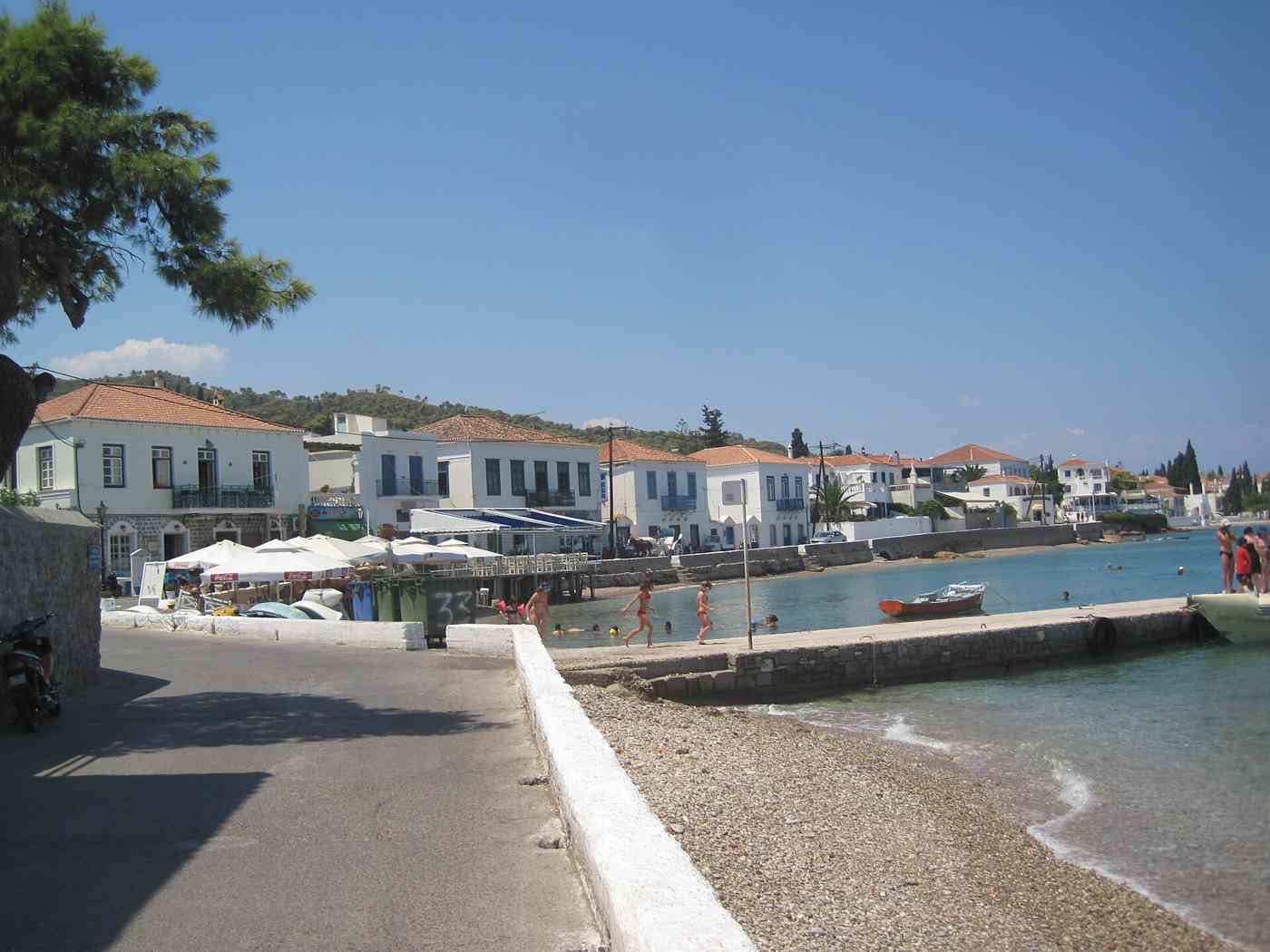
Spetses Town is defined by the stone mansions, or archontika, of its shipping captains, imposing eighteenth and nineteenth-century houses whose neoclassical facades, walled gardens, and carved interiors reflect the wealth the island earned at sea.
The captains’ mansions are the architectural signature of Spetses Town and a direct legacy of its maritime fortunes. Built by shipowning families from the eighteenth century onward, these archontika are substantial two and three-storey houses of stone, often set behind high walls with courtyards, gardens, and grand entrances. Their design blends local island tradition with the neoclassical taste that swept Greece in the nineteenth century, producing symmetrical facades, tall shuttered windows, and decorative cornices. Many display terracotta or pastel plaster, wrought-iron balconies, and carved stone doorframes. Scattered through the lanes behind the Dapia and out toward the Old Harbour, they lend the town a dignity and cohesion unusual for a Greek island.
Spotting them is one of the quiet pleasures of exploring on foot.
Inside, the finest mansions were richly appointed to reflect their owners’ status and their contact with the wider Mediterranean world. Painted wooden ceilings, ornate plasterwork, imported furniture, and family portraits were common, and some interiors survive remarkably intact. The Bouboulina Museum and the Hatzigiannis Mexis mansion both allow visitors to see this domestic grandeur at first hand. Because Spetsiot captains traded and sailed far beyond Greece, their homes absorbed influences from Italy, France, and the Ottoman east, giving the interiors an eclectic richness. The houses were designed to impress guests and to display the success of the family.
Walking through a preserved example, room by room, makes the abstract history of the island’s prosperity suddenly tangible and human in scale.
The mansions also tell the social history of the island. In the age of sail, Spetses punched far above its weight, its fleets carrying cargo across the Mediterranean and later turning to the fight for independence. The wealth those voyages generated was invested back home in these grand houses, in churches, and in civic works, so the architecture is essentially frozen prosperity. Some archontika have passed down through the same families for generations, while others have become hotels, museums, or private restorations. This continuity means the town has avoided the wholesale modern rebuilding seen in many resorts.
The streetscape still reads clearly as a nineteenth-century merchant town, an unusual and valuable survival in the Greek islands that repays slow, attentive walking.
For visitors, the mansions are best appreciated by simply walking and looking, since many are private homes rather than open sights. A stroll through the lanes between the Dapia and the Old Harbour will take you past dozens of them, each with its own doorway, garden gate. Detailing worth pausing over. The Poseidonion Grand Hotel, though a hotel rather than a family home, belongs to the same confident building tradition and shows how the neoclassical style scaled up to a grand public building. Together these structures give Spetses Town its distinctive, harmonious character.
Photographers especially love the interplay of white walls, coloured plaster, cascading bougainvillea, and black-and-white pebble-mosaic courtyards that recurs, house after house, throughout the older quarters of the town.
What is the church of Agios Nikolaos in Spetses Town?
Agios Nikolaos is a historic church between the Dapia and the Old Harbour, dedicated to the patron saint of sailors, and it is remembered as the place where the Spetsiots first raised their revolutionary flag in 1821.
The church of Agios Nikolaos stands on the coast road linking the Dapia to the Old Harbour, and it is among the most significant religious buildings on the island. Dedicated to Saint Nicholas, the patron saint of sailors, it is a fitting focus for a community that lived by the sea. The church is easily recognised by its handsome bell tower, its pebble-mosaic courtyard, and the wide terrace that overlooks the water. As one of the older and grander churches in the town, it reflects the same maritime wealth that built the captains’ mansions.
Its decoration and scale set it apart from the many smaller neighbourhood chapels scattered through the lanes, each of which serves its own little quarter and feast day.
Agios Nikolaos carries a special place in the island’s revolutionary memory. It was here, according to tradition, that the flag of the uprising was first raised on Spetses in 1821, marking the island’s entry into the War of Independence. That event is commemorated with pride, and the church remains a symbolic heart of the town’s identity alongside the Bouboulina Museum and the Armata festivities. The building thus links the everyday devotion of a seafaring community to the dramatic history that made Spetses famous. Visitors interested in the 1821 story find that a stop here deepens their understanding of how thoroughly the revolution shaped the town and its self-image.
It connects naturally with a visit to the Bouboulina Museum a short walk away.
Architecturally, the church rewards a slow look. Its whitewashed walls, stone detailing, and tiered bell tower are characteristic of island church-building, while the interior holds icons and religious art in the Orthodox tradition. The courtyard, paved in the black-and-white pebble mosaic that is a Spetsiot speciality, is worth admiring in its own right. The terrace offers a fine vantage over the passing boats. Because the church sits directly on the walking route between the town’s two harbours, it is easy to include without any detour. Visitors are asked to dress modestly when entering, as at any working Greek church, covering shoulders and knees out of respect for worshippers.
To keep their voices low if a service happens to be under way.
Agios Nikolaos also functions as a landmark that helps you gauge your progress along the coast. Roughly midway between the Dapia and the Old Harbour, it signals that the boatyards of Baltiza are not far ahead. The stretch of waterfront around the church is pleasant to linger on, with views across the channel and, often, the sound of church bells marking the hour. Together with the Poseidonion in the other direction, Agios Nikolaos gives the seafront walk two strong anchor points. Pausing here connects the town’s spiritual life, its maritime devotion.
Its revolutionary history in a single spot, and the terrace is one of the most photographed corners of the Spetses waterfront outside the Dapia itself, especially in the soft light of early evening.
How do you get around Spetses Town’s car-free streets?
You get around Spetses Town on foot, by bicycle, by scooter or quad, or in a traditional horse-drawn carriage, because private cars are banned in the centre and the compact town is easily walkable.
Spetses is celebrated as a largely car-free island, and the ban on private cars in the town is central to its charm. The result is a quiet, unhurried centre where the loudest sounds are footsteps, bicycle bells, and the clip-clop of carriage horses rather than engines. Because the old town is compact, walking is by far the most rewarding way to see it. Nearly all the main sights lie within a fifteen-to-twenty-minute stroll of the Dapia. Comfortable shoes help on the pebble-mosaic and flagstone lanes, some of which climb the hillside.
Our guide to getting around Spetses covers the full range of local transport in more depth for trips beyond the town centre, including how to reach the beaches strung along the island’s coast.
Horse-drawn carriages are the town’s signature form of transport and a genuine part of daily life rather than a tourist novelty. A line of them waits at the Dapia. A driver will take you along the waterfront to the Old Harbour, up to a mansion district, or on a scenic circuit of the town. The pace is leisurely and the experience atmospheric, well suited to arriving with luggage or to a relaxed sightseeing loop with children. Because carriages have long served the island, they blend naturally into the streetscape rather than feeling staged.
Fares vary by route and season, so it is sensible to agree the price with the driver before setting off to avoid any confusion at the end.
For getting a little further afield, bicycles, scooters, and quad bikes are widely available to hire near the port. Cycling suits the flatter coastal stretches and is a fine way to reach beaches beyond walking distance, while a scooter or quad covers the perimeter road that loops the island. Riders should note that helmets and a valid licence are expected, and that the coastal road is shared with pedestrians and carriages, so a cautious pace is wise. Within the town itself, though, most visitors leave any hired vehicle at the edge of the centre and continue on foot, since the narrowest and most atmospheric lanes are best experienced slowly, on foot.
Are not suited to motorised traffic anyway, nor is it permitted there.
Water transport rounds out the options and reflects the town’s seafaring character. Small water taxis operate from near the Dapia and can whisk you around the coast to beaches or across the channel to the mainland ports of Kosta and Porto Heli far faster than the land route. In summer, scheduled small boats also serve the more popular beaches.
This mix of feet, hooves, wheels, and water gives Spetses Town an unusually gentle relationship with movement, and it is a large part of why the place feels so relaxed. Planning your day around the walkable centre, with a horse-drawn carriage or a water taxi for the longer hops, is the most enjoyable and authentic way to experience the town.
Which museums tell the story of Spetses Town?
Two museums tell the town’s story: the Spetses Museum, housed in the grand Hatzigiannis Mexis mansion, which covers island history and the 1821 war, and the Bouboulina Museum, set in the heroine’s former home.
The main museum of the island is the Spetses Museum, housed in the imposing mansion of Hatzigiannis Mexis, a wealthy shipowner and one of the leading figures of the town in the eighteenth century. The building alone justifies a visit, a fine stone archontiko whose scale and detailing show the confidence of the island’s merchant elite. Set a short walk uphill from the port, it gathers the threads of local history under one roof. Its collection spans the island’s seafaring past, folk traditions, and above all the central role Spetses played in the War of Independence.
For visitors who want the full context behind the mansions, the churches, and the monuments they see outside, this is the essential first stop before exploring further on foot.
Inside, the Spetses Museum displays a wide range of exhibits: ship models and maritime instruments, weapons and relics from 1821, traditional costumes, coins, ecclesiastical items, and archival documents. Among its most revered holdings are relics associated with the heroine Bouboulina, which are kept here with particular reverence. The rooms of the old mansion, with their carved ceilings and period proportions, form an atmospheric setting that suits the collection well. Together the objects trace how a small island grew wealthy through shipping and then poured that wealth and its fleets into the national cause.
From the mansions to the churches, the museum makes the rest of the town far more legible and rewarding to walk.
The Bouboulina Museum complements the Spetses Museum by focusing tightly on a single extraordinary life. Set in the heroine’s former mansion near the Dapia and run by her descendants, it offers guided tours through rooms filled with her weapons, portraits, and personal belongings. Where the Spetses Museum gives the broad sweep of island history, the Bouboulina Museum brings the drama of the revolution down to a personal, human scale.
Seeing both on the same visit gives you a rounded picture: the wide context of Spetsiot seafaring and independence in one mansion. The intimate story of its most famous participant in another. Both are within easy walking distance of the port and of each other, so it is simple to see the pair on a single morning or afternoon in the town.
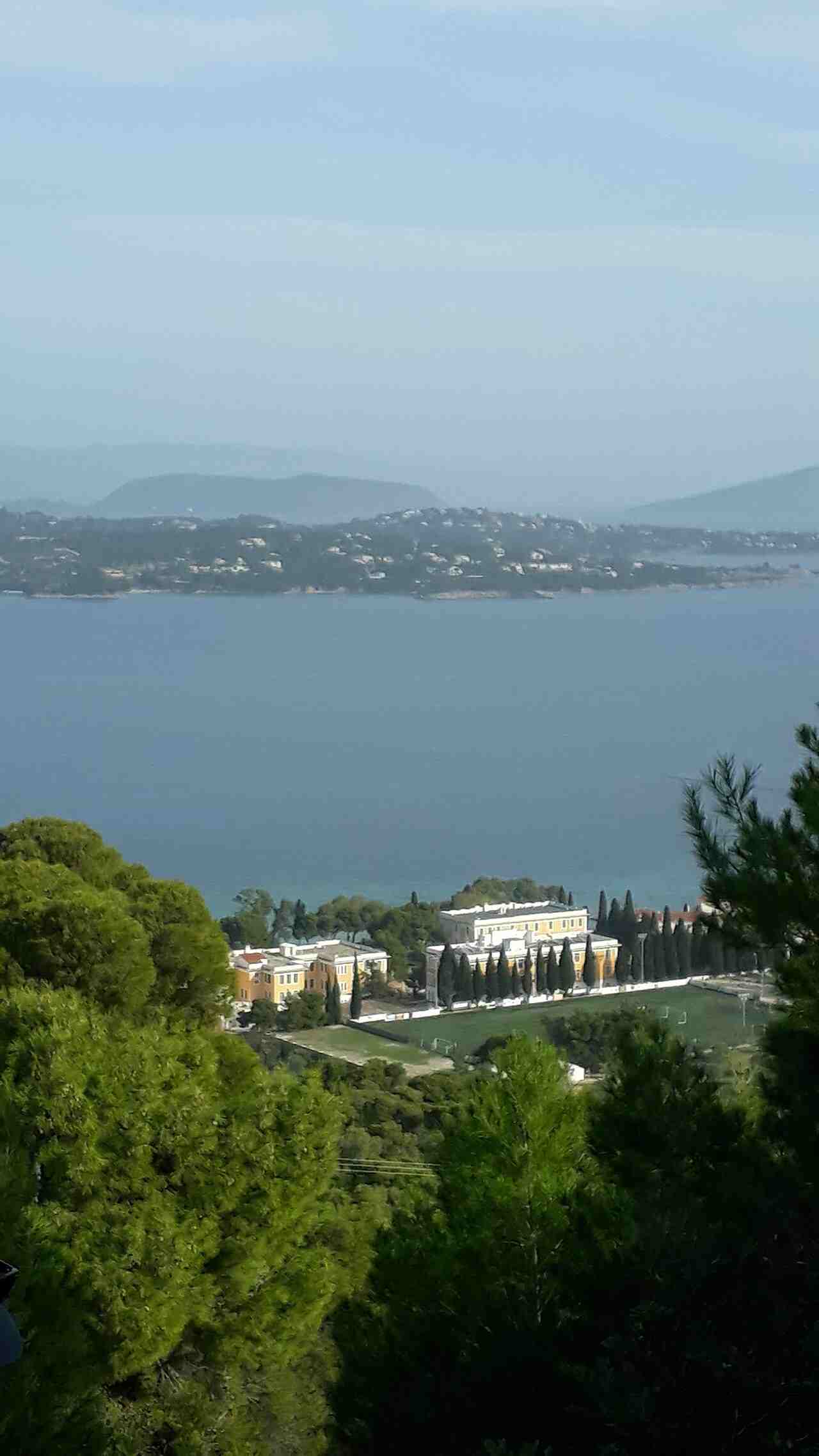
Beyond these two principal museums, the town rewards curiosity with smaller layers of heritage. Churches such as Agios Nikolaos hold their own historical and artistic interest. The celebrated Anargyrios and Korgialenios School, endowed by the same benefactor who built the Poseidonion, is a notable institution in the town’s story and inspired the setting of a well-known English novel. Monuments, statues, and memorial plaques across the waterfront extend the narrative outdoors.
Taken together, the museums and these supporting sights let you assemble a full portrait of Spetses Town: a prosperous merchant port that produced heroes of 1821 and preserved its neoclassical character into the present, all explorable comfortably on foot from the Dapia in a day or two of unhurried wandering.
Frequently Asked Questions
How do you get to Spetses Town and the Dapia?
You reach Spetses Town by sea, since the island has no airport and no bridge to the mainland. Fast passenger hydrofoils and catamarans run from the port of Piraeus near Athens, with the crossing typically taking around two hours to two and a half hours depending on the service and the number of stops. Boats arrive directly at the Dapia, the town’s main quay, so you step ashore in the heart of the old town. From the mainland, the small ports of Kosta and Porto Heli sit just across a narrow channel. Frequent water taxis and short local ferries connect them to the island in a matter of minutes, which suits travellers arriving by road to that coast.
Once at the Dapia you continue on foot, by carriage, or by water taxi. Because private cars are banned in the centre, most visitors leave vehicles on the mainland before crossing.
Is Spetses Town really car-free?
Spetses Town is effectively car-free, and this is one of its defining pleasures. Private cars are banned from the centre, so the waterfront and the narrow lanes stay quiet and safe for walking. In place of cars, the town relies on horse-drawn carriages, bicycles, scooters, quad bikes. Water taxis, and the compact centre means most sights are within a short walk of the Dapia. A limited number of service vehicles, taxis of the small three-wheeled type. Motorbikes do operate, particularly along the coast road and toward the edges of town, so the island is not entirely without engines. Still, the overall atmosphere is remarkably calm compared with most Greek ports.
The absence of ordinary traffic is a major reason the neoclassical streetscape has survived so well and why an evening stroll along the Dapia or out to the Old Harbour feels so relaxed and unhurried. For many visitors, this gentle pace, set by footsteps and carriage horses rather than engines, is the single thing they remember most fondly about the town.
What is there to see in the Old Harbour of Spetses?
The Old Harbour, called Baltiza, is the town’s most atmospheric quarter and easily reached on a coastal walk of about twenty minutes from the Dapia. Its main draw is the surviving tradition of wooden boatbuilding: open-air yards along the shore still shape and repair hulls by hand, offering a rare living link to the island’s seafaring past. Around the inlet you find stone mansions, small chapels, a lighthouse, and the church of Panagia Armata near the harbour mouth. By day the scene is quietly industrious; by night it becomes the liveliest part of town, with waterside tavernas serving seafood and bars filling with a relaxed crowd.
The bay is also the stage for the Armata festival each September, when a mock naval battle re-enacts the victory of 1822. Arriving before sunset lets you watch the quarter shift from working boatyard to romantic evening setting, with the harbour lights reflecting on the water. Allow enough time to walk out slowly, look at the boats under construction, and settle at a waterside table for dinner.
Who was Laskarina Bouboulina and where can I learn about her?
Laskarina Bouboulina was a wealthy Spetsiot shipowner who became a naval commander and heroine of the 1821 Greek War of Independence. She funded and captained armed ships, most famously the corvette Agamemnon. Took part in blockades and naval operations against Ottoman forces, an exceptional role for a woman of her time. On Spetses her memory is everywhere, and she is honoured as one of the island’s greatest figures. To learn her story, visit the Bouboulina Museum, set in her former mansion a short walk from the Dapia and run by her descendants, where guided tours display her weapons, portraits, and personal effects.
A prominent statue of her also stands on the waterfront, and relics associated with her are kept at the Spetses Museum. Her heroism is celebrated each September during the Armata festival, which commemorates the island’s decisive naval victory of 1822. Seeing the museum, the statue, and the festival together shows just how central she remains to the identity of Spetses.
What is the Poseidonion Grand Hotel and can I visit it?
The Poseidonion Grand Hotel is the town’s most recognisable landmark, a grand Belle Epoque building on the seafront a short walk west of the Dapia. It opened in , funded by the Spetsiot benefactor Sotirios Anargyros, and was modelled on the luxury resorts of the French Riviera, quickly becoming a magnet for Athenian high society. Its palace-like facade, tall windows, and mansard roof stand out clearly along the waterfront. After a long decline in the later twentieth century, the hotel was carefully restored and reopened, so it once again operates as a functioning grand hotel. You do not need to be a guest to admire the exterior, which is a favourite subject for photographs.
Its terrace and public areas make a pleasant spot for a drink. Even travellers staying elsewhere treat the Poseidonion as an essential sight and a useful landmark for orienting themselves in the town, since its distinctive silhouette is visible from much of the waterfront and helps you find your way back to the Dapia.
How much time do you need to explore Spetses Town?
You can see the highlights of Spetses Town comfortably in a single well-planned day, though staying overnight lets you experience the quarter at its most rewarding. In a few hours you can walk from the Dapia along the waterfront to the Poseidonion Grand Hotel and Kounoupitsa, then head the other way past the church of Agios Nikolaos to the Old Harbour and its boatyards. Adding the Bouboulina Museum and the Spetses Museum in the Hatzigiannis Mexis mansion fills out the history and takes perhaps another two hours between them. Because the town is compact and car-free, walking between sights is quick and pleasant.
Where an overnight stay really pays off is in the evening, when the Old Harbour comes alive with waterside dining and the Dapia fills for the sunset stroll. Two nights give a relaxed pace and time to combine the town with the island’s beaches, reached by bicycle, water taxi, or the coastal road that loops around Spetses.
When is the best time to visit Spetses Town?
The best time to visit Spetses Town is generally late spring through early autumn, when the weather is warm, the sea is inviting. The waterfront tavernas and museums are in full swing. May, June, and September are especially pleasant, offering reliable sunshine with fewer crowds than the peak of high summer, so the Dapia and the Old Harbour feel lively but not overwhelmed. July and August are the busiest and hottest months, popular with Athenian weekenders who arrive by hydrofoil. A standout date is early September, when the town stages the Armata festival, re-enacting the naval victory of 1822 with a mock sea battle and fireworks off the Old Harbour, a memorable spectacle worth planning around.
Spring brings wildflowers and green hillsides, while the shoulder seasons keep accommodation easier to arrange. Winter is quiet, with reduced ferry services and many seasonal tavernas closed. It is better suited to travellers seeking solitude than to first-time visitors hoping to see the town at its liveliest.