
Getting around Spetses defines the whole experience of the island, because private cars are restricted here and the streets belong to bicycles, horse carriages and pedestrians. This Saronic island near the Peloponnese moves at a gentler pace, and My Greece Tours treats that trait as its charm rather than a limitation. On Spetses you plan your day around wheels, hooves and boats.
Once you understand the four main ways to move, the island opens up quickly. Bicycles handle the long coastal ring road, horse-drawn carriages carry luggage and families through the old lanes, water taxis reach beaches the roads barely touch. Scooters or quads cover distance for those in a hurry. Each mode suits a different traveller, and most visitors end up mixing all four across a stay.
How do you get around Spetses without a car?
You get around Spetses by bicycle, horse-drawn carriage, water taxi, scooter or quad, and on foot, because private cars are heavily restricted across the island and almost nobody drives one in town.
Spetses runs on a small family of transport modes, and choosing between them is the first decision every visitor makes. Bicycles are the signature choice, cheap to rent and quick along the flat waterfront. Horse-drawn carriages, known locally as fiacres, handle the short hops through town with luggage. Water taxis leave from the main quay for beaches and the Old Harbour, while scooters, mopeds and ATV quads cover the longer stretches for those who prefer an engine. Walking ties everything together, since the town itself is compact.
The modes overlap, so most travellers combine two or three within a single day, cycling out in the morning and taking a boat back when their legs have had enough. The freedom to switch modes whenever the mood changes is a large part of the island’s easy appeal.
The absence of ordinary traffic changes how the island feels from the moment you step off the ferry. There are no queues of hire cars at the port, no car-rental desks competing for your attention, and no need to master unfamiliar mountain roads. Instead you arrive at the Dapia, the main quay and social heart of the town, and simply walk into the action. Understanding how to get to Spetses by hydrofoil or ferry is the natural first step, and once you land the question shifts immediately from driving to pedalling. This is why regulars describe the island as liberating rather than restrictive, a place where movement slows down on purpose.
The shift from driving to pedalling happens within minutes of stepping ashore at the quay.
Distances on Spetses are modest, which makes the car-free lifestyle practical rather than romantic idealism. The town clusters tightly around the Dapia and the Old Harbour, so most cafes, tavernas and shops sit within a fifteen-minute walk of each other. Beyond the town, the coastal road hugs the shore for roughly twenty-six kilometres, linking beach after beach in a single loop. A fit cyclist can circle the whole island in a couple of unhurried hours, stopping to swim along the way. Because nothing is far, you rarely feel stranded without a car. The modest scale is exactly what allows bicycles and carriages to remain genuinely useful rather than merely picturesque tourist props.
This compact geography is the quiet secret behind the island’s relaxed, car-free rhythm.
Planning your transport also shapes where you base yourself, since some corners of the island are easier to reach than others. Staying near the Dapia keeps you within walking range of ferries, water taxis and the busiest carriage stands, while quieter districts reward those happy to cycle. Reading up on where to stay in Spetses before you book helps you match your accommodation to the way you intend to travel. Families with young children often favour central lodgings and short carriage rides, while active couples pick spots along the ring road so a bicycle becomes their daily workhorse. The right base makes getting around feel effortless instead of a constant logistical puzzle.
Thinking about transport and lodging together, rather than separately, pays off across the whole stay.
Why is Spetses a car-free island?
Spetses restricts private cars to protect its narrow historic lanes, its quiet character and its pedestrian-friendly waterfront, so most vehicles are banned from the town centre and only limited categories are allowed anywhere at all.
The car restriction is the island’s defining trait and the reason its atmosphere differs so sharply from mainland resorts. Spetses has long limited the circulation of private cars, keeping the historic core almost entirely free of everyday traffic. The town’s lanes were laid out for people and horses, not vehicles, and they are simply too narrow and too full of character to absorb modern cars. By keeping engines out, the island preserves the calm that draws visitors back year after year.
The policy is not a marketing gimmick invented for tourists. It grew from the practical shape of the place and from a genuine local preference for a slower, cleaner and safer way of moving through the streets. It is a choice the island has kept for good reason.
Not every wheeled vehicle disappears, which sometimes surprises first-time visitors expecting total silence. A number of service vehicles, delivery three-wheelers, taxis of a distinctive kind, and scooters do operate, and residents have their own arrangements. The key point is that the fleet of private hire cars familiar from other Greek islands is essentially absent. You cannot rent a normal car at the port and drive off. This makes bicycles and boats the practical answer rather than optional novelties. The limited motor traffic that remains moves slowly and courteously, aware that pedestrians, cyclists and horses share every lane. The result is a soundscape dominated by hooves, bicycle bells and the sea rather than revving engines.
Most newcomers adjust to the calm within a day or two.
The car-free character has deep roots in the island’s identity as a genteel retreat. Spetses grew wealthy from shipping and became a fashionable destination for Athenian society. That heritage is visible in the grand mansions and the elegant Poseidonion Grand Hotel, which opened in facing the Dapia. A place built for promenading and carriage rides never needed a tangle of car parks. Preserving that inheritance means protecting the streetscape from the visual clutter and noise of dense traffic. Because the island leans on tourism and its refined reputation, keeping cars out is also an economic decision, since the tranquillity itself is the product visitors come to buy and remember long after they leave.
Protecting that calm is, in the end, simply good business sense.
For the traveller, the philosophy behind the ban matters less than its practical consequences, which are entirely positive once embraced. You breathe cleaner air, cross the street without watching for traffic, and let children roam the waterfront with far less anxiety. The absence of cars also flattens the social hierarchy of the road, since a family on rented bikes moves at much the same pace as everyone else. Choosing a quieter season to visit can further improve the experience, as the shoulder months bring even calmer lanes and easier, cooler cycling. Rather than fighting the restriction, savvy visitors lean into it and discover that a car would only have got in the way.
Embracing the car-free rule turns out to be one of the island’s quiet pleasures.
Is renting a bicycle the best way to explore Spetses?
Renting a bicycle is the classic and most flexible way to explore Spetses, because the coastal road is flat, the distances are short, and bike shops cluster near the Dapia offering machines for every age and fitness level.
The bicycle is the island’s true native vehicle, and hiring one is almost a rite of passage for visitors. Rental shops gather around the Dapia and along the main waterfront, so you can pick up a bike within minutes of arriving. The choice ranges from simple town cruisers with baskets to geared hybrids and children’s models, along with tandems and trailers for families. Cycling is so common that the island feels built for it, with ample shady spots to lean a bike while you swim or drink a coffee. A day’s hire costs little, and hotels often lend bicycles or arrange them for guests, making two wheels the default way to reach the beaches strung along the coast.
What makes cycling so pleasant here is the terrain, which stays gentle for most of the popular routes. The waterfront promenade and the coastal road are largely flat, so you can pedal from the town towards the beaches without punishing climbs. The interior of the island rises into pine-covered hills, and those routes reward stronger riders with quiet lanes and views, but nobody is forced onto them. This range means a family with young children and a pair of serious cyclists can both find a route that suits them on the same island.
Sea breezes keep the ride comfortable even in warmer months, though it pays to carry water and to set off earlier when the midday sun is strongest.
Cycling also changes the rhythm of a day in a way that suits the island perfectly. Instead of rushing between sights, you drift along the shore, stopping wherever the water looks inviting or a taverna smells right. The freedom to pause anywhere is the great advantage of a bicycle over a scheduled boat or a carriage hired by the trip. You can chain together a run of beaches in a morning, then loop back to the Old Harbour for lunch, all under your own power.
This self-directed exploration is exactly the sort of unhurried travel the island rewards. It is why returning visitors often say the bicycle is the single thing they missed most once they were home. Little else in travel feels so perfectly matched to a destination.
Sensible habits keep cycling safe and enjoyable on shared lanes. Ride at a relaxed pace through the town, where pedestrians, carriages and the occasional scooter all use the same narrow streets, and give horses a wide, calm berth. Lights are worth having if you plan to ride back after dark, and a lock lets you leave the bike with confidence while you swim. Check the brakes and tyres before you set off, since a quick test at the shop saves trouble later.
People often combine a bike with a boat, cycling out to a distant beach and taking a water taxi back, which spares tired legs and adds a memorable sea view to the return. Blending pedal power with a boat ride is one of the island’s most rewarding combinations.
What is the coastal ring road around Spetses like?
The coastal ring road circles Spetses in roughly twenty-six kilometres of largely flat, scenic tarmac, threading past pine woods and one beach after another, and it is the island’s main cycling and scooter route.
The perimeter loop is the backbone of getting around beyond the town, and it defines how most visitors plan their beach days. Running for about twenty-six kilometres, the road hugs the shore for long stretches and dips inland through fragrant pine forest where it climbs slightly. Because it forms a complete circle, you can set out in either direction and eventually return to your starting point without retracing your route. This makes it ideal for a leisurely day of island touring, whether by bicycle, scooter or quad.
The surface is generally good, and traffic is light given the car restriction, so cyclists and riders share the tarmac in a relaxed, unhurried way that feels a world apart from mainland roads.
Following the loop clockwise from the town takes you past a string of well-loved beaches in sequence, each with its own character. Ligoneri sits close to the town and is easy to reach on foot or by a short ride, while further along the road opens onto larger bays. The western and southern shores hold the celebrated coves of Agia Paraskevi, Agioi Anargyroi and Zogeria, backed by pines and served by seasonal beach tavernas. Rounding the far end of the island, the road passes Xylokeriza and Vrellos before curving back towards the Old Harbour.
Cycling the whole ring in one go is a satisfying half-day project, and stopping to swim at two or three of these beaches turns it into a full day out.
The scenery along the loop is a large part of its appeal and rewards a slow, stop-start approach. Pine trees grow almost to the water’s edge in places, scenting the air and offering welcome shade on warmer stretches. Between the trees the sea shifts through bands of turquoise and deep blue, and small chapels and old estates punctuate the route. Because the road stays mostly flat near the coast, you can look up from the tarmac and take in the views without fighting a steep gradient. The inland climbs are modest and short, and even they repay the effort with glimpses across the channel to the Peloponnese.
Little else among Greek island rides packs such variety into so compact and forgiving a circuit.
Timing and preparation make the ring road far more enjoyable, especially in the height of summer. Setting off in the morning avoids the strongest heat and gives you the pick of the beaches before they fill. Carry water, sunscreen and a snack, since services thin out on the far side of the island. Consulting the best time to visit Spetses helps here too, because the spring and autumn shoulder seasons make the whole circuit cooler and greener. If you tire before completing the loop, you can often flag a water taxi from one of the beaches back towards the town, turning an ambitious ride into a comfortable one.
That flexibility is exactly why the ring road suits every kind of traveller.
How do horse-drawn carriages work in Spetses Town?
Horse-drawn carriages, called fiacres, wait at stands near the Dapia and the Old Harbour and carry passengers and luggage through the town lanes for a set fare agreed with the driver before you set off.
The horse-drawn carriage is the most romantic survivor of the car-free island, and it remains a working form of transport rather than a mere photo prop. These open carriages, known as fiacres, have carried people through the streets of the town for generations, and their clip-clop is part of the island’s soundtrack. You will find them lined up at stands around Spetses Town and the Dapia, where drivers wait for fares. A ride might be a practical transfer with your bags from the port to a hotel, or a leisurely tour of the waterfront and the lanes behind it.
Either way, the carriage moves at exactly the gentle pace the island seems designed for, and it delights children and adults alike.
Practically speaking, carriages solve the luggage problem that a car-free island otherwise creates. When you step off the ferry with suitcases, wheeling them over cobbles to a hotel can be awkward, and this is where a fiacre earns its keep. Drivers know every corner of the town and can reach lodgings that no vehicle could otherwise serve. Fares are typically agreed directly with the driver before you climb aboard, and it is sensible to confirm the price and destination at the outset to avoid any confusion. Because demand rises when ferries arrive, you may occasionally wait for a free carriage at the busiest moments.
The stands near the quay usually turn over quickly and another is rarely far behind.
Beyond transfers, visitors also hire a carriage simply for the pleasure of the ride itself. A slow circuit past the grand old mansions, the Poseidonion Grand Hotel and the Old Harbour offers a gentle introduction to the town’s history and architecture. Drivers often share snippets of local knowledge, pointing out the homes of shipping families or the settings of island legends. Seeing the streets from a carriage, above the bustle and without the effort of walking, casts the town in a nostalgic light that suits its elegant heritage.
It is an especially good choice on a first evening, when a relaxed tour helps you get your bearings and decide which lanes and waterfront stretches you want to return to on foot the next day.
Treating the horses and their drivers with consideration keeps this tradition healthy and pleasant for everyone. The animals work in the heat, so it is kind to keep rides reasonable and to avoid overcrowding a single carriage. When cycling or walking, give a working horse plenty of space and pass calmly, since sudden movements can unsettle it. Tipping a driver for a good tour is customary and appreciated. Booking a carriage in advance is not usually necessary for a short transfer. During the busiest festival periods, such as the early-September Armata celebrations, the stands can be busy and a little patience helps.
Used thoughtfully, the fiacre remains one of the most charming and genuinely useful ways to move around the town.
How do water taxis from the Dapia work on Spetses?
Water taxis are small motorboats that depart from the Dapia and the Old Harbour to shuttle passengers to beaches and coves around the island, running on demand for an agreed fare rather than a fixed timetable.
Water taxis turn the sea into the island’s most flexible road, reaching corners the coastal loop only skirts. Based mainly at the Dapia and the Old Harbour, these small boats wait for passengers and set off when a fare is agreed, ferrying people to the popular beaches and quieter coves scattered around the shoreline. Because Spetses is compact, the crossings are short, and a boat can whisk you to a distant beach far faster than a bicycle could manage. For most visitors the water taxi is the highlight of getting around, combining transport with a scenic cruise.
Prices are settled with the boatman before departure, and it pays to confirm both the destination and the arrangement for the return trip so there are no surprises later.
The great advantage of a water taxi is access to beaches that are awkward to reach by land. Coves such as Zogeria and Agioi Anargyroi sit some way from the town, and while the ring road serves them, arriving by sea is quicker and more romantic. Some smaller beaches and swimming spots are barely served by road at all, and the boat is by far the easiest way to reach them. Approaching from the water also lets you see the island’s pine-clad shoreline as sailors always have, with the mansions of the town receding behind you.
For a group splitting the fare, a water taxi can be surprisingly good value, and it removes any worry about tired legs on the ride home.
Coordinating a water taxi takes a little forethought but is refreshingly simple in practice. On the outward trip you find a boat at the quay, agree your beach and price, and go. For the return, boats often circulate past the busier beaches at intervals, and many beach tavernas will happily call one for you when you are ready to leave. It is wise not to leave the last boat too late, especially from the more remote coves, so ask about the final pickup when you arrive. Keeping the boatman’s contact where possible, or noting where the return boats gather, saves a long wait.
Personal arrangements, a friendly word and a clear agreement smooth the whole experience.
Water taxis also pair beautifully with the island’s other modes to build a perfect day. A common plan is to cycle out along the coast in the cool of the morning, swim and lunch at a distant beach. Then load the bicycle onto a water taxi for an easy glide back to town. Others take a boat out and walk a coastal path back, or use the taxi purely as a scenic sunset cruise around the shore. Reaching the island in the first place already involves crossing the water, so continuing to travel by boat once you arrive feels entirely natural.
The water taxi is the thread that ties the car-free island’s various forms of transport together into one seamless, sea-facing whole.
Are scooters, mopeds and ATV quads allowed on Spetses?
Scooters, mopeds and ATV quads are allowed on Spetses and are widely rented, though they are subject to the island’s restrictions and are best used on the coastal ring road rather than the crowded town centre.
For visitors who want to cover ground faster than a bicycle allows, small motorbikes and quads fill the gap. Rental outlets near the port and along the waterfront hire out mopeds, scooters and ATV quad bikes by the day. They are a popular choice for reaching the far beaches quickly or carrying a little more gear. A scooter turns the twenty-six-kilometre ring road into an easy afternoon’s touring. A quad appeals to those who like the stability of four wheels or want to ride two-up in comfort.
This is the pragmatic option for travellers short on time or energy, or for anyone whose base sits at the quieter end of the coastal loop.
That said, motorised transport comes with responsibilities that matter more here than in most places. The town’s narrow lanes are shared with pedestrians, cyclists and horses. Riders are expected to keep speeds low and to treat the historic centre as a place to move through gently, not to race. A valid licence appropriate to the machine is required, helmets should be worn, and it is worth checking exactly what your rental agreement covers before you set off.
The same courtesy that governs cycling applies with even greater force to an engine, since a scooter can startle a horse or intimidate a family on foot. Riders who respect the island’s pace are welcome; those who treat it as a racetrack quickly find themselves out of step with everyone around them.
The ring road is the natural habitat of the scooter and quad, and this is where they really come into their own. Away from the congested town, the coastal route offers open, lightly trafficked tarmac that makes touring a genuine pleasure. You can hop between Agia Paraskevi, Agioi Anargyroi and Zogeria in a single relaxed outing, spending far more time swimming than travelling. The modest inland climbs that can tire a cyclist are effortless on a scooter, opening up the pine-covered interior and its viewpoints.
For a couple wanting to see the whole island in a day without the physical effort of pedalling, a scooter or quad strikes a sensible balance, delivering the freedom of self-directed travel with a good deal less sweat.
Deciding between a bicycle and a motorised option often comes down to your priorities and where you are staying. If you value silence, exercise and the ability to stop anywhere on a whim, a bicycle remains the purest way to experience the island. If distance, heat or a remote base tips the balance, a scooter or quad is the practical answer. People often rent one for a single day of wider exploration while cycling or walking the rest of the time. Matching your transport to where you choose to stay makes this choice easier, since a central base rarely needs an engine while a far-flung one may benefit from one.
There is no single right answer, only the mode that fits your plans.
Does Spetses have a bus or shared transport?
Spetses runs a limited seasonal minibus service and distinctive shared taxi-scooters that cover popular routes between the town and the main beaches, giving visitors a low-cost option beyond bicycles and private boats.
Public transport on Spetses is modest but genuinely useful, and it reflects the island’s small scale. During the busier months a seasonal minibus or small bus links the town with some of the more popular beaches along the coast, giving a cheap and simple way to travel for those who would rather not pedal or ride. Services are geared to the summer visitor season and tend to be pared back or absent outside it. It is wise to check locally for the current arrangement when you arrive.
For a family heading to a particular beach, or for anyone happy to travel on someone else’s schedule, the minibus is an easy and affordable choice that fits neatly alongside the island’s other modes.
Alongside the minibus, Spetses is known for its distinctive shared taxi-scooters, a local institution that surprises many first-time visitors. These are three-wheeled scooter taxis and small motorised vehicles that operate as a kind of shared cab, carrying passengers around the town and to nearby destinations. They fill the role that ordinary taxis play elsewhere, adapted to the island’s narrow lanes and car restrictions. You can find them at the Dapia and other central points, and fares are agreed in the usual island manner. For short hops with luggage, or when a carriage is not to hand, these little taxis are quick and practical.
Riding in one is itself a small piece of the local experience that you will not find on the mainland.
Choosing between the shared options depends on your destination and your mood. The minibus works best for a straightforward trip to a named beach at a set time, spreading the modest cost across everyone aboard. The taxi-scooters suit shorter, more flexible journeys within and just beyond the town, especially when you are carrying bags or travelling in the evening. Neither replaces the freedom of a bicycle or the reach of a water taxi, but together they round out the island’s transport so that nobody is ever truly stuck.
Knowing they exist takes the pressure off planning, since you can always fall back on a shared ride if your legs are tired, the weather turns, or you simply want to arrive somewhere without effort.
For most visitors, the shared services are a supplement rather than a mainstay, used to plug the occasional gap. You might cycle for most of a stay but take the minibus on a hot day when a particular beach is calling, or hail a taxi-scooter to carry shopping back to your rooms. Because the town clusters around the Dapia, people often find they walk more than they expected and use the shared options only now and then. Getting to know the streets around the Dapia helps you picture where these services gather and how central everything really is.
Taken together, the minibus and the taxi-scooters ensure the car-free island stays fully accessible to every kind of traveller, whatever their fitness or budget.
How do you reach remote beaches like Agioi Anargyroi and Zogeria?
You reach remote beaches such as Agioi Anargyroi and Zogeria by cycling or riding the coastal ring road, by taking a water taxi from the Dapia, or on the seasonal minibus, with the boat being the quickest and most scenic route.
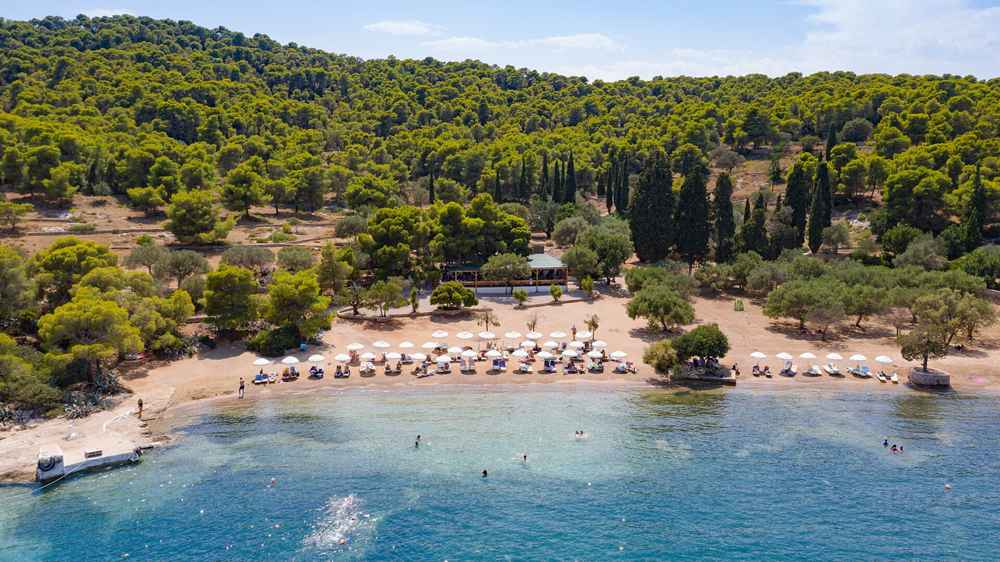
The island’s finest beaches sit away from the town, and reaching them is where all the transport modes finally come together. Agioi Anargyroi, on the south-western shore, is one of the most celebrated, a broad sweep of clear water backed by pines and served by beach tavernas. Zogeria, further round, is a pair of sheltered coves prized for their calm, translucent sea and forested setting. Both lie along the coastal ring road. A bicycle, scooter or quad will get you there, and both are favourite drop-offs for the water taxis that leave the Dapia through the day.
These beaches are the destinations that most shape how visitors plan their movement around the island.
By land, the ride to these beaches is a pleasure in itself and part of the reason to visit. Following the ring road from the town, you pass through fragrant pine woods and past a succession of smaller coves before the road opens onto the larger bays. On a bicycle the trip is a moderate but manageable outing, best tackled in the cooler morning hours, while a scooter or quad shortens it to a brief cruise. Signposting is generally clear, and the road’s gentle profile near the coast keeps the effort reasonable. Arriving under your own power, sweaty and ready to swim, gives the cool water an extra reward.
You have the freedom to move on to the next cove whenever the mood takes you.
By sea, the same beaches feel like a different world, and regulars often insist the boat is the only way to arrive. A water taxi from the Dapia sweeps you along the pine-fringed shore and sets you down at the beach with none of the effort of the road. The approach from the water, with the coves opening between the trees, is genuinely beautiful and impossible to see from land. For Zogeria in particular, whose sheltered coves face the calm inner channel, arriving by boat frames the setting perfectly. Groups often find the shared fare reasonable, and the boat removes any anxiety about the return journey in the heat of late afternoon.
Pairing an outward boat with a walk or ride back makes for an especially satisfying day.
Whichever way you travel, a little planning ensures these remote beaches deliver their full magic. Carry water, sunscreen and cash, since the far coves have limited services and cannot be relied upon for everything. Arrive earlier to claim shade and beat the busiest hours, particularly in high summer. If you come by water taxi, confirm how and when you will get back before the boat leaves, as the last pickups can be earlier than you expect. Basing yourself thoughtfully and consulting island guidance in advance helps you slot these beaches into a wider itinerary.
Reached with a bicycle, a boat or a shared ride, Agioi Anargyroi and Zogeria show exactly why the car-free island rewards travellers who embrace its unhurried, sea-facing way of moving.
Frequently Asked Questions
Can you rent a car on Spetses?
No, you cannot rent a normal private car on Spetses in the way you can on larger Greek islands, because the island heavily restricts car circulation and the historic town centre is essentially car-free. There are no rows of hire-car desks at the port, and driving an ordinary car around the town is neither possible nor expected. Instead, the island runs on bicycles, horse-drawn carriages, water taxis, scooters, ATV quads and a limited number of shared taxi-scooters. This is the island’s signature trait rather than an inconvenience, and most visitors quickly discover a car would only have been a burden on the narrow lanes.
You generally leave it at the ports of Kosta or Porto Heli opposite the island and cross by boat, then travel on wheels and water once you land on Spetses itself. In short, embracing the car-free system rather than fighting it means you will not miss having a car at all.
How long does it take to cycle around Spetses?
Cycling the full coastal ring road around Spetses takes most people roughly two to three hours of actual riding, since the loop runs for about twenty-six kilometres and stays largely flat near the coast. Add generous stops to swim, eat and rest, however, and the circuit comfortably fills a whole day, which is exactly how most visitors treat it. A fit cyclist moving steadily could complete the loop faster, while a family with children pausing at several beaches will take far longer and enjoy every minute of it. The modest inland climbs through the pine forest are the only sections that demand real effort, and even these are short.
You can turn back at any point rather than committing to the whole distance. Setting off in the cooler morning hours, carrying water and choosing a couple of beaches to target makes the ride relaxed rather than a race against the heat.
Are horse-drawn carriages expensive on Spetses?
Horse-drawn carriages on Spetses are a hired service rather than a fixed-fare public transport. The cost depends on the distance and the length of the ride, and you agree the price with the driver before you set off. A short transfer from the port to a nearby hotel with your luggage costs less than a leisurely sightseeing tour of the waterfront and the old lanes. Because these fiacres are a traditional and somewhat exclusive way to travel, they are generally pricier than pedalling a rented bicycle. Many visitors consider a ride well worth it at least once for the experience and the charm.
To avoid any misunderstanding, always confirm both the destination and the fare at the outset, and remember that tipping a driver for a good tour is customary. For families arriving with heavy bags, the convenience of a carriage that can reach lodgings no vehicle could otherwise serve often justifies the cost on its own.
Do water taxis on Spetses run on a fixed timetable?
No, water taxis on Spetses do not follow a strict published timetable in the way scheduled ferries do. They operate more like on-demand sea taxis that depart when passengers and a fare are agreed. You find them at the Dapia and the Old Harbour, tell the boatman which beach or cove you want, settle the price before boarding, and set off. On the busier routes to popular beaches, boats do tend to circulate at intervals through the day. Return trips are usually available, and beach tavernas will often call one for you when you are ready to leave.
Personal arrangements rather than a fixed schedule, a little planning helps: confirm how and when you can get back before you commit to a remote cove. Never leave the last pickup too late in the afternoon. For groups, sharing the fare makes a water taxi a surprisingly economical as well as scenic way to travel.
Is Spetses suitable for visitors with limited mobility?
Spetses presents some challenges for visitors with limited mobility, mainly because of its cobbled lanes, the absence of ordinary cars, and the need to walk, cycle or ride between places. That said, the car-free environment also brings advantages, since the flat waterfront around the Dapia is pleasant and traffic-free to move along at your own pace. Horse-drawn carriages and the shared taxi-scooters offer door-to-door transport that can reach many lodgings, which helps those who find long walks difficult. Water taxis provide seated transport directly to several beaches, avoiding rough tracks. Basing yourself centrally near the Dapia keeps ferries, cafes, shops and carriage stands within a short, level distance, which makes a real difference.
It is sensible to discuss specific needs with your accommodation in advance so they can advise on the easiest routes and arrange a carriage or taxi-scooter when required, rather than assuming everything is within a comfortable walk of the port.
What is the best way to get from the port to your hotel on Spetses?
The best way to reach your hotel from the port on Spetses depends on how far it is and how much luggage you have. If your accommodation sits close to the Dapia, the main quay where ferries and hydrofoils arrive, walking is often simplest, since the central town is compact and many lodgings are only a few minutes away. For hotels further out, or when you are carrying heavy bags, a horse-drawn carriage is the classic solution, as the drivers know every lane and can reach places no vehicle could serve. The shared taxi-scooters offer a quicker motorised alternative for the same job. Many hotels will also arrange a transfer or lend bicycles once you arrive.
It is worth asking your accommodation in advance how they recommend arriving, especially if you land on a busy ferry when the carriage stands near the quay can briefly get busy.
Can you walk everywhere in Spetses Town?
Yes, you can comfortably walk almost everywhere within Spetses Town, and many visitors find walking their main mode of transport once they have settled in. The town clusters tightly around the Dapia and stretches along the waterfront to the Old Harbour. The cafes, tavernas, shops and sights all lie within a modest, largely level stroll of each other. The car-free streets make walking safe and genuinely pleasant, without the noise and hazard of traffic. The lanes behind the waterfront reward wandering with glimpses of grand mansions and quiet corners. For destinations beyond the town, such as the far beaches along the coastal ring road, walking becomes impractical and a bicycle, scooter or water taxi is the sensible choice.
Within the town itself, though, the compact scale and the absence of cars mean that a good pair of shoes will take you to most places you want to go. Exploring on foot is part of the island’s charm.