
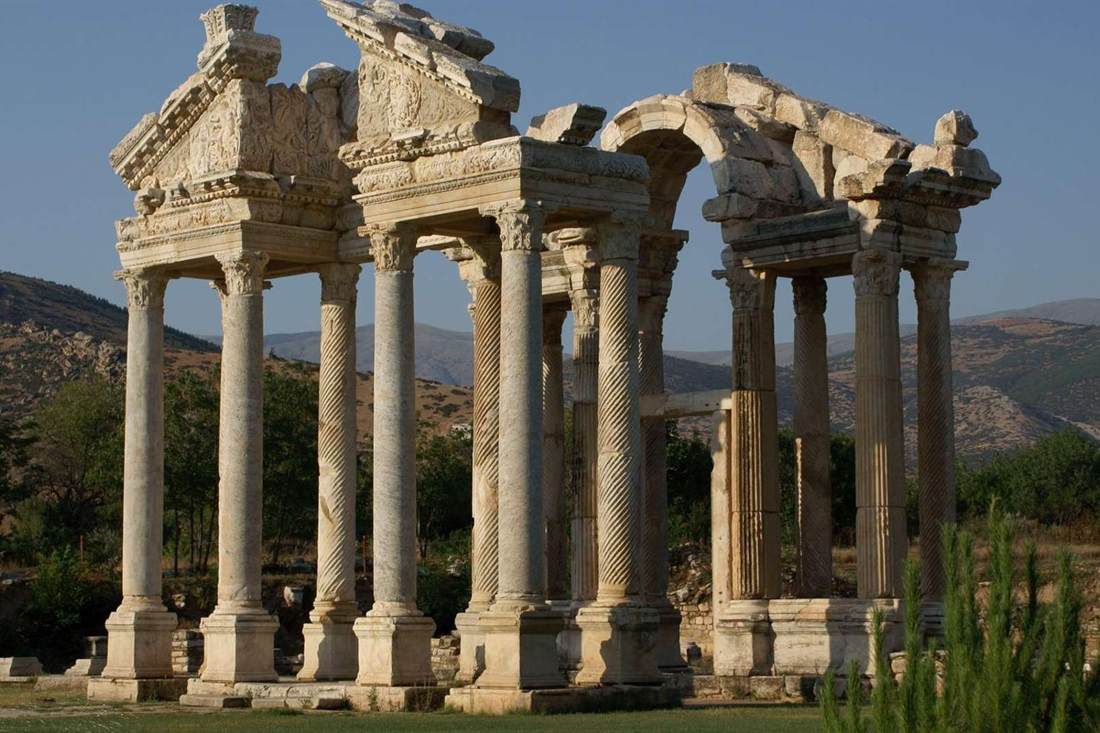
Sebasteion tours end at a marble avenue 90 metres long in Aphrodisias, Turkey, where about 200 relief panels were set into two porticoes. The drive from Denizli takes about 1.5 hours, and one listing starts in Pamukkale.
Heat decides the season, because the site has little shade and July highs reach 38°C. Anyone who also wants a Greek stop can open the Greece Tours homepage and pair this trip with an Athens or island tour.
What are Sebasteion tours, and where do they go?
Sebasteion tours visit the Roman sanctuary of the emperors at Aphrodisias, an ancient city in Aydin Province, south-west Turkey. UNESCO lists the city as a World Heritage Site. A visit joins a walk through the ruins with the site museum.
Sebasteion tours stay in Turkey, not in Greece. The Wikipedia article on Aphrodisias places the city in Caria, a historic region of western Asia Minor. It lies next to the modern village of Geyre. The Wikipedia article on Geyre puts that village in Karacasu district. The city took its name from Aphrodite, the Greek goddess of love.
UNESCO inscribed Aphrodisias on 9 July two thousand seventeen, at its 41st committee session in Krakow. The excavation project gives that date. Sebasteion tours therefore visit a protected site. The Ministry of Culture and Tourism lists the archaeological site and the museum on one museum page.
One listing names Aphrodisias in its title: a private tour that starts in Pamukkale. It runs for 7 hours with a private group and offers pickup. The listed language is English.
The description names the Temple of Aphrodite, the Tetrapylon and the stadium, plus a Turkish lunch. The page carries the labels small group and free cancellation. The listing is new and has no reviews yet.
The Sebasteion stands in the same city, so this listing is the closest match to Sebasteion tours. The Wikipedia article on Aphrodisias counts the Sebasteion among the buildings of the city.
Travellers who want more of the country can start from our Turkey tours page. It is the hub for the regions we cover there.
What is the Sebasteion at Aphrodisias?
The Sebasteion was a temple complex for Aphrodite and the Julio-Claudian emperors, built between about AD 20 and 60. Sebasteion tours reach a processional avenue, 90 metres long and 14 metres wide, that two three-storey buildings once lined.
The excavation project calls it a grandiose temple complex. It took two generations to build, from the reign of Tiberius to that of Nero. Two prominent Aphrodisian families paid for it.
Sebasteion tours visit ruins of a three-part plan: a Corinthian temple, a narrow avenue and two portico buildings. Each portico building stood three storeys and 12 metres high. The storeys carried three column styles, Doric, Ionic and Corinthian, stacked one above the other.
Reliefs filled the upper two storeys along the whole length of both buildings. The columns around them made each facade look like a closed wall of pictures, the excavation project explains.
A first-century inscription on the entrance gate dedicates the complex. It reads: “To Aphrodite, the Divine Augusti and the People.” The Wikipedia article on Aphrodisias quotes it. That article adds that Sebastos is the Greek form of the Latin Augustus and gives Augusteum as a second name.
Aphrodite had a political role here. The article calls the link between the goddess and the imperial house a politic one. The family of Julius Caesar and Augustus claimed descent from Venus, the Roman Aphrodite.
A relief from the south portico shows the personified city making a sacrifice to her cult image. The people honoured her as foremother. Visitors on Sebasteion tours walk through that story of city, goddess and emperors.
Which reliefs do Sebasteion tours show?
Sebasteion tours reach marble reliefs of emperors, gods, Greek heroes and conquered peoples. The project needed about 200 reliefs, and more than 80 were recovered in the dig. The Aphrodisias Museum displays reliefs from the Sebasteion in its own hall.
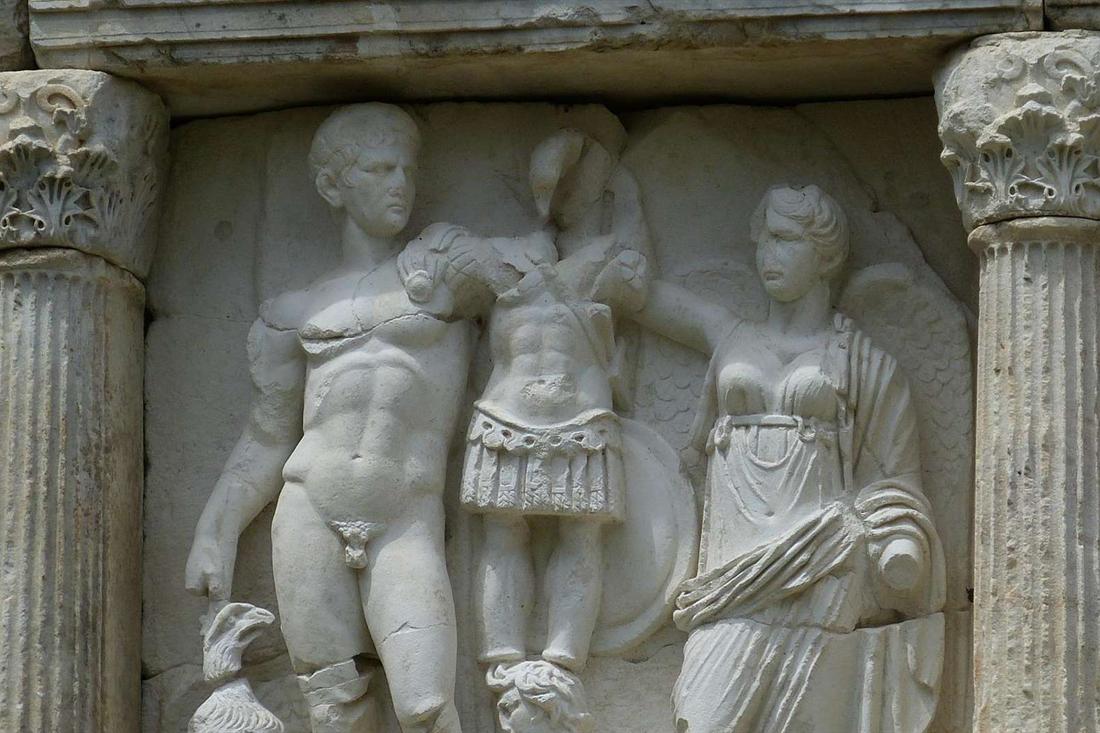
The two buildings told different stories. The South Building, sponsored by two brothers and their family, joined gods, emperors and Greek heroes. The North Building showed the peoples of the empire.
In the third storey of the South Building, the reliefs stood in groups of three. A wide panel sat between two narrow ones. The wide one hung above the door into each of 15 rooms. Sebasteion tours that include the museum can see the originals in that hall.
The sources describe five kinds of panel that Sebasteion tours can show.
- Emperors with gods: the South Building’s third storey set Augustus, Tiberius, Claudius and Nero beside the Olympian gods, and an inscription calls them Olympian Emperor Gods.
- Conquest scenes: Claudius appears over Britannia and Nero over Armenia, and one frieze from the dig shows a female warrior labelled Britannia under the knee of a Roman soldier.
- Greek myths: the lower storey of the South Building carried Herakles, Telephos, Bellerophon, Achilles and Aineias, shown as heroes to compare with the emperors above.
- Personified peoples: the second storey of the North Building held statues of nations of the Augustan empire, each with a label such as “of the people of the Dacians”, from the Ethiopians of eastern Africa to the Callaeci of western Spain.
- Allegories and imperial scenes: the third storey of the North Building mixed figures such as Day and Ocean with scenes such as Nero with his mother Agrippina.
About eighty per cent of the reliefs of the South Building survive, so its programme can be followed in detail. The North Building series is the least well preserved part of the complex. The excavation project adds that the selection of peoples stressed those at the edges of the empire.
The museum hall for the reliefs opened in two thousand eight, the excavation project reports. One relief there shows the deified Augustus beside a trophy crowned by the goddess Victory, with an eagle of Zeus. The Wikipedia article dates it to the reign of Tiberius.
How was the site that Sebasteion tours visit excavated and protected?
Sebasteion tours visit a site that New York University has excavated since nineteen sixty-one. The work runs under the Turkish Ministry of Culture and Tourism. The University of Oxford has collaborated on the project since nineteen ninety-five.
The first formal digs took place in the early twentieth century, led by a French railway engineer, according to Wikipedia. Part of the finds from that work, mostly friezes, pilasters and capitals, now sit in the British Museum.
The excavation project dates the dig at the Sebasteion to the years from nineteen seventy-nine to nineteen eighty-one. The current project concentrates on conservation and documentation of monuments already dug. It also runs targeted new excavations, research and publication.
Drones mapped the above-ground ruins in three dimensions. The Wikipedia article reports that the Austrian Archaeological Institute in Vienna was analysing the data. Sebasteion tours therefore cross ruins that have a three-dimensional map.
Protection also meant moving people. Part of the old village of Geyre covered the ancient city. The Turkish government built a new Geyre a short distance away, around nineteen sixty. The reasons were earthquake threats and the protection of the site, the Wikipedia article on Geyre states.
The UNESCO listing covers 152.25 hectares. A buffer zone of 1,040.57 hectares surrounds it, according to the infobox of the Wikipedia article on Aphrodisias. UNESCO inscribed the property under four cultural criteria. The museum stands inside the site, in Geyre.
Visitors in the region also tour Hierapolis, which has its own page on this site.
How do Sebasteion tours reach Aphrodisias?
Sebasteion tours go by road. Aphrodisias lies 100 km from Denizli and 110 km from Aydın. An independent visitor guide puts each drive at about 1.5 hours.
The Wikipedia article on Aphrodisias puts the ruins 230 km south-east of Izmir. It adds that the site sits about 100 km inland from the Aegean coast.
The Wikipedia article on Karacasu describes the last stretch. The road leaves the Aydın to Denizli road at Kuyucak. It turns south-east and follows the Dandalaz River upstream into the hills. Olives and citrus fruit grow below, and pines grow higher up.
Karacasu itself lies 87 km from the city of Aydın. The visitor guide calls public transport limited and recommends a private car or a tour vehicle, which suits sebasteion tours. Visitors who come from Pamukkale take the route through Karacasu.
The private listing for Aphrodisias leaves from Pamukkale. Day trips to Pamukkale and Hierapolis leave from Antalya, Kemer, Side, Alanya, Marmaris, Fethiye, Bodrum, Kusadasi, Selcuk and Izmir. Each listing page shows pickup. A Pamukkale day trip is a different product from sebasteion tours, because those listings sell the travertines and Hierapolis.
Trip lengths on the Pamukkale listings depend on the start town.
- Antalya: 11 to 15 hours
- Side: 15 hours
- Alanya: 15 to 16 hours
- Marmaris: 11 to 14 hours
- Fethiye and Bodrum: 12 hours
- Izmir: 11 or 12 hours
- Kusadasi: 9 or 12 hours
Group type also differs. One Marmaris listing is a private group, and one Antalya listing is a small group. The Alanya listing and one Izmir listing offer a private option. Each listing page also shows free cancellation.
Starting in Izmir? See Pamukkale day trips from Izmir for that city. Starting in Kusadasi? See day trips from Kusadasi.
What else do Sebasteion tours cover at Aphrodisias?
Sebasteion tours share the site with six more sights. They are the stadium, the theatre, the Temple of Aphrodite, the tetrapylon, the council house and the museum. The excavation project measures the ancient town at 72 hectares.
The city behind sebasteion tours was a medium-sized town of about 10,000 people, says the excavation project. It was built with metropolitan grandeur. The building pages of the excavation project supply the sizes below. The Ministry of Culture and Tourism supplies the museum.
- Stadium: about 270 m by 60 m, with thirty tiers of marble seats for about 30,000 spectators. It dates to the later first century AD. The excavation project ranks it first for preservation among ancient Greek stadia.
- Theatre: twenty-seven tiers of seats survive below the walkway, and the theatre first seated about 7,000. A three-storey marble stage building went up before 28 BC.
- Temple of Aphrodite: an Ionic marble temple of the 30s BC, about 8.5 m by 31 m. Around AD 500 it became a church, and fourteen columns and the apse still stand.
- Tetrapylon: the monumental gate to the sanctuary, with sixteen columns. A stone-for-stone rebuild used 85% original blocks. The west pediment shows Erotes hunting in acanthus leaves.
- Council house: rebuilt in the second century AD as a covered marble theatre for up to about 1,700 people. The nine lower rows of seats survive in excellent condition.
- Museum: it stands at the entrance to the ancient city. Sarcophagi from the local school of sculpture form its richest collection, says the Ministry of Culture and Tourism.
Sebasteion tours also cross a site in an earthquake zone. Wikipedia reports severe tremors in the fourth and seventh centuries. One fourth-century quake changed the water table, and parts of the town flooded.
Emergency plumbing from that period is still visible. The Wikipedia article on Karacasu adds a bath whose heating system can be seen, next to the agora.
Which season suits Sebasteion tours?
Spring and autumn suit sebasteion tours. An independent visitor guide names April, late spring, September and October as the comfortable months. Midday heat reaches 38°C in July and August.
The Wikipedia article on Aydın Province calls the climate typical of the Aegean region, very hot in summer.
The article on the city of Aydın adds hot, dry summers. Highs pass 35°C on the majority of summer days. Winters are mild and rainy, and snow is rare.
The Wikipedia article on Denizli, 100 km away, gives the weather behind sebasteion tours. Summers are hot and dry, and winters are mild to cool and rainy. It calls spring and autumn mild, warm and rainy, with snow on the mountains around the city in winter.
Heat matters on sebasteion tours, because the site has very little shade. The only refreshment kiosk stands at the entrance. The visitor guide lists water, sunscreen and a hat as the three essentials. It also asks for closed shoes with thick soles on the stony ground.
The Ministry of Culture and Tourism lists opening at 08:30 and closing at 17:30. Its ticket office closes at 17:00. The visitor guide gives 08:30 to 19:00 from April to October and 08:30 to 17:30 in winter.
Early starts help on sebasteion tours. The first two hours after opening are cool and quiet, and the light suits photos of the stadium. Travellers who add Pamukkale to the day can check when to visit Pamukkale for the seasons at that stop.
What do visitors ask about Sebasteion tours?
One ticket covers both the ruins and the museum on sebasteion tours, says an independent visitor guide. Photos are free for personal use, but drone flights need permission from the Ministry of Culture and Tourism.
Is the Sebasteion in Greece or Turkey?
Turkey. Wikipedia calls Aphrodisias a Hellenistic Greek city of Caria, in western Asia Minor. The ruins lie in the Aegean Region of Turkey. The Sebasteion is a Turkish site, not a Greek one.
Who built the city of Aphrodisias and for which goddess?
Wikipedia calls Aphrodisias a Hellenistic Greek city named after Aphrodite, the goddess of love. A local fertility goddess drew worshippers here from at least the seventh century BC. The Hellenistic period identified her with Aphrodite.
Can you reach the Sebasteion without a tour?
Yes. The ancient city sells tickets at the entrance and opens seven days a week. A visitor with a car needs no tour. The Turkish Museum Pass is accepted at the site and the museum.
Does a Pamukkale day trip include Aphrodisias?
Not by default. The Pamukkale day trips list the travertines, Hierapolis and lunch, and a small number add a balloon flight. Before booking sebasteion tours, read the stops of a listing for the word Aphrodisias.
How long does a visit take?
The visitor guide allows two and a half hours for the ancient city and one hour for the museum. Half a day suits an unhurried visit on sebasteion tours. The walk across the site covers about 3 km.
Can wheelchair users visit the site?
The museum building and the entrance area are accessible. The paths in the ancient city are earth and stone with sloping sections. So a wheelchair cannot cover the whole site. The visitor guide says so.