
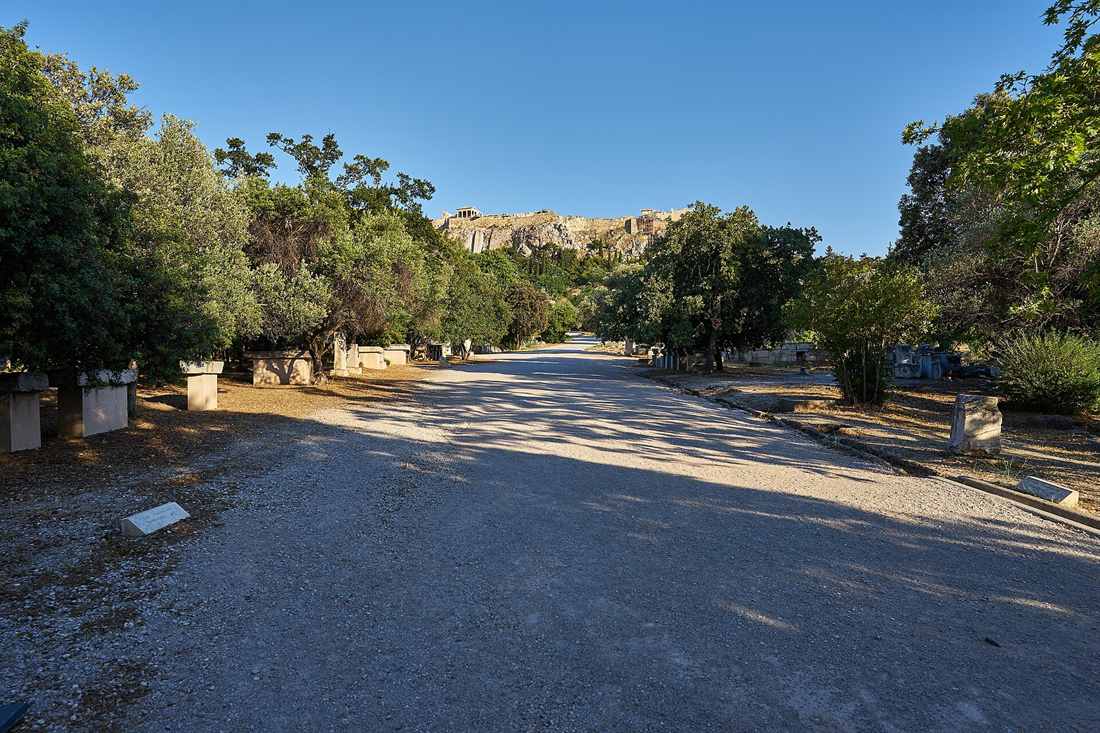
Panathenaic Way tours walk a road of about 1.5 km that climbs 94 m from the Dipylon Gate to the Propylaea. A guided Acropolis and Agora walk lasts 4 hours, and an Agora audio visit lasts 1.5 hours.
Small-group listings cap the party at 8 or 12 guests, and one entry listing needs booking only 15 minutes ahead. Travellers who want an island after Athens can browse the Greece Tours homepage for boat trips and day tours by region.
What are Panathenaic Way tours, and what do they walk?
Panathenaic Way tours are walks along the ancient road from the Dipylon Gate to the Acropolis. The road crossed Athens from the northwest to its centre. Booking sites sell these walks inside Acropolis and Ancient Agora visits, because the road ran through both.
Panathenaic Way tours follow what the Wikipedia article calls a major road of classical Athens. The article dates its use for processions to the sixth century BCE. It gives a second English name, the Street of the Panathenaia.
The name is known from an inscription of the fourth century BCE. It sits in the northern wall of the Acropolis, near the Klepsydra fountain. No other ancient source uses the name, but modern scholars and Panathenaic Way tours both do.
Panathenaic Way tours cover a road that served more than one festival. In the City Dionysia, a procession carried a statue of the god Dionysos along it. That procession ended at his sanctuary on the south slope of the Acropolis.
A cavalry procession for the festival of Olympian Zeus used the same route. It ended at the Temple of Olympian Zeus. Initiates of the Eleusinian Mysteries walked the road in the other direction, from the City Eleusinion to the Sacred Gate.
The road was a working street too. From the fourth century BCE, it carried traffic from the Attic countryside into the Agora. From the Hellenistic period, shops and stoas lined the section between the Dipylon and the Agora.
Panathenaic Way tours therefore cross a street that served trade as well as ritual. The Agora that the road crossed has its own page on this site, the Ancient Agora of Athens.
Where does the Panathenaic Way run from and to?
Panathenaic Way tours follow a road of about 1.5 km. It starts at the Dipylon Gate and crosses the Agora. It then climbs to the Propylaea, the gatehouse on the western side of the Acropolis.
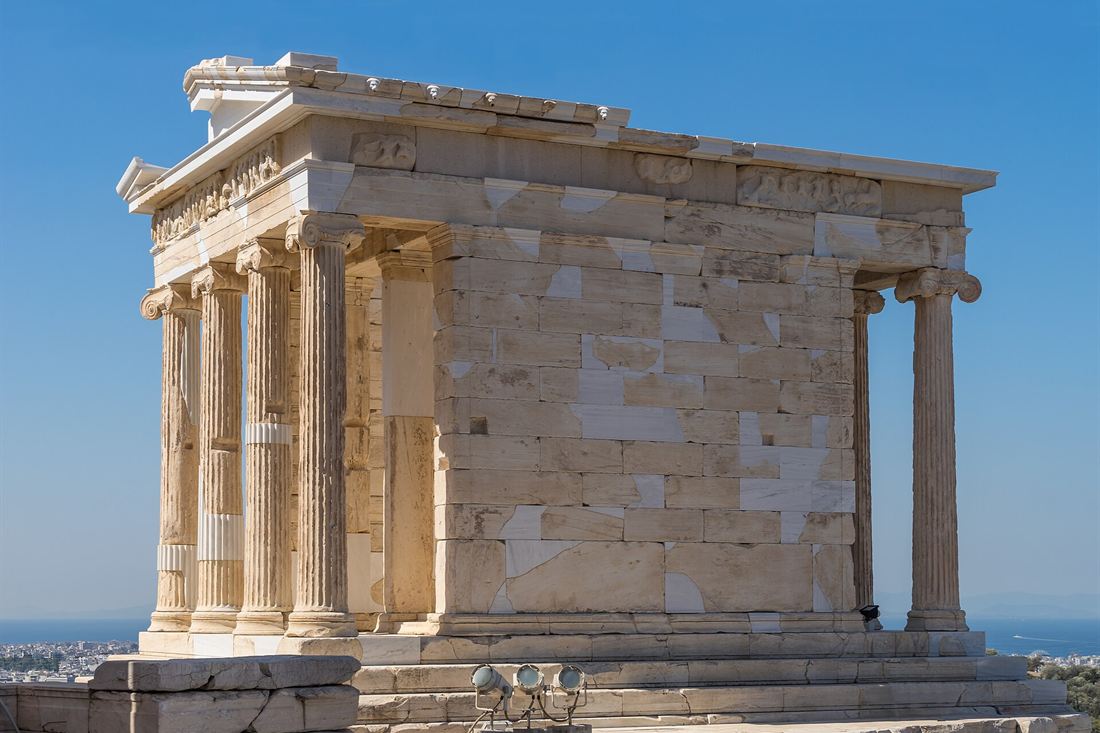
The road began at the Dipylon Gate. The Wikipedia article on the gate calls it the main gate in the city wall of classical Athens. It stood in the modern suburb of Kerameikos. Visitors to the Kerameikos can walk the first blocks of the Way towards the Acropolis.
From the Dipylon, the road ran southeast through the inner Kerameikos towards the Agora. The Eridanos river crossed it at the northwest corner of the Agora. The river was later canalised and covered, by the Roman period.
The Wikipedia article says the line across the Agora in the fifth century BCE is not fully known. Panathenaic Way tours cross the Agora along what a travel blog about the Acropolis describes as a diagonal.
Past the Agora, the road reached the City Eleusinion. There it turned southeast to the Klepsydra fountain and climbed to the Acropolis through the Propylaea. On Panathenaic Way tours, the steepest stretch begins at this turn.
The overall rise is 94 m, says the Wikipedia article. The climb steepens at the end. The stretch from the City Eleusinion to the Acropolis gains 55.3 m. The stretch from the Dipylon to the Eleusinion gains 38.7 m.
The festival procession walked from the Dipylon to the Acropolis, so both stretches climbed. A walk in the same direction starts in the northwest and ends on the rock.
How did the festival procession use the Panathenaic Way?
The Great Panathenaia procession crossed Athens on this road every four years. Over 1,000 people walked in it, carrying a new peplos for Athena and leading a herd of animals for sacrifice. Panathenaic Way tours follow the same path.
The festival ended on 28 Hekatombaion, a day in the first month of the Attic calendar. The Wikipedia article on the festival says the procession climbed to the Acropolis on that last day. The first Great Panathenaia took place in 566 BCE.
The procession formed in the Kerameikos, and Panathenaic Way tours that start there begin at the same place. At the Pompeion, a hall beside the Dipylon Gate, the Athenians prepared the peplos. They hoisted it like a sail on a chariot shaped like a ship.
The high priestess and the treasurers of the temple led the line. The girl who carried the peplos came next. Priests, priestesses, magistrates, soldiers, athletes, delegates from other states, musicians and herdsmen followed.
Non-Athenians joined too. Women carried water jars, and men carried bread and offerings on trays. Young women began weaving the peplos nine months before the festival, says the Wikipedia article on the garment. The cloth showed the gods fighting the giants.
The march ended at the altar of Athena on the Acropolis, the hill that Panathenaic Way tours climb. There, more than one hundred cows and sheep were sacrificed in a rite called a hecatomb. A meal of bread and parts of the animals followed.
The Parthenon frieze carries 378 figures and 245 animals in two files of procession. The Wikipedia article on the frieze gives the more accepted view. It reads the scene as the Great Panathenaia procession from the Dipylon Gate to the Acropolis. Panathenaic Way tours walk the route that the frieze shows.
The processions stopped in the early fifth century CE, according to the Wikipedia article on the road. Panathenaic Way tours walk a road that no longer carries a procession.
What does the Panathenaic Way look like on the ground today?
Panathenaic Way tours cross a road that began as a hard pebble track. It was 10 to 20 m wide in the classical period and gained paving in the first century CE. Wheel ruts, a stone gutter and a boundary marker show how it worked.
Panathenaic Way tours walk a road that was far wider than a normal Athenian street. In the classical period it was 10 m wide at its narrowest, between the Agora and the Acropolis. An average Athenian street was 3.5 to 4.5 m wide. At the Agora entrance from the northwest, the road reached 20 m.
By the Hellenistic period, the road was around 29 m wide just before the Agora. Outside the Dipylon it reached 39 to 40 m. The Wikipedia article says the unusual width made room for ritual events.
The part that climbs the Acropolis has retaining walls and steps. In the first century CE, the stretch from the southeast of the Agora to the Acropolis was paved. Paving was unusual for Athenian streets.
The paving is made of reused blocks of poros stone and of marble from a building of the Periclean period. It still shows wheel ruts. Panathenaic Way tours between the Agora and the Acropolis cross this paved stretch.
A stone gutter ran along the southwest side of the road in the Hellenistic period. Between the Dipylon and the Agora, a terracotta pipeline ran underground.
Excavators found the two edges of the road at different times. The German Archaeological Institute at Athens found the northern edge in the late nineteenth century. The American School of Classical Studies later uncovered a boundary marker for the southern edge.
- Layers: twentieth-century test trenches in the Agora uncovered sixteen layers of road surface, from the middle of the fifth century BCE to the late first century BCE.
- Depth: the bulk of the Kerameikos site lies about 7 to 10 m below the modern street.
- Acropolis: parts of the Way still give access to the site, and recent works widened them and covered them in reinforced concrete.
- North Slope Trail: restoration work reopened the trail at the base of the Acropolis and gave the public access to the last stretch before the climb onto the rock.
A programme of the Greek Archaeological Service restored ancient routes around the Agora and the Areopagus. The Panathenaic Way was among them. A recent Ministry of Culture programme for the Agora and Kerameikos covered the Way again. Panathenaic Way tours therefore reach a road that has been restored more than once.
Which Panathenaic Way tours run in Athens?
Panathenaic Way tours come in four types. These are guided Acropolis plus Ancient Agora walks, Agora e-ticket visits with audio, small-group walks and private tours. Each type covers sites that sit on the old road.
Three Agora listings carry the highest review counts. An entry ticket has 712 reviews, a guided Acropolis and Agora walk has 690 and an audio e-ticket has 615. The guided walk holds a 4.8 rating. Panathenaic Way tours of each type are listed below.
- Guided Acropolis plus Agora walks: one listing has a licensed guide lead the visit to the Parthenon and the Temple of Athena Nike, then to the Stoa of Attalos in the Agora, with skip-the-line entry.
- Agora e-ticket and audio visits: one listing pairs a pre-booked e-ticket with a self-guided audio tour on a smartphone, and a second ticket listing names the Church of the Holy Apostles beside the Temple of Hephaestus.
- Small-group walks: one small-group listing links Greek myths to the Temple of Zeus, the Acropolis and the Ancient Agora, with a licensed guide.
- Private tours: one listing offers a private group for the Acropolis and the Acropolis Museum, and a second private listing offers pickup and describes a personalised tour.
Entry listings sell the ticket, with an audio guide as an option. Our page on Ancient Agora tickets explains the entry options. One two-site listing pairs the Roman Agora and the Ancient Agora with two e-tickets and two audio tours.
Heritage walks widen the route. One listing adds the Old City of Athens and its last surviving public baths as an upgrade. Two guided Acropolis listings offer the Acropolis Museum as an option. Panathenaic Way tours of this kind can then end indoors.
How long do Panathenaic Way tours take?
Panathenaic Way tours last 1.5 hours for an Agora audio visit and 4 hours for a guided walk. A guided Acropolis visit on its own lasts 2 hours.
The Agora e-ticket and audio listing shows 1.5 to 2 hours. A small-group Agora listing with a licensed guide lasts 2 hours. Two guided Acropolis plus Agora listings last 4 hours. A listing that adds the Plaka district lasts 3 hours 30 minutes.
Three guided Acropolis listings last 2 hours each. Two others run 2 to 4 hours and offer a visit to the Acropolis Museum. The guided Acropolis listing with the highest review count, 14,503, is one of them.
A private Acropolis and museum listing lasts 1 hour 30 minutes. A half-day private listing lasts 4 to 5 hours. An Acropolis e-ticket listing with audio shows 40 minutes.
One pass listing shows 2 hours to 3 days. Its Acropolis ticket leaves 3 days to visit up to 5 other sites, so the Agora can wait.
Group size is stated in two small-group listings of Panathenaic Way tours. One caps the group at 8 guests and the other at 12. Two private listings take one party only.
The 8-guest listing holds a 4.9 rating from 530 reviews. The 12-guest listing holds a 4.9 rating from 637 reviews.
Booking lead times for Panathenaic Way tours differ. One Agora ticket listing needs booking at least 15 minutes ahead. One Agora audio listing needs at least 10 hours. Free cancellation is listed on the small-group Agora walk and on both four-hour guided walks.
Distances between the sights, with route lengths and metro stations, sit on our Athens historical walking routes page.
How do you plan a morning around Panathenaic Way tours?
Plan Panathenaic Way tours for the early hours. A first-access Acropolis listing offers an early-morning visit away from the summer heat. The Ministry of Culture closed the Acropolis from 12:00 to 17:00 on one heatwave day.
One early-access listing starts on the Acropolis and moves on to the Ancient Agora. It also visits the Agora Museum inside the Stoa of Attalos. A premium Acropolis listing starts at the Theatre of Dionysus. Two guided Acropolis listings include earsets, so the group hears the guide clearly.
On that heatwave day, ticket holders for the closed hours were allowed to enter later. The site reopened at 17:00 and stayed open until 20:00. A morning slot on Panathenaic Way tours ends before the closure begins.
The first-access Acropolis listing needs booking at least 10 hours ahead. It holds a 4.8 rating from 2,808 reviews.
At the Acropolis, the city visitor guide puts the ticket office and the information booth in one structure. It has an entrance step. Adapted toilets sit next to the booth. The accessible entrance is at the left of the main entrance.
The same guide places the Acropolis lift 350 metres from the entrance, reached by a special electric platform. It rises about 25 metres to the plateau. The service is not available in severe weather or intense winds.
Our guide to avoiding the crowds at the Acropolis goes deeper on timing and slots.
What do visitors ask about Panathenaic Way tours?
Five questions come up before booking Panathenaic Way tours. They cover the promenade, guides, the Acropolis gate, access for children and wheelchairs, and the road to the stadium.
Is the Panathenaic Way the same as the Dionysiou Areopagitou promenade?
No. The promenade is a walking street along the south side of the Acropolis. It runs from near the Arch of Hadrian to Philopappos Hill. The Way is an ancient road that climbed the rock from the Agora.
Can you walk the Panathenaic Way without a guide?
Yes. Panathenaic Way tours without a guide use entry tickets. One Acropolis ticket listing offers an audio guide or a live guide as options. A pass listing adds a self-guided audio tour for the Acropolis and the Agora.
Which Acropolis gate does the Way reach?
The Propylaea, a monumental gateway that Wikipedia calls the entrance to the Acropolis. The Beulé Gate, built in the third century, restricted entry in front of it.
Are Panathenaic Way tours suitable for children or wheelchairs?
Listings sell child places for ages 6 to 12 on the four-hour guided Acropolis and Agora walk. One Agora ticket listing and one small-group Acropolis listing carry a wheelchair accessible tag. For the Acropolis lift, the city visitor guide says to phone before arriving.
Is the Panathenaic Way the same as the road to the Panathenaic Stadium?
No. The Panathenaic Stadium stands in the Pangrati district, south of the Ilissos river. It sits in a ravine between Agra hill and Ardittos hill. The Way ran to the Acropolis.