
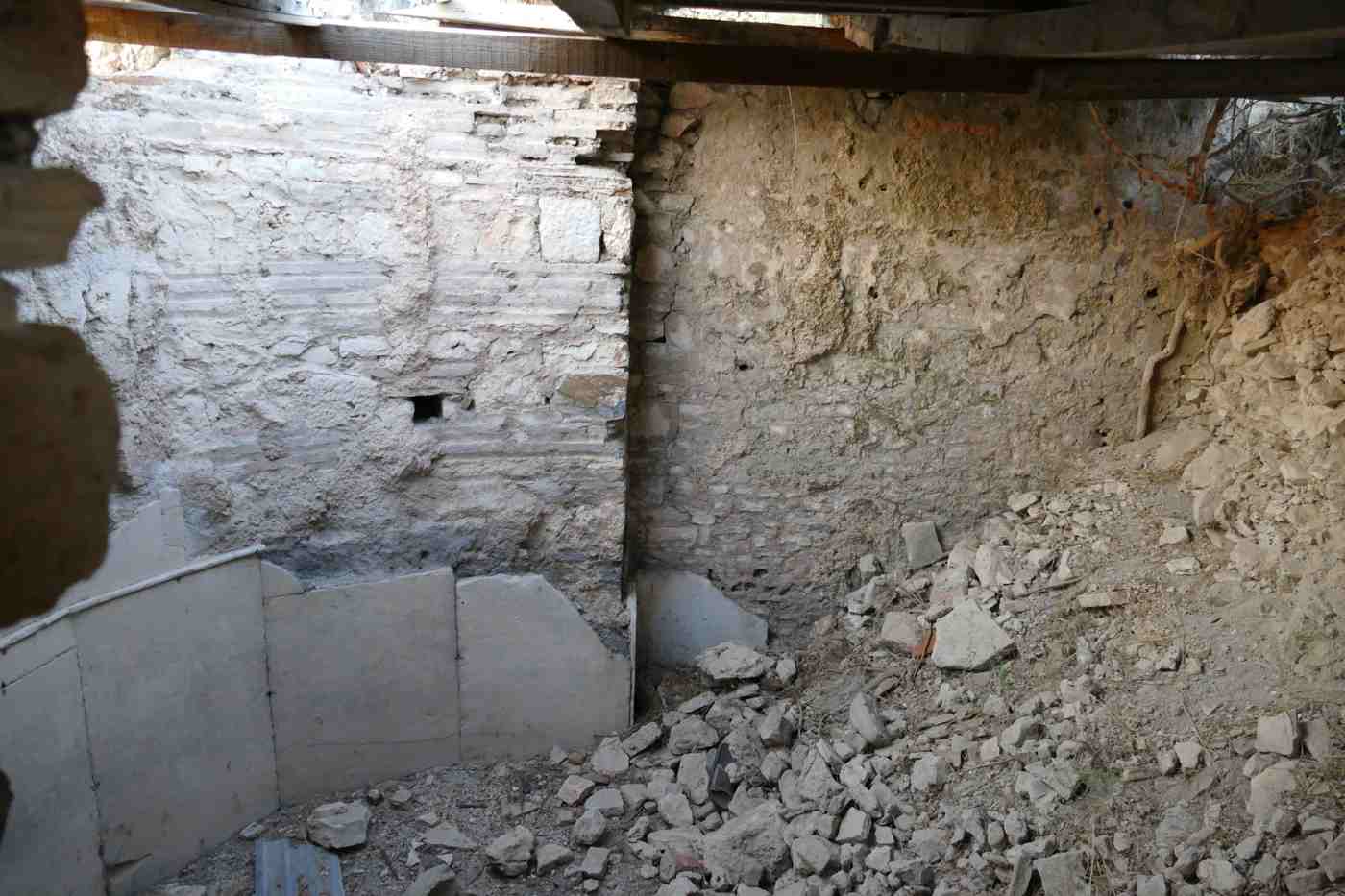
The Cave of Pythagoras stands on the southern slopes of Mount Kerkis, high above the village of Marathokampos on the southwest coast of Samos. A marked footpath climbs through pine to a pair of rock openings, where the small cave-chapel of Panagia Sarantaskaliotissa sits beside a deeper cavern. Local tradition ties the site to the philosopher Pythagoras, who is said to have hidden here from the tyrant Polycrates. Plan the whole trip with Greece Tours.
This guide covers the caves and the Pythagoras tradition, the chapel of the Forty Steps reached by its carved stair, and the larger cavern beside it. It sets out the setting on Mount Kerkis. The wide views over the southwest coast and the Aegean. How the climb fits with the beaches and villages of the quiet southern side of the island.
What is the Cave of Pythagoras on Samos and where does it sit on Mount Kerkis?
The Cave of Pythagoras sits on the southern slopes of Mount Kerkis, above Marathokampos on Samos, a cluster of caves linked by local tradition to the philosopher Pythagoras and reached by a marked footpath.
The Cave of Pythagoras occupies the remote southwest corner of Samos, where the land climbs sharply from the coast into a wall of grey limestone. The site groups two rock openings, set roughly 500 metres above the sea on the mountain flank. Marathokampos, the largest village on this side, spreads across the slope below, and the small harbour of Ormos Marathokampou sits on the shore. Pine and low scrub cover the ground around the caves, and a spring near the chapel supplies water through the cooler months. The place carries the Greek name Sarantaskaliotissa, taken from the carved steps that lead up to it.
No road reaches the entrance, so walkers climb the final stretch on foot from a car park lower down the hillside.
Mount Kerkis, also called Kerketeas, rises to about 1,434 metres and forms the highest peak in the eastern Aegean. Its bare limestone summit dominates the western third of the island and drops steeply toward the sea on the southern side. The Cave of Pythagoras lies on this southern face, tucked into a fold of rock where erosion has hollowed out the caverns. Cloud often gathers on the peak in the morning and clears by midday, changing the light on the cliffs. The mountain sheltered hermits and monks over the centuries, and the caves served as retreats long before modern walkers arrived.
Goats graze the lower slopes, and the path passes stone terraces where farmers once grew grain and olives on the thin mountain soil. Springs on this flank fed those old farms.
The drive to the trailhead runs west from Marathokampos along a narrow road toward the Kerkis slopes and the hamlet of Kosmadaioi. A rough track then climbs to a small car park, where a wooden sign marks the start of the footpath. Pythagorio, the island’s southeast harbour and airport town, sits about 50 kilometres away by road, so most walkers base themselves closer, at Votsalakia or Marathokampos. The village of Votsalakia strings along the beach directly below the mountain and offers the nearest rooms and tavernas. From the car park the caves stay hidden until the last turn of the trail, when the whitewashed chapel appears against the grey cliff.
Drivers reach the track in a normal car, though the surface turns stony near the top.
The name Cave of Pythagoras covers two distinct rock shelters set a short distance apart on the same cliff. The upper shelter holds the chapel of Panagia Sarantaskaliotissa, a whitewashed cell squeezed under an overhang and entered through a low door. The lower and wider opening forms a true cavern, a dark hollow that runs back into the rock behind a screen of stone. Local people link both to Pythagoras, though the philosopher belongs to the sixth century before the common era and the chapel dates from far later. The steps, the icon stands and the water basin all mark the site as a place of worship.
Visitors move between the two openings on a short cut path, gaining a clear sense of how the rock shaped the shelters.
Why does tradition say Pythagoras hid in these caves from the tyrant Polycrates?
Local tradition holds that Pythagoras hid in these caves to escape Polycrates, the tyrant who ruled Samos in the sixth century before the common era, using the remote mountain as a refuge before he left the island for Italy.
Polycrates seized power on Samos in the sixth century before the common era and built the island into a naval force across the eastern Aegean. He ruled from the harbour town now called Pythagorio and drove great public works, including the Eupalinos Tunnel and the ancient mole. Pythagoras, born on the same island, clashed with the tyrant’s court and, by tradition, withdrew to the heights of Mount Kerkis to think and teach in peace. The southern caves offered water, shade and a clear line of sight over the sea, which suited a man wary of the ruler below.
Ancient writers record that the philosopher later sailed west to Croton in southern Italy, where he founded his school and community. The distance from the capital made the mountain a natural hiding place.
The link between the caves and Pythagoras rests on oral tradition rather than written proof from his own lifetime. No inscription at the site names the philosopher, and ancient sources place much of his adult life in Italy rather than on Samos. The connection took firm shape in later centuries, when monks and villagers attached his memory to the mountain retreat. Pythagoras stands among the island’s three great thinkers, beside the astronomer Aristarchus and the philosopher Epicurus, and Samos guards their names with pride. The caves give visitors a physical place to picture the young philosopher at work, even where the evidence stays thin.
The tradition endures because the setting fits the story so well, with its isolation, its water and its long view over the sea.
Pythagoras shaped mathematics and philosophy in ways that still carry his name, from the theorem on right triangles to early work on musical ratios. He taught that numbers underlie the order of the world and that the soul passes through repeated lives. His followers formed a tight community with shared rules on diet, study and silence, first on Samos and later at Croton. The tyrant Polycrates, by contrast, is remembered for sea power, grand building and a sudden, violent end at the hands of a Persian governor. The caves hold both men in a single frame, the thinker who fled and the ruler who stayed.
This tension between free thought and hard power gives the site its lasting pull for travellers who climb the path.
Reaching the caves the way tradition imagines Pythagoras did adds weight to the walk up the cliff. The path demands effort, the sun beats on the open rock, and the sea stretches wide below, exactly the conditions a fugitive scholar have faced. Villagers from Marathokampos have kept the memory alive through the small chapel and the yearly festival held at the site. Pilgrims once climbed the carved steps to pray, and walkers now follow the same worn stone toward the overhang. The story turns a simple mountain hike into a link with the ancient island and its most famous son.
Standing at the cave mouth, a visitor looks out on the same horizon that the tradition assigns to the philosopher himself. The climb takes about 20 to 40 minutes from the car park.
What is the cave-chapel of Panagia Sarantaskaliotissa reached by the carved steps?
The chapel of Panagia Sarantaskaliotissa fills a shallow cave near the top of the climb, reached by a flight of carved stone steps.
The name Sarantaskaliotissa joins the Greek words for forty and steps, and it fixes the chapel to the stair carved into the living rock. The steps climb a steep pitch of grey limestone, worn smooth by centuries of pilgrim feet and washed pale by rain. A metal handrail now guards the outer edge, where the drop falls away toward the pine below the cliff. At the head of the stair a low white wall and a small blue door mark the entrance to the cave chapel. The builders squeezed the whole structure under a natural overhang, so the raw rock forms the ceiling above the icons.
This blend of built wall and bare stone gives the shrine its close, cell like feel. Candles and oil lamps light the dim interior.
Inside the chapel a single icon of the Virgin Mary holds the place of honour on a small stone altar. Oil lamps and thin candles light the space, and their smoke has darkened the rock ceiling over the years. The cave stays cool even in high summer, when the air outside on the cliff turns hot and still. Worshippers leave offerings of flowers, coins and hand written notes, which cluster around the icon stand near the wall. A narrow bench of rock lets tired pilgrims sit and rest after the climb up the steps. The whitewashed walls reflect the lamplight onto the icon.
The chapel holds only about ten people at once, so groups take turns to step inside and light a candle before moving on.
Pilgrims have climbed to the chapel for generations, drawn by the Virgin of the Forty Steps and the healing water of the spring. The site holds its main festival on the feast of the Virgin, when villagers from Marathokampos and Votsalakia walk up in procession. Priests lead a liturgy at the cave mouth, and families share bread and wine on the rock terrace outside. The carved steps then fill with a slow line of worshippers, each pausing to cross themselves at the door. Icons and lamps get fresh oil and flowers for the day, and the sound of chant carries out over the cliff.
The festival ties the modern village to a place of worship that predates any living memory on the mountain. Many walk the last steps barefoot as a vow.
The spring beside the chapel draws its own respect, since fresh water high on a dry limestone mountain is rare and prized. Pilgrims collect it in bottles to carry home, and the flow feeds a small stone basin set into the rock. The water stays cool and clear through summer, when streams lower on the slope run dry under the sun. Its presence explains why hermits and, by tradition, Pythagoras himself lived on the cliff for long stretches. The chapel builders framed the spring with stone and set a cross above it to mark the gift. Walkers refill here before the climb back down, grateful for the shade of the overhang and the taste of the mountain water.
The basin never overflows, and the stone stays wet all day.
What is the larger cavern beside the chapel at the Cave of Pythagoras?
The larger cavern opens beside the chapel as a deep, dark hollow in the cliff, running back into the rock behind a screen of stone. Tradition names this wider cave as the true refuge of Pythagoras on the mountain.
A short scramble from the chapel leads to the mouth of the larger cave, set lower and deeper in the same cliff. The opening frames a wide arch of grey rock, and cool air flows out from the dark interior even on hot days. Inside, the floor drops and narrows, and the ceiling closes down until a person must stoop to move further back. Water seeps through the limestone and drips from the roof, leaving pale mineral streaks on the walls of the hollow. The cave runs back about ten metres into the mountain before the passage tightens and the light from the entrance fades.
Loose stone and damp footing make the inner reaches awkward, so most visitors stay near the bright mouth of the cavern.
The larger cave gives the Pythagoras tradition its physical heart, since a hollow of this size can shelter a person for days. Tradition holds that the philosopher slept and studied here, hidden from Polycrates and his guards in the town far below. The depth of the rock keeps the interior at a steady, cool temperature through the fierce heat of the Aegean summer. A body of stone this thick also blocks sound, so the cave stays silent apart from the drip of water on the floor. Early monks likely used the same shelter, and soot on the roof marks old fires lit against the mountain cold.
The cave and the chapel together form a single refuge, one open to prayer and one open to solitude.
Exploring the larger cavern calls for care, since the ground stays wet and the light drops away within short steps of the arch. A torch or head lamp helps beyond the entrance, where the walls close in and the floor turns uneven and slick. The rock holds no railing or marked route inside, so walkers test each step and keep one hand on the stone. Bats roost in the deeper cracks, and their presence signals the natural, undisturbed state of the inner cave. The air smells of damp earth and cool stone, a sharp change from the pine and thyme outside on the cliff.
Sensible visitors stay within sight of daylight and treat the dark chamber as a place to glimpse, not to probe. Sturdy shoes grip the slick rock best.
The two caves reward a slow, quiet visit rather than a quick look and a photograph at the entrance. Standing in the cool mouth of the cavern, a walker feels the weight of the mountain and the silence of the deep rock. The contrast between the bright chapel and the dark hollow beside it shapes the whole experience of the climb. Pilgrims come for the icon and the spring, while others come for the cave and the memory of the philosopher. Both groups share the same steep path, the same carved steps and the same wide view from the ledge outside.
The site works as a single whole, where faith, legend and raw geology meet on one narrow shelf of Mount Kerkis. Few other places on Samos fold together myth and rock so tightly.
What views open over the southwest coast and the Aegean from the Cave of Pythagoras?
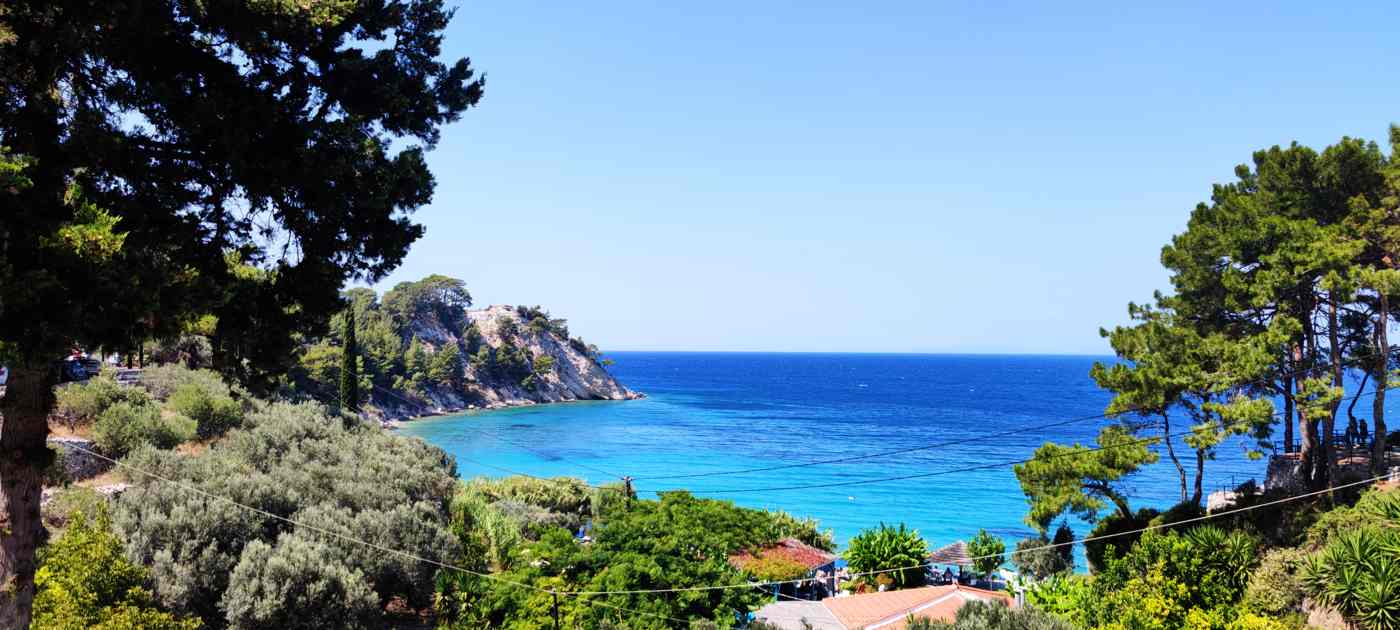
The ledge outside the caves opens a wide view over the southwest coast of Samos, taking in the Votsalakia and Kampos beaches, the blue sweep of the Aegean, and the outline of nearby islands on the horizon.
The rock terrace outside the chapel serves as the reward for the climb, with the land falling away in one long sweep to the sea. Directly below, the beaches of Votsalakia and Kampos trace a pale line along the shore beneath the mountain. The blue water of the southwest gulf fills the middle distance, dotted with the wakes of small boats crossing to the coves. On a clear day the eye reaches the small island of Samiopoula off the coast and the higher land of other Aegean islands beyond. The view runs from the green lower slopes of Kerkis to the bare rock near the summit above the caves.
This wide field of sea, beach and mountain sums up the whole southwest corner of the island in one glance.
Light shapes the view through the day, and the terrace rewards visitors who time the climb well. Morning sun strikes the coast from behind the mountain, throwing the beaches into bright relief against the dark water. By late afternoon the light turns gold and low, and the sea takes on a deep, glassy calm below the cliff. Sunset drops behind the western ridge of Kerkis and the far islands, silhouetting the peaks against the fading sky. The open aspect faces southwest, so the ledge holds the sun until the last hour of the day. Walkers who plan the descent before dark still catch this long evening light on the water while they retrace the path down.
The air often clears after midday, sharpening the far horizon. Haze can soften the islands at noon.
The view sets the caves within the wider geography of Samos and its place in the eastern Aegean. West across the water lie the small Fourni islands, once a pirate haunt, and the larger mass of Ikaria on the horizon. The strait toward the Turkish coast runs to the north and east, hidden here behind the bulk of the mountain. The southwest shore below the caves holds the island’s quietest beaches, far from the ferry ports of Vathy and Karlovasi. Boats from Votsalakia run day trips to Samiopoula and the sea caves along the base of Kerkis. From this height the whole layout of coast, island and open sea reads like a map spread out beneath the cliff.
Ferries and fishing boats trace slow lines across the gulf.
The climb to the caves pairs well with the rest of the southwest coast, and it ranks among the best walks in any guide to things to do in Samos. Most visitors combine the site with a swim at Votsalakia or Kampos, where the sand shelves gently into clear water. A meal at a taverna in Marathokampos village rounds out the day, with local wine, grilled fish and mountain greens. The route back east toward Pythagorio and Vathy passes wine villages on the slopes of Mount Ampelos, home of the sweet Muscat. Planning the caves for the cooler morning hours leaves the afternoon free for the beach below the cliff.
This mix of history, walking and coast makes the site a full day out on the quiet side of the island.
How long does the climb from the car park to the Cave of Pythagoras take?
The climb from the car park to the Cave of Pythagoras takes about 20 to 40 minutes. The marked path rises through pine on the southern slopes of Mount Kerkis above Marathokampos.
The paved car park sits at the road head above Marathokampos, on the southern flank of Mount Kerkis. The footpath begins at a signposted gate beside the last parking bay. Walkers climb steadily toward the cave-chapel of Panagia Sarantaskaliotissa, whose name recalls forty carved steps. Pine shade covers the lower third of the route, then the trees thin toward open rock. The gradient stays moderate at the start and steepens near the chapel steps. Most visitors reach the cave in 25 to 30 minutes at a steady pace. Fitter walkers manage the ascent in about 20 minutes without a stop. The surface mixes packed earth, loose gravel and cut stone steps.
Trekking poles steady the knees on the gravel. The return descent runs faster, near 20 minutes for most walkers.
The route climbs in switchbacks that ease the steepest pitches near the top. Red paint marks and small cairns guide walkers where the path forks. The lower stretch follows an old shepherds’ track lined with kermes oak and pine. Sun reaches the open rock by mid-morning, so the shade thins as the day warms. A short scramble over bare limestone precedes the final flight of stone steps. These steps lead directly to the chapel doorway set into the cliff. Children and older walkers slow the group on this upper section. Pauses at the switchback bends give the legs a rest and open the view south. Water and a hat matter more here than on the shaded start.
The whole ascent stays under one hour for unhurried families.
The cave-chapel of Panagia Sarantaskaliotissa marks the end of the marked climb. Its whitewashed front fills a natural hollow in the grey Kerkis rock. A narrow flight of carved steps drops into the shaded interior below. The larger cavern beside it runs deeper into the mountain toward cool darkness. Local tradition ties the site to the philosopher who fled the tyrant Polycrates. Walkers curious about that era can read the history of Samos before the trip. The view from the terrace stretches over the southwest coast toward the open Aegean. A small water source seeps near the chapel in the cooler months. The stone bench outside gives the only shaded seat at the top.
Most walkers rest here twenty minutes before starting the descent to the car park.
The descent demands care on the loose gravel between the switchbacks. Cut steps near the chapel can grow slick after rain or morning dew. Sturdy soles grip the polished stone better than smooth trainers. Walkers face the slope and shorten their stride on the steepest pitches. The pine shade returns halfway down and cools the final stretch. A steady pace brings the car park within about 20 minutes. Knees take the strain on the drop, so poles earn their weight here. The old track rejoins the road exactly at the signposted gate. Cars park along the widened road head with room for a dozen vehicles. Space fills fast on summer mornings, so an early start secures a spot.
The whole loop, climb and return, fits inside 90 minutes for most fit visitors.
Where is the trailhead for the Cave of Pythagoras near Marathokampos?
The trailhead sits above Marathokampos, a large village on the southwest coast of Samos. A signposted mountain road climbs from the village toward the car park below the Cave of Pythagoras on Mount Kerkis.
Marathokampos spreads across a hillside above its coastal annexe of Votsalakia. The old village holds narrow lanes, a central square and tavernas under plane trees. Drivers reach it on the ring road that circles the southwest corner of Samos. From Pythagorio the drive runs about 45 kilometres and takes near one hour. From Vathy the distance grows to roughly 55 kilometres over mountain bends. Signs for the cave and for Panagia Sarantaskaliotissa point uphill from the village edge. The asphalt narrows past the last houses and climbs in tight curves. A final gravel stretch ends at the car park below the trail. The road demands a careful driver and a car with sound brakes.
Local buses reach Marathokampos village but not the high trailhead itself.
The car park marks the official start of the marked footpath. A wooden information board once stood at the gate beside the trail. Painted arrows and a small shrine confirm the correct direction uphill. Drivers park tidily, since the space holds only about a dozen cars. The last fuel and shops sit down in Marathokampos or Votsalakia. Walkers fill water bottles in the village before the climb begins. A café in the coastal strip serves breakfast for an early departure. The mountain road carries little traffic outside the summer months. Goats and sheep cross the asphalt on the higher bends. A slow, watchful pace keeps both driver and animals safe.
The trailhead gives no shade, so walkers move off quickly onto the shaded pine path.
Marathokampos rewards a visit in its own right before or after the walk. Stone houses climb the slope in tiers toward the church at the summit. The village square fills at dusk when residents gather for coffee. Tavernas serve goat, local greens and the sweet Muscat wine of Samos. A short drive down reaches the long beach at Votsalakia and Kampos. The coastal strip holds rooms, tavernas and a sheltered swimming bay. Drivers combine the cave, the village and the beach in one full day. The road between them runs about 6 kilometres from shore to trailhead.
Views over the Aegean open at every bend of the climb, and the nearby islet of Samiopoula floats offshore to the south. Fishing boats run short day trips there from the coastal jetty in summer.
Drivers approach the trailhead from either the north or the south coast road. The northern route from Karlovasi crosses the mountain shoulder past Kosmadei and Kallithea. This road climbs high and rewards patience with long views over the Aegean. The southern route from Pythagorio follows the coast through Ormos and Votsalakia. Both meet at Marathokampos before the final climb to the car park. Fuel stations sit in the larger coastal villages, not on the mountain road. A full tank before the climb spares any worry on the empty stretches. Mobile signal weakens on the high bends below Mount Kerkis, so downloads are best done earlier. Walkers tell someone their plan before starting the ascent alone.
The last section of gravel suits a compact car better than a wide one.
What walkers bring, and how safe is the steep path to the cave?
Sturdy shoes, water and sun protection matter most on the steep path to the Cave of Pythagoras. The trail crosses loose gravel and cut steps, so firm grip and a steady head guard against slips.
Closed walking shoes with a gripped sole handle the gravel and stone best. Smooth trainers slide on the polished steps near the chapel doorway. Each walker carries at least one litre of water in warm weather. A brimmed hat and sunscreen shield the skin on the open upper rock. Sunglasses cut the glare off the pale limestone at midday. A light long-sleeve layer guards against the sun and the scrub. The pine and thorny bushes brush the legs on the narrow track. Long trousers spare the shins from scratches on the overgrown sections. A small daypack keeps hands free for the steps and scramble. Trekking poles add balance on both the climb and the steep descent.
A basic first-aid kit covers scrapes on the rough stone.
The steepest danger lies on the loose gravel between the switchbacks. Small stones roll underfoot and send a careless walker sliding. Facing the slope on the descent keeps the weight over the feet. Cut steps near the chapel turn slick after rain or heavy dew. Walkers test each step before trusting their full weight to it. The cliff edge near the terrace drops sharply toward the ravine below. Children stay close and within reach on this exposed final stretch. Loose scree by the path warns against straying off the marked line. A slip here brings a long, painful slide over sharp rock. A twisted ankle far from the road turns a short walk serious.
Slow, deliberate movement beats speed on every metre of the climb.
Weather shapes the risk on Mount Kerkis more than any other factor. Midday heat in high summer drains walkers on the shadeless upper rock. An early start beats the worst sun and the crowded car park. Cloud can wrap the peak of Kerkis and hide the marked path. Wind strengthens on the exposed terrace beside the chapel doorway. Rain turns the gravel and steps into a genuine slipping hazard. Walkers check the forecast and skip the climb in a storm. The last water and toilet sit down in the coastal village. No café, tap or bin waits at the trailhead or the cave. A charged phone and a paper map cover a lost signal high up.
Each visitor packs out every wrapper and bottle brought up the mountain.
Solo walkers tell a friend their route and expected return time. The empty mountain carries little traffic outside the summer weeks. Help lies far away, so caution outranks ambition on this path. A small group moves at the pace of its slowest member. Dogs stay leashed near the grazing goats and the cliff edge. Walkers respect the chapel as a working place of worship. Modest cover and quiet keep faith with the site inside. The carved steps into the cave demand hands as well as feet. A torch lights the darker recess beyond the chapel hollow. A whistle signals for help where a shout fades in the wind.
Bright clothing helps rescuers spot a walker on the grey rock. Firm footing and patience carry every visitor safely back to the car park.
How do walkers combine the Cave of Pythagoras with the Kerkis beaches at Votsalakia?
The Cave of Pythagoras pairs with the Kerkis beaches at Votsalakia and Kampos, a short drive downhill. Walkers climb in the cool morning, then swim below Mount Kerkis through the warm afternoon.
The long shore below Marathokampos carries two joined names, Votsalakia and Kampos. Votsalakia beach stretches west under the grey wall of Mount Kerkis. Fine pebbles and clear water line the sheltered western end. Tamarisk trees give patchy shade above the waterline in high summer. Sunbeds and umbrellas fill the central stretch near the tavernas. The eastern Kampos section runs longer and quieter toward the headland. A shallow, sandy entry suits families with young swimmers. The road behind the beach holds rooms, cafés and a small market. Walkers reach the shore about 6 kilometres downhill from the cave trailhead. The drive links the mountain climb and the swim in one easy loop.
Windless mornings leave the water flat and clear for a first swim before the climb.
Balos beach sits just west of Votsalakia below the Kerkis cliffs. A rough track and a short walk reach its quieter pebble coves. The water deepens fast off the shore into a clear blue. Snorkellers explore the rocky edges where fish gather in the shallows. Psili Ammos in the far southwest offers finer sand and calm water. These beaches share the shadow of Mount Kerkis through the late afternoon. The peak blocks the low sun earlier here than on the east coast. Swimmers time a long stay before the shade crosses the sand. Tavernas along the strip serve fresh fish and the wine of Samos. A cold drink under the tamarisks closes the day after the climb.
The islet of Samiopoula marks the horizon straight out to sea.
A full day loop starts with the climb in the cool early hours. Walkers reach the cave, rest at the chapel, then descend by late morning. A drive downhill brings them to Votsalakia for lunch and a swim. The afternoon passes on the pebbles under the Kerkis wall. Marathokampos village suits an evening meal above the coast. The order reverses in the heat of high summer for shade. An early swim, a midday break, then a late-afternoon climb also works. Kerkis shades the west slope and cools the cave path by evening. The loop covers about 15 kilometres of driving in total. One tank and one relaxed day cover the cave and the coast.
Sunset over the Aegean closes the loop from the coastal tavernas.
Water at Votsalakia stays cool and clear against the deep Kerkis coast. The pebble bed keeps the shallows free of stirred-up sand. Morning brings the calmest sea before the afternoon breeze rises. Wind funnels down the mountain and ruffles the surface by midday. Swimmers and small boats read the flags before entering the water. The western coves shelter better from the north wind than the open bay. Kitesurf and windsurf gear appear on the breezier open stretches. Families keep to the shallow, sandy east end near the tavernas. Freshwater showers and sunbeds line the central strip in season. A short pebble walk separates the busy centre from the quiet ends.
The clear water and mountain backdrop reward a final swim. Sun leaves the sand early as Kerkis throws its long shadow east.
Who does the Cave of Pythagoras hike suit, and when is the best time to go?
The hike to the Cave of Pythagoras suits reasonably fit walkers who handle a short, steep climb. Spring and autumn bring the best conditions, with mild air and a shaded, quiet path.
The climb suits walkers with steady legs and a head for heights. Regular hikers manage the ascent and descent inside 90 minutes. Families with older children handle the path at a slower, careful pace. Young children need close hands near the cliff edge and the steps. The short distance rewards effort with wide views and a quiet chapel. History lovers reach a site tied to Pythagoras and the tyrant Polycrates. Pilgrims climb to worship at Panagia Sarantaskaliotissa in the cliff. Walkers with weak knees find the gravel descent the hardest part. Poles and firm shoes ease that strain on the way down. The route rewards patience over speed on every metre of rock.
Walkers who dislike exposed edges skip the final terrace and rest lower down.
Spring brings mild air, green slopes and wildflowers across Mount Kerkis. The path stays cool and the views run clear in the fresh light. Autumn offers warm sea, thinner crowds and comfortable walking temperatures. The gravel dries out after the first rains ease the summer dust. Summer demands an early start before the sun bakes the open rock. Midday heat on the shadeless upper section drains unprepared walkers. Winter turns the high path wet, cold and often shrouded in cloud. Rain slicks the steps and the gravel in the colder months. The shoulder seasons pair the climb with a warm swim below. April, May, September and October reward the walk with the best balance.
Early morning stays best in every season for cool air and empty parking.
The cave rewards walkers who value quiet history over easy sightseeing. No ticket booth, café or crowd waits at the remote trailhead. The reward lies in the effort, the view and the silent chapel. Photographers catch the coast, the islet and the grey cliffs from the terrace. Birdwatchers spot raptors riding the thermals above Mount Kerkis. Botanists find pine, kermes oak and spring flowers along the track. The climb pairs well with a day exploring the southwest of Samos. Marathokampos, Votsalakia and Kosmadei fill the hours around the walk. The remote setting rewards those content with wild ground and no facilities. Casual sightseers after an easy stop find better sites near Pythagorio.
The Eupalinos Tunnel and the Heraion near Pythagorio suit a gentler cultural day.
Timing the day matters as much as choosing the season. An early climb beats the heat, the crowds and the full car park. The light of early morning sharpens the coast and the far islands. Late afternoon brings soft light but leaves less margin before dark. Walkers finish the descent well before dusk on the unlit path. The chapel festival draws pilgrims on its saint’s day each year. Quieter dates leave the site and the view nearly empty. Weekdays outside high summer offer the calmest climb and the emptiest trailhead. A midweek spring morning delivers cool air, clear views and open parking. The cave rewards the walker who plans the hour as well as the month.
A packed lunch turns the climb into a relaxed half-day trip.
Frequently Asked Questions
How hard is the climb to the Cave of Pythagoras?
The climb rates as moderately hard: short but steep, on loose gravel and cut stone steps. The marked path gains height quickly on the southern slopes of Mount Kerkis above Marathokampos. Most walkers reach the cave-chapel of Panagia Sarantaskaliotissa in 20 to 40 minutes. Regular hikers manage the full ascent and descent inside 90 minutes. The lower third climbs through pine shade on a packed-earth track. The upper section crosses open rock and steepens toward the carved chapel steps. Loose gravel between the switchbacks makes the descent the trickiest part. Firm shoes with a gripped sole handle the surface far better than smooth trainers. Trekking poles add balance on the steepest pitches.
The distance stays short, so fitness matters less than sure footing and care. Fit families with older children complete the walk at a steady pace. Walkers who dislike exposed edges rest below the final terrace. Patience and a slow, deliberate pace carry every visitor up and back safely.
Can I visit the Cave of Pythagoras with children?
Children who walk confidently manage the climb to the Cave of Pythagoras with close supervision. The path is short but steep, on loose gravel and cut stone steps. Older children with hiking experience handle it at a slower, careful pace. Young children need a hand on the exposed upper section near the cliff edge. The carved steps into the cave demand steady feet and watchful parents. A cliff drop beside the terrace calls for constant attention with toddlers. Carrying very young children up the gravel adds real risk on the descent. Families pack extra water, sun hats and snacks for the shadeless climb. The reward is a quiet chapel, wide sea views and a cave tied to Pythagoras.
Most children enjoy the small scramble and the story of the hidden philosopher. A morning start keeps the heat and the crowds off the narrow path. Families short on time swim first at Votsalakia, then climb in the cooler hours.
What I wear to hike to the Cave of Pythagoras?
Closed walking shoes or hiking boots with a gripped sole suit the Cave of Pythagoras path best. Smooth trainers slide on the loose gravel and the polished chapel steps. Long trousers guard the shins against the thorny scrub along the narrow track. A brimmed hat and sunglasses shield the eyes and skin on the open rock. A light long-sleeve top blocks the sun on the shadeless upper section. Breathable layers handle the warm climb and the cooler shade near the cave. A small daypack keeps the hands free for the steps and the short scramble. Sunscreen matters year-round on the pale, reflective limestone rock. Cooler months call for a windproof layer against the gusts on the exposed terrace.
Bright clothing helps others spot a walker on the grey mountainside. Trekking poles ease the loose descent for anyone with weak knees. Comfortable, sun-safe gear turns the short climb into an easy and safe walk up the mountain.
Is there water or shade on the path to the Cave of Pythagoras?
No café, tap or reliable water waits at the trailhead or the cave. Each walker carries at least one litre of water in warm weather. The last shops and fuel sit down in Marathokampos and Votsalakia. Pine shade covers only the lower third of the marked climb. The upper section crosses open rock with no cover from the sun. Midday heat on this shadeless stretch drains an unprepared walker very fast. An early start keeps the worst sun off the exposed upper path. The chapel terrace offers a stone bench and the only shaded seat at the top. A small spring seeps near the cave in the cooler months. Walkers never rely on that trickle for drinking water.
A brimmed hat and sunscreen replace the missing shade on the rock. Families pack extra water and snacks for children on the climb. Packing out every bottle keeps the remote mountain site clean for the next walker.
Is the Cave of Pythagoras really where Pythagoras lived?
Local tradition, not firm proof, links the cave to the philosopher Pythagoras. The story holds that he hid here from Polycrates, the tyrant of Samos. The caves sit on the southern slopes of Mount Kerkis above Marathokampos. The site carries his name and draws visitors on the strength of that legend. Ancient sources place Pythagoras on Samos before he left for Croton in Italy. No inscription or dig confirms he ever used these particular caves. The cave-chapel of Panagia Sarantaskaliotissa now marks the spot for pilgrims. Its carved steps and hollow shrine sit beside a larger natural cavern. The link matters more as heritage and story than as hard history.
Samos claims Pythagoras as its most famous son, alongside Aristarchus and Epicurus. The port town of Pythagorio also carries his name across the island. Visitors climb for the view, the quiet and the legend, not proven fact. The birthplace of Pythagoras remains a lasting draw for the whole island.
Can I combine the Cave of Pythagoras with a beach day?
The Cave of Pythagoras pairs easily with a beach day at Votsalakia and Kampos. The long pebble shore sits about 6 kilometres downhill from the cave trailhead. Walkers climb in the cool morning, then swim below Mount Kerkis in the afternoon. Votsalakia offers sunbeds, tavernas and a sheltered western end for families. Balos and Psili Ammos lie a short drive further west along the coast. The peak of Kerkis shades these beaches earlier than the east coast. A morning climb and an afternoon swim fill one relaxed day. Marathokampos village suits an evening meal above the coast. The whole loop covers about 15 kilometres of driving in total.
Summer visitors reverse the order and climb in the cooler late afternoon. Fresh fish and the sweet Muscat wine of Samos close the day. The cave, the village and the beach fit one easy southwest circuit. An early swim before the climb suits the hottest summer mornings best.
When is the best time to visit the Cave of Pythagoras?
Spring and autumn bring the best conditions for the Cave of Pythagoras. April, May, September and October offer mild air, clear views and comfortable walking. Spring covers Mount Kerkis in green slopes and wildflowers along the track. Autumn pairs warm sea with thinner crowds and cooler climbing temperatures. Summer demands a very early start before the sun bakes the shadeless rock. Midday heat on the open upper section drains unprepared walkers fast. Winter turns the high path wet, cold and often wrapped in cloud. Rain slicks the gravel and the steps in the colder months. Early morning stays best in every season for cool air and open parking.
The light of dawn sharpens the coast and the far Aegean islands. Weekdays outside high summer give the quietest climb and the emptiest trailhead. A midweek spring or autumn morning rewards the walk with the finest balance. The shoulder seasons also let walkers pair the climb with a warm swim below.