
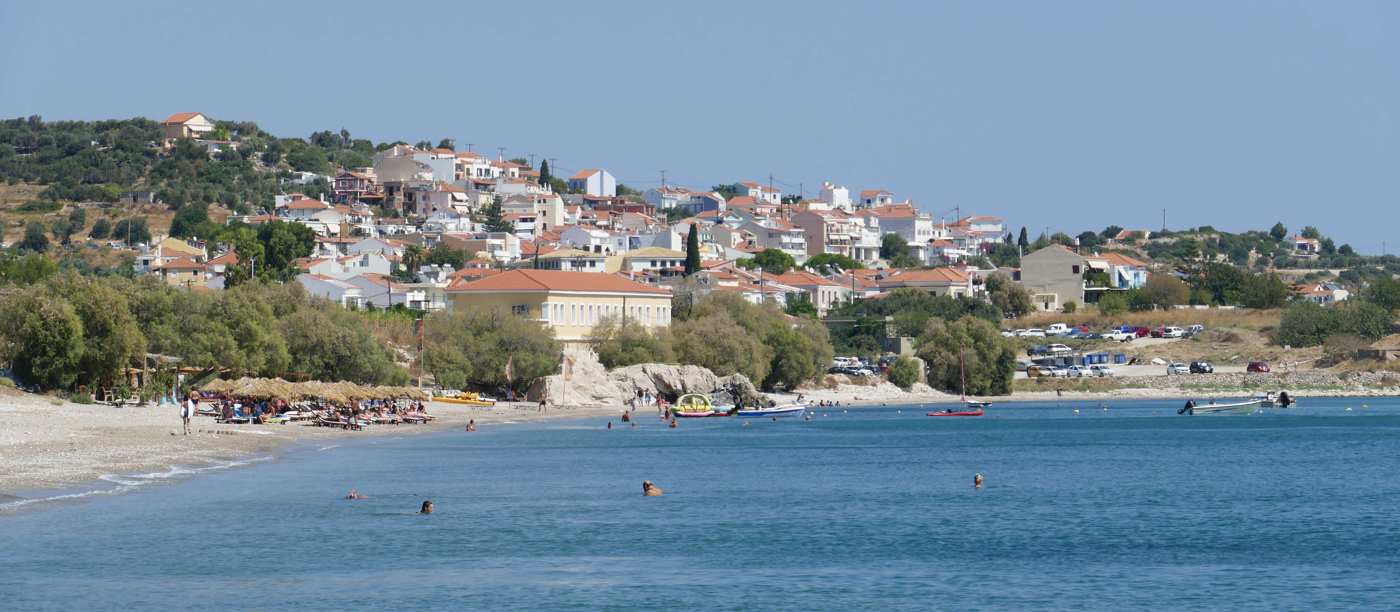
Mount Kerkis, known in antiquity as Kerketeas, is the highest mountain on Samos at about 1,434 metres. It rises steeply over the southwest of the island, straight from the sea above the beach villages of Votsalakia and Kampos. Bare grey limestone, deep gorges, caves and hidden chapels give the peak a wild character unusual for an Aegean island. The mountain dominates the western skyline and shapes the landscape, weather and beaches of this quieter corner of Samos. Plan the whole trip with Greece Tours.
Kerkis is a protected massif of rugged limestone that draws walkers, pilgrims and naturalists as much as beachgoers. A demanding marked trail climbs to the summit from Votsalakia and the monastery of Evangelistria. The top gives views across the Aegean to nearby islands and the Turkish coast. Cave churches such as Panagia Sarantaskaliotissa, old hermit cells and white chapels dot the mountain’s flanks. This guide covers the mountain and its height, the protected landscape, the summit hike and its trailheads, the chapels and caves, and the far-reaching views from the summit.
What is Mount Kerkis on Samos and how high is it?
Mount Kerkis, also called Kerketeas, is the highest mountain on Samos at about 1,434 metres. It rises steeply over the southwest of the island and dominates the horizon above the Votsalakia coast.
Mount Kerkis anchors the western half of Samos, a large green island in the eastern Aegean off the Turkish coast. The peak reaches about 1,434 metres and stands as the highest point on the island by a clear margin. Kerketeas, its ancient name, still appears on maps and trail signs beside the common modern form Kerkis. The mountain forms a steep mass of pale limestone that falls toward the sea along its western and southern flanks. From the ferry approach and from much of the island, its bare grey crest rises clear above the forested lower slopes.
The summit block often gathers cloud while the coast below stays bright and warm, a contrast that walkers learn to read carefully before any climb to the top.
The mountain sits in the southwest corner of Samos, a quieter, less-built part of the island than the northern resorts. Its lower slopes carry pine forest, olive groves and terraced fields that thin into bare rock and scree near the ridge. Two beach settlements, Votsalakia and Kampos, spread along the coast directly beneath the western face, sheltered from the meltemi wind. The road that circles the mountain links small villages such as Marathokampos, Kallithea and Drakei on its flanks. Marathokampos, a hillside village, looks down over the whole bay and the summit rising behind it.
Drivers reach this side from Pythagorio or Vathy in about an hour, following the south coast west past Ormos Marathokampos, the small fishing harbour that serves the villages below Kerkis.
Kerkis holds a strong place in the island’s identity and sightlines. Sailors used its cone as a landmark when approaching Samos from the west and south. The name Kerketeas belongs to the mountain in ancient sources, while Kerkis is the form heard on the island today. Local tradition links the peak and its caves to hermits and monks who withdrew to the heights over the centuries. The mountain also marks a clear divide on Samos: the greener, wetter west around Kerkis contrasts with the drier, gentler hills toward the east. The mountain rises straight from the sea. The vertical gain from shore to summit approaches the full 1,434 metres.
Which explains why the climb ranks among the hardest day walks on any Greek island.
Two summits crown the massif, with the higher one carrying the survey marker at about 1,434 metres. The ridge between them is bare, rocky and exposed, swept by wind for most of the year. Snow settles on the top through winter and lingers in shaded gullies into spring, unusual for an Aegean island. Below the rock, holm oak, wild olive and aromatic scrub of thyme, sage and oregano cover the slopes and scent the air. Griffon vultures and other raptors ride the updrafts along the cliffs, and the massif shelters rare plants found in few other places.
This mix of height, bare limestone and wild vegetation gives Kerkis a character closer to a small alpine range than to the low, dry hills of the neighbouring islands.
Why is the Mount Kerkis landscape on Samos protected and so rugged?
Mount Kerkis forms a rugged limestone massif protected under the European Natura network of conservation sites for its habitats and wildlife. Deep ravines, cliffs, caves and bare grey rock give the mountain its harsh, dramatic character.
Kerkis is built from hard crystalline limestone and marble, rock that weathers into sharp ridges, sinkholes and caves. Rainwater sinks quickly through the fissured stone, feeding springs lower down rather than surface streams on the heights. Steep gorges cut the flanks, and loose scree covers the ground below the summit cliffs. The bare grey rock of the upper mountain reflects light and stands out against the pine and oak of the lower slopes. Karst features such as caves and swallow-holes riddle the massif, and its caverns have served as chapels and hiding places over the centuries.
This geology explains both the mountain’s steepness and its dryness on top, where water drains away fast and only tough, drought-hardy plants take hold among the rocks and thin soil.
Protection of Kerkis covers the mountain as a Natura conservation area valued for its habitats, birds and plants. Griffon vultures nest on the high cliffs, and Bonelli’s eagles, buzzards and kestrels hunt the open ground and the deep ravines. The scrub and forest shelter reptiles, and the caves house bats, while rare endemic plants grow on the limestone and nowhere else nearby. Rules limit new building, road-cutting and disturbance across much of the massif, keeping the higher slopes wild and roadless. Walking the mountain ranks among the most rewarding things to do in Samos for anyone drawn to nature and quiet.
The terrain is fragile, so walkers keep to marked paths, carry out their rubbish and avoid disturbing nesting birds on the crags during the spring breeding season.
The landscape of Kerkis changes with height in clear bands up the mountain. Pine forest and olive terraces clothe the lower slopes, giving way to holm oak, arbutus and dense maquis on the middle flanks. Above the tree line, low thorny cushions of astragalus and wind-clipped scrub survive on bare limestone and gravel. Springs and small chapels mark points where water once drew hermits and shepherds to the heights. Fire has scarred parts of the mountain in past summers, and blackened trunks stand among the regrowth on the higher slopes. Deep, shaded gorges hold cooler, damper pockets where ferns and plane trees cluster along seasonal streams.
This banding of forest, scrub and bare rock over a short horizontal distance gives Kerkis a range of habitats rare on a single Aegean mountain.
Rugged terrain keeps most of Kerkis free of roads, so the mountain stays a wild block at the island’s western end. A rough track climbs part way from Votsalakia toward the Evangelistria monastery, but the upper slopes are reached only on foot. Shepherds still graze goats on the lower pastures, and beekeepers set hives among the thyme and heather that flower on the slopes. The protected status guards the birds, plants and caves while allowing walking, grazing and worship at the chapels to continue. Cloud often caps the summit even on clear days, drawn up the steep western face by rising warm air.
This wildness, so close to the beaches of Votsalakia and Kampos, is a large part of what draws walkers and naturalists to the southwest of the island.
How do you hike Mount Kerkis on Samos and where do the trails start?
Marked trails climb Mount Kerkis from the coastal village of Votsalakia and from the Evangelistria monastery on its southern flank. The route to the summit and back needs a full day, water, sturdy boots and an early start.
The main summit route starts at the monastery of Evangelistria, reached by a narrow road climbing inland from Votsalakia. Walkers leave the monastery courtyard and follow red waymarks up through pine and then open scrub onto the bare upper mountain. The path gains height steadily over rock and scree, with steep sections near the ridge that call for care and free hands. Reaching the summit block from the monastery takes roughly three to four hours of climbing, depending on pace, rests and fitness. The final stretch crosses steep, exposed rock to the old survey marker at about 1,434 metres.
Walkers usually start at first light to reach the top before the midday heat and afternoon cloud build over the exposed western face of the mountain.
A second approach climbs directly from Votsalakia, the beach village strung along the southwest shore below the peak. The trail leaves the back of the settlement and rises through terraces and pine before joining the higher ground toward the summit. This line is longer from the sea, since it gains the full height from near sea level to the top. Walkers on either route pass close to chapels and old cells tucked into the rock on the mountain’s flank. The long pebble strands of Votsalakia and Kampos, among the quietest Samos beaches, wait at the foot of the climb for a cooling swim afterwards.
Buses to this corner are sparse, so most walkers reach the trailheads by hire car or taxi from Pythagorio, Vathy or the nearer village of Marathokampos.
Preparation matters on Kerkis more than on any other walk on Samos. The summit route has little shade above the trees and no water once past the monastery spring. Walkers carry at least two to three litres each, sun protection, a hat and layers for the cool, windy top. Sturdy boots grip the loose scree and sharp limestone far better than trainers. The waymarks fade in places on the open rock, so a map, a charged phone and an eye for the next paint mark help on the descent. Starting early, turning back in bad weather and telling someone the plan all lower the risk.
Summer heat makes the climb hardest in July and August, when late spring or September offer cooler, safer conditions for the long day out.
Not every visitor tackles the full summit, and Kerkis rewards shorter outings too. A walk from Votsalakia up to the Evangelistria monastery and back gives forest, chapels and wide sea views without the exposed final climb. The circuit road around the mountain links Marathokampos, Kallithea and the tiny western hamlets of Votsalakia and Drakei for drivers who prefer to admire the peak from below. Guided walks led by local mountain guides help less experienced hikers attempt the top safely in season. The path forms part of a wider network of marked trails across western Samos, linking villages, springs and chapels on the flanks of Kerkis.
Whichever version walkers choose, the mountain offers a full day of effort and quiet high above the beaches and the harbour of Ormos Marathokampos.
What chapels, hermitages and caves does Mount Kerkis on Samos hold?
Mount Kerkis holds scattered chapels, old hermit cells and caves used for worship across its flanks. The cave church of Panagia Sarantaskaliotissa, reached by a long rock stairway, and the Evangelistria monastery are the best known of these sites.
The cave church of Panagia Sarantaskaliotissa hides high on the flank of Kerkis, its name meaning ‘Our Lady of the Forty Steps’. A long, rough stone stairway cut into the rock leads down or up to the cave mouth, giving the shrine its name. Inside the cavern a small chapel holds icons and a spring, lit by candles in the cool dark of the rock. Pilgrims and walkers climb to it for the feast of the Virgin in late summer, when the cave draws people from the villages below. The setting, deep in the mountain with the sea far beneath, has drawn worshippers to this cave across the centuries.
Reaching Sarantaskaliotissa needs a steep walk, so sturdy shoes and water suit the approach even for the short pilgrimage.
The monastery of Evangelistria stands on the southern flank of Kerkis, above Votsalakia and below the bare summit rock. A working religious house, it marks the start of the main path to the top and offers walkers a shaded courtyard and a spring before the climb. Whitewashed walls, a small church and cells enclose a quiet yard planted with cypress and fruit trees. The monastery keeps the tradition of monastic life on the mountain that once filled its caves and cells with hermits. Its feast and the views over the southwest coast draw visitors who never intend to climb higher. The road up from Votsalakia is narrow and steep.
Drivers take it slowly, and the last stretch to the gate rewards them with the mountain rising sheer behind the buildings.
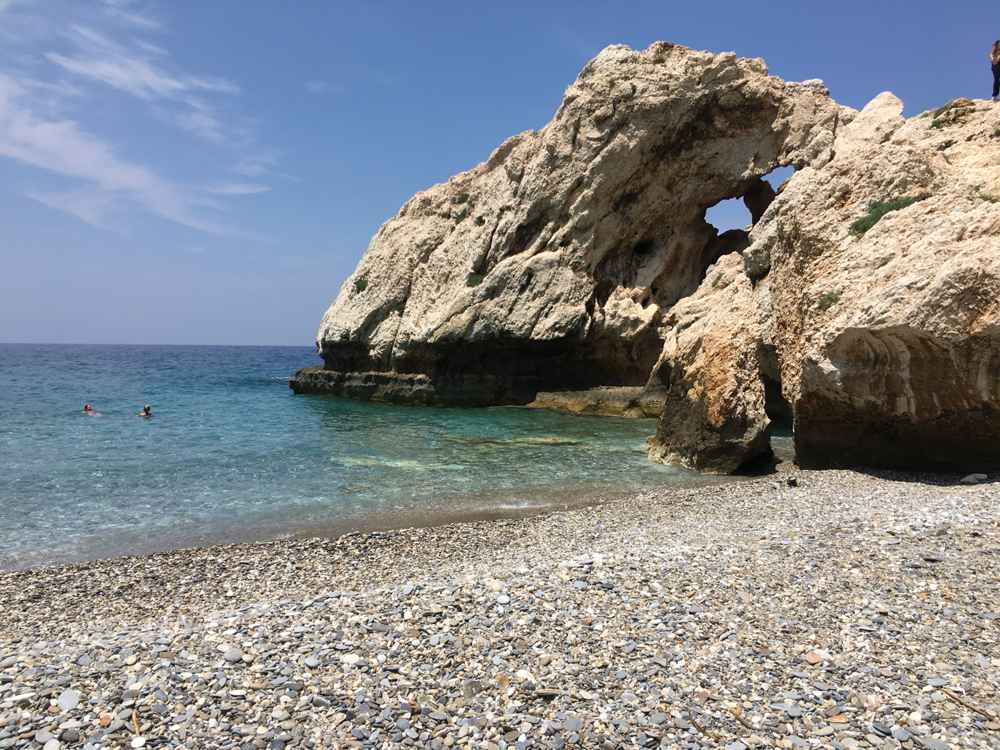
Caves riddle the limestone of Kerkis, and over time they have served as shelters, chapels and hermit retreats. Small whitewashed chapels stand at springs and cave mouths across the flanks, kept by the villages and visited on saints’ days. Old cells and half-ruined hermitages mark where monks and ascetics once lived apart on the mountain, drawn by its remoteness and caves. One tradition even links a cave on Kerkis to Pythagoras, said to have withdrawn to the mountain, though the ancient sources are thin. Shepherds and walkers still use the caverns as shelter from sun and storm on the high ground.
These caves, chapels and cells give the mountain a human, sacred layer beneath its wild rock, tying the summit walk to a long history of worship and solitude on Samos.
Faith and the mountain stay closely tied on this side of Samos through the year. Feast days at Sarantaskaliotissa and Evangelistria fill the chapels with candles, incense and villagers who climb the steep paths together. The white chapels dotting the green and grey slopes act as waypoints for walkers as well as places of prayer. Springs beside them once watered hermits and shepherds and still refresh those who pass on foot. The blend of wild limestone, caves and small shrines gives Kerkis a quiet, spiritual weight beyond its role as the island’s high peak. Visitors who climb to the cave church or the monastery meet this older Samos, where the mountain.
Its water and its saints have shaped village life on the southwest coast for a very long time.
What can you see from the summit of Mount Kerkis on Samos?
The summit of Mount Kerkis opens a wide view across the eastern Aegean, taking in much of Samos, the Turkish coast and nearby islands. On clear mornings the panorama stretches from Ikaria and Fourni to the mountains of Asia Minor.
The view east from the summit falls onto the Turkish mainland across the narrow Mycale strait. The strait pinches to about 1.2 km at its narrowest point, so the hills and towns of Asia Minor stand close and sharply clear. The Dilek peninsula and the ranges behind Kusadasi fill the eastern horizon beyond the blue channel. Much of Samos spreads below, from Pythagorio and the airport in the southeast to Karlovasi in the northwest. The green ridge of Mt Ampelos rises across the island, with Vathy hidden in its deep northern bay. This sweep from the Greek island to the Turkish shore, taken in at a single glance.
Is one of the strongest reasons walkers make the long, hard climb to the top of Kerkis.
The western and northern view from Kerkis reaches out over the open Aegean toward a ring of islands. Ikaria lies close to the west, its long mountain wall often the first land beyond the sea channel. The scattered islets of Fourni sit between Samos and Ikaria, low and dry on the water. Farther off, Patmos, Chios and the peaks of the Cyclades show on clear days as pale shapes on the horizon. Ships track slowly across the channels between the islands, tiny from the height of the summit.
This wide Aegean panorama, changing with the light and haze through the day, rewards the early start, since the clearest, longest views usually come in the cool hours soon after dawn before cloud and heat haze rise.
Conditions at the top shape the view as much as distance does. Wind sweeps the bare summit rock almost daily, and cloud can wrap the peak within minutes even after a clear dawn. Morning light throws the shadow of Kerkis west over the sea and picks out the ridges and gorges of the mountain below. Haze from summer heat softens the far islands by midday, so the sharpest views of Turkey and the Aegean come early. The bare rock gives an open horizon in every direction, unbroken by trees or higher ground. Standing at the marker at about 1,434 metres, walkers see the whole shape of Samos at once.
The strait to Turkey and the ring of Aegean islands, a reward that repays the hard climb from the coast below.
Timing turns a good view from Kerkis into an unbroken one. Late spring and early autumn bring clearer air than high summer, when heat haze thickens over the sea. A dawn start puts walkers on the summit while the light is low and the air still cool and clean. Winter and early spring can leave snow on the top, adding white to the grey rock but demanding real mountain skill. The wind almost always blows on the crest, so a windproof layer matters even in warm weather. Walkers who reach the marker on a clear morning look out over Samos, the Mycale strait.
The Turkish ranges and a scatter of distant Aegean islands, the widest and most far-reaching view on the whole island of Samos.
What beaches lie beneath Mount Kerkis on the southwest coast of Samos?
Votsalakia and Balos stretch along the southwest shore directly under Mount Kerkis. These long pebble strands anchor the island’s quietest resort coast, backed by the mountain’s steep slopes and reached by the coastal road.
Votsalakia, also signed as Kampos, forms the main beach settlement under Mount Kerkis on the southwest coast of Samos. The strand runs for roughly a kilometre in pale pebbles and coarse sand, sloping into clear water that deepens fast. A single road behind the beach holds tavernas, rooms and small markets serving a low-key resort strip. Tamarisk trees give patchy shade, and sunbeds with umbrellas cover parts of the front in season. The mountain rises straight behind the village, so afternoon shadow reaches the sand earlier than on open coasts. Swimmers find calm water on still mornings, though the strand faces the open sea toward the southwest.
Families and older visitors favour Votsalakia for its flat access and steady, shallow entry near the western end.
Balos lies a short drive west of Votsalakia, a longer and wilder pebble beach under the same mountain wall. The shore here stays less developed, with scattered tavernas and rooms rather than a full resort strip. Coarse grey pebbles line a broad bay that faces southwest into the afternoon light and occasional swell. The water runs deep and clean, drawing snorkellers along the rocky edges at each end of the bay. Parking sits on the dirt and gravel behind the beach, close to the water’s edge. Fewer sunbeds and quieter sand make Balos a choice for visitors who want space away from the busier Votsalakia front.
The two beaches share the same road, so walking or driving between them takes only minutes along the coastal road.
The southwest coast under Mount Kerkis offers the island’s warmest swimming on calm days, sheltered from the north meltemi. The wind cools Kokkari and the north shore, yet Votsalakia and Balos often stay flat and clear through the morning. Small coves and rocky inlets break the coast between the two main beaches, reachable on foot along the shore. Seasonal canteens sell water, coffee and snacks close to the sand, so a full beach day needs little planning. Shade stays limited outside the tamarisk fringe, so an umbrella helps through midday heat. Snorkelling suits the clear water and rocky margins, where small fish gather around the submerged stones.
Sunsets fall behind the mountain and out over the sea, closing the day along this quiet, west-facing coast that crowds reach.
Walkers often pair a Mount Kerkis morning with an afternoon on these beaches, cooling tired legs in the sea below the trail. The village of Votsalakia sits at one of the main trailheads, so a climb can start and end at the sand. Buses reach the southwest in summer, though a hire car gives the surest access to both beaches and the mountain paths. The road from Pythagorio and the airport runs west along the south coast, then climbs and drops toward the Kerkis shore. Ormos Marathokampos, a small harbour just east, adds fishing boats, tavernas and a jetty to the same stretch.
The combination of high mountain and quiet strand makes the southwest a distinct corner of Samos, apart from the busy northern resorts.
How hikers plan the timing, safety and gear for the full Mount Kerkis climb?
Hikers plan the Mount Kerkis summit as a full day and start at first light. Sturdy boots, two to three litres of water, sun cover and a map of the marked route keep the demanding climb safe.
An early start matters most on Mount Kerkis, where the full climb and descent fill about eight to ten hours for most walkers on foot. A dawn departure puts the hardest, most exposed sections behind before the midday heat builds strongly on the open upper slopes. The southwest face bakes through the afternoon, with little shade above the tree line near the summit ridge. Walkers turn back by early afternoon to leave a safe margin for the long descent back to Votsalakia or the Evangelistria monastery. Summer days give long light, yet the fierce heat raises the risk on the higher rock.
Cooler months shorten the daylight window, so an early departure stays the rule across the walking season on this steep and rugged peak above the sea.
The marked route up Mount Kerkis follows painted waymarks and cairns, though sections cross bare limestone where the path fades. A downloaded offline map and a charged phone help hold the line where waymarks thin near the ridge. Loose scree and steep rock demand care on the descent, when tired legs slip most on the sharp limestone. Cloud can wrap the summit fast, cutting visibility on the upper slopes even on clear mornings below. A walking partner adds safety on the remote higher sections, far from roads and quick help. A shared plan and an expected return time matter, since phone signal drops in the deep folds of the massif.
Steady pace and full attention keep the rugged terrain manageable for fit and prepared walkers.
Water leads the packing list for Mount Kerkis, with two to three litres per person and no springs on the upper route. Trail food such as nuts, fruit and bread keeps energy steady across the long hours of climbing and descending. Sturdy hiking boots with grip protect ankles on the loose scree, far better than trainers on the sharp rock. A hat, sunglasses and high-factor sunscreen guard against the strong Aegean sun on the exposed slopes. A light layer helps at the breezy summit, where wind cools the ridge even on hot days below. A basic first-aid kit, a whistle and a head torch cover the small emergencies on a full mountain day.
Poles ease the steep descent and spare the knees on the long drop to the coast.
Weather shapes safety on Mount Kerkis more than any gear choice across the walking season. Strong meltemi wind buffets the ridge in high summer, while heat pushes the risk on the exposed rock. Spring and autumn give steadier air and cooler climbing, the surest windows for the full ascent. Rain and low cloud turn the limestone slick and hide the waymarks, so walkers postpone the summit in poor conditions. A softer day near Karlovasi at the Potami waterfalls offers a shaded river walk when the high peak stays out of reach. A forecast check the night before guides the call between the summit and a gentler plan.
Respect for the mountain’s scale keeps the day safe, since Kerkis rises far above every road on Samos.
What easier walks cross the lower slopes of Mount Kerkis for visitors who skip the summit?
Gentle paths cross the lower slopes of Mount Kerkis around Votsalakia, Kosmadei and the Evangelistria monastery. These shorter routes reach chapels, viewpoints and shaded ravines on easy grades, giving the mountain’s scenery without the demanding, full-day ascent to the summit.
A short walk to the Evangelistria monastery gives the easiest taste of Mount Kerkis from the southwest. A narrow road and path climb from above Votsalakia to the whitewashed hillside monastery on the lower flank of the peak. The route gains height gently through pine and scrub, opening views over the Votsalakia and Balos coast below. The monastery courtyard offers shade, water and a rest point where the hard summit trail begins for those going higher. Non-summiters turn back here after an hour or two, well satisfied with the coastal panorama. The walk suits families and casual visitors, far shorter and safer than the full ascent above.
Morning light and cooler air make the climb to the monastery pleasant before the midday heat settles in.
The village of Kosmadei sits on the northwest flank of Mount Kerkis, a base for gentle walks among terraces and springs. A quiet lane and marked paths link Kosmadei with Drakei and Kallithea, the remote hamlets ringing the mountain’s western end. These routes run mostly level or gently graded, through olive groves, vineyards and old stone threshing floors. Walkers pass chapels and springs along the way, resting in the shade of plane trees near the water. The paths give wide views west over the sea toward Ikaria and Fourni on clear days. Buses reach these villages rarely, so a hire car opens the western trailheads for a half-day of easy walking.
The western slopes stay green and quiet, a contrast to the beach strip on the south coast.
Walkers who find even the lower Kerkis paths too remote often turn to the greener, gentler Ampelos side of Samos. The north-slope villages give shorter, shadier forest walks with tavernas at each end, an easier day than the bare limestone of Kerkis. Manolates anchors that network, its cobbled lanes and marked trails linking gently to Vourliotes through the pines. The Kerkis lower slopes stay rockier and more open, better suited to walkers who want quiet and space. Both sides reward a half-day on foot without the commitment of the summit climb. The choice between them comes down to shade and company against solitude and raw mountain scenery.
The southwest paths under Kerkis stay the wilder, emptier option for a gentle mountain morning on southwest Samos.
A level coastal walk runs west from Votsalakia along the shore beneath Mount Kerkis toward quieter coves. The track passes small pebble inlets and rocky points, with the mountain wall rising sharply on the inland side. Swimmers break the walk at empty coves reached only on foot, away from the sunbeds of the main beach. The path stays close to sea level, an easy option on a hot day when the summit sits out of reach. Short spur trails climb a little toward chapels on the lower slope, each a brief detour with a sea view. Turnaround points suit any fitness, so walkers set their own distance along the coast.
This shoreline route gives the flavour of the Kerkis massif without a single steep or exposed section.
How do visitors reach the southwest of Samos and the Mount Kerkis trailheads by car?
Drivers reach the Mount Kerkis trailheads on the southwest road through Marathokampos to Votsalakia and Kosmadei. The route runs about 50 km from Pythagorio and the airport, climbing over the island’s spine before dropping to the beaches under the peak.
The drive from Pythagorio and the airport to the Kerkis coast takes about an hour across the south of Samos. The road runs west through Chora and Mesogeio, then over rolling farmland toward the wide Marathokampos bay. A steady climb crosses the low saddle between the peaks of Mt Ampelos and Mt Kerkis before the descent to the coast. The final stretch drops through Marathokampos village to the shore at Ormos Marathokampos, Votsalakia and Balos. Signposts point to Votsalakia and Kampos, the main beach settlements at the foot of the mountain. Petrol stations thin out west of Pythagorio, so a full tank before leaving the airport area helps.
The paved main road stays in fair condition, though bends and gradients slow the pace over the green hills.
Drivers from Vathy and the north coast reach Mount Kerkis on the road through Karlovasi and the west. The route runs along the north shore past Kokkari, then through Karlovasi, the island’s second ferry port and largest western town. From Karlovasi the road climbs steadily southwest over the shoulder of the mountain toward Kosmadei, Drakei and the western trailheads. This northern approach reaches the remote west-end villages more directly than the southern beach road does. The Votsalakia side, by contrast, sits closer to the southwest coast road from Marathokampos. Two roads therefore ring Mount Kerkis, one along the south to the beaches and one across the west to the quiet highland hamlets.
The chosen trailhead and the base for the night decide the best approach.
Parking at the Votsalakia trailhead sits near the beach and the marked start of the monastery track above the village. A rough track continues toward Evangelistria, where a small clearing holds parking close to the higher trail. West-end roads to Drakei and Kallithea narrow to rough single lanes with blind bends above steep drops. A small hire car handles these roads, though care and low speed matter on the loose gravel shoulders. Meeting a vehicle on a narrow bend calls for one car to reverse to a wider passing spot. Fuel, water and snacks are wise before the western villages, where shops and pumps stay scarce.
An early drive beats both the heat and any slow tour traffic on the coast road to the beaches.
Buses serve the southwest of Samos in the summer months, linking Vathy and Karlovasi with Marathokampos and Votsalakia. The service runs on a limited timetable in season, enough for a beach visit but tight for a dawn climb. Taxis reach Votsalakia from the main towns, though the distance makes the fare a notable cost each way. Walkers without a car often base themselves at Votsalakia for a night to start the summit trail at first light. A room near the trailhead removes the long morning drive and the pressure of a fixed bus time. Scooters and small motorbikes suit the coast road, yet the exposed mountain and heat make them a poor choice for climbers.
A hire car stays the most flexible way to match an early start with a full mountain day.
Who does Mount Kerkis suit, and who choose a gentler part of Samos?
Mount Kerkis suits fit, experienced hikers who want a demanding full-day summit and wide Aegean views. Casual visitors, families and beach-first travellers gain more from the coastal walks, the monastery path and the beaches beneath the peak.
Experienced mountain walkers gain the most from Mount Kerkis, the highest and hardest climb on Samos. The full ascent rewards fitness and hill experience with a wild limestone summit and views across the eastern Aegean. Walkers used to long days on rough ground handle the scree, the heat and the route-finding with confidence. The lack of crowds appeals to those who prefer solitude over the busy trails of larger Greek peaks. A sense of remote wilderness marks the upper mountain, far from the resorts on the coast below. Hikers who track their own water, pace and weather find Kerkis a satisfying test on a Greek island.
The peak fills a serious walking day for anyone chasing the highest point in this corner of the Aegean.
Families with young children and casual travellers gain little from the full Kerkis summit, a long and exposed summit climb. The coastal walks, the monastery track and the beaches at Votsalakia and Balos suit them far better. Older visitors and those short on time enjoy the lower slopes without the effort and risk of the top. Beach-first travellers pair a swim under the mountain with a short chapel walk for a full, easy day. Casual hikers who still want height reach the Evangelistria monastery for a taste of the massif. The southwest keeps plenty for non-climbers, from quiet coves to shaded village lanes on the flanks.
A day matched to fitness and interest turns Kerkis into a reward rather than a strain for every visitor.
Mount Kerkis fits a wider Samos trip as one bold contrast on the large, varied island. Travellers pair the raw southwest peak with the green mountain villages, the UNESCO ancient sights and the north-coast beaches. A week on Samos leaves room for the Kerkis coast alongside Pythagorio, Vathy and the wine slopes of Ampelos. The mountain gives the trip its wild, high note, set against the deep culture of the ancient sites. Even non-climbers gain from a drive to the southwest, where the peak towers over the quiet Votsalakia strand. The scale of Kerkis reminds visitors that Samos ranks among the greener, more mountainous Greek islands.
A balanced plan mixes the summit or its lower walks with beaches, villages and the island’s sweet Muscat wine.
Mount Kerkis stands as the landmark of western Samos, visible from passing ferries, beaches and villages across the island. Sailors have long used its bulk as a seamark on the approach to the harbours of the north coast. The peak divides weather too, catching cloud on its heights while the coast below stays clear and warm. The mountain anchors the island’s western half, admired from a beach lounger or climbed to the top. Its protected slopes shelter wildlife and old chapels, a wild counterpoint to the resorts and the ancient sites. The choice to climb or simply to look up rests with each visitor and the day’s plan.
Mount Kerkis rewards both the summit hiker and the beach walker who never leaves the sand below.
Frequently Asked Questions
How hard is the Mount Kerkis summit climb?
The Mount Kerkis summit ranks as a hard, strenuous climb, the toughest walk on Samos. The trail gains over 1,400 metres from near sea level to the top, on steep and rough ground. Sections cross loose scree and bare limestone, where the path fades and route-finding needs attention. The upper slopes lie open and exposed, with little shade against the strong Aegean sun. The climb suits fit walkers with hill experience and a head for steep, remote terrain. Beginners and casual visitors find the full ascent too demanding, especially in summer heat. The descent tests tired legs on the sharp rock, often harder than the climb up.
Good boots, plenty of water and an early start make the day manageable for prepared hikers. Cloud can close over the summit fast, adding to the challenge on the higher rock. Anyone unsure of their fitness starts instead with the monastery walk on the lower slopes. Steady pace and preparation turn a hard climb into a rewarding mountain day.
How long does it take to climb Mount Kerkis?
The full Mount Kerkis climb takes about eight to ten hours for the round trip to the summit. The ascent from Votsalakia or the Evangelistria monastery fills roughly four to five hours to the top. The descent adds another three to four hours, slower on the loose, steep limestone. Rest stops, photos and lunch stretch the day toward the longer end of that range. Fit, fast walkers reach the summit sooner, while others take the full daylight window. An early start near dawn leaves a safe margin for the long return before dark. The times shift with heat, wind and the walker’s pace on the rough ground.
Cloud or poor footing slows the upper sections and adds to the total. Most hikers plan a full day and carry food and water for the whole route. A pre-dawn breakfast and a first-light start keep the schedule comfortable. Turning back by early afternoon protects the descent, even for a strong and steady group.
Do you need a guide to climb Mount Kerkis?
A guide is not required to climb Mount Kerkis, since a marked trail leads to the summit. Confident, experienced hikers follow the waymarks and cairns on their own with a map and preparation. A guide still helps on this remote peak, where the path fades over bare limestone near the ridge. Local walking guides know the route, the water points and the fastest line through the scree. Solo walkers without mountain experience benefit most from a guide or a walking partner. An offline map, a charged phone and a downloaded track cover navigation for self-guided hikers. A shared plan and return time matter, since phone signal drops on the massif.
Groups often climb together for safety on the exposed higher sections, far from quick help. A guide adds local knowledge, safety and stories of the chapels and caves on the mountain. Fit, prepared walkers manage alone, while the cautious gain peace of mind from expert company.
How much water and what gear do you need for Mount Kerkis?
Two to three litres of water per person lead the gear list for Mount Kerkis. No springs run on the upper route, so walkers carry all their water from the start. Sturdy hiking boots with good grip protect ankles on the loose scree and sharp limestone. A hat, sunglasses and high-factor sunscreen guard against the strong sun on the exposed slopes. A light layer covers the breezy summit, where wind cools the ridge even on hot days. Trail food such as nuts, fruit and bread keeps energy steady through the long hours. A basic first-aid kit, a whistle and a head torch handle small emergencies.
Walking poles ease the steep descent and spare the knees on the long drop. An offline map and a charged phone cover navigation where the waymarks thin out. A small, comfortable backpack carries the load without strain on the climb. Light but complete kit keeps the full mountain day safe and manageable for prepared hikers.
Can you climb Mount Kerkis with kids?
Young children do not suit the full Mount Kerkis summit, a long and exposed climb. The steep scree, the heat and the eight-to-ten-hour length make the top unsafe for small legs. Older teenagers with hiking experience and fitness handle the ascent alongside prepared adults. Families with young kids choose the lower slopes instead of the demanding summit trail. The short walk to the Evangelistria monastery gives children a taste of the mountain without the risk. The coastal path from Votsalakia offers a level, shaded stroll to quiet coves for a swim. These easy options pair a picnic and a beach day with a gentle look at the peak.
Shade, water and a short distance keep children comfortable on the lower routes. The full climb waits for older, fitter walkers ready for a serious full mountain day. A family matches the outing to the youngest walker, turning Kerkis into a fun day rather than a struggle.
What are the easier alternatives to the Mount Kerkis summit?
Easier alternatives to the Mount Kerkis summit ring the mountain’s lower slopes and coast. The walk to the Evangelistria monastery climbs gently from Votsalakia for wide views over the southwest coast. A level coastal path runs west from Votsalakia to quiet pebble coves beneath the mountain wall. The west-end villages of Kosmadei, Drakei and Kallithea link by gentle lanes through terraces and springs. These half-day walks give the scenery of Kerkis without the scree, heat and length of the top. The beaches of Votsalakia and Balos offer a full day of swimming under the peak. Chapels and viewpoints on the lower slopes reward short spur trails from the coast road.
Walkers who want more shade turn to the green Ampelos villages on the north side. Each option matches a gentle pace, family group or a hot day when the summit stays out. The southwest keeps plenty for visitors who skip the demanding full climb to the top.
What is the best season to climb Mount Kerkis?
Spring and autumn make the best seasons to climb Mount Kerkis, with mild air and steady footing underfoot. May, June, September and October give cooler temperatures for the long, exposed summit ascent. Wildflowers cover the slopes in spring, while autumn brings clear light and calmer wind. High summer turns the climb hard, as heat builds fast on the shadeless upper rock. July and August suit the beaches below far better than the demanding summit trail. The meltemi wind cools the coast in summer, yet buffets the exposed ridge near the top. Winter leaves the peak cold, wet and often cloud-bound, poor for the full ascent to the top.
Rain slicks the limestone and hides the waymarks, so walkers avoid the summit in storms. An early start stays wise in every season, beating the heat and the afternoon cloud. Clear, cool and calm days in spring or autumn give the surest window for the top of Samos.