
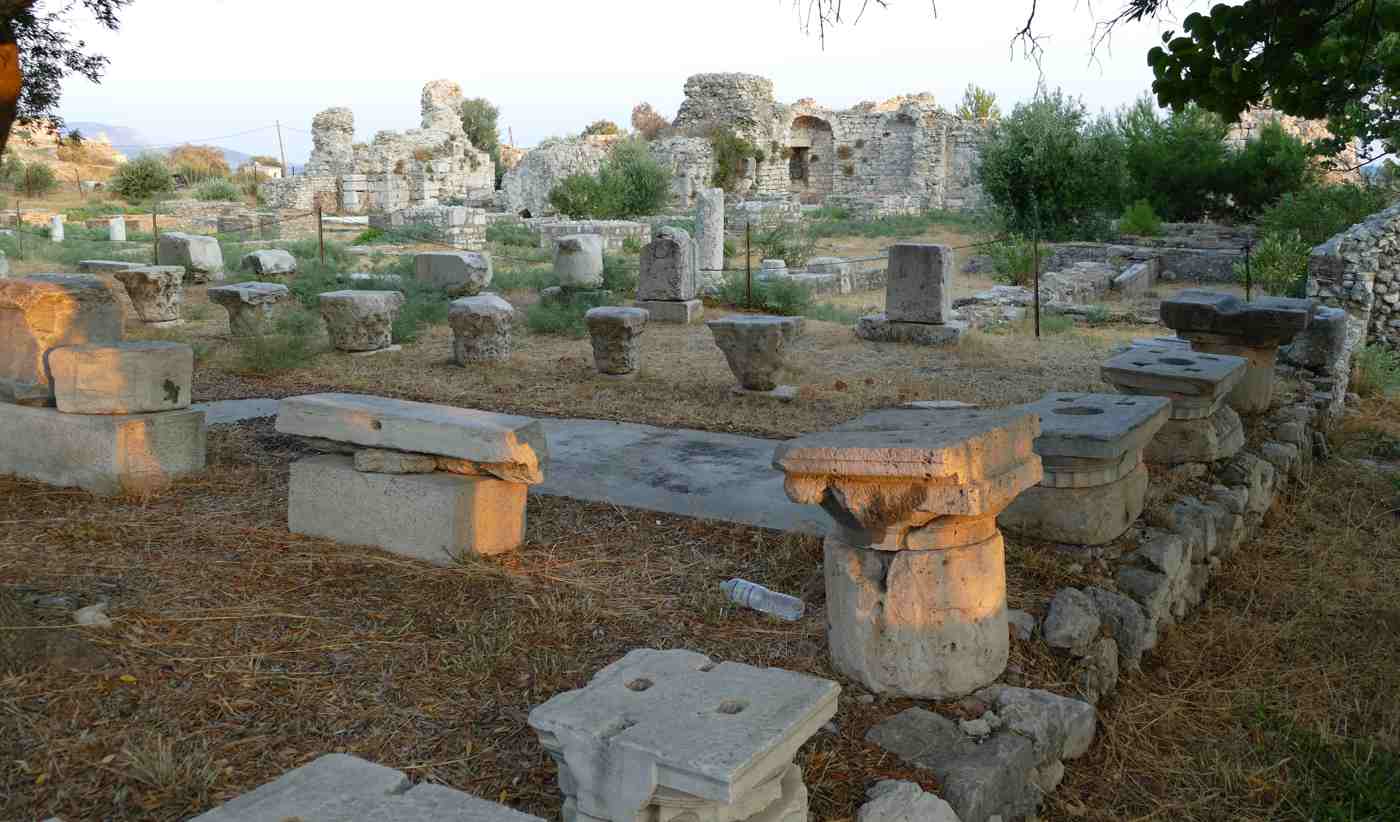
Manolates is a traditional stone village high on the north slopes of Mount Ampelos on the Greek island of Samos. It sits above the coastal resort of Kokkari at around 350 metres, reached by a winding road through pine forest and vineyard. The village is known for its car-free lanes of stepped stone, its houses draped in flowers, and its terraces looking out over the valley to the sea. Family-run tavernas, small craft workshops, and marked walking trails to Vourliotes and the coast fill the compact centre. Cool summer air, wooded ravines and singing nightingales set Manolates apart from the hot beaches below. Plan the whole trip with Greece Tours.
This guide covers the village, its setting, its lanes, its tavernas and crafts, and its climate.
Manolates ranks among the best-known mountain villages of Samos, together with neighbouring Vourliotes on the same green flank of Ampelos. The island is large and mountainous, and its interior holds a string of stone hamlets above the resorts of the coast. Manolates draws visitors up from the beaches for its cool air, its flowered alleys, its valley views and its walking trails. The terraced Muscat vineyards that made Samos wine famous climb the slopes around the village. Reaching Manolates means a drive or walk up the winding north face from Kokkari, gaining height in tight bends.
The reward is a quiet, car-free village of stone and flowers, set among forest and vineyard high above the Aegean, cool even in the heat of summer.
What is Manolates and where does the hillside village sit on Mount Ampelos?
Manolates is a traditional hillside village on the north slopes of Mount Ampelos on Samos, sitting above Kokkari and the coast among terraced vineyards, stone houses and pine forest at around 350 metres altitude.
Manolates crowns a green ridge on the northern flank of Mount Ampelos, the second high massif of the island after Mount Kerkis. The village grew as a farming settlement whose families worked vineyards and orchards on the terraces below. Grey stone houses stack up the slope in tight rows, their balconies hung with pots of geraniums and bougainvillea. Wooden doors, painted shutters and narrow steps give the place its old character. The altitude of around 350 metres keeps Manolates cooler than the shore, and pine, plane and chestnut trees shade the surrounding ravines. From the upper lanes the ground falls away to the sea.
Most houses look north over the vineyards toward the blue water of the north coast far below. A view that defines daily life here.
Manolates ranks among the best-known mountain villages of Samos, together with neighbouring Vourliotes on the same slope. The wider island is large, green and mountainous, and its interior holds a string of such stone hamlets above the resorts. Manolates keeps a resident population that thins in winter and swells with visitors in the warm months. The village has no through traffic, since the road ends at its edge and the lanes climb by steps. A small square, a church with a bell tower, and a handful of family-run tavernas form the centre. Water runs from old fountains, and cats doze on warm stone.
The pace stays slow, tied to the farming calendar of the terraces and the passage of walkers who pause here between trails.
Stone remains the signature material of Manolates, quarried locally and laid without much mortar in the oldest walls. Roofs of tile and timber, thick lintels over doorways, and small windows suit the mountain weather. Restoration has revived houses as homes and guest rooms while keeping the traditional face of the village. Flowers spill from every ledge, and vines shade the narrow passages in summer. The layout follows the contour, so lanes bend and rise rather than run straight. Steps of worn stone connect one level to the next, and mules once carried goods where cars cannot go.
This compact, vertical plan is typical of Aegean mountain villages built for shade, defence and the steep ground of Mount Ampelos. The result feels grown from the hillside rather than placed upon it.
Mount Ampelos, also spelled Ambelos, forms the long green spine of central and eastern Samos, distinct from the higher, barer Mount Kerkis in the west. Its name means ‘vine’ in Greek, a fitting label for a slope wrapped in Muscat terraces. Springs rise across the massif and feed the streams that cut the shaded ravines around Manolates. Forests of black pine, plane and oak clothe the upper ground, home to birds and butterflies. Marked trails cross the mountain, linking villages, chapels and old threshing floors. Manolates sits near the middle of this walking country, a natural base for exploring the range.
The green cover, running water and steady breeze explain why the mountain villages grew here rather than on the dry lower slopes near the sea.
How does Manolates sit above Kokkari, and what is the winding approach road like?
Manolates lies above the north-coast village of Kokkari, reached by a winding paved road that climbs about 8 km through pine and vineyard from the shore, gaining height in tight bends past Vourliotes and the terraced slopes.
The approach to Manolates begins on the coast at Kokkari, the fishing and windsurf village about 10 km west of Vathy. From the shore road a signed turning heads inland and starts to climb the northern face of Mount Ampelos. The route twists through pine woods and past terraced vineyards, gaining height in a series of hairpin bends. Vourliotes appears first, set on its own shoulder of the slope, before the road continues up to Manolates near the end. The drive covers roughly 8 km from the coast and takes about twenty minutes at an easy pace. Buses run up from the coast in the warm season, though visitors drive or walk the marked paths.
Each bend opens a wider view back over Kokkari and the sea.
Manolates stands at around 350 metres, high enough to command a broad panorama of the north coast. The view stretches over the vineyard terraces and pine ridges to the blue line of the Aegean below. On clear days the coast of Turkey shows across the water beyond the Mycale strait. This elevated setting gives the village its cool air and its long light at sunset. The land drops sharply from the houses into wooded ravines, so the horizon feels wide and open. Vourliotes, the nearest village, sits a short distance east on the same flank of Mount Ampelos. Footpaths and the road tie the two together, and both look out over the same sweep of coast.
The height and the greenery set these villages apart from the beaches far below.
The road to Manolates rewards slow driving, since the bends are tight and the surface narrow in places. Passing spots appear at intervals, and traffic thins above Vourliotes where the road narrows further. A small parking area sits at the edge of the village, because the lanes beyond take steps and cannot admit cars. Walkers reach Manolates on marked trails from Kokkari and from the neighbouring valleys, climbing through pine and terrace. The ascent on foot takes a couple of hours from the coast, following old paths once used between village and shore. Cyclists and motorbikes also tackle the climb in the cooler hours.
The route forms part of a wider network of mountain roads that links the villages of northern Ampelos, threading vineyards, chestnut groves and running streams along the way.
Kokkari serves as the natural gateway to Manolates, offering the closest beaches, buses and services on the coast. Its pebble bay and harbour lie at the foot of the climb, and the beaches of Tsamadou and Lemonakia sit just to the west. Most visitors base themselves on the coast and drive up to the mountain villages for a meal or a walk. The contrast is sharp: within twenty minutes the busy shore gives way to quiet stone lanes and cool forest air. Signposts on the coast road mark the turning clearly, and the route is easy to follow.
This link between beach and mountain defines a day on northern Samos, pairing a morning swim with an afternoon among the vineyards and tavernas of Manolates high above the water.
Why are the flowered lanes of Manolates closed to cars, and what are its stone houses like?
Manolates keeps its lanes closed to cars, a maze of stepped stone alleys threading between grey houses draped in flowers. Pots of geraniums, jasmine and bougainvillea line the passages, and vines arch overhead to shade the narrow, climbing paths.
Cars stop at the edge of Manolates, so the heart of the village belongs to walkers alone. The lanes are too narrow and too steep for vehicles, laid instead as steps and ramps of worn stone. This car-free plan keeps the village quiet, with only footsteps, birdsong and the clink of taverna glasses breaking the calm. Flowers grow at every turn, trained up walls and spilling from tins, pots and old olive jars. Residents tend these displays through the warm months, so the alleys stay bright with colour. Cats stretch on the steps, and washing hangs between the houses. The absence of traffic lets visitors wander freely, looking up at balconies and into small courtyards.
This intimate, walkable core is the feature most associated with Manolates.
Stone houses line the lanes on tiered levels, their walls built from local grey rock. Houses rise two or three storeys, with living quarters above and stores or stables once kept below. Wooden balconies project over the alleys, carried on carved brackets and shaded by vines. Doors and shutters wear faded blues, greens and reds that stand out against the stone. Restored houses now serve as guest rooms and homes, while others wait quietly with closed shutters. Arched passages tunnel beneath upper rooms, linking one lane to the next through cool shade. Small courtyards hold lemon trees, a well or a stone bench for the evening.
This dense stack of stone and timber, built to the slope, gives Manolates the layered look of an old Aegean mountain village.
Flowers define the streets of Manolates as much as the stone does. Geraniums, roses, jasmine, hibiscus and bougainvillea grow in tins and pots stacked along every wall and step. Climbing vines and morning glory drape the arches, turning the lanes into shaded green corridors in summer. The villagers water and prune these plants daily, a tradition shared with the neighbouring mountain villages. Colour changes with the season, from spring blossom to the deep reds of late summer. Butterflies and bees move between the blooms, and the scent of jasmine hangs in the evening air. Photographers and walkers pause at the prettiest corners, where flowers frame a doorway or a flight of steps.
This care for the lanes reflects the pride the residents take in the appearance of their village.
Walking is the only way to see Manolates, and the village rewards a slow, aimless wander. Lanes branch and climb without a clear grid, so getting briefly lost is part of the visit. Steps lead up to tiny squares, down to hidden courtyards, and out to viewpoints over the valley. The church and its bell tower mark the centre, reached through a knot of alleys. Signs point to tavernas, workshops and the paths that leave the village for the forest. Benches and low walls offer shady spots to rest and take in the view. The compact size means an hour covers the main lanes, though most visitors linger far longer.
This unhurried exploration on foot, free of cars and noise, is the essence of a stop in Manolates.
What do the tavernas with valley views and the craft workshops of Manolates offer?
Manolates supports a handful of family-run tavernas and small craft workshops set among its lanes. Terraces perched on the slope serve local dishes with wide valley views, while workshops show ceramics, weaving and other handmade goods to passing walkers.
Tavernas in Manolates cluster near the square and along the upper lanes, most run by local families. Their terraces are built out over the slope, so tables look across the valley to the sea far below. Menus lean on mountain cooking: grilled meats, garden vegetables, pies, cheeses and dishes cooked in the pot. Produce comes from the terraces and gardens around the village, and honey and herbs are gathered nearby. Shade comes from vines and mulberry trees trained over the seating. The setting makes a meal here as much about the view and the cool air as the food. Prices and dishes vary with each place and the season, so it is worth reading the day’s offerings.
This combination of home cooking and open outlook draws visitors up from the coast.
Craft workshops share the lanes with the tavernas, keeping older skills alive in the village. Potters, weavers and other makers work in small studios that double as shops, open to walkers passing by. Ceramics, textiles, carved wood, jewellery and painted pieces reflect the traditions of the island and the mountain. Local clay and wool feed the work, and makers often show pieces in progress at the bench. The goods suit small, light souvenirs to carry home, and buying direct supports the resident craftspeople. Opening depends on the season and the maker, so hours are informal in a village this size. Alongside the studios, small stores sell honey, herbs, spoon sweets and other local produce.
This mix of handmade craft and home food gives Manolates a living trade beyond tourism alone.
Vineyards wrap the slopes below Manolates, part of the terraced country that produces Samos wine. The sweet Muscat of the island grows on these high, stone-walled terraces cut into Mount Ampelos over centuries. Growers around the mountain villages tend the vines and bring the grapes down at harvest in late summer. Tavernas in Manolates pour local wine with their meals, and small producers sell bottles direct. A glass of the sweet Muscat pairs with the cheeses, nuts and honey of the mountain table. The vineyards colour the slope through the year, green in spring and gold before the leaves fall.
This link to the vine runs deep in the village, whose setting on Ampelos ties it to the wine that made Samos famous across Greece and beyond for generations.
Evenings suit Manolates, when the light softens and the terraces fill for dinner. Cool air drifts down from the forest as the coast below still holds the day’s heat. Tavernas string lights through the vines, and the smell of grilling and herbs spreads along the lanes. Diners settle at tables on the edge of the slope to watch the sun drop toward the sea. The village stays quiet without traffic, so conversation and cicadas carry on the still air. A slow meal here, followed by a wander through the lit alleys, rounds off a day in the mountains. Workshops often stay open into the evening for browsers after dinner.
This mix of food, view and calm keeps visitors in Manolates long after the beaches below have emptied.
Why does Manolates stay cool in summer, and what fills its wooded ravines?
Manolates stays cool through summer thanks to its height on Mount Ampelos and the shade of dense forest. Streams cut wooded ravines around the village, where nightingales sing in the trees and the running water keeps the air fresh.
Height sets the climate of Manolates apart from the coast below. At around 350 metres the village catches breezes off the mountain and cools quickly after dark. Summer days stay comfortable in the shade of the lanes, while the beaches broil under the sun. Forest of pine, plane and chestnut wraps the slopes, holding moisture and blocking the fierce midday light. Springs and streams run through the ravines even in the dry months, feeding the green cover. The contrast with the parched lower slopes is clear, since the north face of Ampelos stays wooded and damp. This cool, shaded setting has long drawn people up from the hot coast in high summer.
The climate explains why the mountain villages became summer retreats as much as farming settlements.
Wooded ravines cut into the slope around Manolates, carved by streams running down from the springs of Ampelos. Plane trees, oleander and ferns crowd the damp gullies, and the water runs clear over the rocks. These shaded clefts stay green and cool even at the height of summer, a refuge for wildlife. Paths cross the ravines on old stone bridges and follow the streams between the villages. The sound of running water and birdsong fills these hollows, a contrast with the dry ridges above. Frogs, lizards and small birds live along the banks, and dragonflies hover over the pools. Walkers on the trails from Manolates pass through these green corridors on the way to Vourliotes and the coast.
The ravines give the mountain its lush, layered character.
Nightingales are the noted birds of the Manolates ravines, singing from the dense cover through spring and early summer. Their song carries through the wooded gullies at dusk and after dark, a sound long tied to the village. The thick riverside growth of plane and oleander gives the birds shelter and feeding ground. Other species share the forest, from warblers and finches to birds of prey circling the ridges above. The green, watered slopes of northern Ampelos support far more birdlife than the dry south of the island. Birdwatchers and walkers come to the mountain villages partly for this rich wildlife.
Manolates markets itself around the nightingale, and the birds appear on signs and in the names of tavernas. The dawn and dusk chorus is a fixed feature of a stay in the village.
Summer nights in Manolates turn cool enough for a light layer, unlike the warm coast below. The mountain air, the running streams and the forest keep temperatures down after sunset. Residents and visitors gather on the terraces in the evening, when the heat of the day has gone. The chorus of nightingales and cicadas fills the dark, broken only by talk from the tavernas. Stars show clearly in the sky above the village, away from the lights of the resorts. Mornings start fresh and damp, with mist sometimes hanging in the ravines until the sun climbs. This gentle climate, paired with the birdsong and greenery, marks Manolates as a summer refuge on Samos.
The cool air and the sound of water draw visitors back up the mountain year after year.
What are the marked footpaths from Manolates to neighbouring Vourliotes on Samos?
Marked footpaths link Manolates with Vourliotes across the north slopes of Mt Ampelos on Samos. The route runs about 3 to 4 kilometres through pine and vineyard, taking around ninety minutes each way.
Waymarked trails on Mt Ampelos connect Manolates with Vourliotes, its closest mountain neighbour on Samos. The two villages sit about 3 to 4 kilometres apart by path, though the road between them is longer. Red paint marks, cairns and old signposts guide walkers along the route, which follows shepherds’ tracks and terrace walls. The path crosses wooded ravines where nightingales sing in spring, then climbs to open vineyard slopes with valley views. Most walkers cover the distance in around ninety minutes each way, and many pair the walk with lunch in either village. Sturdy shoes help on the loose stone, and the shaded sections keep the hike cool even in high summer heat.
Walkers can start from either end, and the trail is used in both directions.
Walking between the mountain villages ranks among the best things to do in Samos for anyone who enjoys the hills. The Manolates-to-Vourliotes path forms one leg of a wider network that reaches Stavrinides, Ambelos and the coast below. Springs and stone fountains along the way once watered flocks, and two or three still run cool water for walkers. The terrain mixes pine forest, chestnut and plane trees with terraces of Muscat vines climbing the slope. Morning starts avoid the midday sun, and the route stays walkable from spring through late autumn. Benches and shaded clearings give resting points along the higher stretches of the climb.
Local walking maps and the marked junctions keep navigation simple, so most visitors manage the trail without a guide across the green Ampelos ridge.
The Vourliotes end of the trail arrives at a village slightly larger than Manolates, set around a shaded central square. Its name recalls settlers from Vourla on the Asia Minor coast, and its lanes hold tavernas and the Vrondiani monastery nearby. Walkers often reverse the route, starting in Vourliotes and finishing in Manolates for the descent toward Kokkari. The path between the two crosses a deep ravine, so a short climb waits on either approach whichever way you go. Water, a hat and a charged phone matter, since shops are limited once you leave the villages.
Fig and mulberry trees shade parts of the trail, and grapevines mark the edges of old family plots along the terraced hillside above the valley floor. Signs at the square point back to Manolates.
Guided and self-guided walking both work well on the Manolates-to-Vourliotes route, and small groups hire local walking guides in season. The trail suits moderately fit walkers rather than families with very young children, given the loose ground and gradients. Rain can make the stone slippery, so the drier months from late spring to early autumn give surer footing. Wildflowers cover the slopes in spring, while autumn brings the grape harvest and cooler, clearer air over the ridge. The views open across the Aegean toward the neighbouring island of Ikaria and, on clear days, the Turkish coast. Finishing back in Manolates, walkers reward the effort at a taverna terrace.
The light fades across the vineyard-covered slopes toward the sea below the village. The full circuit through both villages fills half a day.
Where does the forest walk down from Manolates to the coast on Samos lead?
A forest footpath descends from Manolates through pine and plane woods to the north coast near Kokkari on Samos. The marked route drops about 600 metres in altitude over roughly 4 to 5 kilometres.
The descent from Manolates begins at the edge of the village, where a signed path enters the pine forest below the houses. It drops through dense woodland of pine, plane and chestnut, following a stream bed that runs after winter rain. The gradient is steady rather than sheer, but loose stones and roots reward careful footing on the way down. Old terrace walls and abandoned watermills line parts of the route, remnants of when the slopes were farmed intensively. The path meets the coast road near Kokkari and its beaches after about two hours of walking.
Birdsong fills the ravine, and shade covers most of the descent, keeping walkers cool even when the coast below bakes in summer heat. Springs cross the trail in its upper section near the village.
Walkers plan the forest descent in one direction, arranging a lift or bus back up from Kokkari to Manolates. Going downhill saves the long climb, though the steady drop still works the knees over the 600-metre descent. The path is marked with paint splashes and the occasional signpost, but the tree cover hides distant landmarks. Reaching the coast, the route emerges near the Tsamadou, Lemonakia and Tsabou beaches west of Kokkari, ideal for a swim after the walk. Buses and taxis run along the coast road, linking the trailhead back toward the village road junction uphill.
Firm shoes, water and an early start make the descent comfortable, especially in the warmer months when the lower slopes heat quickly by midday. The full walk down fills a morning.
The forest around Manolates forms part of the green mantle covering northern Samos, unlike the barer heights of Mount Kerkis in the southwest. Nightingales, chaffinches and warblers nest in the ravine, and the shaded stream keeps the undergrowth thick through summer. The walk passes stands of tall Calabrian pine, plane trees along the water, and terraces where vines and olives once grew. Butterflies gather at the damp spots near springs, and orchids and cyclamen flower on the banks in spring. The mix of running water and dense canopy makes this one of the coolest walks on the island.
Careful walkers watch for slippery roots and the low branches that cross the narrow trail through the thickest forest sections downhill. The canopy blocks much of the sun overhead.
Combining the descent with a beach day makes a full outing from Manolates down to the Kokkari coast. Walkers set out after breakfast, reach the shore by late morning, and swim at Tsamadou or Lemonakia. Tavernas at the beaches and in Kokkari serve lunch, and afternoon buses return toward the mountain road junction. Other visitors reverse the plan, climbing from the coast to Manolates in the cool of the morning for the harder uphill effort. The stream runs strongest in spring, when the descent is greenest and the waterfalls in side gullies flow. Sturdy footing and enough water carry walkers through the forest, whose shade makes even a hot Samos afternoon feel bearable on the way down.
The round trip needs a full free day to enjoy properly.
What are the terraced Muscat vineyards around Manolates on Samos like?
Stone-terraced Muscat vineyards climb the slopes of Mt Ampelos around Manolates on Samos, reaching high altitude above the village. Growers tend Muscat Blanc a Petits Grains on narrow terraces, the grape behind the island’s sweet PDO Samos wine.
Dry-stone terraces built into the hillside surround Manolates, holding thin soil in place for the Muscat vines on the steep ground. Generations of farmers stacked the walls by hand, carving flat strips from the slope of Mt Ampelos above the village. The vines grow low and gnarled, spaced along the terraces where they catch sun, mountain air and cool nights. This altitude, reaching around four hundred metres up the slope, slows ripening and concentrates the sugar and aroma in the small grapes. Olive trees and kitchen gardens share the terraces, a patchwork of cultivation climbing toward the pine forest higher up.
The terraces make walking through the vineyards a series of short climbs and level stretches along the old field paths. Wildflowers edge the walls in spring.
The Muscat harvest around Manolates comes in late summer, when families and hired pickers work the terraces by hand. Steep ground rules out machines, so the grapes are cut into crates and carried down the narrow paths. Pickers choose the ripest bunches, since the sweet Samos styles depend on high sugar built by the mountain sun. The fruit goes to the island cooperative and small wineries, which turn it into the sweet Vin Doux, Nectar and Anthemis wines. Vine leaves turn gold on the terraces in autumn, colouring the slopes below the village before the winter rains arrive.
Walking the vineyard paths at harvest, visitors see the whole cycle that links these mountain terraces to the glass on the table. The scent of ripe Muscat hangs over the lanes then.
Tastings of the local Muscat happen in and around Manolates, where small tavernas and shops pour the sweet island wine. A glass of chilled Vin Doux or Anthemis often closes a meal on a village terrace above the vineyards. Small producers on the slope sell wine and grape spirit direct, alongside honey, spoon sweets and jars of preserved fruit. The sweet Samos Muscat pairs with local cheese, walnuts and the syrupy desserts served in the mountain villages. Buying a bottle at the source connects the wine to the exact terraces visible across the ravine from the village. The cooperative near Vathy and the wine museum at Malagari add depth for visitors who want the fuller Samos wine story.
Chilled glasses suit the warm village evenings well.
The vineyards frame the views from Manolates, dropping in green steps toward Kokkari and the blue line of the north coast. Terraces catch the evening light, when the low sun rakes across the walls and rows before dusk. Walking paths thread between the plots, letting visitors reach quiet corners where only birdsong and wind break the silence. The vines share the ground with fig, almond and olive trees, a mixed farming pattern old to these Aegean slopes. In spring the terraces green over and wildflowers fill the gaps; by autumn the leaves redden after the harvest. These stone-terraced Muscat vineyards give Manolates its setting, tying the village directly to the sweet wine that carries the island’s name abroad.
Sunset from these terraces draws walkers back each evening.
How do you reach Manolates from Kokkari by car on Samos?
A winding uphill road climbs from Kokkari on the north coast to Manolates in about 20 to 25 minutes by car. The route covers roughly 8 kilometres, gaining altitude through pine forest and vineyard terraces on Mt Ampelos.
The drive to Manolates starts at Kokkari, where a signed junction leaves the coast road and heads inland uphill. The narrow asphalt road climbs in tight bends through pine forest, passing the villages of the north Ampelos slope. Drivers gain around three hundred metres of altitude over the 8-kilometre route, so second gear suits the steepest turns. Oncoming cars and the occasional flock mean a careful pace, and passing places let vehicles squeeze by on the bends. The road ends at a car park below Manolates, since the village lanes themselves stay closed to traffic. From there a short walk up the stepped alleys reaches the square, the tavernas and the viewpoints over the coast.
Signposts mark the turning off the coast road at Kokkari. The climb rewards drivers with widening sea views.
Parking waits at the edge of Manolates, where a car park and roadside spaces sit below the first houses. The lanes above climb by steps and cobbles, so drivers leave the car and continue on foot. Spaces fill on summer weekends and at lunch, when day-trippers arrive from Kokkari and the coastal resorts. Arriving earlier in the day or later in the afternoon usually finds an easier spot near the entrance. The road is paved the whole way but stays narrow, so large vehicles and nervous drivers take the bends slowly. A rental car gives the most freedom, though taxis from Kokkari also run up for those without their own transport.
Buses to the mountain villages run on a limited schedule in season. Most visitors drive up for a long lunch.
The route from Kokkari links easily with other stops on a north-coast drive around Samos. Drivers pair Manolates with neighbouring Vourliotes, reached by a separate signed road a short distance along the slope. The Tsamadou, Lemonakia and Tsabou beaches lie minutes from the junction, so a morning swim precedes the climb uphill. From Vathy, the capital, the coast road reaches the Kokkari turning in around fifteen to twenty minutes by car. The airport near Pythagorio sits about an hour away by road across the island’s mountainous centre. Renting a car at Vathy, Karlovasi or the airport gives the range to reach Manolates and the beaches on one loop.
The mountain roads are well surfaced but demand steady, unhurried driving on the bends. A half-day loop takes in villages and beaches together.
Driving remains the simplest way to reach Manolates, since public buses to the mountain villages run on a thin timetable. A hire car lets visitors time the visit for lunch, an afternoon walk, or the evening light over the vineyards. The climb from Kokkari rewards drivers with widening sea views at each bend up the forested slope. Parking below the village and walking the last stretch on foot is part of the arrival, given the car-free lanes. Confident hill driving and a small car make the narrow bends easy, even at the busiest midday hours. Returning downhill to the coast, drivers reach a beach or a Kokkari taverna within about half an hour.
The short drive makes Manolates an easy half-day trip from the coast. Fuel up in Vathy or Kokkari before the climb.
Who does Manolates on Samos suit best as a destination?
Manolates suits walkers, wine lovers and quiet-seekers most of all. The village rewards visitors who want mountain trails, Muscat tastings, cool air and slow days over beach resorts, nightlife or big-hotel comfort on Samos.
Walkers gain the most from Manolates, which sits at the centre of the north Ampelos trail network on Samos. Marked paths lead to Vourliotes, down through the forest to the coast, and on to Stavrinides and Ambelos. The cool mountain air and shaded ravines make walking comfortable even when the coast swelters in high summer. Serious hikers use the village as a base for longer routes across the green slopes and terraced vineyards. The gradients and stone underfoot suit steady walkers more than those wanting flat, easy strolls near the sea. A pair of good shoes and an early start open a full day of trails straight from the village square.
Guides run walks in season for those who prefer company. The village makes an ideal walking base.
Wine lovers find Manolates rewarding, set among the terraced Muscat vineyards that make the sweet PDO Samos wine. Tavernas and shops in the village pour the local Vin Doux, Anthemis and Nectar styles for tastings. The surrounding terraces let visitors see the vines, the stone walls and the harvest that stand behind the glass. A meal on a village terrace pairs the sweet Muscat with local cheese, walnuts and syrupy mountain desserts. Buyers take bottles home from the source, or combine the village with the cooperative and wine museum near Vathy. The link between the vineyards, the village and the wine gives wine-minded travellers a full sense of place.
Autumn visitors catch the harvest working across the slopes below. Chilled glasses close long lunches on the terraces.
Quiet-seekers settle happily into Manolates, where car-free lanes, valley views and mountain silence replace the bustle of the coast. Mornings pass with coffee on a shaded terrace, birdsong in the ravines, and the slow rhythm of village life. The whitewashed alleys, flowered courtyards and craft workshops reward wandering without a fixed plan or a crowd. Evenings stay cool and dark, with dinner on a terrace above the vineyards and quiet after nightfall. Travellers who want rest, walking and scenery rather than beach bars or resorts find the village a calm base. The height and forest keep Manolates cooler than the coast, a relief on the hottest Samos days.
Late spring and early autumn bring the calmest, coolest days here. The pace matches those escaping the summer crowds.
Manolates fits less well for travellers whose priority is a beach holiday, nightlife or a big resort with a pool. The coast at Kokkari, a short drive downhill, better suits sun-and-sea days and evening bars. Families with very young children face the car-free steps and steep walks, which slow buggies and small legs. The village works best as a half-day trip or a quiet two or three nights, paired with the beaches below. Reaching it needs a car or a taxi, since buses to the mountain run on a thin timetable. Walkers, wine lovers and calm-seekers, though, find in Manolates one of the most rewarding stops on Samos.
Older children who enjoy walking and nature settle in well here. Matching the village to your travel style avoids disappointment.
Frequently Asked Questions
Is Manolates worth the drive on Samos?
Manolates rewards the drive for walkers, wine lovers and travellers who want mountain scenery and quiet away from the coast. The winding 8-kilometre road climbs from Kokkari in about 20 to 25 minutes through pine forest and vineyard terraces. At the top, car-free stone lanes, flowered courtyards, tavernas with valley views and craft workshops fill the village. The setting on Mt Ampelos, cooler and greener than the shore, makes the climb feel worthwhile in high summer heat. Marked footpaths from the village lead to Vourliotes and down through the forest to the beaches near Kokkari. The terraced Muscat vineyards around Manolates tie it to the sweet PDO Samos wine poured in its tavernas.
Travellers set only on beaches and nightlife gain less, since the village trades sand and bars for trails and calm. Paired with a north-coast beach day, the short drive up to Manolates fills a rewarding half-day on Samos. Parking sits below the entrance, and a short climb on foot reaches the square.
Can you visit Manolates with kids?
Manolates suits families with older children who enjoy walking, exploring lanes and short mountain trails more than very young ones. The village lanes climb by steps and cobbles and stay closed to cars, which makes buggies and prams hard to push. From the car park below the houses, reaching the square means a short walk up the stepped alleys. Older kids enjoy the flowered courtyards, the craft workshops, the tavernas with valley views and the forest paths nearby. The walk down through the woods to the Kokkari coast rewards active families, though the descent is long and steep. Shade, cool mountain air and birdsong make summer visits comfortable when the coast turns hot.
Tavernas serve simple local food that children eat happily on terraces above the vineyards. Families wanting beaches, playgrounds and flat, easy ground gain more from Kokkari and the north-coast resorts a short drive downhill. Sturdy shoes and water suit the walks even for capable young walkers.
Where do you park at Manolates?
Parking at Manolates sits at the edge of the village, in a car park and roadside spaces below the first houses. The stepped lanes above stay closed to cars, so drivers leave the vehicle here and continue on foot. A short climb up the cobbled alleys reaches the central square, the tavernas and the viewpoints. Spaces fill on summer weekends and around lunch, when day-trippers arrive from Kokkari and the coastal resorts. Arriving earlier in the morning or later in the afternoon usually finds an easier spot near the entrance. The access road from Kokkari is paved but narrow, climbing about 8 kilometres in tight bends through the forest.
A small car handles the turns and the parking better than a large vehicle on the busiest days. Drivers without a car reach the village by taxi from Kokkari, since buses to the mountain villages run on a thin timetable in season. The car park lies just a short walk from the square.
How do you walk from Manolates to Vourliotes?
Walkers reach Vourliotes from Manolates on a marked footpath across the north slopes of Mt Ampelos, about 3 to 4 kilometres each way. The trail follows old shepherds’ tracks and terrace walls, marked with red paint splashes, cairns and the occasional signpost. It crosses a wooded ravine, so a short climb waits on either approach, whichever direction you take. The route runs through pine forest, chestnut and plane trees, with terraced Muscat vines climbing the open slopes. Most walkers cover the distance in around ninety minutes each way and pair the walk with lunch in either village. Sturdy shoes suit the loose stone, and water, a hat and a charged phone help on the exposed sections.
The path is part of a wider network reaching Stavrinides, Ambelos and the coast below toward Kokkari. Spring brings wildflowers and birdsong, while autumn adds the grape harvest and cooler, clearer air over the ridge. Walkers start from either village, since the route works in both directions.
Can you stay overnight in Manolates?
Manolates offers small guesthouses and rooms for visitors who want to stay overnight in the mountains rather than at the coast. The village suits a quiet couple of nights of walking, wine and cool air rather than a long beach holiday. Staying over lets guests walk the trails to Vourliotes and the coast early, before day-trippers arrive by car. Evenings turn calm and dark, with dinner on a terrace above the vineyards and quiet after nightfall. The car-free lanes, flowered courtyards and mountain silence give an experience unlike the busy resorts below on the coast. Guests need a car or a taxi to reach the village, since buses run on a thin timetable.
Beach lovers who want sand, bars and nightlife base themselves better in Kokkari, a short drive downhill. Booking ahead helps in the busy summer months, when village rooms fill quickly on weekends. A hire car gives the freedom to explore the north-coast beaches by day.
Where do you eat in Manolates?
Tavernas in Manolates serve local mountain food on terraces with valley and sea views over the north coast of Samos. The kitchens lean on village produce: grilled meat, garden vegetables, cheese, honey and the syrupy desserts of the mountains. A glass of the sweet local Muscat, chilled, often closes a meal on a shaded terrace above the vineyards. The car-free lanes hold small tavernas and cafes, reached on foot from the car park below the houses. Lunch draws day-trippers up from Kokkari and the coast, so terraces fill around midday in the summer season. Quieter tables wait in the late afternoon and evening, when the light softens over the terraced slopes.
Craft workshops and shops nearby sell honey, spoon sweets, preserved fruit and the local wine to take home. Simple, local cooking rather than resort menus defines eating in the village, matching its calm mountain setting on Ampelos. Booking a table is rarely needed outside the busiest summer weekends.
What is the best season to visit Manolates?
Late spring and early autumn suit Manolates best, when walking is comfortable, the slopes are green, and crowds stay thin. May and June bring wildflowers, birdsong and cool, clear air ideal for the trails to Vourliotes and the coast. September and early October add the Muscat grape harvest, warm days and quieter lanes after the summer peak. July and August turn hot, though the village stays cooler than the coast thanks to its height and forest shade. Summer also fills the tavernas at lunch with day-trippers, so mornings and evenings give the calmest visits. Winter is mild, green and rainy, with the village turned to local life and reduced services around.
Walkers gain the most from spring and autumn, when the forest paths and vineyard terraces are at their finest. Matching the season to walking, wine or quiet helps travellers plan the trip up from the coast. The cool mountain air makes even a hot Samos afternoon bearable here.