
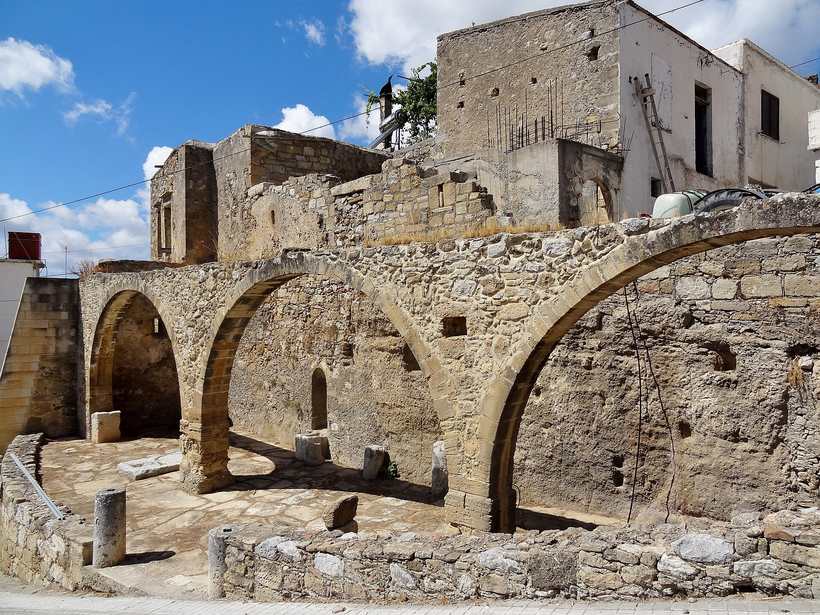
Polyrrinia stands as one of western Crete’s most evocative archaeological sites, where a living mountain village merges seamlessly with the ruins of an ancient powerhouse. Perched above Kissamos in the Chania region, this settlement rewards curious travelers with stone-built lanes winding through Hellenistic walls, Roman inscriptions embedded in village houses, and an acropolis commanding sweeping views over the Gulf of Kissamos. Springs and an old aqueduct once sustained the city, a rarity in Crete’s arid landscape. Visitors seeking authenticity beyond beach resorts will find quiet tavernas, rock-cut tombs, and layers of history spanning millennia. Plan your journey to this hilltop sanctuary with My Greece Tours.
The sections below cover the ancient origins and strategic importance of Polyrrinia, practical directions from Kissamos, the archaeological highlights scattered through the village, the panoramic acropolis views, and why this site deserves a place on every itinerary. Polyrrinia offers a counterpoint to crowded coastal attractions, blending Hellenistic foundations with Venetian fortifications and Ottoman traces. The village church incorporates carved blocks from an ancient temple, and stone houses rise directly over cisterns and terraces hewn from bedrock. For broader context on the island’s archaeology and culture, consult our comprehensive Crete travel guide.
Why was Polyrrinia one of the most important cities in ancient Crete?
Polyrrinia controlled strategic high ground above the western coast, with natural springs ensuring water security rare among Cretan settlements. Its acropolis dominated trade routes and offered defensive advantages that sustained power through Hellenistic and Roman periods.
The city’s prominence stemmed from geography and hydrology working in concert. Polyrrinia occupied a commanding hilltop south of modern Kissamos, overlooking the Gulf of Kissamos and the approaches to western Crete. Natural springs fed an aqueduct system that freed the population from dependence on cisterns, a luxury most Cretan cities lacked. This reliable water supply supported a larger population and enabled the city to withstand sieges. Fortified terraces and walls climbed the slopes, protecting grain stores and temples. The acropolis crowning the summit served as both sanctuary and final refuge, its position offering sightlines across the coastal plain and out to sea.
Control of these heights meant control of the region’s agricultural hinterland and maritime access, making Polyrrinia a power broker in western Crete’s political landscape throughout antiquity.
Archaeological evidence reveals continuous occupation from the Archaic period through the Roman era, with the city minting its own coins and maintaining alliances with other Cretan poleis. Inscriptions carved into stone blocks record decrees, treaties, and dedications to gods, testimony to a literate civic culture. The settlement’s name, meaning “many sheep,” hints at pastoral wealth complementing its strategic assets. Roman conquest brought integration into imperial trade networks rather than decline, and the city flourished as a regional center. Later, Venetian and Ottoman occupiers recognized the site’s defensive value, refortifying the acropolis and adding new walls.
Visitors exploring things to do in Crete will find Polyrrinia’s layered history written in stone, from Hellenistic foundations to Byzantine chapels, all woven into the fabric of a living village that refuses to abandon its ancient roots.
How do you reach Polyrrinia from Kissamos and the coast?
Polyrrinia lies a short drive south from Kissamos town, reached by a paved road climbing into the hills. Park at the village edge and walk up stone-paved lanes through the settlement to reach the acropolis and main ruins.
The journey begins in Kissamos, the coastal town serving as the gateway to western Crete’s archaeological and natural wonders. From the town center, follow signs pointing south toward Polyrrinia, taking the road that climbs steadily into the foothills. The drive covers approximately six kilometers, winding through olive groves and terraced slopes that have sustained agriculture for millennia. The paved road narrows as it approaches the village, with stone walls pressing close on either side. Parking is available at the village entrance, where the modern road ends and the old settlement begins. The walk from car to acropolis takes fifteen to twenty minutes, ascending stepped lanes and passing stone houses that incorporate ancient blocks and lintels.
The route is straightforward, with the hilltop church and acropolis visible above, guiding your steps upward through the village’s quiet heart.
Visitors combining Polyrrinia with coastal attractions will find the site an easy detour from the main routes linking Chania to western beaches. The drive from Chania takes roughly forty minutes, passing through Kissamos before turning inland. Those planning a day exploring the region often pair Polyrrinia with a morning visit to Balos lagoon or other coastal highlights, returning inland for a late lunch at the village taverna. The site remains accessible year-round, though the best time to visit Crete for comfortable walking among ruins is spring or autumn, when temperatures moderate and wildflowers color the hillsides.
No entrance fee applies, and the village maintains its authentic character precisely because it lies off the main tourist circuits, rewarding those who make the short journey with solitude and unmediated encounters with the past.
What archaeological features can visitors see at Polyrrinia today?
Visitors encounter Hellenistic walls, Roman inscriptions, rock-cut cisterns, tombs carved into bedrock, and terraces supporting ancient buildings. The village church stands on temple foundations, reusing carved blocks. The acropolis retains fortifications from multiple periods overlooking the coast.
The archaeological landscape at Polyrrinia unfolds as a palimpsest, with each era leaving its mark on the hillside. Stone houses in the village incorporate massive blocks quarried and dressed in antiquity, their surfaces bearing Greek inscriptions and decorative moldings. Walk the narrow lanes and you pass over rock-cut cisterns, their openings now covered but their chambers still intact beneath your feet. Terraces carved from living rock once supported public buildings and private dwellings, their retaining walls visible where erosion has exposed the ancient work. Tombs hewn into cliff faces dot the slopes below the village, their chambers empty but their architectural details still sharp.
The village church of the Ninety-Nine Martyrs occupies the site of an ancient temple, its walls built from reused column drums, architraves, and inscribed stones that once honored Olympian deities. This recycling of sacred space and building material creates a continuity linking pagan and Christian worship across two millennia.
The acropolis crowning the summit offers the most dramatic architectural remains, with fortification walls climbing the final slopes in a series of defensive circuits. Hellenistic masonry forms the lowest courses, its precisely fitted blocks requiring no mortar. Venetian engineers added crenellated towers and gun platforms in the sixteenth century, adapting the ancient stronghold to the age of gunpowder. Ottoman modifications followed, creating the layered fortifications visible today. The views from the summit stretch across the coastal plain to the Gulf of Kissamos, with the White Mountains rising to the east and the sea glittering to the north. Interpretive signs are minimal, allowing the stones to speak for themselves.
Polyrrinia ranks among the hidden gems in Crete, a site where patient observation reveals details that guidebooks cannot capture, from mason’s marks on ancient blocks to the play of light on weathered inscriptions at different hours of the day.
What makes the water supply at Polyrrinia unique among Cretan sites?
Polyrrinia possessed natural springs and an aqueduct system, unlike most Cretan settlements that relied solely on cisterns to capture rainwater. This reliable water source gave the city strategic advantages and supported a larger population through all seasons.
Water determined survival and prosperity in ancient Crete, where summer drought lasted months and rainfall concentrated in winter. Most cities depended on cisterns, underground chambers plastered to hold rainwater collected from roofs and paved surfaces. These cisterns required careful management and could fail during prolonged dry spells. Polyrrinia’s springs changed the equation entirely. Emerging from the limestone bedrock, these perennial sources flowed year-round, fed by aquifers deep beneath the hills. An aqueduct system channeled spring water into the city, distributing it to fountains and storage tanks. This infrastructure required engineering skill and ongoing maintenance, but it freed Polyrrinia from the water anxiety that constrained other settlements.
The springs also made the site attractive for initial settlement, explaining why successive cultures chose to build and rebuild on this particular hilltop rather than abandoning it for more convenient lowland locations.
The strategic implications of reliable water extended beyond daily consumption to military calculations. A city with springs could withstand siege indefinitely, provided food stores held out. Attackers could not cut off water supplies by controlling cisterns or poisoning storage tanks. This defensive advantage made Polyrrinia a formidable stronghold and a valuable ally in the shifting alliances of Hellenistic and Roman Crete. The springs also supported agriculture on the surrounding terraces, with irrigation extending the growing season and increasing yields. Olive groves and vineyards flourished on slopes that might otherwise have remained marginal. Today, the springs still flow, though the ancient aqueduct lies in ruins.
Visitors can trace sections of the water channels cut into rock faces and see the cisterns that supplemented the spring supply, storing surplus water for peak demand. This hydraulic infrastructure, mundane yet essential, underpinned everything else Polyrrinia achieved, from its political influence to its cultural flowering.
Why should travelers include Polyrrinia in their Crete itinerary?
Polyrrinia offers authentic encounters with layered history in a living village, far from coastal crowds. The site combines accessible ruins, panoramic views, quiet exploration, and a taverna meal, rewarding visitors seeking depth beyond beaches and conventional tourist circuits.
The appeal of Polyrrinia lies in its integration of past and present, where archaeology is not cordoned behind fences but woven into daily village life. Stone houses rise on Hellenistic foundations, children play in lanes flanked by Roman walls, and the church bell rings from a tower built with temple blocks. This continuity creates an immediacy that museum displays cannot match. Visitors walk the same paths ancient inhabitants trod, see the same coastal views that guided sailors home, and touch stones carved by hands dead two thousand years. The absence of tour buses and ticket booths preserves an atmosphere of discovery. You explore at your own pace, following curiosity rather than guided itineraries.
The village taverna serves traditional fare with views across the valley, a meal becoming part of the experience rather than a commercial interruption. Polyrrinia rewards slow travel and patient observation, qualities often lost in the rush between famous sites.
Including Polyrrinia in your itinerary adds historical depth to a coastal holiday and provides welcome contrast to beach days and resort amenities. The site pairs naturally with visits to Kissamos, the ancient port that served as Polyrrinia’s maritime outlet, and with explorations of western Crete’s dramatic coastline. The drive inland takes less than thirty minutes, yet it transports you from tourist infrastructure to a world where time moves differently. Spring brings wildflowers to the hillsides and comfortable temperatures for walking among ruins. Autumn offers clear light perfect for photography and fewer visitors. Even summer, hot on the coast, finds relief in the village’s elevation and shade.
Polyrrinia represents what draws thoughtful travelers to Crete: layers of culture, landscapes shaped by millennia of human presence, and communities maintaining identity despite modernization. The site asks nothing more than attention and respect, offering in return perspectives that package tours cannot provide and memories that outlast sunburns and souvenir shopping.
Frequently Asked Questions
Is there an entrance fee to visit Polyrrinia, and what facilities are available?
Polyrrinia charges no entrance fee and maintains no formal visitor facilities, preserving its character as a living village rather than a managed archaeological park. The site remains open at all times, with access through the village lanes unrestricted. This openness means visitors must exercise personal responsibility, watching footing on uneven ancient paving and respecting private property where houses incorporate ruins. No ticket office, visitor center, or interpretive displays guide your exploration, though the village church and acropolis are clearly visible landmarks. A traditional taverna near the church offers meals and refreshments, its terrace providing views across the valley. Restroom facilities are limited to the taverna for customers.
Parking at the village entrance is informal, with space along the roadside. The lack of commercial development preserves authenticity but requires self-sufficiency. Bring water, sun protection, and sturdy footwear. The walk from parking to acropolis involves climbing stepped lanes and navigating uneven surfaces. Mobile phone coverage is generally reliable, allowing map applications to function. The village maintains its traditional rhythms, with midday quiet and evening activity. Respect for residents and their property ensures continued access to this remarkable site, where the absence of tourism infrastructure is itself a precious quality worth preserving.
Can Polyrrinia be combined with other attractions in western Crete?
Polyrrinia fits naturally into itineraries exploring western Crete, pairing well with coastal attractions, archaeological sites, and mountain villages. The site lies a short drive from Kissamos, the port town offering beaches, seafood tavernas, and ferry connections to the Peloponnese. Visitors often combine a morning at Balos lagoon or Falasarna beach with an afternoon at Polyrrinia, balancing sea and archaeology. The drive from Chania takes forty minutes, making day trips feasible for those based in the regional capital. Travelers exploring the Gramvousa peninsula can include Polyrrinia on the return journey, adding historical context to coastal scenery.
The site also works as a stop on routes between Chania and the southwest coast, breaking the drive with a walk through ruins and a taverna lunch. Spring and autumn offer ideal conditions for combining beach time with upland exploration, while summer heat makes early morning or late afternoon visits to Polyrrinia more comfortable. The village’s elevation provides cooler temperatures than the coast even in peak season. Photographers appreciate the quality of light on ancient stones in the hours before sunset. Polyrrinia requires two to three hours for thorough exploration, including the walk to the acropolis and time at the taverna.
This duration allows easy integration into broader touring plans without dominating the day, making it an ideal complement to western Crete’s better-known attractions.
What should visitors know about exploring Polyrrinia respectfully and safely?
Exploring Polyrrinia requires awareness that you are walking through a living village where residents maintain homes among ancient ruins. Respect private property, keeping to public lanes and avoiding areas clearly marked as residential. The archaeological remains are unguarded and unfenced, placing responsibility on visitors to tread carefully and leave nothing but footprints. Ancient paving can be slippery, especially after rain, and cistern openings may be partially concealed. Watch your footing on stepped lanes and terraces. The climb to the acropolis involves uneven surfaces and exposed drops, requiring reasonable fitness and caution. Bring adequate water, as the taverna is the only reliable source. Sun protection is essential, with limited shade on the upper slopes.
Sturdy walking shoes with good grip are strongly recommended over sandals or beach footwear. Photography is welcome, but be considerate when residents are visible in frames. The church may be open for respectful visits outside service times. Avoid climbing on fragile ruins or removing stones as souvenirs, actions that accelerate deterioration and diminish the site for future visitors. Litter is particularly offensive in a village setting; carry out everything you bring in. The taverna appreciates patronage from visitors, supporting the community that maintains access to the ruins. Early morning or late afternoon visits avoid midday heat and offer better light for photography.
Polyrrinia’s preservation depends on visitor respect, ensuring this remarkable fusion of ancient city and living village endures for generations to come.