
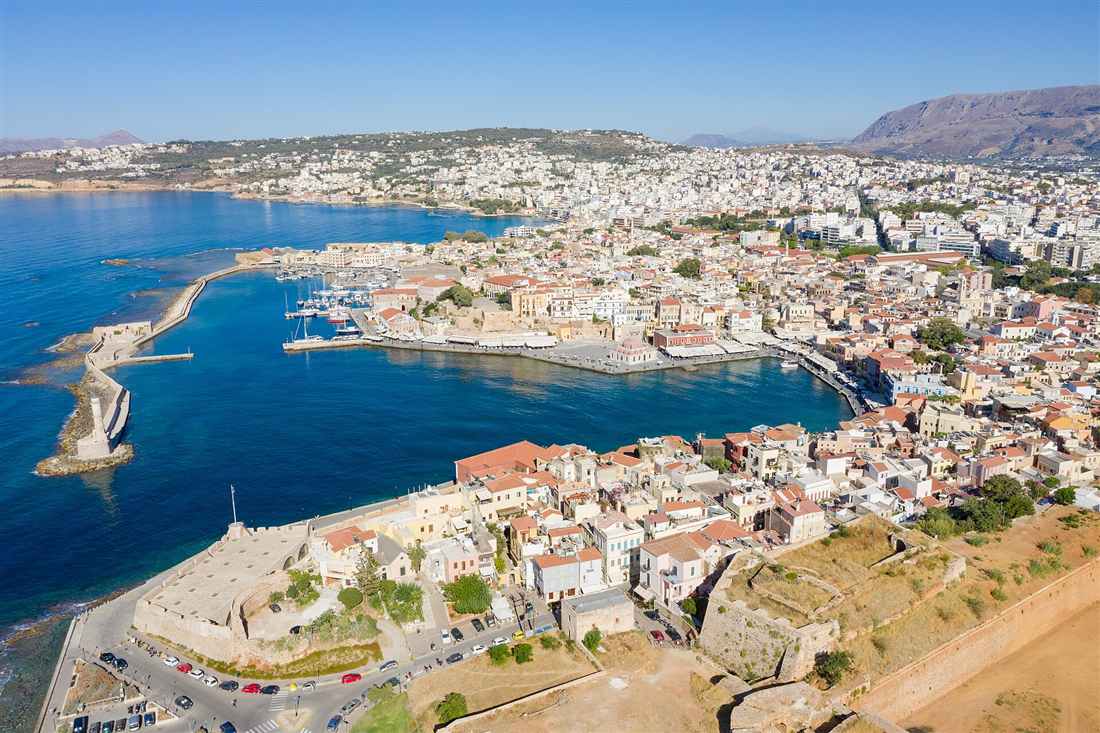
One day in Chania is enough to walk the Venetian harbour and the Egyptian lighthouse, wander the old town alleys and the covered market, eat a Cretan lunch, swim at Nea Chora, and stay for the sunset and dinner in western Crete. Plan the whole trip with Greece Tours.
This guide lays out one day in Chania in full: whether a day is enough, the hour-by-hour itinerary, the morning harbour and lighthouse walk, the old-town quarters and the market, where to eat lunch and dinner, the midday swim, the museums, the sunset spot, the evening volta, the day with kids, the trip from Heraklion or Rethymno, and what to skip and what to bring.
Do you see Chania in one day?
Yes. One full day covers the Venetian old town, the harbour and a swim. The compact centre packs the Egyptian lighthouse, the covered market, the Topanas and Splantzia quarters and Nea Chora beach into an area you cross on foot in twenty minutes.
Chania sits on the north-west coast of Crete, and the historic core forms a tight crescent around the Venetian harbour. Every headline sight stands inside a 900-metre arc from the market to the lighthouse. That density is the reason a single day delivers the town in full rather than a rushed sample. You walk from the Municipal Market to the harbour arch in eight minutes, and from the harbour to Nea Chora beach in twelve.
A group with a car parks it once and forgets it, since the historic lanes bar traffic and the whole route runs on foot. The plan hinges on distance, not luck. Because the streets run short and the sights cluster, you spend the day inside the centre and lose no time in transfers. A car stays parked. Foot travel connects the Venetian shipyards, the Mosque of the Janissaries, the leather-workers’ lane and the town beach in one continuous loop, and the longest single leg of that loop, harbour to beach, runs under fifteen minutes at a stroll. The Greece Tours guide to the region confirms the walkable footprint, and the destination hub at Chania maps the same ground for a full itinerary.
The single caveat is heat and light. You front-load the walking into the cool morning, break for lunch and a swim through the midday sun, then return to the harbour for the evening. Structured that way, one day in Chania closes with the old town, the port and the sea all seen properly, not skimmed.
Arriving travellers reach the town from three directions. Chania airport on the Akrotiri peninsula sits 14 kilometres east, a 20-minute drive or a KTEL bus into the central station. The port of Souda, where the overnight ferries from Piraeus dock, lies 7 kilometres from the harbour, a 15-minute transfer. From either gateway the old town opens on foot the moment you cross Plateia 1866 into the market. A day-tripper driving in from Rethymno or Heraklion parks at the Talos or the harbour-edge car parks and walks the rest, since the historic core bars cars from its lanes.
What is the perfect one-day Chania itinerary?
Start at 8am with harbour coffee, walk the old town and lighthouse before 11am, spend an hour in the covered market, eat a backstreet Cretan lunch at 1pm, swim at Nea Chora from 3pm, and return to the harbour for sunset at 8pm.
The hour-by-hour frame turns a crowded list into a calm sequence. At 8am the harbourfront tavernas set out chairs and the light rakes low across the water, so coffee lands first. From 8.30am to 11am you thread the Topanas alleys, reach the Firkas Fortress at the harbour mouth and walk the mole to the Egyptian lighthouse while the stone stays cool. The Splantzia quarter and the Mosque of the Janissaries fill the late morning.
Midday belongs to food and water. At noon you enter the Municipal Market for picnic supplies or an early bite, then sit down for a proper lunch at 1pm in a backstreet taverna away from the harbour prices. From 3pm to 5pm the sun drives everyone to the sea, and Nea Chora beach, a twelve-minute walk west of the harbour, takes the afternoon dip. A shaded rest and a frapp\u00e9 bridge the gap to evening.
The day ends where it started. From 6pm you drift back through the Venetian shipyards, the Arsenali, and settle on the harbour arm as the sky turns. Sunset over the lighthouse at roughly 8pm in high summer closes the loop. Dinner follows at a harbour or Splantzia table. The sequence wastes no daylight and puts the hardest walking in the coolest hours.
The timings flex with the season without breaking the frame. In spring and autumn the sun sets nearer 6.30pm, so the beach shifts to 1pm and the harbour return to 4pm, and the cooler air stretches the comfortable walking window across the whole day. In peak summer the midday break widens, and a long lunch plus a two-hour beach stop shelters you from the 2pm to 5pm heat. The fixed points stay the same: harbour coffee first, the old town before the crowds, food and water through the middle, the port at dusk. Around that spine the exact clock bends to the light.
How do you start a day in Chania?
Start with coffee on the Venetian harbour at 8am, then walk the seafront to the Egyptian lighthouse before the heat builds. The 570-metre mole delivers the town’s defining view back across the domed mosque and the pastel harbour houses.
The harbour is the town’s stage, and the morning is the hour to own it. A Greek coffee or a frapp\u00e9 at a waterfront table costs the price of a seat with the finest view in Chania. Fishing boats unload, the water sits flat, and the crowds that fill the arc by lunch stay in bed. This first half-hour sets the pace for a slow, complete day rather than a hurried march.
The Venetians built this harbour in the fourteenth century as a naval base, and the arc of the quay still traces their design. The inner harbour holds the small fishing craft, while the outer basin behind the mole once sheltered war galleys. Reading the waterfront from the coffee table gives the whole day its map: the mosque and the Grand Arsenal to your left, the shipyards curving away east, the Firkas bastion and the lighthouse framing the mouth ahead. Fixing those four points before you move turns the tangle of the old town into a plan you walk with confidence.
From the coffee table you walk east along the quay to the harbour entrance and out onto the stone breakwater. The Egyptian lighthouse stands at the far end, a slim minaret-shaped tower rebuilt under Egyptian rule in the nineteenth century. The walk out and back runs fifteen minutes at an easy pace, and the reward is the postcard frame: the whole Venetian arc, the Firkas bastion and the white-domed Mosque of the Janissaries lined up in one shot.
Timing the lighthouse for the morning matters. The mole carries no shade, the stone throws heat by midday, and the light flattens under a high sun. At 9am the low angle picks out texture in the harbour facades and the sea reads deep blue. Back on the quay, the Firkas Fortress and the Maritime Museum guard the harbour mouth, and the old-town alleys open directly behind them for the next stretch of the walk.
The Firkas Fortress rewards the short detour before you turn inland. The Venetian bastion at the north-west corner of the harbour housed the garrison that once controlled the port, and its parapet gives the second great view of the town after the lighthouse. The Cretan flag first flew here at the union with Greece, and the courtyard now holds the Maritime Museum of Crete with its ship models, naval charts and Battle of Crete gallery. A twenty-minute stop reads the harbour’s history before the alleys of the Topanas begin two steps from the fortress gate.
What do you see in the Chania old town in the morning?
The morning old town delivers the Topanas quarter’s Venetian mansions, the narrow leather-and-craft alleys, the Mosque of the Janissaries on the harbour, the Splantzia district around Plateia 1821, and the surviving stretches of the Venetian sea walls.
Behind the harbour the streets tighten into the Topanas, the former Christian and Venetian quarter climbing west toward the Firkas Fortress. Odos Theotokopoulou runs as its spine, a lane of restored mansions, doorways carved with Venetian arms and craft workshops at street level. The buildings stack Venetian stone under Ottoman timber balconies, a layered record of the town’s rulers written in the walls themselves. Detailed coverage of this quarter sits on the Chania old town page.
The pace of the morning walk favours getting lost on purpose. The Topanas grid runs no straight line, and each turn opens a fresh frame: a bougainvillea spilling over a Venetian lintel, a workshop stacked with hand-thrown ceramics, a doorway framing a slice of the harbour below. The lane widths hold two people abreast, so the crowds thin the moment you leave the waterfront. Reaching the Renieri Gate, a carved Venetian arch mid-quarter, marks the halfway point of the Topanas before the streets tip back down toward the water and the mosque.
On the harbour edge stands the Mosque of the Janissaries, the oldest Ottoman building on Crete, its single grey dome flanked by smaller cupolas. The mosque now hosts exhibitions, and its silhouette anchors every harbour photograph. Steps away, the Grand Arsenal and the row of Venetian shipyards, the Neoria, run their vaulted stone bays down to the water where galleys once sheltered for winter repair.
East of the harbour the mood shifts in the Splantzia quarter, the old Turkish district around the plane-tree square of Plateia 1821. The lanes here carry less polish and more daily life, with the church of Agios Nikolaos and its unusual paired minaret and bell tower at the heart. Threaded through both quarters, the Venetian sea walls and the Schiavo Bastion mark the line the old city once defended, and a morning walk traces that perimeter before the alleys fill with the afternoon crowd.
A short list of set-piece stops anchors the morning circuit. The Archaeological Museum, moved to the Halepa district, holds Minoan larnakes and Roman mosaics lifted from the town’s foundations. The Etz Hayyim Synagogue, tucked in a lane off the harbour in the old Jewish quarter of Evraiki, restores the last Jewish monument on Crete as a quiet memorial. The cathedral of the Trimartyri and the covered Kioutsouk Hasan hammam add Ottoman and Orthodox layers within three minutes of each other. You choose two of these to enter and pass the rest as street-level landmarks, keeping the walk moving toward the market by 11am.
Is the Chania covered market worth an hour?
Yes. The Municipal Market, the cross-shaped Agora at the top of the old town, earns an hour for its Cretan cheese, honey, herbs and olive oil, the neighbouring leather-workers’ lane, and a picnic haul for the beach afternoon.
The Agora sits where the old town meets the modern centre, a steel-and-glass hall built on a cruciform plan with four arms meeting under a central crossing. Butchers, fishmongers, greengrocers and dry-goods stalls line the aisles, and the produce names the island: graviera and mizithra cheese, thyme honey, dried oregano and mountain tea, barrel olives, raki and cold-pressed olive oil from the villages inland. A slow circuit of the four arms takes twenty minutes and reads as a portrait of Cretan eating.
The market solves the day’s logistics. For a one-day visit you assemble lunch on the move here: a wedge of graviera, a bag of olives, tomatoes, a loaf, sesame-crusted koulouri and a jar of honey travel straight to the beach or a shady bench. Stallholders cut, weigh and wrap on the spot, and the prices sit below the harbour cafes for the same island goods.
The Agora also stocks the take-home haul in one stop. Bottled Cretan olive oil, vacuum-sealed graviera, thyme honey and packets of dried mountain tea travel well and pack flat, so the market covers both the picnic and the souvenir shelf before you leave town. Herb stalls hang bunches of oregano, sage and dittany gathered from the White Mountains, and the raki sellers fill small bottles to order. Fitting the shopping into the same hour spares a second errand later and keeps the afternoon free for the sea.
Outside the market’s western door runs Odos Skridlof, the leather street, a narrow lane packed with workshops selling sandals, belts and bags in local hide. The smell of tanned leather fills the alley, and craftsmen fit sandals to the foot while you wait. Between the Agora and Skridlof the hour fills itself, and you leave carrying both a meal and a keepsake before the walk down to the water.
The building itself repays a look upward. The Agora opened at the start of the twentieth century as a copy of the market hall in Marseille, and its ironwork span, clerestory windows and 4,000 square metres of floor make it the largest covered market on Crete. Small ouzeri counters wedged between the produce stalls pour raki with a plate of cheese and olives for a stand-up morning snack, so the market doubles as an early bite as much as a larder. The four gates open onto four different parts of town, and stepping out of the southern arm drops you straight onto Skridlof and the craft lanes.
Where do you have lunch on a one-day visit to Chania?
Eat lunch in the backstreet tavernas of the Splantzia and Topanas quarters rather than the harbour front. Two streets inland the same Cretan dishes cost less and the tables sit under vines instead of tour traffic.
The harbour arc trades on its view, and the front-row tavernas price the sea accordingly. Walk two minutes into the lanes behind and the equation flips, trading the panorama for a fairer bill and a kitchen that answers to regulars. Around Plateia 1821 in Splantzia, plane-tree shade covers the tables and the kitchens cook for locals as much as visitors. In the Topanas, small courtyards off Theotokopoulou hide family-run rooms where the menu names the season. The dedicated rundown of tables sits on the where to eat in Chania guide.
The dishes to order name Crete directly. Dakos, a barley rusk soaked and piled with grated tomato, mizithra cheese and oregano, opens the meal cold and light for a hot day. Boureki layers courgette, potato and cheese under a mint-scented crust. Apaki, pork cured and smoked over aromatic wood, and antikristo, lamb roasted upright by an open fire, carry the meat courses. Snails in rosemary, gigantes beans and wild horta greens round out the island table.
A one-day lunch stays deliberate rather than long. You sit at 1pm, order a short spread of dakos, boureki and a village salad with a carafe of house wine or a bottle of water, and finish inside an hour. The kitchen sends raki and a plate of fruit or Sfakian pie drizzled with honey to close, unbilled by custom. That leaves the afternoon clear for the sea, and the light meal sits easier than a harbour feast before a swim.
The drink list matches the plate for a full Cretan table. The mountain villages behind Chania press their own olive oil and bottle red and white from Romeiko and Vidiano grapes, and the house carafe pours that local wine straight from the barrel. Raki, the clear grape spirit distilled across the island each autumn, arrives cold to open and to close the meal. For a non-alcoholic finish, Cretan dittany or sage tea, gathered in the White Mountains, steeps at the table. The pairing keeps the lunch anchored to the island rather than a generic Greek menu, and it costs a fraction of the same bottle on the harbour front.
Where do you swim on a day in Chania?
Swim at Nea Chora, the town beach a twelve-minute walk west of the Venetian harbour. The strip of sand and shallow water fronts a line of fish tavernas, so a midday dip needs no car and no bus from the old town.
Nea Chora is the closest real beach to the centre, tucked just past the Firkas Fortress on the western edge of the old town. The walk from the harbour runs along the shore in twelve minutes, so the swim slots into the day without a transfer. The beach carries fine sand, a gentle shelf into clear water and a run of sunbeds and umbrellas for hire. A short breakwater calms the swell, and the shallow entry suits a quick cooling dip in the hottest hours.
The setting doubles as a lunch alternative. The seafront behind Nea Chora lines up fish tavernas with tables almost on the sand, so a plate of grilled sardines or fried calamari with a swim between courses turns the afternoon into a single stop. For the picnic assembled at the market, the sand and the low sea wall give a free spot to spread it out under an umbrella.
Nea Chora carries a Blue Flag, and the water sits clean and calm behind its breakwater, so the swim suits children and weaker swimmers as much as a quick cool-off. Sunbeds and umbrellas rent by the pair, showers and changing spots line the promenade, and a lifeguard covers the main stretch through high summer. The sand runs 200 metres before the rocks at each end, enough room to find a clear patch even at the afternoon peak. Snorkelling along the rocky western edge turns up small fish among the shallows for a diversion between dips.
Timing the beach for 3pm to 5pm answers the midday sun. While the old-town stone bakes and the alleys glare, the water holds its cool and the breeze off the sea cuts the heat. After the swim a frapp\u00e9 at a beach cafe bridges the rest before the evening return to the harbour. For a longer stretch of sand, the buses to Agioi Apostoloi run west from the centre, but for one day the twelve-minute walk to Nea Chora keeps the loop tight and the feet on the ground.
The wider coast waits for a second visit rather than this day. Agioi Apostoloi and Kalamaki spread wider sand 4 kilometres west, reachable on the town bus in fifteen minutes. The pink-sand lagoon of Elafonisi lies 75 kilometres south-west, a 90-minute drive that swallows a whole day on its own, and the palm beach of Vai and the Balos lagoon sit further still. Picking Nea Chora over those distant names is the choice that protects the one-day plan, because a swim within walking range keeps the afternoon inside the town and the evening free for the harbour. The famous beaches earn their own trip, listed in full on the destination hub.
What do you do in Chania in the afternoon?
The Chania afternoon runs on three indoor stops around the Venetian harbour: the Maritime Museum of Crete at the Firka Fortress, the Firka ramparts, and the Archaeological Museum on Halidon Street, each a five-minute walk from the harbour arch, with a shaded rest between them.
Start the afternoon at the Maritime Museum of Crete, planted at the western tip of the harbour inside the Firka Fortress. The ground floor tracks Cretan seafaring from Minoan hulls to the naval history of the island, and the model ships fill two rooms. The walk from the lighthouse causeway to the museum door takes four minutes along the quay. Entry sits at a low ticket price, and the rooms stay cool through the hottest hours between 14:00 and 17:00, which is the exact stretch the harbour paving turns to glare.
Step straight from the museum onto the Firka Fortress ramparts. The Venetians raised Firka to guard the harbour mouth, and the parapet delivers the widest view of the whole basin, the lighthouse opposite, and the White Mountains behind the town. The Greek flag first flew here at the union of Crete with Greece, and a plaque on the wall marks the spot. The climb to the rampart walk takes three minutes.
Close the afternoon indoors at the Archaeological Museum of Chania, a ten-minute walk inland on Halidon Street. The collection holds Minoan clay tablets in Linear A and Linear B, floor mosaics from the Roman town, and painted larnakes from the region’s tombs. Between the fortress and the museum, drop into a shaded courtyard caf\u00e9 on Theotokopoulou Street for a cold frapp\u00e9 and a sit in the plane-tree shade before the heat lifts. The full list of afternoon stops sits on the things to do in Chania guide.
Time the three stops as a chain. The Maritime Museum opens at 09:00 and closes at 17:00, the Firka ramparts share the same gate, and the Archaeological Museum holds afternoon hours to 20:00 in summer. Chain them west to east: fortress first at 14:00, ramparts at 15:00, then the ten-minute inland walk to Halidon Street for the Archaeological Museum at 16:00. The three tickets together stay under the price of a harbour lunch, and the whole indoor circuit shelters the body through the hardest sun of the day while the harbour paving bakes empty outside.
Where do you watch the sunset in Chania?
Watch the Chania sunset from the Venetian lighthouse pier and the harbour-front quay. The stone causeway to the lighthouse runs 500 metres from the harbour mouth, and golden hour paints the water and the White Mountains between 19:30 and 20:30 through the summer months.
The lighthouse pier is the front-row seat. Walk east from the Firka Fortress along the curving breakwater, past the Mosque of the Janissaries, and out onto the long stone arm that ends at the Egyptian-built lighthouse. The full walk out takes twelve minutes at a slow pace. From the pier the sun drops behind the harbour headland to the west, and the light throws the lighthouse tower into a warm silhouette against a pink sky. The pier fills before 19:00 in July and August, so arrive by 18:45 to hold a spot on the seaward edge.
The harbour-front quay is the second choice, and it trades the walk for a drink in hand. Take a table at a caf\u00e9 along the eastern arc of the basin, where the row of Venetian fa\u00e7ades catches the last direct light and glows ochre and rose. From here the lighthouse reads across the water as the classic Chania postcard, lit gold at the top and grey at the base as the sun sinks.
For a higher line of sight, climb to the rooftop bars behind the Splantzia quarter, a six-minute walk from the harbour. The roofs clear the fa\u00e7ade line and open the horizon over the sea. Golden hour lasts twenty-five minutes; the blue hour that follows lights the harbour lamps one by one and reflects them across the still water, and the reflection holds until full dark near 21:00.
Where do you have dinner on one day in Chania?
Dinner on a Chania day belongs in the Splantzia quarter, five minutes inland from the harbour, at a mezedopoleio around Plateia 1821 or Plateia Katre. Order raki and a spread of Cretan meze rather than a single main, and eat late, from 21:00.
Splantzia is the old Ottoman-era quarter, a grid of narrow lanes east of the harbour built around two squares. Plateia 1821 spreads its tables under a giant plane tree beside the church of Agios Nikolaos, and Plateia Katre sits two lanes north. Both squares hold mezedopoleia, the Cretan small-plate tavernas, and the walk from the harbour arch to Plateia 1821 takes five minutes through Daliani Street. The squares stay lively past midnight, and the plane-tree canopy keeps the evening cool.
Order the Cretan way. A mezedopoleio brings raki, the clear pomace spirit, and the table fills with small plates: dakos rusk topped with grated tomato and mizithra cheese, boiled horta greens dressed in lemon and oil, fried kalitsounia cheese pies, gigantes butter beans, grilled octopus, and staka fried in sheep’s-milk fat. Each plate lands at a low price, and four to six plates feed two people. The raki arrives free at the start and again at the end of the meal.
Book nothing and walk the squares first. Read the tables, pick the taverna with Cretan diners and a handwritten menu, and take a corner table. Cretan dinner runs long, and the pace matches the day’s slow rhythm. Close the meal with the second round of raki and a plate of honeyed loukoumades or a wedge of watermelon that the taverna sends out without a bill line.
What is the evening like in Chania?
The Chania evening is a slow volta, a walk around the lit Venetian harbour after dinner. Families and couples circle the basin from 21:00, the lighthouse and fa\u00e7ades reflect across the still water, and a nightcap by the quay closes the day near midnight.
The volta is the Greek evening stroll, and Chania stages it around the harbour arc. After dinner the whole town drifts down to the water, and the crowd moves in a loose counter-clockwise loop from the Firka Fortress along the quay to the mosque and back. The pace is unhurried, the lit fa\u00e7ades throw colour onto the water, and the lighthouse pier draws a steady line of walkers out to the tower and back. The full harbour loop measures 1.2 kilometres and takes twenty-five minutes at strolling speed.
The lit harbour is the centre of the night. Warm lamps pick out the Venetian arches, the Mosque of the Janissaries glows against the dark water, and the reflection of the lighthouse stretches across the basin when the water lies flat. Street musicians set up along the eastern quay, and the arsenali boat-sheds stand floodlit at the harbour’s inner corner.
Close with a nightcap by the water. Take a table at a quay-front bar for a Cretan raki, a glass of local white from the Chania vineyards, or a cold beer, and watch the volta pass. The bars stay open past midnight through the summer, and the last walkers leave the pier near 01:00. The Chania hub maps the harbour circuit end to end.
How do you spend one day in Chania with kids?
A Chania day with kids runs on three easy stages: a morning harbour boat trip from the quay, an afternoon on a shallow town beach, and a flat old-town walk. Every stage sits within a ten-minute walk of the harbour, and none needs a car.
Start with a boat trip from the harbour. Glass-bottom and small tour boats leave the quay near the mosque from 10:00, run a 45-minute loop past the lighthouse and along the coast, and turn back so children watch fish through the hull. Tickets sit at a low price for children, and the boats load right off the paving where families gather. The short duration keeps young children settled and delivers the sea view without a full-day excursion.
Move to a town beach in the afternoon. Nea Chora beach lies a twelve-minute walk west of the harbour, a sand-and-shingle strip with shallow, calm water off the town, sunbeds for hire, and tavernas at the back of the sand. The shallow shelf suits small children, and the walk back to the harbour for dinner takes the same twelve minutes. The full list of family sands sits on the Chania beaches guide.
End with the flat old-town walk. The harbour paving, the Splantzia squares, and the covered market all lie level, with no steps and no hills, so a pushchair rolls the whole route. The Agora covered market sells cheese, honey, and dried fruit under one cross-shaped roof, a five-minute walk from the harbour, and its stalls hold a child’s attention between the boat and the beach.
Pace the family day around naps and heat. Run the boat trip at 10:00 while the sea stays calm and children stay fresh, break for an early lunch at a harbour taverna at 12:30, and hold the beach for the afternoon shade at 16:00 once the sun drops off the vertical. The flat old-town walk fills the gap between lunch and the beach, with the covered market and the plane-tree squares as air-conditioned and shaded stops. Ice-cream kiosks line the eastern quay, and the horse-drawn carriages that wait by the mosque run a short harbour loop that turns the walk back into a treat.
Is one day in Chania enough?
One day in Chania covers the Venetian harbour, the old town, the covered market, a museum, dinner in Splantzia, and the lighthouse sunset. A single day leaves the far beaches, the Samaria Gorge, and the inland villages for a longer stay of three days.
A single day delivers the core of the town. The morning walks the harbour and the old-town lanes, the market and the fortress fill the middle of the day, an afternoon museum shelters the heat, and dinner and the sunset close it. That circuit sits inside a walkable 2-kilometre core, needs no car, and gives a full read of the Venetian and Ottoman layers that built the town. A first-time visitor leaves with the harbour, the food, and the light all seen.
The day leaves the region untouched. Chania is the gateway to the west of Crete, and the west holds the pink sand of Elafonisi 75 kilometres away, the lagoon of Balos 56 kilometres out, and the Samaria Gorge, a 16-kilometre walk that fills a whole day from a 06:00 start. None of these fit a single town day, and each rewards its own dedicated day.
The verdict: one day satisfies the town, and it opens the appetite for the region. A traveller with a fixed single day sees Chania complete as a town. A traveller with the choice extends to three days and reaches one gorge and one far beach beyond the harbour, and the extra days change the trip from a town visit to a west-Crete base.
How do you spend a day trip to Chania from Heraklion or Rethymno?
Drive or coach the north-coast E75 motorway to Chania: 140 kilometres and 90 minutes from Heraklion, 60 kilometres and 45 minutes from Rethymno. Leave by 08:00, park at the harbour edge, and hold the town core from 10:00 to 20:00.
From Heraklion the road is the E75 national road, dual carriageway the whole way along the north coast. The drive covers 140 kilometres in 90 minutes at motorway speed, and an 08:00 departure lands in Chania by 09:30 with the parking still open. KTEL coaches run the same route from Heraklion bus station hourly from 05:30, take two hours 45 minutes with stops, and terminate at Chania’s central bus station, an eight-minute walk from the harbour.
From Rethymno the trip halves. The E75 covers the 60 kilometres to Chania in 45 minutes by car, and KTEL coaches run the leg in one hour, departing Rethymno bus station through the day from 06:15. The Rethymno start gives a fuller Chania day, with arrival by 10:00 and a relaxed return coach after the sunset near 20:30.
Time the day around parking and heat. Park in the pay lots on the harbour’s western edge below the Firka Fortress or on Piraeus Street, both a four-minute walk to the quay, and fill before 10:00 in high summer. Walk the harbour and market in the morning, shelter in a museum through the 14:00 heat, and hold the sunset before the drive back. Route notes for the reverse direction sit on the day trips from Chania guide.
What do you skip if you only have one day in Chania?
Skip the far beaches and the Samaria Gorge on a single Chania day. Elafonisi sits 75 kilometres west, Balos 56 kilometres northwest, and the Samaria Gorge is a 16-kilometre one-way walk from a 06:00 start. Each fills a full day of its own.
The far beaches drain a whole day in transit. Elafonisi’s pink sand lies at the island’s southwest corner, a 90-minute drive each way over mountain road, and Balos lagoon needs a 56-kilometre drive to Kissamos plus a boat or a rough track and a downhill walk to the sand. A day trip to either beach is the day, with three hours on the road and the town core never seen. On a single Chania day, hold the town and read the far beaches off the list for a return trip.
The Samaria Gorge is the clearest skip. The gorge cuts 16 kilometres through the White Mountains from the Omalos plateau at 1,230 metres down to the sea at Agia Roumeli. The walk starts at 06:00, runs six hours downhill, and ends with a ferry and a coach back to Chania after 18:00. The gorge is a full expedition, not a half-day, and it needs a dedicated early start that a town day rules out.
Skip the inland villages too on a single day. The mountain villages of the Apokoronas and the Therisos gorge road reward a drive, and both add distance a walking town day has no room for. Hold the walkable core, and the town alone fills the hours from 09:00 to midnight.
What do you need for a day in Chania?
Pack flat walking shoes for the cobbled lanes, swimwear and a quick-dry towel for a town-beach dip, sun cover for the exposed harbour, and cash in euros for the tavernas and the market stalls that price low and take notes over cards.
Walking shoes come first. The old-town lanes are Venetian cobble and worn marble, the harbour paving turns slick at the water’s edge, and the day covers 4 to 6 kilometres on foot. Flat closed shoes hold the footing that sandals lose on the polished stone. A day on cobbles in the wrong footwear ends the walking early.
Swimwear and sun cover pair up. Nea Chora beach sits a twelve-minute walk from the harbour, so a swimsuit and a light towel turn the hottest hours into a sea break. The harbour quay and the lighthouse pier carry no shade, and the midday sun off the water and the pale stone doubles the glare. A hat, sunglasses, and high-factor sunscreen hold through the 12:00-to-16:00 stretch, and a refillable water bottle beats the harbour prices.
Carry cash in euros. The Splantzia mezedopoleia, the covered-market stalls, the boat-trip kiosks, and the small kafeneia price low and settle in notes, and the smallest tavernas keep no card terminal. Draw euros from an ATM near the market before the harbour, keep small notes for the raki rounds and the market cheese, and hold a card in reserve for the larger quay-front restaurants that take it.
What is the best one-day Chania itinerary by pace?
Two paces fit one Chania day. The relaxed version holds the harbour, the market, one museum, a beach swim, and the sunset across nine hours. The packed version adds the fortress, a second museum, and the Splantzia lanes into the same window.
The relaxed day breathes. Start at 09:30 with a slow harbour loop and a frapp\u00e9 on the quay, walk the covered market at 11:00, and take one museum, the Maritime Museum at the Firka Fortress, at 12:30. Break for a long lunch in Splantzia at 14:00, walk twelve minutes to Nea Chora beach for an afternoon swim at 16:00, and return for the lighthouse sunset at 19:45 and a late Cretan dinner at 21:00. The relaxed day covers 4 kilometres on foot with two long sit-down breaks, and it suits families and first-time visitors.
The packed day fills every hour. Start at 08:30 at the empty harbour for photographs before the crowd, take the Firka Fortress ramparts at 09:30, the covered market at 10:30, and the Archaeological Museum on Halidon Street at 11:30. Lunch quickly at 13:00, walk the full Splantzia grid and the leather-lane Skrydlof Street through the afternoon, add the Maritime Museum at 16:00, and hold the lighthouse pier for sunset at 19:45 before a Splantzia dinner at 21:00. The packed day covers 7 kilometres on foot and reaches two museums, the fortress, and both old-town quarters in one window.
Match the pace to the group. A relaxed day trades a second museum for a beach hour and a longer lunch; a packed day trades the swim for depth across the town’s monuments. Both end on the same lighthouse sunset and the same late Cretan dinner, and both leave the region’s gorges and far beaches for a return trip.
Frequently Asked Questions
Can you see Chania in one day?
One day is enough to see the heart of Chania. Morning covers the Venetian harbour, the lighthouse and the old-town alleys, midday the market, lunch and a swim at Nea Chora, and the evening the sunset and dinner in the Splantzia squares.
What is the best one-day Chania itinerary?
Start with coffee on the harbour and the lighthouse walk, tour the Topanas and Splantzia alleys and the covered market, lunch in a backstreet taverna, swim at Nea Chora, then watch the sunset by the lighthouse and dine on Cretan meze with raki.
Is one day in Chania enough?
One day captures the old town, the harbour and a swim. A longer stay adds the Samaria Gorge, the Balos and Elafonisi beaches and the day trips, which each need a full day of their own beyond the town.