
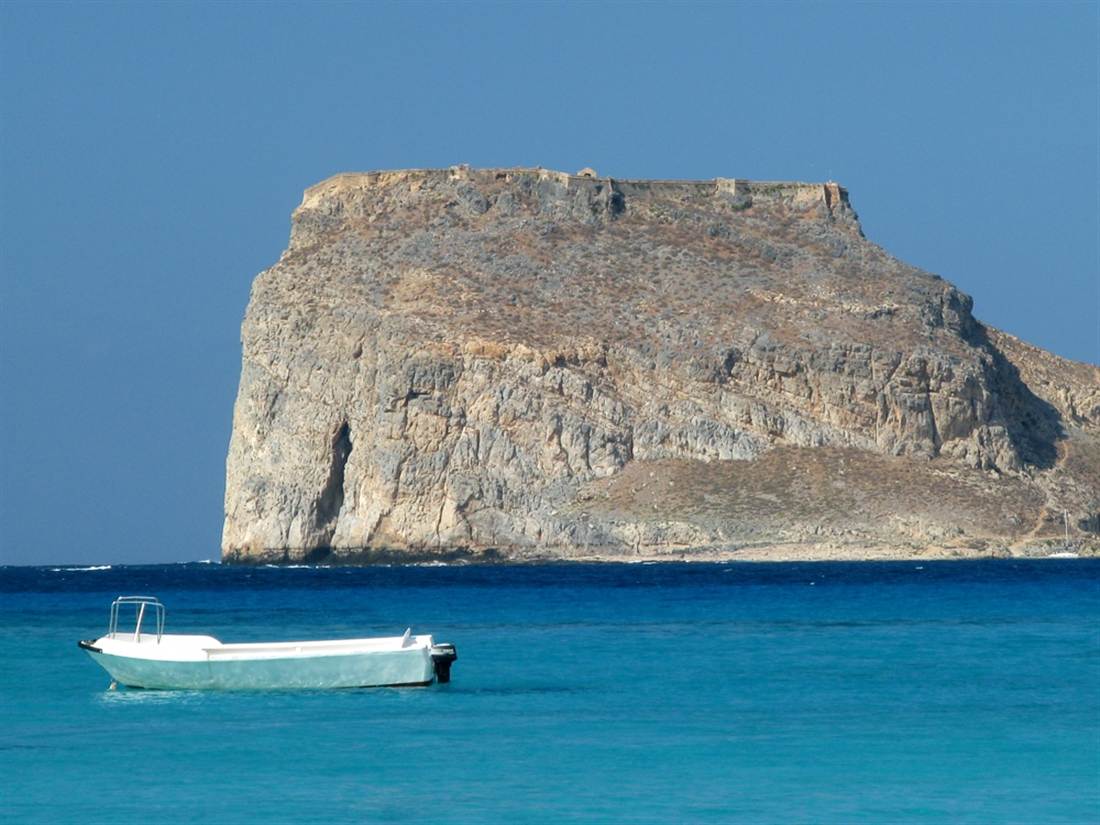
The best day trips from Chania reach the Samaria Gorge, the Balos lagoon and Gramvousa, the pink sand of Elafonisi, the Venetian town of Rethymno and the Minoan palace of Knossos, each within a day’s drive across Crete. Plan the whole trip with Greece Tours.
This guide covers day trips from Chania in full: the Samaria Gorge hike, the Balos and Gramvousa cruise, Elafonisi and Falassarna, Rethymno, Preveli and the south coast, Knossos and Heraklion, the mountain villages and Argyroupoli springs, Imbros Gorge, Kournas Lake, Aptera and Souda bay, whether you need a car or a tour, the best trip by boat, and how to choose by distance, with a base in Chania town.
What are the best day trips from Chania?
The best day trips from Chania are the Samaria Gorge, Balos lagoon, Elafonisi pink beach, Falassarna, Rethymno old town, Preveli palm beach and the Sfakia coast \u2014 each sits within a 45-minute to two-hour drive of the city.
Chania is the launch point for western Crete, and the road network fans out from the city in three directions. The E65 national road runs east along the north coast toward Rethymno and Heraklion. A separate route climbs south-west through the Kissamos peninsula toward Balos and Falassarna. A third road cuts through the White Mountains to reach Omalos, Elafonisi and the isolated southern shore at Sougia, Loutro and Chora Sfakia. Every headline excursion listed here starts on one of those three arteries, and the longest of them puts you at the trailhead or the sand in under two hours.
The city itself rewards a slow morning, so plan the day trip around an early departure and a return in time for dinner in the Chania old harbour. Guided coaches leave from the bus station on Kydonias Street and from hotel pickup points along the north-coast strip. A hire car unlocks the beaches and mountain villages that fixed coach timetables skip, and the mountain roads are paved, signposted and driven daily by local traffic. Distances stay short because western Crete is compact: the peninsula tapers to a point at Gramvousa, and the whole west coast fits inside a 90-minute radius of the harbour.
Match the trip to the season and the crowd tolerance. The Samaria Gorge opens from late spring to mid-autumn and demands a full day of walking. Balos and Elafonisi draw the heaviest summer traffic, so an early start beats the midday coaches to the sand. Rethymno, Sfakia and the palm beach at Preveli hold their appeal across the shoulder months, when the north-coast resorts empty and the light turns gold. The eight excursions below cover the full spread, from a strenuous mountain gorge to a Venetian old town you stroll at your own pace.
Decide between a hire car and an organised coach before you fix the itinerary, because that choice shapes every trip on the list. A car buys the beaches at dawn, the empty mountain villages and the freedom to link Falassarna with Balos in one westward loop. A coach removes the hairpins, the parking scramble and the ferry logistics of a one-way gorge walk, and the driver-guide adds the history along the way. Petrol stations thin out west of Kissamos and south of the White Mountains, so top up the tank in Chania before any run to Elafonisi, Sougia or Sfakia, and carry cash for the small parking and beach fees the card machines at remote coves do not take.
Is the Samaria Gorge a good day trip from Chania and how do you do it?
The Samaria Gorge is the finest day trip from Chania \u2014 a 16-kilometre walk down the longest gorge in Europe. Coaches climb 42 km to the Omalos plateau in about 75 minutes, you descend on foot, then a boat lifts you off the south coast.
The mechanics run in one direction only, downhill from the mountains to the sea. A coach collects walkers from Chania before dawn and grinds up to the Xyloskalo trailhead at 1,230 metres on the edge of the Omalos plateau. From there the path drops through pine forest and past the abandoned village of Samaria before threading the Iron Gates, where the walls narrow to three metres apart and rise 300 metres overhead. The route ends at Agia Roumeli on the Libyan Sea, a village with no road in or out. A ferry carries you west to Sougia or Chora Sfakia, where a second coach waits to drive you back to Chania over the mountains.
Budget a full day and treat the timing as fixed. The descent takes five to seven hours at a steady pace, and the last ferry from Agia Roumeli leaves in the late afternoon, so a slow party risks missing the boat and the connecting coach. Wear broken-in walking boots, carry two litres of water per person, and refill at the springs that line the trail. The park charges a modest entry fee at the Xyloskalo gate, and rangers record every ticket to confirm each walker reaches the far end. Full timings, the fitness required and the ferry connections sit on the dedicated Samaria Gorge guide.
The gorge opens from late spring to the middle of October, and the exact dates shift with the spring snowmelt that floods the riverbed. Outside that window the park closes for safety, though a short “lazy way” walk up from Agia Roumeli to the Iron Gates stays open when the full route is shut. Book the organised coach-and-boat package to remove the logistical knot of a one-way walk that ends at a roadless village \u2014 the operator holds your ferry seat and the return coach, and the single ticket covers both legs plus the morning pickup at your hotel.
The trail earns its reputation on the descent through the Iron Gates, but the wildlife and the ghost village fix the memory. The gorge shelters the kri-kri, the wild Cretan goat that survives nowhere else on the island in the wild, and the sharp-eyed spot them on the high ledges above the path. Halfway down, the deserted houses and the little church of Samaria mark the old settlement, cleared when the gorge became a national park. Rest at the springs, refill the water bottles, and pace the last two hours to the sea, where the black-pebble beach and the cold beer at Agia Roumeli reward the finish before the ferry casts off.
How do you reach Balos lagoon and Gramvousa island from Chania?
Balos lagoon sits 56 km west of Chania at the tip of the Gramvousa peninsula. Reach it two ways: a cruise boat from Kissamos port that also lands on Gramvousa islet, or a hire car to the trailhead and a 20-minute walk down to the sand.
The cruise is the effortless route and the one most day-trippers choose. A coach runs the 42 km from Chania to Kissamos port in about 50 minutes, and the boat sails from there. It anchors first at the islet of Imeri Gramvousa, crowned by a ruined Venetian sea fortress, where you climb the 20-minute path to the ramparts and swim off a shipwreck beached in the shallows. The boat then repositions to Balos itself, dropping anchor off the lagoon so you wade ashore into water the colour of turquoise glass. The whole cruise fills a day and returns to Kissamos in the late afternoon.
The self-drive route trades comfort for freedom and an earlier arrival. From Kissamos a signposted turn leads onto a rough 10-kilometre dirt track that clings to the peninsula’s spine, and the final stretch demands slow, careful driving in an ordinary car. A car park at the end of the track charges a small fee, and from there a stone path descends 20 minutes to the beach. Drivers who arrive before the first cruise boat get the pale sand and the shallow pink-tinged shallows to themselves for an hour. The full breakdown of the track, the walk and the cruise timetable sits on the Balos lagoon guide.
Choose the boat for the fortress and the shipwreck, the car for the dawn light and the empty sand. The lagoon has no shade, no taverna and no fresh water at the beach, so carry an umbrella, plenty to drink and a packed lunch whichever way you travel. The dirt track closes to hire cars in the wettest winter weeks, and the cruise runs from late April to the end of October. Wind off the Gramvousa point kicks up in the afternoon, so an early visit also buys calmer water for the swim across to the lagoon’s warm inner pool.
The lagoon forms where a spit of pale sand curls out from the shore to enclose a shallow, near-motionless pool of turquoise water. The shallows warm to bath temperature by mid-morning and the sand runs pink where crushed shell mixes into the white, strongest at the water’s edge. Gramvousa islet, the fortified rock offshore, guarded the sea lanes into the Cretan sea for the Venetians, and the climb to its ramparts gives a hawk’s view straight down onto the lagoon’s colours. Reef shoes protect the feet against the stony patches on the walk down the peninsula path, and a wide hat and high-factor sun cream matter on a beach with no natural shade at all.
Is Elafonisi pink-sand beach worth a day trip from Chania?
Elafonisi rewards the drive with pink coral sand and a lagoon shallow enough to wade across to an offshore islet. It lies 76 km south-west of Chania, a 90-minute mountain drive, and daily buses and tours run through the summer.
The road is the price of admission and part of the reward. From Chania the route climbs through the Topolia gorge, past the cave-church of Agia Sofia and the chestnut villages of the Kissamos highlands, before dropping to the south-west corner of the island. The tarmac twists through 76 km of mountain scenery, so the drive fills 90 minutes each way and demands a steady hand on the hairpins. A single daily public bus leaves the Chania station in the morning and returns in the late afternoon, which gives roughly five hours on the sand \u2014 enough for a full beach day without the wheel.
Break the drive with the roadside stops that make the mountain route a trip in itself. The Topolia gorge narrows to a road tunnel cut through the rock, and the cave-church of Agia Sofia hides in a cavern above the road, cool and dim behind a whitewashed front. The village of Elos sits in a bowl of chestnut trees that flame copper in the autumn, and the tavernas along the way pour local wine and serve mountain lamb. These halts turn the 90-minute transfer into a slow discovery of the Kissamos highlands rather than a drive to endure.
Elafonisi is a double beach split by a shallow lagoon. The pink tint comes from crushed coral and the shells of tiny marine organisms mixed into the white sand, strongest along the water’s edge on the islet side. You wade thigh-deep across the warm channel to the nature reserve of Elafonisi islet, where marked paths cross low dunes to a lighthouse and quiet coves on the seaward shore. The lagoon water stays warm and calm, and the depth suits families with small children. Sunbeds, umbrellas and two canteens cluster at the mainland end, so the far cove stays wild.
Go early or late to sidestep the midday coach crush, and book an organised tour to skip the mountain driving and the car park scramble. Tours pick up from north-coast hotels, handle the road and give a fixed window on the sand, and the operator threads the Topolia gorge stop into the itinerary. The reserve protects nesting sea turtles and rare dune plants, so the wardens rope off sections in the breeding season and ask visitors to keep to the paths. Full transport options, the walk to the islet and the best hours to arrive sit on the Elafonisi beach guide.
Is Falassarna beach a good day trip from Chania for the sunset?
Falassarna is the west coast’s great sunset beach \u2014 a broad sweep of pale sand facing due west into the open Mediterranean, 52 km from Chania and a 55-minute drive. The flat sand and the unbroken horizon make it the finest sundown on this side of Crete.
The beach fills a wide bay below the Gramvousa peninsula, a run of five sandy coves stitched into one long strand. The main beach measures over a kilometre of fine, pale sand that shelves gently into clear water, and the western aspect means the sun drops straight into the sea with nothing between the shore and the horizon. Afternoon winds whip up rolling surf that draws bodyboarders and kite riders, while the sheltered southern coves stay calm for a family swim. Sunbeds, umbrellas and a line of tavernas back the main strand, so a full day here needs no planning beyond the drive.
Pair Falassarna with the morning at Balos for a full west-coast day, since both sit off the same Kissamos road. Drive the Gramvousa track at dawn for the lagoon, retreat before the afternoon wind, then cross the peninsula to Falassarna for lunch on the sand and the long wait for sundown. The two beaches face opposite quarters \u2014 Balos north into the sheltered gulf, Falassarna west into the open sea \u2014 so the light and the water read entirely different within the same afternoon.
The drive runs west along the coast road to Kissamos, then a short turn over a low ridge to the bay, 52 km covered in about 55 minutes of easy tarmac. Above the northern end stand the ruins of ancient Falassarna, a Hellenic harbour town whose stone-cut throne and dry docks now sit stranded inland \u2014 the coastline lifted metres out of the sea in an earthquake, leaving the old port high and dry. Walk the site in the cool of the late afternoon before settling on the sand for the main event. Time the drive to arrive two hours before dusk, claim a taverna table on the sand, and watch the light turn the whole bay copper and rose as the sun sinks into the water.
Is Rethymno old town worth a day trip from Chania?
Rethymno’s old town is the best cultural day trip from Chania \u2014 a Venetian and Ottoman quarter crowned by the largest Renaissance sea fortress in Crete. It lies 60 km east on the national road, a 50-minute drive, with hourly intercity buses.
The old town rewards an unhurried wander with a coffee stop and a lunch of local cheese pies and grilled fish. The Historical and Folk Art Museum fills a restored Venetian mansion with Cretan weaving, ceramics and rural tools, and the Archaeological Museum sits within the fortress walls. Craft workshops still cut leather sandals and turn ceramics in the back lanes, and the covered market off the main street sells thyme honey, herbs and raki straight from the barrel. Time the return for the golden hour, when the low sun sets the ochre facades and the fortress bastions glowing above the harbour.
The trip is the easy one, a straight run east on the E65 national road that hugs the north coast. Intercity KTEL buses leave the Chania station on the hour through the day and reach Rethymno in about an hour, so a car is optional. The old town packs its treasures into a walkable warren behind the harbour: narrow lanes of Venetian merchant houses with carved stone doorways, Ottoman fountains, a slender minaret rising over tiled roofs, and the Rimondi Fountain spilling water through three lion heads into a marble basin. The Venetian harbour, ringed with fish tavernas and guarded by a squat lighthouse, anchors the eastern edge.
The Fortezza dominates the headland above the town. This star-shaped fortress, the largest the Venetians raised on the island, encloses a whole hilltop of bastions, a domed mosque converted from a cathedral, and ramparts that give a full sweep over the sea and the terracotta roofs below. Buy a ticket at the gate and allow 90 minutes to walk the walls and the interior. Below the fortress, the town beach runs east for kilometres of sand backed by a palm-lined promenade, so a morning of history pairs with an afternoon swim. Return on an evening bus after dinner in the harbour, and the whole day costs little beyond the fare and the fortress ticket.
How do you reach Preveli beach and the palm forest on the south coast?
Preveli beach sits where a palm-lined river meets the Libyan Sea on Crete’s south coast, 82 km from Chania \u2014 a two-hour drive east then south over the mountains. A monastery car park above the gorge starts the 15-minute descent to the sand.
Preveli is Crete’s palm-beach set piece. The Kourtaliotiko gorge funnels a freshwater river down to a cove where a dense grove of Cretan date palms lines both banks, and the river runs cold and clear across the sand into the warm sea. Swimmers float up the river channel into the shade of the palms, or strike out into the open bay. The setting has no road to the sand itself: you park at the Preveli Monastery, a working Orthodox foundation perched high above the coast, and walk down a stepped stone path that drops through the cliffs to the river mouth in about 15 minutes.
Visit the monastery before the beach to read the setting whole. Preveli Monastery played a part in the Cretan resistance, sheltering stranded soldiers who slipped off this coast by submarine, and a memorial at the gate marks the story. The chapel, the small museum of icons and silver, and the terrace over the Libyan Sea reward the stop, and modest dress covers shoulders and knees at the door. From the terrace the palm gorge opens below, the river threading its green line to the sea, which sets up the descent that follows.
The drive is the long one on this list, but the scenery earns every kilometre. From Chania the route runs east to Rethymno on the national road, then turns inland and climbs south through the Kourtaliotiko gorge, a 82-kilometre journey of roughly two hours. Boats also run to Preveli from the resort of Plakias and from Agia Galini, which turns the day into a coastal cruise and skips the cliff steps for anyone who prefers the sea approach. Carry water and food, because the single seasonal canteen at the beach keeps short hours. A morning start beats the afternoon heat on the return climb up the stone path from the sand to the car park.
How do you day-trip to Sougia, Loutro and Chora Sfakia on the south coast?
Sougia, Loutro and Chora Sfakia are the three great villages of Crete’s wild south coast, reached from Chania over the White Mountains. Chora Sfakia lies 72 km south, a 90-minute drive; Sougia 68 km, 80 minutes; and Loutro, road-free, is a short ferry hop from Sfakia.
Each village offers a different flavour of the isolated Sfakia shore. Sougia is a laid-back grey-pebble beach at the mouth of the Agia Irini gorge, with a scatter of tavernas and rooms and a long, quiet strand where the mountains fall straight into the Libyan Sea. Chora Sfakia is the ferry hub of the south, a fishing harbour clinging to a rocky bay that serves as the road-head for the boats to Agia Roumeli, Loutro and the beach at Sweetwater. The drive to Sfakia climbs across the Askifou plateau and drops through the dramatic Imbros gorge road, 72 km of mountain switchbacks covered in about 90 minutes.
Loutro is the jewel and the catch: a whitewashed crescent of houses around a sheltered blue bay with no road in at all. Reach it by the coastal ferry from Chora Sfakia, a 15-minute crossing, or walk the coast path in from Sfakia in about two hours. With no cars, no through road and no crowd of coaches, Loutro keeps the pace of an older Crete \u2014 you swim off the harbour steps, eat at a taverna over the water and walk the goat paths to hidden coves. Sfakia guards a fierce mountain identity, and the local table proves it: sfakianes pites, thin cheese pancakes drizzled with mountain honey, arrive fresh at the harbour tavernas, alongside grilled lamb and the strong local raki. Drive to Sfakia, park at the harbour, and let the ferries stitch the three villages into a single day of the south coast at its most untamed.
Is Knossos and Heraklion worth the drive east from Chania?
Knossos sits 145 km east of Chania, a 90-minute drive on the E75 national road. The Minoan palace and the Heraklion Archaeological Museum reward the distance, and a guided tour removes the parking and ticket-queue friction of the long day.
The E75 hugs the north coast the entire way, passing Rethymno and Georgioupoli before the road curves inland toward Heraklion. Knossos lies 5 km south of Heraklion city centre, so the palace and the museum form a paired visit inside the same trip. The palace covers the ceremonial and administrative heart of Bronze Age Crete, with the restored throne room, the grand staircase, and the fresco reproductions that Arthur Evans installed during the excavation. The originals hang in the Heraklion Archaeological Museum, which means the two sites explain each other and demand a full day together.
Self-drivers leave Chania by 08:00 to reach Knossos before the coaches arrive from Heraklion port. The site opens early, and the first two hours carry the lightest crowds and the coolest air. Parking sits across the road from the entrance, and a licensed guide meets independent visitors at the gate for a walk-through of the labyrinth legend, the drainage engineering, and the light-well architecture. A guided coach tour from Chania folds the driving, the entrance, and the expert commentary into one price, which suits travellers who prefer to read the landscape through a window rather than a windscreen. The return leg reaches Chania by early evening, leaving time for dinner in the old harbour.
The Heraklion Archaeological Museum holds the finest Minoan collection in the world across two floors and twenty-seven galleries. The Snake Goddess figurines, the Bull-Leaping fresco, the Phaistos Disc, and the bull’s-head rhyton all sit here, and the museum stands in the city centre a five-minute walk from the old Venetian harbour and the Koules fortress. Pairing the palace with the museum in a single day turns fragments of restored wall into a coherent narrative of Bronze Age Crete. Drivers park in the harbour car parks and walk to both the museum and the Morosini fountain on the central square, which adds a Venetian layer to the Minoan one.
What do the Rethymno wineries and the Amari valley add to a day out?
The Amari valley and the wine villages south of Rethymno sit 60 to 80 km east and south-east of Chania, a 70 to 90 minute drive. The route strings together mountain hamlets, working wineries, and the Argyroupoli springs, where plane trees shade a cascade of cold water.
Argyroupoli stands on the site of ancient Lappa, 25 km south-east of Rethymno and roughly 85 km from Chania. The lower village channels spring water through stone troughs and under a canopy of century-old plane trees, and tavernas built over the streams serve trout and lamb beside the running water. The temperature drops noticeably in the shade of the springs, which turns the stop into a midday refuge during the hot months. From Argyroupoli the road climbs south into the Amari valley, a broad green basin cradled between Mount Ida and the Kedros massif.
The Amari valley holds Byzantine chapels, terraced olive groves, and villages such as Thronos, Meronas, and Fourfouras, where Venetian and frescoed churches stand a short walk apart. The wine estates cluster on the eastern flank toward Heraklion prefecture, and the local grapes\u2014Vidiano, Vilana, Kotsifali, and Liatiko\u2014define the tasting flights. A day framed around Amari trades coastline for altitude: cool air, panoramic ridgelines, and a slower rhythm of mountain kafeneia. Drivers pair the valley loop with a return through Rethymno old town, where the Fortezza and the Venetian harbour close the day beside the sea.
The tasting stops build the day’s structure. Estate cellars open their doors for flights that walk through the indigenous grapes, and the food follows the wine: graviera cheese aged in mountain caves, wild greens gathered from the terraces, and honey from thyme-covered slopes. The village of Spili, on the road between Rethymno and the Amari basin, marks a natural mid-point, where nineteen stone lion heads spill spring water into a long trough on the main square. Rethymno itself, 72 km from Chania, holds the third-largest Venetian old town on Crete, and the drive back down from the mountains delivers travellers to its narrow lanes for the evening. The full loop covers wine, cheese, springs, and two historic towns inside a single circuit.
How short is a Therisso Gorge trip into the Chania hinterland?
Therisso Gorge lies 15 km south of Chania, a 25-minute drive that opens straight into a rock corridor. The half-day loop through the gorge to Therisso village and back fits inside a morning, which makes it the closest escape from the city.
The road leaves Chania through the suburb of Perivolia and enters the gorge within twenty minutes of the old harbour. Sheer limestone walls press against both sides of the tarmac for 6 km, and the drive threads under overhangs where the rock leans over the road. The gorge carries historical weight as the base of the autonomy uprising led by Eleftherios Venizelos, and the village of Therisso holds a small museum devoted to that chapter. Tavernas in the village grill local meat over charcoal and serve it with village bread and raki, which turns the turnaround point into a lunch stop.
Therisso works as a self-drive outing without a full itinerary. The gorge floor stays shaded through the morning, and the drive rewards a slow pace with pull-offs beside the stream that runs after winter rain. Travellers based in the old town reach the trailhead of the gorge, the village, and the return in under four hours, which leaves the afternoon free for the beach or the market. The route suits a first day on the island, an acclimatisation loop that shows the transition from coast to White Mountains without committing to a long expedition. A hire car handles the road, and the surface stays paved the entire distance.
The village end delivers a second reward beyond the gorge itself. Therisso stands at 580 m in a fold of the mountains, and the tavernas here built their reputation on charcoal-grilled lamb, pork, and the local sausages, served through the year to walkers and drivers. A small anti-slip road continues past the village toward the Meskla valley for travellers extending the loop, though the gorge and the meal make a complete half-day on their own. The proximity to Chania\u2014a 25-minute drive each way\u2014turns Therisso into the outing that fills an unexpected free morning without any planning, a gorge, a historic village, and a mountain lunch inside a single tank-friendly loop.
Why choose Imbros Gorge over Samaria?
Imbros Gorge runs 8 km through the White Mountains, 57 km south of Chania, a 75-minute drive to the village of Imbros. The trail measures 8 km against Samaria’s 16 km, which makes Imbros the shorter, gentler descent to the Libyan Sea.
The gorge starts at the village of Imbros at 780 m altitude and drops to Komitades near the south coast. The descent takes two to three hours at a steady walk, half the time of the Samaria Gorge, and the path never narrows into the technical scrambles that the longer route demands. The walls close to two metres apart at the famous narrows, a stone slot that frames the sky, and the trail passes old cypress stands and the ruins of a wartime supply route. The exit at Komitades lands beside tavernas that arrange the shuttle back up to the car at Imbros.
Imbros opens the whole year, unlike the seasonal window that governs Samaria, and the shorter length suits families, older walkers, and anyone short on time. The entrance fee stays modest, and the logistics stay simple: a taxi or a pre-booked transfer carries walkers from Komitades back to the parked car, or an organised tour handles both ends. The southern exit sits a short drive from Chora Sfakion, where the harbour serves the boats to Loutro and Agia Roumeli. Pairing the gorge with an afternoon swim off the south coast turns Imbros into a full day that stays well within the reach of a moderate walker.
The descent stays gentle underfoot, with a well-graded path and only a modest total drop of 600 m across the 8 km. Walkers carry two litres of water, wear trainers rather than heavy boots, and finish at Komitades in time for a taverna lunch under the vines. The village of Frangokastello lies 12 km east of the exit, where a square Venetian fort stands alone on a flat coastal plain beside a shallow sandy bay. Adding Frangokastello to the Imbros day pairs a manageable mountain walk with an empty south-coast beach and a photogenic castle, a combination the longer Samaria route leaves no time for.
What makes Kournas Lake an easy family day?
Kournas Lake is Crete’s only freshwater lake, 43 km east of Chania and a 45-minute drive near Georgioupoli. Pedal boats, a shaded shoreline, and a ring of tavernas turn the emerald basin into a low-effort outing for families and non-walkers.
The lake sits in a bowl below the foothills of the White Mountains, fed by underground springs that keep the water cool through the summer. Pedal boats and rowing boats launch from the northern shore, and a lap of the lake takes under an hour at an easy pace. The eastern edge stays wild and reed-fringed, home to terrapins and waterfowl, while the western beach shelves gently into shallow water that suits small children. The colour shifts from turquoise to deep green as the depth changes, and the surrounding hills reflect across the still surface in the morning.
Kournas pairs with the beach at Georgioupoli, 4 km north at the river mouth, where the Almiros river meets the sea under a long eucalyptus avenue. A day that starts at the lake and ends on the Georgioupoli sand covers freshwater and coast inside a 45-minute radius of Chania. Tavernas above the lake serve grilled fish and Cretan salads on terraces that overlook the water, and the car park sits a short walk from the boat rental. The outing demands no hiking and no early start, which makes it the counterweight to the gorge days and a reliable choice when the forecast turns hot.
The lake level rises through the winter rains and drops through the summer, and the receding water exposes a small beach on the southern shore that fills with families by midday. A footpath circles part of the northern bank for walkers who prefer the shore to a boat, and the taverna terraces above serve the lake trout and the local dakos rusk salad. The drive from Chania follows the E75 to the Kournas turn-off near Georgioupoli, then climbs 4 km of paved lane to the water, a route a standard hire car handles without difficulty.
What is there to see at Aptera and Souda bay?
Aptera stands 13 km east of Chania on a plateau above Souda bay, a 20-minute drive. The ancient city walls, Roman cisterns, a Greek theatre, and a Turkish fort crown the ridge, with the deep natural harbour of Souda spread below.
Aptera commanded the bay from the Classical era through the Roman and Byzantine periods, and the site scatters across a broad hilltop enclosed by 4 km of city walls. The most complete monument is the trio of vaulted Roman cisterns, a subterranean hall of arches that stored the city’s water, and the restored Greek theatre hosts events through the warm months. A Venetian and Ottoman monastery and the later Koules fortress on the cliff edge round out the walk, and the whole circuit takes 90 minutes at a measured pace. The elevation delivers a wide view over Souda bay, the largest natural deep-water harbour in the Mediterranean.
The site sits a short detour off the E75, which makes it a natural pairing with a drive further east or a stop on the way back from Rethymno. Entry costs little, the parking sits at the gate, and the plateau catches a breeze that eases the summer heat. Below the ruins, the Souda peninsula holds the Allied war cemetery, a quiet garden of headstones for the fallen of the Battle of Crete, and a visit there adds historical depth to the archaeology on the hill. The combination of Minoan-to-Ottoman layers and the panoramic bay turns Aptera into a compact half-day that most self-drivers underestimate.
The site pairs naturally with the town of Kalyves and the beaches of the Apokoronas coast, 5 km down the hill toward the sea. A morning at the ruins and an afternoon on the sand at Almyrida or Kalyves fills the day inside a 20-minute radius of the archaeological gate. The plateau road stays paved to the car park, and the museum-style signage across the site explains each monument in English and Greek. Travellers with a single spare half-day near the city treat Aptera as the closest genuine archaeological outing to Chania, closer than Knossos by two hours of driving and richer in standing structure than the city’s own Venetian walls.
Do you need a car or a tour for day trips from Chania?
A hire car unlocks the mountain villages, the gorges, and the remote coves at your own pace. An organised tour suits the long runs to Knossos and the boat trips to Balos. The KTEL bus network links Chania to Rethymno, Heraklion, and the south coast on a fixed timetable.
Self-drive delivers the widest reach for the least money across a group of two or more. The mountain roads to Therisso, Amari, and the Sfakia coast reward the freedom to stop, and the Amari valley and Kournas Lake stay awkward to reach on public transport. A hire car from Chania costs a modest daily rate, the E75 north-coast road stays fast and well surfaced, and parking near the trailheads and archaeological sites stays straightforward outside the city centre. Drivers who prefer to read the scenery rather than the road hand the long eastern runs to a coach instead.
The KTEL bus network covers the corridor between Chania, Rethymno, and Heraklion with frequent departures, plus seasonal services south to Chora Sfakion, Omalos for the Samaria trailhead, and the beaches at Elafonisi and Falasarna. Buses remove the parking problem in the towns and the cost of a hire car for a single traveller, though the timetable governs the day and the remote valleys stay off the routes. Organised tours settle the calculation for Knossos, the Balos and Gramvousa boat, and the Samaria descent, where the logistics of tickets, transfers, and one-way trailheads reward a package. Guidance on basing yourself for these outings sits in the where to stay in Chania overview.
What is the best day trip from Chania by boat?
The Balos and Gramvousa cruise is the finest boat day from Chania. The vessel sails from Kissamos, 42 km west, to the pirate islet of Gramvousa and the turquoise lagoon of Balos, a full day of swimming stops. Sunset cruises from the old harbour offer a shorter evening alternative.
The boat leaves Kissamos port, a 40-minute drive west of Chania, and steams first to the islet of Imeri Gramvousa, crowned by a Venetian fortress that guards a shipwreck grounded on the reef below. A stop of two hours allows the climb to the fort and a swim off the sandbar. The vessel then anchors off Balos, where a shallow lagoon of white sand and graded blues sits between the mainland cape and the islet of Tigani. The wading depth stays warm and calm inside the lagoon, and the beach walk across the shallows defines the image most travellers carry home from western Crete.
The full-day cruise returns to Kissamos by late afternoon, and the drive back to Chania closes the day. Travellers who prefer to skip the boat reach Balos by the rough 8 km unpaved road to the car park above the lagoon, followed by a 20-minute descent on foot, though the cruise handles the heat and the walking in one package. For an evening rather than a full day, sunset cruises leave the Chania old harbour for a two-hour loop along the coast with a swim stop and a drink as the light drops behind the Rodopou peninsula. Both formats book out fast through the warm season, so a reservation the day before secures a place.
A second boat option runs south from Chora Sfakion along the Libyan coast to Loutro and Agia Roumeli, villages the road never reaches. Loutro clings to a car-free horseshoe bay of white houses and blue doors, accessible by sea and on foot alone, and the ferry links it to the beaches at Marmara and Sweetwater. Travellers who finish the Samaria or Imbros descent on the south coast board these boats to shortcut the return, which folds a coastal cruise into the walking day. The southern crossings run shorter and calmer than the western lagoon trips, and they trade the crowds of Balos for the isolation of the Sfakia shore.
How do you pick a day trip from Chania by how far it is?
Sort the outings by drive time from Chania. Under 30 minutes: Therisso, Aptera, Stavros. Under an hour: Kournas, Elafonisi, Falasarna. One to two hours: Imbros, Rethymno, Balos, Knossos. The near list suits a slow morning; the far list demands an early start.
The close ring, inside 45 minutes, holds the outings that forgive a late departure. Therisso Gorge at 15 km, Aptera at 13 km, the Stavros beach at 17 km, and Kournas Lake at 43 km all return to the city by lunch or mid-afternoon without pressure. These make the natural choice for an arrival day, a family day, or a forecast that turns hot by noon, and they demand no ticketing beyond a parking fee. A traveller with a single free morning fills it comfortably from this ring.
The far ring, 60 to 90 minutes each way, rewards an 08:00 start and a full day in the field. Knossos at 145 km, Balos from Kissamos at 42 km, Elafonisi at 76 km, the Samaria trailhead at Omalos at 42 km of mountain road, and Imbros at 57 km all pull the day into ten or twelve hours door to door. Grouping the far outings by direction\u2014east to Rethymno and Heraklion, west to Kissamos and Balos, south to Sfakia and the gorges\u2014keeps the driving efficient across a week. The overview at the Chania destination guide maps the clusters against a typical stay.
What is the ideal number of day trips on a Chania holiday?
A seven-night stay in Chania supports three or four full day trips. Space them with rest days in the old town between the long drives, and alternate a demanding outing such as Samaria with an easy one such as Kournas Lake. The rhythm protects the holiday from turning into a driving marathon.
The arithmetic starts with the recovery cost of each outing. A gorge walk or a Knossos run consumes a full day and leaves the legs and the eyes tired, so a second heavy day straight after blunts the pleasure of both. Interleaving a demanding trip with a beach afternoon, a market morning, or a short Therisso loop restores the balance. Over seven nights, a plan of three full excursions\u2014one east to the Minoan sites, one west to Balos, one south into the mountains\u2014plus a light half-day and two unstructured days in Chania itself fills the week without strain.
Direction dictates the pairing more than distance alone. Grouping the eastern outings\u2014Rethymno, Aptera, Argyroupoli, and Knossos\u2014into one or two days keeps the E75 mileage tidy, while the western cape and the southern gorges each form their own axis. Weather steers the order too: a clear, calm forecast goes to the boat day and the exposed lagoons, and a hot, still day goes to the shaded gorges and the freshwater lake. A holiday built on this cadence delivers the range of Crete\u2014Minoan palace, mountain village, freshwater lake, and turquoise lagoon\u2014without reducing the base town to a place to sleep between drives.
Frequently Asked Questions
What is the best day trip from Chania?
The Samaria Gorge and the Balos lagoon rank as the best day trips from Chania. Samaria is a 16-kilometre mountain hike ending at the Libyan Sea, while Balos is a turquoise lagoon reached by the Kissamos cruise or a rough 4×4 track over Gramvousa.
Can you do Knossos as a day trip from Chania?
Knossos sits about 145 kilometres east of Chania, a two-hour drive or a full-day coach tour that pairs the Minoan palace with Heraklion and its archaeological museum. The distance makes it the longest of the popular Chania day trips.
Do you need a car for day trips from Chania?
A hire car gives the most freedom for day trips from Chania, reaching Elafonisi, Falassarna and the south coast on your own schedule. The KTEL bus network and organised tours cover the Samaria Gorge, Balos, Rethymno and Knossos without a car.