
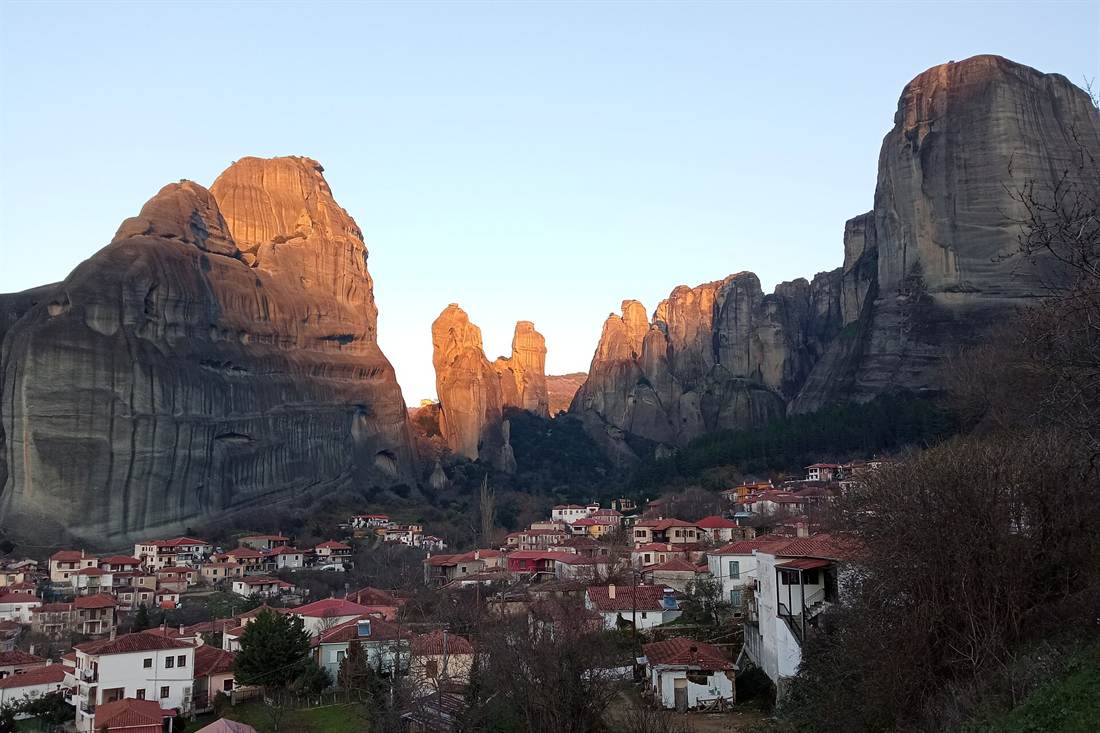
Meteora has a festival or a feast on the calendar from Carnival to 26 December. A climb to a cave chapel in Kastraki comes on 23 April. Echoes of Meteora fills three July evenings with free music in the edition ERT reports. A free mushroom weekend closes the summer, and Trikala opens a Christmas park with an ice rink.
Four of these events have a fixed day in the guides: the Elijah fair on 20 July, the Pyli fair in late August, the St Vissarion feast on 14 and 15 September and the Echoes weekend. Fix a bed around those dates first, because the Visit Meteora guide advises reserving a room three to five months early for June to August. To add an island or a mainland town after the festival, start from the Greece Tours homepage, which links each region we cover.
Which Meteora festivals and feast days run through the year?
Six web pages name twelve recurring Meteora festivals and local events outside Easter. The year opens with a Carnival street game in Kalabaka and closes with a Christmas park in Trikala. Half of the events fall in summer.
This calendar of Meteora festivals credits each line to its source in brackets. Geopark is the Meteora Pyli Geopark events page. Infotourist is the events menu of the Kalambaka tourist information centre. The other four sources are the Greeka guide, the ERT report, the Visit Meteora guide and Wikipedia.
- Carnival season, Kalabaka: the Carnival Treasure Hunt, a street game for all ages (Geopark, Infotourist).
- Carnival season, Pyli and Gomfoi: the local Carnival tradition (Geopark).
- July to September, Kalambaka: the Meteora Technis cultural events (Greeka). The Geopark page lists a Meteora Art Festival there each summer.
- 7 to 9 July in the reported edition: the Echoes of Meteora music festival (ERT).
- 20 July, Kalambaka: the Prophet Elijah fair, which the Geopark page puts at 5 days (Geopark, Visit Meteora).
- 21 to 24 August, Pyli: the annual fair, with exhibitors from all over Greece (Geopark).
- End of August, Kastraki: the Wine Festival (Geopark).
- End of summer: the Annual Mushroom Festival, organised by the Natural History Museum of Meteora (Geopark, Infotourist).
- 14 and 15 September, Pyli: the feast of St Vissarion, patron saint of the Holy Metropolis of Trikki and Stagios (Geopark).
- End of October, Kastania: the Chestnut Festival at the Goura location (Geopark).
- December, Trikala: the Mill of the Elves Christmas park (Wikipedia, Visit Meteora).
- The feast day of St George Mandilas: young villagers hang scarves in the monastery (Geopark, Infotourist).
That makes twelve Meteora festivals and feasts. The Technis and the Art Festival share one line. Both sources place a summer programme of concerts and theatre in the same town.
The Infotourist menu adds four sports events by name. They are Meteora Trail Running, the International Half Marathon between Kalampaka and Trikala, Enduromania and Meteora MTBrace. It gives no dates for them.
The Greeka guide lists two of the Meteora festivals: Easter and the Meteora Technis programme. It says the Technis runs from July to September. The programme has theatre, dance, lectures, art exhibitions and concerts of traditional Greek, international and church music. Greeka adds that the monasteries hold large feasts on the name days of their saints.
The Visit Meteora guide lists different Meteora festivals and seasons. It gives the Elijah fair around 20 July, autumn harvest food and the Mill of the Elves in December.
Neither guide mentions Echoes of Meteora, the Wine Festival in Kastraki or the Chestnut Festival. The Visit Meteora guide says no single headline festival dominates autumn. The Geopark page still names a Chestnut Festival for the end of October.
Meteora festivals carry a month or a season in these sources, not a calendar date. Only four events get fixed days. They are the Elijah fair, the Pyli fair, the St Vissarion feast and the one Echoes edition that ERT reports.
Holy Week has its own page, so read Meteora Easter celebrations for it. Wikipedia counts six monasteries still standing at Meteora, and the Meteora travel guide covers each one. Pick your Meteora festivals first, then fit the monastery visits around those dates.
What is the Echoes of Meteora music festival?
Among Meteora festivals, Echoes of Meteora is a three-evening music event with free entry. ERT reports a second year in a row. It lists four acts a night from 8.30, at the cultural space of the former KEGE.
ERT’s regional report is the only page here with a programme for any of the Meteora festivals. It calls Echoes the biggest music date of the summer. The report describes a three-day event devoted to music, artistic expression and a shared experience.
It says the festival hosts bands and artists from different genres, in a varied programme of modern sounds. It sums the days up as music, image and creative expression.
The venue is the cultural space of the former KEGE. In the ERT wording it sits under the natural landscape of Meteora. The report gives no street address and no travel directions.
Wikipedia calls Kalabaka the seat of the Meteora municipality. Ask at the town’s tourist information centre for the way.
The Municipality of Meteora supports the event, together with a theatre workshop. A music company handles the artistic direction and the production. ERT adds that the festival aims to become a fixed cultural institution of the area. This is the second year, so the report describes no older edition.
Each evening begins at 8.30, and entry is free, according to the report. The programme lists four acts per evening, with these styles in this order:
- Tuesday 7 July: modern heavy metal, Greek hardcore punk, alternative rock, then hip-hop.
- Wednesday 8 July: blues, rock and hard rock; progressive rock; entechno rock; and entechno.
- Thursday 9 July: Greek-language rock, Greek rock, Greek and foreign rock, and a live drum performance.
Wikipedia describes entechno as orchestral music with elements from Greek folk rhythm and melody. These dates belong to the edition ERT reports. The report gives no dates for a later edition. Check the municipality’s notice before you book a trip for Meteora festivals in July.
Which monasteries hold a saint’s day feast?
Among the Meteora festivals, the monastery feasts fall on the name day of each house’s saint, says the Greeka guide. All six monasteries have a dedication, and the church calendar gives each one a date. The guides describe no public programme.
Two sources give the dedications behind the Meteora festivals at the monasteries: Wikipedia and the municipal tourism site of Meteora. The dates come from Wikipedia’s articles on each feast or saint.
- Great Meteoron. Wikipedia says its dedication is the Transfiguration. Wikipedia puts that feast on 6 August on the Revised Julian calendar. Its founder, Athanasius the Meteorite, has his own feast on 20 April.
- Varlaam. The municipal site says the monastery is dedicated to all the saints. Wikipedia says the Eastern Orthodox Church marks All Saints on the first Sunday after Pentecost.
- Rousanou. The municipal site says the church is dedicated to the Transfiguration of the Saviour, and that St Barbara is honoured here on 4 December. Wikipedia’s article on Saint Barbara gives the same date.
- Holy Trinity. Wikipedia says the monastery is dedicated to the Holy Trinity and has a chapel of St John the Baptist carved into the rock. In Eastern Christianity, Wikipedia adds, Trinity Sunday is the Sunday of Pentecost.
- St Nicholas Anapausas. The municipal site names its main church for St Nicholas. Wikipedia gives 6 December as his feast day.
- St Stephen. The municipal site says the old main church honours St Stephen and the newer one honours St Charalambos, whose skull the monastery keeps. Wikipedia lists 27 December among Stephen’s Eastern dates and 10 February for Charalambos.
Two of these dates move. Pentecost falls 49 days after Easter, says Wikipedia, and it calls Pentecost a moveable feast. Holy Trinity’s date is Pentecost Sunday, and Varlaam’s comes a week later. Check the church calendar for your year before you plan around these Meteora festivals.
The sources say little about the day itself at these monasteries. Greeka writes that every religious feast at Meteora is kept with solemnity. The municipal site adds that the faithful of the area celebrate St Barbara at Rousanou. None of the pages I read lists a service time or a meal for the Meteora festivals.
Near Kalambaka, the municipal site names the monastery of Agioi Theodoroi as an important pilgrimage. It says the pilgrims come from the whole area, from the Chasia villages to the plain. The monastery holds relics of Agioi Theodoroi and Agios Tryphon.
Our page on Holy Trinity Monastery explains how to visit it, whichever of the Meteora festivals you choose.
Which town and village festivals add to the Meteora festivals?
The local side of the Meteora festivals runs from April to November. Kalambaka stages a summer arts season. Kastraki keeps a rope climb on St George’s Day and a wine festival in late August. Villages such as Kria Vrisi and Nea Zoe celebrate name days.
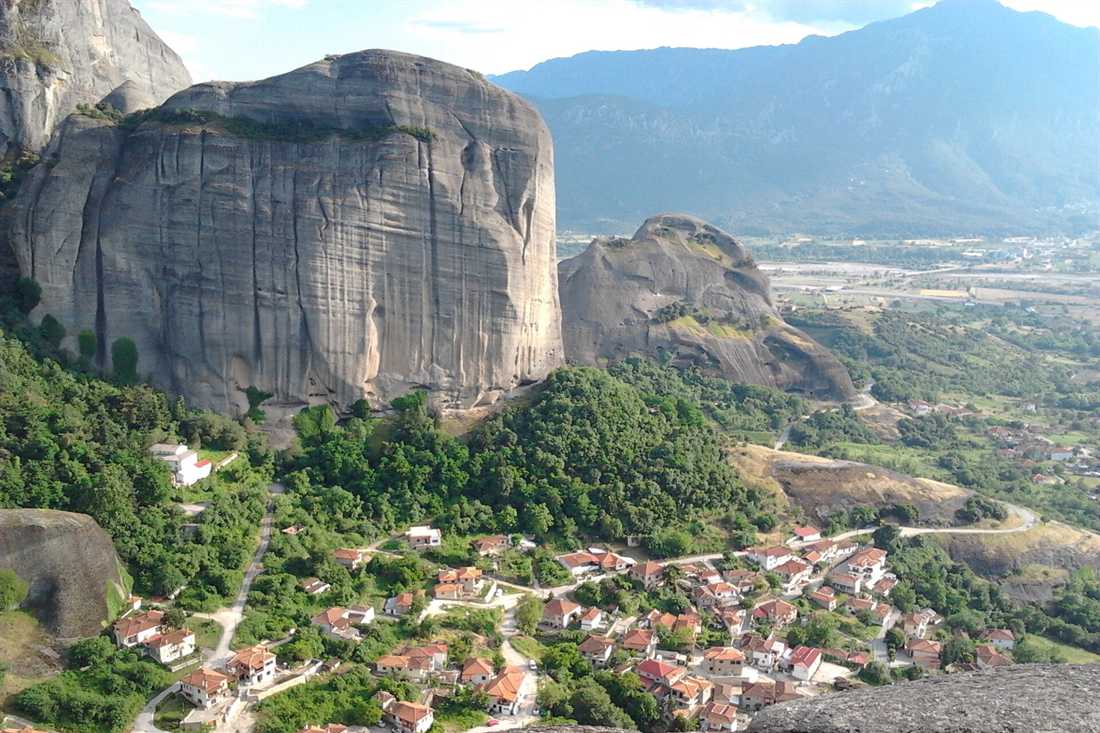
- 23 April, Kastraki. The municipal site says young men climb to the cave chapel of St George Mandilas after the Divine Liturgy. It puts the chapel 30 metres above the ground. They swap last year’s coloured handkerchiefs for new ones.
- June to September, Kalambaka. The municipal site lists Meteora of Art, run by the town hall, with music and theatre. Greeka lists Meteora Technis from July to September, with theatre, concerts, dance, lectures and art exhibitions.
- 7 July, Nea Zoe. The municipal site says the settlement celebrates the name day of St Kyriaki.
- 20 to 25 July, Prophet Elias. The municipal site says the festival opens on the saint’s name day and ends on 25 July. It lists children’s play areas and stalls selling goods and food. The Visit Meteora guide cites an Elias fair around 20 July as one of the summer feasts, and says they add energy to the evenings in Kalambaka and Kastraki.
- 26 July, Kria Vrisi. The municipal site says the country church of St Paraskevi celebrates on this day.
- End of August, Kastraki. The municipal site describes a wine festival with free wine, traditional dancing, and sausages and meat from the local area.
- 11 November, Kria Vrisi. On the name day of St Menas, the municipal site says, the village serves bean soup and wine to every visitor after the Divine Liturgy.
- End of November, Kastania. The municipal site describes a chestnut festival. The locals hand out boiled and grilled chestnuts free of charge, with traditional products and dancing.
Kalambaka and Kastraki split the calendar of local Meteora festivals. Kalambaka holds a season of events run from the town hall. The sources start it in June or July and end it in September. Kastraki holds two dated events, the April climb and the August wine festival. The municipal Kastraki page tells visitors not to miss either one.
The two Kastraki events among the Meteora festivals differ in feel. The wine festival hands out wine and local sausage with dancing. The April custom is a church feast with a climb. Greek Wikipedia says villagers and visitors from all over Greece offer a handkerchief to the saint on his day.
Both villages hold name-day feasts too. Kria Vrisi sits 650 metres up, 7 kilometres from Kalambaka, with about 300 residents. Nea Zoe sits 500 metres up with about 170. For these small Meteora festivals the municipal site gives dates, with no programme beyond the bean soup.
Your base decides how close you sleep to the Meteora festivals. Our guide to Kastraki describes the village under the rocks. Our guide to Kalabaka describes the town below them.
What does the Christmas season look like in Trikala and Kalambaka?
The Meteora festivals reach into winter in two towns. Trikala runs the Mill of Elves, a Christmas park by the river, from late November to early January. Kalambaka lights its streets, and a news report describes a lit nativity scene in a cave above the town.
The Christmas entry among the Meteora festivals sits in Trikala, not at the rocks. Greek Wikipedia says the old Matsopoulos mill, an industrial monument of the 19th century, becomes the park’s central building. The park’s own site puts it only minutes from the city centre, on foot, by bike or by car.
The park’s English page says entry is free. It names these attractions for a winter stop among the Meteora festivals:
- Rides and play: the Fun Park, the ice rink and the Elves’ Children’s Park.
- Treats and shopping: a Christmas market, a mushroom market, a sweet market, a chocolate factory, a candy castle and street food.
- Free themed corners: Santa’s house, the elves’ post office, face painting and Santa’s wood workshop.
- Stage events: music, dance, theatre and fairy tales on the main stage. The edition on the site lists 48 days of them.
- Hours: every day from 10:00 to 22:00 in that same edition.
A new central theme frames the park every season. The site posts the dates of each edition. Check them before you plan a trip around these Meteora festivals.
The programme spills into the city. Greek Wikipedia says events run in the centre, along the pedestrian streets and in the old Manavika entertainment area. It also lists outings and events in Kalambaka, Pyli, Elati, the Pertouli ski centre, Mouzaki and Lake Plastiras. That list shows how far the Meteora festivals of winter stretch beyond Trikala.
Among the Meteora festivals of winter, Kalambaka adds its own Christmas. A December report on the news site iefimerida said the town was dressed for the holidays. Occupancy already touched 90% for Christmas and New Year days. The municipality planned concerts, games and gifts for children, plus traditional food for visitors.
Greek City Times described a nativity scene inside a cave above Kalambaka. Locals call the rock Ambaria and the Eye of God. Figures of Mary, Christ and the magi stand under a large star. Night lighting makes the scene visible from the town and from a long way off.
Christmas is the winter side of the Meteora festivals, so the weather matters for the trip. For snow and road conditions, read Meteora in winter. For the city beyond the park, our Trikala tours page covers the river and the road to Pyli.
Which Meteora festivals are the mushroom festival and the Geopark geofestivals?
The Annual Mushroom Festival is the first of these Meteora festivals: it fills Kalambaka at the end of every summer. The Geopark site adds 23 geofestivals in the Meteora and Pyli municipalities, from village feasts to fairs. Pyli’s cultural events fall mainly in summer.
A museum runs the Mushroom Festival. The Infotourist page names the Museum of Natural History of Meteora and Mushrooms as organiser. It runs under the auspices of the Municipality of Kalambaka. The page lists concerts, talks, mushroom dishes and traditional dancing. Every activity is free.
A report from the news site iefimerida shows how one of these Meteora festivals ran. The 4th festival went from Friday 7 to Sunday 9 September, over one weekend:
- Friday: children’s shows with stilt walkers, conjurers and shadow theatre, then a folk orchestra with a local dance group.
- Saturday: groups go out to pick mushrooms and hunt truffles. In the evening come a mushroom seminar and a cookout with ten chefs.
- Sunday: painting for children and traditional dances, with the close at 14:30.
A second museum event joins the Meteora festivals calendar in October. It is a Panhellenic Truffle Festival, run with the Municipality of Meteora. Iefimerida covered its second edition, from Thursday to Sunday in Rigas Feraios Square, Kalambaka. The report lists seminars, a truffle hunt in the forest on Saturday and about 40 chefs cooking. Everything was free.
The Geopark lists these Meteora festivals itself. Its site says the Meteora Pyli Geopark belongs to the UNESCO Global Geoparks Network. It joins the rock pillars of Meteora to the Pindos mountains, rivers and forests of western Thessaly. Our Meteora geology page explains how those rocks formed.
On the Geopark site, a geofestival joins the landscape with the local culture. Cultural life in Pyli happens mainly in summer and stays local in scale. These Meteora festivals are village affairs, run by cultural associations and the municipality. The Pyli side of the list holds these events:
- Battle of Porta, 8 and 9 June: a celebration of the fight where 150 ELAS fighters and 80 to 100 reserves held back 4,500 Italian troops at the Porta pass.
- Sarakatsani gathering, end of June, Pertouli: three days of games, folk dances and a re-enactment of the seasonal move between mountain and plain. It ends with the Great Dance.
- Pyli Cultural Summer, July and August: a concert on the steps, a folk night and a rebetiko night at the fountain.
- Trout Festival, 6 August, Palaiokarya: fried trout beside the old watermill, with music and dancing.
- Achelous Festival, Mesochora, seven days in August: concerts, talks, workshops and outdoor activities.
- Onion Festival, last Sunday of August, Palaiomonastiro: stew and pies with onion, plus traditional dances.
- Pyli fair, 22 and 23 August: after Vespers at Porta Panagia, crowds fill the main street and the pedestrian zone.
- Dance of the Elders, 17 August, Gardiki: village elders dance with lit candles, closing a three-day Dormition feast.
- Saint Vissarion feast, 14 and 15 September: Vespers at the monastery, Liturgy the next day and a procession of the saint’s skull to Pyli. The monastery is not open to women.
- Chestnut Festival, end of October, Kastania: boiled and roasted chestnuts are free, with dances by cultural associations.
- Gournochara, 26 December, Palaiokarya and Filyra: a cultural association cooks pork, sausages and pancakes for a pig feast.
August is the busy month for Meteora festivals in Pyli. The Trout, Onion and Achelous festivals, the fair and the Dance of the Elders all fall inside it. The Geopark’s own pages disagree on one date. The festival list gives the Pyli fair as 21 to 24 August. The fair’s own page says 22 and 23 August.
The two pages on the Mushroom Festival also differ. The Infotourist page lists concerts, talks, food and dancing. The Geopark page adds mushroom hunting, truffle hunting, theatre, seminars and art workshops for children. Both place the festival at the end of summer.
A museum runs the mushroom weekend in town, and village associations run the geofestivals in Pyli. Taken together, these Meteora festivals run from June to October, with one pig feast in December.
Which tours go well with the Meteora festivals?
Six GetYourGuide listings suit a trip built around the Meteora festivals. Only the Christmas tour from Athens names a season in its title. The other five cover truffles, the Mushroom Museum, the Pindos villages, a 360-degree show and a day trip from Larissa.
The listing data gives the length of each tour, plus the languages and the start city where it shows them. It ties none of them to an event date. Treat them as ways to fill the days around the Meteora festivals, not as festival tickets.
- Christmas tour from Athens. The tour lasts 2 days. It runs in English and Greek, and the listing shows pickup. The listing says it visits the Mill of the Elves, offers activities at Lake Plastiras and sees the Meteora rocks and monasteries.
- Truffle hunt below Meteora. The experience lasts 3.5 hours, in English and Greek, and sits under Kalabaka. A truffle hunter and his dogs lead the search for rare kinds of truffle. The truffles come with pasta prepared in front of you. The title adds a lunch and a museum visit.
- Volos tour with Trikala and the Mushroom Museum. Pickup is available on this 10-hour tour, offered in English and Greek. It visits the monasteries, Trikala and the Mushroom Museum in Kalabaka, after a drive through the Thessalian landscape.
- Terra Immersia ticket. The 360-degree immersive experience lasts 1 hour in Kalambaka, minutes from the monasteries, says the listing. It is wheelchair accessible. The listing names no language.
- Pindos Mountains and Trikala day trip. The listing calls it a day trip from Meteora. It lasts 7 hours, in English, with pickup available. It visits the villages of Elati and Pertouli, the hermit caves of Badova and Trikala city.
- Monasteries and rock formations from Larissa. The 8-hour day trip is offered in English and Greek, and the listing shows pickup. The listing names monastery visits, rock formations, panoramic views and free time in Kalambaka or Kastraki.
The Christmas tour is the one listing with a season attached. Its booking calendar runs from 1 December to 5 January. No other tour here carries a festive date.
One of the Meteora festivals has a loose link to a tour stop. The Infotourist page names the Natural History Museum of Meteora as the organiser of the mushroom festival. That museum carries Mushroom Museum in its name. The Volos tour stops at a Mushroom Museum, but its listing does not say it is the same one.
For a one-day run from the capital, read our Meteora day trips from Athens guide.
How do you plan a stay around the Meteora festivals?
Book the bed first, whichever of the Meteora festivals you pick. The Visit Meteora guide says to book 3 to 5 months ahead for June to August. For April, late spring, September and October it says 10 to 14 weeks. For winter it gives 2 to 4 weeks, unless you travel for a specific holiday.
The Visit Meteora FAQ says storm damage disrupted the train route. It tells rail travellers to take the Athens to Thessaloniki train to Paleofarsalos. A Hellenic Trains bus then runs on to Kalambaka. Wikipedia lists Kalambaka station on the Palaiofarsalos to Kalambaka line, so check the current service before you buy a ticket.
The Visit Meteora timing guide says KTEL runs the main Athens and Thessaloniki routes to Kalambaka. The FAQ adds that public KTEL buses are no longer allowed outside urban areas, including around the monasteries. From late spring to late October, parking is limited outside Great Meteoron, Varlaam and Saint Stephen. The FAQ also reports brief traffic jams there.
Kalambaka, Kastraki and Trikala each host one of the Meteora festivals. Kalambaka is the town at the foot of the Meteora massif, says Wikipedia. Kastraki is a village of 1,023 residents. It lies in a small valley open to the southwest flank of the massif.
Trikala sits beside the A3 motorway and has daily trains to Athens and Thessaloniki. Read where to stay in Meteora before you pick a base.
The Meteora festivals fall in different seasons, so the time to visit Meteora depends on the event you choose.
- Pick one of the Meteora festivals first. Note its month or season and match it to your free dates.
- Check those dates against national holidays. The timing guide says holidays can mean reduced intercity bus schedules, limited train frequency and sold-out seats. It calls 15 August a peak-summer exodus, with roads and buses packed, and says crowds stay high until the 28 October holiday.
- Book transport early around those dates, as the guide advises, and the bed by the lead times above.
- Choose Kalambaka, Kastraki or Trikala as your base.
- Allow two nights. The guide calls 2 nights ideal for hikes and all the monasteries without rushing. The FAQ says people manage between 2 and 4 monasteries a day.
- For December, keep Meteora for a weekday and add Trikala in the evening. The guide says Meteora stays calm in early to mid-December, with a modest weekend uplift from families who combine both stops.
Each of the six tours above shows a free cancellation label. Their booking cut-offs run from 15 minutes for the Terra Immersia ticket to 20 hours for the truffle hunt.
What do travellers ask about Meteora festivals?
Is there a music festival at Meteora?
Yes. Among the Meteora festivals, Echoes of Meteora fills three July evenings. ERT reports twelve acts and free entry.
Is there a Christmas park near Meteora?
Yes, in Trikala, which Wikipedia places near Meteora and Kalambaka. The stone-built Matsopoulos Mill, a museum and cultural centre, turns into the Mill of Elves in the Christmas period.
When is the mushroom festival?
At the end of summer, says the Infotourist page. The Geopark page adds artistic workshops for children to a programme of concerts, hunts and dances.
Do the Meteora festivals change how busy the area is?
Slightly, around set dates. The Visit Meteora guide names the Prophet Elias fair on about 20 July. It reports busier roads and accommodation, plus extra local energy in Kalambaka and Kastraki evenings.
Do the Meteora festivals change the monastery hours?
This page gives no hours. The Visit Meteora FAQ warns against relying on guidebook hours, because the timetable changes from year to year. Our monastery opening hours page holds the schedule.