
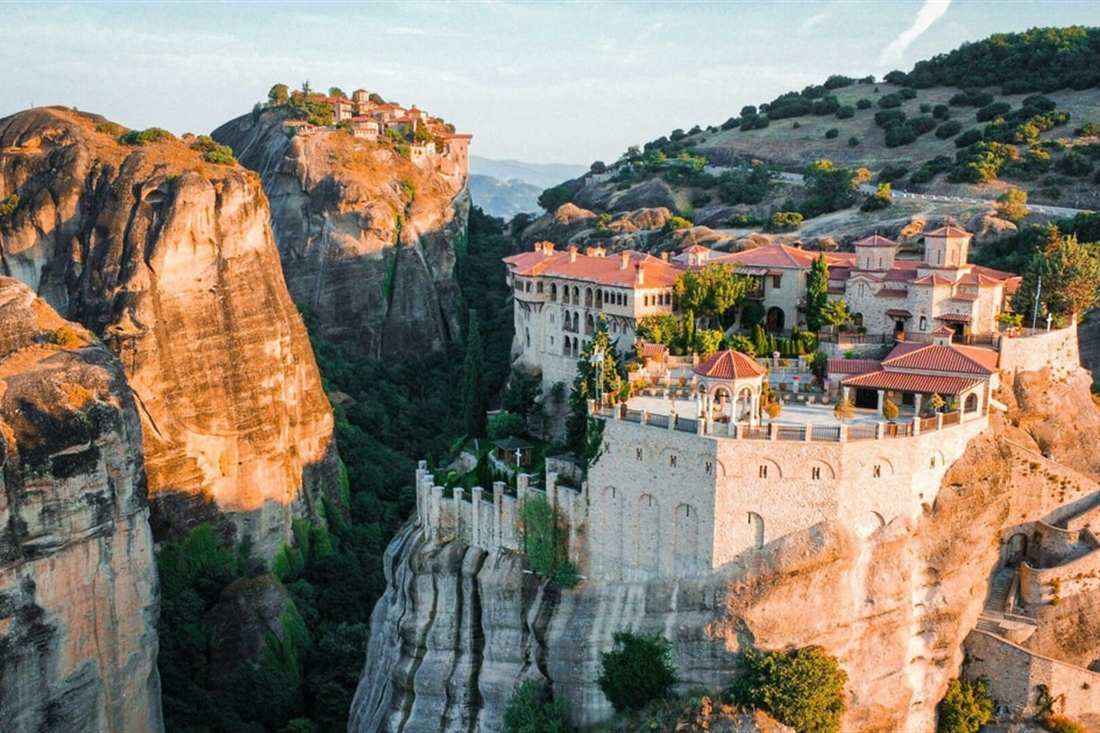
A Larissa private guided tour of Meteora is an 8-hour day trip with hotel pickup in Larissa, a private vehicle and an English-speaking guide, west across the Thessalian plain to the rock-top monasteries. Tours across the rest of the country are listed on Greece Tours.
The sections below cover what the Larissa private guided tour of Meteora includes, the road, the monasteries, the frescoes, the viewpoints, closing days, dress code, booking and cancellation, with links into the Meteora pages. The tours shown are checked on GetYourGuide.
What is a Larissa private guided tour of Meteora?
A Larissa private guided tour of Meteora is a one-day excursion starting from the city of Larissa. It uses private transportation and an English-speaking guide to explore the monasteries and rock landscape. The private group is capped at 8 travellers.
GetYourGuide lists this trip under the name “Larissa: Private Guided Tour of Meteora with Hotel Pickup”. The platform files it under Kalambaka, the town at the foot of the rocks.
The entire experience runs as a private trip. Only the booked group rides in the vehicle. No strangers join the ride or share the guide. A Larissa private guided tour of Meteora keeps the day for one group. Other day trips from the city sit on the Larissa tours page.
The listed duration is 8 hours. During this time, the group travels west from the city to the rocks. The guide speaks English throughout the day. The focus stays on the rock formations and the buildings perched on top of them.
- Private transportation carries only the booked group
- An English-speaking guide leads the excursion
- The group size has a cap of eight travellers
- The total duration lasts for 8 hours
- The destination sits near the town of Kalambaka
What does the Larissa private guided tour of Meteora include?
The Larissa private guided tour of Meteora includes hotel pickup, private transportation, and an English-speaking guide. The vehicle collects the group at its hotel in Larissa. It brings everyone back to the same hotel at the end of the day.
The transport is entirely private. The vehicle arrives and leaves on the group’s own schedule. There is no fixed coach timetable to follow. The day follows the group’s pace rather than a fixed departure board.
The guide speaks English during the whole trip. They explain the rock landscape and point out the monasteries. The group stays together inside the private vehicle. With up to eight people, the guide speaks to one small group.
At the end of the day, the vehicle returns the group to its starting point. The vehicle drops everyone off at the exact hotel where the morning began. A Larissa private guided tour of Meteora therefore needs no separate transport back to the accommodation.
- Hotel pickup directly from the accommodation in Larissa
- Return transfer to the same hotel at the end of the day
- Private vehicle operating on the group’s own schedule
- English-speaking guide for the entire 8-hour duration
- Group size capped at a maximum of eight travellers
Why does Larissa make a short start for Meteora?
Larissa makes a short start because it sits close to the rocks. A Larissa private guided tour of Meteora begins here since the city is the main hub of Thessaly. The drive west takes about one hour.
Larissa is the main city of the Thessaly region. It connects to the rest of Greece through major transport routes. The city sits on the main railway line of the country. It also sits right on the main motorway of Greece.
Travellers reach Larissa by train. The train from Athens takes about three hours. The train from Thessaloniki takes about an hour and a half. These fast connections make the city a practical base for a Larissa private guided tour of Meteora.
Road travel to Larissa is equally straightforward. By road, Athens is 355 km away, taking about three and a half hours. Thessaloniki is 150 km away, taking about an hour and a half. Starting a Larissa private guided tour of Meteora from this central point saves time. Formats that start at the foot of the rocks sit on the Kalambaka private tour page.
The city acts as a crossroads for different directions. From Larissa, Mount Olympus lies an hour to the north. Volos and Pelion sit an hour to the south-east. The rocks of Meteora are just an hour to the west.
- Athens is 355 km away by road
- Thessaloniki is 150 km away by road
- The train from Athens takes about three hours
- The train from Thessaloniki takes about an hour and a half
- Meteora is about one hour west of the city
Which road runs from Larissa to Kalambaka?
The EO6 national road runs from Larissa to Kalambaka. Taking a Larissa private guided tour of Meteora means driving this route across the Thessalian plain. The distance is about 82 km, taking between one hour ten minutes and one hour twenty minutes.
The EO6 national road starts in the coastal city of Volos. It runs inland through Larissa and continues westward. Along the way, it passes through Trikala before reaching Kalambaka. The private vehicle follows this road to reach the rocks.
The drive crosses the flat Thessalian plain. This area consists of farmland and rivers stretching out in every direction. The land remains level for almost the entire journey. Then, at Kalambaka, the Pindus mountains begin and the rock pillars rise straight out of the plain.
Trikala lies 21 km east of Kalambaka on this road. It is a town built on the Lithaios river. Trikala holds an old quarter called Varousi and a fortress with a clock tower. It also has Ottoman monuments and the Matsopoulos Mill. The tour listing does not name a stop in Trikala. The town has its own Trikala tours.
The transition from flat land to tall rocks happens quickly. Guests on a Larissa private guided tour of Meteora watch the landscape change in the final kilometres. The flat fields give way to vertical stone columns. Kalambaka sits right at the base of these giant formations.
- The EO6 national road connects the two points
- The total distance is about 82 km
- The drive takes one hour ten minutes to one hour twenty minutes
- The road crosses the flat Thessalian plain
- Trikala lies 21 km east of Kalambaka
- The Pindus mountains begin at Kalambaka
How is the 8-hour day split between the road and the rocks?
The 8-hour day splits into driving time and exploration time. A Larissa private guided tour of Meteora spends about two and a half hours on the road. The remaining five and a half hours take place at the rocks.
The drive from Larissa to Kalambaka takes over an hour each way. The return trip requires the same amount of time. Together, the two drives take about two and a half hours. This leaves the rest of the 8-hour block for the actual visit.
About five and a half hours remain once the driving is done. The group spends this time looking at the monasteries and the rock landscape. The English-speaking guide uses these hours to explain what the group sees. The private vehicle moves the group between different spots near Kalambaka.
The vehicle runs on the group’s own schedule. The five and a half hours follow the group’s pace. There is no coach timetable forcing early departures.
The two and a half hours of driving cross the flat Thessalian plain. This gives the group time to rest between exploring the rocks. The return drive of a Larissa private guided tour of Meteora ends at the hotel in Larissa. The full 8-hour day ends where it started.
- The total duration of the trip is 8 hours
- The two drives take about two and a half hours together
- About five and a half hours are spent at the rocks
- The private vehicle moves on the group’s own schedule
- The day ends with a return to the hotel in Larissa
What are the rocks that a Larissa private guided tour of Meteora visits?
A Larissa private guided tour of Meteora visits tall sandstone and conglomerate pillars between Kalambaka and Kastraki. Water and wind shaped these rocks over a long time. The name means suspended in the air, and the site holds UNESCO World Heritage status.
The pillars rise high above the plain of Thessaly. Orthodox monasteries sit on top of these tall rock formations. A Larissa private guided tour of Meteora takes visitors right to the base of these giant stones.
Sandstone and conglomerate form the main material of the rocks. Water and strong winds carved the shapes over a very long period. The result is a landscape of isolated columns standing close together near the village of Kastraki.
The word Meteora translates directly to suspended in the air. This name fits the sight of buildings resting on narrow rock tops. Visitors see at once why the name fits.
- Sandstone forms the core material of the tall pillars
- Conglomerate rock mixes with the sandstone layers
- Water and wind shaped the columns over a long time
- The rocks stand between Kalambaka and the village of Kastraki
Who lived on the Meteora pillars before the monasteries?
Hermits lived in caves and cracks in the rocks from about the 9th to the 11th century. On a Larissa private guided tour of Meteora, their story starts with Doupiani, the first organised community.
These hermits sought quiet places away from towns. They climbed into natural holes in the sandstone pillars. Their life focused on prayer and isolation inside the rock faces. Exploring the caves and hermitages reveals where these early residents spent their days.
The first organised group gathered at the foot of the pillars near Kastraki. They called this community Doupiani. They met around a small chapel dedicated to the Panagia Doupiani. This chapel still stands today in a rebuilt form.
Doupiani started in Kastraki, at the foot of the pillars on a Larissa private guided tour of Meteora. The chapel gave the hermits a shared place of prayer.
- Hermits occupied natural caves in the rock faces
- Cracks in the pillars provided small sleeping spaces
- The community of Doupiani gathered near Kastraki
- The chapel of Panagia Doupiani served as their centre
- This early chapel survives today in a rebuilt form
Which monasteries stand on the rocks today?
Twenty-four monasteries once stood on the pillars. Six remain open on a Larissa private guided tour of Meteora. They are Great Meteoron, Varlaam, Rousanou, St Nicholas Anapafsas, Holy Trinity and St Stephen. Monks built them from the 14th century onward.
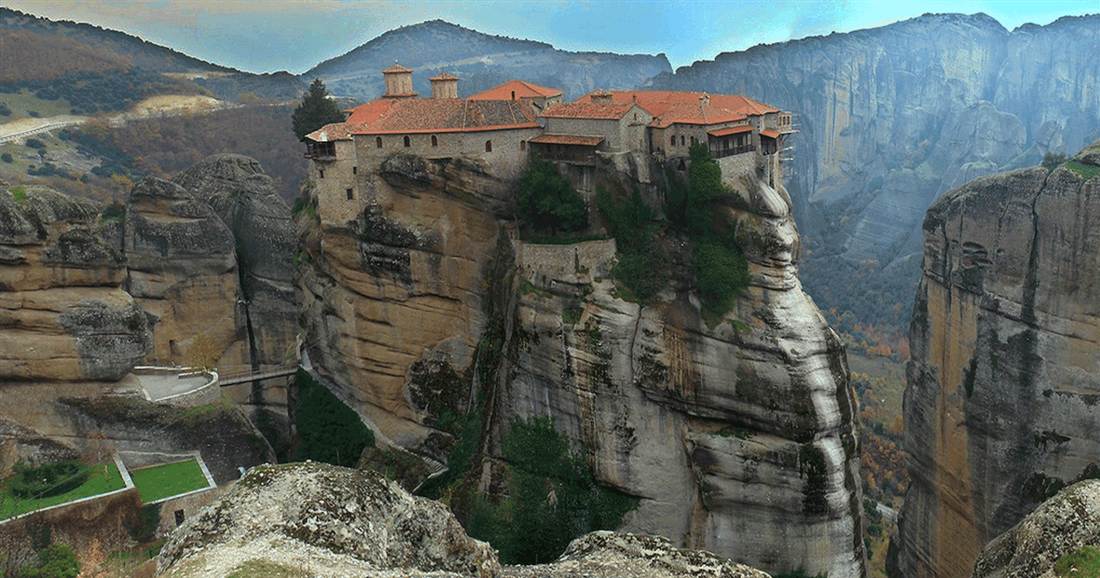
Great Meteoron is the largest of the six open sites. St Athanasios the Meteorite founded it in the 14th century. He was a monk who travelled from Mount Athos. The main church inside is dedicated to the Transfiguration. Visiting the Great Meteoron Monastery shows the scale of this early construction.
Varlaam is the second largest monastery on the rocks. It sits on a tall pillar close to Great Meteoron. St Stephen operates as a convent run by nuns. It rests at the south-eastern end of the rocks, just above the town of Kalambaka.
A Larissa private guided tour of Meteora passes the rocks of all six. The open days decide which gates the group enters. Rousanou, St Nicholas Anapafsas and Holy Trinity complete the six. Each building sits on a separate rock column. Monks and nuns continue to live and pray inside these structures every day.
- Great Meteoron is the largest and was founded by St Athanasios the Meteorite
- Varlaam stands as the second largest monastery on the pillars
- Rousanou sits on a narrow rock column
- St Nicholas Anapafsas features early painted walls
- Holy Trinity rests on a tall isolated peak
- St Stephen is a convent located just above Kalambaka
Which painters decorated the monastery churches?
The main fresco cycles are post-Byzantine paintings of the 16th century in the Cretan School style. Two painters stand out on a Larissa private guided tour of Meteora: Theophanes the Cretan and Frangos Katelanos.
The Cretan School style uses gold and dark backgrounds. The figures appear long and expressive. Story scenes follow a clearly ordered layout. The usual plan puts Christ Pantocrator in the dome. The Dormition of the Virgin goes on the west wall, while standing saints cover the lower walls.
Theophanes the Cretan painted the main church of St Nicholas Anapafsas in the early 16th century. He covered the entire small space from floor to vault. His work fills every available surface with religious scenes. Guests who enter St Nicholas on a Larissa private guided tour of Meteora see his work up close.
Frangos Katelanos painted the main church of Varlaam around the middle of the 16th century. This building is known as the church of All Saints. He included a large Last Judgment scene on a broad wall. Photography inside the main churches is not allowed, so visitors study the details with their own eyes. The Meteora frescoes page covers each painted church in more detail.
- Theophanes the Cretan painted St Nicholas Anapafsas in the early 16th century
- Frangos Katelanos decorated the church of All Saints at Varlaam
- Christ Pantocrator appears in the dome of the churches
- The Dormition of the Virgin sits on the west wall
- Standing saints cover the lower sections of the rooms
- Photography inside the main churches is strictly forbidden
Which viewpoints show the monasteries from the road?
Psaropetra, also called Sunset Rock, sits on the road between Kastraki and the monasteries. A second viewpoint, beside Holy Trinity, opens from a flat concrete road. Both are reachable by car on a Larissa private guided tour of Meteora.
Psaropetra lies about 650 metres south of the fork that leads to Varlaam. From this spot, visitors look directly at Rousanou and Varlaam. The location has a small car park. This parking area fills quickly before sunset. The edge of the rock is not fenced at every point, so guests walk carefully. Watching the Meteora sunset from Psaropetra requires arriving early to find space.
The viewpoint beside Holy Trinity offers a different experience. It connects to a concrete road that stays flat. This setup suits guests who feel uneasy with heights. Guests on a Larissa private guided tour of Meteora who dislike heights pick this stop. People stand on solid ground while looking at the tall pillars.
Sunset times change across the months. In December, the sun sets at about 17:10 in Kalambaka. By late June, sunset falls close to 21:06. Arriving at Psaropetra early secures a spot in the small car park before other groups arrive.
- Psaropetra sits about 650 metres south of the Varlaam fork
- The Sunset Rock viewpoint faces Rousanou and Varlaam directly
- A small car park at Psaropetra fills before sunset
- The edge at Sunset Rock lacks fencing at certain points
- The Holy Trinity viewpoint connects to a flat concrete road
- Sunset in Kalambaka ranges from 17:10 in December to 21:06 in late June
Which days and hours shape a Larissa private guided tour of Meteora?
A Larissa private guided tour of Meteora follows two seasonal timetables. Summer runs from April to October, while winter covers November to March. Winter brings shorter opening hours and extra closed days at each monastery.
Saturday and Sunday are the only days when all six monasteries open their gates. A winter Thursday leaves only three houses available: Rousanou, St Stephen, and St Nicholas Anapafsas. Planning a Larissa private guided tour of Meteora around these weekly schedules keeps the day on track.
Great Meteoron closes on Tuesday year-round. In winter, it also stays shut on Wednesday and Thursday. Its daily opening time is 09:30, and the gates close at 15:00. An afternoon plan needs to reach this house before that hour.
Varlaam closes every Friday. During the winter months, it adds Thursday to its closed days. It opens at 09:00 and closes at 16:00. Visitors following a private guided itinerary note these times closely.
Rousanou shuts its doors on Wednesday. In summer, it welcomes guests from 09:00 until 16:30. Holy Trinity takes Thursday off and operates from 10:00 to 16:00. These specific hours dictate the order of stops on any given day.
St Stephen rests on Monday. During summer, it splits its day into two shifts: 09:00 to 13:30 and 15:30 to 17:30. St Nicholas Anapafsas closes on Friday and opens from 09:00 to 17:00 in summer.
- Great Meteoron closes Tuesday, plus Wednesday and Thursday in winter.
- Varlaam closes Friday, plus Thursday in winter.
- Rousanou closes Wednesday.
- Holy Trinity closes Thursday.
- St Stephen closes Monday.
- St Nicholas Anapafsas closes Friday.
Around Easter and on the patron saint day of a specific house, the schedule changes again. A monastery either closes entirely or opens only for the morning. Guides adjust the route to match these shifting dates.
What do you wear for the monasteries on a Larissa private guided tour of Meteora?
Dress rules apply at every gate during a Larissa private guided tour of Meteora. Women wear skirts below the knee and tops covering the shoulders. Men wear long trousers, and sleeveless shirts are banned for everyone.
Wrap-around skirts hang near the entrances for women who arrive in trousers. Guests borrow them before stepping inside. This rule applies at all six houses on a Larissa private guided tour of Meteora. Checking clothing before leaving the vehicle saves time at the gate.
Entry fees are paid in cash at each individual gate. Carrying small notes speeds up the process. Every stop requires a separate payment right at the door.
Comfortable shoes handle the uneven stone steps safely. The paths between the road and the gates feature rough surfaces. Light layers help manage changing temperatures throughout the day. Sun protection matters on exposed rocky trails.
Bringing water bottles prevents dehydration during the climbs. The sun hits the rocks directly, especially in summer. A hat and sunglasses help on the open viewpoints.
- Skirts below the knee for women.
- Tops covering the shoulders for women.
- Long trousers for men.
- No sleeveless tops for anyone.
- Cash for entry at each gate.
What climb does each Meteora monastery involve?
The physical effort varies greatly during a Larissa private guided tour of Meteora. Great Meteoron requires about 300 steps, while Varlaam needs 195 steps from the main road. St Stephen remains the only step-free option.
Reaching Rousanou involves about 140 steps followed by a short bridge. The climb feels harder in hot weather. Holy Trinity asks visitors to walk downhill first, then climb 145 steps carved directly into the rock face.
St Nicholas Anapafsas also features steps carved straight into the rock. These rock staircases demand steady footing. Wearing shoes with good grip helps navigate the worn stone surfaces safely. Taking breaks on the way up keeps energy levels steady.
Guests who find stairs hard put St Stephen first on a Larissa private guided tour of Meteora. A small footbridge provides access to this house without a long staircase. It stands alone as the only monastery reachable without climbing steep stairs.
Tackling the longest climb early leaves the easier stops for the afternoon, when legs are tired.
Those interested in walking the surrounding trails find options beyond the monastery stairs. Exploring the area on foot reveals different angles of the rock pillars. Routes for guided hiking excursions connect viewpoints away from the main roads.
Which months suit a Larissa private guided tour of Meteora?
Choosing the right month shapes the entire Larissa private guided tour of Meteora experience. Late February to early June offers mild days. Late October to mid-December provides similar comfortable temperatures for walking and exploring.
July and August bring high heat by midday. Climbing hundreds of stone steps becomes exhausting under direct summer sunlight. Timing the visits correctly prevents discomfort.
A summer Larissa private guided tour of Meteora puts the monasteries first in the morning. Starting early avoids the peak temperatures of the afternoon. Early starts keep the pace relaxed.
Winter months run from November through March. The operating hours shrink, and extra closed days appear on the calendar. Warm layers suit the short winter days at the gates and viewpoints.
Spring and autumn bring milder heat for the stone steps. Walking between the houses takes less effort without the summer heat.
Checking the exact opening dates before traveling prevents disappointment. Holiday periods alter the standard timetables. The Meteora monasteries tickets page lists entry at each gate.
Who suits a Larissa private guided tour of Meteora?
A Larissa private guided tour of Meteora fits guests staying in Larissa. It also serves travellers arriving by train. Families and small groups of up to eight people benefit from having one vehicle to themselves.
History and art fans find deep value in the scheduled stops. Each house holds distinct architectural details and religious artifacts. Moving at a private pace allows time to examine these elements closely.
Small groups enjoy the flexibility of a dedicated vehicle. This setup eliminates waiting for strangers or adhering to rigid bus schedules. The guide works with one group only.
Train travellers reach Larissa from Athens or Thessaloniki and stay at a hotel in the city. They join a Larissa private guided tour of Meteora at the hotel door. No car hire or bus change is needed.
Guests with limited mobility ask for St Stephen, the step-free house. The other gates involve long stone staircases.
Families have the guide to themselves for questions. Parents control the timing of snack breaks and rest periods. A private setting accommodates the unpredictable nature of traveling with younger members.
How does a Larissa private guided tour of Meteora compare with starts in other cities?
A Larissa private guided tour of Meteora takes 8 hours and covers about 82 km each way. The drive lasts 1 hour 10 to 1 hour 20 minutes, the shortest of the three city starts.
Thessaloniki sits about 230 km from the rocks. A private trip from that city takes 11 hours. It includes 2.5 to 3 hours of driving each way. A GetYourGuide full-day group bus trip from Thessaloniki also lasts about 11 hours. Guests based in the north compare the Meteora day trip from Thessaloniki.
Volos offers a 7-hour private trip covering 144 to 147 km. That drive takes 1 hour 45 minutes to 2 hours each way. Groups travel in a Mercedes Vito Tourer minivan on this route. A Larissa private guided tour of Meteora still beats both options for driving time.
- Thessaloniki: 11 hours in total, about 230 km, 2.5 to 3 hours of driving each way
- Volos: 7 hours in total, 144 to 147 km, up to 2 hours of driving each way
- Larissa: 8 hours in total, about 82 km, 1 hour 10 to 1 hour 20 minutes each way
- Kalambaka or Kastraki: 3 to 6 hours, starting at local hotels
In Kalambaka itself, private trips last between 3 and 6 hours. These start right at hotels in Kalambaka or the nearby village of Kastraki. Travellers staying overnight there skip the intercity drive entirely. For guests based in a city, a Larissa private guided tour of Meteora keeps the drive short.
The short distance from Larissa leaves more time at the rocks. Guests spend less than 3 hours in the vehicle in total. This format suits travellers who dislike long car rides. Choosing a Larissa private guided tour of Meteora means arriving rested and ready to explore.
What can you see in Larissa before or after the tour?
Before or after a Larissa private guided tour of Meteora, visitors explore the city centre. It holds an ancient theatre, a museum, an Ottoman market and a riverside park. The First Ancient Theatre, the Diachronic Museum, and Frourio hill sit within one kilometre of each other.
The First Ancient Theatre stands on the southern slope of Frourio hill. Builders raised it in the 3rd century BC. It seated about 10,000 people. It has been restored for performances. This site gives context to the region before taking a Larissa private guided tour of Meteora.
The Diachronic Museum of Larissa sits on Mezourlo hill. Its exhibits cover Thessaly from the Palaeolithic era to the Ottoman period. The museum and the theatre are close together. Visitors walk between them in minutes. Planning a stop here adds depth to the day.
The Bezesteni is a covered market built in the 15th century under Ottoman rule. It sits on the Frourio hill near the theatre. Alcazar park lies along the Pineios river. It features a bridge and a summer stage for events. Hippocrates died in Larissa, adding historical weight to the city.
- The First Ancient Theatre: 3rd century BC, about 10,000 seats, restored for performances
- The Diachronic Museum: located on Mezourlo hill, covering Thessaly from the Palaeolithic to the Ottomans
- The Bezesteni: a 15th-century Ottoman covered market on the Frourio
- Alcazar park: set on the Pineios river with a bridge and summer stage
These sights cluster tightly together. The theatre, the museum, and the Frourio are all within one kilometre. Walking connects them quickly. Guests back from a Larissa private guided tour of Meteora cover all three in a short walk.
How do you book a Larissa private guided tour of Meteora?
To book a Larissa private guided tour of Meteora, use GetYourGuide. Select the date, group size and hotel address. Bookings close 10 hours before the start time. Confirmation arrives immediately upon completing the reservation.
The booking process happens entirely online. Pick the preferred date on the platform first. Then enter the exact number of guests. Finally, type the hotel address for the pickup. The price per guest changes depending on the total group size.
Timing matters for reservations. Bookings close 10 hours before the scheduled start. A morning departure requires a reservation by the previous evening. Waiting until the same morning risks missing the cutoff. Plan ahead to secure the spot.
Only the booked party rides in the vehicle. Strangers do not join the trip. This keeps the experience private. After paying, a confirmation message arrives right away. Keep this message on a phone. The town at the foot of the rocks has its own Kalabaka page.
Selecting the correct hotel address prevents delays. Drivers go directly to the provided location. Double-check the spelling before submitting the form. Booking a Larissa private guided tour of Meteora takes only minutes when details are ready.
What are the cancellation terms for a Larissa private guided tour of Meteora?
Cancelling a Larissa private guided tour of Meteora is free up to 24 hours before the start. It earns a full refund. Cancellations inside the final 24 hours receive no refund. Operator cancellations always result in a full refund.
The 24-hour mark is strict. A cancellation request before that deadline returns the entire amount.
Missing the deadline means losing the payment. A guest who cancels 23 hours before the start gets no money back. Set a reminder on a phone to avoid this issue. Plans change, so acting early protects the budget.
The operator can also cancel the trip. In that case, every guest receives a full refund. No penalties apply when the cancellation comes from the company side. Booking a Larissa private guided tour of Meteora carries this safety net.
Frequently Asked Questions
Is hotel pickup included on a Larissa private guided tour of Meteora?
Yes, hotel pickup in Larissa is included. The driver collects guests directly from the address provided during booking. This applies to all confirmed reservations.
How long does a Larissa private guided tour of Meteora last?
The duration is 8 hours. This total includes the driving time from Larissa to the site and the return trip. Guests spend the remaining hours exploring.
What is the largest private group?
The private group is capped at 8 travellers. Only the booked party rides in the vehicle. No outside guests join the trip.
Which days have all six monasteries open?
Saturday and Sunday are the only days with all six monasteries open. Weekdays feature different schedules, meaning not every site welcomes visitors daily.
Can you book a Larissa private guided tour of Meteora on the same day?
Yes, as long as the booking lands at least 10 hours before the start. A morning departure needs a booking by the evening before.
Is the guide English-speaking?
Yes, the guide is English-speaking. They provide information and answer questions throughout the 8-hour trip for the entire group.