
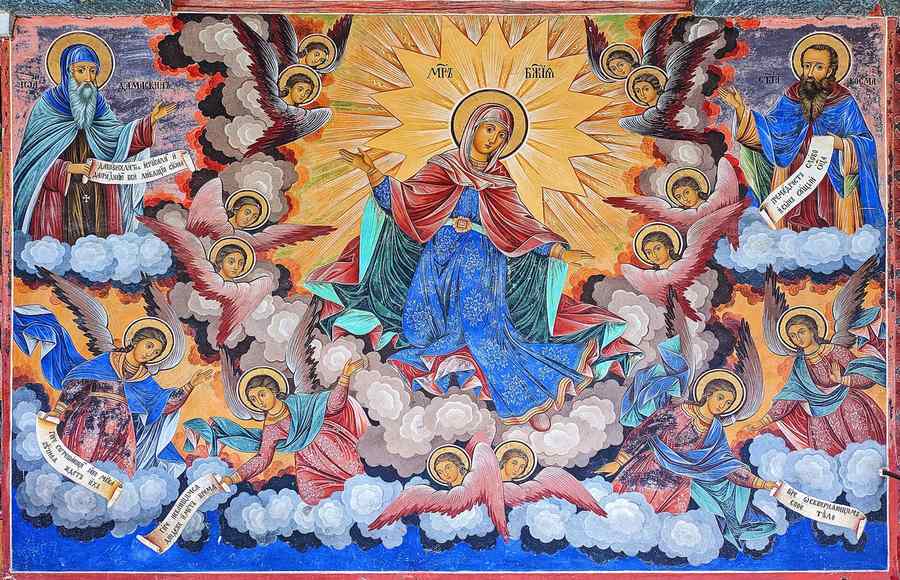
The Meteora frescoes rank among the finest post-Byzantine wall paintings in Greece. The katholika, the main churches of the monasteries perched on their sandstone pillars, hold dense narrative cycles painted mostly in the sixteenth century. Gold and dark grounds, elongated expressive figures and richly organised feast scenes define the Cretan School style that shaped this art. Theophanes the Cretan and Frangos Katellanos left work here that scholars study to this day. You can stand before Christ Pantocrator in the dome, the Dormition of the Virgin and the Last Judgment on a single visit. Plan the walk between churches and the timing of your day with My Greece Tours.
This guide explains what the paintings depict, who created them and how to view them without harming the pigments. Read it alongside the wider Meteora travel guide so you can fit the art into a full day among the rocks. The sections below cover the Cretan School style, the named painters of St Nicholas Anapausas and Varlaam, the standard subjects you meet in every katholikon, the reason photography is forbidden inside, and the practical order for touring the frescoed churches. Each answer stays concrete so you arrive knowing exactly what hangs on the walls above you.
What makes the Meteora frescoes important in Byzantine art?
The Meteora frescoes preserve mature post-Byzantine painting of the sixteenth century in the Cretan School style. Their gold and dark grounds, elongated figures and dense narrative cycles mark a high point of Greek monastic wall painting.
The katholika of the Meteora monasteries carry post-Byzantine wall paintings of the sixteenth century, and their quality places them beside the finest monastic cycles in the Greek world. The Cretan School style that governs them favours gold and dark grounds, elongated and expressive figures, and tightly organised narrative scenes that fill every available surface. Painters trained in this tradition brought a disciplined draughtsmanship to the pillar-top churches, and their work survives across the Meteora monasteries in remarkable condition. The frescoes reward slow looking: dome, apse, walls and vaults each carry a distinct programme, so a single church can hold hundreds of individual figures arranged into a coherent theological scheme that a visitor can read from floor to ceiling.
The paintings matter because they document a living school at its height rather than a provincial copy of earlier work. Theophanes the Cretan set a standard at St Nicholas Anapausas that later painters answered, and the churches together form a compact record of how the Cretan style spread through mainland monastic centres. Anyone tracing the history of the Meteora monasteries finds the frescoes woven into that story, since each monastery decorated its katholikon as it grew in wealth and standing. The result is a group of churches within walking distance of one another where the visitor watches one painting tradition mature across a few decades, all preserved in situ on the sandstone summits above the Thessalian plain.
Who painted the Meteora frescoes in the katholika?
Two named masters dominate the Meteora frescoes. Theophanes the Cretan painted St Nicholas Anapausas in the early sixteenth century, and Frangos Katellanos painted the Varlaam katholikon around the mid sixteenth century, both leading figures of the Cretan School.
Theophanes the Cretan, also recorded as Theophanes Strelitzas, painted the katholikon of St Nicholas Anapausas in the early sixteenth century, and the cycle stands as a landmark of the Cretan School. His work shows the controlled modelling, calm faces and clear narrative order that made his reputation across the Orthodox world. A visitor climbing to the St Nicholas Anapausas monastery enters a small church whose walls are covered floor to vault, a compact masterpiece rather than a grand hall. The scale suits close study, since the figures sit near eye level in the lower registers and the density of scenes rewards the effort of the steep approach to the pillar-top entrance.
Frangos Katellanos painted the katholikon of Varlaam around the mid sixteenth century, a generation after Theophanes, and his cycle carries the same Cretan discipline with its own vigorous character. The frescoed church at Varlaam monastery is larger and its programme more expansive, giving the painter room for extended feast cycles and monumental compositions such as the Last Judgment. The two churches together let a visitor compare the founding master with a leading successor within an hour’s walk. No other artist names should be assumed for the remaining katholika without verified attribution, so treat Theophanes and Katellanos as the two securely documented hands you meet on a Meteora fresco tour.
What subjects appear in the Meteora frescoes?
The Meteora frescoes follow the standard Byzantine church programme. Christ Pantocrator fills the dome, the Dormition of the Virgin sits above the west door, and walls carry the Last Judgment, martyrdoms of saints and the twelve-feast cycle of the liturgical year.
Every katholikon organises its paintings by position, so the same subjects recur across the churches in predictable places. Christ Pantocrator, the ruler of all, gazes down from the centre of the dome, surrounded by prophets and angels in the drum below. The Dormition of the Virgin, the scene of Mary’s death with Christ receiving her soul, traditionally occupies the west wall above the entrance, meeting the worshipper on the way out. Great Meteoron’s katholikon of the Transfiguration is richly frescoed with this full scheme, and its dedication gives the church its formal name. The lower walls carry standing saints, so a visitor reads the programme from the divine order overhead down to the human figures at eye level.
The Last Judgment covers a broad wall in the larger churches, a crowded composition of the saved and the damned that painters used to display their skill with figures and drama. Martyrdoms of the saints appear in the narthex, the entrance hall, often in graphic detail meant to instruct and warn. The twelve great feasts, from the Nativity to Pentecost, run in bands around the upper walls and vaults, tracing the liturgical year in order. These same cycles decorate the churches that cling to the summits and the earlier Meteora caves and hermitages below them, showing how one iconographic tradition served both the great monasteries and the ascetic retreats scattered across the rock faces.
Why is photography forbidden inside the frescoed churches?
Interior photography is usually forbidden in the frescoed katholika, and flash is banned outright. Bright light degrades the pigments over time, so the rule protects the sixteenth-century paintings and keeps the churches quiet places of worship rather than photo stops.
The monasteries forbid interior photography in the katholika to protect the paintings and to preserve the churches as active places of prayer. Flash is the direct threat: repeated bursts of intense light accelerate the fading of organic pigments, and the sixteenth-century frescoes cannot be repainted without loss. Monastery staff enforce the rule at the church door, and a visitor should put the camera away before stepping inside. The restriction also keeps the small, dim interiors calm, since a frescoed katholikon holds only a modest number of people at once and a crowd taking pictures would disrupt both worship and the flow of visitors climbing through on a busy day.
The ban asks the visitor to look rather than shoot, which suits the frescoes anyway, since the cycles reveal themselves only to a patient eye adjusting to the low light. Bring nothing that needs to be photographed and you leave more attentive to what the walls actually show. Travellers who cannot manage the steep stairs to every summit will find that the same courtesy and care extend to accessible Meteora planning, where a smaller set of churches can be reached with less climbing. The photography rule is uniform across the monasteries, so treat every katholikon interior as a no-camera zone and plan any images for the exterior views and the landscape instead.
How should I plan a tour of the Meteora frescoes?
Plan the Meteora frescoes tour around the two securely attributed churches first. Start at St Nicholas Anapausas for Theophanes, continue to Varlaam for Katellanos, then add Great Meteoron’s Transfiguration katholikon, checking opening days before you set out.
Build the Meteora frescoes route around the churches with the clearest painting to see. St Nicholas Anapausas comes first for many visitors because it sits lowest on the road and holds Theophanes the Cretan’s early-sixteenth-century cycle in a compact, well-preserved church. From there the road climbs toward Varlaam, whose katholikon carries Frangos Katellanos’s work and a full Last Judgment. Add the Great Meteoron monastery, the largest of the group, whose katholikon of the Transfiguration is richly frescoed and rewards a longer stop. Three churches make a full, unhurried morning, since each involves a stair climb and time inside to let your eyes adjust to the dim, painted interiors before you move on.
Check opening days before you travel, since each monastery closes on a fixed weekday and the schedule shifts between the warmer and cooler seasons. Dress for entry: shoulders and knees covered, and long skirts provided at the door for those who need them. Carry water and start early, because the frescoed churches fill through the middle of the day and the light inside stays best when the crowds are thin. A guide who knows the iconographic programme turns the visit from sightseeing into reading, pointing out the Pantocrator, the Dormition and the feast cycle in each katholikon so the sixteenth-century paintings resolve into a story rather than a blur of gold and dark grounds.
Frequently Asked Questions
Are the Meteora frescoes original or later restorations?
The principal cycles are original post-Byzantine wall paintings of the sixteenth century, executed directly on the plaster of the katholika and preserved in place. Theophanes the Cretan’s work at St Nicholas Anapausas and Frangos Katellanos’s cycle at Varlaam survive as the painters left them, which is why scholars can study them as securely dated examples of the Cretan School. Conservation over the centuries has cleaned and stabilised the surfaces, and some areas show the wear of age and candle smoke, yet the compositions, figures and colour schemes remain the original hands. The monasteries treat the paintings as irreplaceable, which is the reason flash and interior photography are banned.
A visitor therefore sees genuine sixteenth-century art rather than a modern repainting, and the immediacy of standing before the actual plaster the master worked on is central to the value of the churches. Verified attribution beyond the two named painters should not be assumed for every katholikon.
Which Meteora monastery has the best frescoes to see?
St Nicholas Anapausas holds the single most celebrated cycle, painted by Theophanes the Cretan in the early sixteenth century and regarded as a landmark of the Cretan School. The church is small, so its walls feel densely painted from floor to vault, and the figures sit close enough for careful study. Varlaam offers a larger, more expansive programme by Frangos Katellanos from around the mid sixteenth century, including a monumental Last Judgment that shows the painter’s range. Great Meteoron, the biggest monastery, has a katholikon of the Transfiguration that is richly frescoed and worth a longer visit for the full church programme.
The honest answer is that these three reward the fresco-focused traveller most, and seeing all three in one morning lets you compare the founding master, a leading successor and the grandest church. Choose St Nicholas Anapausas if you have time for only one painted interior on your Meteora day.
What should I wear and know before entering the frescoed churches?
The monasteries are active religious houses, so modest dress is required to enter the frescoed katholika. Men wear long trousers, women wear skirts below the knee, and shoulders stay covered; wrap-around skirts are lent at the entrance for those who arrive unprepared. Speak quietly inside, since the small painted interiors are places of prayer, and switch your phone to silent. Interior photography is usually forbidden and flash is banned outright to protect the sixteenth-century pigments, so keep the camera stowed until you are back outside. Each monastery closes on a set weekday, and hours differ between the warmer and cooler seasons, so confirm the schedule before you climb.
Wear sturdy shoes for the stairs cut into the rock, carry water, and allow time for your eyes to adjust to the dim light, because the frescoes only reveal their detail once you stop and look. A knowledgeable guide helps you read each programme.