
Larissa tours cover the capital of Thessaly and the plain around it: the ancient theatre excavated in the middle of the modern streets, the Diachronic Museum, the Frourio hill with its Ottoman market and mosque, the Tempe valley where the Pineios cuts between Olympus and Ossa, the wine village of Rapsani, the carnival town of Tyrnavos and 40 km of Aegean beach under Mount Ossa. Plan the rest of the trip with Greece Tours.
This page covers the Larissa tours you can book in the city and the plain, what each part of the unit holds, the theatre and the museums, the gorge and the two mountains, the tsipouro and the wine, the history from the Aleuadae to 1881, and how the roads, the railway and the seasons shape the route.
What do Larissa tours cover?
Larissa tours cover the ancient theatre in the middle of the city, the Diachronic Museum, the Frourio hill and its Ottoman mosque, the Pineios riverside and Alcazar park, the Tempe valley with the Agia Paraskevi chapel, Mount Ossa and the beaches of the Aegean coast.
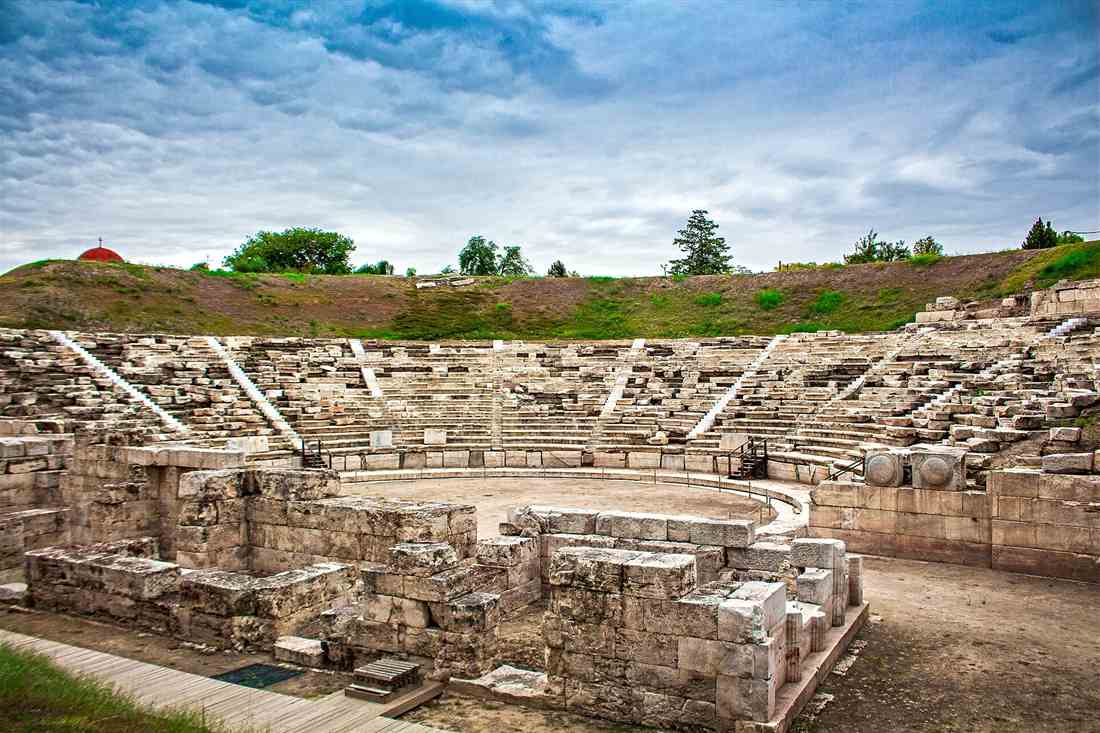
Larissa is the capital of Thessaly and the fourth city of Greece, a flat market town on the Pineios in the middle of the largest agricultural plain in the country. Its ancient theatre was uncovered in the 1980s under shops in the centre, and the excavation now runs through three city blocks.
- First Ancient Theatre – the 3rd-century BC theatre for about 10,000 people in the centre.
- Diachronic Museum – the regional collection from the Palaeolithic to the Ottoman period.
- Frourio hill – the acropolis with the second theatre, the Bezesteni and the mosque.
- Pineios and Alcazar – the river walk, the park and the old stone bridge.
- Tempe valley – the gorge between Olympus and Ossa, 25 km north.
- Ossa and the coast – Stomio, Agiokampos and the beaches under the mountain.
Our Thessaly tours page covers the wider region. Larissa tours work as a day in the city with a second for Tempe, Ossa and the coast, or as a base for Meteora and Olympus an hour away.
What do Larissa tours see in the city?
Larissa tours in the city see the First Ancient Theatre with its marble seating and stage building, the Diachronic Museum on Mezourlo hill, the Frourio with its Ottoman Bezesteni and mosque, the covered market, and the cafes along the Pineios at Alcazar park.
The theatre is the city’s centrepiece. Built in the 3rd century BC on the southern slope of the Frourio, it seated about 10,000, was buried under the Ottoman and modern town, and has been dug out over forty years; the restoration opened it for performances again after eighteen centuries.
The Diachronic Museum, opened in 2015, runs the whole record of the plain in one building: Palaeolithic tools, the Neolithic villages of Thessaly, the horsemen of the classical cities, Roman sculpture and Ottoman ceramics, with the finds of Larissa itself in the centre of the display.
- First Ancient Theatre – the excavated and restored 3rd-century BC theatre.
- Second theatre – the smaller Roman theatre on the northern side of the hill.
- Diachronic Museum of Larissa – Thessaly from the Palaeolithic to the Ottomans.
- Bezesteni – the 15th-century Ottoman covered market on the Frourio.
- Alcazar park – the riverside park, the bridge and the summer stage.
- Central market – the produce of the Thessalian plain, open every morning.
Hippocrates died in Larissa and a plane tree in the city is named for him. The tree stands on the edge of the old centre, propped and fenced, and the medical school of the university keeps the association in its seal. Larissa also carries the oldest continuously working market in Thessaly, held on the same ground since the Ottoman period. Larissa tours cover the theatre, the museum and the Frourio on foot in half a day, since all three sit within a kilometre.
What do Larissa tours see at the Tempe valley and Mount Ossa?
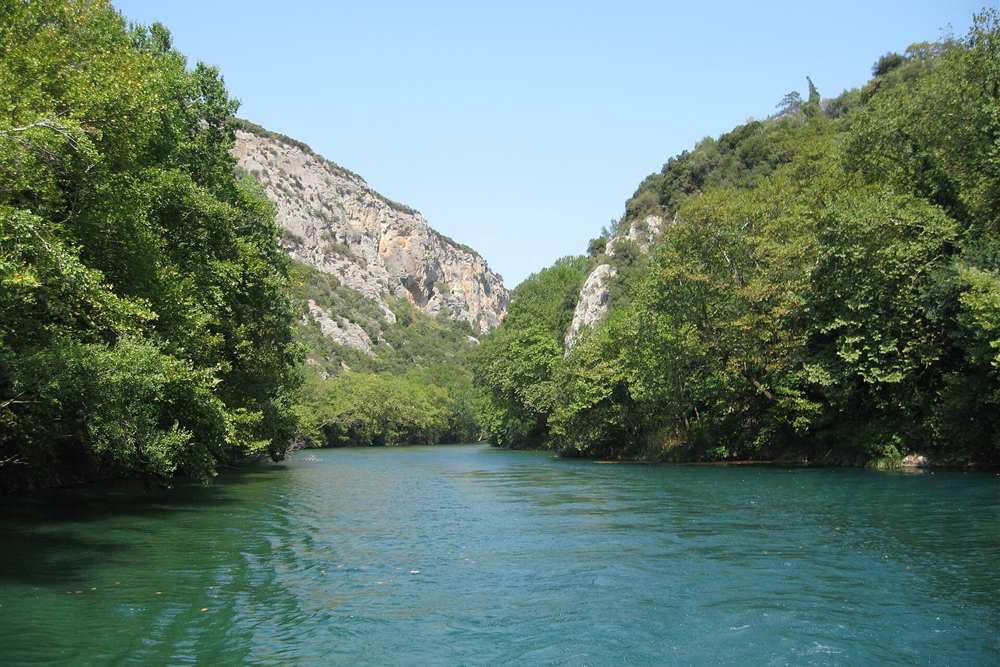
Larissa tours at Tempe see the gorge where the Pineios cuts between Olympus and Ossa for 10 km, the chapel of Agia Paraskevi reached by a footbridge, the spring of Daphne, and above it the villages of Ossa with the coast at Stomio and Agiokampos below.
Tempe is the gate of Thessaly. The valley narrows to about 25 m at its tightest, with walls of 500 m on both sides, and every army entering Greece from the north has used it; Xerxes turned aside from it in 480 BC and took the Perrhaebian passes instead.
The chapel of Agia Paraskevi sits against the rock on the northern bank, reached by a suspension footbridge over the Pineios, with a cave shrine cut into the cliff behind it. Apollo was said to have cut his laurel crown at the spring of Daphne a little upstream.
- Tempe gorge – 10 km of valley between Olympus and Ossa, with the river through it.
- Agia Paraskevi – the cliff chapel and cave, reached by the footbridge.
- Spring of Daphne – the water of the laurel myth on the southern bank.
- Mount Ossa – 1,978 m, with chestnut forest and the villages of Spilia and Anatoli.
- Stomio – the fishing village where the Pineios reaches the Aegean.
- Agiokampos and Velika – the sandy beaches on the Larissa coast.
The coast east of the mountain runs 40 km of sand and pebble and is the beach of the whole plain in summer. Larissa tours take Tempe, a village on Ossa and a beach in one day, about 120 km of driving.
What do Larissa tours eat, and what else is in the plain?
Larissa tours eat the tsipouro and meze of the Thessalian tavernas, kebab and pies from the city grills, the cheeses of Ossa and Olympus, and reach Elassona, the Neolithic sites of Sesklo and Dimini nearby, and Farsala on the Roman battlefield.
Tsipouro is the city’s drink. Larissa tavernas serve it by the small bottle with plates of meze that arrive without ordering, a Thessalian habit shared with Volos, and the tsipouradika round the market fill from six in the evening.
The plain around it holds the oldest farming settlements in Europe. Neolithic villages at Sesklo and Dimini near Volos and the mounds, or magoules, scattered across the Larissa fields date from the 7th millennium BC and make Thessaly the cradle of European agriculture.
- Tsipouradika – the meze bars round the market, from six in the evening.
- Thessalian cheese – the feta and hard cheeses of Ossa, Olympus and the plain.
- Neolithic magoules – the settlement mounds of the 7th millennium BC in the fields.
- Elassona – the town under Olympus with the Olympiotissa monastery.
- Farsala – the battlefield of 48 BC where Caesar beat Pompey.
- Ampelakia – the Tempe village of the 18th-century dyers’ cooperative.
Ampelakia, above the gorge, ran a cooperative of red-yarn dyers in the 18th century that traded as far as Vienna and kept mansions to show for it. Larissa tours add it to the Tempe day in twenty minutes.
How do visitors reach Larissa, where do they stay, and when do the tours run?
Visitors reach Larissa by train from Athens in three hours and from Thessaloniki in an hour and a half, by motorway from Athens in three and a half hours, and by air to Thessaloniki or Volos. The tours run all year, with the sites open and the coast working from June.
The city sits on the main railway and the main motorway, which makes it the easiest base in Thessaly: Meteora is an hour west, Olympus an hour north, Volos and Pelion an hour south-east, and the Aegean coast 40 minutes east.
- Athens to Larissa – 355 km, about three and a half hours, or three hours by train.
- Thessaloniki to Larissa – 150 km, about an hour and a half.
- Larissa to Meteora – 80 km, about an hour.
- Larissa to Tempe – 25 km, about 25 minutes.
- Larissa to the coast – 40 km to Agiokampos, about 40 minutes.
- Where to stay – the city centre for the sites, Stomio or Agiokampos for the beach.
Spring and autumn suit the city and the gorge, summer the coast under Ossa, and winter brings snow to Olympus an hour away with the plain grey and cold. Larissa tours take the city in a day and the valley, the mountain and the sea in a second.
Which museums do Larissa tours visit?
Larissa tours visit the Diachronic Museum on Mezourlo hill, the Municipal Art Gallery with the Katsigras collection of Greek painting, the Folklore and Historical Museum, the Mill of Pappas cultural centre and the archaeological collection inside the Bezesteni.
The Katsigras collection is the surprise of the city. About 800 works of 19th and 20th-century Greek painting, given by a local doctor, hang in a purpose-built gallery beside the park, with Parthenis, Lytras, Gyzis and Tsarouchis among the names.
The Mill of Pappas, a brick flour mill of 1893 on the Pineios, was restored as the city’s exhibition and concert space, and the Folklore Museum holds the costume, tools and weaving of the Thessalian villages in a townhouse near the centre.
- Diachronic Museum of Larissa – Thessaly from the Palaeolithic to the Ottoman centuries.
- Municipal Art Gallery – the Katsigras collection of Greek painting.
- Folklore and Historical Museum – costume, looms and village life of the plain.
- Mill of Pappas – the 1893 brick mill, now an exhibition hall.
- Bezesteni collection – the finds displayed in the Ottoman covered market.
- Military Museum – the campaigns of the Thessalian front.
The museums sit within twenty minutes of each other on foot except the Diachronic, which is 3 km south. Larissa tours take two of them in a morning with the theatre between.
What do Larissa tours see at Mount Olympus and Elassona?
Larissa tours reach the southern side of Mount Olympus through Elassona, with the Olympiotissa monastery above the town, the villages of Kokkinopilos and Karya on the slopes, the Sarantaporo pass into Macedonia, and the summit ridge at 2,918 m beyond them.
Elassona sits at 300 m at the foot of the massif, 40 km north-west of Larissa, with a Byzantine bridge over the Elassonitis and the monastery of Panagia Olympiotissa on the rock above the town, founded in the 11th century and rebuilt after fires, with frescoes and a carved door.
Above it the road climbs to Kokkinopilos at 1,150 m, the highest village of the Olympus range and the starting point for the southern routes to the summit, which is 2,918 m at Mytikas and shared with the Pieria unit on the far side.
- Olympiotissa monastery – the 11th-century house on the rock above Elassona.
- Kokkinopilos – the highest Olympus village, at 1,150 m.
- Karya and Livadi – the mountain villages of the western slope.
- Sarantaporo – the pass north into Macedonia, fought over in 1912.
- Mytikas – the 2,918 m summit of Olympus, reached from the Pieria side.
- Elassona town – the Byzantine bridge, the square and the market.
Our Mount Olympus tours page covers the mountain itself. Larissa tours take Elassona and one high village in a day of about 120 km.
Which villages and towns do Larissa tours reach?
Larissa tours reach Ampelakia above Tempe with its dyers’ mansions, Rapsani on the Olympus slope with its vineyards, Agia under Ossa, Spilia and Anatoli in the chestnut forest, Tyrnavos in the tsipouro plain and Farsala on the battlefield.
Rapsani is the wine village. Its vineyards climb the southern slope of Olympus between 200 and 800 m, the appellation blends Xinomavro, Krassato and Stavroto, and the cellars in the village take visitors for tasting with the plain spread out below them.
Tyrnavos, 18 km north-west, distils more tsipouro than any other town in Greece and is known for the Bourani carnival on Clean Monday, a fertility rite of phallic symbols and soup that the town has kept for centuries and that fills its streets every spring.
- Ampelakia – the 18th-century dyers’ cooperative village with its mansions.
- Rapsani – the Olympus wine village and its appellation.
- Tyrnavos – the tsipouro town and the Bourani carnival.
- Agia and Metaxochori – the apple and chestnut villages under Ossa.
- Spilia and Anatoli – the forest villages on the Ossa slope.
- Farsala – the town on the battlefield of 48 BC.
The Bourani draws visitors from across Greece on Clean Monday. Larissa tours in that week book rooms early and take Tyrnavos in the morning.
What history do Larissa tours tell?
Larissa tours tell of the Aleuadae who ruled the city in the classical period, of Hippocrates who died here about 370 BC, of Philip II and the Macedonian control of Thessaly, of the Ottoman centuries when the city was a regional capital, and of the annexation to Greece in 1881.
Thessaly was horse country and Larissa its largest city. The Aleuadae family ruled it, sided with Persia in 480 BC and later with Macedon, and the plain supplied the cavalry that fought with Alexander; the city minted coins showing horses and the nymph Larissa.
Hippocrates of Kos died in the city and was buried between Larissa and Gyrtoni; a plane tree in the centre carries his name. Under the Ottomans, Larissa was the seat of a pasha and the main Muslim centre of Thessaly, and it passed to Greece only in 1881.
The city grew fast after the exchange of populations and again after the war, which is why little of the old town survives above ground. Larissa tours read the sequence in the Diachronic Museum and in the theatre excavation beneath the shopping streets.
Which festivals and events do Larissa tours meet?
Larissa tours meet the Bourani carnival at Tyrnavos on Clean Monday, the Pineia festival in the city in summer, the ancient theatre performances, the Rapsani wine days in September and the Agia chestnut festival in October.
The restored ancient theatre stages drama and concerts in July and August, which is the first time the building has been used for performance since antiquity. The city’s summer programme runs concerts in Alcazar park and the Mill of Pappas alongside it.
- Bourani, Tyrnavos – the Clean Monday carnival rite, six weeks before Easter.
- Ancient theatre season – drama and concerts in July and August.
- Pineia – the city’s summer cultural festival in the park.
- Rapsani wine days – the September harvest events in the vineyards.
- Agia chestnut festival – the October feast under Mount Ossa.
- Tsipouro season – the November distilling in Tyrnavos and the villages.
Rooms fill for the Bourani and for the summer theatre nights. Larissa tours in those weeks book ahead, and find the city otherwise easy to stay in.
Which beaches do Larissa tours use?
Larissa tours use the 40 km of Aegean coast under Mount Ossa: the sand at Agiokampos and Velika, the pebble bays at Kokkino Nero and Sotiritsa, the river mouth at Stomio, and the long shore at Rakopotamos where the plain meets the sea.
The coast is the beach of the whole Thessalian plain. It runs from the Pineios delta at Stomio south to the Magnesia border, backed by the wooded slope of Ossa, with villages every few kilometres and water that deepens quickly because the mountain drops straight into the sea.
- Agiokampos – the longest sand, with the resorts and the tavernas.
- Velika – the wide beach south of it, shallow and family ground.
- Kokkino Nero – the pebble bay named for its iron spring.
- Sotiritsa and Polydendri – the quieter coves under the Ossa slope.
- Stomio – the fishing village at the Pineios mouth, with the pine wood behind.
- Rakopotamos – the open shore where the plain reaches the water.
The drive from the city takes 40 minutes on the Agia road and the coast fills only in July and August. Larissa tours swim in the afternoon after the gorge or the mountain in the morning.
Which outdoor trips run around Larissa?
Larissa tours walk the Ossa paths from Spilia and Anatoli, climb the southern routes of Olympus from Kokkinopilos, raft and kayak the Pineios through Tempe, cycle the flat lanes of the plain, and ski at the Elatia centre on the Olympus slope in winter.
The Pineios carries the easiest water trip in Thessaly. Rafts and kayaks run the river through the Tempe valley between the cliffs, a gentle descent of about 10 km with the chapel and the footbridge halfway, and the operators work from the villages at either end.
- Tempe rafting – the 10 km descent of the Pineios through the gorge.
- Mount Ossa paths – the chestnut-forest routes from Spilia and Anatoli.
- Olympus southern routes – the climbs from Kokkinopilos and Karya.
- Cycling the plain – the flat lanes between the villages and the magoules.
- Elatia ski centre – the small winter slopes on the Olympus side.
- Birdwatching – the Pineios delta wetland at Stomio.
Spring runs the river highest and covers Ossa in flowers, and winter puts snow on both mountains within an hour of the city. Larissa tours pair one mountain day with one river or coast day.
Which trips combine with Larissa tours?
Larissa tours combine with Meteora an hour west, Mount Olympus an hour north, Volos and Pelion an hour south-east, the Sporades by ferry from Volos, Thessaloniki an hour and a half north and Lake Plastira two hours south-west.
The city sits at the centre of Thessaly, which makes it the cheapest base for the region: every major destination is inside 90 minutes, and the trains north and south run through the station on the edge of the centre.
- Meteora – 80 km west, about an hour by Trikala.
- Mount Olympus – Elassona and the southern routes, an hour and a quarter.
- Volos and Pelion – an hour south-east, with the Sporades ferries beyond.
- Thessaloniki – 150 km north, an hour and a half by motorway or train.
- Lake Plastira – two hours south-west through Karditsa.
- Pieria coast – the Olympus riviera at Platamon, 50 minutes north.
Our Thessaly tours page covers the region and the Sporades tours page the islands off the coast. Larissa tours use the city for two nights and reach anything in Thessaly from it.
Which visitors do Larissa tours suit?
Larissa tours suit visitors who want a working Greek city rather than a resort, walkers heading for Olympus and Ossa, wine travellers on the Rapsani slopes, rail travellers between Athens and Thessaloniki, and families using the coast under the mountain.
The city is not a tourist town and does not behave like one: its theatre sits among shops, its squares fill with residents rather than visitors, and its prices are the lowest of any Thessalian base. That is the reason to stay there and drive out.
- City visitors – the theatre, the museums and the tsipouradika.
- Walkers – Ossa, Olympus and the Tempe paths.
- Wine travellers – the Rapsani appellation on the Olympus slope.
- Rail travellers – the stop between Athens and Thessaloniki.
- Families – the Agiokampos and Velika beaches, 40 minutes away.
- Carnival visitors – the Bourani at Tyrnavos on Clean Monday.
What the unit lacks is a famous single sight, which is why most visitors pass through on the way to Meteora. Larissa tours that stop for two days find the theatre, the gorge and the coast between them worth the stay.
Frequently Asked Questions
Where is Larissa?
In the centre of the Thessalian plain, on the Pineios river, with Mount Olympus to the north, Mount Ossa and the Aegean to the east, and Meteora an hour to the west.
What is the ancient theatre of Larissa?
A theatre of the 3rd century BC for about 10,000 spectators, built on the southern slope of the Frourio, buried under the later town and excavated since the 1980s. It stages performances again.
What is in the Diachronic Museum?
The record of Thessaly from Palaeolithic tools and Neolithic villages through the classical cities and Roman sculpture to Ottoman ceramics, in a building on Mezourlo hill south of the centre.
What is the Tempe valley?
The 10 km gorge where the Pineios cuts between Olympus and Ossa, narrowing to about 25 m, with the cliff chapel of Agia Paraskevi reached by a footbridge and the spring of Daphne on the bank.
Can you reach Mount Olympus from Larissa?
Yes. The southern side is reached through Elassona and Kokkinopilos at 1,150 m, about an hour and a quarter from the city, with the summit at 2,918 m shared with the Pieria unit.
What is Rapsani?
The wine village on the southern slope of Olympus whose appellation blends Xinomavro, Krassato and Stavroto from vineyards between 200 and 800 m. The cellars take visitors for tasting.
What is the Bourani?
The Clean Monday carnival of Tyrnavos, 18 km from Larissa, a fertility rite of phallic symbols and soup that the town has kept for centuries and that fills its streets each spring.
Where are the beaches?
On 40 km of Aegean coast under Mount Ossa, 40 minutes east of the city: sand at Agiokampos and Velika, pebble bays at Kokkino Nero and Sotiritsa, and the river mouth at Stomio.
How do you reach Larissa?
By train from Athens in about three hours and Thessaloniki in an hour and a half, or by motorway in three and a half hours from Athens. The city sits on both main routes.
When is the best time for Larissa tours?
Spring and autumn for the city, the gorge and the mountains, summer for the coast under Ossa, and winter for snow on Olympus an hour away with the plain cold and grey.