
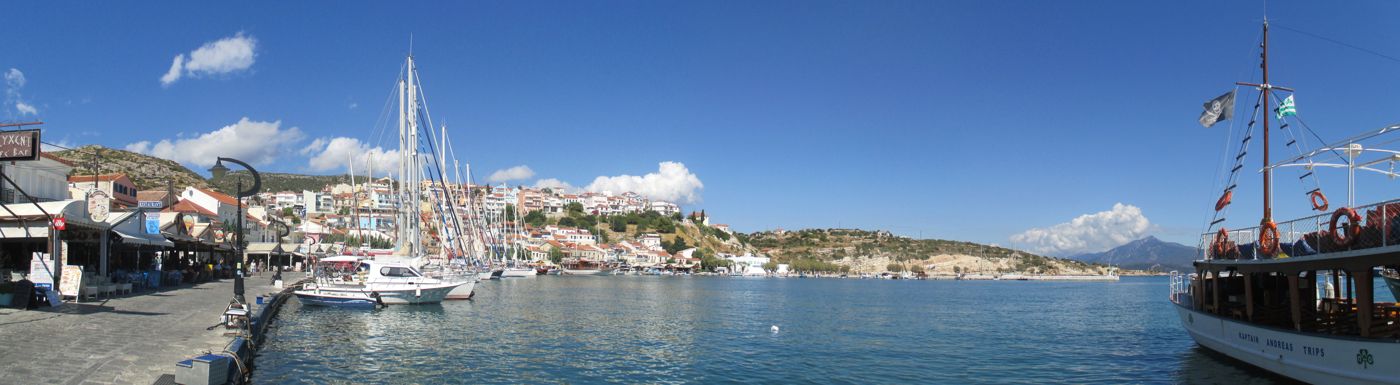
Karlovasi is the second town of Samos and the main settlement on the island’s northwest coast. It sits about 30 km west of Vathy, spread across three linked districts around a working ferry port. The town rises below the peaks of Mount Kerkis. It mixes a maritime past, a tanning-industry heritage and a modern university campus. This blend gives Karlovasi a character different from the harbour resorts to the east. Plan the whole trip with Greece Tours.
This guide explains what Karlovasi is, how its port and setting work, and how its three districts fit together. Those districts are Palaio, Meséo and Neo Karlovasi. The guide covers the old leather and tanning trade preserved in the waterfront warehouses. It describes the University of the Aegean campus and its student life. It also looks at the squares and seafront that shape the town today for residents and visitors.
What is Karlovasi on Samos, and how do its northwest setting and port shape the town?
Karlovasi is the second town of Samos, sitting on the northwest coast about 30 km from Vathy. A working ferry port anchors the settlement, linking the island to Piraeus and the Aegean below Mount Kerkis.
Karlovasi occupies the northwest corner of Samos, a green and mountainous island in the eastern Aegean. The town lies about 30 km west of Vathy, the island capital. A coast road reaches it past Kokkari and Agios Konstantinos. Mount Kerkis, the highest peak on Samos at about 1,434 m, rises to the south and west. It frames the town against forested slopes. The setting joins sea and mountain within a short distance of the centre. Beaches sit close to the shore, while the Potami valley and the wild Seitani coves lie about three kilometres further west. Karlovasi grew where a sheltered bay met fertile farmland. This gave the town both a harbour and cropland.
The pairing shaped its economy across the tanning era and the farming seasons that followed.
The port defines the daily rhythm of Karlovasi, the second ferry gateway of Samos after Vathy. Ferries connect the harbour to Piraeus and to northern Aegean islands, carrying residents, students and freight. The quay handles fishing boats, coastal traffic and larger car ferries at the outer mole. A breakwater shelters the basin from the meltemi, the strong summer wind that sweeps the strait toward the Turkish coast. Trucks load produce and goods for the mainland. Passengers wait near the terminal and the waterfront cafés. The port sits below Neo Karlovasi, the newest district, and gives the town its outward link. Arrivals by sea reach the northwest of the island directly.
This route avoids the longer road from the airport near Pythagorio in the southeast of Samos.
Geography gives Karlovasi a role as the western hub of Samos. The town anchors the quieter half of the island, away from the busier resorts around Vathy and Pythagorio. Roads lead south and west toward Marathokampos, Votsalakia and the villages under Mount Kerkis. Other roads run north to the forested Seitani coast. A local network of buses links Karlovasi with the capital and the mid-island villages of Ampelos. The town spreads over its three districts, so distances inside Karlovasi reach a couple of kilometres from the old quarter to the port. Residents move between the seafront, the market streets and the campus through the day.
The northwest position keeps the town cooler and greener than the drier southeast plains. Springs and winter streams keep its gardens and orchards fed.
Water and terrain frame every approach to Karlovasi. The Potami valley opens just west of the town, carrying a stream down from the hills to a pebbled bay. Beyond it the coast turns wild toward Mikro and Megalo Seitani, reached mainly on foot. Forested ridges of Mount Kerkis and Mount Ampelos rise inland. They hold pine, plane and chestnut trees fed by winter rain. The shoreline near the town mixes shingle beaches with rocky points and small church-topped headlands. This green, watered landscape sets Karlovasi apart from the drier Aegean towns. The combination of a real port, farmland and mountains explains the town’s growth.
Karlovasi became an industrial and academic centre, not only a fishing village on the northwest shore of the island below the high peaks.
How do the three districts of Karlovasi — Palaio, Meséo and Neo — fit together?
Karlovasi divides into three linked districts: Palaio (old) Karlovasi on the hill, Meséo (middle) Karlovasi between them, and Neo (new) Karlovasi by the port. Roads and a short distance connect all three across the town.
Karlovasi grew as three separate settlements that merged into one town. Palaio Karlovasi, the oldest quarter, sits inland on a green hillside above the coast. It is built around older churches and stone houses among gardens and running water. The district keeps a village feel, with narrow lanes, plane trees and tavernas set back from the sea. Meséo Karlovasi, the middle district, spreads on lower ground between the old quarter and the shore. Neo Karlovasi, the newest and largest part, lines the coast around the harbour. It holds most shops, offices and the ferry port. The three names translate simply as old, middle and new. Together they form a town of thousands of residents.
Karlovasi stretches about two kilometres from the hillside down to the working waterfront.
Palaio Karlovasi rewards a slow walk uphill from the coast. Springs and a small stream feed gardens and orchards, keeping the quarter green through the dry summer. Stone mansions and older churches stand among the trees, part restored and part left to age. A path climbs past the church of the Metamorphosis toward viewpoints over the bay and Mount Kerkis. The old district holds the oldest cores of Karlovasi society. Families settled here before the tanning boom pulled the town toward the sea. Quiet squares under plane trees offer shade and a couple of tavernas. From here the ground drops toward Meséo Karlovasi and then the port.
The hillside setting gives Palaio a cooler, more sheltered climate than the exposed waterfront below. The walk up rewards the effort with shade.
Meséo Karlovasi acts as the connective middle of the town. The district holds houses, shops and the parish life that binds the old quarter to the new port area. Its lanes carry traffic between the hillside and the coast, passing gardens, churches and older two-storey homes. Meséo keeps a residential, everyday character rather than a tourist face. Local bakeries, kafeneia and services cluster along its main street. They serve the families who live away from the seafront noise. The district also links to the road west toward Potami and the villages under Mount Kerkis. Meséo sits between the two more distinct quarters, so visitors often pass it unnoticed.
Yet it carries much of the daily movement that keeps the three parts of Karlovasi joined as one working town.
Neo Karlovasi holds the public face of the town. The district lines the harbour, gathering the ferry port, banks, offices, the market and most cafés and restaurants along the seafront. Grand old tanning warehouses and neoclassical mansions stand here, recording the wealth of the leather-trade era. The University of the Aegean campus sits within this coastal district, drawing students into its streets. Neo Karlovasi feels the most urban of the three, with wider roads, apartment blocks and a working waterfront. Ferries dock at the outer port, while fishing boats tie up nearer the squares. The newest district became the commercial and administrative heart of Karlovasi. Industry and shipping moved trade to the coast.
That shift left the older quarters on the greener slopes above the town centre.
What remains of Karlovasi’s tanning and leather industry, and its warehouses and neoclassical architecture?
Karlovasi grew into a leather and tanning centre, and grand stone warehouses and neoclassical mansions along its waterfront still record that wealth. Old tanneries stand empty or restored, marking the town’s industrial past below Mount Kerkis.
Karlovasi built much of its wealth on leather. Across the industrial era the town ran a cluster of tanneries. These works processed hides into leather for shoes and goods, shipped out through the port. The trade drew workers from the villages and turned the coastal district into a factory zone. Water from the hills, a working harbour and access to hides made Karlovasi one of the leading leather towns of Greece. The industry shaped streets, jobs and the social order of the town for generations. Cheaper production and changing markets later ended the boom. The tanneries closed one after another. Their large stone shells still line parts of the shore.
They stand as the clearest reminder that this quiet northwest town once served as a busy centre of Greek manufacturing and export.
The tanning warehouses form Karlovasi’s most striking industrial heritage. Long stone and brick buildings stand near the water. They have tall arched windows, thick walls and wide floors made to hold hides and machinery. A number have collapsed roofs and empty interiors, weathered by decades of sea air. Others have been cleaned and reused, turned into cultural spaces, offices or university rooms. The scale of these structures shows how large the leather trade grew. Rows of warehouses near the port trace the old production line. Goods moved from delivery at the quay to finished leather for export. Walking among them reveals the industrial ambition of a town that visitors often expect to be only a harbour.
The buildings anchor the local memory of the leather era below Mount Kerkis.
Neoclassical mansions stand alongside the industrial ruins. Tanning families and merchants built tall stone houses with symmetrical facades, carved doorways, iron balconies and painted shutters. These homes rose especially through Neo and Meséo Karlovasi. They displayed the money that leather and shipping brought to the town. A number remain occupied and maintained, while others wait empty behind shuttered windows. Their design followed the wider Greek neoclassical style of the trading era, with pediments, cornices and tall proportions. Set between plainer modern blocks, the mansions give parts of Karlovasi an unexpected grandeur. Together with churches and public buildings of the same period, they record a confident, prosperous town.
The mix of grand houses and vast warehouses tells the paired story of Karlovasi: private wealth built on organised industry.
Restoration keeps parts of the industrial legacy alive. The University of the Aegean and local bodies have reused old tanneries and warehouses for teaching, exhibitions and events. This adaptation gives disused industrial shells a new working role within the town. Signs and cultural projects explain the leather process to visitors who walk the waterfront. Not every building survives, and a number stand fenced and unsafe. Yet enough remain to read the pattern of the old industry. The surviving warehouses and mansions make Karlovasi a rare example of a Greek island town shaped by heavy industry rather than tourism alone. Preserving this fabric ties the modern student town to its manufacturing past.
It keeps the tanning story visible on the northwest edge of Samos for residents and travellers who look for it.

How does the University of the Aegean campus shape daily life in Karlovasi?
The University of the Aegean runs a campus in Karlovasi, bringing students, staff and academic life to the town. Its presence supports cafés, rentals and cultural events, keeping Neo Karlovasi active outside the summer tourist season.
The University of the Aegean gives Karlovasi a second identity as a student town. The institution spreads across the Aegean islands. Its Karlovasi campus hosts departments in fields such as mathematics, information and communication systems, and statistics. Faculties and lecture halls occupy buildings in and near the coastal district. A number of them were converted from old industrial and neoclassical structures. Students arrive from across Greece and abroad, living in rented flats through the town. Their presence fills cafés, bookshops and tavernas during term. This adds a younger population to a town that otherwise lean older and quieter. The campus links Karlovasi to national academic life and to research.
It turns the former tanning centre into a place of study on the northwest coast of Samos.
Student life reshapes the calendar of Karlovasi. Through term the town gains energy as classes fill and young residents move between the campus, the seafront and rented homes. Cafés and bars near the water stay busy into the evening. Cultural events, talks and screenings appear across the year. When terms end and students leave, the town grows quieter, and the summer visitors take their place. This rhythm differs from the purely seasonal pattern of the resort villages. It gives Karlovasi activity across more of the year. Autumn and spring stay busy for shops and tavernas while the beach resorts empty. Anyone weighing things to do in Samos finds Karlovasi useful as a base.
The town offers real, year-round services rather than a settlement that closes once the beach season ends on the island.
The university underpins parts of the local economy. Landlords rent flats and rooms to students. Shops and tavernas gain steady custom, and jobs in teaching, administration and services support families across the year. This steady demand cushions Karlovasi against the sharp swings that hit tourism-only towns. The campus also draws visiting academics and conferences. These add short-stay guests outside the summer peak. Local transport, from buses to the ferry port, carries students to and from the mainland at term boundaries. The presence of a public institution keeps services, from banks to clinics, active in the town. In this way the University of the Aegean does more than teach.
It anchors the working population and the everyday economy of the northwest capital of Samos below Kerkis.
Daily life in Karlovasi blends town, campus and sea. Mornings bring market shopping, school runs and coffee in the squares. Students head to lectures near the shore. The seafront serves as a shared space where residents and young people meet across the day. Practical services cluster in Neo Karlovasi: banks, a health centre, supermarkets, bakeries and the bus and ferry links. The town is a real administrative centre for the west of the island. It stays busy with errands and work rather than only leisure. Families, older residents, farmers from nearby villages and students share the same streets. This ordinary working life, set against the warehouses and the sea, gives Karlovasi a grounded character.
It stands apart from the holiday feel of the eastern Samos resorts.
What are the waterfront and squares of Karlovasi like?
Karlovasi’s waterfront runs from the ferry port past fishing quays to seafront squares lined with cafés and tavernas. Plane-shaded plateias behind the shore form the social centre of the northwest town below Mount Kerkis.
The Karlovasi waterfront stretches along the north-facing coast of the town. A road and promenade follow the shore from the ferry port, past the fishing harbour, to the beaches at the western edge. Cafés, tavernas and shops line the landward side, while boats rock at the quays opposite. The seafront at the district known as Ormos, the small fishing port, gathers much of the town’s evening life. Tables stand close to the moored caiques. Fishers land their catch here, and the sea view opens toward the strait and the Turkish coast beyond. The promenade gives residents and visitors a place to walk, eat and watch the ferries come and go.
This working, lived-in shore defines the everyday face of Karlovasi more than any single monument or building.
Squares, or plateias, form the social heart of the town. Shaded by tall plane trees, they hold kafeneia and tavernas where residents gather for coffee, meals and conversation. The main squares sit back from the seafront in Neo Karlovasi, close to the shops and the market streets. Older squares in Palaio and Meséo Karlovasi keep a quieter, village character under their trees. These open spaces host the ordinary rituals of the town, from morning coffee to evening strolls. They fill during local festivals and holidays through the year. Karlovasi is a real town rather than a resort, so its squares serve residents first.
The plateias give visitors an honest view of island life on the northwest coast of Samos below the mountains and the sea.
Karlovasi works well as a base for the northwest of the island. The town gives quick road access to the Potami valley just west. A stream, a Byzantine chapel and a wooded gorge there lead toward the Potami waterfalls and the pools above the beach. Beyond Potami, walkers reach the wild coves of Mikro and Megalo Seitani on foot. The western villages under Mount Kerkis lie within a short drive south. The beaches around Votsalakia and Marathokampos sit close by as well. Staying in Karlovasi puts these green, less-crowded parts of Samos within reach. The choice keeps town services, the port and the university close at hand. Buses also run east to Vathy through the day.
The town suits travellers who want a working base rather than a purely seasonal beach resort.
Eating and staying in Karlovasi follow the town’s practical character. Tavernas near the fishing harbour serve grilled fish, local dishes and the sweet Muscat wine for which Samos is known. Cafés and bakeries cluster in the squares and along the shore. Accommodation ranges across small hotels, guesthouses and rented rooms spread through the districts and near the water. The town lacks the large resort complexes of the east coast. The port operates year-round and the university keeps the town alive off-season, so services stay open longer than in the resort villages. Karlovasi rewards visitors who value a genuine Greek town, an industrial heritage and easy access to the wild northwest.
It offers this instead of a manicured holiday strip on the busier southeastern side of the island.
How does Karlovasi serve as the gateway to Potami and the wild Seitani coves on Samos?
Karlovasi sits at the western edge of the north coast, minutes from Potami beach and its river gorge. The town anchors the trailhead network reaching the roadless Mikro and Megalo Seitani coves beyond.
Potami lies about 3 km west of Neo Karlovasi, an easy drive or a coastal walk. A green valley opens behind the sand-and-pebble beach, where a stream cuts a wooded gorge. A signed path follows the water past the small Byzantine church of Metamorphosis. It reaches the first waterfall and rock pools. Stronger walkers scramble higher, using a fixed ladder to gain the upper cascades. The forest keeps the ravine cool through the hottest months. Karlovasi supplies the parking, tavernas and last shops before the trail. Signposts around the town point drivers toward the beach and the gorge. Families stop at Potami beach itself, then send only the sure-footed uphill.
The river walk ranks among the most visited outings on the northwest coast. The town remains its natural base for the whole excursion.
Beyond Potami the coast turns roadless, and the Seitani coves are reached only on foot or by boat. Mikro Seitani is a small pebble cove set in a rocky inlet, backed by cliffs. Megalo Seitani is a long strip of pale sand below steep slopes and a ravine mouth. The path from Potami runs about two hours each way over open ground. Walkers carry water, sun cover and food for the shadeless route. This protected stretch shelters the Mediterranean monk seal, and building is banned along it. Small seasonal boats also drop swimmers at the coves from the Karlovasi side. The absence of any road keeps visitor numbers low even in the peak weeks.
Karlovasi holds the last shops before the trail. That supply role makes the town the practical launch point for Seitani.
The coastal route west of Karlovasi forms part of the island’s marked walking network. It joins Potami, the Seitani coves and the western capes into one long trail. Pine, oak and low scrub cover the slopes above the sea. The path runs high on the hillside with wide Aegean views. Spring brings wildflowers and running water in the gorge. Autumn cools the exposed sections for longer walks. Walkers set out early from Karlovasi to beat the midday heat on the open ground. The town’s port and bus stop reach the trailheads without a car. Return options include retracing the path or catching a seasonal boat toward the harbour.
Sturdy shoes, water and a hat handle the rocky ground and strong sun. This walking country defines the northwest corner more than any single sight.
Basing at Karlovasi puts Potami and Seitani within a reach that other Samos towns cannot match. Vathy and Pythagorio sit about 30 km and 40 km away. That distance means an hour or more of mountain driving from these coves. Guests in Karlovasi walk or drive to Potami in minutes. They start the Seitani trail the same morning without a long transfer. The town’s tavernas, bakeries and shops resupply walkers over successive days. A working port and regular buses connect Karlovasi to Vathy, Kokkari and the airport road. This position suits travellers who rate river walks and quiet coves above nightlife. The northwest keeps a slower rhythm than the resort coast east of Kokkari.
For anyone centred on Potami and Seitani, Karlovasi is the logical place to sleep.
What does the west end of Samos under Mount Kerkis offer travellers based in Karlovasi?
The west end holds Samos’s highest mountain and its quietest beaches. From Karlovasi a coastal road curves south under the Kerkis massif toward Votsalakia and Kampos, opening rugged hiking and long, undeveloped shores.
The southwest of Samos rises to Mount Kerkis, the island’s high peak at about 1,434 metres. A steep limestone massif lifts straight from the sea here. Karlovasi sits on the north flank of this range. A road threads west, then south, around its base. The mountain carries caves, chapels and hermitages on its slopes. Demanding marked trails climb toward the summit from the villages below. Cloud often caps the peak while the coast stays clear and hot. Drivers from Karlovasi reach the western village of Marathokampos in under an hour. The high ground stays green and cool against the dry lowlands. Walkers come through spring and autumn when the trails are kinder.
This protected massif dominates every view along the western coast. It gives the whole region its wild, upland character.
Below Kerkis on the southwest coast stretch the long pebble beaches of Votsalakia and Kampos. These form the island’s main western resort strip. Their shallow, gently shelving shores suit families. They also stay calmer than the meltemi-battered north coast. Small Balos beach and the coves beyond Marathokampos add quieter swimming a little farther on. Tavernas and rooms line parts of the strand, yet development stays low and spread out. The drive from Karlovasi crosses the western flank of the island on winding but paved roads. The sun sets behind the sea here, unlike the sunrise-facing east coast. These beaches feel remote because the mountain separates them from the busier north.
Day trips from Karlovasi combine a morning on Kerkis with an afternoon swim below it. The contrast of peak and shore marks the whole outing.
Marathokampos, a large hillside village on the mountain’s southwest flank, looks over the western gulf. Its harbour, Ormos Marathokampou, holds a small fishing and pleasure port. Waterfront tavernas line the quay below the village. Seasonal boats run from here toward remote southern coves and around the Kerkis capes. The village keeps old stone houses, narrow lanes and a working farm life. Olives and vines fill the terraces around it. Karlovasi drivers reach the upper village and the port on the ring road under the peak. Walkers use Marathokampos and nearby Votsalakia as trailheads for the Kerkis ascent. The route needs a full day, water and firm footwear on loose rock.
The summit gives views across the Aegean to nearby islands and Turkey. This western hub pairs naturally with a Karlovasi base.
Choosing Karlovasi over the eastern towns shortens every trip into this western country. The road under Kerkis runs long and slow from Vathy or Pythagorio. It is far quicker from the northwest town. Travellers watch the peak in the morning light, hike a section by day, then swim off Votsalakia. The region rewards drivers who accept winding mountain roads for near-empty beaches. Fuel, supplies and repairs are easiest handled in Karlovasi first. The thinly settled west offers little once the road climbs. The contrast between green summit and sun-baked coast marks the whole area. Few package tours reach this corner, so crowds stay light outside the peak weeks.
For hikers and beach-seekers alike, the west end is Karlovasi’s natural playground. The town holds the keys to both the mountain and its shores.
How does the ferry port at Karlovasi link Samos to Piraeus and the wider Aegean?
Karlovasi is the second ferry port of Samos, on the northwest coast. Long-haul boats from Piraeus call here, and Aegean routes link the town to Mykonos, Naxos, Ikaria, Fourni and neighbouring islands.
Samos runs two main ferry ports, Vathy in the northeast and Karlovasi in the northwest. Most mainland sailings serve both harbours in turn. Ferries from Piraeus reach Karlovasi in roughly 8 to 13 hours. The time depends on the vessel and the stops it makes. Faster boats cut the crossing, while overnight ferries with cabins sail through the night. The Karlovasi port sits at Neo Karlovasi, a short distance from the town centre and its rooms. Arriving passengers find taxis, buses and car-hire offices near the quay. The harbour handles both car ferries and passenger craft on the eastern Aegean routes. Its northwest position makes Karlovasi the closer landing for the Potami and Kerkis side.
Travellers heading straight west often pick this port over Vathy. That choice saves the long cross-island drive.
From Karlovasi the island links into the wider Aegean network through Ikaria and Fourni. These islands lie nearest to the west. Routes continue toward Mykonos and Naxos in the Cyclades. That chain connects Samos to the central Aegean. Northward, mainline services reach Chios and the northeast Aegean. Southern links touch Patmos and the Dodecanese. Sailing frequency rises through the warm season and thins in winter. The island then turns to local life. Schedules shift with weather, and the meltemi can delay open-water crossings in high summer. Travellers island-hopping through the eastern Aegean often route via Samos and its two ports. Operators and times change through the year. Passengers check current schedules close to travel.
Karlovasi’s calls make it a useful hop point on these longer chains.
Choosing between the two Samos ports comes down to where a traveller is staying and heading next. Karlovasi suits guests bound for the northwest, the Kerkis coast and the western villages. It cuts out a long mountain drive on arrival. Vathy serves the capital, the Kokkari beaches and the airport-Pythagorio side more directly. Certain sailings call only at one port. Passengers match the timetable to their base. Not every mainland ferry stops at Karlovasi. Peak days sometimes route through Vathy alone. Checking which port a specific sailing uses avoids a needless cross-island transfer. Buses and taxis bridge the two ports and the airport when a connection demands it.
The two-port setup gives Samos flexible sea access from both ends. Travellers plan the arrival port around their first night’s base.
Arriving at Karlovasi drops travellers straight into the quiet northwest. It skips the busier eastern hub entirely. The port area holds the practical services a new arrival needs. Onward transport reaches Potami, Kokkari, Vathy and the airport road. Buses, taxis and hired cars cover those links. Overnight ferries from Piraeus let visitors sleep on the crossing. They wake near the mountain and the coves. Day sailings suit those who prefer to watch the Aegean pass in daylight. The northwest opens up from the first step ashore. The harbour’s calm scale contrasts with the larger quays of the mainland. Luggage, timing and the first night’s base all shape the choice of port. A northwest-focused trip starts most smoothly here.
For that plan, landing at Karlovasi is the easiest way onto Samos.
What is staying and eating in Karlovasi like in general terms on Samos?
Karlovasi offers modest, everyday accommodation and Greek tavernas rather than a resort strip. Rooms cluster around Neo Karlovasi and the port, while old Palaio Karlovasi and the waterfront hold traditional eating spots.
Accommodation in Karlovasi runs to small hotels, guesthouses and rented rooms. Large resorts are absent here. Neo Karlovasi, near the port and the university, holds most of the town’s beds and services. The middle and old districts add a scatter of traditional rooms among their mansions. Prices tend to run lower than in the resort towns of the east coast. That reflects the everyday, working feel of the place. A useful overview of island bases sits in this guide to where to stay in Samos. It places Karlovasi in context against the eastern towns. The town works as a lived-in place first and a tourist centre second. Students fill the rooms in term time.
Summer then opens more space for visitors. Booking ahead still helps in the peak weeks of high summer.
Eating in Karlovasi centres on Greek tavernas, ouzeri and cafes. International menus are rare here. The waterfront at the port and the squares of the old town hold the gathering spots. Fish and seafood arrive from the working harbour. Grilled meats, vegetable dishes and local cheese fill out the menus. Sweet Samos Muscat wine appears on tavern tables, poured with dessert or after a meal. The student population keeps casual bars and coffee spots busy through the year. Prices sit closer to local rates than to resort prices on the east coast. Bakeries and small shops in Neo Karlovasi cover picnics for the Potami and Seitani walks. The mix leans practical and Greek.
It feeds residents and students as much as travellers. Evenings stay calm and centred on the waterfront.
The three districts give the town more variety than a single-street resort. Palaio Karlovasi, the old quarter uphill, keeps stone houses, churches and quiet lanes. It carries a village feel above the coast. Meseo Karlovasi, the middle district, links the old town to the sea. It runs past the neoclassical mansions of the tanning era. Neo Karlovasi, the new town by the port, holds the shops, the university and most services. Walking or a short drive connects the three across a spread-out town. Each district offers a slightly different base. Choices range from harbourside convenience to quiet old-town lanes. The old leather warehouses along the shore still mark the waterfront.
Choosing a district within Karlovasi matters as much as choosing the town. Guests weigh port access against old-town calm.
Daily life in Karlovasi runs on the port, the university and the surrounding farmland. Tourism is only part of the picture. Shops, a market, banks and services make it a real town. Visitors resupply here without trouble. The pace stays calm, with evenings centred on the waterfront and the squares. Beaches sit close, from town-edge shores to Potami about 3 km west. The town rarely feels crowded, even when the trails draw walkers in summer. This everyday character suits travellers who prefer a working Greek town to a built resort. Services thin a little in winter as the season and the ferries wind down. The rhythm then belongs to residents and students.
For an authentic, low-key stay, Karlovasi delivers substance over polish. The northwest rewards those who value real over packaged.
Who does Karlovasi suit as a base on Samos?
Karlovasi suits walkers, beach-seekers and independent travellers drawn to the quiet northwest. The town rewards those centred on Potami, Seitani, Mount Kerkis and the western coast over nightlife and organised resorts.
Walkers and nature travellers gain the most from a Karlovasi base on Samos. Potami’s gorge, the Seitani coves and the Kerkis trails all start within a short reach. Guests hike a different route each day, then resupply in the town between outings. The northwest keeps a wilder, greener character than the coast east of Kokkari. Drivers reach the western beaches under the mountain far faster from here than from Vathy. The town’s port and buses also serve travellers arriving without a car. The Potami waterfalls make an easy half-day outing. The Seitani path fills a longer, harder day. Spring and autumn suit the exposed trails best.
This corner rewards early starts, sturdy shoes and a taste for empty paths. For outdoor-focused visitors, Karlovasi puts the island’s best walking country on the doorstep.
Independent and budget travellers also fit Karlovasi’s everyday character well. The town runs on students, farming and the port. Rooms and meals sit closer to local prices than to resort rates. Real shops, a market and services make self-catering and long stays straightforward. The calm, uncrowded streets suit visitors who prefer a working town to a holiday strip. Ferries from Piraeus land here directly. That saves a cross-island transfer for northwest-bound guests. Rooms in Neo Karlovasi keep the port and the university district within an easy walk. The lower-key scene favours travellers who make their own plans. Packaged tours reach this corner rarely. For value and authenticity, the town holds a clear edge over the resort coast.
The town suits slow, self-guided travel. Long-stay visitors settle in comfortably here.
Karlovasi fits families who rate quiet beaches and nature over nightlife and busy resorts. Potami beach offers shallow swimming and shade. The gorge walk adds a short adventure nearby. The western shores under Kerkis add long, gently shelving sand a manageable drive away. The town’s real services simplify shopping, meals and everyday needs with children. Calmer streets and lower crowds ease the pace against the busier east coast. Older children who walk enjoy the Seitani trail and the waterfall scramble. The base suits families comfortable with short drives to reach spread-out beaches. A car or scooter helps on this large island. For a nature-first family trip, the northwest offers space and calm.
Parents trade resort facilities for quiet shores and forest walks. That trade suits outdoor-minded households.
Karlovasi suits less well travellers who want nightlife, big resorts or a car-free stay beside major sights. The UNESCO monuments cluster around Pythagorio and the Heraion in the southeast. That side sits an hour or more away. Vathy holds the archaeological museum, the Kouros and the capital’s harbour scene. Kokkari concentrates the windsurf beaches, bars and the busiest resort life on the north coast. A car or scooter greatly helps a Karlovasi stay, given the spread-out west. Visitors set on ancient sites or lively evenings base better on the east coast. Karlovasi trades those draws for quiet, nature and lower prices. Matching the town to walking, beaches and calm makes it the right pick.
Mismatching it to monuments or nightlife makes it the wrong one. The choice rests on what a trip is built around.
Frequently Asked Questions
Is Karlovasi worth staying in on Samos?
Karlovasi is worth staying in for travellers focused on the northwest coast, walking and quieter beaches. The town puts Potami’s gorge and waterfalls within a short reach. It also anchors the roadless Seitani coves and the Mount Kerkis trails, far closer than Vathy or Pythagorio. Ferries from Piraeus land directly at its port. That lets northwest-bound visitors skip a long cross-island transfer. Karlovasi is the second town of Samos. It keeps real shops, tavernas, a market and services. A University of the Aegean campus gives it a lived-in feel through the year. Prices tend to run lower than in the eastern resorts. The trade-off is distance from the UNESCO sites around Pythagorio and the busiest nightlife.
Travellers who rate river walks, empty coves and a working Greek town find real value here. The town also makes a calm, well-connected base for exploring the northwest by day. Those set on ancient ruins or lively evenings base better on the east coast instead.
How does Karlovasi compare with Vathy and Pythagorio as a base on Samos?
Karlovasi, Vathy and Pythagorio each serve a different kind of trip on Samos. Karlovasi, the northwest town, suits walkers and beach-seekers. It sits minutes from Potami, Seitani and the Mount Kerkis coast, with lower prices and a quiet feel. Vathy, the northeast capital, offers the archaeological museum with its giant Kouros. It also holds a working harbour, the main ferry port and quick access to Kokkari’s beaches. Pythagorio, the southeast harbour town, wraps the UNESCO Eupalinos Tunnel and Heraion. It adds a lively marina, boutique hotels and the nearest base to the airport. Vathy and Pythagorio anchor the busier, sight-rich east. Karlovasi anchors the wilder, greener west.
The island is large, so the drive between them takes an hour or more of mountain road. First-time visitors chasing monuments often pick Pythagorio. Nature-focused travellers prefer Karlovasi. The northwest town wins for value and quiet, while the eastern pair win for sights and buzz. Matching each town to your priorities matters more on Samos than on smaller islands.
Is Karlovasi a good base for a family holiday on Samos?
Karlovasi works well for families who value quiet beaches, nature and an everyday town over nightlife and big resorts. Potami beach, about 3 km west, offers shallow, shaded swimming. The short gorge walk to its first waterfall makes an easy adventure for children who walk. The long, gently shelving pebble shores under Mount Kerkis add calmer family swimming a drive away. Karlovasi is a real town. It keeps supermarkets, bakeries, pharmacies and tavernas that simplify daily needs with children. Its calmer streets and lower crowds ease the pace against the busier east coast. Older children enjoy the Seitani trail and the ladder scramble above Potami. A car or scooter helps here.
Samos is large, and its beaches and sights sit far apart. Families set on organised resorts, water parks or nightlife find more of that around Pythagorio, Kokkari and the east coast. Older children and outdoor-minded parents suit the town best. For a nature-first family break, the northwest delivers space and calm.
What are the nearest beaches to Karlovasi on Samos?
Potami is the nearest notable beach to Karlovasi, about 3 km west. It is a sand-and-pebble shore below a wooded river gorge with waterfalls behind it. Beyond Potami the coast turns roadless. The wild Mikro and Megalo Seitani coves are reached only on foot or by seasonal boat. The walk runs about two hours each way. Karlovasi also has town-edge beaches near Neo Karlovasi for a quick swim without a drive. West and south under Mount Kerkis lie the long pebble strands of Votsalakia, Kampos and small Balos. These offer calmer, family-friendly swimming within a scenic drive. The western shores stay quieter than the meltemi-exposed north coast around Kokkari.
The pine-backed coves of Tsamadou, Lemonakia and Tsabou lie farther east near Kokkari. They sit roughly a 20 to 30 minute drive from Karlovasi. Walkers carry water, food and sun cover for the shadeless Seitani path, since no shops sit beyond Potami on that stretch. Small boats from the Karlovasi side also reach the coves in season.
What to know about the ferry port at Karlovasi on Samos?
Karlovasi is the second ferry port of Samos, on the northwest coast at Neo Karlovasi. It sits a short distance from the town centre and its rooms. Long-haul ferries from Piraeus call here. The crossing takes roughly 8 to 13 hours, depending on the vessel and its stops. Faster boats and overnight cabin ferries both run in the warm season. The port links Samos to Ikaria, Fourni, Mykonos, Naxos and other Aegean islands, plus northern connections toward Chios. Its northwest position makes Karlovasi the closer landing for the Potami, Seitani and Mount Kerkis side of the island. That saves a long cross-island drive. Taxis, buses and car-hire offices sit near the quay for onward transport.
Not every mainland sailing stops at Karlovasi, and others route through Vathy alone. Passengers check which port a specific ferry uses. Schedules and operators change, and the meltemi can delay crossings, so travellers confirm current times close to travel. Landing here saves the long drive from the eastern ports for northwest-bound guests.
How do I get around Karlovasi and the northwest of Samos?
A rented car or scooter is the most flexible way to explore Karlovasi and the northwest of Samos. The island is large, and its beaches, villages and trails sit far apart. Hire offices operate in Karlovasi, at the airport near Pythagorio, and in Vathy and Kokkari. A good paved road links Karlovasi with Vathy, Kokkari and the airport road. It then narrows and climbs around Mount Kerkis to the western beaches of Votsalakia and Marathokampos. Buses connect Karlovasi with Vathy and other towns, useful for travellers without a car, though timetables thin outside summer. Taxis cover shorter hops and airport transfers.
Within the spread-out town, walking or a short drive links the three districts of Palaio, Meseo and Neo Karlovasi. Roads are mountainous and winding, and driving is on the right. Rough tracks to remote coves such as Seitani are footpath-only. Those spots are reached on foot or by boat rather than by car. Planning a route around the town keeps daily driving times short.
Is Karlovasi quiet or busy compared with the rest of Samos?
Karlovasi is markedly quieter than the resort areas of Samos. It keeps the feel of a working town rather than a holiday centre. Its economy runs on the port, the University of the Aegean campus and surrounding farmland. Tourism is only part of daily life, so the town continues around its visitors. The northwest coast stays greener and less developed than the busy strip east of Kokkari. That strip concentrates most bars, windsurf beaches and package hotels. Even in high summer, the roadless Seitani coves and the Kerkis trails see thin crowds. Karlovasi does fill more in university term time. Students take most of the rooms then, so summer often opens space for travellers.
Evenings centre on the waterfront tavernas and the town squares rather than late nightlife. Services ease off in winter as the ferries and season wind down. Travellers wanting lively resorts head to Kokkari or Pythagorio, while those seeking calm choose Karlovasi.