
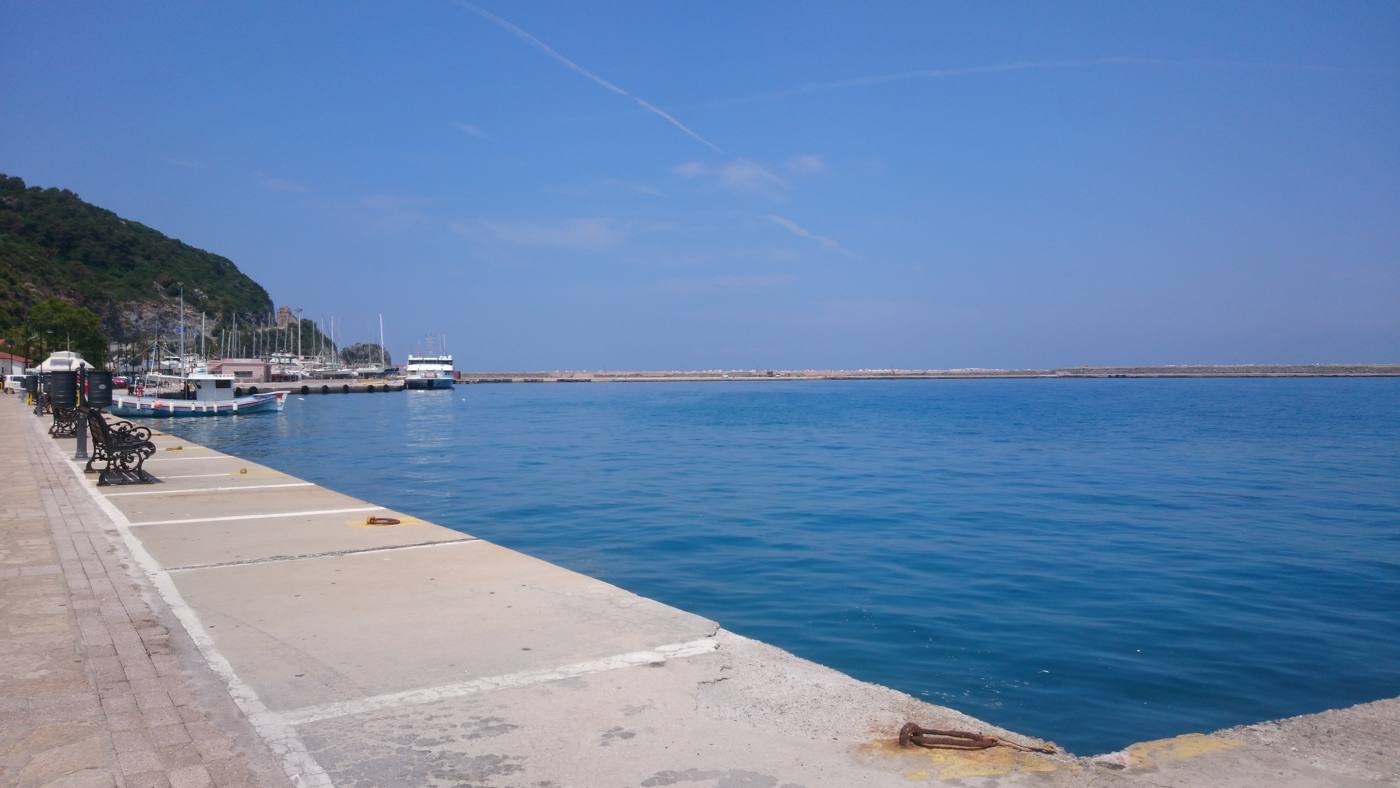
Car rental on Samos turns a spread-out island into a single-day reach. Samos covers about 476 square kilometres, and its beaches, mountain villages and ancient sites sit far apart. A rented car or scooter links Vathy, Pythagorio, Kokkari and Karlovasi in one trip. Rental offices cluster at Samos Airport near Pythagorio and inside the main towns. Driving runs on the right, and a valid licence is required. Plan the whole trip with Greece Tours.
This guide covers why a car helps, where to pick one up, and how the road network connects the towns. It then follows the mountain roads up to the Ampelos villages and around Mt Kerkis to the southwest coast. Roads climb, narrow and wind, so a steady pace matters. Distances stay short in kilometres, yet slow in minutes, because the terrain shapes every route across Samos.
Why does a car unlock Samos, an island of about 476 square kilometres?
A car unlocks Samos because its 476 square kilometres spread beaches, mountain villages and ancient sites far apart. One rented vehicle links the north coast, the Ampelos slopes and the southwest beaches within a single day.
Samos measures about 476 square kilometres, ranking among the larger islands of the eastern Aegean. Its shape stretches roughly 43 kilometres from Karlovasi in the west to the eastern capes near Vathy. Two mountain ranges, Ampelos and Kerkis, split the interior and push roads around the coast. A visitor without a car reaches only the town nearest the port. A rented vehicle instead ties the whole map together, from the northern beaches to the southern harbours. Planning a trip across Samos starts with this scale, because bus links run thin outside the main towns. Fuel stations sit mainly in the towns, so a full tank before the mountains helps.
Distances look small on paper, yet the winding profile turns short hops into deliberate drives that reward an early start each morning.
Public buses on Samos connect Vathy, Pythagorio and Karlovasi on set schedules, yet gaps stretch long between departures. A rented car erases that wait and reaches coves the timetable ignores. Drivers cross from the north coast at Kokkari to the southern harbour of Pythagorio in about 40 minutes. The same car climbs to Manolates or drops to Votsalakia without a transfer. Families with beach gear, coolers and small children value this door-to-door freedom most. A scooter suits solo riders on short north-coast hops, while a compact car handles the mountain grades with more grip. Choosing the vehicle depends on route, group size and the steepness ahead.
Renting on Samos therefore matches the terrain, not just the budget, and it shapes how far a single day can stretch.
Reaching the island by air or sea sets up the rental plan on arrival. Ferries dock at Vathy and Karlovasi, while flights land at Samos Airport near Pythagorio. Readers weighing the routes can compare options in the guide on how to get to Samos before booking a vehicle. A car collected at the airport meets a beach on the south coast within about 15 minutes. The same pickup point sits close to Pythagorio harbour, handy for early ferry connections. Arriving without a booked car often means a taxi ride first, then a return trip to an office. Reserving the vehicle ahead of the crossing removes that detour.
Matching the rental office to the arrival gateway keeps the first hours on Samos simple, steady and moving forward.
A single day on Samos shows why the car matters. A morning swim at Tsamadou near Kokkari fits before a drive west to Karlovasi. Lunch in a mountain village, then an afternoon at Votsalakia under Mt Kerkis, rounds out the loop. That chain needs no bus and no schedule, only fuel and a map. The route covers about 90 kilometres, yet the winding grades stretch it near two hours of driving. Stops multiply the reward, from a roadside viewpoint to a shaded taverna. A rented car turns scattered sights into one continuous ribbon across the island. Traffic stays light outside the towns, so the drive stays relaxed.
This freedom, more than any single beach, explains why most visitors to Samos put wheels first and pick the vehicle to suit the ground.
Where do you pick up a rental car on Samos?
Rental offices on Samos cluster at Samos Airport near Pythagorio and inside the main towns of Vathy, Pythagorio, Kokkari and Karlovasi. Pickup points match the two ferry ports and the airport, so arrival gateway guides the choice.
Samos Airport sits about 3 kilometres from Pythagorio on the southeast coast. Its full name, Samos International Airport Aristarchos of Samos, honours the ancient astronomer born on the island. Rental desks line the arrivals area, and cars wait in a lot beside the terminal. A vehicle collected here reaches Pythagorio harbour in under 10 minutes. The same road runs to Vathy, the capital, in about 25 minutes over a low ridge. Drivers landing in the evening find the southern beaches close, an easy first swim after the flight. The airport pickup suits itineraries that start in the UNESCO south and work north later.
Booking the office nearest the runway removes any transfer, and the keys change hands steps from the baggage belt on Samos before the drive begins.
Vathy, also called Samos Town, wraps around a deep northeastern bay. This capital serves as the main ferry port, so most visitors first touch the island here. Rental offices stand near the waterfront and along the road toward the ferry quay. A car picked up in Vathy reaches Kokkari in about 15 minutes heading west. The same base puts the eastern beaches of Psili Ammos and Kerveli within a short drive. Parking in Vathy tightens near the harbour at midday, so a lot on the edge saves time. Drivers arriving by ferry from Piraeus or the nearby islands find this the natural start.
Collecting the car steps from the boat keeps the journey moving inland without a taxi leg first on Samos. The western road out of town climbs gently past olive groves.
Pythagorio anchors the southeast coast as a harbour town and UNESCO site. Rental offices line the marina front, steps from the fishing boats and cafes. A car based here reaches the Heraion of Hera in about 10 minutes westward. The same town sits beside the airport, so ferry and flight arrivals meet in one hub. Kokkari, on the north coast, adds a second cluster of rental desks in a windsurf village. A vehicle from Kokkari climbs to Vourliotes or Manolates within about 20 minutes uphill. The village also flanks the pebble beaches of Tsamadou and Lemonakia, a walkable stretch.
Picking up in Pythagorio or Kokkari splits the island into a southern and a northern base, each close to its own coast on Samos. Fuel stations wait at both ends of the road.
Karlovasi holds the northwest corner as the second ferry port on Samos. This town splits into three quarters and serves the university campus. Rental offices sit near the harbour and along the main street inland. A car from Karlovasi reaches Potami beach in about 10 minutes to the west. The same base opens the trailhead for Mikro and Megalo Seitani, coves reached on foot. Drivers planning a coast-to-coast tour of the Samos beaches often start north and finish south. Karlovasi also marks the western approach to the Mt Kerkis loop and Votsalakia. Ferry passengers landing here skip the long drive from Vathy, saving about 50 minutes.
Choosing Karlovasi as the pickup suits a west-first plan, with the wild northwest coast close at hand. Parking stays easy along the quiet quay.
How does the road network link the main towns of Samos?
The main road on Samos links Vathy, Kokkari, Karlovasi and Pythagorio in a rough loop around the coast and low interior. Vathy to Pythagorio runs about 12 kilometres south, while Vathy to Karlovasi covers about 30 kilometres west.
The north-coast road forms the busiest link on Samos, tracing the shore from Vathy to Karlovasi. This route passes through Kokkari, the windsurf village, about 10 kilometres out of the capital. Beyond Kokkari the tarmac hugs cliffs above Tsamadou and Lemonakia before turning inland. The road then reaches Agios Konstantinos, a quiet seafront hamlet, near the halfway mark. Karlovasi appears about 30 kilometres from Vathy, a drive near 40 minutes at a steady pace. Two lanes carry the traffic, with pullouts for slower vehicles on the bends. Sea views open on the right for most of the western stretch. Fuel stations stand at Kokkari and near Karlovasi along the way.
This northern artery ties the two ferry ports together and anchors every touring plan across the island of Samos.
The southern road connects Vathy with Pythagorio over a low ridge inland. This link runs about 12 kilometres and takes close to 20 minutes by car. The route climbs from the capital, crests near Mytilinii, then drops to the southern plain. Mytilinii holds a small palaeontology museum beside the road, a quick stop. Past the ridge the tarmac reaches the airport and the harbour of Pythagorio. A branch heads west to the Heraion sanctuary and the Eupalinos Tunnel entrance. Traffic thickens near the airport at flight times, so a margin helps. The southern plain around Pythagorio stays flat and easy after the mountain roads elsewhere. The grades stay gentle throughout.
This corridor joins the UNESCO south to the capital and completes the eastern side of the Samos loop.
West of Karlovasi the network thins as the road bends around Mt Kerkis. A route continues to Marathokampos, a hillside village above the southwest gulf. From there the tarmac drops to Votsalakia and Kampos on the coast. This western arc covers about 25 kilometres from Karlovasi to the beaches below Kerkis. The road narrows, gains curves, and asks for a lower gear on the climbs. Marathokampos offers a fuel stop and a wide view over the gulf. Beyond Votsalakia the surface degrades toward Balos and the far cape. Signs mark each junction clearly. Drivers reaching the southwest complete the loop back east through the interior.
This quieter western section rewards patience, and it opens the least-crowded shore on Samos for those willing to drive the extra distance.
Distances on Samos read short in kilometres yet long in minutes. The Vathy-to-Karlovasi run covers about 30 kilometres in near 40 minutes. Vathy to Pythagorio takes close to 20 minutes over about 12 kilometres. Kokkari to the airport runs about 25 minutes across the low ridge. A full coastal loop of the island totals near 130 kilometres of driving. Curves, grades and village speed limits stretch every estimate, so plans allow extra time. Petrol stations gather in Vathy, Karlovasi, Pythagorio and near Kokkari, spaced for the loop. Drivers filling up in a town avoid a long detour later in the mountains. Road signs post distances in kilometres throughout.
Reading the map by driving time, not raw distance, keeps a Samos itinerary honest and the days unhurried.

What are the mountain roads to the Ampelos villages of Manolates and Vourliotes like?
The mountain roads to Manolates and Vourliotes climb the Ampelos slopes above Kokkari on the north coast. Both routes narrow, switchback and gain height quickly, rising to about 400 metres through pine forest and terraced vineyards on Samos.
The road to Vourliotes leaves the north coast just west of Kokkari. It climbs about 5 kilometres through switchbacks to reach the village near 350 metres. Vourliotes ranks among the oldest settlements on the Ampelos slopes. Its central square, framed by painted houses, opens above a valley of vineyards. The nearby Vronta Monastery sits a short drive higher on the same ridge. Drivers meet tight hairpins and a single narrow lane in places on the ascent. A car with a low gear handles the grade better than an underpowered scooter. The village produces the Muscat grapes that feed the sweet PDO Samos wine. Parking waits at the entrance, since the lanes inside stay too narrow for cars.
This climb rewards a slow, deliberate pace on Samos.
The road to Manolates branches higher up the same Ampelos flank. It winds about 8 kilometres from the coast to the village near 400 metres. Manolates clings to a wooded ridge above the Aidonia gorge, the valley of nightingales. Narrow lanes, stone houses and craft workshops fill the car-free centre. Drivers park at the edge, then walk the last stepped alleys on foot. The approach road tightens near the top, with blind bends under plane trees. A footpath links Manolates to Vourliotes for walkers who leave the car behind. Springs and shaded tavernas draw visitors up from the hot coast in summer. The village overlooks the north Aegean, with the Turkish mainland faint on the horizon.
This ascent shows the green, mountainous heart of Samos.
Mountain driving on Ampelos asks for steady habits over speed. The lanes measure a single car width in the villages, so oncoming traffic waits at pullouts. Gears matter more than throttle, since long climbs and descents test the brakes. A first-gear crawl through hairpins keeps the car composed on loose gravel. Horns sound a short warning before blind bends, a local courtesy on these roads. Scooters manage the grades in dry weather, yet gusts and gravel raise the risk. Shade from pine and plane trees cools the tarmac even at midday. Roadside springs offer a pause, though the water source stays unmarked in places. Speed limits drop sharply inside every village.
Drivers who plan fuel, water and daylight tackle the Ampelos roads with room to spare across upland Samos.
The Ampelos villages repay the climb with cool air and wide views. Manolates and Vourliotes sit high enough to escape the coastal heat by about 4 degrees. Vineyard terraces step down the slopes, feeding the sweet Muscat harvest each autumn. Tavernas serve local wine beside plates of grilled meat and garden vegetables. A round trip from Kokkari to both villages covers about 25 kilometres. That loop takes near 90 minutes of driving, more with photo stops. The road connects the two villages by a higher traverse for those with a car. Walkers instead follow the old footpath between them through the forest. Fuel stands at Kokkari before the climb, the last station on the route.
These upland roads open the quiet, green interior that defines Samos beyond its beaches.
How do you drive around Mt Kerkis to the southwest beaches of Votsalakia?
The drive around Mt Kerkis follows the road southwest from Karlovasi through Marathokampos to Votsalakia. This route bends beneath the 1,434-metre peak, the highest on Samos, then drops to the pebble-and-sand beaches of the southwest gulf.
Mt Kerkis rises to about 1,434 metres, the highest summit on Samos. Its bulk fills the western end of the island and shapes every southwest route. The road from Karlovasi swings inland, then south, to skirt the mountain’s northern flank. Marathokampos appears about 20 kilometres on, a village stacked above the gulf. From this balcony the tarmac drops in tight curves toward the coast below. The descent loses about 400 metres of height over a short, winding stretch. Drivers use a low gear here to spare the brakes on the grade. The great limestone mass of Kerkis stays in view for most of the drive. Fuel waits at Marathokampos before the descent.
This mountain approach frames the least-developed corner of Samos, far from the northern crowds and closer to raw coast.
Votsalakia spreads along the southwest gulf beneath Mt Kerkis. This long beach of pebbles and coarse sand faces the open Aegean. The road reaches it about 25 kilometres from Karlovasi, near 40 minutes by car. Kampos beach continues west along the same shore, an easy extension by road. Tavernas and rooms line the back of the strand, quieter than the north coast. A gentle slope of clear water suits families and long swims. The gulf catches afternoon breezes, welcome relief in the summer heat. Parking sits behind the beach on packed earth, free and unhurried. The pebbles shine white against the blue water. Votsalakia rewards the long drive with space that the busier northern beaches lack.
This southwest shore shows a wilder, emptier face of Samos under the island’s tallest mountain.
Beyond Votsalakia the road degrades toward Balos and the far southwest cape. The surface turns to gravel and rough patches unsuited to a low car. A high-clearance vehicle handles the track to Balos, a small cove past the resort strip. Drivers in a compact rental stop at Votsalakia and walk the final stretch. The mountain paths up Kerkis start near here, marked for hikers on foot. A trail climbs to the summit chapel at about 1,434 metres over about 5 hours. Cars stay at the trailhead, since no road reaches the peak. The southwest cape holds the loneliest coast on the island, reached slowly and with care. No fuel waits past Marathokampos.
Poor tracks reward preparation, so a full tank and daylight matter on this corner of Samos.
A southwest day loops out from the north coast and back through the interior. The route runs Karlovasi, Marathokampos, Votsalakia, then returns east over the hills. This full circuit covers about 90 kilometres from Vathy and back. Driving time nears three hours without stops, longer with a swim and lunch. The road climbs, drops and winds, so a rested driver and full tank help. Kerkis dominates the western sky for most of the loop, a constant marker. Fuel stands at Karlovasi and Marathokampos, the last stations before the coast. A compact car suits the whole route, while rough spurs stay off-limits to it. Signs point back to Karlovasi at each junction.
This grand southwest loop closes the driving map of Samos, from ferry port to hidden gulf and home.
Which rough tracks and footpath-only coves on Samos you avoid in a low rental car?
Dirt tracks to Mikro and Megalo Seitani stay footpath-only near Karlovasi, and low hire cars scrape on the rutted approaches. Firm gravel spurs toward remote southwest coves also punish soft suspension, so a standard car handles paved routes best.
Mikro and Megalo Seitani sit west of Karlovasi on the wild northwest coast, and no drivable road reaches either cove. A dirt track runs from Potami toward a trailhead, then the route becomes a walking path across the headland to the sand. Drivers park where the graded surface ends, roughly a 30 to 45 minute walk from Megalo Seitani. The final track sections carry loose stone, deep ruts and washouts after rain, which ground a low city car. Sturdier vehicles reach the trailhead, yet the coves themselves remain foot access only, protecting the Mediterranean monk-seal refuge. Carry water and sun cover, because shade thins on the exposed path and no canteen operates at either bay.
Signposts mark the coastal path clearly, so most walkers navigate it without a map.
Gravel spurs branch off the sealed coast road toward isolated bays under the southwest massif of Mount Kerkis, and their condition changes within a couple of hundred metres. One spur stays firm and level to a taverna or small cove, while the next drops over exposed bedrock and loose scree that scrape a low bumper. Balos and the far strands past Votsalakia sit at the end of narrow lanes with tight passing points. Reverse to a wider spot when a vehicle approaches, because two cars rarely pass on these single-track sections. Walk the surface first before committing a hire car down an unknown spur, and turn back where sharp stone or deep ruts begin.
A compact hatchback copes with graded gravel but grounds on rock steps.
The paved network across Samos suits a standard low rental without trouble. Vathy, Pythagorio, Kokkari, Karlovasi and the Ampelos village roads carry asphalt the whole way, so a compact car reaches most sights comfortably. Clearance matters only on the unpaved final stretches to wild coves, dirt viewpoints and mountain trailheads. Ask the rental desk which access roads stay sealed for the beaches on your plan, and treat any brown-sign track marked 4×4 as off-limits for a city car. Rain worsens ruts and turns clay tracks slick, so postpone rough spurs after a storm. Sticking to tarmac still opens Tsamadou, Potami, Votsalakia and the UNESCO sites, leaving only the remotest sand behind a walk.
A basic hire car with normal ground clearance manages every route in this guide except those flagged as track.
Reaching the footpath-only coves needs a plan beyond the car itself. Park at Potami or the Seitani trailhead, then walk the marked coastal path to Mikro and Megalo Seitani on foot. Boat trips from Karlovasi and Kokkari also visit Seitani in season, removing the rough drive entirely. Travellers set on the wildest bays sometimes hire a small four-wheel-drive or a quad from a town office, which clears the ruts a sedan cannot. Keep the hire car on tarmac and use these alternatives for the last rough kilometre, protecting your deposit against underbody and tyre damage. Rental contracts commonly exclude off-road use, so a scrape on a banned track falls on the driver, not the insurer.
Local buses reach the main resorts too, covering days when you skip the car.
Do you choose a scooter, a quad or a car for getting around Samos?
A car suits Samos best because the island stretches about 45 km end to end with long mountain drives between sights.
A car carries luggage, shields passengers from sun and meltemi wind, and covers the wide spacing of Samos in comfort. The drive from Pythagorio to Karlovasi crosses roughly 50 km of coast and mountain, a tiring stretch on two wheels. Families with children, couples touring the whole island, and travellers chasing three or four beaches in one day gain most from four wheels. Air conditioning matters through the hot midsummer months, when open riding bakes exposed skin. A boot also locks away valuables at trailheads and beaches. Standard cars reach every paved sight, from the Heraion to the Ampelos villages, without the balance and fatigue issues of a loaded scooter on steep hairpins.
Two adults with beach bags and cool boxes rarely fit comfortably on a single scooter.
Scooters and quads earn their place for short trips around a single base on Samos. A rider staying in Kokkari can reach Tsamadou, Lemonakia and the harbour tavernas in minutes without parking hassle. The climb to Manolates and the Ampelos villages, though, runs steep and winding, testing an underpowered scooter carrying two. Quads look rugged yet handle poorly at speed and stay slow on the long coast road, so they fit lanes, not touring. Wind gusts on exposed north-coast bends unsettle light machines. Helmets are compulsory, and a full deposit rides on returning the bike unscratched. Choose two wheels for a relaxed beach base, and a car for covering the island’s spread of sights.
Riders also need a licence category that covers the engine size they hire.
Running costs separate the two choices on Samos in clear ways. Scooters and quads sip fuel and slip into gaps a car cannot, cutting both the pump bill and the parking search in busy Pythagorio. A car costs more to hire and to fill, yet splits easily across three or four passengers, often undercutting two scooters for a group. Weather swings the balance further, since a sudden meltemi blow or a rain shower leaves riders soaked while drivers stay dry. Distance decides most trips, because the daily mountain kilometres between Vathy, the wine villages and the southwest beaches wear down a scooter rider fast.
Match the vehicle to the itinerary, weighing group size, luggage, planned range and the season’s heat before booking. Age limits and a minimum licence period apply to both categories.
Samos roads demand respect from anyone on two wheels. Gravel washes across bends after rain, olive and pine debris litter village lanes, and goats stray onto quiet mountain sections without warning. The steep descents off Ampelos and around the Kerkis foothills heat brakes and reward slow, deliberate riding. New riders unused to loose surfaces face a real fall risk on the unlit night roads between resorts. A car absorbs these hazards inside a cage of steel, while a scooter exposes the rider fully. Wear closed shoes, long sleeves and the helmet even for short hops, and avoid two-wheel travel after dark on the mountain roads.
Confident, licensed riders enjoy the freedom; hesitant travellers gain more safety and range from a compact car. Two wheels leave little margin when a bus rounds a blind mountain bend.
Where do you park a rental car in Vathy, Pythagorio and Kokkari on Samos?
Parking on Samos concentrates in free lots and roadside bays just outside each town centre, since the old harbour cores stay narrow and busy. Vathy, Pythagorio and Kokkari each reward arriving early and walking the final stretch.
Vathy spreads along a deep bay, and its waterfront doubles as the main parking strip. Roadside bays line the harbour road and the streets behind the town square, filling by mid-morning in high season. Larger open lots near the ferry quay and the north end of the promenade take the overflow, a short walk from the museum and cafes. The tiled lanes of Ano Vathy on the hillside stay too narrow and steep for parking, so leave the car below. Ferry arrival and departure times crowd the quay, so avoid the port edge then. A slow cruise of the waterfront usually turns up a space, yet a five-minute walk from a back street beats circling the square repeatedly.
Blue-marked bays and any signed resident zones call for care to dodge a fine.
Pythagorio packs a compact grid above a busy marina, and its centre bars most car traffic in peak hours. Drivers use the lots and roadside spaces on the approach roads and around the edges, then walk down to the harbour front. The marina promenade itself stays pedestrian and taverna-lined, so no parking sits at the water. Space tightens sharply in high summer, when day-trippers, diners and the Turkey boat crowd converge. Arrive before mid-morning for the closest spots, or accept a walk from higher up the slope. The airport and Heraion lie a short drive west, each with their own parking.
Leave nothing visible in the car at a busy edge-of-town bay, and note the walk back before choosing a distant space. Shade sits at a premium, so a tree-shaded spot spares a hot cabin.
Kokkari curls around a pebble bay and a small harbour, with a village core too tight for easy parking. Roadside bays sit along the main coast road and the entrances to the village, filling as the beach crowd arrives. A two-minute walk from the coast road reaches the harbour tavernas and the pebble beach. The nearby coves of Tsamadou and Lemonakia have only small clifftop parking areas, which fill early on calm summer days. Squeezing a car into the village lanes risks a scrape and a blocked neighbour, so use the marked bays instead. Windsurf gear and beach traffic add to the pressure through midday.
Park on the approach, walk in, and time beach visits away from the noon peak for a space. Overnight stays usually include a spot at the hotel or rooms.
Parking rules on Samos stay simpler than in a mainland city, yet a little care avoids trouble. Yellow kerb lines and signed bus stops, taxi ranks and loading zones ban parking, and a blocked lane draws a fine or a tow near the ports. Free spaces outnumber paid ones outside the peak weeks, so most stops cost nothing. Reverse into tight bays on the narrow lanes, because turning space runs short by the harbours. Fold the mirrors on the tightest streets, and leave room for delivery vans and buses to pass. Point the car uphill or downhill with wheels turned on the steep village slopes.
Planning arrival before the mid-morning rush remains the single best parking tactic across all three towns. A photo of the car’s spot helps in the maze of similar back streets.
What you know about fuel, driving on the right and licences when renting on Samos?
Greece drives on the right, so wheels stay to the road’s right and overtaking passes on the left. Petrol stations cluster in the towns, and drivers carry a valid licence plus the rental papers at all times.
Greece follows right-hand traffic, matching most of mainland Europe. Drivers keep right, overtake on the left, and give way to the left at the island’s roundabouts. Seatbelts are compulsory front and rear, headlights help on the dim mountain tunnels and gorges, and using a handheld phone at the wheel is banned. Speed limits fall on the winding rural roads, where blind bends and oncoming buses reward a steady pace. Locals often drive briskly and overtake on straights, so hold your line and let faster cars pass at wide points. Children need proper restraints, and drink-driving limits stay strict. Steady, defensive driving suits the mountainous Samos roads far better than speed, especially on the Ampelos and Kerkis sections.
Drivers arriving from left-driving countries need extra care at junctions on the first day.
Petrol stations line the main roads around Vathy, Pythagorio, Karlovasi and the airport, with fewer options in the mountains and the far southwest. Most sell unleaded petrol and diesel, and attended forecourts fill the tank for you. Rental cars usually come with a full-to-full fuel policy, so return the tank as received to avoid a refuelling charge. Fill up in a town before a long mountain loop, since stations thin out around Kerkis and the Ampelos villages. Opening hours shorten on Sundays and in the evening, though larger stations near Vathy stay open longer. Cards work at most forecourts, yet carrying cash covers the smallest village pumps.
Note the fuel type on the rental papers before the first fill. A tank of petrol covers days of island touring given the short distances.
A full driving licence held for the required minimum period lets you rent on Samos, and the desk checks it at pickup. EU and EEA licences are accepted directly, while other national licences often pair with an International Driving Permit obtained at home before travel. The main driver signs the contract, and adding a second driver on the paperwork keeps the insurance valid for them. Minimum-age and licence-held rules apply, and younger drivers often meet a young-driver surcharge. Carry the licence, the rental agreement and your passport or ID in the car, since police checks happen. Keep the rental company’s contact and the insurance details to hand for a breakdown or a bump.
Confirm exactly which documents the office needs when you book, avoiding a pickup-desk refusal.
Rental terms on Samos hinge on the insurance and the deposit, so read them before signing. Basic cover comes with the car, while an excess reduction lowers the sum you owe on damage, and the deposit blocks on a credit card. Photograph every existing scratch, the tyres and the fuel gauge at pickup, and note them on the sheet to protect the deposit. Underbody, tyre and off-road damage often fall outside the cover, which ties back to keeping a low car off rough tracks. Return the car on time, with the agreed fuel level, at the arranged place. A quick call to the office solves most questions during the hire.
Clear paperwork and honest photos at both ends keep the return smooth and the deposit refunded in full.
How days of car rental are worth it on Samos?
Three to five rental days suit most Samos visits, enough to tour the UNESCO sites, the north beaches, the wine villages and Kerkis without paying for idle car days. Shorter beach-based stays need only two.
A one-week stay on Samos rarely needs the car for all seven days. Guests based in a walkable resort like Kokkari or Pythagorio can fill entire days on foot, at the harbour, the town beach and nearby tavernas. Two or three well-chosen driving days then cover the far-flung sights, spreading the cost and cutting the parking hassle on rest days. Buses link the main towns and beaches for the car-free days, though timetables thin outside summer. A short hire also dodges the daily worry over a parked car in a crowded lot.
Match the rental length to your touring days, not the whole holiday, and book the car for the stretch holding the Heraion, the wine villages and the southwest. Airport pickups suit travellers who want the car from the first morning.
Longer stays and full island explorers justify a car for most of the trip. A traveller circling Samos from Pythagorio to the Heraion, the Eupalinos Tunnel, Vathy, the Kokkari beaches, Manolates, Karlovasi, Potami and the Votsalakia coast fills five or six full days easily. Spreading these over a slower pace suits the mountain driving and the summer heat, leaving time to swim and linger. A week-long hire often carries a lower daily rate than short bookings, improving the value for constant touring. Drivers who plan a Kusadasi day trip or a boat day simply leave the car parked those days.
Longer rentals reward the wide, mountainous spread of Samos, where the distances between the best sights make a car the practical touring choice. Off-season hires cost less, matching the quieter roads and open parking.
A practical rental split maps neatly onto the island’s geography. Day one takes the southeast, the Heraion, Pythagorio, the Eupalinos Tunnel and the airport corner near your likely base. Day two runs the north coast, Kokkari, Tsamadou, Lemonakia and up to the Ampelos villages for lunch and wine. Day three heads west to Karlovasi, Potami, the Seitani trailhead and the Votsalakia beaches under the high peak. A fourth day absorbs the sights missed and a slow return to a favourite beach. This three-to-four-day frame covers the whole island without wasted car days. Trimming or padding the plan by a day flexes it to a five-day or a long-weekend visit, keeping the hire aligned to real driving needs.
Each day starts and ends at the same base, so unpacking happens once.
Weighing the cost against the freedom settles the rental length for Samos. A car removes the wait for buses, the fixed excursion times and the limits of a single beach base, opening the whole island on your own schedule. Booking ahead for the peak weeks secures a car and a better rate, since airport stock runs short in high summer. Pickup and drop-off at the airport or in your base town saves a transfer, and a one-way between Vathy and Karlovasi suits a split ferry plan. Matching the hire to your touring days, rather than the full stay, keeps the spend efficient.
Three to five days covers the classic Samos loop, leaving the beach and rest days car-free and cost-free. A daily rate falls as the booked stretch lengthens across the week.
Frequently Asked Questions
Do you need a car to visit Samos?
A car is not strictly essential on Samos, yet it transforms the visit on such a large, spread-out island. Buses connect Vathy, Pythagorio, Kokkari, Karlovasi and the main beaches, and taxis and organised excursions fill the gaps, so a car-free trip works for a relaxed, resort-based holiday. The catch shows on Samos’s scale: the island runs about 45 km end to end, with the UNESCO sites. The Ampelos wine villages, the Potami gorge and the southwest beaches under Kerkis scattered far apart. Reaching them by bus eats time and ties you to timetables that thin outside high summer. A rented car or scooter unlocks the remote coves, the mountain villages and the flexible day-tripping that make Samos rewarding.
Travellers staying put in one walkable resort manage without wheels; those wanting the whole island benefit from a car for at least part of the stay. Renting for three to five touring days often strikes the best balance.
Should you rent an automatic or a manual car on Samos?
Manual cars dominate the rental fleets on Samos, as across Greece, so an automatic needs booking well ahead and usually costs more. Both handle the island’s roads, and the choice comes down to what you drive at home and your comfort on hills. Manual gears give control on the steep Ampelos and Kerkis climbs and descents, letting engine braking hold speed on long downgrades, which suits confident stick-shift drivers. An automatic removes the clutch work on the endless hairpins and in slow town traffic, easing the load for drivers used only to automatics or nervous on gradients. The trade-off is availability: automatics run fewer and pricier, so reserve early for the peak weeks.
Whichever you pick, expect a small hatchback rather than a large car, matching the narrow lanes. Drivers unfamiliar with a manual do better to book an automatic rather than learn clutch control on Samos’s mountain bends. Test the gears and handbrake in the rental lot before driving off.
Can you drive a rental car to the remote beaches on Samos?
Most Samos beaches sit at the end of a sealed road, so a standard rental reaches them without trouble, but the wildest coves need a walk or a boat. Tsamadou, Lemonakia, Potami, Votsalakia and Psili Ammos all have paved access and parking areas, opening the great majority of the coast to any hire car. The exceptions are the protected Mikro and Megalo Seitani coves west of Karlovasi. Which no road reaches. Drivers park at the trailhead and walk the coastal path, or arrive by boat from Karlovasi and Kokkari. Two or three southwest spurs under Kerkis turn to rough gravel near the end, grounding a low car, so check the surface on foot first.
Rental contracts commonly exclude off-road and underbody damage, meaning a scrape on a track falls on you. Keep the car on tarmac, use boats and short walks for the last rough stretch, and the beaches stay open. Buses and organised boat trips also reach the popular beaches on car-free days.
Are the mountain roads on Samos suitable for nervous drivers?
Samos mountain roads are manageable for a careful, nervous driver, though they demand a slow pace and full attention. The main routes are paved and marked, yet they climb and twist through the Ampelos and Kerkis foothills with tight hairpins, steep drops and sections without barriers. Meeting an oncoming bus or truck on a narrow bend is the common worry, solved by slowing, holding your line and using the wider points to pass. Driving these roads in daylight, avoiding the mountains after dark, and letting faster local cars overtake removes most of the stress. An automatic car eases the load by cutting clutch work on the endless bends, and low gears help control speed on long descents.
Nervous drivers who stick to the coastal and town roads still reach the harbours, the UNESCO sites and the north beaches comfortably. Building confidence on the flatter southeast first makes the later mountain drives feel far easier overall.
Is parking easy on Samos?
Parking on Samos is easier than in a big city, yet the small harbour towns tighten in high summer, so timing and a short walk matter. Free roadside bays and open lots sit on the edges of Vathy, Pythagorio, Kokkari and Karlovasi, and most stops cost nothing outside the peak weeks. The old cores are narrow and busy, and the marina fronts of Pythagorio and Kokkari stay pedestrian, so you park on the approach and walk in. Spaces fill by mid-morning in July and August, when day-trippers, ferries and beach traffic converge, making an early arrival the best tactic.
Yellow kerbs, bus stops, taxi ranks and loading zones ban parking and risk a fine or a tow near the ports. Beach parking is often a small clifftop area that fills early on calm days. Arriving before the rush, using edge lots and walking the last short stretch solves nearly every parking problem on the island.
Can you rent a car one-way between the Samos ports?
One-way rentals between the Samos ports are possible with the larger offices, though a drop-off fee and advance arrangement usually apply. Samos has two main ferry ports, Vathy in the northeast and Karlovasi in the northwest. Plus the airport near Pythagorio. A split ferry plan sometimes arrives at one and leaves from the other. Picking up in Vathy and returning in Karlovasi, or the reverse, saves backtracking across the island on the last day. The catch is that a company needs an office at both ends and charges a relocation fee. Confirm the option and the cost when booking rather than at the desk. Smaller local firms often limit returns to the pickup point, so ask directly.
Matching the rental to your ferry and flight points, whether the airport, Vathy or Karlovasi, avoids a wasted transfer. Booking the one-way ahead for the peak season secures both the car and the arrangement. Note the fuel and pickup point on the papers to close the hire cleanly.
What is the best place to pick up a rental car on Samos?
Samos Airport near Pythagorio is the most convenient pickup point for most visitors, putting a car in hand the moment you land. Offices cluster at the airport and in Pythagorio, Vathy, Kokkari and Karlovasi, so the best choice follows how you arrive and where you stay. Fly in and an airport pickup skips a transfer and starts the touring at once, with the Heraion and Pythagorio minutes away. Arrive by ferry and collecting the car in Vathy or Karlovasi, whichever port you land at, makes more sense than crossing the island first. Basing yourself in Kokkari or Pythagorio and picking up in town suits travellers who want a car-free first day or two before touring.
Booking the pickup point that matches your arrival and base avoids a wasted taxi ride. Reserving ahead for the peak weeks secures the car at the airport, where high-summer stock runs short fastest. The airport also concentrates the widest range of cars and automatics.