
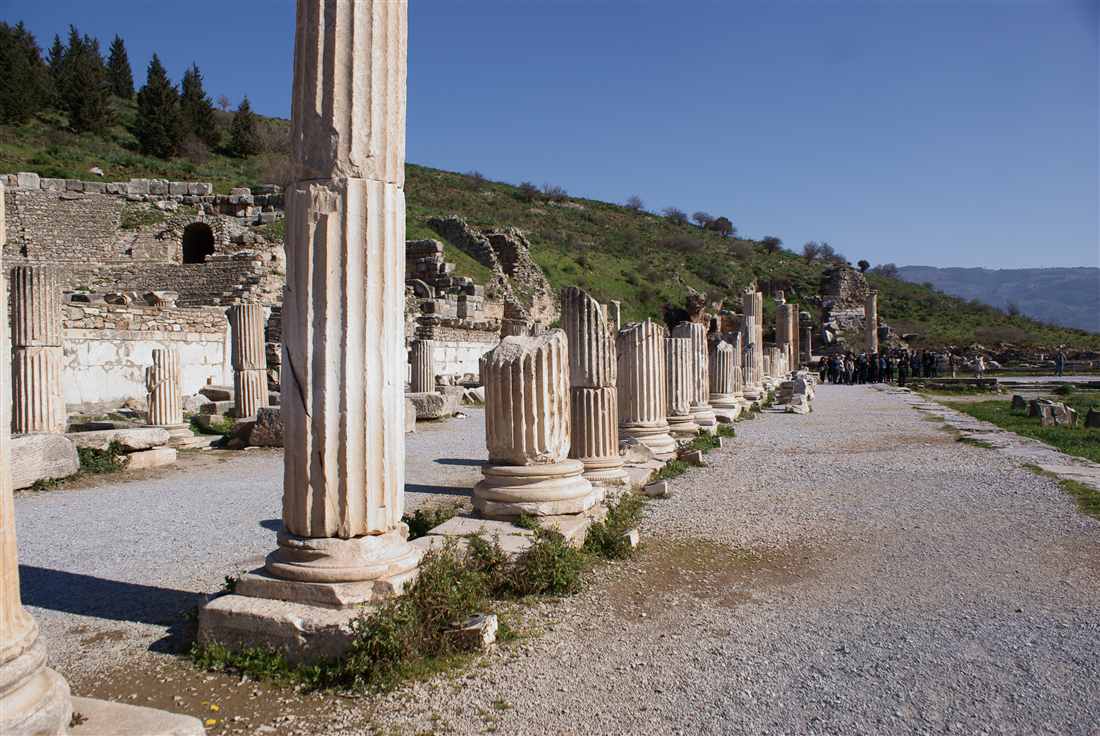
The history of Ephesus spans three thousand years, from an Ionian Greek foundation and the great Temple of Artemis through its Roman golden age as capital of Asia to its Byzantine decline as the harbour silted and the sea drew away. Plan the whole trip with Greece Tours.
This guide covers the history of Ephesus in full: who founded it, its rule under the Lydians and Persians, the Classical and Hellenistic city refounded by Lysimachus, its Roman heyday, its central role in early Christianity and the Council of Ephesus, the reasons for its decline, its Byzantine, Seljuk and Ottoman afterlife, and how the ruins were rediscovered.
What is the history of Ephesus in brief?
Ephesus began as an Ionian Greek colony founded in the tenth century BC, rose through Lydian and Persian rule, reached its peak as the Roman capital of the province of Asia, then declined through harbour silting, earthquakes and raids into a Byzantine and Ottoman backwater.
The story of Ephesus spans nearly three thousand years of continuous settlement on the Aegean coast of Asia Minor, in what is today western Turkey. Greek settlers under the prince Androklos established the classical city beside the sanctuary of a local mother-goddess, whom they identified with Artemis. That sanctuary grew into the Temple of Artemis, one of the Seven Wonders of the Ancient World, and it anchored the wealth and fame of the city for eight centuries.
Ephesus passed from Greek independence into the Lydian empire of Croesus, then the Persian empire of Cyrus, then back to Greek control after Alexander the Great. His general Lysimachus rebuilt the city on higher ground with new walls in the third century BC. Under Rome the city became the seat of the proconsul of Asia, a port of a quarter-million people, and a stage for Saint Paul, Saint John and the Third Ecumenical Council of AD 431. Travellers who follow the wider Aegean story with Greece Tours encounter Ephesus as the crossroads where the Greek, Roman and Christian worlds met.
The decline was slow and physical. The River Cayster deposited silt that pushed the coastline kilometres away, stranding the harbour that had made the city rich. Earthquakes flattened its marble streets, the Goths sacked it in AD 262, malaria drained the marshy lowland, and Arab raids emptied the coast. The population retreated to the hill of Ayasoluk around the tomb of Saint John, and the modern town of Selcuk grew there. The ruins of Ephesus that visitors walk today preserve this entire arc in stone.
Who founded Ephesus?
Ionian Greek colonists led by Androklos, son of the Athenian king Kodros, founded classical Ephesus in the tenth century BC, settling beside an older Bronze-Age town the Hittites knew as Apasa, capital of the Arzawa kingdom, and Greek legend credited Amazon warriors with the earliest settlement.
The layers beneath Ephesus reach back into the second millennium BC. Hittite records name a coastal centre called Apasa, seat of the Arzawa lands, which scholars locate on the Ayasoluk hill above the later Greek city. Mycenaean Greek pottery and a Mycenaean cemetery confirm early Aegean contact, and the very name Ephesus preserves an echo of the older Anatolian toponym. The site guarded a fertile river mouth and a sheltered gulf, and every people who reached this coast wanted it.
Greek tradition made the foundation heroic. Androklos, a prince of Athens, consulted the Delphic oracle, which told him a fish and a boar marked the spot. Fishermen cooking their catch scattered sparks that startled a wild boar; Androklos killed the beast and founded the city on that ground. He drove out or absorbed the earlier Carian and Lelegian inhabitants and joined Ephesus to the Ionian League of twelve cities.
A second legend credited the Amazons, the warrior women of Anatolian myth, with founding the sanctuary of the goddess and the first town around it. The historical picture combines these threads:
- An Anatolian Bronze-Age town, Apasa, under Hittite and Arzawan influence.
- A cult of a local mother-goddess later fused with Greek Artemis.
- Ionian Greek settlers under Androklos organising the polis.
- A mythic Amazon origin story attached to the goddess and the shrine.
From these origins Ephesus emerged as one of the wealthiest and most cultured members of Ionia, a producer of philosophers such as Heraclitus and a magnet for trade between the Aegean and the Anatolian interior.
What happened to Ephesus under the Lydians and Persians?
The Lydian king Croesus conquered Ephesus in the sixth century BC, moved the population toward the plain around the sanctuary and funded the great marble Temple of Artemis; after Cyrus the Great defeated Croesus, Ephesus fell under Persian rule as part of a satrapy governed from Sardis.
Croesus of Lydia, whose name became a byword for wealth, absorbed the Ionian cities of the coast in the middle of the sixth century BC. He treated Ephesus with calculated generosity. Rather than sacking the shrine of Artemis, he became its greatest patron, and the sculptured column drums of the archaic temple carried inscriptions recording his donations. Under Lydian dominance the settlement shifted down from its defensible height toward the low ground near the goddess, tying the city’s fate to the sanctuary.
The archaic Temple of Artemis that Croesus financed was a colossal Ionic structure, the first monumental building raised entirely of marble, designed by the architects Chersiphron and his son Metagenes. It measured well over a hundred metres in length and stood on a forest of high columns. Pilgrims, traders and dedicators poured wealth into it, and it functioned as bank, asylum and religious heart of the region.
Lydian rule ended when Cyrus the Great of Persia crushed Croesus and captured Sardis. Ephesus and the other Ionian cities passed to the Achaemenid Persian empire, paying tribute and accepting governors answerable to the satrap at Sardis. The Persians kept the sanctuary intact and allowed the city its Greek institutions under overall imperial control. Key features of this era include:
- Croesus as chief benefactor of the archaic Temple of Artemis.
- The relocation of the town toward the plain and the shrine.
- Persian conquest under Cyrus and incorporation into the satrapy of Sardis.
- Continued tribute payments and Greek civic life under Persian oversight.
This double subjection, first to Lydia and then to Persia, set the stage for the great revolt that opened the fifth century BC.
What was Ephesus like in the Classical and Hellenistic periods?
Ephesus joined the Ionian Revolt against Persia in the early fifth century BC, later welcomed Alexander the Great as a liberator, and under his successor Lysimachus in the third century BC the whole city was moved to higher ground and enclosed within massive new walls.
When the Ionian cities rose against Persia at the start of the fifth century BC, Ephesus served as the base from which the Greeks marched inland to burn Sardis. The revolt failed, and Persian control returned, though the city’s harbour and trade kept it prosperous through the classical age. In this period Ephesus produced the philosopher Heraclitus, who taught that all things flow and that fire is the primal element, and the painter Parrhasius, celebrated across the Greek world.
In the fourth century BC the archaic Temple of Artemis burned down, by tradition on the very night Alexander the Great was born; a man named Herostratus set the fire to make his name immortal. When Alexander reached Ephesus during his conquest of the Persian empire, he offered to pay for the temple’s reconstruction, but the Ephesians tactfully declined, saying it was improper for one god to build a temple to another. The rebuilt temple rose even grander than before.
After Alexander’s death his general Lysimachus took control of the region and transformed the city physically. Because the old harbour was already silting, he shifted the urban centre to the valley between the hills of Panayir and Bulbul and ringed it with a defensive wall stretching around nine kilometres. He renamed it briefly Arsinoeia after his wife and forced reluctant citizens to move by blocking the drains during a storm. The Hellenistic city gained:
- New walls running roughly nine kilometres across the hills.
- A planned grid on the valley floor between Panayir and Bulbul hills.
- A relocated harbour to fight the advancing silt.
- Fresh public buildings, agoras and a theatre carved into the slope.
This Hellenistic layout became the skeleton of the Roman metropolis that followed, and most of the marble ruins standing today trace their street plan to the decisions of Lysimachus.
Why was Ephesus so important under the Romans?
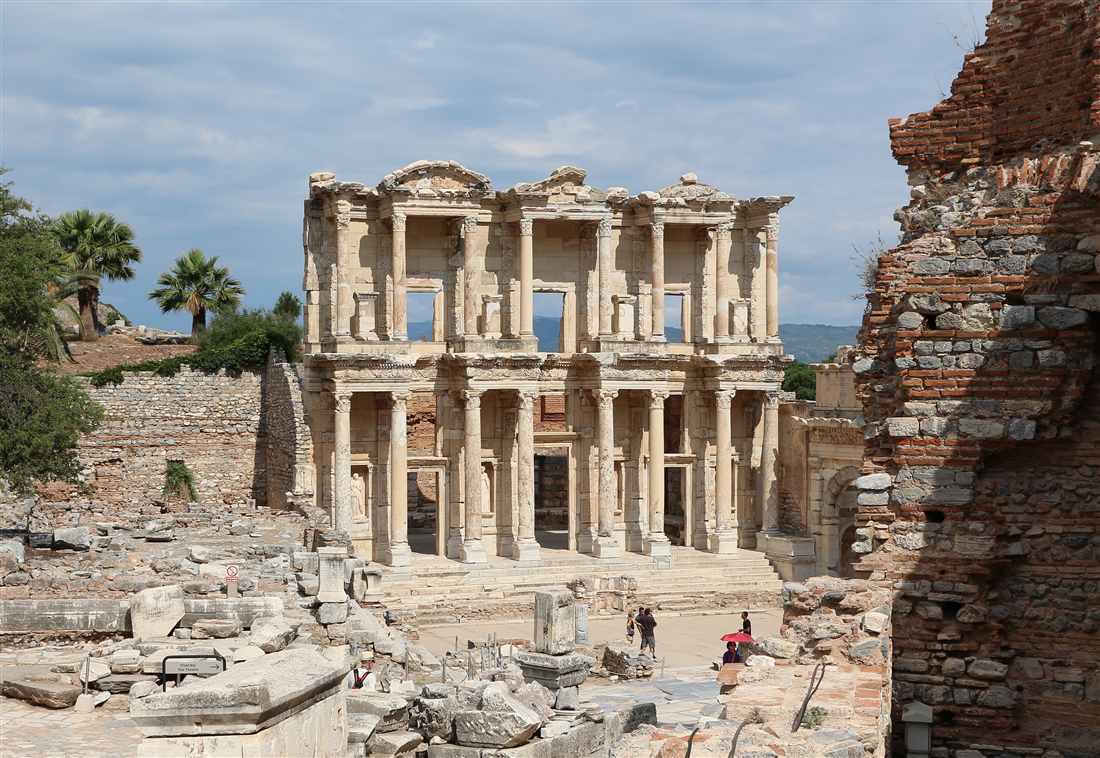
Under Rome, Ephesus became the capital of the province of Asia and residence of the proconsul, a harbour metropolis of roughly a quarter-million people, and the second city of the eastern empire, adorned with the Library of Celsus, the Great Theatre, marble avenues and a Temple of Artemis still counted a Wonder of the World.
Rome inherited the region when the last king of Pergamon bequeathed his kingdom to the Roman people in the second century BC. Ephesus was made the seat of Roman administration for the wealthy province of Asia, and the proconsul who governed millions of subjects held court there. Its harbour handled the trade of the Anatolian interior flowing to the Mediterranean, and goods, grain, marble and pilgrims passed through its quays in vast quantity.
The city grew into one of the largest in the Roman world, ranked behind Rome and Alexandria, with a population estimated around a quarter of a million at its height. The emperors and the local elite competed to fill it with monuments. The Great Theatre, cut into the flank of Panayir hill, seated an audience of about twenty-five thousand. A colonnaded street, the Arcadian Way, ran from the theatre to the harbour lit by lamps at night. The Library of Celsus, raised in the early second century AD to hold thousands of scrolls, presented a two-storey marble facade that remains the emblem of the site.
Ephesus also held the coveted title of neokoros, temple-warden of the imperial cult, and built temples to the emperors that drew provincial festivals and games. The monuments and institutions that defined Roman Ephesus include:
- The residence and tribunal of the proconsul of the province of Asia.
- A harbour metropolis of roughly a quarter-million inhabitants.
- The Great Theatre seating around twenty-five thousand spectators.
- The Library of Celsus, the terrace houses and the marble Curetes Street.
- Aqueducts, baths, latrines and a piped water supply for the population.
For two centuries the city stood at the summit of its prosperity, a showcase of Roman urban civilisation on the Greek Aegean coast.
What role did Ephesus play in early Christianity?
Ephesus was a foundational centre of early Christianity: Saint Paul preached there for three years and provoked the silversmiths’ riot in the theatre, Saint John is traditionally linked to the city and the Fourth Gospel, the Virgin Mary is held to have spent her last years nearby, and the Council of Ephesus met there in AD 431.
The apostle Paul made Ephesus a base of his mission for about three years in the middle of the first century AD, and the letter to the Ephesians in the New Testament carries the city’s name. His preaching threatened the trade in silver shrines of Artemis, and the silversmith Demetrius stirred a mob that filled the Great Theatre chanting “Great is Artemis of the Ephesians” for two hours, an episode recorded in the Acts of the Apostles. The confrontation shows how deeply the cult of the goddess was woven into the city’s economy.
Christian tradition ties the apostle John to Ephesus, holding that he wrote his Gospel there and died in the city; the great Basilica of St John was later built over his reputed tomb on Ayasoluk hill. A parallel tradition holds that the Virgin Mary travelled to the region with John and spent her final years in a small house on the slopes of Bulbul hill, a site venerated today as the House of the Virgin Mary.
The city’s Christian prominence reached its height in AD 431, when the emperor Theodosius II summoned the Third Ecumenical Council to Ephesus. Meeting in the Church of Mary, the council condemned the teaching of Nestorius and proclaimed the Virgin Theotokos, mother of God, a definition central to Christian doctrine ever after. The Christian landmarks of Ephesus include:
- The three-year mission of Saint Paul and the riot of the silversmiths.
- The tradition of Saint John’s Gospel, death and tomb on Ayasoluk hill.
- The House of the Virgin Mary on Bulbul hill.
- The Council of Ephesus of AD 431 that proclaimed Mary Theotokos.
Few cities carry so dense a concentration of Christian memory, and Ephesus became a pilgrimage destination that outlived its commercial greatness.
Why did Ephesus decline?
Ephesus declined because the River Cayster silted its harbour into a malarial marsh cut off from the sea, repeated earthquakes shattered its buildings, the Goths sacked the city and burned the Temple of Artemis in AD 262, and later Arab naval raids and disease drained its population.
The deepest cause was geological. The Cayster carried enormous loads of sediment down to its mouth, and despite repeated dredging the harbour steadily filled. Over the centuries the coastline advanced kilometres westward, leaving the quays and the Arcadian Way stranded on dry land far from the Aegean. A port with no sea has no reason to exist, and the trade that had fed a quarter-million people withered. The stagnant lowland bred mosquitoes, and malaria became endemic in the marshes.
Natural disaster compounded the retreat. The coast of Asia Minor lies on active fault lines, and severe earthquakes toppled colonnades, cracked the theatre and ruined the aqueducts across the third and later centuries. In AD 262 a Gothic seaborne raid stormed the city and set fire to the already-weakened Temple of Artemis, which was never rebuilt to its former glory; its marble was later quarried for other structures.
Political insecurity finished the work. From the seventh century AD onward Arab fleets raided the Aegean coast, and the exposed lowland city became indefensible. The forces that broke Ephesus were:
- The silting of the Cayster that carried the sea away from the harbour.
- Recurrent earthquakes that flattened the marble monuments.
- The Gothic sack and burning of the Temple of Artemis in AD 262.
- Endemic malaria in the abandoned marshland.
- Arab naval raids that made the coast unsafe to inhabit.
By the early medieval period the great Roman metropolis on the plain was a shrinking shell, and its surviving population began climbing back to the safer hill from which their ancestors had descended a thousand years before.
What happened to Ephesus in the Byzantine, Seljuk and Ottoman eras?
In the Byzantine era Ephesus shrank to the fortified hill of Ayasoluk around the Basilica of St John built by Justinian; the Seljuk Turks took it in the medieval period and the Aydinid emirs raised the Isa Bey Mosque, and under the Ottomans it dwindled into the small town later renamed Selcuk.
As the plain became unlivable the Byzantines concentrated on the hill of Ayasoluk, where the emperor Justinian in the sixth century AD replaced an earlier shrine over the tomb of Saint John with a vast domed basilica. This Basilica of St John, one of the largest churches of its age, became the centre of a fortified settlement and a major pilgrimage site, and a strong citadel crowned the hilltop above it. The lower Roman city was mostly abandoned, its marble carried off for new building or burned for lime.
Turkish power reached the coast in the medieval centuries. The Seljuks and then the Aydinid emirate of the fourteenth century controlled the town, which they knew as Ayasoluk from the Greek phrase for “the holy theologian,” meaning Saint John. The Aydinid ruler built the elegant Isa Bey Mosque below the hill in the fourteenth century, a fine example of early Anatolian Turkish architecture with a broad courtyard and reused ancient columns. For a period the port at the new coastline handled trade before it too silted.
Under the Ottoman Empire the settlement lost its remaining importance and became a modest agricultural town. The main phases of this long twilight were:
- Byzantine retreat to Ayasoluk hill and Justinian’s Basilica of St John.
- The Seljuk and Aydinid Turkish takeover of the medieval town.
- The Isa Bey Mosque raised by the Aydinids in the fourteenth century.
- Ottoman rule and the shrinking of the town into a quiet village.
The Turkish Republic later renamed the town Selcuk, and it is from this modern town that visitors set out to walk the excavated ruins of the ancient city on the plain below.
How was Ephesus rediscovered and excavated?
Ephesus was rediscovered when the English engineer John Turtle Wood, digging for the British Museum in the mid-nineteenth century, located the buried Temple of Artemis; systematic excavation followed under the Austrian Archaeological Institute from the end of that century, uncovering the theatre, Curetes Street and the Library of Celsus.
For centuries the site of the Temple of Artemis was lost, buried under metres of river silt with no trace above ground. In the middle of the nineteenth century John Turtle Wood, working for the British Museum, spent years searching the marshy plain. An inscription in the theatre describing a procession from the temple gave him the direction, and he finally struck the foundations deep below the water table. His finds and later marble fragments went to London, where a single reconstructed column stands in the British Museum.
Serious, continuous excavation of the city itself began under the Austrian Archaeological Institute at the close of the nineteenth century, and Austrian teams have worked the site across the decades since. They uncovered and partly re-erected the monuments that draw crowds today: the Great Theatre, the marble-paved Curetes Street, the terrace houses with their frescoes and mosaics, the Temple of Hadrian and, most famously, the facade of the Library of Celsus, painstakingly reconstructed from its fallen blocks in an anastylosis project.
Today Ephesus ranks among the most complete ancient cities open to visitors anywhere and holds status as a UNESCO World Heritage Site. The strands of its rediscovery include:
- John Turtle Wood’s search for the Temple of Artemis for the British Museum.
- The inscription in the theatre that guided him to the buried foundations.
- The Austrian Archaeological Institute’s long-running excavations of the city.
- The reconstruction of the Library of Celsus facade by anastylosis.
- Inscription of the site on the UNESCO World Heritage list.
What began as a lost sanctuary under a swamp is now a walkable marble metropolis, letting a visitor trace three thousand years from Ionian foundation to Christian council to modern archaeology in a single day.
Frequently Asked Questions
Who founded Ephesus?
Ephesus was founded by Ionian Greek settlers led by the prince Androklos of Athens, on the site of an earlier Bronze-Age settlement linked to the Arzawa kingdom and the Hittites. The Amazons figure in its foundation legend.
Why was Ephesus important under the Romans?
Under Rome, Ephesus was the capital of the province of Asia and a great harbour city of a quarter of a million people. Its wealth raised the Library of Celsus, the Great Theatre and the marble avenues that survive today.
Why did Ephesus decline?
Ephesus declined as its harbour silted up and the coastline retreated, cutting off its sea trade. Earthquakes, the Gothic sack of AD 262, malaria and later Arab raids drained the city, which shrank to the hill town of Selcuk.