
The Temple of Artemis at Ephesus was a colossal all-marble Ionic temple dedicated to the goddess Artemis, ranked among the Seven Wonders of the Ancient World and, in its day, the largest temple in the Greek world. Plan the whole trip with Greece Tours.
This guide covers the Temple of Artemis in full: what it was and where it stood, why it counted as a Wonder, the distinctive Artemis of Ephesus, when it was built and by whom, its size and 127 columns, its appearance, its destruction by the arsonist Herostratus and later by the Goths, its role in the life of Ephesus, what survives today, where its sculptures are held, and how to visit the site.
What is the Temple of Artemis?
The Temple of Artemis was a colossal all-marble Ionic temple at Ephesus on the Ionian coast of Asia Minor, dedicated to the goddess Artemis of Ephesus. Its scale and craftsmanship earned it a place among the Seven Wonders of the Ancient World.
The Temple of Artemis, known in Greek as the Artemision, stood as the largest sacred building of the classical Greek world and the centrepiece of the sanctuary of Artemis at Ephesus. It rose on a foundation platform in a marshy plain, its forest of tall marble columns supporting a wide roof over a deep inner chamber that housed the cult statue of the goddess. Pilgrims, merchants and pilgrimage delegations from across the Mediterranean travelled to worship there, and the temple functioned as a religious focus, a treasury and a place of asylum. Travellers touring the classical sites of Turkey and Greece with Greece Tours reach the site through the modern town that grew beside its ruins.
Three distinct meanings attach to the name. First, the Temple of Artemis names the physical marble building, the vast dipteral structure ringed by a double row of columns. Second, it names the sanctuary as a whole, the sacred precinct that surrounded the temple with its great altar, subsidiary shrines, votive monuments and treasury. Third, it names the institution of the cult itself, the priesthood, the festivals and the economic power that made the Ephesian Artemis one of the richest religious foundations of antiquity. All three senses converged on a single point in the plain below the ridge of Ayasoluk.
The temple that won lasting fame was rebuilt more than once. An archaic marble temple funded in the sixth century BC by Croesus, king of Lydia, established the monumental form. That building burned on the night of the birth of Alexander the Great, according to ancient tradition, and the Ephesians raised an even grander replacement on the same plan across the fourth century BC. It was this later temple, standing well into the Roman era, that classical authors described as one of the world’s supreme wonders before Gothic raiders sacked it in AD 262.
Several features set the Artemision apart from every other Greek temple:
- It was built entirely of marble, roof and all, at a period when most Greek temples used limestone with only marble facing.
- It followed the dipteral plan, wrapping the inner building in a double colonnade rather than a single row of columns.
- It carried sculpted relief figures around the lower drums of the front columns, the columnae caelatae, a decorative treatment found almost nowhere else at this scale.
- It stood far larger than the Parthenon, covering a footprint more than four times the Athenian temple’s area.
Beyond its religious function, the temple operated as a formidable economic institution. Its treasury held deposits of coin, bullion and precious objects entrusted to the goddess by private citizens, cities and rulers, so that the sanctuary served the ancient economy as a secure bank under divine protection. The temple estates owned land, herds and fisheries around the Cayster valley, and the priesthood administered rents, sacrificial dues and the sale of votive objects to the constant stream of pilgrims. This concentrated wealth financed the successive rebuildings and drew both benefactors and, in the end, plunderers to the sacred plain.
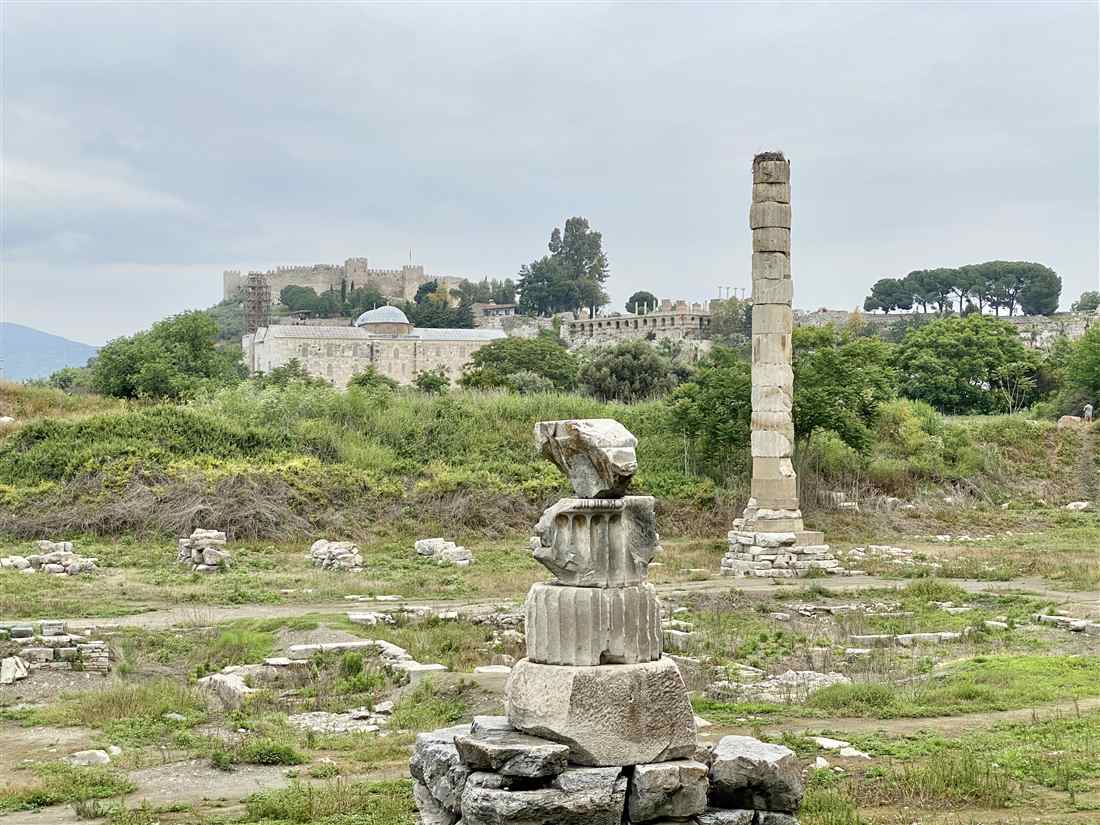
The temple’s fame outlived its stones. Ancient poets, geographers and historians catalogued it, early Christian writers recorded the conflict between the cult and the new faith at Ephesus, and later antiquarians hunted for its buried foundations. Today a single reconstructed column marks the spot, assembled from fragments in the marshy field, a lonely marker for a building that once astonished the entire ancient world with its size, its whiteness and the wealth of its decoration.
Where is the Temple of Artemis?
The Temple of Artemis stood at ancient Ephesus, on the edge of the modern town of Selçuk in Izmir Province on the Aegean coast of western Turkey. Its ruins lie in a low field directly below the hill crowned by the Basilica of Saint John.
The site sits in the valley of the Cayster River, the ancient Kaystros, where the river deposited silt across a broad coastal plain over the centuries. In antiquity the sanctuary lay close to a shallow harbour inlet that connected Ephesus to the sea, but the relentless silting of the Cayster pushed the coastline kilometres west, leaving both the temple field and the wider city of Ephesus stranded inland today. The marshy ground that plagued the ancient builders is the same low, damp terrain that surrounds the reconstructed column now.
Selçuk, the town that grew around the site, lies about three kilometres northeast of the main archaeological zone of Ephesus and roughly seventy kilometres south of the city of Izmir. The temple field is an easy walk from the centre of Selçuk, tucked between the railway line, the road to Ephesus and the foot of Ayasoluk Hill. Visitors reach it through the town rather than through the ticketed main gates of the Ephesus ruins, and the field stands open beside the road with a clear view up to the fortress and basilica on the ridge above.
The geography knits the monuments together in a tight cluster around Ayasoluk Hill:
- The Temple of Artemis field, at the base of the hill in the plain.
- The Basilica of Saint John, the great sixth-century AD church built by the emperor Justinian over the reputed tomb of the apostle, crowning the ridge.
- The Ayasoluk fortress, the Byzantine and later citadel at the summit.
- The Isa Bey Mosque, a fourteenth-century AD Seljuk-era mosque on the slope, whose builders reused marble columns quarried from the ruined temple and city.
This reuse of the temple’s marble tells much of the story of its disappearance. Column shafts and blocks from the Artemision were carried off to build the Basilica of Saint John, the Isa Bey Mosque and, according to a long tradition, even the Hagia Sophia in Constantinople. Over the medieval centuries the abandoned temple served as a quarry, its cut marble too valuable to leave in the mud, until the ground level rose and the last foundations vanished beneath silt and swamp.
The rediscovery of the buried temple came through patient excavation. An English engineer, John Turtle Wood, digging on behalf of the British Museum, traced the sanctuary’s location through inscriptions and finally struck the temple platform deep below the modern surface in the mid-nineteenth century AD. Later excavation by David George Hogarth and by Austrian and Turkish teams recovered the plan, the foundations and thousands of votive offerings. The single standing column seen today was reassembled from disparate drum fragments, a modern gesture that fixes the wonder’s position in a landscape otherwise reclaimed by reeds and standing water.
The setting rewards a visitor who reads the landscape as a layered record of the site’s long life. From the temple field the eye climbs the slope to the basilica, the fortress and the mosque, three great monuments raised in part from the temple’s own dismembered marble, so that the wonder survives dispersed into the buildings that succeeded it. Storks nest on the reconstructed column in spring, water pools around the foundations after rain, and the fragments of capitals and drums lie half-submerged in the grass. The plain that the ancient architects chose for its yielding softness now holds the temple’s memory in its silt, a short walk from the crowded main ruins of Ephesus and the harbour street that once carried pilgrims toward the goddess.
Why is the Temple of Artemis one of the Seven Wonders?
The Temple of Artemis earned its place among the Seven Wonders through sheer scale and splendour. The poet Antipater of Sidon ranked it above every other marvel he had seen, declaring that the sight of the temple outshone the pyramids, the Colossus and the hanging gardens combined.
The canonical list of the Seven Wonders of the Ancient World, compiled by Hellenistic writers, gathered the most spectacular constructions of the Greek and Near Eastern world into a traveller’s catalogue of things worth crossing the sea to behold. The Temple of Artemis sat firmly on that list alongside the Great Pyramid of Giza, the Hanging Gardens of Babylon, the Statue of Zeus at Olympia, the Mausoleum at Halicarnassus, the Colossus of Rhodes and the Lighthouse of Alexandria. Of that famous seven, the temple was the only one built to house a single deity in the ordinary form of a Greek sanctuary, raised to a scale that dwarfed its peers.
Antipater of Sidon, writing an epigram preserved in the Greek Anthology, gave the temple its most quoted testimonial. He listed the other wonders he had beheld, then set them aside, writing that when he saw the house of Artemis mounting to the clouds, the other marvels lost their brilliance and that, apart from Olympus, the sun never looked on anything so grand. That praise from a widely travelled Greek poet fixed the temple’s reputation across the ancient literary tradition and secured its inclusion on every version of the list.
The reasons behind the acclaim were concrete rather than poetic:
- Its enormous footprint, larger than any Greek temple ever completed, stretching beyond a hundred metres in length.
- Its 127 columns, each rising to a height of roughly eighteen metres, forming a dense marble forest visible from far across the plain.
- Its construction entirely from gleaming white marble, an extravagance of material unmatched at the time of its building.
- Its sculpted column bases and richly carved decoration, the work of the leading Greek sculptors of the age.
- Its immense accumulated wealth, the gold, silver and votive treasures deposited by kings, cities and pilgrims over centuries.
The temple’s wonder-status also rested on its endurance and its repeated resurrection. When the archaic temple burned, the Ephesians rebuilt it larger and finer, refusing help from Alexander the Great, who offered to fund the reconstruction if his name were inscribed as dedicant. The city’s proud reply, that it was not fitting for one god to build a temple to another, entered the anecdotal history of the ancient world and added to the temple’s mystique. That refusal turned the rebuilding into a civic achievement and reinforced the sanctuary’s fame.
The temple also embodied a distinctly Greek achievement in engineering and art. Its architects pioneered the use of solid marble at monumental scale, developed the methods for transporting and raising blocks of extraordinary weight, and refined the Ionic order into the form later architects imitated. The building set a benchmark that shaped temple design across the Greek east, and its plan directly influenced the great Ionic temples that followed, among them the temple of Apollo at Didyma and the Heraion of Samos. To later Greeks the Artemision stood as proof of what wealth, skill and devotion combined were able to raise, and that reputation carried it onto the wonders list as much as its raw dimensions.
Longevity distinguished the Artemision from most of its fellow wonders. It stood for the better part of a thousand years across its successive incarnations, drawing pilgrims, hosting festivals and amassing riches long after other wonders had toppled or crumbled. Ancient geographers such as Strabo and Pliny the Elder devoted detailed passages to it, recording its dimensions, its architects and its treasures. Pliny in particular preserved the technical marvels of its construction, and it is through these written descriptions, more than through the vanished stones, that the temple keeps its rank among the great wonders of antiquity.
Who was Artemis of Ephesus?
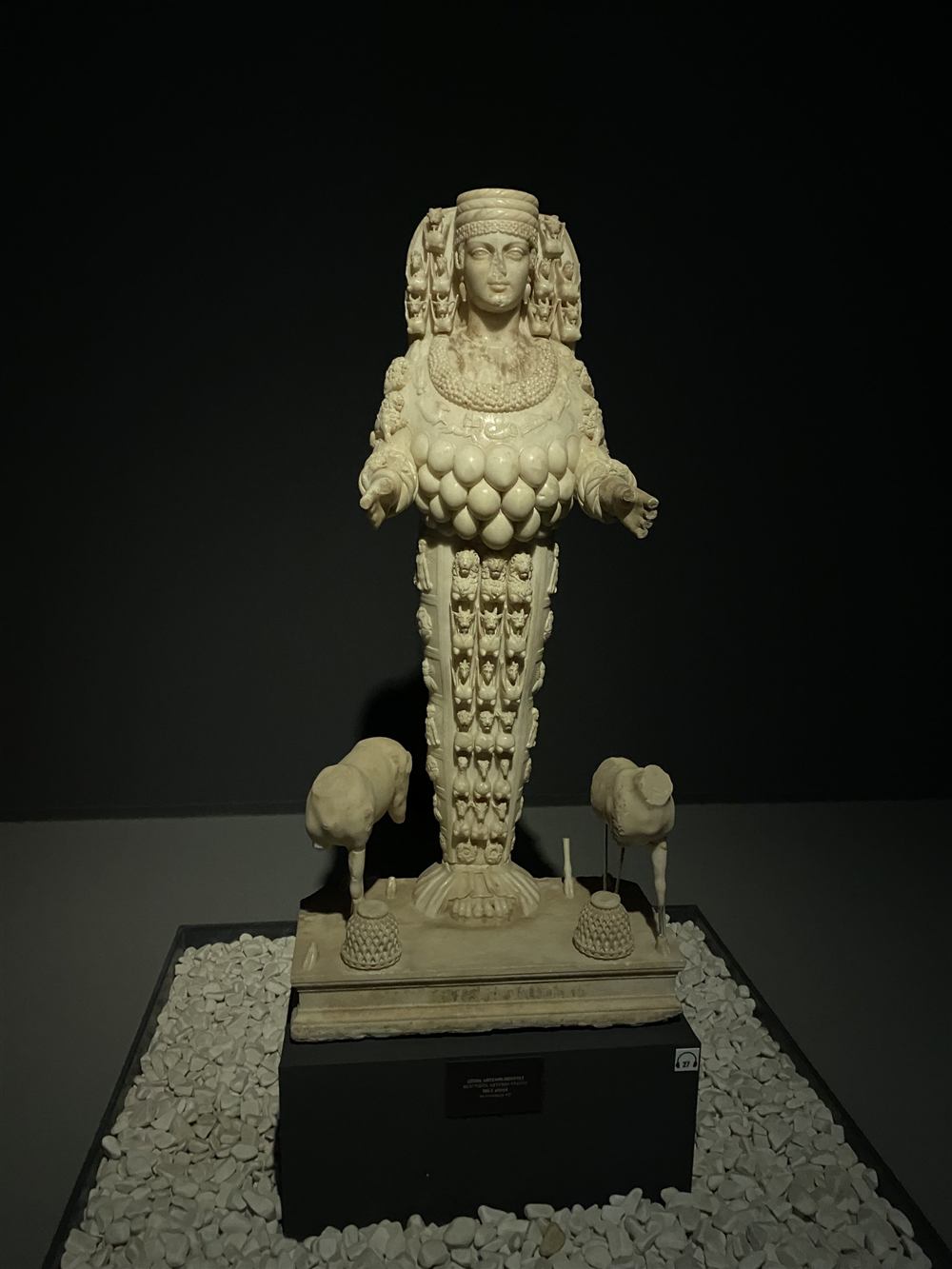
Artemis of Ephesus was a distinct Anatolian mother-goddess, worshipped as a fertility deity and lady of animals, quite unlike the slender Greek huntress Artemis. Her cult statue showed a rigid figure covered in rows of ovoid protuberances across the chest, fused with the older Anatolian goddess Cybele.
The Ephesians identified their goddess with the Greek Artemis by name, yet her image and her attributes descended from a far older Anatolian tradition of the great mother-goddess. Where the Greek Artemis roamed the mountains as a virgin huntress with bow and hounds, the Ephesian Artemis stood frontal and immobile, a pillar-like idol crowned with a tall headdress, her arms extended, her lower body sheathed like a mummy in bands carved with animals. She embodied fertility, nourishment and the fecundity of nature, presiding over the wild creatures of the land as their mistress.
The most striking and most debated feature of her image is the mass of rounded protuberances covering her chest. Ancient and modern observers have read these ovoid forms in competing ways, and the true meaning stays contested among scholars:
- As multiple breasts, marking her as a nurturing mother-goddess of boundless fertility, the interpretation favoured by early Christian writers.
- As bull testicles, hung on the idol as sacrificial offerings, a reading advanced by later researchers on iconographic grounds.
- As gourds, eggs, or amber ornaments, votive tokens of abundance draped across the original wooden image.
Whatever their origin, these protuberances made the Ephesian Artemis instantly recognisable and reinforced her role as a goddess of generation and plenty. Her worship absorbed the identity of Cybele, the great mountain-mother of Phrygia and Anatolia, whose cult of fertility, wild nature and ecstatic devotion long predated the arrival of Greek settlers on the Ionian coast. The syncretism gave the Ephesian goddess a double heritage, Greek in name and Anatolian in substance.
The cult supported an elaborate organisation. The priesthood at Ephesus included the megabyzos, a high priest whose title and possibly whose eunuch status echoed Near Eastern religious practice, alongside colleges of priestesses and temple attendants. The goddess drew donations from kings and cities, and her sanctuary held the right of asylum, granting refuge to fugitives within a marked sacred boundary around the temple. This protected zone extended outward from the building and reinforced the goddess’s authority over the life of the city.
The festivals of the goddess punctuated the Ephesian year and drew crowds from across Ionia. The Artemisia, the great annual celebration, filled the sanctuary with sacrifices, processions, athletic and musical contests, and a month sacred to the goddess bore her name in the local calendar. A grand procession carried images of Artemis from the temple through the city and back, escorted by the youth of Ephesus, and wealthy benefactors endowed the ceremonies with foundations recorded on inscribed marble. These rites bound the civic identity of Ephesus to its goddess and turned the sanctuary into the ceremonial heart of the whole community.
The power of the Ephesian Artemis surfaces vividly in the New Testament account of the apostle Paul’s stay at Ephesus. When Paul’s preaching threatened the trade in silver shrines of the goddess, the silversmith Demetrius stirred the craftsmen to riot, and the crowd filled the theatre for hours chanting the cry that Great is Artemis of the Ephesians. That episode records both the commercial machinery of the cult, which sold miniature shrines and images to pilgrims, and the fierce civic loyalty the goddess commanded. Her worship persisted at Ephesus until the temple’s final destruction and the triumph of Christianity in the region.
When was the Temple of Artemis built, and by whom?
The great marble temple was funded by Croesus, king of Lydia, in the mid sixth century BC, designed by the architects Chersiphron of Crete and his son Metagenes. It replaced a sequence of earlier shrines that had stood on the same sacred spot for centuries before.
The site held religious significance long before the monumental temple rose. Excavation beneath the classical foundations uncovered layers of earlier structures, small shrines and altars reaching back into the archaic and geometric periods, together with rich deposits of votive offerings including the earliest known coins. The sacred plot in the marshy plain drew worship for generations, each successive shrine larger than the last, until the ambition of the Ephesians and the wealth of a foreign king combined to produce a building on an unprecedented scale.
Croesus, the fabulously rich king of Lydia whose name became a byword for wealth, conquered the Greek cities of the Ionian coast in the sixth century BC and contributed lavishly to the temple’s construction. Ancient sources record that he dedicated the columns, and inscribed column drums recovered from the site preserve dedications naming the king. His patronage transformed the project from a civic undertaking into one of the most costly building enterprises of the ancient world, and it is his temple that established the vast dipteral form later authors admired.
The architects charged with the work were among the most celebrated of their age:
- Chersiphron of Knossos in Crete, who directed the original design and devised ingenious methods for moving and raising the enormous marble members.
- Metagenes, son of Chersiphron, who continued the work after his father and solved the problem of hoisting the massive stone lintels across the column tops.
- Theodoros of Samos, an engineer credited with laying the foundations on a bed of charcoal and fleeces to stabilise the marshy ground.
- Demetrius and Paeonius, later architects associated with the completion and the fourth-century rebuilding of the temple.
Pliny the Elder preserved the memorable engineering anecdotes attached to these builders. He recorded that Chersiphron transported the gigantic column shafts and lintels by encasing them in wooden frames and rolling them like axles behind teams of oxen, and that the deliberate choice of the swampy site aimed to protect the building against earthquakes by resting it on soft, yielding ground. Pliny also related the story that Chersiphron despaired of raising one huge threshold block into place until the goddess herself appeared to reassure him, a legend that underscored the difficulty of the work.
The archaic temple of Croesus met a violent end. On a night in the fourth century BC, a man named Herostratus set fire to the temple, destroying its timber roof and much of its structure in an act committed, according to the sources, purely to make his own name immortal. The Ephesians executed him and forbade the mention of his name, though the attempt to erase it failed. They then rebuilt the temple on the same plan and even grander scale during the following decades, and it was this fourth-century BC reconstruction, refusing the sponsorship of Alexander the Great, that stood as the wonder the Roman world knew.
How large was the Temple of Artemis?
The Temple of Artemis was the largest Greek temple ever built, measuring roughly 115 metres long by 55 metres wide. It carried 127 Ionic columns standing about eighteen metres tall, arranged as a double colonnade in the dipteral plan that wrapped two rows of columns around the inner building.
The dimensions recorded by ancient authors and confirmed by excavation place the Artemision far beyond the scale of any other temple of the Greek world. Pliny the Elder gave its length as 425 feet and its breadth as 225 feet, figures that translate to well over a hundred metres in length. The building stood on a stepped platform raised above the plain, itself a substantial structure, and the sheer horizontal spread of the temple across its site made it visible as a marble mass from a great distance across the flat valley of the Cayster.
The count of 127 columns comes directly from Pliny, who added that each column rose to sixty feet and that thirty-six of them carried carved decoration. The columns stood in a dense arrangement dictated by the dipteral scheme, which multiplied the number of shafts far beyond a normal peripteral temple with its single surrounding row. A comparison of proportions shows how the Artemision overshadowed the most famous temple of mainland Greece:
- The Artemision covered a ground area more than four times that of the Parthenon in Athens.
- Its columns rose roughly eighteen metres, against the Parthenon’s shafts of about ten metres.
- It carried 127 columns against the Parthenon’s outer count of forty-six.
- Its plan doubled the exterior colonnade where mainland temples used a single row.
The dipteral plan defined the temple’s character. Instead of one ring of columns surrounding the central chamber, the Artemision set two rings, one behind the other, so that a worshipper approaching the building passed through a deep screen of columns before reaching the walls of the inner room. At the front, the ranks of columns multiplied into a dense grove, with rows standing in front of the entrance in the pronaos as well as along the flanks. This design created an interior of shifting shadow and vertical marble that struck ancient visitors with its forest-like depth.
The immense scale demanded engineering solutions unknown at smaller temples. The marshy foundation required the elaborate substructure of charcoal and packed materials described by ancient writers, laid to spread the crushing weight of the marble across unstable ground and to cushion the building against tremors. The transport of column shafts eighteen metres long and lintels of enormous weight tested the ingenuity of Chersiphron and Metagenes, whose rolling frames and lever systems entered the technical lore of ancient architecture through Pliny and Vitruvius.
The height of the columns, close to eighteen metres, put the entablature and roofline at a level that dominated everything around it. Above the columns ran the architrave, frieze and cornice, and over the deep interior stretched a roof whose central portion left the cult statue’s chamber open to the sky in the manner of the largest Ionic sanctuaries. The combination of length, breadth, column height and doubled colonnade produced a building of a magnitude that no later Greek temple attempted to match, and it is this raw size, as much as its ornament, that fixed the Artemision among the wonders.
What did the Temple of Artemis look like?
The Temple of Artemis presented a gleaming white marble facade of towering Ionic columns, the lower ones carved with figured reliefs on their lower drums, the columnae caelatae. Inside stood the venerated cult statue of the goddess, and before the temple rose the great sacrificial altar within the sacred precinct.
The overwhelming visual impression was one of marble whiteness on a colossal scale. Every part of the superstructure, from the stepped platform to the columns, the entablature and the roof tiles, was cut from marble quarried in the hills near Ephesus, so that the entire building shone pale against the green marsh and the blue coastal sky. Ancient descriptions dwell on this all-marble construction as an extravagance beyond the reach of ordinary sanctuaries, which economised with limestone cores. The Ionic order gave the temple its slender proportions, its volute capitals scrolling outward at the column tops and its moulded bases spreading each shaft onto the platform.
The most distinctive decorative feature was the sculpted column, the columna caelata. Pliny recorded that thirty-six of the 127 columns carried relief carving, and fragments recovered by excavation confirm figured drums with life-size or larger human figures worked in high relief around the base of the shaft. These carved drums stood at eye level along the approach, presenting the worshipper with a band of sculpted mythological figures before the plain fluting rose to the capitals above. The fourth-century BC rebuilding drew on the finest sculptors of the age, and the famous carver Scopas has been linked to the relief work on the later columns.
The elements a visitor encountered in sequence formed a rich programme of architecture and sculpture:
- The great altar of Artemis, a monumental sacrificial structure standing in the open before the temple’s west front, the focus of public sacrifice.
- The deep pronaos, the columned porch through which worshippers approached, screened by rows of the massive shafts.
- The carved column drums, the columnae caelatae, ringed with figures in high relief at the building’s front.
- The cella or inner chamber, housing the sacred image on its base at the heart of the temple.
- The pediments and the coffered marble ceilings, worked with mouldings and ornament in the Ionic manner.
At the sacred core stood the cult statue of Artemis of Ephesus, the ancient idol that gave the whole sanctuary its purpose. The venerated image, believed by the Ephesians to have fallen from heaven, showed the rigid, frontal goddess with her tall crown, extended arms and the mass of ovoid forms across her chest, her lower body sheathed in bands of carved animals. Roman-era copies preserve the appearance of this statue, and ancient sources describe the original, gilded and adorned, standing in the dim depths of the cella where lamplight and the gleam of votive gold surrounded it.
The surrounding precinct completed the spectacle. The sacred enclosure held rows of votive statues, dedicatory monuments, columns and offerings accumulated over centuries, together with the treasury deposits of gold, silver and jewels that made the sanctuary a bank as well as a shrine. Kings, cities and private worshippers left their gifts within the marked boundary of asylum. The whole ensemble, the towering marble temple, the carved columns, the great altar and the crowded precinct, presented to the ancient traveller the single most magnificent religious complex of the Greek world, a wonder whose splendour ancient writers struggled to convey in words. Fragments of the sculpted drums and the carved marble now rest in the British Museum and in the museums of Selçuk and Istanbul, where the surviving reliefs give a direct sense of the quality of the carving that once ringed the great temple’s front.
How was the Temple of Artemis destroyed?
The Temple of Artemis was destroyed and rebuilt across a millennium: burned by the arsonist Herostratus in the fourth century BC, restored on a grander marble scale, sacked by Gothic raiders in AD 262, closed under Christian rule, and quarried to bare foundations by late antiquity.
The temple that the Greeks numbered among the Seven Wonders was not a single building but the last in a sequence of structures raised on the same swampy ground beside the Cayster river. An early shrine stood on the marsh from the eighth century BC. A monumental temple funded partly by King Croesus of Lydia rose in the sixth century BC, measuring roughly 115 metres long and 55 metres wide, ringed by more than one hundred Ionic columns each about 18 metres tall. Fire ended that Croesan temple in the fourth century BC, and the Ephesians rebuilt it larger still.
The destruction came in stages, each tied to a shift in the ancient world:
- The arson of the fourth century BC — Herostratus set the Croesan temple ablaze on the night, by tradition, that Alexander the Great was born. The timber roof and interior fittings fed the flames and the marble cracked in the heat.
- The grander rebuild — Ephesus rejected Alexander’s later offer to pay for reconstruction in exchange for an inscription crediting him, and financed the new temple from its own treasury and the sale of the old columns. The rebuilt structure stood on a raised platform of thirteen steps and reached even greater height.
- The Gothic sack of AD 262 — a seaborne raid by Gothic bands swept the Aegean coast and struck Ephesus, plundering and burning the sanctuary. The temple never fully recovered its former splendour after this blow.
- Closure and quarrying — the spread of Christianity through Ephesus, and imperial edicts against pagan cult in late antiquity, ended worship. The abandoned marble was carried off as ready-cut building stone.
Column drums and cut blocks from the wonder were reused across the region. Tradition and later study point to Artemis marble travelling into the great church of Hagia Sophia in Constantinople and into the Basilica of St John built on the hill above the ruined sanctuary. Stone that had framed a goddess was recut to frame a Christian saint, a transfer of material that mirrors the transfer of devotion in the city itself.
The scale of the rebuilt temple explains why its loss registered so heavily. Ancient measurements put the platform at roughly 137 metres in length and 69 metres in width, with a forest of columns arranged in double rows across the front and flanks, each shaft rising to about 18 metres. Pliny the Elder recorded that one hundred and twenty-seven columns stood in the finished building, and that thirty-six of them carried carved decoration at their bases. A structure of that footprint dwarfed the Parthenon of Athens, and its destruction removed the largest marble temple the Greek world had raised.
The final phase of ruin owed as much to economics as to violence. Once the roof was gone and the cult ended, the temple became a marble quarry standing conveniently at the edge of an inhabited plain. Lime burners reduced fine carving to mortar, masons split drums into blocks, and cartloads of dressed stone rolled toward new churches, mosques, walls and houses across the district. The dismantling was patient and total, spread across generations, and it left the foundation scoured almost to the waterline.
By the time the marsh reclaimed the site, the temple had sunk beneath river silt and the water table rose to swallow the platform. Malaria haunted the low ground and the settlement drifted toward the hill of Ayasuluk, the core of modern Selçuk. The wonder that travellers had sailed to see became a memory recorded in books, its exact position lost until nineteenth-century excavation traced it again in the mud.
The story of the temple’s end is therefore the story of Ephesus in miniature: Lydian wealth, Greek craftsmanship, Macedonian ambition, Roman prosperity, barbarian raid, Christian triumph, and finally the slow victory of the river. No single catastrophe erased the Temple of Artemis. It was unmade by centuries.
Who was Herostratus and why did he burn the temple?
Herostratus was an obscure Ephesian who set fire to the Temple of Artemis in the fourth century BC for the sole purpose of making his name immortal. The city executed him and forbade anyone to speak or record his name, a penalty that failed and gave rise to the phrase “Herostratic fame.”
Almost nothing is known of Herostratus beyond the crime, and that absence is the point. He was, by the ancient accounts, a man of no rank and no achievement who reasoned that destroying something universally admired attaches his name to it forever. He chose the most celebrated building of the Greek world and put it to the torch. Under torture he confessed that fame, and fame alone, drove the act.
The Ephesian response was as deliberate as the crime. The authorities imposed a damnatio memoriae, a formal erasure:
- Herostratus was put to death for the sacrilege.
- A decree forbade any citizen to utter or write his name, on pain of death.
- The intent was to deny him the immortality he had killed for, condemning him instead to be forgotten.
The ban failed. The ancient historian Theopompus of Chios recorded the name in his account of the age, and later writers such as Strabo and Valerius Maximus repeated it. The very effort to suppress the name drew attention to it, and the arsonist achieved exactly the notoriety the city tried to deny. His name outlived the temple he burned and the officials who condemned him.
From this episode comes the term “Herostratic fame,” describing infamy sought for its own sake, a reputation won by destruction rather than creation. The concept has proved durable because the psychology behind it recurs: the desire to be remembered at any cost, even when nothing worthy of memory has been made. Herostratus supplied the ancient world, and the modern one, with the archetype of the criminal who craves an audience.
The traditional dating adds a further layer. Ancient authors placed the fire on the night Alexander the Great was born, and told a legend that Artemis was absent from her temple because she was attending the birth, and so failed to protect her own shrine. Whether coincidence or literary invention, the pairing bound the temple’s destruction to the birth of the man who conquered the Persian empire and later stand before its ruins offering to rebuild it.
The episode has drawn moralists and philosophers ever since, because it isolates a disturbing truth about renown. Fame, the story insists, attaches to magnitude rather than merit, and a large enough act of destruction purchases a name as surely as a great act of creation. Ancient rhetoric teachers used the case as a warning; later writers reached for it whenever a public crime seemed driven by hunger for attention rather than by gain or grievance. The name that Ephesus tried to bury became a permanent piece of moral vocabulary.
There is a further irony in the mechanism of the ban. A silence enforced on pain of death is itself a monument, an admission that the thing silenced is worth silencing. By making the name unspeakable, the city made it unforgettable, and every historian who explained the prohibition had to name the man to explain it. The prohibition became the vehicle of the fame it was meant to deny, a self-defeating punishment that has fascinated students of memory and censorship for more than two thousand years.
Herostratus therefore occupies a strange place in the temple’s history. He is the least significant person in it and the most remembered. The craftsmen who raised the columns, the sculptors who carved the drums, and the priests who tended the cult are largely anonymous, while the man who destroyed their work is named in every telling. That inversion is his monument, and the warning folded inside it.
What was the role of the Temple of Artemis in Ephesus?
The Temple of Artemis was the beating heart of Ephesus: the chief sanctuary of the city’s patron goddess, a place of asylum for fugitives, a bank and treasury that held deposits and lent money, the focus of the great Artemisia festival, and the engine of a silversmith trade that sparked a famous riot in the Acts of the Apostles.
Artemis of Ephesus was not the slender huntress of mainland Greece but a mother figure hung with rows of ovoid protuberances, a fusion of Greek Artemis with an older Anatolian mother goddess of fertility and nature. Her cult statue, draped with rows of rounded protuberances and flanked by animals, embodied abundance and protection. The temple that housed her image was the religious axis around which the entire city turned, drawing pilgrims from across Ionia and beyond.
The sanctuary held a bundle of functions that a modern city divides among separate institutions:
- Religious centre — the temple housed the cult image, the altars and the offerings, and served as the destination of processions that wound out from the city through the sacred gate.
- Asylum and sanctuary rights — the ground around the temple offered inviolable refuge to fugitives, debtors and the accused. The boundary of protection was marked and defended, and its extent was a matter of dispute and imperial adjustment over time.
- Bank and treasury — the temple accepted deposits from individuals and states, safeguarded wealth behind its sacred status, and lent money at interest. Its reserves made it one of the richest financial institutions of the Greek world.
- Civic pride and identity — the temple defined Ephesus to outsiders and bound its citizens together in shared devotion.
The Artemisia festival crowned the sanctuary’s calendar. Held in the month named for the goddess, it filled the city with processions, sacrifices, athletic and musical contests, and crowds of visitors whose spending enriched innkeepers, traders and craftsmen alike. The festival turned devotion into commerce and made the goddess the economic patron of her people as surely as their spiritual one.
That commerce fed a specialist trade in devotional goods, above all the work of the silversmiths who made miniature shrines and images of Artemis for pilgrims to buy and dedicate. The New Testament records the collision between this trade and the preaching of Paul. In the Acts of the Apostles, a silversmith named Demetrius rallied his fellow craftsmen, warning that Paul’s message threatened both their livelihood and the honour of the goddess. The mob filled the great theatre of Ephesus for two hours with the chant “Great is Artemis of the Ephesians,” until the city clerk calmed the crowd and dismissed the assembly. The episode captures the temple at the centre of the city’s economy, faith and civic passion in a single scene.
The temple’s wealth reached far beyond the city walls. As a treasury under divine protection, it functioned as a safe deposit for kings, merchants and private citizens who trusted the goddess to guard what no lock secured. Records describe the sanctuary holding funds on behalf of distant clients and advancing loans from its reserves, a role that made it a pillar of the regional economy and a target for anyone who coveted the coast. Roman governors and emperors took a direct interest in the temple’s accounts, its landholdings and the extent of its asylum, because a sanctuary that banked money and sheltered fugitives touched the order of the whole province.
The goddess also owned property and people. Sacred estates, herds, fisheries and workshops belonged to Artemis and generated income for the cult, administered by an establishment of priests, wardens and attendants. Sacred slaves and free officials ran the daily operation of sacrifice, festival and finance. This machinery turned devotion into a permanent institution with a budget, staff and calendar, one that outlasted individual rulers and shaped the rhythm of Ephesian life across centuries.
To grasp Ephesus is to grasp that the temple was inseparable from the life of the harbour city that grew rich beside it. The wealth that raised the marble monuments of the lower city, among them the celebrated Library of Celsus, flowed through a settlement whose prosperity and prestige rested on the goddess and her sanctuary. The temple was not merely in Ephesus. In a real sense, Ephesus was the temple’s city.
What survives of the Temple of Artemis today?
Almost nothing survives of the Temple of Artemis. A single reassembled column, pieced together from fragments and topped with a stork’s nest, stands in a marshy field near Selçuk. Scattered blocks, column bases and carved fragments lie around it, all traced by the nineteenth-century excavations of John Turtle Wood.
The visitor who arrives expecting a wonder finds instead a lesson in impermanence. Where more than one hundred columns once carried a roof of marble, one lone column rises from standing water and reeds. It is a modern composite, assembled from drums that never belonged to a single original shaft, raised to give the site a vertical marker roughly matching the ancient height. A stork nests on its capital in season, and the bird has become the unofficial emblem of the ruined wonder. The single shaft stands in deliberate contrast to the forest of columns that ancient writers described, a marker planted so that the empty field reads as the site of something, rather than as open ground.
Around the column the ground tells the rest of the story:
- The foundation platform survives beneath water and silt, its outline recoverable by excavation rather than by eye.
- Scattered column bases, drums and architectural blocks lie across the field, green with algae and half-submerged.
- Fragments of the carved decoration were lifted and removed to museums, leaving the site stripped of its finest sculpture.
- The marsh and a high water table keep much of the platform waterlogged, a hazard that has shaped every excavation.
The rediscovery of the site is itself part of its history. For centuries the exact position was lost, the marble carried off and the platform buried in river mud. The English engineer and architect John Turtle Wood, working under the sponsorship of the British Museum, hunted for the temple across six seasons in the mid-nineteenth century. He followed a clue in an ancient inscription found in the theatre that described the route of a religious procession to the sanctuary, and tracing that road led him at last to the buried foundations metres beneath the surface.
Wood’s excavation confirmed the temple’s plan and recovered fragments of its sculptured columns and architecture, but it also revealed how thoroughly the monument had been robbed. The upper structure was gone, carried into later buildings and burned for lime. What Wood found was a footprint and a scatter of the pieces too broken or too deep to have been worth removing. Later work by the Austrian Archaeological Institute added detail to the plan and traced the earlier temples beneath the last one.
Wood’s persistence set the terms for everything that followed. He shipped his best finds to London, published his account of the search, and fixed the temple’s location on the map after centuries of uncertainty. The Austrian teams who returned in later decades pumped water from the waterlogged trenches, sectioned the platform, and identified the sequence of earlier temples buried beneath the last, from the archaic shrine through the Croesan building to the fourth-century rebuild. Their work turned a single footprint into a stratified record of a thousand years of worship on one patch of marsh.
The result is a site that rewards imagination more than sight. Standing at the rail beside the marsh, a visitor sees a single column, a field of stones and a horizon that holds the hill of the Basilica of St John and, beyond, the ridge lines around ancient Ephesus. The wonder is present as an absence, its scale legible only when the eye stretches the lone column across a hundred more that are no longer there.
Where are the sculptures and finds from the Temple of Artemis?
The finest sculptures and finds are dispersed among museums. The British Museum in London holds the carved column drums recovered by John Turtle Wood. The Ephesus Archaeological Museum in Selçuk displays the great Artemis cult statues found nearby, and further material sits in Istanbul and in the on-site collections around ancient Ephesus.
The dispersal follows the pattern of nineteenth-century excavation, when the sponsoring institution carried its finds home. Because the British Museum funded Wood’s search, the most important architectural sculpture from the temple travelled to London:
- The British Museum, London — fragments of the sculptured column drums, including a celebrated relief drum carved with figures, together with capital and base fragments and architectural pieces that reconstruct the temple’s decorative scheme.
- Ephesus Archaeological Museum, Selçuk — the two famous marble statues of Artemis of Ephesus, the “Beautiful Artemis” and the “Great Artemis,” draped with the rows of rounded protuberances that define the goddess, recovered from the civic centre of Roman Ephesus.
- Istanbul Archaeological Museums — additional material from Ephesus and its territory held in the national collections.
- On-site and regional collections — bases, blocks and lesser fragments that remain at or near the sanctuary and across the excavated city.
The Artemis statues in Selçuk deserve particular attention, because they preserve the appearance of the cult that the vanished temple served. Carved in Roman date, they show the goddess rigid and frontal, her lower body sheathed like a pillar and carved with tiers of animals and bees, her chest hung with the rows of ovoid forms whose meaning scholars have read as breasts, bull testicles, eggs or amber ornaments. Lions or other beasts flank her arms. These images explain what the temple housed and why pilgrims crossed the sea to reach it.
The carved column drum in London is equally telling. The Ephesian temple was famous for its columnae caelatae, sculptured column bases and lower drums carved with figures in high relief, a feature that set it apart from ordinary colonnades. The surviving drum shows draped figures moving around the shaft, and it stands as one of the few direct witnesses to the quality of the carving that ancient authors praised.
For the traveller, the practical consequence is that seeing the Temple of Artemis fully means visiting more than the marsh. The site gives the scale and the setting; the museum in Selçuk gives the goddess and the cult; the British Museum gives the sculpture. Together they reconstruct a wonder that no single location preserves. The Selçuk museum sits a short walk from the ruined sanctuary, which makes it the natural companion stop to the field and its lone column.
This scattering of the finds is a common fate for the ancient wonders, and it turns their study into an act of assembly across borders. The Temple of Artemis exists today as a distributed monument, its foundations in Turkey, its cult images in Selçuk, its sculpture in London, held together by the record of the excavations that lifted each piece from the mud.
How do you visit the Temple of Artemis today?
The Temple of Artemis is a free, open site on the edge of Selçuk in western Turkey, a short distance from ancient Ephesus and the Basilica of St John. Most visitors reach it from the resort town of Kusadasi or by ferry from the Greek island of Samos, and pair it with the city ruins and museum.
The sanctuary sits in a low field between the modern town of Selçuk and the archaeological site of Ephesus, within sight of the hill crowned by the Basilica of St John and the Ottoman İsa Bey Mosque. Entry is free and the site is open in daylight, fenced but readily viewed from a raised path along the marsh. A visit takes fifteen to thirty minutes, since there is one column, a field of stones and a set of information boards to absorb rather than a walkable complex.
The temple works best as one stop in a cluster of nearby sites:
- Ancient Ephesus — the vast Roman city with its marble street, terrace houses, great theatre and the celebrated Library of Celsus, a short drive or long walk from the temple field.
- The Ephesus Archaeological Museum, Selçuk — home to the Artemis cult statues, a few minutes away in the town centre.
- The Basilica of St John — built over the traditional tomb of the apostle on Ayasuluk hill, overlooking the temple site.
- The House of the Virgin Mary — a pilgrimage chapel in the hills above Ephesus, reached by road.
Getting there is straightforward from the coast. Kusadasi, the cruise and resort town on the Aegean, lies roughly twenty kilometres south and connects to Selçuk by frequent minibus (dolmuş), by taxi, or on an organised excursion. Travellers already planning a day at the ruins choose a guided trip taking in Ephesus from Kusadasi, which threads the temple, the city and the museum into one itinerary and removes the puzzle of local transport.
The site is also within reach of Greece. The island of Samos lies a short ferry crossing from Kusadasi across the narrow strait, and day visitors sail over from Samos in the morning, tour Ephesus and the temple, and return in the evening. This makes the wonder an accessible add-on for a Greek island holiday, and it places the Temple of Artemis on the natural bridge between the Aegean islands and the Anatolian mainland that Ephesus has always occupied.
Practical expectations matter here more than at most monuments. A visitor who arrives braced for a standing wonder leaves disappointed; a visitor who arrives understanding that this is the ghost of a wonder finds the lone column and the wide marsh strangely moving. Comfortable shoes suit the damp ground, the field offers little shade, and the reward is the setting and the story rather than the stones. Read the temple as the origin point of the city whose full grandeur waits a short distance away at Ephesus, and the modest field falls into its proper place.
Why does the Temple of Artemis still matter?
The Temple of Artemis still matters as the vanished wonder, the one member of the Seven Wonders reduced to a single column, and as the origin and heart of Ephesus. Its disappearance turned it into a lesson on the fragility of greatness and the endurance of memory over marble.
Of the Seven Wonders of the ancient world, only the Great Pyramid stands substantially intact. The others survive as fragments, foundations or pure report, and the Temple of Artemis is the extreme case: the largest and, to ancient eyes, the most beautiful of them all, now a lone reassembled shaft in a marsh. That contrast between fame and remnant gives the temple its peculiar power. The traveller Antipater of Sidon, who compiled an early list of the wonders, singled out the temple above the rest, writing that when he set eyes on it the other wonders lost their brightness. Nothing survives to justify the praise except the record of the praise itself.
The temple matters, then, on multiple levels at once:
- As a wonder — it fixes the ancient definition of architectural greatness, a benchmark of scale and craft that shaped how the classical world measured its own achievements.
- As a warning — its erasure by fire, raid, edict and river shows how the most admired human works pass, and how the desire for fame, in Herostratus, turns to destruction.
- As the heart of Ephesus — it explains why a city rose and flourished on this coast, and why its harbour drew the wealth that built the marble city still standing nearby.
- As a hinge of history — it stands at the meeting of Anatolian and Greek religion, of pagan and Christian Ephesus, and of the sea route between the Greek islands and the Asian mainland.
The temple’s place in the story of Ephesus is inseparable from what came after it. As the sanctuary faded, the cult of the goddess gave way to the Christian city, and the marble of Artemis passed into the Basilica of St John and, by tradition, into Hagia Sophia. Ephesus became a centre of the early Church, host to a great council of late antiquity, and a place tied to the apostle John and to the Virgin Mary. The wonder did not vanish so much as transform, its material and its role recycled into the next age of the city.
For the modern traveller the temple offers something the intact wonders cannot. A standing monument overwhelms; a vanished one demands imagination and rewards it. To stand at the marsh and reconstruct one hundred and twenty columns from a single shaft is to perform the act that keeps the ancient world alive, the act of remembering what is no longer there. The Temple of Artemis endures precisely because it is gone, its greatness preserved in words, its lesson written in the empty field where a wonder once caught the light off the Cayster and turned every other marvel dim.
Frequently Asked Questions
What is the Temple of Artemis?
The Temple of Artemis was a giant marble Ionic temple at Ephesus dedicated to the goddess Artemis, one of the Seven Wonders of the Ancient World. Funded by King Croesus of Lydia in the sixth century BC, it was the largest temple of the Greek world.
How was the Temple of Artemis destroyed?
The Temple of Artemis burned in the fourth century BC in an arson by Herostratus, was rebuilt grander, then sacked by the Goths in AD 262 and finally abandoned and quarried in late antiquity, leaving only foundations and scattered marble.
What survives of the Temple of Artemis today?
A single reassembled column stands in a marshy field near Selçuk, built from fragments of the original. Sculpted column drums are held in the British Museum, and the great Artemis statues sit in the Ephesus Archaeological Museum.