
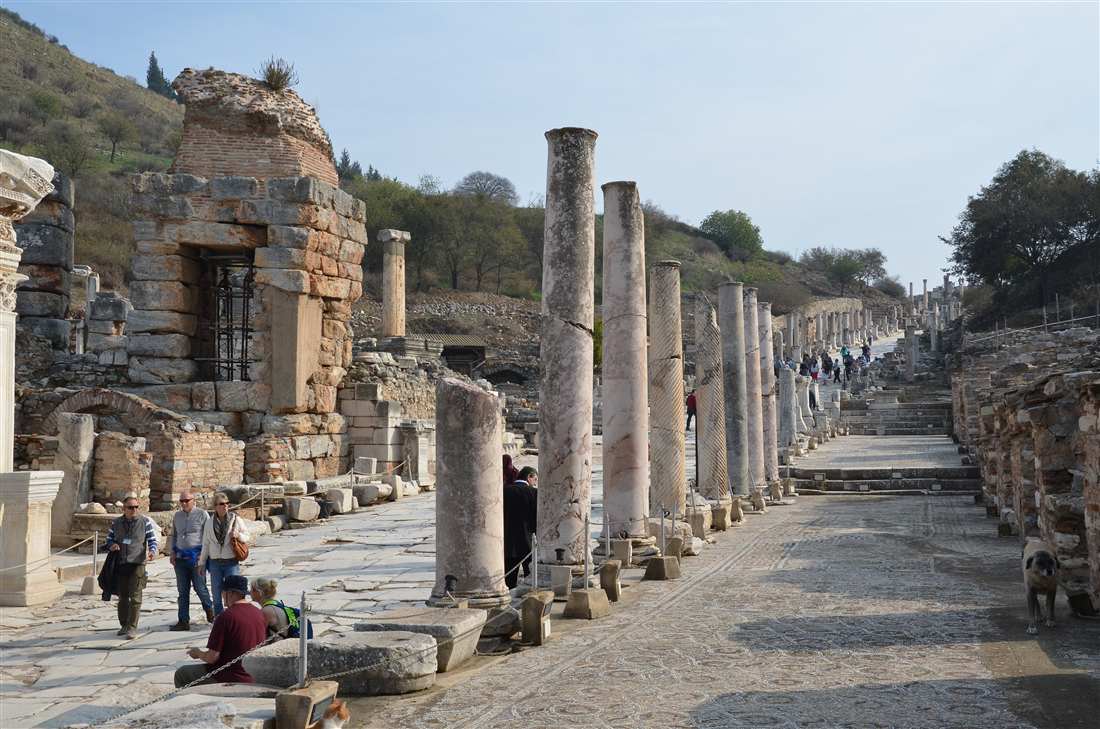
One day in Ephesus is enough to walk the whole ancient city: a downhill route from the Upper Gate past the Temple of Hadrian, the Library of Celsus and the Great Theatre, with the afternoon for the museum and the nearby shrines. Plan the whole trip with Greece Tours.
This guide covers one day in Ephesus in full: whether a day is enough, the best downhill route, the upper city, Curetes Street, the Library of Celsus and Marble Street, the Great Theatre, the afternoon at the House of the Virgin Mary and the Temple of Artemis, the Selcuk museum and Basilica, the timing and walking, what to bring, how to get there, and a sample itinerary.
Can you see Ephesus in one day?
Yes. A single downhill walk from the Upper Gate to the Lower Gate covers the entire excavated ancient city in a half-day, leaving the afternoon free for the Ephesus Archaeological Museum in Selçuk, the Temple of Artemis foundation, and the Basilica of St John above the town.
The archaeological zone of Ephesus stretches roughly 1.5 kilometres from the Magnesia Gate at the top to the Harbour Gate at the bottom. A person walking that main marble spine at a steady pace, pausing at each monument, clears the whole classical core in three to four hours. The route drops about 40 metres in elevation from the upper plateau to the old harbour plain, so the walk runs downhill the entire distance and rewards an early start before the midday heat settles over the exposed stone. Serious walkers who want context beyond the ruins pair the site with wider Greece Tours that thread the classical world of the Aegean into one trip.
The one-day rhythm works because Ephesus is linear, not sprawling. Almost every headline monument sits on or immediately beside two connected streets — Curetes Street and Marble Street — so a visitor never doubles back. The upper city holds the civic and political buildings: the Odeon, the State Agora, the Prytaneion. The middle stretch delivers the photogenic set-pieces: the Temple of Hadrian, the Fountain of Trajan, the Terrace Houses. The lower city closes with the two giants — the Library of Celsus and the Great Theatre — before the Harbour Street runs out toward the silted plain.
A realistic one-day plan splits into three blocks:
- Morning (08:00–12:00): the full downhill walk through the ancient city, Upper Gate to Lower Gate, including the Terrace Houses under their protective roof.
- Midday (12:00–13:30): a lunch break in Selçuk, 3 kilometres east, or at a café near the Lower Gate car park.
- Afternoon (13:30–17:00): the Ephesus Archaeological Museum, the lone standing column of the Temple of Artemis, and the hilltop Basilica of St John under the Ottoman İsa Bey Mosque.
Two logistics decide the quality of the day. The first is direction: entering at the Upper Gate turns the whole visit into a descent rather than a climb, which matters on a site with almost no shade. The second is the Terrace Houses ticket, a separate paid enclosure of Roman residences with mosaic floors and frescoed walls that adds roughly 45 minutes and stands as the single richest stop inside the fence. A visitor who books a licensed guide for the morning and keeps the afternoon self-guided sees the Ephesus core, its museum, and its two satellite religious sites inside a comfortable ten-hour window without rushing any monument.
What is the best one-day route through Ephesus?
Start at the Upper Magnesia Gate and walk downhill to the Lower Harbour Gate. This one-way descent follows the ancient street grid from the civic upper city through Curetes Street to the Library and Theatre, ending on the flat harbour plain, so the walk loses 40 metres of elevation instead of gaining it.
Ephesus has two entrances, and the choice between them shapes the entire day. The Upper Gate — the Magnesia Gate — opens onto the plateau where the political and administrative heart of the Roman city stood. The Lower Gate — the Harbour Gate — sits on the old coastal plain beside the modern car park and the largest tour-bus lot. Both gates sell the same ticket and admit visitors in either direction, but the topography is decisive. Walking from the top down means every step of the 1.5-kilometre spine runs with the natural slope, and a visitor finishes on level ground near transport rather than facing a hot uphill return.
The route itself is a single connected line, and the ancient Ephesians built it that way. The sequence of streets reads north-west across the excavated zone:
- The State Agora district — the civic square, the Odeon, the Prytaneion, and the Basilica Stoa, clustered just inside the Upper Gate.
- Domitian Square and the Hercules Gate — the transition point where the plateau narrows and the ceremonial street begins its drop.
- Curetes Street — the marble-paved slope lined with the Temple of Hadrian, the Fountain of Trajan, the latrines, and the Terrace Houses.
- The Library of Celsus and the Commercial Agora — the architectural climax at the foot of the slope.
- Marble Street and the Great Theatre — the turn north toward the 25,000-seat auditorium.
- Harbour Street (the Arcadian Way) — the colonnaded avenue running straight to the vanished port and the Lower Gate.
The one-way logic pays off in three concrete ways. Descending keeps the sun mostly at a walker’s back through the morning, since the spine runs roughly north-west and the early light falls from the east. Ending at the Lower Gate places a visitor beside the main café, the toilets, and the taxi rank, rather than stranding them on the empty upper plateau. And the dramatic reveal of the Library of Celsus works best when approached from above, framed at the bottom of Curetes Street as the sightline opens.
Drivers with two cars, or groups on an organised coach, arrange a drop-off at the Upper Gate and a pick-up at the Lower Gate, walking the whole city without retracing a metre. Independent visitors arriving by a single taxi from Selçuk ask the driver for the Upper Gate — Yukarı Kapı in Turkish — and either arrange a return pick-up at the Lower Gate or take one of the shuttle dolmuş minibuses that link the Lower Gate back to Selçuk town centre through the day.
What do you see first — the upper city of Ephesus?
The upper city opens with the Odeon and its bouleuterion, then the long State Agora, the Prytaneion with its sacred hearth, the Memmius Monument, Domitian Square with the Temple of Domitian, and the Pollio Fountain, before the Hercules Gate narrows the road and begins the descent.
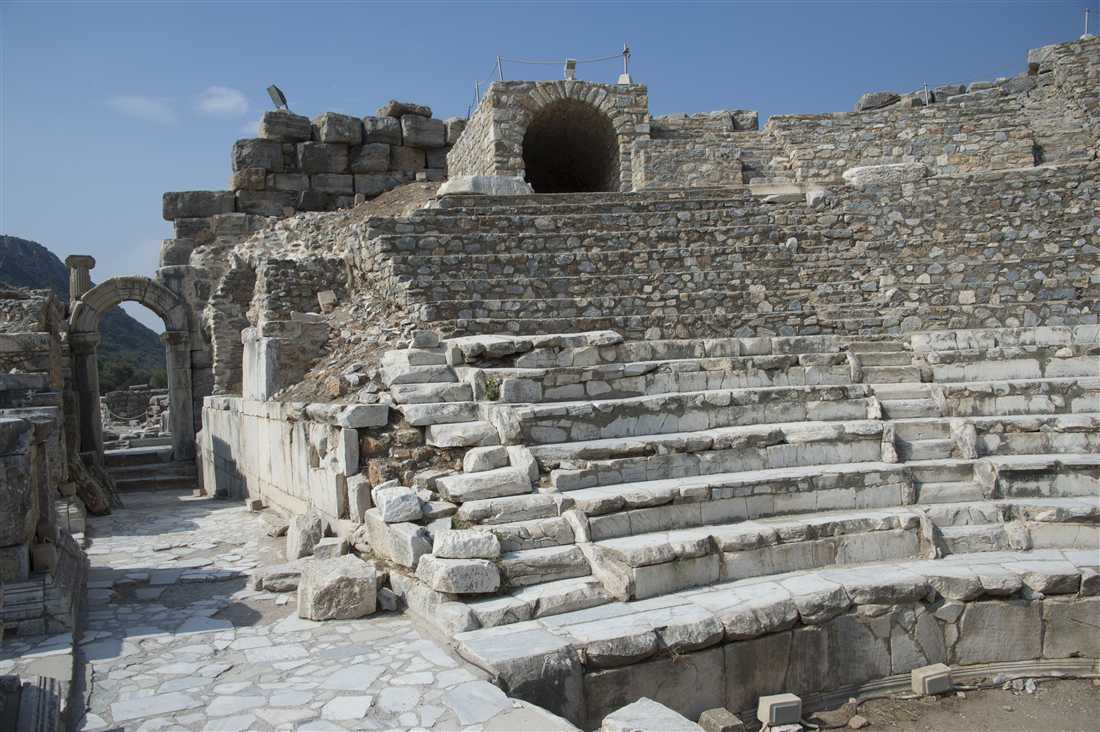
Just past the Upper Gate turnstiles, the ground levels into a broad terrace that formed the political and religious core of Roman Ephesus. The first structure on the right is the Odeon, a roofed council chamber built in the 2nd century AD by Publius Vedius Antoninus and his wife Flavia Papiana. It seated about 1,400 people on a semicircle of marble benches and served two functions — the bouleuterion where the city council met, and a covered hall for concerts and recitals. Its cavea survives in good order, and the front rows still carry the moulded profiles the Romans cut for their senators.
Below the Odeon spreads the State Agora, a rectangular civic square measuring roughly 160 by 58 metres. This was not a market — commerce happened lower down in the Commercial Agora — but the ceremonial and administrative plaza where the assembly gathered and where a small temple dedicated to the deified Augustus and the goddess Roma, once stood at its centre. Along the north edge ran the Basilica Stoa, a triple-aisled colonnaded hall whose ionic capitals carry carved bull’s-head volutes. The upper city concentrates the institutions that governed a metropolis of a quarter-million residents:
- The Prytaneion — home of the eternal sacred flame of Hestia Boulaia, tended by the Curetes priests; the two great Artemis statues now starring in the Selçuk museum were unearthed buried in its floor.
- The Memmius Monument — a 1st-century BC funerary monument honouring Gaius Memmius, grandson of the dictator Sulla, standing at the corner where the square meets the descending street.
- The Temple of Domitian — the first Ephesian temple dedicated to an emperor, raising the city to its first neokoros (temple-warden) status, its terrace bordering the square that carries the emperor’s name.
- The Pollio Fountain and the Hydreion — twin water monuments framing the top of Domitian Square, fed by the aqueducts that crossed the valley on tall arched piers.
Domitian Square marks the hinge of the whole route. Here the plateau ends and the road tips downward through the Hercules Gate — a narrow ceremonial arch whose two surviving piers carry reliefs of Herakles wrapped in the skin of the Nemean lion. The gate physically restricted wheeled traffic, turning the ceremonial street below into a pedestrian way, and its position at the crest gives the first long view down the slope of Curetes Street toward the Library facade waiting at the bottom.
Two features reward a slow look before the descent. The Nike relief — a winged Victory holding a laurel wreath, her billowing drapery forming the shape a modern sportswear logo later echoed — lies propped near the Hercules Gate at eye level, one of the most photographed carvings on the site. And the reconstructed Memmius Monument, with its engaged figures and cornice fragments reassembled, shows how Roman Ephesus dressed even its tombs in imperial marble.
What is on Curetes Street on a one-day walk?
Curetes Street carries the Temple of Hadrian with its Medusa-and-Tyche arch, the two-storey Fountain of Trajan, the marble public latrines, the Baths of Scholastica, the Gate of Hercules at the top, and the turn-off to the Terrace Houses — the richest 300 metres of the entire descent.
Curetes Street runs about 210 metres downhill from the Hercules Gate to the Library square, paved in marble slabs worn glassy by twenty centuries of feet and rutted by ancient cart wheels. It took its name from the Curetes, a college of priests connected to the cult of Artemis whose names were inscribed on columns relocated here from the Prytaneion. The street was lined on both sides with colonnaded porticoes, shops, and honorific statues on inscribed pedestals, and beneath the paving ran the clay pipes that distributed the city’s aqueduct water to fountains and houses.
The Temple of Hadrian is the signature monument of the street, standing on the north side about halfway down. Its facade is a Corinthian arch: a curved lintel over the doorway carries a bust of Tyche, the goddess of fortune, while the inner arch above the door frames a relief of a female figure rising from acanthus foliage, read as Medusa or a floral deity warding off evil. The small temple honoured the emperor Hadrian after his visit to the city, and the four Corinthian columns and their reconstructed pediment make it the most complete street-front on the site. The frieze panels visible today are casts; the originals sit in the museum.
The street packs its monuments tightly, each a set-piece in its own right:
- The Fountain of Trajan — a two-storey nymphaeum whose central pool was overlooked by a colossal statue of the emperor; only the base and one foot beside a globe survive, symbolising Trajan’s mastery of the world.
- The public latrines — a rectangular hall of marble seats set over a running water channel, part of the Scholastica baths complex, with a small central pool and a floor once covered in mosaic.
- The Baths of Scholastica — a three-storey bathing complex rebuilt in the 4th century AD by a Christian woman named Scholastica, whose headless seated statue stands in the entrance hall.
- The Terrace Houses turn-off — the entrance to the covered enclosure of Roman residences climbing the hillside on the south of the street.
The Terrace Houses deserve the extra ticket and the extra 45 minutes. Two insulae of luxury homes rise in terraces up the slope of Bülbül Dağı, sheltered under a modern protective roof and crossed by raised walkways. Inside, mosaic floors, marble wall-veneer, and painted frescoes survive in situ — dining rooms with mythological scenes, a domestic theatre mask painted on plaster, and a graffiti wall recording accounts and games. These were the homes of the Ephesian elite, fitted with heated floors and private latrines, and they preserve the domestic texture that the public monuments cannot show.
Curetes Street also rewards attention to its smaller survivals. The Gate of Heroon, a small round monument near the top; the inscribed statue bases naming benefactors and provincial governors; and the mosaic-paved sidewalk on the north side, a covered footpath of geometric tesserae that let pedestrians walk the length of the street in shade. Reaching the bottom, the street opens suddenly onto the paved square in front of the Library of Celsus, the moment the whole descent has been building toward.
What is the Library of Celsus and Marble Street stop?
The Library of Celsus is the two-storey marble facade at the foot of Curetes Street, built as a tomb-library for the Roman senator Tiberius Julius Celsus. Beside it the Gate of Augustus opens into the Commercial Agora, and Marble Street runs north past a carved “advertisement” toward the theatre.
The Library of Celsus is the visual climax of Ephesus and the image on every poster of the site. Completed around 117 AD, it honoured Tiberius Julius Celsus Polemaeanus, a Roman consul and governor of the province of Asia, whose son Tiberius Julius Aquila financed the building and whose sarcophagus lies in a crypt directly beneath the reading hall — a rare fusion of monumental tomb and public library. The facade rises two storeys of paired Corinthian columns arranged with deliberate optical tricks: the central columns stand taller and the platform curves slightly, so the front reads as wider and grander than its 21-metre width.
Four statues occupy the ground-floor niches between the doors, personifications of the virtues attributed to Celsus — Sophia (wisdom), Arete (excellence), Ennoia (thought), and Episteme (knowledge). The figures visible today are casts; the originals stand in the Ephesus Museum in Vienna, excavated by the Austrian Archaeological Institute that reconstructed the facade from its fallen fragments in a decades-long anastylosis. The interior was a single rectangular hall, its walls lined with niches for scrolls and doubled against damp, and it held an estimated 12,000 scrolls at its height, ranking it among the great libraries of the Roman world after Alexandria and Pergamon.
The square in front of the library links three monuments in a few paces:
- The Gate of Augustus (the Mazaeus and Mithridates Gate) — a triple-arched marble gateway built by two freedmen of the emperor Augustus, opening from the library square east into the Commercial Agora.
- The Commercial Agora (the Tetragonos Agora) — a vast square market of roughly 110 metres a side, ringed by two storeys of shops and once the trading heart of the port city, its columns marching around a central open court.
- Marble Street — the paved avenue heading north from the library toward the theatre, rutted by cart wheels and flanked by the agora wall.
Marble Street carries one of the most talked-about carvings in Ephesus. Set into the paving on the west side is a group of incised figures — a left foot, a woman’s head, a heart shape, and a rectangle read as a coin or a purse. Guides present it as an ancient “advertisement” directing sailors and visitors toward the brothel, the foot supposedly pointing the way and the figures naming the price and the service. The reading is popular rather than proven, but the carving is genuine and unmistakable underfoot, and it draws a crowd at the exact spot where the street meets the theatre approach.
The street itself sits well above the original Roman level in places, raised by later repaving after earthquakes, and its slabs show the deep parallel grooves worn by centuries of wheeled traffic hauling goods up from the harbour to the market. A raised colonnaded walkway once ran along the agora side, sheltering pedestrians, and the socket holes for its columns remain visible in the kerb. From the northern end of Marble Street the ground opens toward the great bowl of the theatre cut into the western flank of Mount Pion.
What is the Great Theatre and Harbour Street stop?
The Great Theatre is the 25,000-seat auditorium carved into Mount Pion at the end of Marble Street, the largest in Anatolia. From its foot the colonnaded Arcadian Way — Harbour Street — runs 500 metres straight toward the silted harbour, ending the downhill walk at the Lower Gate.
The Great Theatre dominates the lower city, its cavea scooped into the western slope of Mount Pion (Panayır Dağı) in a hemisphere 145 metres across. Begun in the Hellenistic period and enlarged under the Roman emperors through the 1st and 2nd centuries AD, it rose to three tiers of seating separated by two horizontal walkways, holding an audience of about 25,000. The steepness of the upper rows is severe — the top seats stand more than 30 metres above the orchestra — and from them the view runs the full length of Harbour Street to the plain where the sea once reached.
The theatre carries a weight of history beyond its scale. It hosted drama, gladiatorial contests once the orchestra was walled for the arena, and civic assemblies of the whole city. The Acts of the Apostles places the riot of the silversmiths here, when the crowd shouting “Great is Artemis of the Ephesians” filled the theatre in protest at the preaching of Paul, who traded in Artemis shrines fearing for their business. The three-storey stage building (the skene) that closed the view behind the orchestra collapsed in later earthquakes, but its foundations and scattered architectural fragments mark the front of the arena, and modern concerts test the surviving acoustics on summer nights.
The final stretch of the walk turns west onto the grandest avenue in Ephesus:
- The Arcadian Way (Harbour Street) — a colonnaded boulevard 11 metres wide and 500 metres long, paved in marble and lined with covered porticoes, rebuilt under the emperor Arcadius and once lit by street lamps at night.
- The Harbour Baths and Gymnasium — a vast bathing and athletic complex on the north side of the avenue, the largest building in the city, serving travellers arriving by sea.
- The silted harbour basin — the vanished port at the avenue’s western end, choked by the alluvium of the Küçük Menderes river that pushed the coastline 5 kilometres away and killed the city’s trade.
The Arcadian Way tells the story of Ephesus in a single sightline. The city thrived because ships docked at the end of this street, unloading cargo that filled the Commercial Agora and passengers who climbed to the theatre and the temples. As the river silted the harbour century by century, dredging held the port open for a while, then failed, and the population drifted east toward the hill of Selçuk and the shrine of St John. Walking the avenue toward its dead end, a visitor traces the same route the last ships’ passengers walked into a city that the sea was already abandoning.
The walk closes at the Lower Gate. Beyond the Harbour Baths the modern path bends south to the exit beside the main car park, the café, and the dolmuş stop back to Selçuk. A visitor standing at the western end of the Arcadian Way, looking back east and uphill, sees the whole descent in reverse — the theatre on the mountainside, Marble Street climbing to the Library facade, and Curetes Street rising beyond it to the vanished upper city — the entire one-day route laid out in one final view before stepping out through the Lower Gate.
What do you add in the afternoon — the House of the Virgin Mary and the Temple of Artemis?
The afternoon pairs two contrasting shrines: the hilltop chapel of the House of the Virgin Mary, 7 kilometres up Bulbul Mountain above Ephesus, and the single re-erected column of the Temple of Artemis on the plain below Selcuk, once a Wonder of the ancient world.
The House of the Virgin Mary sits at 420 metres on the wooded slopes of Bulbul Dagi (Nightingale Mountain), a 20-minute drive from the Upper Gate of Ephesus. The small cruciform building of stone reflects a tradition that the Apostle John brought Mary here after the Crucifixion, and that she spent her final years on this hillside. Excavation in the 19th century matched the foundations to the visions of Anne Catherine Emmerich, a German nun, and the site drew formal recognition when Pope Paul VI, Pope John Paul II, and Pope Benedict XVI each prayed here. The chapel holds a bronze statue of Mary, a single nave, and an apse lit by candles.
Below the chapel a spring feeds three taps that pilgrims drink from, and a wishing wall carries thousands of paper and cloth strips tied by visitors of every faith. Muslims venerate Mary as Meryem, mother of the prophet Isa, so the shrine draws Christian and Muslim pilgrims alike. The grounds stay quiet under pine and plane trees, a cool contrast to the marble glare of the ruined city. Allow 40 minutes for the chapel, the spring, and the wall. Entry carries a separate ticket from the Ephesus site.
The Temple of Artemis lies in the opposite direction, on flat marshy ground at the edge of Selcuk beside the Isa Bey Mosque. At its height the temple measured 115 metres by 55 metres and stood on 127 Ionic columns 18 metres tall, four times the footprint of the Parthenon in Athens. Antipater of Sidon named it the most breathtaking of the Seven Wonders. Fire, flood, and Gothic raids reduced it, and stonemasons carried its marble to build the Basilica of St John and the Hagia Sophia in Constantinople.
Today one reconstructed column stands in the flooded field, topped by a stork’s nest, ringed by broken drums and column bases in the reeds. The site takes 15 minutes and asks for no ticket. The contrast is the point of the visit:
- House of the Virgin Mary — a living pilgrimage shrine, wooded and cool, 7 km uphill, 40-minute stop, separate ticket.
- Temple of Artemis — the ghost of a Wonder, one column on a marsh, 15-minute stop, free entry, beside the Isa Bey Mosque.
- Isa Bey Mosque — a 14th-century Seljuk mosque next to the temple field, worth a five-minute look for its carved portal.
A driver links both shrines to the main site with ease, since the chapel sits above the Upper Gate and the temple sits on the road into Selcuk town. Order the afternoon by geography: descend from the city through the Upper Gate, drive up to the House of the Virgin Mary, then come down to the Temple of Artemis on the way into Selcuk, where the museum and the basilica finish the day within a short walk of the temple field.
Should you visit the Ephesus Museum and the Basilica of St John in Selcuk?
Yes — Selcuk town holds the two pieces the ruins alone lack: the Ephesus Archaeological Museum with its two marble Artemis statues and the finds from the Terrace Houses, and the Basilica of St John on Ayasuluk Hill above the tomb of the Apostle.
The Ephesus Archaeological Museum stands in the centre of Selcuk, a 4-kilometre drive from the site’s Lower Gate. It gathers the portable treasures lifted from the excavation so the ruins keep their bare marble skeleton while the statues, bronzes, and frescoes sit under one roof. The two Artemis of Ephesus statues anchor the collection: the Great Artemis and the Beautiful Artemis, each a marble figure covered from chest to waist in rows of ovoid protrusions, read as bulls’ testicles, bees’ eggs, or breasts, symbols of a fertility goddess older than the Greek Artemis grafted onto her.
The museum runs through themed halls in a set order. The Terrace Houses room displays the frescoes, mosaics, and ivory frieze of Trajan pulled from the hillside mansions. The bronze of a resting warrior, the head of Socrates, the reclining figure of the river god, and the priapic Bes figures fill the sculpture halls. A gladiator gallery presents the tombstones and weapons excavated from the necropolis east of the stadium, where dozens of fighters were buried. Allow 60 to 90 minutes, and note that the museum trades a hot outdoor walk for cool shaded rooms in the middle of the afternoon.
The Basilica of St John crowns Ayasuluk Hill, a short climb above the museum and the Isa Bey Mosque. Emperor Justinian raised it in the 6th century over the reputed grave of John the Apostle, replacing a smaller shrine. Built as a cross of six domes on a colonnaded nave, the finished church ranked among the largest in the world, 130 metres long, rivalling the Hagia Sophia in scale. Earthquakes and the Mongol raids brought it down, and re-erected columns, marble paving, and the marked tomb slab in the centre of the nave survive.
The hilltop delivers the day’s widest view. From the basilica terrace the eye takes in the whole plain at once:
- The single column of the Temple of Artemis in its marsh directly below.
- The Isa Bey Mosque and the red-tiled roofs of Selcuk.
- The line of the ancient harbour road running out toward the silted coast.
- The Ayasuluk Fortress, a Byzantine and Seljuk castle, crowning the summit above the church.
Both sites carry their own tickets, distinct from the Ephesus site pass, and both sit within a 10-minute walk of the Temple of Artemis, which turns the four Selcuk stops into one tight afternoon cluster. The order that wastes no steps: park by the museum, tour the galleries first while the day burns hottest, walk up to the basilica for the view as the light softens, and finish at the Temple of Artemis and the Isa Bey Mosque on the flat below the hill. A visitor short on time keeps the museum and drops the basilica, since the statues supply the context the ruins withhold.
How much time and walking does one day in Ephesus need?
One day needs two to four hours inside the ancient city and a further three to four hours for the afternoon cluster, over roughly 4 to 6 kilometres of walking. The main street runs downhill from the Upper Gate to the Lower Gate, a one-way 1.5-kilometre descent that favours a top-down route.
The classic walk enters at the Magnesian (Upper) Gate at 90 metres elevation and exits at the Koressos (Lower) Gate near the harbour plain, a drop of about 50 metres along Curetes Street and the Marble Road. The descent means the legs work least on the longest stretch, and a driver dropped at the top collects the group at the bottom, sparing the uphill return. A visitor who parks at the Lower Gate and walks up faces the climb in reverse under full sun, so the top-down direction earns its popularity.
Distances inside the site stay short but the surface is hard. From the Upper Gate the route passes the Odeon, the State Agora, and the Memmius Monument in the first 300 metres, then drops down Curetes Street past the Temple of Hadrian, the Trajan Fountain, and the Terrace Houses to the Library of Celsus at the 800-metre mark. The Marble Road and the Arcadian Way carry the walker the final 700 metres past the Great Theatre to the Lower Gate. The paving is worn marble and cut stone, polished slick in the busy centre, so grip matters more than distance.
Time inside the city splits by depth of interest. A brisk pass takes two hours; a thorough visit with the Terrace Houses, the theatre climb, and the library facade takes four. The pace that reads well:
- Upper Gate to Library of Celsus — 60 to 90 minutes, the monument-dense core.
- Terrace Houses — 30 to 45 minutes under the protective roof, a separate ticket.
- Great Theatre and Marble Road to Lower Gate — 30 to 45 minutes, with the theatre climb optional.
- Afternoon cluster — House of the Virgin Mary, Temple of Artemis, museum, basilica — 3 to 4 hours.
Total moving time across the whole day lands near seven hours including drives, which fits a single day trip that starts by 8am. Add the two Selcuk museums and the two shrines and the walking total reaches 5 to 6 kilometres, spread over hard marble in the city and level ground at the shrines. A visitor with limited mobility trims the load by driving between the Selcuk stops, skipping the theatre climb, and taking the Terrace Houses at a slow pace, since the covered walkways there run on gentle ramps rather than steps. The single hardest stretch is the exposed Marble Road between the library and the theatre, where no shade falls across the stone at midday.
What do you bring for a day at Ephesus?
Bring at least a litre of water per person, a wide-brimmed hat, high-factor sun cream, sunglasses, and closed sturdy shoes with grip. The city is a shadeless field of marble that reflects heat upward, and tickets for the main site and the separately gated Terrace Houses are the two passes to hold.
Water tops the list because the ancient city offers almost no shade between the Upper Gate and the theatre. The marble paving and pale stone throw the sun back at face level, and summer readings on Curetes Street pass 40 degrees Celsius by early afternoon. A refillable bottle of a litre per adult covers the site, and vendors at both gates sell chilled water and soft drinks for refills. Salt and heat drain energy fast on the open Marble Road, so a small snack — dried fruit, nuts, a sandwich — steadies a long morning.
Footwear decides the comfort of the day. The paving is uneven, worn, and polished slick where millions of feet have crossed the centre, and loose marble drums lie beside the path. Closed shoes with a gripping sole beat sandals on this surface, and the descent from the Upper Gate adds a downhill load that flat-soled shoes handle poorly. Sun protection carries equal weight: a wide hat shields the neck the reflected glare reaches, factor 30 or higher cream guards the arms, and sunglasses cut the white dazzle off the marble.
Tickets are the piece a visitor forgets. The Ephesus site pass admits the main city, but the Terrace Houses sit behind their own gate on Curetes Street and take a second ticket, sold at the entrance or bundled in a combined pass. The Ephesus Museum, the Basilica of St John, and the House of the Virgin Mary each carry their own separate entry. A Museum Pass Turkey or Museum Pass Aegean covers the cluster at a set price and skips the ticket queues, worth holding for anyone touring all four Selcuk stops. The pack that clears a day without a return trip to the gate:
- Water — 1 litre per adult, refillable, topped up at the gate vendors.
- Sun kit — wide hat, factor 30+ cream, sunglasses; the marble reflects heat from below.
- Shoes — closed, sturdy, gripping soles for worn slick paving and a downhill route.
- Tickets — Ephesus site pass, Terrace Houses add-on, and passes for the museum, basilica, and Virgin Mary chapel; a Museum Pass bundles them.
- Extras — a light snack, a small backpack, a phone or camera charged, and cash in Turkish lira for gate vendors and the chapel spring.
A guide or a printed map earns its place because the site sets out few explanatory boards, and the monuments read as anonymous marble without context. An audio guide rented at the gate names the Odeon, the fountains, the Temple of Hadrian, and the library in walking order. Skip the umbrella; the wind off the plain turns it inside out, and the hat does the shade work a fixed umbrella cannot.
How do you get to Ephesus for the day, and when is the best time?
Ephesus lies 3 kilometres from Selcuk, 18 kilometres from the Kusadasi cruise port, and 80 kilometres south of Izmir. Reach it by shore excursion from Kusadasi, by car or bus from Izmir, or by ferry from the Greek island of Samos to Kusadasi. Spring and autumn with an 8am start beat the heat and the cruise crowds.
The Kusadasi cruise port is the most common gateway. Ships dock 18 kilometres from the site, a 25-minute drive, and a tour Ephesus from Kusadasi runs the itinerary of the city, the Terrace Houses, the House of the Virgin Mary, and Selcuk within the port’s shore-leave window. Independent visitors take a taxi or a shared minibus from the port; the drive follows the coast road inland to Selcuk. A cruise day locks the timetable to the ship’s all-aboard call, so the early start matters more here than anywhere.
Izmir supplies the second route by air and rail. Izmir Adnan Menderes Airport sits 60 kilometres north, a 50-minute drive, and the Izban suburban train links central Izmir to Selcuk station in about 90 minutes for a handful of lira. From Selcuk station the site lies a 3-kilometre taxi or a 40-minute walk past the Temple of Artemis. Intercity buses run from Izmir’s Otogar to Selcuk through the day, and a rented car covers the distance in under an hour on the O-31 motorway, with parking at both the Upper and Lower Gates.
The Greek island of Samos adds a cross-border option. A morning ferry from Vathy or Pythagorio on Samos crosses to Kusadasi in 60 to 90 minutes, and a Turkish visa or e-visa clears the port; from Kusadasi the site is the same 25-minute drive. The ferry timetable thins outside the summer season, so a day trip from Samos runs on a fixed morning-out, evening-back pair of sailings that leaves five to six hours ashore, enough for the city and the Virgin Mary chapel but tight for the full Selcuk cluster.
Timing decides how the day feels. Spring, from April to early June, and autumn, from September to October, bring 20 to 28 degrees, wildflowers on the slopes, and thinner crowds. Summer bakes the shadeless marble past 40 degrees by noon, and winter turns the paving slick with rain but empties the site. The hour of arrival matters as much as the season:
- 8am to 9am — gates open, cool air, empty Curetes Street, soft light on the Library of Celsus.
- 10am to 1pm — cruise coaches arrive, the centre fills, the theatre and library crowd, the heat climbs.
- 2pm to 4pm — coaches leave for the ships, the city thins again, the light warms for photographs.
The move that wins the day is a first-through-the-gate start at the Upper entrance, walking the core before the coaches unload, then shifting to the museum and shrines when the city fills at midday. A visitor who arrives at 11am meets the full crush on the Marble Road and the worst of the sun on the same stretch, the two things the early start avoids in one stroke.
What is a sample one-day Ephesus itinerary, and is one day enough?
A full day runs from an 8am Upper Gate entry down through the city to the Library of Celsus and the Great Theatre, up to the House of the Virgin Mary at midday, then the Temple of Artemis, the Ephesus Museum, and the Basilica of St John in Selcuk by late afternoon. One day covers the city and the key nearby sites.
The hour-by-hour timeline threads the sites in walking and driving order, top to bottom, city to shrines to town, so no stretch doubles back on itself. Start at the top of the hill in the cool of the morning, descend with the slope, break the midday heat in the wooded chapel and the shaded museum, and finish on the hilltop basilica as the light softens. The plan that fits a single day without rush:
- 08:00 — Enter the Upper (Magnesian) Gate. Walk the Odeon, the State Agora, and the Memmius Monument in the first quiet 30 minutes.
- 08:45 — Descend Curetes Street past the Temple of Hadrian and the Trajan Fountain to the Terrace Houses.
- 09:15 — Tour the Terrace Houses under their roof, the frescoes and mosaics of the hillside mansions, on the second ticket.
- 10:00 — Reach the Library of Celsus, the two-storey facade, before the coaches fill the square.
- 10:30 — Walk the Marble Road to the Great Theatre, climb a few rows for the harbour-road view, exit the Lower Gate.
- 11:15 — Drive 7 km up Bulbul Mountain to the House of the Virgin Mary; the chapel, the spring, the wishing wall.
- 12:15 — Descend to Selcuk; the single column of the Temple of Artemis and the Isa Bey Mosque beside it.
- 13:00 — Lunch in Selcuk town, gozleme or kebab off the main square.
- 14:00 — The Ephesus Museum: the two Artemis statues, the Terrace House frescoes, the gladiator gallery, in cool rooms.
- 15:30 — Climb Ayasuluk Hill to the Basilica of St John, the tomb slab, and the widest view of the plain.
- 16:30 — Return to Kusadasi, Izmir, or the Samos ferry.
The verdict is that one day is enough for the essential Ephesus. The itinerary delivers the marble city end to end, the Terrace Houses, the two shrines, the museum that holds the statues, and the basilica that crowns the town, all inside a single 8am-to-5pm window. The route trades nothing important away; it drops only the outlying Cave of the Seven Sleepers, the Ephesus stadium, and the deeper harbour ruins, which reward a second day but do not define a first visit.
A visitor with two days spreads the same content wider and slower: the full city and Terrace Houses on day one, the shrines and Selcuk museums on day two, with the Cave of the Seven Sleepers and a Sirince village lunch added. A visitor with half a day cuts the plan to the Upper Gate, the library, and the theatre, and keeps the museum, which strips the day to its three strongest hours. For the standard one-day trip, the top-down city walk plus the afternoon cluster is the plan that covers the ground and beats both the heat and the coaches.
Frequently Asked Questions
Can you see Ephesus in one day?
Yes. A downhill walk from the Upper Gate to the Lower Gate covers the whole ancient city in two to four hours, leaving the afternoon for the Ephesus Museum, the Basilica of St John, the House of the Virgin Mary and the Temple of Artemis.
What is the best route through Ephesus in one day?
Start at the Upper Magnesia Gate and walk downhill to the Lower Harbour Gate, so the route descends past the Odeon, Curetes Street, the Library of Celsus and the Great Theatre, ending near the exit for the ancient harbour.
How do you get to Ephesus for a day, and when is best?
Ephesus is reached from the Kusadasi cruise port, from Izmir, and on a day trip from the Greek island of Samos. Spring and autumn bring mild weather, and an early start beats the summer heat and the cruise-day crowds.