
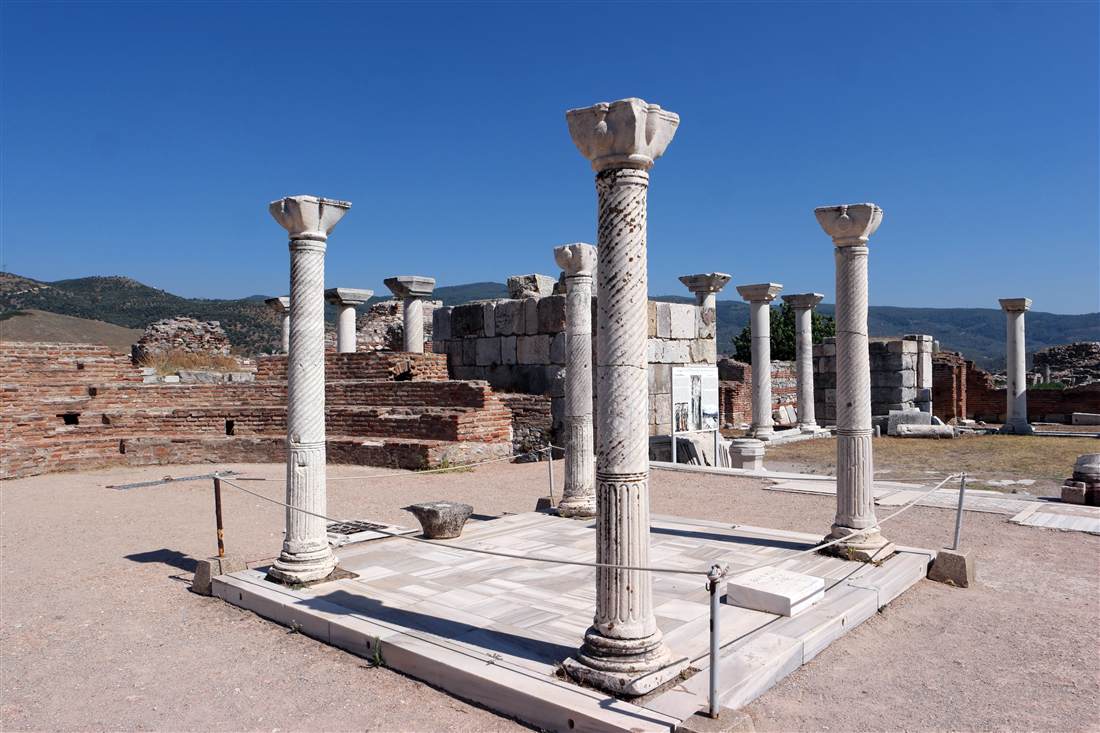
The Basilica of St John is a monumental Byzantine church on Ayasoluk Hill at Selcuk near Ephesus, built by the emperor Justinian over the traditional tomb of John the Apostle and once among the largest churches in the world. Plan the whole trip with Greece Tours.
This guide covers the Basilica of St John in full: what it is and where it stands, who built it and when, why it rose over the tomb of Saint John, what the six-domed church looked like, the tomb and the healing manna, what survives on the hill today, the Gate of Persecution and the Isa Bey Mosque around it, its place in Christian pilgrimage, and how to visit.
What is the Basilica of St John?
The Basilica of St John is the great domed cruciform church at Selçuk in western Turkey, raised over the traditional tomb of John the Apostle. It ranks among the largest churches of the Byzantine world and crowned Christian Ephesus.
The Basilica stands on Ayasoluk Hill above the modern town of Selçuk, a short distance from the ruins of ancient Ephesus. Its builders laid the church out as a Latin cross with six domes carried on massive piers, and they set the central dome directly above the grave they venerated as the resting place of the beloved disciple. The structure measured about 130 metres in length, a scale that placed it in the same class as the imperial churches of Constantinople. Travellers who explore Byzantine and early Christian heritage on a wider circuit of Greece Tours reach this monument as the eastern anchor of the Aegean pilgrimage world.
The building belonged to a wider sacred landscape. Ephesus had been one of the four great cities of the Roman East, a port of the province of Asia and the seat of a bishop from the earliest Christian generations. The city hosted the Third Ecumenical Council, which defined the title Theotokos for the Virgin Mary. When the harbour silted and the population drifted inland toward the hill, the Basilica became the heart of the settlement, giving the town its Byzantine name Theologos, after John the Theologian.
The Basilica served three roles at once. It was a martyrium enclosing a venerated grave, a cathedral for the local church, and a magnet for pilgrims who crossed the Aegean to touch the tomb of an Apostle. Its precinct held a baptistery, a treasury, a chapel, and courtyards paved in marble. The complex functioned as a self-contained religious citadel that dominated the skyline of the plain.
Key facts define the monument at a glance:
- Dedication: John the Apostle and Evangelist, called John the Theologian in the Greek tradition.
- Location: Ayasoluk Hill, Selçuk, İzmir Province, western Turkey.
- Plan: six-domed cruciform basilica with nave, transept, and apse.
- Length: about 130 metres, one of the largest churches of its era.
- Patrons: the Emperor Justinian and the Empress Theodora.
Today the Basilica stands as a partial reconstruction. Columns, walls, and the marble floor of the nave have been re-erected, and the tomb is marked in the pavement beneath the site of the vanished central dome. The visitor walks the full ground plan of a lost cathedral, reading its shape in re-raised marble against the backdrop of the Ephesus plain and the distant line of the Aegean coast.
The monument holds a distinct rank among the churches of the Christian East. It surpassed every rival in its province in size and enshrined the grave of an Apostle rather than a lesser martyr. Its patronage came from the throne itself, and its fame reached across the empire through the pilgrims who carried the manna of the tomb home to distant provinces. The Basilica of St John gathered imperial power, apostolic relic, and architectural genius into one commanding hilltop monument.
Where is the Basilica of St John located?
The Basilica of St John sits on Ayasoluk Hill in Selçuk, in İzmir Province of western Turkey. It crowns the ridge above the town, beside the Isa Bey Mosque and within sight of the Temple of Artemis and the ruins of Ephesus on the plain below.
Selçuk lies about three kilometres from the archaeological site of ancient Ephesus and roughly 70 kilometres south of the city of İzmir. Ayasoluk Hill rises at the northern edge of the town, a natural acropolis that has attracted settlement since the Bronze Age. The Basilica occupies the broad summit terrace, enclosed within later fortress walls that turned the sacred precinct into a defended citadel. From this height the church commanded the road, the harbour route, and the entire valley of the Cayster River.
The immediate setting binds the Basilica to a cluster of famous monuments. Directly below the western slope stands the Temple of Artemis, one of the Seven Wonders of the ancient world, now reduced to a single reassembled column in a marshy field. A few steps from the fortress gate rises the Isa Bey Mosque, a masterpiece of Seljuk-era architecture. The three structures together trace a line through pagan, Christian, and Islamic Anatolia within a single walk.
The wider geography places the Basilica at a crossroads of the eastern Aegean:
- Ancient Ephesus: about 3 kilometres south-west, reached in minutes by road or on foot.
- Kuşadası cruise port: about 20 kilometres to the south-west on the coast.
- İzmir and its airport: about 70 kilometres to the north.
- The Greek island of Samos: a short ferry crossing from Kuşadası across the strait.
- The House of the Virgin Mary: on Bülbül Dağı above Ephesus, a few kilometres away.
The name of the hill records the church itself. Ayasoluk derives from the Greek Hagios Theologos, the Holy Theologian, the epithet of St John, worn down through Turkish speech over the centuries. The town below carried the Greek name Theologos through the Byzantine period, then the Turkish form Ayasuluk, before it was renamed Selçuk in the twentieth century in honour of the Seljuk dynasty. Place-names in this valley preserve the memory of the Apostle at every level.
The position was chosen for meaning as much as defence. The grave on the hill drew the settlement upward as the coastal city declined. Pilgrims arriving by sea followed the old harbour road inland and climbed toward the twin landmarks of the basilica domes and, later, the citadel. The Basilica stands where the sacred grave, the strategic summit, and the failing port met, a single hill that gathered the whole history of Ephesus into one commanding place.
Who built the Basilica of St John and when?
The Emperor Justinian and the Empress Theodora raised the monumental Basilica of St John in the sixth century AD. Their marble-domed church replaced a smaller wooden-roofed basilica of the previous century, itself built over a modest memorial that marked the Apostle’s grave.
Justinian ruled the Eastern Roman Empire at the height of its power and pursued an ambitious building programme across his territories. The same reign produced Hagia Sophia in Constantinople, the churches of Ravenna, and fortifications along every frontier. The historian Procopius recorded the Ephesus project directly, writing that the earlier church on the hill was small and decayed, and that the emperor rebuilt it on a grand scale so that it rivalled the greatest sanctuaries of the capital. The imperial couple appear as patrons in the monograms carved on the capitals, where the letters spell their names on the marble crowns of the columns.
The site carried a long sequence of buildings before the Justinianic church. The layers on Ayasoluk Hill record a deepening cult across the centuries of late antiquity:
- A simple tomb monument marked the grave in the earliest Christian phase.
- A funerary chapel or martyrium enclosed the tomb as veneration grew.
- A timber-roofed basilica of the fifth century AD replaced the chapel.
- The vast domed cruciform basilica of Justinian absorbed and enlarged the whole.
- Later Byzantine repairs and the fortress walls completed the precinct.
The construction drew on the finest materials of the empire. Builders shipped marble for the columns and revetment, laid mosaic in the vaults, and paved the floors in patterned stone. The six domes rested on brick and mortar carried by great piers, a technique perfected in the workshops of Constantinople. The scale of the project required imperial resources of quarrying, transport, and skilled labour, which only Justinian’s reign supplied to a provincial city.
The dedication honoured John under his Greek title, the Theologian, distinguishing the Evangelist from other saints of the same name. The church anchored the bishopric of Ephesus, which held metropolitan rank over the province of Asia. Through the following centuries the basilica received the emperors’ successors as pilgrims and benefactors, and its clergy guarded the tomb, the relics, and the treasury that grew around the cult.
The Justinianic date fixes the Basilica firmly in the golden age of Byzantine architecture. It stands as the eastern counterpart to the emperor’s works in the capital and in Italy, a single coherent programme that stamped the sixth century across the map of the empire. At Ephesus the programme reached the grave of an Apostle and enshrined it in a cathedral built to last a thousand years.
Why was the Basilica built over the tomb of St John?
The Basilica rose over the grave because an unbroken tradition placed the last years and burial of John the Apostle at Ephesus. Christians venerated the tomb on Ayasoluk Hill from the early centuries, and each church built there enshrined that grave.
The tradition rests on the New Testament and the writings of the early Church. John, the son of Zebedee and brother of James, belonged to the inner circle of the Apostles. The Gospel and the letters that bear his name, together with the Book of Revelation, are tied to Ephesus and the province of Asia. Early Christian authors state that John settled at Ephesus after the crucifixion, led the churches of the region, and died there at a great age, the only Apostle to reach a natural death rather than martyrdom.
Several strands of testimony converge on the Ephesus grave:
- The Book of Revelation addresses the seven churches of Asia, whose circuit centred on Ephesus.
- Early bishops of Asia named John among the great teachers buried in their territory.
- Second-century writers describe John living into old age and dying at Ephesus.
- Pilgrim accounts of late antiquity record veneration at the tomb on the hill.
- The town’s Greek name, Theologos, preserved the Apostle’s memory in daily speech.
The care of a saint’s grave shaped Christian practice across the empire. A martyrium marked the burial place, and the faithful gathered there to pray, to seek healing, and to be buried near the holy body. At Ephesus the grave drew this devotion so strongly that the community built ever larger churches to shelter it. Each rebuilding preserved the exact spot, so that the domed basilica of Justinian rose with its central dome set precisely over the tomb inherited from the earlier memorials.
The choice of the hill mattered as well. In antiquity burials lay outside the city walls, and the height above Ephesus offered a fitting and visible resting place. As the coastal city declined, the grave on the hill became the focus that drew the whole population upward. The living settlement clustered around the dead Apostle, and the church that housed him became the cathedral of a town renamed for him.
The Basilica therefore expressed a theology of place. The relic of an Apostle bound heaven to a single point of earth, and the emperor’s marble made that point magnificent. Pilgrims unable to reach Jerusalem or Rome found at Ephesus a grave of one who had stood beside Christ. Building the greatest possible church over that grave proclaimed the standing of Ephesus in the Christian map of the world and honoured the disciple whom the tradition called the friend of the Lord.
What did the Basilica of St John look like in its prime?
The Basilica formed a vast cruciform hall roofed by six domes, with a long nave and a broad transept meeting over the tomb. Marble columns, mosaic vaults, and patterned floors filled a church whose scale rivalled Hagia Sophia in the capital.
The plan took the shape of a Latin cross. A five-aisled nave ran from the western atrium to the crossing, where the transept extended north and south. Beyond the crossing stood the sanctuary and the semicircular apse. Great piers rose at the intervals of the cross, and on these piers the builders set the domes, one over each arm and the central and eastern bays, carried on pendentives in the manner of the imperial workshops. The tomb lay beneath the crossing, so the largest dome floated directly above the grave.
The dimensions announced imperial ambition. The church stretched about 130 metres from atrium to apse and spread 40 metres across the transept. Rows of columns divided the aisles and carried galleries above, and the capitals bore the carved monograms of Justinian and Theodora. Coloured marble sheathed the lower walls, gold-ground mosaic covered the vaults and domes, and the floor spread in geometric panels of cut stone. Light entered through windows in the drums of the domes and washed the interior in the shifting brilliance that Byzantine builders prized.
The features that gave the Basilica its grandeur are listed in order of the approach:
- A colonnaded atrium and narthex at the western entrance.
- A five-aisled nave lined with marble columns and topped by galleries.
- A transept crossing the nave to form the arms of the cross.
- Six domes on brick pendentives carried by massive stone piers.
- A raised sanctuary and apse with synthronon seating for the clergy.
- The tomb chamber beneath the central dome at the crossing.
The interior worked as a stage for liturgy and pilgrimage at once. The clergy processed along the nave to the sanctuary, while pilgrims descended to the tomb below the crossing. The galleries held additional worshippers and separated groups within the congregation. Mosaic images of Christ, the Virgin, John, and the saints covered the upper surfaces, turning the whole vault into a heaven of gold above the marble world of the floor.
The comparison with Hagia Sophia was deliberate and contemporary. Procopius set the two churches side by side, and the six-domed profile of the Ephesus basilica answered the single vast dome of the capital with a rhythm of its own. For a provincial city the building represented an extraordinary concentration of wealth and skill, a statement that the grave of the Apostle deserved a church equal to the greatest in the empire. In its prime the Basilica of St John stood among the supreme achievements of Byzantine architecture.
What is the tomb of St John, and what was the miracle dust called manna?
The tomb of St John lies at the crossing of the Basilica, marked in the marble pavement beneath the site of the central dome. Pilgrims venerated a fine dust that rose from the grave, called manna, and carried it away as a cure for illness.
The grave sat in the most sacred position of the whole church, directly under the largest dome, so that the architecture focused every line on the burial. Four columns once framed the tomb and carried a canopy above it. Today four re-erected column stumps and a marble slab set into the floor mark the exact spot, and steps lead down to the level of the burial chamber. The whole basilica was, in effect, a stone reliquary raised around this single point.
Early accounts describe an unusual phenomenon at the tomb. A soft dust or powder rose from the grave, which the faithful gathered and called manna, after the miraculous food of the Israelites. Pilgrims collected the dust in small flasks and carried it home as a blessing and a remedy. The clergy distributed it on the Apostle’s feast, and the belief in its healing power drew crowds across the Aegean and beyond. Reports of the manna spread the fame of the shrine through the Christian world of late antiquity.
The cult of the tomb generated a set of practices and objects:
- Small clay and glass flasks made to hold the miracle dust from the grave.
- The annual feast of St John, celebrated at the tomb with the gathering of manna.
- Pilgrim burials placed as near the holy grave as the precinct allowed.
- Votive offerings and gifts of the faithful stored in the church treasury.
- Written accounts and pilgrim tokens that carried the shrine’s fame outward.
A further tradition heightened the mystery of the grave. Some early Christians held that John had not truly died but slept, and that the ground above him stirred with his breathing, which explained the rising dust. This belief drew on a passage where Christ speaks of the beloved disciple remaining until his return. The idea of a sleeping Apostle beneath the dome gave the shrine a charge unlike any ordinary tomb and deepened the devotion of those who prayed above it.
The tomb remained the heart of the site through every phase of its history. The successive churches preserved its position, the domed basilica magnified it, and the fame of the manna sustained the pilgrimage for centuries. When the visitor today stands at the marble slab between the four column stumps, they stand at the fixed centre around which the entire monument was conceived, the grave that made Ayasoluk Hill a holy place.
What survives of the Basilica of St John today?
The Basilica survives as a partial reconstruction of re-erected columns, walls, and the marble nave floor, with the tomb marked in the pavement. The baptistery, the treasury, a chapel, and stretches of mosaic and revetment remain within the fortified precinct.
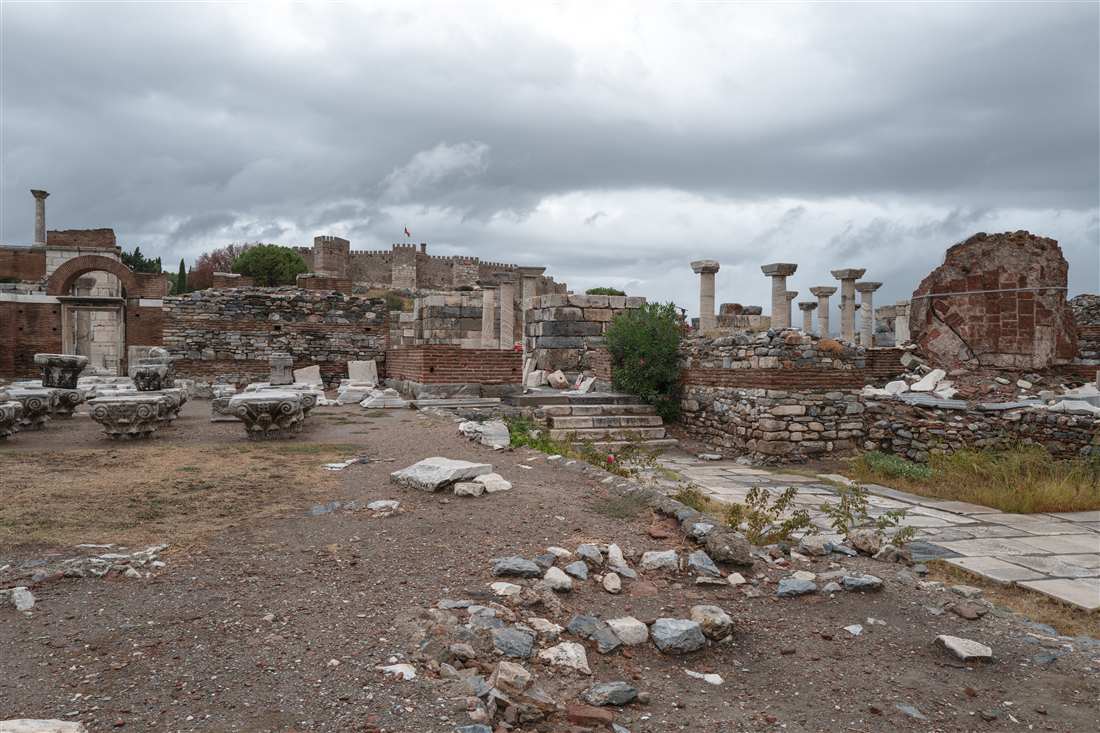
The building fell into ruin after the medieval period, and its marble was quarried and its domes collapsed. Excavation and restoration through the twentieth century cleared the site and raised parts of the structure again. The visitor now reads the full ground plan of the cross-shaped church in re-set columns and low walls, walks the length of the nave, and crosses the transept to the marked tomb. The reconstruction gives shape to the vanished cathedral without disguising its ruined state.
Several elements stand out among the surviving remains:
- Re-erected marble columns along the nave and transept, bearing carved capitals.
- The marked tomb of St John at the crossing, framed by four column stumps.
- The circular baptistery to the north, with its central font for immersion.
- The treasury, a cruciform chamber where the church guarded its relics and gifts.
- A side chapel decorated with fresco fragments from the later Byzantine period.
- Sections of the patterned marble floor and wall revetment across the nave.
The baptistery ranks among the best-preserved parts of the complex. It stands as a separate structure north of the nave, built on a circular plan around a font shaped for the immersion of adult converts. Candidates descended into the water on one side and rose on the other, enacting death and rebirth in Christ. The chamber shows how the great church served the full sacramental life of the Ephesus community, gathering new Christians as well as honouring the dead Apostle.
The treasury and chapel round out the surviving precinct. The treasury took a cruciform shape and held the wealth of the shrine, the offerings of pilgrims, and the relics that supported the cult. The chapel preserves fragments of wall painting, including images of saints, from the church’s later medieval life. Around these buildings the fortress walls of the citadel enclose the whole, so that the sacred plan sits within a ring of military stone added in the centuries of decline.
The restored remains reward a slow walk. The scale becomes clear only as the visitor paces the nave and reaches the far apse, and the tomb draws the eye from the crossing exactly as the architecture intended. Interpretive markers identify the baptistery, the treasury, and the sanctuary, and the re-raised columns give height to a building otherwise reduced to its footprint. What survives is enough to stand within the shape of one of the great churches of the Byzantine East.
What stands around the Basilica — the Gate of Persecution and the Isa Bey Mosque?
The Basilica sits within the Ayasoluk citadel, entered through the Gate of Persecution in the fortress wall. The Byzantine castle crowns the summit above, and the Seljuk Isa Bey Mosque stands on the slope below, forming a dense cluster of monuments.
The Gate of Persecution guards the main approach to the precinct. Its name arose from a relief of combat once set above the arch, which later viewers wrongly read as a scene of Christians being martyred. The gate belongs to the fortifications that wrapped the sacred hill as security declined, turning the pilgrimage church into a defended enclosure. Its twin towers and pointed arch frame the entrance to the whole complex, and the visitor passes beneath it to reach the basilica ground.
Above the church rises the Ayasoluk fortress. The citadel occupies the highest point of the hill and encloses a courtyard, cisterns, a small mosque, and the remains of dwellings within its curtain walls and towers. Byzantine, Seljuk, and Ottoman phases overlap in its masonry, recording the long life of the summit as a stronghold. From the ramparts the view sweeps across the plain of Ephesus to the line of the coast, the same panorama that guarded the road and harbour in every age.
The Isa Bey Mosque completes the group on the western slope below the basilica. It ranks among the finest works of the Anatolian beyliks, the principalities that ruled after the Seljuk sultanate:
- A broad prayer hall roofed by domes and carried on columns taken from ancient buildings.
- An open courtyard with a fountain, framed by an ornate carved portal.
- Reused marble and granite columns drawn from Ephesus and its temples.
- Fine stonework and inscription bands in the tradition of early Turkish architecture.
The three monuments together compress a thousand years of religious history into one hillside. The pagan sanctuary of the Temple of Artemis lies at the foot of the slope, the Christian basilica crowns the terrace, the mosque stands between them, and the fortress tops the height. A visitor who walks from the temple field up through the mosque courtyard and the Gate of Persecution to the basilica and on to the citadel traces the passage of Ephesus through classical, Byzantine, and Islamic eras in a single climb.
The reuse of ancient stone binds the layers physically. Columns from Ephesus and the temple stand again in the mosque, marble from the basilica went into later walls, and the fortress absorbed material from every phase below it. The hill is a quarry of its own past, each age building from the ruins of the last. Around the Basilica of St John the whole history of the site is legible in its recycled stone and its stacked monuments.
How does the Basilica connect to Ephesus and Christian pilgrimage?
The Basilica anchors a pilgrimage circuit rooted in the Christian history of Ephesus. John wrote his Gospel here, the city led the Seven Churches of Revelation, and the House of the Virgin Mary lies nearby, drawing pilgrims to the whole sacred landscape.
Ephesus held a central place in the earliest spread of Christianity. Paul preached and worked in the city, and his letter to the Ephesians addresses its church. John led the churches of Asia from Ephesus in his later years and, by tradition, composed his Gospel in the city. The community hosted the Third Ecumenical Council in the great church of the Virgin, which defined the doctrine of Christ’s person and confirmed the title Theotokos. Few cities carry so dense a record of the apostolic and conciliar age.
The Basilica stood at the head of a network of holy sites clustered around Ephesus:
- The tomb of St John on Ayasoluk Hill, the goal of the eastern Aegean pilgrimage.
- The Church of the Virgin Mary at Ephesus, seat of the Third Ecumenical Council.
- The House of the Virgin Mary on the mountain above the ancient city.
- The Cave of the Seven Sleepers, another venerated Christian site near the ruins.
- Ephesus itself as the leading member of the Seven Churches of the Book of Revelation.
The Book of Revelation ties the region into a single Christian geography. Its opening chapters address seven churches of the province of Asia, and Ephesus stands first among them. Pilgrims who followed the seven-church route through western Anatolia treated Ephesus and the tomb of John as the principal station of the journey. The grave of the Apostle who received the visions of Revelation gave the site a unique authority within that circuit.
The nearby House of the Virgin Mary deepened the draw. The tradition that John brought Mary to Ephesus and cared for her there, following Christ’s charge from the cross, linked the two figures on one hillside. The house on the mountain became a shrine visited by Christian and Muslim pilgrims alike, and it pairs naturally with the basilica in a day’s devotion. The bond between John and Mary, expressed in the Gospel John wrote at Ephesus, is written into the landscape itself.
The Basilica therefore functioned as more than a local cathedral. It was a destination of international pilgrimage, a node on the routes that carried the faithful across the Aegean and through Asia. The manna of the tomb, the Gospel written in the city, the council that met in its church, and the presence of the Virgin’s house combined to make Ephesus one of the supreme Christian centres of the East, with the Basilica of St John as its crown.
How do you visit the Basilica of St John today?
You visit the Basilica in the town of Selçuk on a separate ticket from ancient Ephesus. It is reached on foot from the town centre, by road from Ephesus, from the Kuşadası cruise port, or by ferry from the Greek island of Samos.
The site lies within walking distance of central Selçuk, a few minutes uphill from the town square and the railway station. The entrance stands at the Gate of Persecution on the eastern side of the hill, where the ticket office admits visitors to the basilica precinct and the path up to the fortress. The Basilica carries its own admission, distinct from the ticket for the main Ephesus archaeological site, so a full visit to the region requires more than one entry.
Several approaches serve the different kinds of traveller who reach Selçuk:
- From Selçuk town: a short uphill walk of a few minutes to the Gate of Persecution.
- From ancient Ephesus: about 3 kilometres by taxi, minibus, or a longer walk.
- From Kuşadası cruise port: about 20 kilometres by shore excursion, taxi, or bus.
- From İzmir: about 70 kilometres by road or by the regional train to Selçuk station.
- From Samos in Greece: a ferry to Kuşadası, then the road inland to Selçuk.
The visit rewards a route that links the monuments of the hill. A logical circuit begins at the Temple of Artemis in the field below, climbs through the Isa Bey Mosque, enters the basilica through the Gate of Persecution, crosses the nave to the tomb, and continues to the fortress on the summit for the view. This sequence walks the full history of the site and takes in the pagan, Christian, and Islamic layers in one continuous ascent of an hour or two.
Timing and conditions shape the experience. The summit offers the widest panorama in early morning or late afternoon, when the light rakes across the marble and the heat of midday has eased. The hilltop stands open to the sun, so a hat, water, and firm footwear suit the uneven ground and the climb to the citadel. The elevated terrace commands the plain of Ephesus, the single standing column of the Temple of Artemis, and the distant sea, a vista that rewards the effort of the climb.
A visit to the Basilica fits naturally into a wider tour of Christian and classical Anatolia and the Aegean. It pairs with the ruins of Ephesus, the House of the Virgin Mary, and the crossing to Samos and the Greek islands, forming an itinerary that spans two shores of one sea. Those who plan a broad circuit of the region through organised Greece Tours reach the tomb of the Apostle as the eastern highlight of an Aegean journey, where the grave of John crowns the hill above the greatest city of Roman Asia.
Frequently Asked Questions
What is the Basilica of St John?
The Basilica of St John is a sixth-century Byzantine church on Ayasoluk Hill at Selcuk, built by the emperor Justinian over the tomb of the Apostle John. Its six-domed cruciform plan rivalled the great churches of Constantinople.
Is the Apostle John buried at the Basilica of St John?
Tradition holds that John the Apostle lived his last years at Ephesus and was buried on Ayasoluk Hill. The Basilica rose over the grave, marked under the central dome, a site of pilgrimage since late antiquity.
How do you visit the Basilica of St John?
The Basilica stands in Selcuk town on Ayasoluk Hill, entered on a separate ticket. It sits minutes from Ephesus and the Temple of Artemis, reached from the Kusadasi cruise port or the Greek island of Samos.