
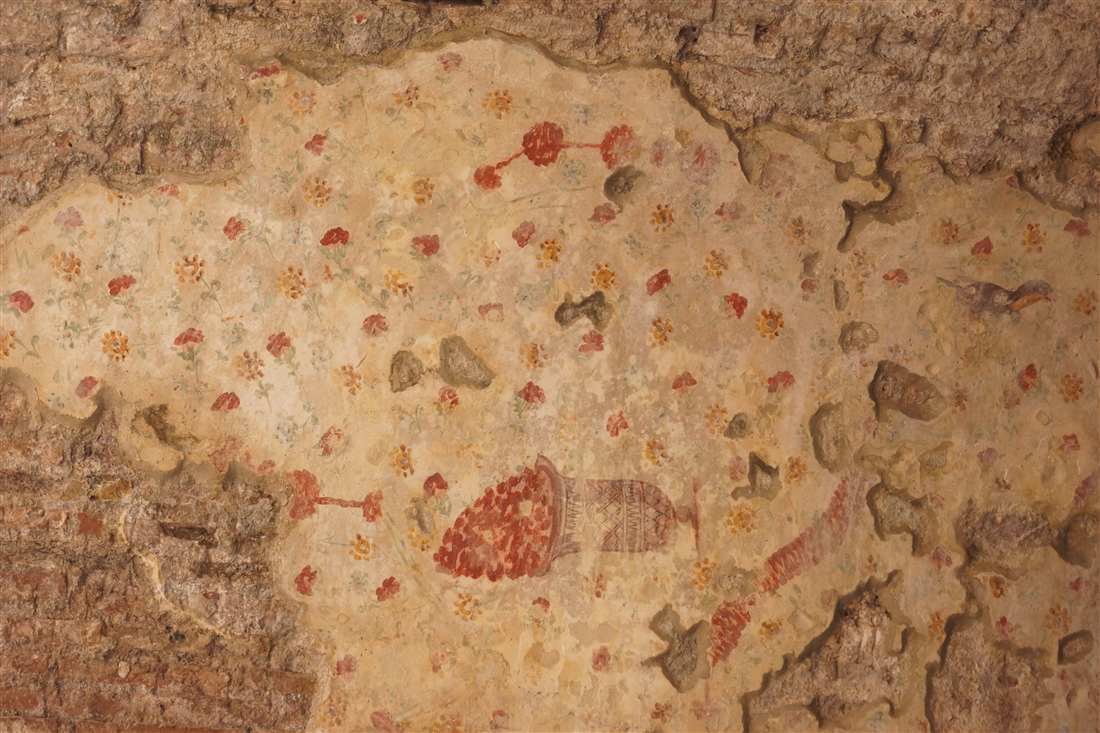
The Cave of the Seven Sleepers is a grotto and early-Christian necropolis on the slope of Mount Pion just outside Ephesus, tied to the legend of seven young Christians who slept in the cave for almost two centuries and woke to a Christian empire. Plan the whole trip with Greece Tours.
This guide covers the Cave of the Seven Sleepers in full: what the site is, the legend of the seven sleepers of Ephesus, why the story is sacred to both Christians and Muslims, what survives among the rock-cut tombs and vaulted catacombs, when the necropolis was raised, and where the cave is and how to visit it.
What is the Cave of the Seven Sleepers at Ephesus?
The Cave of the Seven Sleepers is a rock-cut grotto and early-Christian necropolis on the eastern slope of Mount Pion near Ephesus, in Selçuk, Turkey. It marks the legendary resting place of seven young Christians who, tradition holds, slept for almost two centuries.
The site sits on the hillside of Mount Pion, the ridge the Turks call Panayır Dağı, a short distance beyond the eastern edge of the ancient city. What visitors reach today is a terraced burial ground: a slope pierced with hundreds of tombs, vaulted chambers, domed graves, and the ruins of a church raised in honour of the sleepers. The grotto that gives the place its name lies at the heart of this necropolis, hollowed into the living rock of the hill. Pilgrims tie the whole complex to one of the most widely told legends of late antiquity, a story carried across the Mediterranean and into the wider East. For travellers who pair the classical world of Greece and Anatolia, this grotto ranks among the essential stops served by dedicated Greece Tours and Aegean cruise itineraries.
The Cave of the Seven Sleepers forms part of the sacred geography that surrounds ancient Ephesus. Within a few kilometres stand the ruins of the great port city, the Basilica of Saint John on Ayasuluk Hill, and the shrine on Mount Koressos above the plain. The grotto belongs to this cluster of Christian holy places, drawing pilgrims who arrive to read the legend into the stone. The necropolis that grew up around the sleepers’ tomb testifies to the pull of the story: worshippers wanted to be buried beside the seven, and generations of graves accumulated on the slope. What began as a single legendary sepulchre became a dense field of the dead, wrapped around a shrine.
The grotto is a place of stone and silence. The vaulted brickwork of the tombs, the arches of the ruined church, and the mouths of the cut chambers survive on the terraced hillside, framed by pines and scrub. It is a monument to a legend that shaped the devotion of two faiths, standing quietly at the margin of one of antiquity’s most famous cities.
What is the legend of the Seven Sleepers of Ephesus?
The legend tells of seven young Christians of Ephesus who refused to worship the pagan gods during the persecution under the emperor Decius, hid in a cave on Mount Pion, were sealed inside by their pursuers, and woke almost two centuries later to find the empire Christian.
In the tradition, the seven youths were soldiers or noble sons of Ephesus who declared their faith when the emperor Decius ordered sacrifice to the gods in the third century AD. Rather than renounce Christ, they gave their wealth to the poor and withdrew to a cave on the mountain to pray. When Decius learned where they had gone, he commanded that the mouth of the cave be walled up with stones, sealing the young men inside to die. The seven fell asleep, and in the story their sleep was not death but a divine preservation, their bodies untouched by the passing of the years while empires rose and changed above them.
The tradition names the sleepers and fixes the shape of the miracle. Two centuries after the sealing, in the reign of a Christian emperor, a landowner opened the walled cave to use the stones for a sheepfold. Light entered, and the seven awoke, believing they had slept a single night. One of them, sent into the city to buy bread, offered coins struck under Decius and spoke of an emperor long dead. The astonished citizens and the bishop climbed to the cave, and the sleepers told their story before dying again, this time in peace. The event was received as a sign of the resurrection of the body, proof to a doubting age that the dead rise.
- The persecution under the emperor Decius forced the young Christians into hiding.
- Their pursuers sealed the cave mouth with stone, entombing them alive.
- A miraculous sleep preserved their bodies across the intervening generations.
- They woke under a Christian empire and were recognised by the coins of Decius.
- The miracle was read as a proof of the bodily resurrection.
The number seven and the theme of preserved sleep gave the story its power. It answered a question that troubled late-antique Christians, whether the flesh itself rose, and it did so with a vivid narrative rooted in a named city and a named mountain. That rooting in Ephesus fixed the grotto on Mount Pion as the setting, and the necropolis grew from that identification.
Why is the Cave of the Seven Sleepers sacred to both Christians and Muslims?
The cave is holy to Christians as the site of a resurrection miracle and to Muslims because the Quran retells the same story in Surah al-Kahf, “the Cave,” honouring the sleepers as the “Companions of the Cave” whom God preserved. Both faiths venerate the seven and their grotto.
In the Christian tradition the story spread from Ephesus across the whole late-antique world. It was recorded by the Syriac writer Jacob of Serugh and by Gregory of Tours in the West, translated into Greek, Latin, Syriac, Coptic, Armenian, and Ethiopic, and read on the feast days of the seven martyrs. The eastern and western churches both kept their memory, and the grotto at Ephesus became a pilgrimage goal, its necropolis filling with the graves of the faithful who wished to lie near the sleepers.
In Islam the same narrative enters scripture. The eighteenth sura of the Quran, Surat al-Kahf, recounts the young believers who took refuge in a cave, whom God caused to sleep for a long span of years and then awakened, and it calls them the People, or Companions, of the Cave. The Quranic account preserves the core of the legend, the flight from unbelief, the sealed cave, the long sleep, and the awakening as a sign of God’s power over life and death, while it declines to fix the exact number, noting the disputes over whether they were three, five, or seven, with a dog at their entrance. This shared reverence made the grotto a meeting point of devotion for two faiths.
- Christian sources across Greek, Latin, and Syriac spread the martyrs’ feast and story.
- The Quran’s Surah al-Kahf enshrines the sleepers as the Companions of the Cave.
- Both traditions read the long sleep and awakening as a divine sign.
- Pilgrims of both faiths honoured the grotto on Mount Pion.
The double sanctity of the cave explains the endurance of its cult. Where a purely local shrine faded, the Seven Sleepers held a place in the sacred texts and calendars of both Christianity and Islam, and their grotto outside Ephesus drew veneration from a far wider world than the city itself. The story travelled with traders and pilgrims as far as the Atlantic and the Caucasus, and versions of it took root in dozens of languages.
What survives at the Cave of the Seven Sleepers site?
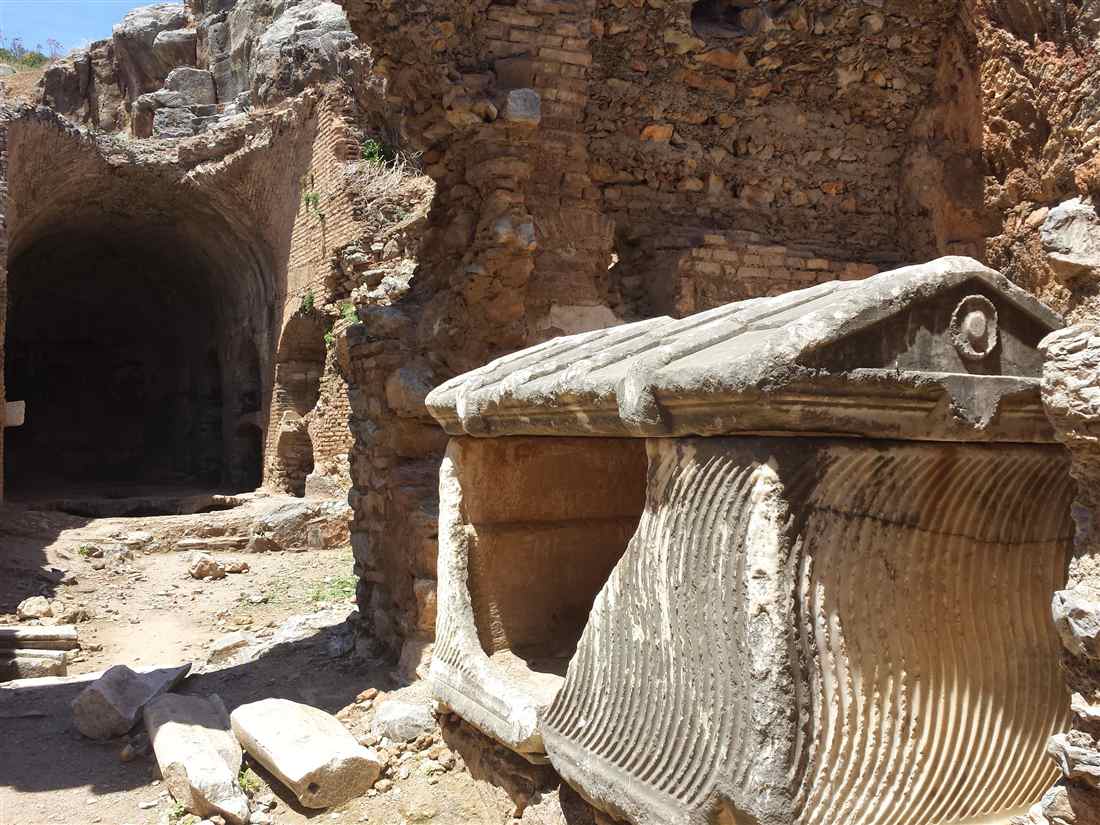
The site preserves a terraced necropolis of rock-cut tombs, the ruins of a domed church raised over the grotto, vaulted brick catacombs, and hundreds of graves cut into the hillside. The chambers and arches climb the slope of Mount Pion around the legendary sepulchre.
Excavation on the slope uncovered a large burial complex built up in layers. At its core stand the remains of a church, its walls and vaulted crypts raised above the grotto that tradition marks as the sleepers’ tomb. Around this centre the hillside is honeycombed with graves: brick-vaulted chambers, arched tomb recesses, and domed sepulchres set into the terraces. Inscriptions dedicated to the Seven Sleepers were found among the graves, confirming that the dead were laid here in the belief that proximity to the sleepers carried the promise of resurrection.
The architecture reflects the growth of a pilgrimage cemetery. The masonry mixes cut stone and Roman brickwork, and the vaulted chambers step up the slope in tiers, linked by passages and open courts. Lamps, terracotta ware, and coins recovered from the tombs record centuries of burial and visitation. Above ground the ruined arches and the shells of the domed graves remain the most striking survivors, standing open to the sky where their roofs have fallen.
- The ruined church and its vaulted crypts stand over the central grotto.
- Brick-vaulted catacombs and arched tomb recesses honeycomb the terraces.
- Domed graves cut into the hillside step up the slope in tiers.
- Dedicatory inscriptions to the Seven Sleepers were found among the graves.
What the visitor sees is a field of the dead wrapped around a shrine. The scale of the necropolis, hundreds of graves packed onto a single hillside, measures the reach of the legend’s appeal. Each buried worshipper sought the same preservation the seven were granted, and the accumulation of their tombs turned a legendary cave into one of the largest early-Christian burial grounds in the region around Ephesus.
When was the site built and the legend recorded?
The necropolis around the grotto took its principal form in the fifth century AD, raised over an earlier cave burial, while the legend itself was recorded across the fifth and sixth centuries AD in Syriac, Greek, and Latin, and later entered the Quran in the seventh century AD.
The burial complex on Mount Pion belongs to the great age of Christian Ephesus. Archaeologists date the main phase of the church and the surrounding catacombs to the fifth century AD, the era when the city hosted the Council that met in the Church of Mary and when Christian building transformed the old pagan centre. The necropolis rose over a modest earlier grotto that the tradition already identified as the sleepers’ tomb, and the fifth-century construction monumentalised that memory with a church and a dense cemetery.
The written record follows the same arc. The earliest full versions of the legend were set down in Syriac by Jacob of Serugh and in Latin by Gregory of Tours, and Greek redactions circulated through the eastern church in the same period. From these the story passed into every major language of eastern Christendom. In the seventh century AD the narrative entered the Quran as Surat al-Kahf, carrying the legend into the heart of the new Islamic world and guaranteeing its survival across a second civilisation.
- The fifth century AD saw the church and catacombs built over the grotto.
- Syriac, Greek, and Latin writers recorded the legend in the fifth and sixth centuries AD.
- The seventh century AD brought the story into the Quran’s Surah al-Kahf.
The sequence shows how a local Ephesian cult became a shared inheritance. A grotto on Mount Pion, monumentalised in the fifth century AD, anchored a story that the written traditions of two faiths then carried far beyond Anatolia. The dating of the ruins and the dating of the texts run together, each confirming the other, and both point to late antiquity as the moment the cult crystallised. Pilgrims from the port at Ephesus, from Constantinople, and later from across the Islamic lands climbed the same slope to honour the seven.
Where is the Cave of the Seven Sleepers, and how do you visit it?
The cave lies on the eastern slope of Mount Pion, just outside the eastern edge of the main Ephesus archaeological site near Selçuk, a few minutes by road from the ruins. Visitors reach it from the Kuşadası cruise port and walk a short path up the terraced necropolis.
The grotto stands beyond the eastern boundary of the ancient city, on the hillside above the valley that runs toward Selçuk. From the upper, eastern gate of the Ephesus ruins the site is a short distance along the road, and it is set apart from the main visitor route, so the terraces are quiet even when the great street of Ephesus is crowded. A café and car park sit at the foot of the slope, and a footpath climbs past the vaulted graves and the ruined church, giving a clear view over the packed necropolis on the hill.
Most travellers arrive as part of a wider Ephesus visit. Cruise passengers dock at Kuşadası, roughly twenty kilometres to the south, and reach the site by a short transfer; a well-planned trip to Ephesus from Kusadasi pairs the grotto with the main ruins and with the nearby House of the Virgin Mary on Mount Koressos. The three sites together map the Christian landscape around Ephesus, from the sleeping martyrs’ cave to the shrine of the Virgin and the Basilica of Saint John.
- Location: the eastern slope of Mount Pion, outside the Ephesus east gate near Selçuk.
- Access: a short road transfer from the Kuşadası cruise port, about twenty kilometres south.
- On site: a car park and café at the foot, and a footpath up through the terraced tombs.
- Combine with: the main Ephesus ruins, the House of the Virgin Mary, and the Basilica of Saint John.
The visit is brief but rewarding. The walk up the necropolis takes a matter of minutes, and the reward is a hillside of open tombs and arches steeped in a legend shared by two faiths. Seen at the end of a day among the marble streets of Ephesus, the grotto of the Seven Sleepers gives the Christian story of the city its most atmospheric setting, a field of graves climbing a quiet mountain slope.
Frequently Asked Questions
What is the Cave of the Seven Sleepers?
The Cave of the Seven Sleepers is a grotto and rock-cut necropolis on Mount Pion near Ephesus, tied to the legend of seven young Christians sealed in the cave who woke almost two centuries later. Domed tombs and a ruined church survive.
What is the legend of the Seven Sleepers of Ephesus?
Seven young Christians hid in the cave from the persecution under the emperor Decius, fell asleep, and woke almost two hundred years later under a Christian empire, taken as a sign of the resurrection of the dead.
Why do Muslims also honour the Seven Sleepers?
The story of the sleepers appears in the Quran as the Companions of the Cave in Surah al-Kahf, so Muslims venerate the site alongside Christians, one of the shared holy places of Anatolia.