
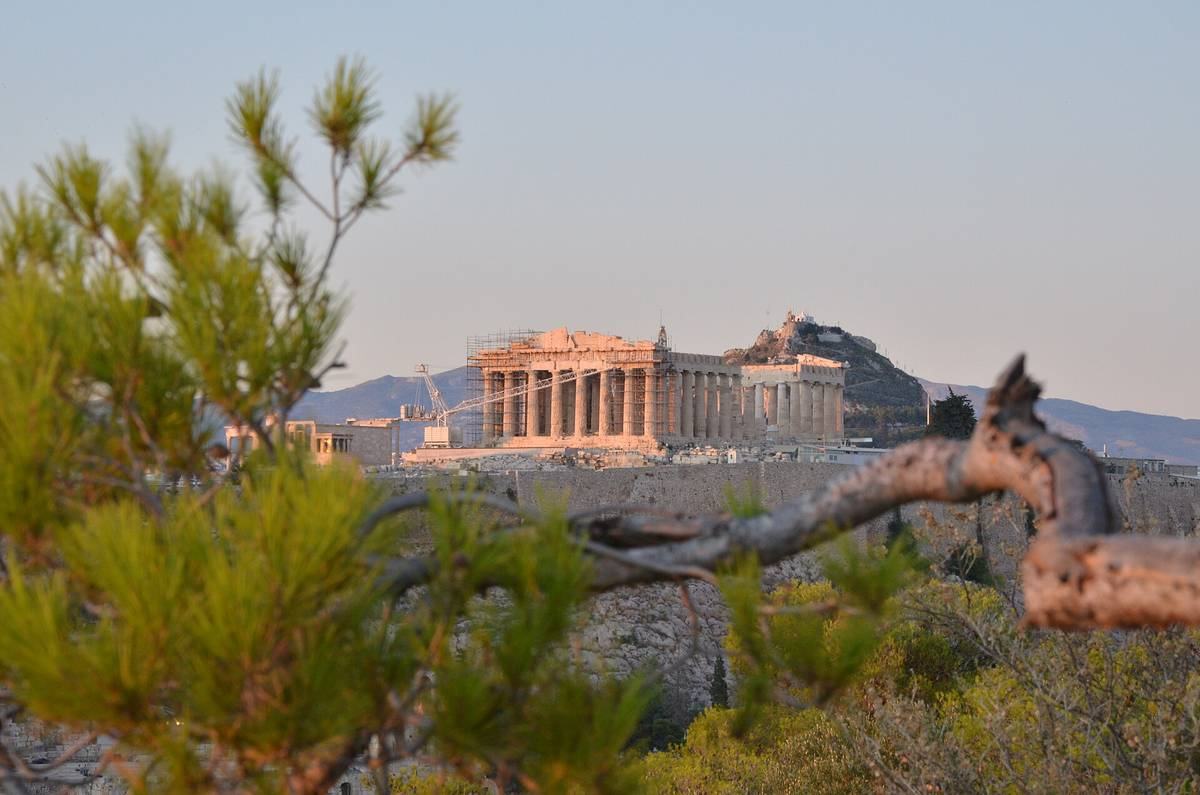
Filopappos Hill in Athens offers the best free Parthenon viewpoint, a Roman monument at its summit, the ancient Pnyx where democracy was practised and a gentle 20-minute walk. Pair the climb with skip-the-line Acropolis tickets and guided tours from My Greece Tours for the complete ancient-Athens experience. Plan the whole trip with Greece Tours.
This green hill is one of the best free things in the Athens travel guide. The sections below cover what it is, the views, the walk, what to see, sunset and how to get there.
What is Filopappos Hill?
Filopappos Hill, the ancient Hill of the Muses, rises just south-west of the Acropolis. It is famous for its face-to-face Parthenon view, the Roman tomb of Philopappos at its summit, and the adjacent Pnyx, where the Athenian assembly met.
Filopappos Hill rises green and peaceful just across a shallow valley from the Acropolis. It is one of the finest free attractions in Athens. The hill stands to the south-west of the sacred rock and was known in antiquity as the Hill of the Muses. It forms part of a cluster of historic hills that frame the western side of the old city.
The hill takes its modern name from the imposing Roman monument on its summit, the tomb of Philopappos. He was a prince and benefactor of Athens, and the monument dates from the early second century. Just to the north lies the Pnyx, the gently sloping hilltop that served as the meeting place of the ancient Athenian assembly. This was the very ground where citizens gathered to debate and vote and where democracy was first practised.
The whole area is a public park of pine woods, wildflowers and paved paths. Ancient remains are threaded through it, and it offers a calm, shaded escape from the busy streets below. Above all, the hill is celebrated for giving the finest free view of the Parthenon anywhere in the city. It looks directly across to the citadel covered in the guide to Acropolis history. That famous view is the main reason to climb.
Why is Filopappos Hill the best Parthenon viewpoint?
Filopappos Hill faces the Acropolis across a narrow valley at a similar height, so the Parthenon appears to float at eye level rather than seen from below. There is no ticket and no entry fee, and the panorama also takes in the sea.
Photographers and visitors flock to this hill because of its position opposite the sacred rock. Viewpoints below the Acropolis crane upward at the walls. Filopappos instead sits across a narrow valley at a comparable elevation, so you look straight across at the Parthenon almost level with it. From here the great temple seems to hover above its rock, framed by sky. The vista is wide, sweeping beyond the Acropolis to take in the sprawl of modern Athens, the distant peak of Lycabettus, and on a clear day the Saronic Gulf and the harbour of Piraeus.
This panorama costs nothing. There is no ticket, no entrance gate and no queue, just a short walk up a public hill that is open at all hours. The combination of a wide view and free access makes it a favourite of both visitors and Athenians. Many consider the photographs taken here better than those from inside the archaeological site itself. For the citadel up close, see the Acropolis Museum guide. Reaching the top is easy and pleasant.
How do you walk up Filopappos Hill?
The climb up Filopappos Hill takes about 15 to 20 minutes on a steady, mostly paved trail that needs no special fitness. From the Acropolis area, head south on Dionysiou Areopagitou and follow the signs to the summit.
The ascent up Filopappos is easy and rewarding for almost everyone. The walk to the summit takes only around fifteen to twenty minutes at a relaxed pace. It follows a steady, well-marked trail that requires no particular level of fitness, so it suits families and casual walkers. The usual starting point is the pedestrianised area below the Acropolis.
From Dionysiou Areopagitou street you head south and follow the signs toward the hill. Near the foot you pass the Byzantine church of Agios Dimitrios Loumbardiaris. The route begins on a paved path designed by the modernist architect Dimitris Pikionis, whose hand-laid stonework is a landmark in itself. It then eases into a gentle dirt trail that winds up through the pines to the monument at the top.
Benches, shade and ever-improving views back toward the Acropolis line the way. The smooth marble sections of Pikionis’s path can be slippery, especially when worn or damp, so comfortable, grippy shoes are wise. The hill is open and unticketed, so you can come and go freely at any time of day. The short, scenic climb is part of the appeal. The wider walking routes connect through nearby Thissio. Several other sights line the way up.
What else can you see on Filopappos Hill?
Besides the views, Filopappos Hill holds the Philopappos Monument at its summit, the ancient Pnyx where the Athenian assembly met, the cave called the Prison of Socrates, the Byzantine church of Agios Dimitrios Loumbardiaris, and the Dora Stratou open-air theatre.
The hill is far more than a viewpoint. It offers a cluster of historical and cultural sights to discover along its paths. Crowning the summit is the Philopappos Monument itself, the tall marble tomb of Gaius Julius Antiochus Philopappos. He was a Roman-era prince and consul and a great benefactor of Athens. Its surviving façade is still carved with figures and inscriptions. A short walk north brings you to the Pnyx, the broad rocky terrace with its speaker’s platform, or bema. Here the citizens’ assembly of ancient Athens gathered to hear orators such as Pericles and Demosthenes and to vote, a site of immense significance as a birthplace of democracy.
On the lower slopes, a series of rooms cut into the rock is known as the Prison of Socrates. Tradition links them, if unreliably, to the philosopher’s final days. Nearby stands the little Byzantine church of Agios Dimitrios Loumbardiaris. The Dora Stratou Theatre is an open-air venue that presents traditional Greek folk-dance performances on summer evenings. Together these turn a walk up the hill into a rich historical ramble. The democratic story links to the civic ruins of the Ancient Agora of Athens. The hill is at its most beautiful at dusk.
Is Filopappos Hill good for sunset, and how do you get there?
Filopappos Hill is one of the best sunset spots in Athens, where crowds watch the Acropolis glow gold over the sea. To reach it, take metro line 1 to Thissio or line 2 to Acropoli, then walk about 20 minutes.
The finest time to climb the hill is the golden hour before sunset. As the day cools, locals head up Filopappos for a walk, a picnic or the sunset from the summit, and the hill takes on a communal mood. The marble of the Parthenon across the valley glows warm gold and then pink. The sky reddens over the distant sea, and the lights of the city begin to twinkle below. It is one of the most memorable scenes in Athens. Getting there is straightforward. By metro you take line 1, the green line, to Thissio station, or line 2, the red line, to Acropoli station. From either it is a walk of around twenty minutes to the foot of the hill and up the path.
The site is open, free and unticketed, so you can stay as late as you like. It is wise to carry water and sun protection for the climb. The paths are unlit, so bring a phone light or small torch for the descent once darkness falls. Comfortable shoes remain essential for the marble and dirt trails. With these simple preparations, sunset here is memorable. The nearby metro routes are explained in the guide to getting around Athens.
What is the Pnyx, the birthplace of democracy?
The Pnyx is a low rocky hill beside Filopappos where the citizens’ assembly of ancient Athens met. Thousands of male citizens gathered here to debate and vote on the city’s laws, making it widely regarded as the birthplace of democracy.
One of the most historically important sites in the world sits quietly on the slopes beside Filopappos, often overlooked by visitors chasing the view. The Pnyx is a broad, gently sloping rocky terrace just north of the Philopappos Monument. In antiquity it served as the regular meeting place of the Ekklesia, the popular assembly of ancient Athens. On this hillside, several thousand adult male citizens gathered dozens of times a year.
The assembled citizens listened to speeches, debated the great questions of war, peace, finance and law, and voted directly on the city’s decisions by a show of hands. Ordinary citizens, rather than kings or a narrow elite, exercised power here. The Pnyx is therefore celebrated as the very birthplace of democracy. The orators Pericles, Demosthenes and Themistocles all addressed the people from its stone platform, and their words shaped the policy of a great city.
The speaker’s platform, the bema, is carved from the living rock and still stands today. Beside it are the curved retaining wall and the wide auditorium where the citizens stood. Standing here, with the Acropolis in view, you are at the foundation of Western political life. It is a moving and free historical experience. The democratic institutions are echoed in the civic Ancient Agora of Athens guide. The questions below cover the points visitors ask most.
What can you see from the top of Filopappos Hill?
From the summit of Filopappos Hill you look across at the Acropolis and the Parthenon, over the sprawl of Athens to Lycabettus, and out to the sea toward Piraeus. The Philopappos Monument stands at the top beside you.
The summit gives a full sweep of the city and its setting. Directly ahead, across the shallow valley, the Acropolis rises with the Parthenon at its crown, seen almost at eye level. To the north-east the wooded cone of Lycabettus marks the highest point in central Athens. Between the two hills the modern city spreads out in a dense grid of white buildings running toward the mountains that ring the basin.
Turn to the south-west and the view opens toward the coast. On a clear day you can pick out the sea, the outline of the port of Piraeus, and the islands of the Saronic Gulf beyond. The Philopappos Monument itself stands at your side, its carved marble façade framing the panorama. Benches and flat rock make the summit a natural place to pause and take photographs. The mix of ancient monument and living city, all seen without a ticket or a gate, makes it one of the finest free vantage points anywhere in Athens.
Is Filopappos Hill worth visiting, and who is it good for?
Filopappos Hill is worth visiting for its free Parthenon view, its ancient sites and its quiet pine woods. It suits families, walkers, photographers and anyone wanting sunset over the Acropolis, and it pairs well with the Ancient Agora nearby.
The hill rewards almost every kind of visitor. Families like the gentle, unticketed paths and the open space for children to roam. Photographers come for the level view of the Parthenon and the changing light at sunset. Walkers and history lovers enjoy the string of monuments along the route, from the Pikionis paths to the Pnyx and the Prison of Socrates.
Its location makes it easy to combine with other sights. The hill sits a short walk from the Acropolis and the Ancient Agora, so many visitors climb it before or after the main archaeological site. Because there is no gate or fee, it also works as a relaxed morning stroll or an evening picnic spot. For a full day in the area, pair it with skip-the-line Acropolis tickets and a guided walk from My Greece Tours.
A few simple choices make the visit more comfortable. Early morning brings cool air, soft light and fewer people, which suits families and photographers alike. Midday can be hot and shadeless on the open upper slopes, so a hat and water help in summer. The late afternoon and sunset hours are the busiest and the most rewarding, when the light turns the marble of the Parthenon gold. Sturdy shoes handle the smooth marble and dirt trails well, and the whole loop from the Acropolis and back fits comfortably into a half-day walk.
Frequently Asked Questions
Is Filopappos Hill free to visit?
Yes, Filopappos Hill is completely free to visit, with no ticket, gate or entrance fee, and it is open at all hours. It offers the finest free Parthenon view in Athens, looking across a narrow valley at the Acropolis, along with the Philopappos Monument and the ancient Pnyx.
How long does it take to climb Filopappos Hill?
It takes about 15 to 20 minutes to walk up Filopappos Hill on a steady, mostly paved trail that needs no special fitness. From the Acropolis area you follow Dionysiou Areopagitou south and the signs to the hill, climbing gently through pine woods to the Roman monument at the summit.
Where is the best free Acropolis view?
Filopappos Hill gives the best free Acropolis view, facing the Parthenon across a narrow valley at a similar height, so the temple appears to float at eye level. There is no entry fee, and the panorama also takes in the city, Lycabettus, the sea and Piraeus.
Can you combine Filopappos Hill with the Acropolis?
You can easily combine Filopappos Hill with the Acropolis, as the two sit a short walk apart across a shallow valley. Many visitors climb the hill for the free Parthenon view before or after touring the archaeological site, and the nearby Ancient Agora fits into the same day.