
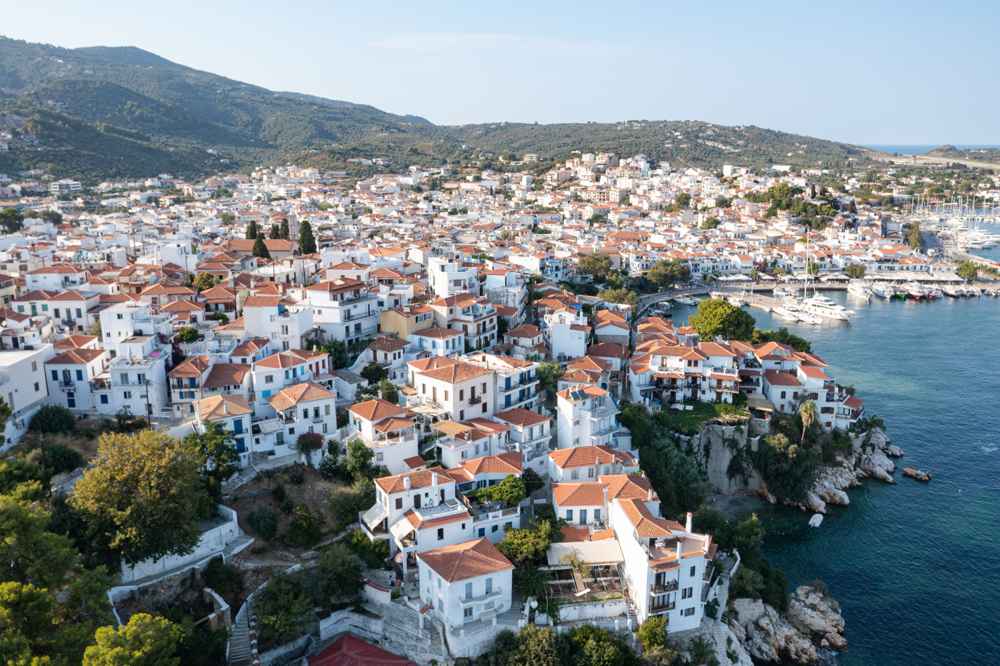
The Bourtzi is the pine-covered fortress islet that splits the harbour of Skiathos Town into its old and new ports. Venetian-era lords fortified the rock in the medieval centuries, a school later occupied its crown, and a cultural venue now stands among the ruins. A stone causeway about 30 metres long connects the islet to the waterfront beside the taxi rank, making it the easiest landmark on the island to reach on foot. Plan the whole trip with Greece Tours.
This guide covers the islet’s position between the two ports, the Ghisi fortress tradition. The walls and gate that survive beneath the pines, the school era and today’s cultural venue. The short causeway walk from the quay. Concrete distances, named viewpoints and era-by-era history replace guesswork, so a first-time visitor plans the stop in minutes and knows exactly what the rock holds.
What is the Bourtzi and where does it sit between the two ports of Skiathos?
The Bourtzi is a small pine-covered fortress islet in the middle of the Skiathos Town waterfront, dividing the harbour into the old port and the new port. A short stone causeway connects it to the quay.
The Bourtzi occupies a rocky, pine-covered peninsula that juts from the centre of the harbourfront on Skiathos, the westernmost island of the Northern Sporades. The islet splits the town’s harbour into two separate basins. The old port curves along the western side, where wooden caiques, fishing boats and summer excursion craft tie up bow-first against the quay. The new port spreads east of the islet and receives the car ferries and hydrofoils arriving from Volos, Agios Konstantinos, Mantoudi and Skopelos. Aleppo pines crown the rock, and their dark green canopy marks the harbour skyline from every approach by sea. A low stone causeway, about 30 metres long. Ties the islet to the waterfront by the taxi rank.
The rock rises roughly 15 metres above the sea on its southern side.
The old port functions as the leisure basin of the harbour. Day-trip boats to Tsougria, Lalaria Beach and Skopelos load passengers here each summer morning, and tavernas line the quay behind the moorings. The new port handles the island’s working traffic: the ferry dock, the hydrofoil berth. The bus stop for Koukounaries and the taxi rank all sit within 200 metres of the causeway. Passengers stepping off a ferry see the Bourtzi immediately to their right across the water. The islet therefore acts as the hinge of the whole waterfront, and every walk between the two basins passes the causeway gate.
Fishermen mend nets on the old-port side in the early morning, while ferry horns sound from the eastern basin, and the contrast defines the harbour’s character.
Skiathos Town climbs two low hills directly behind the harbour, and the Bourtzi completes the amphitheatre of whitewashed houses, red-tiled roofs and masts that defines the island capital. Photographers frame the classic postcard view from the deck of an arriving ferry: the green islet in front. The white town rising behind. The clock tower of Agios Nikolaos on the higher hill. The islet also appears in the paintings and engravings of the town displayed in local galleries. Sunset light hits the western wall of the islet and the old port first, so the final hour of daylight gives the strongest colours.
The pines stay green through every month of the year, holding the composition together across the seasons and in every photograph taken from the arriving ferries.
Orientation from the Bourtzi is simple. Papadiamantis Street, the main pedestrian artery of the town, begins about 150 metres east of the causeway and runs inland from the new port. The old-port promenade leads west toward the yacht moorings and the fish stalls. Tsougria islet lies about two kilometres offshore to the southeast, directly in view from the Bourtzi’s southern terrace. The airport runway occupies the flat isthmus about three kilometres northeast, and landing aircraft cross the harbour view through the summer afternoons. Visitors who fix the islet’s position on arrival navigate the waterfront without a map, because the tall pines of the Bourtzi remain visible from both quays.
From Papadiamantis Street’s first block and from every ferry deck that swings into the sheltered double anchorage.
Who fortified the Bourtzi of Skiathos and what is its Venetian-era history?
Venetian-era rulers fortified the Bourtzi during the medieval centuries, and local tradition ties the castle to the Ghisi brothers, who held the Northern Sporades after the Fourth Crusade partitioned the Byzantine Aegean among Latin lords.
Local tradition attributes the fortress on the Bourtzi to the Ghisi brothers, Venetian adventurers who took the Northern Sporades in the aftermath of the Fourth Crusade. The partition of the Byzantine Empire handed the Aegean islands to Latin lords, and the Ghisi family ruled Skiathos and Skopelos from fortified bases. The brothers raised a castle on the harbour islet, choosing the rock for the same reasons every later garrison did: deep water on three sides. A single narrow approach. Command of both anchorages at once. Chroniclers of the Latin Aegean record the family’s hold over the islands through the early Venetian era.
The name of the islet arrived in a later era, but the walls that visitors trace today began as this medieval Venetian stronghold.
The fortress guarded one of the busiest sea lanes of the western Aegean. Ships running between the Pagasetic Gulf, Euboea and the northern Aegean passed within sight of the islet. The garrison controlled the only sheltered double harbour on the island’s south coast. Watchmen on the walls saw approaching sails long before they reached the anchorage, and the narrow causeway meant a small garrison held the gate against a far larger force. Piracy shaped the entire medieval history of the Sporades, and the Bourtzi served as the harbour’s first line of defence. Gun platforms on the seaward walls covered both entrances to the anchorage.
The fortress protected the trade, the fishing fleet and the population clustered behind the quays through the island’s most dangerous centuries.
Pirate raids drove the islanders away from the harbour entirely. The population abandoned the waterfront settlement in the later medieval era and rebuilt on the Kastro. A sheer sea-cliff at the island’s northern tip, where the community remained through the Ottoman centuries. The Bourtzi fortress lost its town and declined into a watch post, its walls quarried and weathered by the salt wind. Islanders returned to the harbour in the era of the Greek Revolution, when the modern town rose on the two hills behind the old anchorage. The returning settlers found the islet’s fortifications ruined but the site as commanding as ever.
The story of the Bourtzi brackets the town’s history: fortified when the harbour thrived, abandoned with it, and revived alongside the new town.
The name Bourtzi derives from an Ottoman-era word for a sea tower, and the term appears across Greece wherever a small harbour fort stands offshore. Nafplio in the Peloponnese keeps the best-known Bourtzi. A moated castle on an islet in the Argolic Gulf. The word survives in island Greek as the standard label for such works. On Skiathos the name displaced whatever the Venetian builders called their castle, and it now covers the whole peninsula rather than a single tower. The shared name records the Aegean’s layered history: Byzantine foundations, Venetian walls and Ottoman vocabulary on one rock. Guides and maps use the word Bourtzi without translation.
Locals shorten directions to the simple phrase ‘at the Bourtzi’ when arranging to meet a friend anywhere on the busy waterfront.
What survives on the Bourtzi of Skiathos today — walls, gate and pines?
Fragments of the medieval fortress survive on the Bourtzi: stretches of rubble wall along the rock’s seaward edge, a stone gateway at the head of the causeway steps, and foundations hidden beneath the Aleppo pines.
A stone gateway stands at the head of the steps where the causeway meets the rock, and it remains the single formal entrance to the islet. The arch is built of rough local stone with dressed corner blocks, and visitors pass beneath it exactly as garrisons did in the fortress centuries. Above the gate the path forks: the left branch climbs to the crown and the cultural venue, while the right branch circles the base of the rock closer to sea level. The gateway frames the classic arrival photograph, with the pines rising behind the arch and the masts of the old port reflected in the water below.
Worn steps and a low parapet flank the entrance, marking the line of the vanished curtain wall on either side.
Stretches of the medieval wall survive along the seaward edges of the islet. The masonry is rubble core faced with roughly squared blocks, standing in places to about head height and elsewhere reduced to foundations flush with the rock. The clearest sections face the new port, where the wall line follows the cliff edge above the ferry channel. Iron cannons of a later era rest on the upper terrace, pointing over the harbour mouth as a reminder of the islet’s military purpose. Erosion, stone-robbing and the school-era building works removed the upper courses, so no tower stands to full height.
Visitors read the plan from the surviving footings, which trace an enclosure adapted tightly to the natural outline of the rock and its three sea-facing cliffs.
Aleppo pines cover the upper terraces and give the Bourtzi its green silhouette. The trees seed themselves in the thin soil among the ruins, and their resin scent carries across the causeway on warm evenings. Gravel paths loop beneath the canopy, linking stone benches placed at the viewpoints over both ports. Shade covers most of the circuit even at midday, which makes the islet the coolest public space on the waterfront in July and August. Pine roots grip the old wall footings. Fallen needles carpet the steps down to the flat rocks on the southern side. Where locals swim in the clear water below the walls.
The combination of ruins, trees and open sea distinguishes the islet from every other spot in the harbour.
The crown of the islet holds a level terrace around the neoclassical school building, edged with a low parapet. The view runs east over the new port to the airport isthmus and west across the old port to the yacht moorings. With Tsougria and the open Aegean filling the southern horizon. Ship watchers gather on the eastern rail when the large ferries from Volos swing into the channel, passing about 100 metres from the walls. The terrace floor covers the levelled remains of the fortress interior, so every visitor walking to the viewpoint crosses the heart of the medieval castle.
The position explains itself in one glance from the parapet: the terrace demonstrates exactly why the Ghisi builders chose this rock above every other point on the coast.
How did the Bourtzi of Skiathos serve as a school and what is its cultural role today?
A school occupied the Bourtzi in the generations after the Greek Revolution, and the neoclassical building at the islet’s crown now serves as a cultural venue hosting exhibitions, concerts and open-air events each summer.
A school occupied the Bourtzi in the generations after the Greek Revolution, when the new town needed civic buildings and the islet offered a quiet, enclosed site steps from the harbour. Builders levelled part of the fortress interior and raised a neoclassical schoolhouse at the crown, the white building that still dominates the islet. Island children crossed the causeway each morning for lessons above the sea, with the harbour traffic passing below the classroom windows. The school gave the islet its second life and saved it from complete ruin, because the maintained building and the planted pines kept the site in daily civic use.
The change from garrison to classroom mirrors the island’s own passage from a frontier outpost of the Aegean to a settled trading and seafaring town.
The former schoolhouse now serves as a cultural venue, and the terraces around it host open-air events through the summer season. Exhibitions of painting, photography and local history fill the hall, while concerts and theatre performances use the outdoor setting with the harbour lights as a backdrop. The municipality organises the programme, and posters along Papadiamantis Street and the waterfront announce the current events in season. Arrangements differ from event to event, so visitors confirm details at the venue itself rather than relying on fixed listings. The setting carries the programme: an audience on the terrace faces the illuminated town across the old port, with masts and water between the stage and the houses.
Culture returned the islet to the daily life of the town, exactly as the school once did.
A seasonal cafe operates among the pines in summer, with tables set on the terraces above the old port. Coffee on the islet counts among the simplest free things to do in Skiathos: the walk costs nothing, the shade is constant, and the view covers both harbours plus the sea lane to Tsougria. Stone benches around the circuit serve visitors outside cafe hours. Each bench faces a different slice of the panorama. From the ferry channel in the east to the yacht quay in the west. The cafe terrace sits about 30 metres from the waterfront traffic yet feels wholly removed from it, screened by tall pines and surrounded by open water on three sides.
Families, readers and painters share the shaded benches through the long summer afternoons.
An evening visit pairs naturally with a harbour stroll. Locals take their volta along the old-port promenade at dusk, and the loop out to the Bourtzi and back forms the traditional turning point of the walk. Cicadas fill the pines until sunset, then the harbour lights come on and the illuminated town climbs the hills behind the masts. Photographers work the blue hour from the eastern terrace, catching the last ferries departing under deck lights. The whole circuit from Papadiamantis Street across the causeway, around the islet and back to the quay covers under one kilometre, so the Bourtzi slots into any evening without planning.
Dinner at the old-port tavernas sits two minutes from the causeway, which closes the classic Skiathos Town evening in a single unbroken walk.
How do you walk to the Bourtzi from the Skiathos Town waterfront?
A stone causeway about 30 metres long links the Bourtzi to the Skiathos Town quay beside the taxi rank. The walk from the ferry dock takes about five minutes along the flat harbourfront promenade.
The walk starts at the taxi rank on the harbourfront, where the causeway leaves the quay at the point dividing the old and new ports. Ferry passengers reach the spot in about five minutes by turning right along the water after disembarking. Walkers coming from the bottom of Papadiamantis Street cover the 150 metres to the causeway in two minutes, passing the kiosks and the boat-ticket booths of the new port. The causeway itself is a broad paved walkway at sea level, flanked by moored dinghies on the old-port side and open water toward the ferry channel.
Waves break against the stonework on windy days, throwing spray across the paving, and calm summer mornings turn the same stretch into a mirror between the two basins.
Broad stone steps climb from the end of the causeway through the fortress gate to the wooded terraces. The ascent gains roughly 15 metres of height over a short zigzag, and handrails guard the exposed edge beside the steps. Past the gate, the gravel circuit around the islet takes about 15 minutes at a slow pace, including pauses at the benches. The full visit, from the quay to the crown terrace and back, fits inside half an hour, which makes the Bourtzi the shortest complete excursion on the island. Flat sandals handle the paths without trouble, though the polished lower steps turn slick after rain.
Pushchairs manage the flat causeway easily and reach the first terrace by the gate, while the upper circuit involves stone steps throughout its length.
The circuit rewards slow walking. The eastern rail overlooks the ferry channel, where the big boats from the mainland swing past the walls close enough for passengers on deck to wave. The southern rocks face Tsougria across two kilometres of open water, with the swimming ledges below and the airport headland to the left. The western benches look down on the old port, its caiques, its tavernas and the evening promenade along the quay. Uphill, the school terrace pulls the three views together above the pines into a single panorama of town, harbour and sea.
Photographers time the western side for the final hour of daylight and the eastern rail for mid-morning, when the sun stands behind the town and the ferry traffic peaks in the channel.
Practicalities stay simple. Access to the islet grounds is free, the paths are open through the day, and no vehicles ever cross the causeway, which keeps the rock quiet even in August. Shade from the pines covers the climb from mid-morning, and the sea breeze crosses the terraces on the hottest afternoons. Water and coffee come from the seasonal cafe in summer or from the waterfront kiosks 100 metres away in the off-season. The stop combines cleanly with the old port, the fish stalls and Papadiamantis Street in a single half-day town circuit on foot. Early morning offers empty paths and fishermen working below the walls.
Late evening offers the lit town glowing across the water and the quietest stone benches on the entire Skiathos Town waterfront.
What views does the Bourtzi of Skiathos offer over the two harbours?
The Bourtzi overlooks both halves of the Skiathos Town waterfront. The old port with its fishing boats lies west, the new port with its ferry quay lies east, and Tsougria islet sits offshore.
The western side of the Bourtzi faces the old port of Skiathos. Fishing caiques tie up along the stone quay in this sheltered basin. From the railing under the pines you look straight down onto their decks. Their nets and coloured buoys sit within clear view. Painted wooden hulls rock gently at their moorings below. Behind them the tavernas of the old waterfront stack close together. The white houses of Skiathos Town climb the low hill beyond. The church of Agios Nikolaos and its clock crown that hill. Water taxis for Achladies, Kanapitsa and Tsougria load along the same quay. The basin stays busy from early morning until late in the evening.
This angle frames boats, houses and hill in one clean line of sight no waterfront spot reproduces.
The eastern railing overlooks the new port and its working quay. Car ferries and fast hydrofoils from Volos, Agios Konstantinos and Mantoudi come alongside here. Arriving ships swing around the tip of the islet first. They then back onto the quay in a tight manoeuvre. The Bourtzi gives the closest land-side view of that whole turn. Ropes are made fast within earshot of the pines. Excursion boats for Lalaria and Kastro line up west of the ferry berth each morning. Their departures pass directly below the pines within roughly ten meters of the rocks. The airport runway lies across the bay to the north. Landing aircraft descend low over the water in the same field of view.
Watching this traffic from an eastern bench is a fixture of any Skiathos Town morning.
Tsougria fills the horizon south of the Bourtzi across the strait. This uninhabited pine-covered islet lies about two nautical miles offshore. Its beaches face Skiathos Town directly. The small white chapel near its shore stays visible from the fortress terrace on clear days. Water taxis cross to Tsougria in around twenty minutes. From the Bourtzi railing you can follow their whole route across the open water. Their white wakes trace straight lines over the blue strait. Smaller Tsougriaki sits close beside it. The long ridgeline of Evia rises behind both islands on the southern horizon. This open-sea view explains why the islet served as the town’s lookout in the era of sail.
Every approaching hull had to round Tsougria before it reached either harbour of the island’s main anchorage.
A perimeter path circles the upper terrace. The full panorama unfolds in a five-minute loop that you walk in either direction. The northern railing faces the amphitheatre of the town. The eastern one faces the busy ferry quay. The southern one faces Tsougria and the open Aegean. The western one faces the old fishing port. Reading the geography here clarifies the history of Skiathos. One defensible rock commanded two anchorages and stayed valuable to every naval power that held the island. Stone benches stand at each turn of the shaded path. The pines keep most of the loop cool through midday. Root-cracked paving underfoot marks the older parts of the walk.
Low walls edge the terrace above the rocks. Carry a camera, because each railing frames a different subject at a different distance and scale.
Does the Bourtzi in Skiathos have a cafe, and where do you sit under the pines?
A seasonal cafe operates on the Bourtzi terrace through the warm months, serving drinks under the pines. Free stone benches around the perimeter path also offer shaded harbour-view seating at no charge.
The cafe occupies part of the upper terrace. It runs through the tourist season, opening from late spring into the autumn. Its tables stand under the pine canopy. The new port and Tsougria fill the view from each table. The offering covers coffee, fresh juices, cold drinks and light snacks rather than full meals. The setting rather than the menu is the real draw here. Every table faces the open water. Shade from the branches falls across the cups. Ferry arrivals pass within a hundred meters of the railing. Service winds down when the season closes. Outside the warm months the terrace reverts to open public space.
Confirm the day’s opening by looking up from the taxi rank, because the terrace tables stay visible from the waterfront whenever the cafe trades.
Aleppo pines cover the whole islet. They give the Bourtzi its dark-green silhouette between the two white harbour fronts. The dense canopy keeps the terrace noticeably cooler than the exposed waterfront. You feel that difference within a minute of climbing the causeway steps under an August sun. Fallen needles carpet the ground between the stone paths. The sharp scent of resin carries across the terrace on still afternoons. Cones drop onto the benches through late summer. The trees also screen much of the noise from the harbour road. Conversation on the islet happens at a lower volume than on the quay fifty meters away. The shade shifts steadily with the sun through the day.
The benches on the southern rim hold their cover longest through the hottest midday hours.
Stone and wooden benches line the perimeter path and the clearings between the pines. Sitting on any of them costs nothing at all. Locals use the islet as a reading spot in the morning. They also use it as a meeting point before evening walks. Children run the loop while parents rest in the shade. The benches turn over steadily rather than staying occupied for hours. The quietest corner faces south toward Tsougria. It sits well away from both busy quays and the causeway foot traffic. Bring your own water in high summer, because the islet has no kiosk outside the cafe.
A bench here with a bakery breakfast from Papadiamantis Street is the cheapest waterfront seat in Skiathos Town. It carries the same two-harbour view that the cafe tables sell.
Mornings on the terrace belong to walkers and coffee drinkers. They watch the first ferry of the day come alongside the quay. Midday thins the crowd right out. The beach boats have left and the heat pushes visitors toward the water. Late afternoon brings the terrace back to life. The light softens over the old port as the day boats return from Lalaria and Koukounaries. Sunset draws the largest single gathering of the day. That crowd fills the western railing above the fishing harbour. Phones and cameras line the rail as the light drops. On performance evenings the audience arrives after dark. The cafe area then empties toward the open-air venue.
Each phase lasts around two to three hours, so the islet never feels the same twice within one day.
What happens at the Bourtzi of Skiathos on summer evenings?
The Bourtzi hosts open-air cultural events on summer evenings, with concerts, theatre and film screenings on the terrace venue. The pines, the lit town and the harbour reflections make the islet an after-dinner destination.
The cultural venue on the upper terrace stages a summer programme. It runs concerts, theatre performances and open-air film screenings under the night sky. Programming changes with each season. Posters along Papadiamantis Street and notices at the town hall announce it locally. There is no fixed annual calendar to plan around in advance. Events start after dark, once the heat has gone. The harbour lights have come on around the seated audience by then. The seating is temporary and set out fresh for each event. The terrace returns to its ordinary daytime form every morning. Check the posters as soon as you reach town.
A performance on the islet ranks among the most distinctive evenings in Skiathos Town and often sells out on the setting alone.
Evening changes the whole character of the islet before any event begins. The pines turn from daytime shade-givers into a dark canopy strung with the venue’s small lights. The white town across the old port switches on window by window. Ferry movements slow down after dinner. The water between the Bourtzi and the two quays flattens right out. That calm surface doubles every light above it. Couples and families cross the causeway for a slow circuit of the perimeter path. The benches facing the town fill up first of all. The walk over and back takes about fifteen minutes with a pause at each railing.
This makes the islet the standard after-dinner stroll for visitors staying near the old port and the lanes behind it.
Event nights bring a different crowd and a different rhythm to the islet. The audience gathers on the causeway around half an hour before the start. They file slowly up the stone steps to the terrace. Sound checks drift out over the old port in the early evening. They give the waterfront tavernas an unplanned preview of the programme. Performances run under the pines with the two harbours as a backdrop. Applause carries clearly across the still water to the quay. Non-attenders can still use the lower path beside the water during shows. The islet stays partly open even when the terrace is fully booked. Latecomers wait quietly by the causeway rail.
Departure after the final bow funnels the whole audience back over the single causeway within two or three minutes.
Quiet evenings outnumber the event evenings even through August. The islet rewards both kinds equally well. A still night on the southern railing gives you Tsougria as a black outline. It also shows the lights of aircraft on final approach to the runway. The last hydrofoil’s wake catches the town lights. The cafe, when trading, keeps a deliberately low profile after dark. It uses soft table lamps rather than floodlights under the branches. Street noise from the new port fades away by late evening. The cicadas in the pines become the dominant sound across the terrace. Moored rigging taps in the light night breeze.
Walk the loop clockwise and then anticlockwise before you leave, because the town silhouette reads differently in each direction. The lit causeway keeps the return simple.
How do you photograph the Bourtzi and the Skiathos Town silhouette?
Photograph the Bourtzi from the old-port quay for the classic pine-topped islet shot. Shoot from the terrace toward the Agios Nikolaos clock hill for the town silhouette, with early morning and the hour before sunset giving the best light.
The classic image of the Bourtzi shows a green wedge of pines between two white waterfronts. It comes reliably from three positions around the harbour. The old-port quay beside the fishing boats gives a low, wide angle. The moored caiques fill the foreground from there. The deck of an arriving ferry gives the head-on view as the ship rounds the tip of the islet. Keep the camera out for the final ten minutes of every crossing. The terrace of Agios Nikolaos, the clock-tower hill above the old town, gives the elevated shot. That frame shows the causeway, both harbours and Tsougria together. The climb up to the clock takes about ten minutes from the waterfront.
The terrace at the top stays open at all hours.
Shooting outward from the islet itself reverses the postcard view. The western railing frames the old port with the town rising behind it toward the clock of Agios Nikolaos. This is the single most repeated Skiathos Town composition. A medium zoom compresses the stacked white houses against the hillside. A wide lens takes in the whole basin with the fishing boats in front. The eastern railing brings ferry arrivals close enough to fill the frame without cropping. Work the perimeter path in a full circle. The pine branches provide natural framing at each opening in the canopy. The surviving stone gate fragment on the upper terrace works as a solid foreground anchor.
Use it for any composition that looks south across the water toward Tsougria.
Light dictates the whole shooting schedule at the Bourtzi. Early morning sun rises behind the new port. It lights the town amphitheatre face-on, the best window for the shot from the western railing. Midday flattens the scene badly and bleaches the white houses. The middle hours suit close detail work under the shade of the pines instead. The hour before sunset warms the old stone and puts the sun behind the old town. The view from Agios Nikolaos hill then reads as layers of backlit rooftops. Blue hour runs roughly twenty to forty minutes after sunset. It balances the deep sky with the harbour lights, the prime window for the islet-from-the-quay image.
Night shots need a wall or a railing for support, because tripods on the narrow causeway block the walkway.
The town silhouette works best with the Bourtzi itself as its anchor point. Compose with the islet’s pine crown at one edge. Let the sweep of the waterfront lead the eye toward the clock tower. The two harbours then read as two separate bays instead of one. Ferries add useful scale to the frame. Time the shot for an arrival or departure when the ship sits right beside the islet. Winter and spring bring the clearest air of the year. Evia stands sharp on the horizon behind Tsougria in that season. Summer haze softens the distant layers but adds warm colour at dusk. Respect the venue during any evening performance and keep flashes down.
The audience sits in near darkness between the stage lights and the black mass of the pines.
How do you combine the Bourtzi with a full walk through Skiathos Town?
Combine the Bourtzi with a town circuit of around two hours. Start at the causeway, walk Papadiamantis Street to the museum quarter, climb the Agios Nikolaos clock-tower hill, and finish along the old port quay back to the start.
Start the circuit at the taxi rank on the waterfront. The short causeway meets the main harbour road right here. Cross to the islet first. Walk the perimeter loop and the upper terrace, then return to the quay within half an hour. Papadiamantis Street opens directly opposite the causeway. It is the town’s pedestrian spine, running straight inland from the water. The street carries the bakeries, the pharmacies, the bookshops and the souvenir stores of the town. This flat, shaded stretch takes about ten minutes to walk end to end. Side lanes branch east and west roughly every fifty meters. Each one leads quickly into the quieter residential quarters above.
Follow the main street to its upper end first, because its full length is the fastest way to grasp the town’s scale.
One lane east of the main street’s midpoint stands the island’s literary landmark. It is the carefully preserved home of its most famous writer. A stop at the Papadiamantis House adds around thirty minutes to the circuit. It pairs naturally with the Bourtzi. The school that once operated on the islet belongs to the same chapter of the town’s story. The house keeps its original rooms, its plain furnishings and its manuscripts. These sit across two low floors behind a small paved square. A plaque by the door marks the site. From that square, stepped lanes climb east toward the churches of the upper town.
The bougainvillea-covered passages up here are the most photographed streets after the waterfront itself. Yet they carry only a small fraction of the main street’s foot traffic.
The clock-tower hill of Agios Nikolaos crowns the eastern quarter of the town. The climb runs about ten minutes up stepped lanes from the museum quarter below. The terrace beside the church gives the highest accessible viewpoint inside the town. The Bourtzi sits directly below it with its causeway. The old port lies to the right, the new port and runway to the left, and Tsougria offshore. This vantage puts the islet’s whole defensive logic in plain sight. One small rock covered two anchorages at the very head of the bay. Benches on the terrace make it the natural rest stop at the circuit’s highest point. Descend afterward by a different stepped lane toward the old port.
Following the smell of the bakeries downhill keeps the route properly circular.
The old port closes the loop neatly. Its long quay runs beneath the town’s oldest houses. It passes the fish stalls and the caique moorings on the way. The quay delivers you back to the causeway in around fifteen minutes of flat walking. Tavernas line the water here and serve the circuit’s natural finishing meal. The Bourtzi’s dark pines stand directly across the narrow basin from the tables. The water-taxi berths for Tsougria and the south-coast beaches sit along this same stretch. The walk therefore doubles as reconnaissance for the next day’s boat outing. The full circuit of islet, main street, museum quarter, clock hill and old port covers about three kilometers.
Two hours covers it comfortably at a stroll, and half a day absorbs it with proper stops.
Frequently Asked Questions
How much time do you need at the Bourtzi in Skiathos?
Thirty to forty-five minutes covers a standard visit to the Bourtzi. That time takes in the causeway crossing, the perimeter loop, the upper terrace and a pause at two or three railings. Photographers extend it to an hour or more. The light keeps changing and the perimeter offers a dozen distinct compositions. A cafe stop adds whatever a coffee takes, typically another half hour under the pines. Attending an evening event turns the visit into a full evening instead. You arrive half an hour before the start, and the performance runs late. The islet is small, with a loop of around three hundred meters. Nobody budget more time than they want to spend there.
Return trips at different hours cost nothing. Most visitors fold the Bourtzi into a wider town walk rather than treating it as a standalone stop. In that frame it works well as the opening or closing half hour of a two-hour circuit.
Is the walk to the Bourtzi in Skiathos accessible?
The walk to the Bourtzi is short but not fully step-free. The causeway from the taxi rank is flat, paved and about fifty meters long. It stays manageable for strollers and wheelchairs as far as the base of the islet. Steps then climb from the causeway up to the upper terrace. The perimeter path mixes paving, packed earth and exposed pine roots along its length. Wheelchair users reach the lower landing and its water-level views without assistance. The terrace at the top requires the stairs. Sturdy sandals or trainers handle all the paths comfortably. The pine needles turn slick underfoot after rain.
Handrails run beside the main stair, and the climb takes under five minutes at an easy pace. Benches at the top provide immediate rest. Visitors with limited mobility still get the essential experience from the causeway and the lower landing. The two-harbour setting, the ferry traffic and the pine canopy all read clearly from water level.
When is the best light for photographing the Bourtzi?
Early morning and the last hour before sunset give the best light at the Bourtzi by a clear margin. Morning sun lights the town amphitheatre face-on from the islet’s western railing. The white houses show clean colour, and the water in the old port sits calm. Late afternoon warms the old stone and backlights the pines. The hour before sunset is the prime window for the elevated shot down from the clock-tower hill. Blue hour, the twenty to forty minutes right after sunset, balances the harbour lights with the sky. It produces the strongest islet-from-the-quay image of all. Midday is the weakest window by far. Flat overhead light bleaches the whites and casts hard shadows under the canopy.
Season matters too. Winter and spring air is clearest, putting Evia sharp on the horizon. Summer adds haze but far richer dusk colour. Overcast days quietly favour detail work on the wall fragments and the moored caiques.
Is the Bourtzi worth visiting in the evening?
Evenings rank among the very best times to visit the Bourtzi. The heat drops away, and the crowds thin down to scattered strollers. The town lights double themselves in the still water between the islet and both quays. The causeway and the main paths stay lit throughout. The walk over is therefore safe and straightforward after dark. On performance nights the open-air venue fills the terrace with music or theatre under the pines. Posters along Papadiamantis Street announce the programme through the whole season. On quiet nights the southern railing gives Tsougria as a dark outline. It also shows aircraft lights on approach to the runway and the wake of the last hydrofoil.
The cafe, when open, trades gently after dark with low table lighting under the branches. Pair the visit with dinner at the old port, where the tavernas face the islet across the basin. The loop over the causeway before or after the meal takes fifteen minutes and costs nothing.
Is the Bourtzi in Skiathos good for kids?
Kids handle the Bourtzi easily and usually take to it fast. The causeway crossing feels like walking out to a private island. The stairs and paths invite exploring. The ferry traffic below the eastern railing holds attention the way large moving machinery always does with children. Railings guard the drops along the main terrace. The lower rocks down near the water still need close supervision with toddlers. Shade from the pines keeps the whole islet cooler than the open waterfront. That is a real practical advantage with children through July and August. The perimeter loop is short enough that small legs finish it without complaint. The benches allow breaks every fifty meters along the way.
There is no playground on the islet. The appeal is boats, stairs, pine cones and views over two working harbours. An ice cream from Papadiamantis Street carried over the causeway is the standard family formula. Evening screenings also draw local children up to the terrace.
Is there an entry fee for the Bourtzi in Skiathos?
Access to the Bourtzi is free of charge. The islet is public space. The causeway, the paths, the terraces and the benches all cost nothing at any hour. No gate or ticket booth stands anywhere at the entrance. Money changes hands only for the optional extras. That means a drink at the seasonal cafe or a ticket for those evening performances that charge admission. Cultural events split between free municipal evenings and ticketed productions. The posters announcing each event state the arrangement clearly in advance. The fortress remains and the venue terrace are open ground rather than a fenced archaeological site. That is exactly why no standard admission applies anywhere on the islet.
This makes the Bourtzi the best zero-cost activity in all of Skiathos Town. The two-harbour panorama, the deep pine shade and the constant ferry-watching all come without a ticket. Budget only for the cafe if you want a table, and check the event posters for the occasional ticketed night.
What stops sit near the Bourtzi on a town stroll?
The Bourtzi sits within a five-minute walk of nearly all the town’s main stops. The taxi rank and the start of Papadiamantis Street lie directly across the short causeway. The old port quay begins immediately to the west. Its fish stalls, caique moorings and waterfront tavernas all face the islet across the basin. The water-taxi berths for Tsougria, Achladies and Kanapitsa line that same stretch of quay. Papadiamantis Street leads inland to the museum quarter. There the preserved house of the island’s writer stands one lane east of the midpoint. The clock-tower hill of Agios Nikolaos rises above the old town. A ten-minute stepped climb reaches the best elevated view of the islet and its causeway.
The new port and the ferry quay stretch east of the causeway. They are useful for checking the departure boards on the way past. Kiosks along the road sell ferry and boat tickets. A stroll linking all of these covers about three kilometers and two hours.