
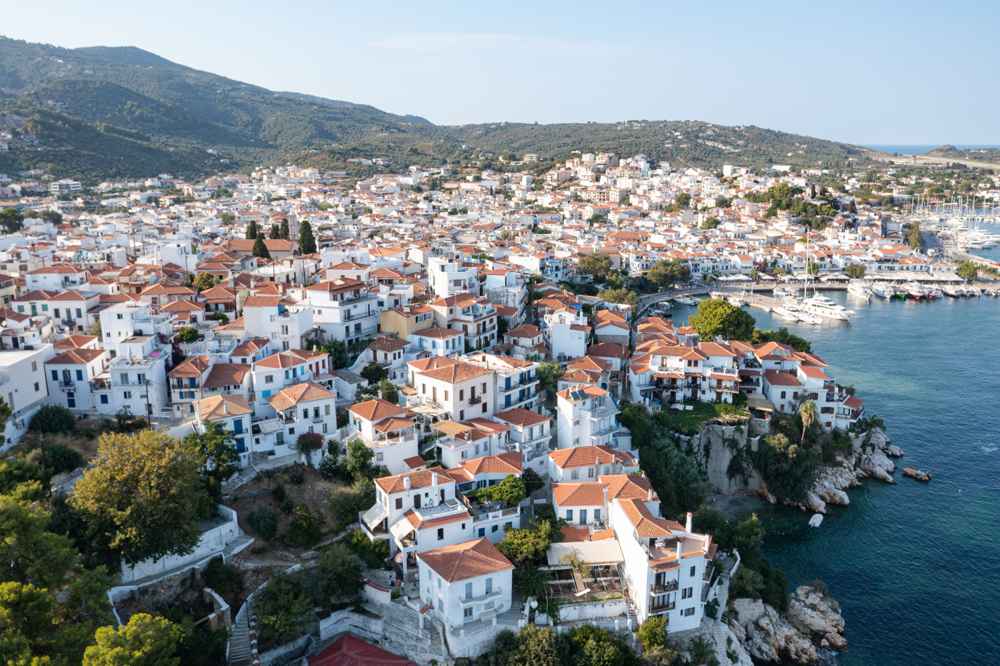
Xanemos beach stretches along the northeast coast of Skiathos, immediately beyond the airport runway and about 3 km from Skiathos Town. The name comes from the Greek word anemos. Meaning wind. The location honours it: this shore takes the full force of the northern Aegean while the island’s sheltered south coast stays flat. Sand mixed with pebbles, open-sea water, and jets crossing low overhead give Xanemos a character no other beach on the island shares. Plan the whole trip with Greece Tours.
This guide explains where Xanemos sits and how to reach it, why the wind shapes two entirely different beach days. What the sand-and-pebble shore offers swimmers in calm and rough conditions, how close the aircraft pass. How to watch them safely. Concrete distances, wind patterns, and viewing positions replace guesswork, so you arrive knowing whether the day suits a swim, a photo session under the flight path, or both.
Where Is Xanemos Beach on Skiathos?
Xanemos beach lies on the northeast coast of Skiathos, immediately beyond the northern end of the airport runway and about 3 km from Skiathos Town. A paved road past the terminal reaches the shore in under 10 minutes by car.
The beach sits at the northeastern tip of Skiathos, where the coastline turns from the sheltered town harbour toward the open Aegean. The airport runway occupies the narrow strip of flat land directly south of the sand, so arriving flights cross the shoreline moments before touchdown. Skiathos Town lies about 3 km away, a drive of under 10 minutes along the airport perimeter road. The short distance keeps the town’s tavernas and shops within easy reach, yet the beach stays far quieter than the harbour front. Xanemos faces north, looking across open water toward the Pelion peninsula on the mainland. The horizon here carries none of the islet clutter that frames the southern beaches of the island.
Access runs through the airport approach road. Drivers leave Skiathos Town on the ring road, follow the airport signs for about 2 km. Pass the terminal building. Continue along the runway fence until the asphalt gives way to a short unpaved stretch that ends at the sand. The drive takes under 10 minutes; on foot the same route takes about 40 minutes. No public bus serves Xanemos, so visitors without a vehicle rely on taxis from the town rank or on rented scooters. Roadside parking near the beach is unmarked and free, with space for roughly 20 cars on the flat ground behind the shore.
Cyclists manage the route comfortably too, since the total climb from the port stays under 40 m.
Development stops at the runway fence. Xanemos has no hotels, no beach bars. No sunbed concessions along its roughly 300 m of shoreline. Which keeps the setting closer to the island’s north-coast wilderness than to the resort strip around Koukounaries. Low hills covered in pine, olive, and Mediterranean scrub rise directly behind the sand, and a rough track climbs from the beach’s western end toward the uninhabited northern shore. Visitors carry their own water, food, and shade, since the nearest shops and tavernas stand back in Skiathos Town, about 3 km away. The absence of infrastructure has a practical upside: even in the first two weeks of August.
Arriving at midday still secures an open patch of sand without any negotiation over sunbeds.
Orientation on the ground is simple. The beach faces almost due north, with the runway’s northern threshold at its eastern edge and the open Aegean stretching toward the Pelion peninsula. Visible about 25 km across the water on clear days. Skiathos Town and its harbour lie hidden behind the airport isthmus to the south, so no town noise reaches the sand. Sunrise light strikes the beach from over the runway end, while late afternoon brings shadow earlier here than on west-facing shores. Swimmers use the western half of the beach, where the shoreline sits farthest from the perimeter fence, and photographers gather at the eastern end nearest the threshold.
The natural split keeps both groups comfortable and out of each other’s camera frames all day.
Why Is Xanemos Called the Windy Beach of Skiathos?
The name derives from anemos, the Greek word for wind, and describes the beach’s exposure honestly. Xanemos faces the open northern Aegean without shelter, so north winds hit it directly while the south coast of Skiathos stays calm.
Greek islanders name their shores plainly. Xanemos follows the pattern: the word builds on anemos. Wind, and marks the one beach near Skiathos Town that stands fully open to the north. The island’s geography explains the exposure. Skiathos tilts its inhabited side, with the port, the town, and the long resort coast, toward the south, where the bulk of the island blunts the weather. The northeast corner enjoys no such screen. Air moving down from the Sporades channel meets Xanemos first, before any ridge or headland has taken the edge off it.
Locals treat the name as a forecast as much as a label, and the beach confirms the reputation on most afternoons from mid-July onward through the height of summer.
The meltemi drives the beach’s rough days. This dry northern wind blows across the Aegean through July and August, building through the morning, peaking in early afternoon at force 4 to 6, and easing after sunset. Xanemos receives it head-on, so a meltemi day turns the shore into a band of breaking waves, blown spray, and sand that stings bare legs. The same hours leave the south coast flat, which is why the island’s sunbed beaches never advertise surf. Wave heights at Xanemos on strong meltemi afternoons reach about 1 m at the shoreline, modest by ocean standards yet forceful for the Aegean.
The wind also scrubs the air clear, giving the sharpest views across to Pelion of the whole summer season.
Calm days show the opposite personality. On mornings without a weather system over the Aegean, Xanemos lies glassy, with water so still that pebbles on the bottom stay visible 3 m down. The north-facing aspect that invites the wind also blocks the afternoon chop that stirs west-facing bays. A windless day here stays windless in a way the busier coast rarely matches. Early June and September deliver the highest share of these flat mornings, before and after the meltemi season. Swimmers who arrive by 09:00 on such days get open-sea clarity, empty sand, and water that carries the deep blue of real depth rather than the turquoise of shallow lagoons.
The beach rewards anyone who checks the forecast the night before.
Reading the day takes one glance from the road above the shore. Whitecaps on the channel mean the wind has settled in, the swim will be short and physical, and the beach belongs to wave-watchers and photographers. A flat, dark-blue sea means hours of easy swimming ahead. Wind forecasts for the northern Sporades give reliable notice, since the meltemi announces itself a day in advance on any marine weather chart. Visitors planning a full beach day use a simple rule: north wind above 15 knots, drive to the sheltered side and pick from the calm Skiathos beaches. Anything less, Xanemos offers the emptier and wilder alternative.
The rule fails on fewer days than any other planning shortcut on the island.
What Is Swimming Like at Xanemos Beach on Skiathos?
Xanemos offers open-sea swimming over a bed of coarse sand and smooth pebbles, with water that deepens within 10 m of the shoreline. Calm mornings give clear, cool conditions; meltemi afternoons bring waves that demand real swimming ability.
The shore mixes coarse golden-grey sand with bands of smooth pebbles, and the ratio shifts along the 300 m of beach. The western half carries more sand underfoot, while the section nearest the runway threshold runs pebblier, with stones from thumb-sized up to fist-sized at the waterline. Water shoes solve the entry for anyone with sensitive feet, and children manage better on the sandy western stretch. Underwater, the pebbles continue for the first 5 m and then give way to a sand bottom that stays visible in the clear water.
The mixed surface has one advantage over pure sand: the water clouds far less when waves stir the shallows, so visibility holds up even on days with moderate movement offshore.
Depth arrives quickly. The bottom drops to chest height within about 10 m of the waterline and keeps falling, which marks Xanemos as a swimmer’s beach rather than a paddling one. Confident swimmers appreciate the immediacy, three strokes and the shore is gone, while parents of small children stay within the first band of shallows. The water runs a degree or two cooler than the enclosed southern bays, since the open channel mixes constantly; in August it reaches about 25°C at the surface. Clarity is the standout feature. The north coast has no rivers, no harbour, and no boat anchorage nearby, so the water carries none of the sediment or fuel film that busy bays collect.
Masks and snorkels earn their place in the beach bag here.
Calm conditions turn the beach into the finest open-water swimming near Skiathos Town. The rocky edges at both ends of the sand hold the marine life: wrasse. Saddled bream. Sea urchins along the boulders, with octopus dens in the deeper crevices at around 4 m. Distance swimmers trace the shoreline west toward the headland and back, a round trip of roughly 1 km in water free of moorings and motor traffic. Snorkellers work the eastern rocks below the runway threshold, where the drop-off starts sooner. Morning light penetrates deepest before the surface picks up texture, so the hours between 08:00 and 11:00 give the clearest viewing.
The seabed slopes evenly without sudden holes, which keeps navigation simple for swimmers of moderate experience.
Rough days demand respect. Xanemos has no lifeguard, no flag system, and no swimming enclosure, so every judgement falls on the swimmer. Waves arriving on a strong meltemi break directly onto the pebble bank and drag back with force, and the backwash unbalances adults standing thigh-deep. The safe pattern on such days keeps swimmers inside the first 15 m. Parallel to the beach. Out of the water entirely once whitecaps run in continuous lines across the channel. Children stay on the sand in these conditions. The waves look modest from the road and feel different at the shoreline, a standard trap for visitors accustomed to enclosed bays.
Locals swim here through rough spells by entering at the sandier western end, where the break loses part of its punch.

How Low Do Aircraft Fly Over Xanemos Beach on Skiathos?
Aircraft cross the Xanemos shoreline at heights of roughly 30 to 60 m during landings toward the south and climb directly over the beach on departures to the north. The runway threshold sits within about 150 m of the sand.
The geometry explains the spectacle. Skiathos airport operates a single runway of about 1,600 m, short for commercial jets, built on a narrow isthmus with the sea close at both ends. Pilots landing toward the south cross the Xanemos shoreline seconds before the wheels touch, because the runway threshold begins almost at the beach and the short strip leaves no room for a high, shallow approach. Departing aircraft rolling north lift off near that same threshold and pass over the water low, engines at full thrust. The arrangement puts Xanemos in a tiny club of beaches worldwide, with Maho Beach on St.
Maarten the famous sibling, where scheduled airliners and swimmers share the same strip of air and ground.
Traffic follows the holiday calendar. Summer brings the charter wave: airliners from British, German, Italian. Scandinavian cities land from late morning through the evening, joined by the year-round domestic service from Athens on smaller aircraft. Peak Saturdays in July and August bring upward of 20 movements, while a winter day sees the Athens rotation and little else. Wind direction decides the show at Xanemos. On days with southerly wind, arrivals descend over the beach itself, wheels down, close enough for watchers to read the operator’s name along the fuselage. On meltemi days the pattern flips: aircraft land from the town side and climb out over Xanemos instead, higher than an arrival yet louder at full power.
Both patterns reward an hour on the sand.
The pass itself lasts seconds and registers in the whole body. An arriving jet appears over the channel as a growing set of landing lights. Holds a steady descent over the water. Crosses the beach with a sound that moves from hum to roar to a sharp fade as it drops behind the fence line. Beachgoers feel the engine note in the chest at the closest points. The scale surprises first-time visitors most: an airliner at 40 m fills the sky in a way no photograph conveys, and conversations on the sand stop mid-sentence for every arrival.
Between movements the beach returns to wind and wave sound within a minute, since the taxiway and terminal sit at the far end of the runway.
Xanemos offers the calmer of the island’s two viewing experiences. The famous spot, the public road pressed against the southern threshold where crowds line the fence for the extreme low passes. Sits at the opposite end of the runway near the port. That location delivers closer passes and bigger crowds; Xanemos delivers a beach. Watchers here spread a towel, swim between arrivals, and track each aircraft against open sea and sky rather than over asphalt. Photographers rate the northern end for exactly this backdrop: water in the foreground, the aircraft mid-frame, and the hills of the mainland behind.
Families favour it too, since children watch from the sand at a comfortable distance instead of standing on a road shoulder among parked scooters.
How Do You Watch Planes Safely from Xanemos Beach on Skiathos?
Safe spotting at Xanemos means staying on the sand, keeping clear of the runway fence, and standing back from the threshold during southbound departures, when aircraft line up beside the beach and jet blast pushes gravel and spray outward.
Position decides both the photograph and the experience. The eastern end of the beach, nearest the runway threshold, puts arrivals almost directly overhead and suits wide-angle shots that squeeze aircraft, sea, and sand into one frame. The middle of the beach gives the classic side-on view of a jet crossing the shoreline, best with a standard zoom around 70 mm. The rise behind the western end adds height, letting photographers shoot slightly down onto the flight path with the channel as a backdrop. Light favours the afternoon, when the sun stands behind a viewer facing the runway and paints the fuselages instead of silhouetting them.
Flight-tracking apps give 10 minutes’ notice of each arrival, which turns a random wait into a planned photo session.
Jet blast deserves the respect the warning signs demand. An airliner departing toward the south lines up beside the northern threshold with its engines pointed at the beach. The exhaust stream stays strong enough beyond the fence to stagger an adult and fling pebbles at painful speed. The danger zone concentrates around the threshold end of the sand during those departure runs. The correct response is distance: watchers move to the middle or western beach before a jet lines up. Loose items rank as the second hazard, since towels, hats, and umbrellas travel far once the blast arrives.
Nothing about the risk hides itself; the airport posts warnings, and the blast announces itself with a rising howl before the aircraft even starts moving.
Ground rules at the fence stay simple and firmly enforced. The perimeter fence marks an absolute boundary: climbing it, leaning objects on it, or passing anything over it breaks Greek aviation law and ends with the airport police involved. Drones are banned across the entire airport zone, which covers the whole beach, so aerial photography stays off the menu regardless of the angle on offer. Laser pointers and flash bursts aimed at cockpits carry criminal penalties. None of these restrictions limits normal spotting, and cameras, binoculars, and radio scanners all remain welcome on the sand. The working principle mirrors every airport boundary in Europe: watch anything, photograph anything, interfere with nothing.
Visitors who follow it never have a difficult conversation at Xanemos.
A full Xanemos day combines both of the beach’s identities on one towel. The rhythm sets itself: swim in the gaps, dry off when the tracking app shows an arrival 10 minutes out, watch the pass, and return to the water. Morning suits the swimming half, with the calmest sea and the clearest light below the surface. Afternoon suits the spotting half. With denser arrivals and better sun angles on the aircraft. Carrying everything matters, from water and food to shade and a windproof bag for the blast moments, since the beach sells nothing.
The combination has no equal elsewhere on the island: the resort coast offers easier swimming and the harbour offers boats, yet only Xanemos lets a visitor log airliners between swims.
How do you get to Xanemos beach on Skiathos?
Xanemos beach sits about 3 km northeast of Skiathos Town, reached by a short drive or scooter ride around the airport runway on a partly rough road ending at a small parking area.
The road to Xanemos leaves Skiathos Town along the northeast shore and skirts the airport perimeter fence. Drivers follow the tarmac past the runway threshold, then meet a stretch of packed dirt and loose gravel near the coast. This final section runs about 500 metres and carries potholes after rain. A standard hire car covers it slowly in dry weather, and clearance matters on the rougher patches. The distance from town totals roughly 3 km, a drive of about ten minutes at a careful pace. Signposting stays sparse, so the runway itself acts as the main landmark. Once the fence ends, the track drops toward the pebbles and the small clearing where cars stop.
Local traffic stays light outside the midday swimming window. Cyclists reach it too, though the gravel demands care.
Parking at Xanemos means a rough clearing rather than a marked lot. Space holds about a dozen cars, and it fills fast on calm mornings when swimmers and plane-spotters arrive together. Drivers pull onto the flat gravel above the pebbles and leave room for others to turn. Scooters slot in easily along the edge. A car booked through Skiathos car rental handles the approach comfortably, though a scooter suits the tight final track better. Shade for parked vehicles stays scarce, so a sunshade across the windscreen helps on hot afternoons. Nobody collects a fee here. Late arrivals also line the verge back toward the fence, adding a short walk to the water.
Turning space tightens once the clearing is full. Arriving before the day heats up secures the easiest spot.
Scooter riders reach Xanemos with the least fuss. The narrow gravel and tight turns suit two wheels, and parking never becomes a problem. From the town waterfront the ride follows the same northeast road past the airport, taking under fifteen minutes. Helmets matter on the loose surface, where a front wheel slides on gravel without warning. Taxis run out from town as well, dropping passengers at the clearing for a short fixed hop. The road stays passable through the dry season, though winter rain cuts channels across the dirt. Buses do not serve this corner, so private transport remains the only practical route.
Walking the full 3 km from town works for the determined, following the shoreline path past the runway threshold in warm sun.
The approach rewards a slow, watchful pace over the final stretch. Loose stones and the odd rut punish speed, and the gravel throws dust over anyone following close. Drivers keep windows shut on the last 500 metres to spare the cabin. The clearing appears suddenly where the fence line falls away toward the sea. Beyond it the pebbles slope to the water within about five steps. Morning arrivals find the surface firmer and cooler before the sun bakes the dirt. Anyone nervous about the track leaves the car near the fence and covers the last stretch on foot in minutes. The route stays the same on the return, so a mental note of the roughest ruts saves guesswork.
Clear light makes the runway threshold an easy marker throughout.
What you bring to Xanemos beach for a day with no facilities?
Xanemos offers no cafe, sunbeds, or taps, so visitors carry everything for the day. Water, food, shade, and reef shoes for the pebbles head the list, alongside a rubbish bag to leave the beach clean.
Water tops every Xanemos packing list because no tap or kiosk stands near the pebbles. Two litres per person covers a half-day in strong sun, and more suits a full day. A cool bag keeps drinks and a picnic from spoiling in the heat. Fruit, bread, and cheese travel well and leave very little waste behind. The nearest shops sit in Skiathos Town, about 3 km along the airport road, so a stop before leaving saves a hot return. Ice from a town supermarket stretches the cool bag well through the afternoon. Nothing gets sold at the beach itself, and the clearing holds no vending machine.
Planning the food before the drive turns a bare beach into a comfortable base for hours by the water.
Shade never occurs naturally at Xanemos, since no trees or umbrellas back the open pebbles. A beach umbrella with a sturdy sand-and-stone anchor becomes essential in summer sun. Wind complicates the setup, so guy lines and a screw-in base hold better than a simple spike. A pop-up sun tent shrugs off gusts and doubles as a windbreak on breezy afternoons. Light-coloured fabric reflects heat and keeps the space beneath cooler. Hats, long sleeves, and high-factor sunscreen guard against the reflected glare off water and pale stones. The exposed setting means the sun reaches every corner from morning to dusk.
Setting shade against the prevailing wind, rather than square to it, stops the whole rig lifting when the meltemi builds through the day. A folded towel weighs the base against sudden gusts.
Reef shoes earn their place on the Xanemos mix of sand and pebbles. The stones grow hot underfoot by midday and hide sharp edges beneath the shallows. Sturdy sandals or water shoes protect toes on the walk from the clearing to the sea. A thick mat or padded lounger softens the pebble bed better than a thin towel. Dry bags keep phones and cameras safe from spray when the waves pick up. A small first-aid kit covers scrapes from the stones, since no help waits nearby. Sunglasses cut the glare that bounces off pale rock and bright water.
Packing these items into one sturdy backpack keeps the walk from the parking clearing to a single trip across the loose gravel and warm pebbles. Spare dry clothes round out a comfortable kit.
Rubbish leaves with every visitor, because no bins stand at Xanemos or its parking clearing. A sturdy bag collects wrappers, bottles, and food scraps for disposal back in town. The meltemi scatters loose litter fast, dragging it into the sea within moments. Reusable containers and a refillable bottle cut waste before it starts. Cigarette ends bury easily in the pebbles, so a small tin keeps them contained. The beach stays clean only through the care each group brings and takes away. A whistle or charged phone adds a safety margin on a shore with no lifeguard.
Loading the packed-out rubbish into the car before the drive keeps the rough airport road free of anything blown loose from an open boot along the gravel. Clean habits protect the pebbles for the next group.
What is the view like from Xanemos beach toward Tsougria and the channel?
Xanemos looks southeast across open water to the islet of Tsougria and the channel between it and Skiathos. Passing ferries, yachts, and fishing boats cross this stretch, while the northeast horizon stays broad and unbroken.
Tsougria rises green and low across the water south of Xanemos, its wooded slopes clear on a bright day. The channel between the islet and Skiathos carries a steady procession of vessels through the season. Ferries bound for Skiathos Town trace the far side, and yachts anchor in Tsougria’s sheltered bays. The outlook opens wide from the pebbles, unbroken by headlands close at hand. Distance to the islet reads at roughly 3 km across the strait. Light shifts the scene through the day, from flat morning calm to wind-chopped afternoon blue. Boats leaving the harbour pass within easy sight, their wakes catching the sun.
This broad channel view gives Xanemos a horizon far wider than the enclosed coves along the sheltered south coast of the island.
The channel doubles as a working sea lane, busy with traffic through daylight hours. Hydrofoils and ferries link Skiathos with Volos and the mainland ports, crossing the strait on schedule. Sailing yachts tack across the wind, their sails bright against Tsougria’s dark treeline. Fishing boats work the shallows at dawn and return past the beach by mid-morning. Watching this movement fills the gaps between swims, a slow parade set against the islet. Binoculars bring the far shore and passing hulls into sharp focus. The open aspect also catches the meltemi cleanly, so the same wind that raises waves also fills the sails offshore.
This constant sea traffic turns the Xanemos horizon into a changing scene rather than an empty stretch of blue. Sunset drops behind the town headland to the west.
Tsougria itself draws day-trippers from Skiathos Town by caique through the summer. Its two sandy bays face the main island, sheltered from the meltemi that batters Xanemos. Swimmers on the beach watch these little boats ferry passengers across the strait each morning. The islet stays uninhabited beyond a seasonal beach taverna serving the day crowd. Pine and low scrub cover its ridges, matching the green flanks of Skiathos behind. From the Xanemos pebbles the shape reads as a single wooded hump above the waterline. Boats crossing to it thread between smaller rocks that break the surface offshore.
This near neighbour gives the view a focal point, a green anchor that holds the eye against the wide blue channel and the open northeast sky above. Cloud shadows drift across its slopes on breezy days.
The channel view pairs with the low aircraft to make Xanemos a rare double subject. A camera catches a ferry mid-strait one moment and a jet over the runway the next. Morning light falls from the east, lighting Tsougria and the water toward the beach. Afternoon sun swings west and silhouettes the boats against a brighter horizon. A polarising filter deepens the blue and cuts the glare off the chopped surface. Wide framing takes in the whole strait, from the beach edge to the distant islet. Longer lenses pull passing hulls and Tsougria’s taverna into detail.
This combination of open sea and busy sky rewards a patient hour on the pebbles, where the changing traffic keeps the same broad view fresh through the day. Golden light near dusk warms the whole channel scene.
When is the best time of day to visit Xanemos beach on Skiathos?
Xanemos rewards an early start, since mornings bring calm, glassy water and cooler pebbles. The meltemi strengthens after midday, raising waves and chop, so swimmers seeking flat water arrive before the wind builds.
Mornings at Xanemos hold the calmest water of the day. The meltemi sleeps at dawn, leaving the surface glassy and clear over the sand-and-pebble bottom. Early swimmers find gentle entry and long views straight down through still water. Cooler pebbles make the walk from the clearing easy on bare feet. The light falls from the east, bright on Tsougria and soft on the beach. Fewer cars sit in the clearing before mid-morning, so parking comes without a scramble. Snorkellers work the shallows while visibility stays high and the swell holds off.
This early window suits families and anyone wary of the afternoon chop, turning an exposed beach into a settled swimming spot for two or three quiet hours after sunrise. Birdsong from the airport scrub carries on the still air.
Afternoons change the mood as the meltemi rises from the north. Wind builds through the early afternoon and drives waves onto the exposed pebbles. The chop churns sand into the shallows, cutting the clear morning visibility. Strong gusts lift umbrellas and scatter loose gear across the beach. Bodyboarders and stronger swimmers enjoy the waves that daunt cautious bathers. The reflected heat off the pebbles eases as the breeze sweeps the shore. Spray drifts inland, so cameras and phones need dry bags close at hand. This windier half of the day gives Xanemos its livelier face. Drawing plane-spotters who pair the gusty swell with the low aircraft that thread the same north wind on their final approach.
Flags on distant masts stand stiff by then. The clearing fills as the swell draws a crowd.
The meltemi shapes the Xanemos calendar as much as the daily clock. This dry north wind blows hardest through high summer, gusting for days at a stretch. Spring and autumn bring gentler air and more settled afternoons on the pebbles. A calm forecast turns even the afternoon into flat swimming time. Windy spells push the best hours firmly toward dawn and early morning. Checking a marine forecast before the drive saves a wasted trip on a rough day. The beach faces the wind head-on, so a north or northeast reading means real waves.
Reading the sky over Tsougria gives a rough live guide, since a whitecapped channel warns of chop building well before the swell reaches the Xanemos shore. Locals time their swims by this simple sky check.
A smart Xanemos plan splits the day around the wind. An early swim in glassy water fills the calm morning hours before the meltemi wakes. A midday break in town or under solid shade covers the fierce heat and rising gusts. Plane-spotters return in the windy afternoon, when arrivals bank steeply against the north wind. This rhythm turns the beach’s exposure into an asset rather than a drawback. Watching the flags and the channel guides each move through the day. A flexible schedule beats a fixed plan on a shore ruled by the breeze. Anyone chasing both flat water and steep landings works the two ends of the day.
The blustery middle suits lunch away from the spray and the loose gravel. The wind sets the schedule here, not the clock.
How can you combine a visit to Xanemos beach with Skiathos Town or the runway-fence viewpoint?
Xanemos sits about 3 km from Skiathos Town, so a swim pairs easily with lunch, shopping, or the waterfront. The airport-fence viewpoint lies minutes away along the same road for close-up plane-spotting.
A short drive links Xanemos with the heart of the island’s main settlement. The same airport road runs back to Skiathos Town in about ten minutes, closing the 3 km gap. A calm-morning swim slots neatly before a late lunch at a harbour taverna. The town supplies everything the beach lacks, from cold drinks to sun cream and ice. Shops along the paved lanes restock a cool bag for a second beach stint. The waterfront fills the windy afternoon while the meltemi churns the Xanemos pebbles. Evening brings the old town’s alleys and the Bourtzi headland into easy reach. This pairing turns a bare, exposed beach into one half of a full island day.
The shops, shade, and food of the busy port balance the wild shore.
The airport-fence viewpoint sits a short hop from the Xanemos clearing along the same coast road. This spot at the runway’s end puts spectators directly under the landing path. Jets clear the fence low, their wheels down and engines loud on final approach. Departing aircraft roll past and lift steeply over the water toward the mainland. A swim at Xanemos and a stint at the fence combine sea and spectacle in one trip. The fence stretch offers no beach, only a roadside verge and the runway threshold. Ear protection helps close to the tarmac, where the noise peaks on each takeoff.
Pairing the two spots gives plane-spotters the best of both angles, the low overhead pass from the pebbles and the head-on landing framed by the fence.
A full loop ties the beach, the fence, and the town into one route. Morning starts with calm water at Xanemos before the meltemi wakes. A walk to the fence follows for the busy stretch of midday arrivals. Lunch back in town covers the windiest hours away from the spray. An afternoon return catches the swell and the steep, wind-braced landings together. The whole circuit spans barely 6 km, so fuel and time stay modest. A hire car or scooter makes each leg quick along the northeast shore. This flexible loop suits a single day that mixes swimming, plane-spotting. Town life.
Letting the wind decide the order rather than forcing a rigid march from one fixed stop to the next. Sunset from the town waterfront closes the loop well.
Pairing Xanemos with town also solves the beach’s lack of shade and food. The 3 km run to the port fixes any shortfall within minutes. A morning swim needs no cafe when lunch waits along the harbour front. The fence viewpoint adds spectacle without needing its own facilities beside the road. Together the three points cover swimming, plane-spotting, and rest in a tight triangle. Each leg stays short enough for a scooter to link them without strain. The wind that empties the beach at midday fills the sheltered town instead. This clustering makes Xanemos an easy addition rather than a standalone trip.
It folds a wild, exposed shore into the wider comfort of Skiathos Town and the runway-fence view along one coastal road. One road knits every stop into a single outing.
Frequently Asked Questions
Is Xanemos beach on Skiathos suitable for children?
Xanemos suits children best on calm mornings, before the meltemi raises waves on the exposed shore. The gentle dawn water and shallow sand-and-pebble entry let young swimmers paddle safely near the edge. Parents watch the wind closely, since the afternoon chop turns the same beach lively and rougher. No lifeguard patrols Xanemos, so an adult stays within arm’s reach of small children at all times. The pebbles heat up by midday, making reef shoes useful for little feet on the walk to the water. Bring plenty of shade, as no trees or umbrellas shelter the open bay. A calm forecast makes the trip far easier with kids, while a strong north wind points toward a sheltered beach elsewhere.
Snacks, water, and spare clothes matter because no cafe stands nearby. Low aircraft passing overhead often thrill children, adding a free show between swims. Timing the visit around the wind keeps a family day at Xanemos safe and comfortable.
Can you reach Xanemos beach by scooter?
Scooters reach Xanemos easily and handle the final rough track better than most cars. The route follows the northeast coast road from Skiathos Town, skirting the airport fence for about 3 km. The last 500 metres turn to packed dirt and loose gravel near the coast. A scooter’s small wheels and light weight cross this stretch with care at low speed. Helmets matter here, since a front wheel slides on gravel without warning. Parking never becomes a problem, as two wheels slot in easily along the clearing’s edge. The ride from town takes under fifteen minutes at a steady pace. Riders keep speed down on the loose surface to hold traction through the ruts.
Dust rises on the dry track, so sunglasses or a visor protect the eyes. A scooter also links Xanemos with the airport fence and town in one short loop. This makes two wheels the simplest way to reach the beach along its rough approach.
Is there any shade at Xanemos beach?
Xanemos offers no natural shade, since no trees, umbrellas, or buildings back the open pebbles. Visitors bring their own cover for any comfortable stay through the middle of the day. A sturdy beach umbrella with a screw-in base holds against the meltemi better than a simple spike. A pop-up sun tent doubles as a windbreak when the north wind rises in the afternoon. Guy lines and weighted bags stop the whole setup lifting in strong gusts. Light-coloured fabric reflects heat and keeps the space beneath it cooler. Hats, long sleeves, and high-factor sunscreen guard against the glare off water and pale stones. The exposed setting means the sun reaches every corner from dawn to dusk.
Setting shade against the prevailing wind, rather than square to it, keeps the rig stable. Anyone without gear escapes the midday heat by pairing a morning swim with lunch in nearby town instead. A folded towel adds weight to any base against sudden gusts. Shade planning turns the bare shore into a workable spot for hours.
Is Xanemos beach good for snorkelling?
Xanemos rewards snorkelling on calm mornings, when the meltemi sleeps and the water turns glassy and clear. The sand-and-pebble bottom slopes gently, giving good visibility over the shallows near the shore. Small fish gather around the scattered rocks that break the surface toward the channel. Reef shoes protect feet on the pebbles during entry and exit from the water. A mask and snorkel suffice, since the calm dawn sea stays shallow and settled close in. Afternoon wind ends the clear conditions fast, churning sand into the shallows and cutting visibility. Swimmers watch the surface for the first whitecaps, which signal the rising chop offshore.
A float or bright cap keeps a snorkeller visible on a beach with no lifeguard. The rocks near Tsougria’s channel side hold the most life on a settled day. Early timing gives the best water, so snorkellers reach Xanemos soon after sunrise before the breeze builds. Calm water and low rocks make it a simple snorkel spot.
How do you photograph aircraft arrivals at Xanemos beach?
Xanemos gives photographers a rare low angle on aircraft crossing the beach toward the runway threshold. Planes on approach pass overhead within tens of metres, filling a wide frame with detail. A shutter speed around 1/500 freezes the fuselage while keeping the propellers or engines sharp. Morning light falls from the east, lighting incoming jets against the sky over the sea. Afternoon sun swings west and silhouettes arrivals for a bolder, high-contrast shot. A zoom lens covers both the tight overhead pass and the wider approach across the channel. Checking arrival patterns helps time the wait, since aircraft cluster around certain hours.
The north wind sets the landing direction, so a strong meltemi means planes approach over the water. Ear protection helps near the runway end, where the noise peaks on each pass. Steady footing on the pebbles and a firm grip capture the fast, low crossings cleanly above the shore. Patience through a busy hour yields the sharpest arrival frames.
How can you check the wind before visiting Xanemos beach?
Xanemos faces the meltemi head-on, so a wind check before the drive shapes any visit. A marine or weather forecast for Skiathos gives the day’s wind direction and strength. A north or northeast reading means real waves on the exposed pebbles by afternoon. A light or southerly forecast points to calm water and easy swimming through the day. The meltemi blows hardest in high summer, gusting for days at a stretch. Spring and autumn bring gentler air and more settled afternoons on the beach. Reading the sky over Tsougria gives a rough live guide before setting out. A whitecapped channel warns of chop building well before the swell reaches the shore.
Flags on masts in town stand stiff once the wind climbs. Morning stays calmest whatever the forecast, so an early start beats a windy afternoon. Checking the wind first turns Xanemos from a gamble into a planned, comfortable beach day. This simple habit saves a wasted trip on a rough day.
Where can you swim near Xanemos when the meltemi blows?
Xanemos loses its calm on windy days, so sheltered beaches on the south coast serve as better swimming spots. Vromolimnos and Troulos face away from the north wind and stay calmer through the afternoon. Koukounaries, at the island’s west end, offers a long sheltered bay backed by pine. Tsougria’s two bays, reached by caique from Skiathos Town, hide from the meltemi across the channel. The south-coast beaches sit within a short drive along the main island road. Each keeps flatter water when the north wind churns the exposed northeast shore. A scooter or hire car links them quickly for a mid-visit switch. Checking the wind direction first points toward the sheltered side for the day.
Xanemos still rewards a calm-morning swim before the breeze builds. Keeping a south-coast backup in mind turns a blustery forecast into an easy change of beach rather than a lost day by the sea. A flexible beach plan beats a fixed choice on a gusty day.