
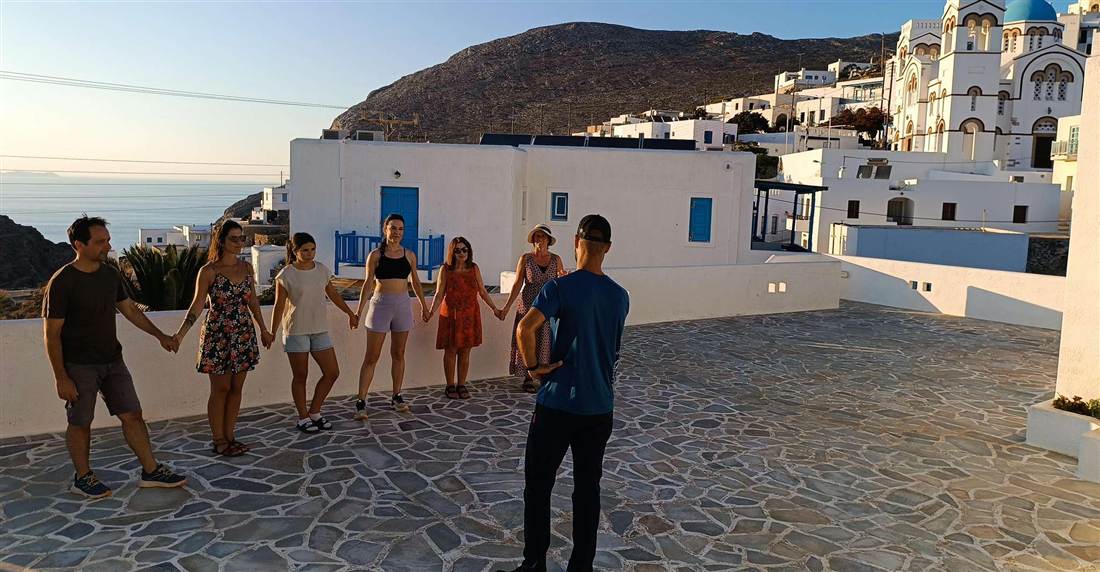
An Amorgos Greek night fills a village square with violin and laouto, circle dances, patatato and psimeni raki, above all on feast days. Greek nights and tours on other islands sit on Greece Tours.
This page covers the bookable classes, the music, the feasts, food, places, seasons and customs.
What is an Amorgos Greek night?
An Amorgos Greek night is an evening of live island music, circle dances, shared food and local drinks. The phrase covers village feasts called panigyria, taverna music nights and dance classes that visitors can book on the island.
No island of the Cyclades lies farther east than Amorgos. It is also the closest Cycladic island to the Dodecanese group. Its municipality takes in 16 neighbouring islets, and fewer than 2,000 people live there. You can reach the island only by boat.
The three main bases for visitors are Chora, Katapola and Aegiali. The Luc Besson film The Big Blue made Amorgos an international destination for travellers and free divers. Our page on Amorgos island covers the rest of a trip.
The island’s table has old roots. The ancient writer Heraclides Lembus recorded that Amorgos produced much wine, as well as olive oil and fruit.
An Amorgos Greek night takes three shapes on the island:
- Village feast (panigyri): a village celebration with live music, dancing and shared food.
- Taverna music night: an evening of live music around taverna tables.
- Dance class: a booked lesson in island steps with a local teacher.
Feasts and taverna nights depend on the village and the date. A dance class runs on a fixed booking, so it is the simplest way to plan an Amorgos Greek night ahead of your trip.
Which Amorgos Greek night experience can you book?
The main Amorgos Greek night experience you can book online is the GetYourGuide “Amorgos: Greek Dance Class with Local Instructor”. The 2-hour lesson teaches authentic island steps, Cycladic rhythms and the stories behind each dance.
The card lists these booking details:
- Language: English
- Group: 2 to 12 participants per booking
- Ages: adults from 18, plus a child ticket for ages 17 and under
- Cancellation: free
- Booking window: at least 10 hours before the start
The dance card does not name a village. Check the meeting point in your booking confirmation, and plan your transport there before the day.
Learning the steps first means you can join the circle at your next Amorgos Greek night instead of watching from a table.
Our Amorgos cooking class page covers the food side: the “Amorgos: Greek Cooking or Pastry Class” in Tholaria. It runs for 1.5 hours in small groups, in English or Greek, and you eat your dishes on a hotel terrace with Aegean views.
Booked on the same trip, the two classes cover the food and dance sides of an Amorgos Greek night. Then you can join a village feast or a taverna table with confidence.
Which dances and music fill an Amorgos Greek night?
An Amorgos Greek night runs on nisiotika, the songs and dances of the Aegean islands. Violin, laouto and tsampouna carry the tunes, while dancers move through syrtos, ballos and kalamatianos in linked lines that curve around the floor.
Nisiotika is the island music of the Aegean and the sound of an Amorgos Greek night. The lyre is its main folk instrument, joined by the violin, the laouto (lute) and the tsampouna. Musicians play the lyre and violin in a microtonal style. Cretan music has left clear marks on the Cyclades and the Dodecanese.
The tsampouna is the island bagpipe. Air from the player’s mouth fills a goatskin bag, which feeds two melody pipes with no drone. The instrument is widespread across the Greek islands. Known examples come from the Cyclades, the island group that includes Amorgos, and the Dodecanese.
- Syrtos: dancers link hands in a chain or circle and move in 4/4 time. The leader breaks away now and then to improvise steps. Island versions, called nisiotikoi, include Syrtos Naxou and Syrtos from Paros.
- Ballos: a couples’ dance and a form of syrtos, born in Greek island culture. Its figures act out a courtship, set to a joyous, lyrical melody.
- Kalamatianos: a chain dance in 7/8 time that turns counterclockwise. Known across Greece, Cyprus and abroad, it is danced at Easter and at weddings.
At an Amorgos Greek night, the circle follows clear rules. Dancers hold hands in a curving line and face right. The dancer at the right end leads. In kalamatianos, the leader holds the second dancer by a handkerchief. That grip frees the leader for more elaborate steps, jumps and squats.
How does a Greek dance class work before an Amorgos Greek night?
A Greek dance class prepares you for an Amorgos Greek night. A local instructor teaches the island steps, explains the Cycladic rhythms and shares the stories behind each dance, so the circle feels familiar when the music starts.
Ask the instructor which dances the session covers, and write down the count for each one. The note helps you recall the steps when the band starts at an Amorgos Greek night.
Simple habits make the first steps easier:
- Wear comfortable, flat shoes with a good grip.
- Learn the basic count. Kalamatianos runs slow, quick, quick, with three steps to each bar.
- Follow the leader and copy the dancer beside you.
- Join near the end of the line, away from the leader.
The class gives you the confidence to join a village feast at an Amorgos Greek night. When musicians strike up in one of the Amorgos villages, you step into the circle and keep pace with the islanders.
Which village feasts turn into an Amorgos Greek night?
The village panigyria turn into an Amorgos Greek night. A panigyri is a feast held on a church’s saint’s day. It starts with a service, then the village shares food, local music and dancing that run late into the night.
At Tholaria, the feast of Agioi Anargiroi runs from 30 June to 1 July. A Divine Liturgy and a procession of the icon come first. Then the village fills with people who eat and dance to traditional music, and the Amorgos Greek night begins.
The feast of Agia Paraskevi falls on 25 and 26 July at its church in Kato Meria, in southern Amorgos. Preparations start ten days ahead. The official Amorgos site calls it the biggest festival in the Cyclades. On 26 July, this Amorgos Greek night brings food, local music and dance.
Other feast dates:
- Klidona, a midsummer feast with music and dance in Chora, 23 June
- The Psimeni Raki Festival in Katapola, 26 July, with dancing until the next morning
- Panagia Epanochoriani in Langada, 14 and 15 August
- Stavros, at the north tip of the island, 13 and 14 September
On 21 November, Amorgos honours Panagia Hozoviotissa at the Hozoviotissa Monastery near Chora. Hozoviotissa is the protector of Amorgos, and the day is a local holiday. Worshippers and visitors arrive from across Greece.
What do you eat and drink at an Amorgos Greek night?
At an Amorgos Greek night, the main dish is patatato, goat stewed with potatoes. The signature drink is psimeni raki, made with raki, honey and spices. Wine and local sweets such as pasteli and loukoumades complete the feast table.
Patatato is the national dish of Amorgos, and villages cook it for their panigyria. The recipe uses goat meat, potatoes, onion, olive oil, red wine and cinnamon sticks. At Agia Paraskevi, it is prepared on the evening of 25 July. When the Tholaria feast falls on a Wednesday or Friday, fasting food replaces it.
Psimeni raki is the drink of an Amorgos Greek night. It blends raki with honey, cinnamon, clove and caramel. It is served at room temperature, as an aperitif or a digestive. Its ingredients resemble rakomelo, but the two are different drinks. The Feast of Christ in Chora on 6 August is celebrated with wine and live music.
Feast sweets and snacks include:
- Loukoumades, fried dough balls, common at festivals
- Pasteli, a sesame and honey bar
- Anevates, a cheese and raki pie served at the Psimeni Raki Festival
- Xerotigana, the Christmas and Easter sweet, with its own festival in Aegiali on 5 September
Taverns around the island serve patatato too, so the taste of an Amorgos Greek night lasts beyond feast days. For more local dishes, read our Amorgos food page.
Where does an Amorgos Greek night take place?
An Amorgos Greek night takes place in Chora, Katapola or Aegiali. These are the three main places where visitors stay on the island. Music fills village squares and churchyards during feasts. In summer, tavernas and bars also host live music after dark.
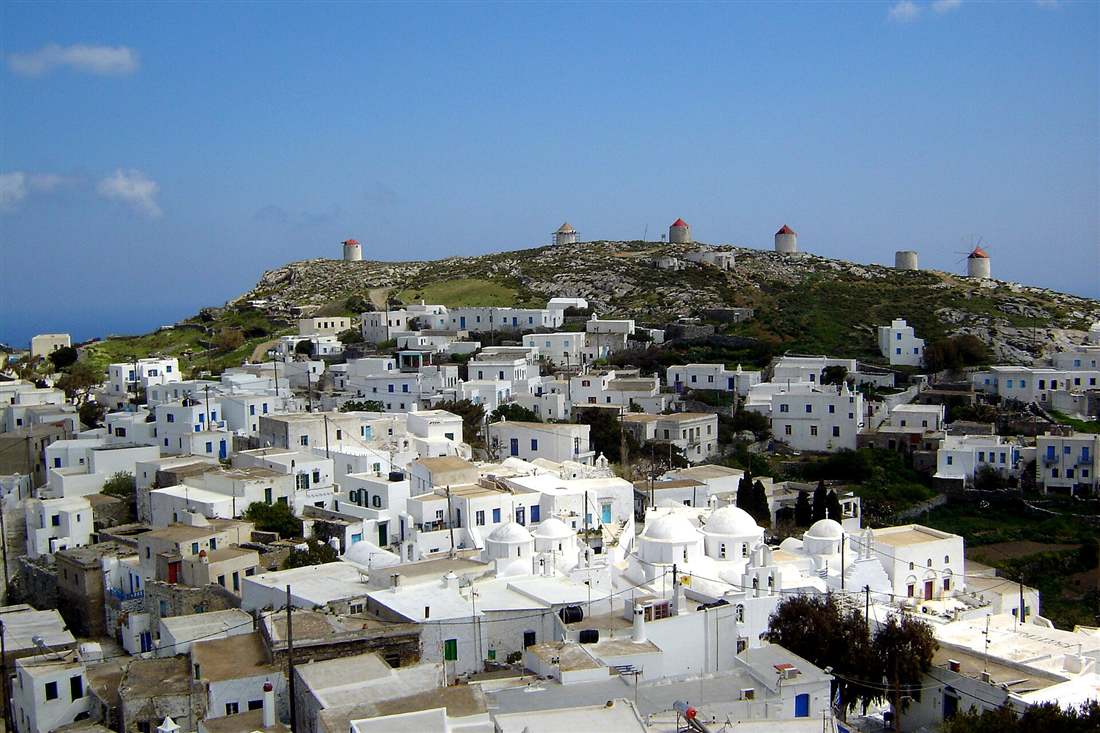
Chora is the capital of Amorgos. A group of windmills stands on a hill above the village. You reach them on foot or by car through its lanes. On a feast day, an Amorgos Greek night in Chora moves into the square and the churchyard.
Katapola is the main port of Amorgos and a natural harbour. It sits at the foot of a hill that once held the ancient town of Minoa. In summer, tavernas and bars around the port add live music to the evening. An Amorgos Greek night here starts a short walk from the quay.
Aegiali is the island’s other port, on a wide, curving bay in the north. The small village of Tholaria sits on a hill 3.5 kilometres from the port, with a view over the bay. Hiking routes start from Tholaria and Langada. A day on the trails can end with an Amorgos Greek night in a village square.
Look for live music in these spots:
- Village squares and churchyards during a feast
- Tavernas with live Greek music in summer
- Bars in Chora and the two ports after dinner
When is the season for an Amorgos Greek night?
Summer is the main season for an Amorgos Greek night. Village feasts and taverna music nights then run across the island. Warm, dry evenings keep the dancing outdoors. The winter feast of Panagia Hozoviotissa, patron saint of the island, is the exception.
Amorgos has a warm-summer Mediterranean climate with mild temperatures all year. At the Aegiali weather station, August days average about 28°C and nights about 24°C. June to August brings close to no rain, while rain falls mainly from October to April. That dry heat keeps an Amorgos Greek night under the open sky.
The meltemi is a strong, dry north wind of the Aegean. It blows on and off through the summer months, with its peak in the afternoon. Gusts hit force 7 or 8, and inter-island ferries then stay in port. On a windy evening, choose a sheltered courtyard and pack a light jacket.
Outside summer, ferry links run less frequently. Tavernas and bars keep shorter opening hours, and live music nights grow rare. In January, days at the Aegiali station average about 15°C, and evenings move indoors. To match your travel dates with an Amorgos Greek night, read when to visit Amorgos before you book.
Which customs apply at an Amorgos Greek night?
An Amorgos Greek night has simple customs. At a village feast, the church service comes first, the meal follows and the dancing starts after it. Visitors are welcome. In the dance, join at the end of the line and follow the leader.
Dress with care if you enter the church during the service. Modest clothes with covered shoulders and knees are the norm. Swimwear and beach clothes belong at the beach, not at the church. A light shawl or shirt in your bag solves this on a hot evening.
The dance line at an Amorgos Greek night moves as one group. Never break into the middle of the line, even to stand next to a friend. Hold hands or shoulders with the dancers beside you and keep to the rhythm. The leader at the front chooses the steps and the turns, so keep your eyes on that person.
Three habits show respect to the hosts at an Amorgos Greek night, whether at a feast or a taverna:
- Ask before you film or photograph people up close.
- Do not climb or sit on church walls.
- Take your rubbish away when you leave.
What do travellers ask about an Amorgos Greek night?
How long does an Amorgos Greek night last?
The length depends on the event. A taverna music night fills one evening, from dinner until the musicians stop. A village feast runs later and can continue past midnight. A dance class has a set length, shown on the booking page before you reserve a place. Plan your transport back before the evening starts.
Do you need to know the dances for an Amorgos Greek night?
No, you do not need to know the dances for an Amorgos Greek night. Guests learn by copying the dancers beside them. Watch one round first, then step in when the music starts again. A dance class before the evening helps if you want more confidence on the floor.
Can children join an Amorgos Greek night?
Yes, children can join an Amorgos Greek night. Village feasts are family events, with grandparents, parents and children at the same tables. Kids join the dance lines too. Late finishes suit older children better, so plan an early exit with young ones. For a taverna night, ask the owner about space for families.
How do you reach Amorgos for an Amorgos Greek night?
Amorgos has no airport, so you reach it by boat. Ferries leave from Piraeus, the port of Athens, and the trip to Katapola takes about eight hours. Ferries also link Amorgos with other Cyclades islands. Check how to get to Amorgos for details. To sleep near the music, see where to stay on Amorgos.